Randy Susan Meyers's Blog, page 24
June 9, 2015


June 4, 2015

May 12, 2015
Madelyn & Madeline: When A Character Pops Out Of Your Book
There’s a reason more people understand the Holocaust from The Diary of Ann Frankthan from The Rise and Fall of the Third Reich. Story. Since the cave man days we’ve learned more history through storytelling than textbooks. I know I have.
Writing a novel that includes social, health or political issues carries great responsibility. We want our audience to learn as they’re immersed in the story; those of us writing hot-button issues are impassioned. We want to write a compelling story. And then there is the third, equally important point of the triangle. We must be unflinchingly honest and also empathic with the characters carrying our banners. We must represent for the people who experienced in real life what we put on paper.
And, I believe, we must give back to those whose realities we’ve appropriated.
Soon after the hardcover version of Accidents of Marriage (a novel of a family shattered by a mother’s traumatic brain injury caused by a her husband’s reckless and angry driving) released, a woman came up to me before an event wearing a quizzical expression. She asked if I’d written about her. Had I read about her in the newspaper? Been told about her accident by a neighbor?
Her name was Madelyn.
Same as my character.
She was a social worker.
Yes, the same.
She had three children. Yes.
And she had suffered from serious traumatic brain injury (TBI) in a car accident eerily similar to–even geographically–my fictional crash.
After assuring her that I hadn’t known of her accident, I gave her a copy of the novel (it was her birthday!) and asked her to contact me to let me know what she thought. Waiting to hear, I was as nervous as I’d be if I were anticipating a newspaper review. Maybe more. Though I’d heard positive responses from many who had family members with TBI, or who worked in the field, Madelyn was the first person suffering TBI I’d spoken to post-writing. Had my research and empathic stretching been satisfactory?
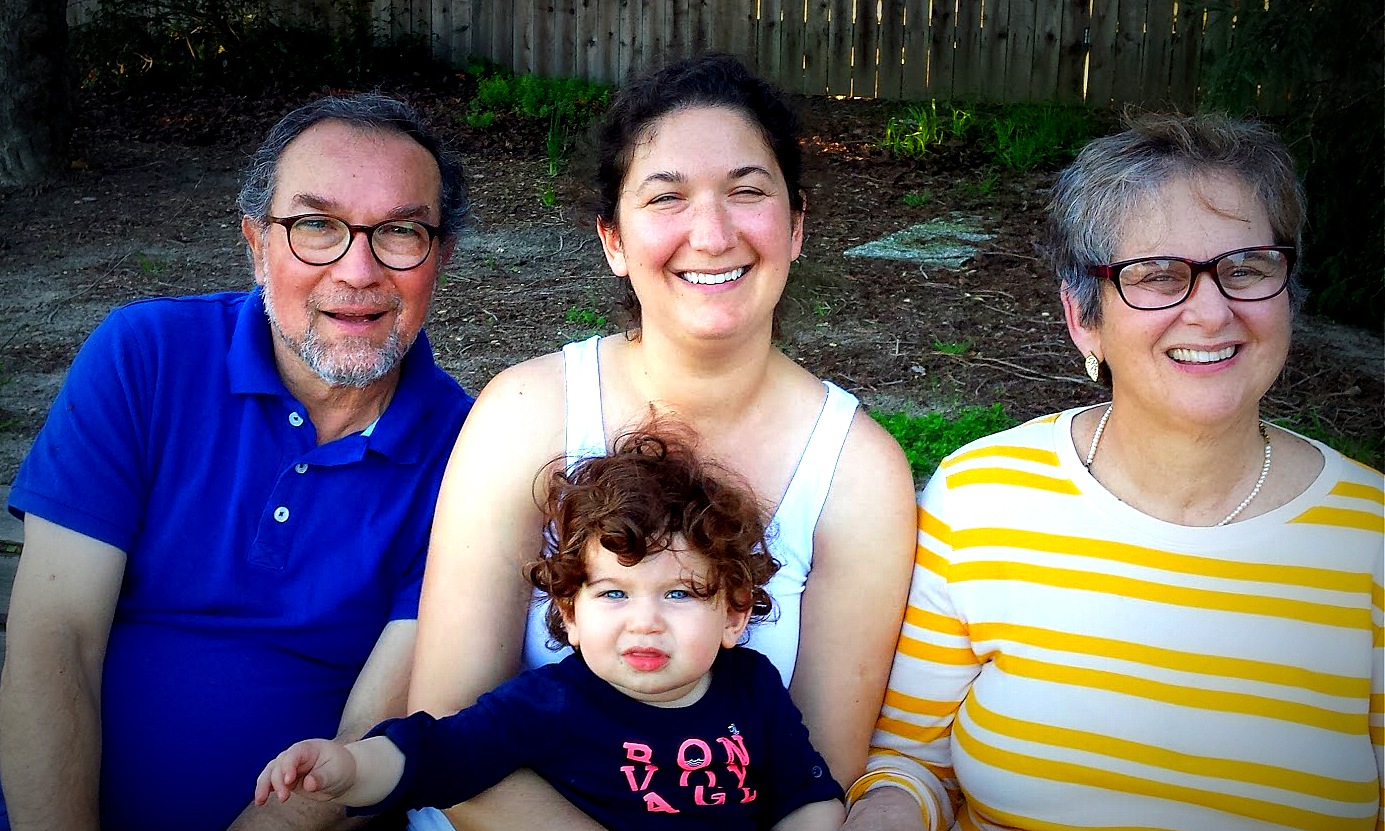
We had coffee, along with her friend Vicky, not far from where my characters lived in Jamaica Plain. Madelyn calmed my fears–the book passed muster–but more important, this Madelyn helped me envision book-character-Madeline years down the line. Courageous. Funny. Heroic. Smart. Reader. Grandmother. Mother. Wife. Avid reader. Very strong at the broken places.
In the “thank goodness” department, though Madelyn Bronitsky’s injuries were similar to those I wrote about, her husband Sam was blessedly different from husband-Ben in Accidents of Marriage. Where Ben fought rage that brought character-Madeline into harm’s way, an anger that followed them through her recovery, Sam became Madelyn’s rock. Knowing this essay was coming, she wrote to me:
U should mention my husband, unlike the one in the book, is wonderful, supportive. That I wouldn’t be in the shape I’m in if I hadn’t got help from him and my whole Temple Hillel Bnai Torah in West Roxbury community.
Meeting people–readers, writers, bookstore-folk (often all three in one)–through one’s books is a joy. Meeting those who’ve lived pieces of your characters lives is transcendent for the breathless wonder it engenders, the joy of learning you touched those who really know, but most important, to remind us of the responsibility we have to tell the truth of the story. To remember that for some, our stories may be the only introduction to the topics we explore and we better get it as right as we can.
Recently I wrote to Madelyn for help in identifying a group with whom I could join for my paperback release. Using each book launch as a fundraiser–where all sales are matched for a non-profit that connects to my book–is an offshoot joy. Madelyn shot an email back instantly:
What immediately occurs to me is AccessSport, the organization with whom I exercise in the winter at the Y and in the summer I go canoeing and biking at Spaulding. I just emailed Ross Lilley, the guy who developed the program to get the address. I am allowed to bring friends canoeing or hiking with me if u ever have time. I would love to take u.
This is the generosity Madelyn brings to the world; she may not be able to keep up with the rigors of social work, but she still cares for all around her. Madelyn reached out to the director that moment. When I then asked my friend Marianne Leone, author of Jesse: A Mother’s Story, what she thought of AccessSport, it turned out her son, Jesse, had some of his peak moments (maybe more nerve-wracking than fun for Marianne, though. Doesn’t motherhood always mean being the one holding your breath?) windsurfing and tubing at AccessSport, a nonprofit which inspires higher function and fitness for children and adults living with challenges through high-challenge sports and training. And in case it wasn’t all clearly bashert (meant-to-be) Marianne Leone and her husband Chris Cooper are on the board of directors at AccessSport.
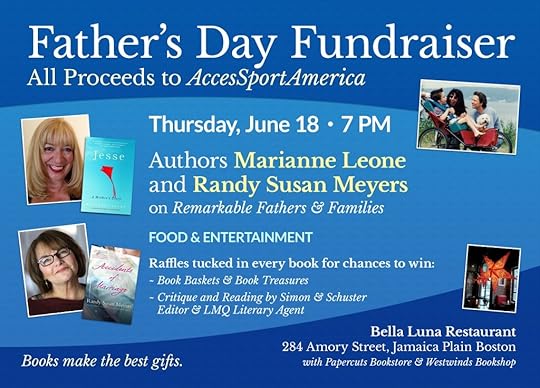
On June 18th Madelyn Bronitsky will join Marianne Leone and me at an event raising funds for AccessSport at Bella Luna Restaurant in Jamaica Plain. We’ll eat, read from our books, talk about how we became friends, and provide a gift for Father’s Day: books which show all the many ways men affect the lives of their wives and children: from my father-character being forced to find courage and face the damage he’d done to his children, to Marianne Leone’s husband, Chris Cooper, who knew his son needed ferocious love for Jesse’s light to come out in full. Together we’ll raise money so adults and children of all abilities can navigate rough water and hike the trails.
We’d all love to see you there.
May 10, 2015
Homemade MFA
(originally published in 2011)
“How did you get published? Do you have an MFA?” a reader asked last week. I struggled for the right answer—how to tell her that, no, I don’t have an MFA, but still, I credit being published on other people’s teaching.
A number of years ago (about ten to be inexact) I faced reality. If I were to be taken seriously by publishers and agents, I had to work with more intent. For a number of reasons (money, reluctance, working 50+ hours a week, and hyper-impatience with lectures) I didn’t return to school. Instead, I dove into self-study and set myself up as a virtual Miss Grundy.
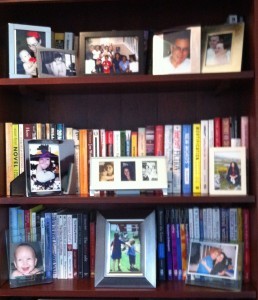
On my bookshelves are over 90 books on writing (not counting those borrowed or given away.) Adding those would bring the number up by 35 or more. I read all, highlighted most, and drove the facts into my brain by writing papers (for myself) on them.
This week, as I began the process of outlining my third novel (having just given over number two to the temporary care and custody of my agent and new editor) I thumbed over a few of my favorites and realized, with gratitude, how much these authors gave me. A private MFA (minus the personal critique—for that I thank Grub Street’s Master Novel Workshop, led by the incredible Jenna Blum.)
I cannot be more grateful. Thank you all, generous writers of craft and more.
On Revision: “Cut it by 10 percent. Cut everything by 10 percent . . . Cut phoniness. There are going to be certain passages that you put in simply in the hope of impressing people. It is true of me, and it almost surely true of you. I have maybe never known a writer of whom it is not true. But literary pretension is the curse of the postmodern age. We all have our favorite ways of showing off and they rarely serve us well. When you have identified your own grandiosity, do not be kind.” The Modern Library Writer’s Workshop: A Guide to the Craft of Fiction, by Stephen Koch
“The only way to improve our ability to see structure is to look harder at it, in our own work and in others’. When you read a book you love, force your mind to see its contours. Concentrate on structure without flinching until it reveals itself. Text is a plastic art, not just a verbal one: it has a shape. To train your mind to see shapes more easily, write them (and sketch them if you like) in a notebook. As with writing down dreams, the more you write, the more you will see.” The Artful Edit: On the practice of editing yourself, by Susan Bell
On Craft:
“Significant detail, the active voice, and prose rhythm are techniques for achieving the sensuous in fiction, means of helping the reader “sink into the dream” of the story, in John Gardner’s phrase. Yet no technique is of much use if the reader’s eye is wrenched back to the surface by misspellings or grammatical errors, for once the reader has been startled out of the story’s “vivid and continuous dream,” the reader may not return.” Writing Fiction, by Janet Burroway
“What is the throughline? Throughline is a term borrowed from films. It means the main plotline of your story, the one that answers the question, ‘what happened to the protagonist?’ Many, many things may happen to her—as well as to everybody else in the book—but the primary events of the most significant action is the thoroughline. It’s what keeps your reader reading.” Beginnings, Middles and Ends, by Nancy Kress
“Imagine you’re at a play. It’s the middle of the first act: you’re really getting involved in the drama they’re acting out. Suddenly the playwright runs out on the stage and yells, ‘Do you see what’s happening here? Do you see how her coldness is behind his infidelity? Have you noticed the way his womanizing has undermined her confidence? Do you get it?’ . . . This is exactly what happens when you explain your dialogue to your readers. Self –Editing for Fiction Writers, by Renni Browne & Dave King.
“ . . . the quickest and easiest way to reject a manuscript is to look for the overuse, or misuse, of adjectives and adverbs. The First Five Pages: A Writer’s Guide to Staying Out of the Rejection Pile, by Noah Lukeman
“Because fiction requires a mighty engine to thrust it ahead—and take the reader along for the ride—backstory if used incorrectly, can stall a story. A novel with too little backstory can be thin and is likely to be confusing. By the same token, a novel with too much backstory can lack suspense . . .. Remember this: The fantasy world of your story will loom larger in your imagination than it will on the page . . ..
Balance is the notion that every element in the story exists in its proper proportion . . . When you lavish a person, place, or object with descriptive details, readers expect them to have a corresponding importance. Between the Lines: master the subtle elements of fiction writing, by Jessica Page Morrell
On Sustaining: “ ‘You have to remind yourself that it’s very hard work. If you drift along thinking you’ve got some sort of gift, you get yourself into some real trouble.’ Arthur Golden
‘I try to remember that a review is one person’s opinion—and a cranky person’s at that.’ ” Elinor Lipman
‘The only reason writers survive rejection is because they love writing so much that they can’t bear the idea of giving it up’ M.J. Rose. The Resilient Writer, edited byCatherine Wald
“Over the years, I have calculated that feedback on any given piece of writing always falls into one of three categories, and breaks down into the following percentages: 14 percent of feedback is dead-on; 18 percent is from another planet; and 68 percent falls somewhere in-between.” Toxic Feedback, by Joni B. Cole
On Tension: “Inner censors interfere with effective revision in a number of ways. For instance, most fiction writers act like protective parents towards their characters, especially the hero and his or her friends. Writers are too nice. You not only don’t have to treat your characters nicely, in revision you should look for ways to make the obstacles bigger, the complications seemingly endless, and their suffering worse. Avoid the temptation to rescue your characters.” Manuscript Makeover: Revision Techniques No Fiction Writer Can Afford to Ignore, by Elizabeth Lyon
On Sex: “Sex is not an ATM withdrawal. Narrate from inside your characters’ bodies and minds, not from a camera set up to record the transaction.” The Joy of Writing Sex, byElizabeth Benedict.
On Public Reading: “Few writers are truly gifted at giving readings, and most have panic attacks before doing an interview, whether for radio, print, or television. And nowadays an author who isn’t deemed ‘promotable’ can be a liability . . . It’s important to plan your readings and selections before you speak in public. Long descriptive passage usually put people to sleep, as does staring down at your book for twenty minutes and reading either too fast or in a monotone . . . provide some meaningful stories. If an audience has come out to see you, give them something they won’t find in the book.”The Forest for the Trees, by Betsy Lerner
On Humilitation: “The lowest moment in my literary career was when I found myself bidding for a middle-aged oil magnate in a mock slave auction at a dinner in Dallas. I was bidding for the sake of Bloomsbury and for the honor of England, but I think the compounds the shame.” Margret Drabble, Mortification: Writer’s Stories of their Public Shame, edited by Robin Robertson
On Environment: “In truth, I’ve found that any day’s routine interruptions and distractions don’t much hurt a work in progress and may actually help it in some ways. It is, after all, the dab of grit that seeps into an oyster’s shell that makes the pearl, not pearl-making seminars with other oysters.” On Writing, by Stephen King
May 5, 2015
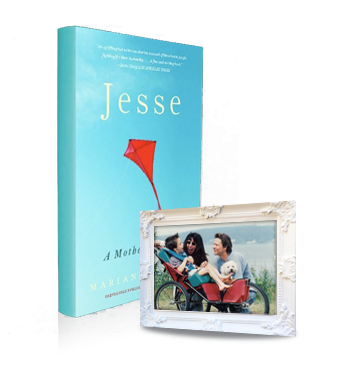
JESSE, A MOTHER’S STORY: A Ferocious and Raging Love

I started Jesse, A Mother’s Story twice.
The stark beauty of this memoir hit me the moment I began. Marianne Leone’s narrative, written with an unrelenting immediacy, yanked me into her world.
Leone’s son Jesse owned me from his first moment on the page. By the end of the prologue, Leone had so engaged me that I put it aside. Because I knew how it would end. Because I was a coward. I’d already fallen in love with the family and I needed to build up courage to continue.
Sometime later I began reading again. This time, thank God, I couldn’t stop, because Jesse, A Mother’s Story gave me one of the greatest gifts of my reading life. I learned that you could go on. You could have utmost love, and then the worst possible pain, and, though you never lose the grief, you could still find that love. That connection between mother and child can continue to envelope you in your dreams and soul. Perhaps that’s what keeps you from total madness.
Jesse, A Mother’s Story is a written by a mother who loves her son with ferocity—the ferocity parents of disabled children needs more than others parents. Jesse Cooper had severe cerebral palsy, was unable to speak, and was quadriplegic and wracked by severe seizures. He was also stunningly bright, funny, and loving. His parents, Marianne Leone and Chris Cooper needed both rage and ferocious love if Jesse’s light was to come out in full.
Leone writes so close that I felt the cigarette she held as she “paced the floor of our apartment above the store, smoking, crying and feeling helpless . . . Our session with the physical therapist was a disaster. She roughly stripped Jesse of his outside clothes, and he began to howl. “Well, I can’t work with him if he’s going to cry all the time,” she said.
Jesse was failing physical therapy. Or was the therapist failing Jesse? To watch your child handled roughly is to have a piece of your soul crumple into ash.”
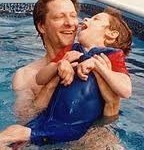
Marianne Leone brought together a band of parents and professionals to fight the system—a battle that continues serving children in the region where Jesse went to school—ensuring her son and others could be fully integrated into the school system, get the services they needed, and write essays poems, like this one written by Jesse:
Courage is like one ant trying to cross a roaring stream.
It may seem impossible but you have to try.
Jesse and his parents lived not only with candor and courage, but with edgy humor and street-fighting reality. Jesse, A Mother’s Story is not a worshipful account of saints, but of parents who reach into every pocket of strength they can access to help their child live fully in this world. Leone’s narrative pulled me like a page-turning novel—I needed to know what would happen, especially when, despite promises made and a law guaranteeing Jesse’s inclusion in a regular classroom, the school system fails not just by sins of omission, but by dedicated commission.
Leone’s realizations of these sins—after sending Jesse’s wonderful home aide, Brandy, to observe Jesse’s school aide and teacher in his classroom—radicalizes her. Thinking that Brandy hates her job, as obviously they do, the aide, in front of a non-verbal, but totally cognizant Jesse, says “he don’t belong here,” and “between you and me, Brandy, we both know where he’s gonna end up.” Jesse’s teacher talks in front of him, as though he were invisible, about the “life-expectancy of a CP kid,” speaking with faux-sympathy, though in truth with criticism of Leone, about how Leone needs to “learn to let go.”
Thus is set in motion a battle that ends up including the entire school district and a newly formed group of parents of special needs children, beginning with Leone’s thoughts:
In the last few minutes I had joined the berserker tribe of mothers, those who go into battle without any armor but rage. Mad as dogs, fierce as wolves, they fight to the death.
We who are unaffected might turn away from the Leone-Cooper’s story, from all stories like Jesse’s. We might want to protect our own denial, but oh what a loss. Jesse, A Mother’s Story has a plethora of happy endings before the ultimate sorrow.
That is what this book taught me: Sorrow doesn’t erase joy. We can hold both.
I, probably like you, am a constant reader. Sometimes I forget titles even as I turn the last page. Some books are appetizers, some momentary candy, some are solid meals. The moment I finished Jesse, A Mother’s Story I wanted to read it again. This book is an account of how we manage to rise further than we ever knew we could.
Leone does not sing her own praises in this book, but I can. She showed me a way. Mothers, even through moments of exhaustion, exasperation, even as they doubt they are up for the task, can find the way to lift that truck off their child. This book lives on my ‘read again and again’ shelf. Jesse, A Mother’s Story was not a book of a disabled child, but a story of being able to move on after a tsunami has hit your heart.
If you are a parent, then you, like me, fear losing your child more than anything in the world. Screw up your courage and buy this book. If you don’t believe me, come here her speak (see below) and read. Not only can she write like crazy, damn that woman is funny. Jesse was blessed to have her for his mother.
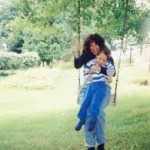
PS: Marianne and I will be hosting a fundraiser for AccessSport on June 18 at Bella Luna Restaurant and would love to have you join us. All book sales will be matched for AccessSport.

May 4, 2015
Give Mom Some Schadenfreude for Mother’s Day!

Two years ago ago, at an event at the incredibly wonderful Reading Public Library (in Reading Massachusetts) one of the librarians bought my second novel book, The Comfort of Lies, for her mother. For Mother’s Day. Using a large amount of not-usually-available-to-me control, I didn’t say any of the following:
“Nothing says Mother’s Day like cheating, anger, and hating-being-a-mother for Mother’s Day!”
In fact, that’s true. Who the heck wants to get Little Women on Mother’s Day? Not me. Does anyone want to psychically compete with Marmee?
No. I. Don’t.
I want to be feted with a pile of books that say:
Dear Mom,
This book is about a really troubled mother. This is a mother who truly effed up her kids. This mother is so much worse than you, Mom!!
Love,
Your fairly normal and grateful daughters.
With that in mind, five books that will tell Mom: You are so much better that these mom-characters. We could have been so much more screwed up! These are difficult complex (not necessarily bad, but not exactly who you want to rock you to sleep) mothers in memoirs and novels. These are all books I’ve read and loved. Which probably tells you everything you need to know about me.
1. We Need To Talk About Kevin by Lionel Shriver
“Eva never really wanted to be a mother—and certainly not the mother of a boy who ends up murdering seven of his fellow high school students, a cafeteria worker, and a much-adored teacher who tried to befriend him, all two days before his sixteenth birthday. Now, two years later, it is time for her to come to terms with marriage, career, family, parenthood, and Kevin’s horrific rampage, in a series of startlingly direct correspondences with her estranged husband, Franklin. Uneasy with the sacrifices and social demotion of motherhood from the start, Eva fears that her alarming dislike for her own son may be responsible for driving him so nihilistically off the rails.”
2. A Map of The World by Jane Hamilton
“The Goodwins, Howard, Alice, and their little girls, Emma and Claire, live on a dairy farm in Wisconsin. Although suspiciously regarded by their neighbors as “that hippie couple” because of their well-educated, urban background, Howard and Alice believe they have found a source of emotional strength in the farm, he tending the barn while Alice works as a nurse in the local elementary school. But their peaceful life is shattered one day when a neighbor’s two-year-old daughter drowns in the Goodwins’ pond while under Alice’s care. Tormented by the accident, Alice descends even further into darkness when she is accused of sexually abusing of a student at the elementary school. Soon, Alice is arrested, incarcerated, and as good as convicted in the eyes of a suspicious community. As a child, Alice designed her own map of the world to find her bearings. Now, as an adult, she must find her way again, through a maze of lies, doubt and ill will. “
3. Terms of Endearment by Larry McMurty
“Aurora is the kind of woman who makes the whole world orbit around her, including a string of devoted suitors. Widowed and overprotective of her daughter, Aurora adapts at her own pace until life sends two enormous challenges her way: Emma’s hasty marriage and subsequent battle with cancer. Terms of Endearment is the Oscar-winning story of a memorable mother and her feisty daughter and their struggle to find the courage and humor to live through life’s hazards — and to love each other as never before.”
4. Tender at the Bone by Ruth Reichl
“Tender at the Bone, is the story of a life determined, enhanced, and defined in equal measure by a passion for food, unforgettable people, and the love of tales well told. Beginning with Reichl’s mother, the notorious food-poisoner known as the Queen of Mold, Reichl introduces us to the fascinating characters who shaped her world and her tastes, from the gourmand Monsieur du Croix, who served Reichl her first soufflé, to those at her politically correct table in Berkeley who championed the organic food revolution in the 1970s. Spiced with Reichl’s infectious humor and sprinkled with her favorite recipes, Tender at the Bone is a witty and compelling chronicle of a culinary sensualist’s coming-of-age.”
5. The Glass Castle by Jeannette Walls
“Jeannette Walls grew up with parents whose ideals and stubborn nonconformity were both their curse and their salvation. Rex and Rose Mary Walls had four children. In the beginning, they lived like nomads, moving among Southwest desert towns, camping in the mountains. Rex was a charismatic, brilliant man who, when sober, captured his children’s imagination, teaching them physics, geology, and above all, how to embrace life fearlessly. Rose Mary, who painted and wrote and couldn’t stand the responsibility of providing for her family, called herself an “excitement addict.” Cooking a meal that would be consumed in fifteen minutes had no appeal when she could make a painting that might last forever.”
May 3, 2015
The Reader-Writer Covenant
What is the relationship between reader and writer? I’ve been a reader for far more hours of my life than I’ve been a writer. As a child, I made twice-weekly trips to the Kensington branch of the Brooklyn library nearest my home (my haul each time limited by the rules for children’s cards.) Writers were gods to me, purveyors of that which I needed for sustenance. Food. Shelter. Books. Those were my life’s priorities.
Naturally, I liked some books more than others. Some of the books I read as a child etched themselves on my soul (A Tree Grows in Brooklyn). I felt as if these books reached inside me and wrenched out truth.
As an adult reader I still feel that way; I’m constantly foraging for books that offer glimpses into a character’s psyche, that go deep enough to make me part of the choir, saying, “Oh yeah, me too, tell it, writer. True that, uh huh.”
Now that I am a writer, I’ve learned that reaching so deep isn’t always comfortable. Hey, my daughter’s gonna read this! Hey, husband: this isn’t you!It’s far easier to skate on the surface. And, honestly, there is a place on my shelf for those soothing books. Sometimes I want a comfort read, a total escape, a warm place to rest.
I believe there should be a covenant between writer and reader – an offering made by a writer to the reader. What it is that you, the writer, are offering to you, the reader? (Because I can’t imagine a writer who is not also a reader.) Are you making a covenant with the reader? Are you offering the reader the same qualities that you want when you’re the reader? Are you offering them your very best?
Sometimes I worry, that in the rush of wanting to publish, I could forget the importance of writing (in the inestimable words of Natalie Goldberg) down the bones.
My favorite books, the ones I return to time and again, are those ones gritty enough to have emotional truth (which is very different than the truth of events.) Thus, I try to write with a knife held to my own throat, so that my work will hold as much emotional truth as possible. Another reader/writer might prefer a thriller that sets their heart pounding–but every genre owns it’s own truth and depth. I suspect that the best writers in each genre are readers of the same.
Books are precious to me. Right now I am turning the pages of Game Change by John Heilemann and Mark Halperin in every spare moment. I schlepped the thing on Amtrak from Boston to Albany to Rhinebeck. I could have taken a lighter book, or simply read something on my electronic device. This is a controversial book – many have denounced it as no more than gossip. But whatever it is, it satisfies my hungry reader. I was so desperate to read this book that I was unwilling to leave it behind for 4 days. (I think Halperin and Heilemann put themselves on the good edge of their genre covering political intrigue in a presidential campaign.)
That’s exactly what this reader wants: writers who have dug deep, whatever their genre, and given me those best hours of my day. They kept their covenant with me.
(first published in 2011)
April 30, 2015
Fiction From Emotional Fact
A parent’s tragedy will always influence the life of their children—often to an overwhelming degree. Writing fiction from the emotional truth of one’s past can be liberating and also confusing. How do writers use their past without being wedded to events as they happened? How do we write honestly, without spilling family secrets that other’s want kept private?
Ellen Meeropol’s exploration of family loyalty, the aftermath of violence, and the possibilities of redemption in House Arrest fascinated me. How one reconciles the past and lives with tragedy that is not of one’s own making, but that color ones’ daily existence was the nub of my own book, The Murderer’s Daughters, where sisters cling to each other in the aftermath of witnessing their father’s murder their mother, building their lives in the shadow of his imprisonment. In House Arrest, a nurse responsible for the health of a pregnant patient (who is under house arrest for the cult-related death of her toddler daughter) is haunted by the consequences of her parents’ antiwar activism a generation ago. Her pregnant patient grew up troubled by her father’s connections to racially motivated violence.
I was only four when my father tried to kill my mother—an event I could never truly remember, despite being there. Then, after ten years of working with batterers and the women they’d victimized, I wrote a story of sisters who witnessed their father murder their mother and how they then lived as virtual orphans.
When Ellen Meeropol fell in love at 19, she had no idea that her husband-to-be was the son of executed “atomic spies,” but his family story led to her political education and activism. Years later, when she started writing fiction, she had no intention of exploring the Rosenberg case, and she never has, not directly. But her characters led her to the intersection of political activism and family, of injustice and divided loyalties.
Neither home-care nurse Emily Klein, nor her pregnant patient Pippa, are happy about being thrown together in House Arrest, but despite their differences, they make a connection. As anti-cult sentiment in the city grows, the women must make decisions about their conflicting responsibilities to their families and to each other—facing in some sense the same issues as did their parents.
As an activist and a mother, author Ellen Meeropol often worried about what would happen to her daughters if she were arrested, imprisoned or hurt during a demonstration, or if she were targeted by an overzealous security apparatus. Her husband was three-years-old when his parents, Ethel and Julius Rosenberg, were arrested and charged with conspiracy to commit espionage. He was six when they were executed. When Ellen started writing House Arrest book, she had no clue where Pippa and Emily’s story would take her, but it’s not surprising that themes of politics and families wormed their way into the narrative. Both her characters are haunted by their parents’ actions – very different actions – and both have been constrained by these legacies.
Meeropol’s characters have empathy for people who’ve done awful things and made terrible mistakes—mistakes that caused death and destruction. A large plot concern, revolving around a religious cult, is handled with great wisdom, managing to avoid the heavy hand of the usual judgment shown around this topic. This, I think, is the genius ofHouse Arrest, the cult is portrayed as a collection of people. Whether exploring an imaginary cult or real ones, we’ll never be able to prevent tragedy borne of zealotry unless we can see into the hearts and minds of those attracted and those repelled by such intense, and sometimes misguided, loyalty.
In researching cults, Ellen Meeropol found a quote that must have guided her work, as she walked the line of finding a realistic moral compass and empathetic burrowing into a character’s heart:
“...if you believe in it, it is a religion or perhaps ‘the’ religion; and if you do not care one way or another about it, it is a sect; but if you fear and hate it, it is a cult.” Leo Pfeffer.
April 26, 2015
Writerly Etiquette

As I waited for my first novel to launch, I was told by the experienced:
1) “Don’t expect to get on Oprah.” (I wasn’t.)
2) Waiting for launch was “the quiet before the quiet.” (Hey, thanks for depressing me!)
3) “You don’t need to spend money on an outside publicist.” (Very glad I ignored that one.)
And my very super favorite warnings:
4) “Don’t get too excited.” and “Don’t pay attention to reviews or Amazon numbers.” (To which I should have answered: “And where should I get the lobotomy?)
Which taught me this: Sometimes people are speaking from sour grapes, sometimes jealousy, and sometimes you’re simply dealing with an Eeyore. Sometimes folks are helpful; sometimes they’re not. Some will spend their time telling you, in gushing terms, how much their ‘they-love-me-to-death’ publisher is doing for them, them, and them, while you gulp and nod, thinking how at least your publisher sent out a net galley . . . wait, they did remember to do that, right? You’ll soon learn to identify these types, but how do you cope with them?
When my grandmother turned 97, we had a party for her. (Why at 97? We are an odd family.) “Grandma,” I asked, “what’s your very best advice for life?”
She looked at me, this warm woman who’d never complained about a person in her life (which makes me unsure that she actually is my biological grandmother, whereas there is no doubt that I received genetic material from my card-sharking kleptomaniac Grandma on the other side) and she said, “Be nice to people.”

I’m certain there are a number of snappish authors who advocate that dogs-should-eat-dogs (dog-eating authors who’ve managed to hit every bestseller list) but I believe in nice. I recommend that ‘nice’ (which, by the way, is entirely unlike being a doormat) color your career.
Start by answering your mail. All of it. When you receive a compliment, say thank you. When a reader complains that you’re biased, don’t rant at them or call them out in public! Ignore them or try to answer thoughtfully. I sent one such email to a ranting angry woman (who’d written to me because she thought I’d been disrespectful at one point in my first novel) and received a far more rational answer. We actually found some common ground.
I’ve read public postings by authors grumbling about the attention and letters they receive. God, I can’t believe what these people write to me! They want a book! They want a signature! They want me to speak to their class! Perhaps public complaining is a way of showing off how Very Important one has become. Or perhaps they really are stretched to the limit. We all know that feeling, but keep quiet in public. Every job has its down side, but do you want your doctor to write about how disgusting she found your rash?
 Limit public grumbling. Especially in print. Never online. And not about fellow writers, unless they were racist, sexist, or some other ist, or you’re looking to build a reputation contingent on your scathing wit or are looking for a public feud. Some writers do want this, or don’t mind being thought of as holding a knife, but this is not recommended for the average sarcastic, funny, or observant person—be certain you truly are thick-skinned enough to pull off calling writers out, because it comes back.)
I don’t give bad reviews. If I dislike something, I keep it to myself—I never post a negative review on Amazon or Goodreads, or anywhere else. Not because I’m too wimpy to be honest, but because there are enough professional and amateur critics out there and I know how much even the best-intentioned criticism can hurt, and I don’t want to add one more bad word to their burdens. I either give five-stars or I don’t do anything. And trust me—writers notice. When I get a 4-star review on Amazon from someone I know, oh, I notice. Never underestimate the thin skin or pettiness of your fellow writers.
Do you plan to write about your life as an author? Most readers—and you are seeking readers, folks, not just the guffaws of your fellow writers—don’t want to hear complaints about how tired you are, how much you hate writing, and what a grind it is to revise. It’s better not to show exactly how the sausage is made—allow readers to enjoy the final product.

The proper audience for swearing about critics, cursing about Amazon reviews, or sneering at the efforts of more successful writers is your own trusted group of writer-friends. And if you have complaints about your treatment at the hands of your publisher, take them to your agent.
Don’t, don’t, don’t whine in public! You have published a book. This is a fantastic feat. Instead of showing off your sweat, let people see your happiness and gratitude.
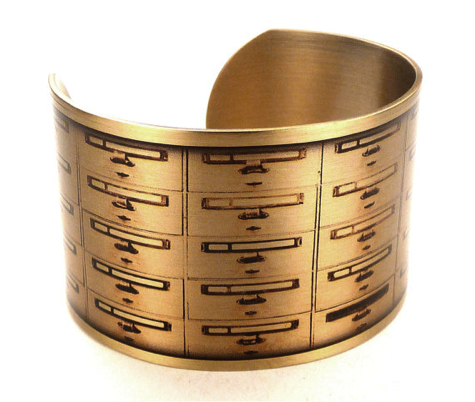
Thank your agent, editor, copy-editor, cover designer—everyone. Flowers, candy and bagels are all nice. Paperweights. Wine. Etsy is a perfect source for unique gifts. A handwritten note of gratitude. Honestly, no matter how much you wish you got more, more, more from your publishers, these folks work hard for you.
And, when you’ve moved along, and maybe had to luck to sell a few books, and now you’re the one with the experience, be kind to new writers. Yes, I know there is a hierarchy, but it only takes a moment to shake a hand and give a genuine “good luck!” As one whose introduced herself to a very-important-writer or two, trust me, those cold shoulders are long remembered.
Last piece of how-to-be-nice advice: Readers don’t limit themselves to reading one book in their lifetime. If you’re a writer, you’re probably also an avid reader. Publicly praise great books you’ve read. (And please, not just classics written by dead people—unless you expect dead people to be your readers.)
Promote other writer’s books—even ones that come out the exact same week as yours. It’s good karma. You can’t expect help if you don’t provide it to others.
And it’s nice. Just like Grandma said.
(Portions of the above were taken from What To Do Before Your Book Launch by MJ Rose & Randy Susan Meyers)
April 22, 2015
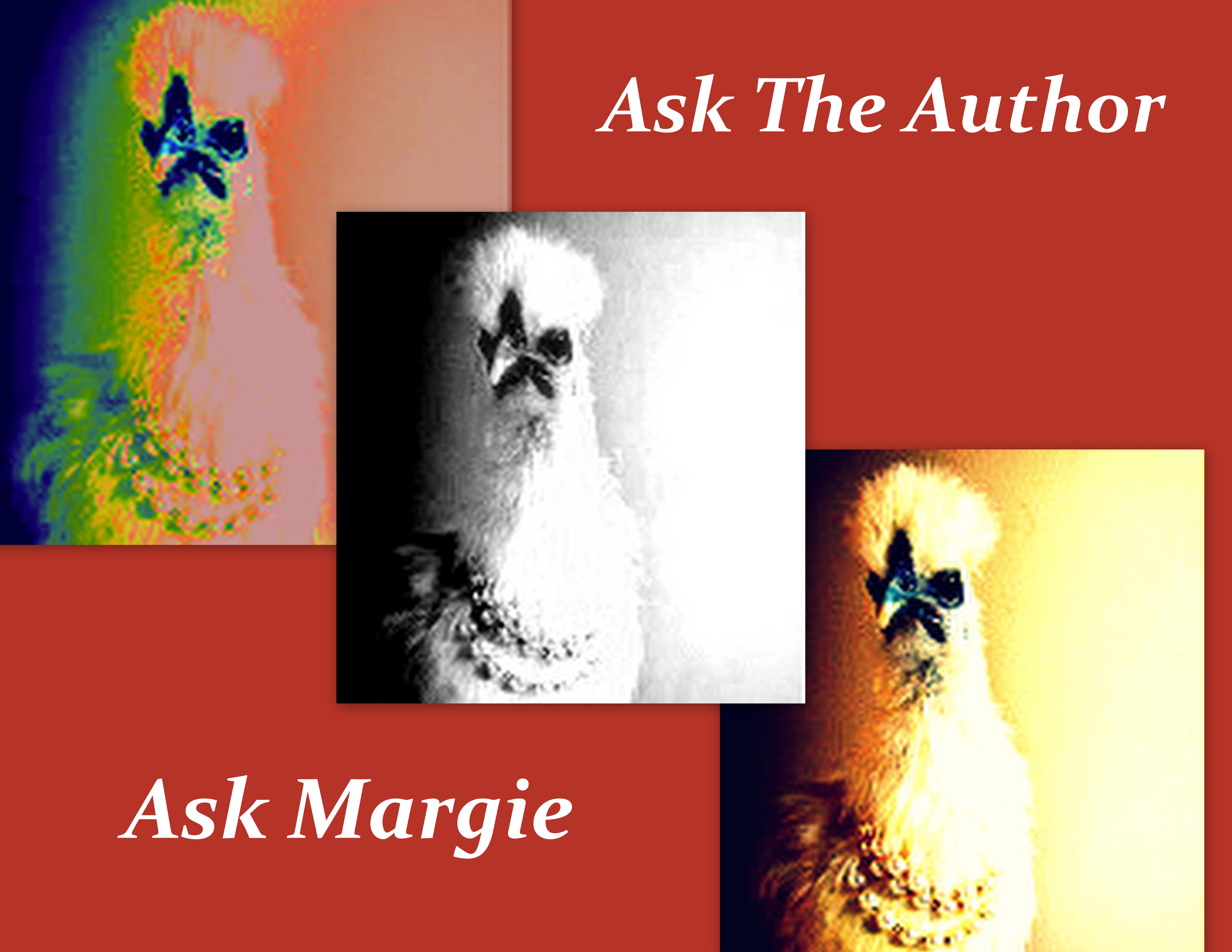
“Ask The Author” for Independent Bookstore Day at Papercuts
Have a question—about anything?
Publishing? Love? Finding an Agent? Best Mascara? What Tie to Wear?
I’m yours for an hour
And the questions can be anonymous!
I must give out the whiff of “yes, let me tell you what to do!” each time I leave the house. Or even when I don’t. (My daughters will attest to this.) That must be why Papercuts, the newest Independent Bookstore in town, right here in my Jamaica Plain, Boston neighborhood asked me to be their anonymous (you, not me) “Dear Abby” for Indie Bookstore day.
Answering your questions on May 2, 2015 at 3PM at Papercuts in JP.
5 Green Street.
Taking on, once again, the guise of Dear Margie (a role I shared with other Jewish mamas) from Beyond The Margins (sniff, sniff, we miss it also) I’ll be answering your questions.
You can ask here in advance. You can drop in in the Papercuts question box at the bookstore, 5 Green Street in Jamaica Plain.
Or . . . if you’re brave, you can ask in person.