Phil Simon's Blog, page 69
January 3, 2015
Advance Praise for Message Not Received
 I have decidedly mixed feelings about book endorsements. For starters, more, higher profile, and/or “better” endorsements have never made for a better book. Next, I for one have never consciously purchased a book because of a quote on the front or back. What’s more, some authors seem to be endorsement whores. I often wonder whether a few people even read the books with their names adorning them.
Here’s another thought: Perhaps a book’s lack of endorsements would raise a few red flags with prospective readers. I suppose that some folks may pick up a book and ask, Why didn’t anyone endorse it?
Brass tacks: I accept that asking people to write nice things about my book is part of my job as an author. Beyond that, why unnecessarily irritate your publisher? I have never known a publisher to skip this step, especially for non-fiction books.
About a month ago, I sent a galley of Message Not Received to a bunch of smart cookies. My goal: to procure a decent number of endorsements for the book.
I’m pleased to report that some pretty influential folks think that, much like my previous six texts, this one doesn’t suck. Without further ado, here are my current endorsements.
“Most of our at-work life is spent communicating—poorly. Phil Simon has written a modern business classic that compels you to adopt new technology and simplify your discourse. Highly recommended!”
—Jay Baer, New York Times best-selling author of Youtility
“The message comes through loud and clear in Phil Simon’s smart new book: today’s workplace is drowning in information overload, bad communication, and missed opportunities. Simon shows us the path forward with his savvy and practical advice.”
—Dorie Clark, Adjunct Professor, Duke University Fuqua School of Business and author of Reinventing You
“Message Not Received tops my list of this year’s business book club suggestions. We need to start a movement for communication clarity throughout our organizations. Simon’s book can be our clarion call.”
—Prof. Terri Griffith, Ph.D., chair of Santa Clara University’s Management department and author of the award-winning book, The Plugged-In Manager
“Ironically, it takes a book—this book—to help people understand how to effectively communicate in a business world increasingly dominated by quick electronic messages that might be completely ignored or flashed to a billion people. Phil Simon lays out the scope of our failure to express ourselves well in new media, the consequences of these misused opportunities, and, most important, a clear, specific roadmap for how any individual can do much, much better in almost any context. Plying us with illuminating examples taken from the real business world, and adding in observations and background from a range of perspectives, Simon has given us a 21st-century guide to communicating that is both personal and universal.”
—David H. Freeman, Contributing Editor, The Atlantic, and author of Wrong and A Perfect Mess
“Message Not Received blows the linguistic lid off all that lazy communication at work. You know what I mean: ‘the synergistic win-win balance of competing forces’ someone proposed at your last meeting, and everyone nodded even though no one had the foggiest idea what was just said. Simon challenges you to take charge of your communications, cut the obfuscation, and make them meaningful. Your colleagues, your customers, and your bottom line will thank you.”
—Dr. Nick Morgan, President of Public Words Inc. and author of Power Cues: The Subtle Science of Leading Groups, Persuading Others, and Maximizing Your Personal Impact
“An essential resource for business clarity. Read Message Not Received to learn how to strip out the jargon and quit confusing people with buzzwords.”
—Anita Campbell, Founder and CEO of Small Business Trends
“In today’s business world, communication is more important and easily accessible than ever before – so why are we making it so complicated? In Message Not Received, Phil Simon closely examines why keeping it simple amounts to clear and efficient communication. I highly recommend that everyone in business omit buzzwords and take Simon’s direction.
—Larry Weber, Chairman & CEO of RacepointGlobal and author, The Digital Marketer
“Look behind any business failure and you’ll find the lack of communication as a root cause. Phil Simon’s latest book, Message Not Received, examines how and why the latest technologies that are intended to radically improve business communication too often obstruct it instead. Simon’s book provides thorough, effective strategies for enabling effective organizational collaboration and communication to ensure business messages are indeed received. If you want to improve your organization’s communication skills, you owe it to yourself to read this book.”
—Robert Charette, President, ITABHI Corporation an internationally known enterprise risk management expert.
The post Advance Praise for Message Not Received appeared first on Phil Simon.


December 29, 2014
Want to Sponsor the Message Not Received Book Tour?
Last spring I hit the road to promote The Visual Organization for my first ever book tour in San Francisco. Because I’m no Lena Dunham (not that I’m complaining, mind you), I funded the tour on my own nickel. I figured that the juice was worth the squeeze.
I was right.
Over the course of four days, I spoke at successful organizations such as eBay, Netflix, Autodesk, Platfora, and others. By and large, the tour was a success. The hosting companies and attendees gave me excellent feedback. For my part, I accomplished my goals: I generated awareness for the book, met some great people, and gave nine recorded talks, most of which wound up on this site.
All in all, I learned a great deal. Although I wouldn’t change a thing, I did make a few mental notes on potential tweaks if I repeated the process on a future book.
Well, that future book is coming soon—March 16, 2015, to be precise. I’m keeping the general process the same (more on that below). This time, though, I am actively seeking an official sponsor for the tour.
FAQ
I’ve put together the following FAQ that should answer most queries.
Basic Questions
What’s the book about?
In short, it’s about fixing business communication via simpler language and collaborative technologies. (For more, see the book main page and related posts.) For those of you who prefer a visual, here’s the trailer:
Who benefits from the sponsorship?
I like to think that everybody wins. Follow my logic here:
Sponsor: Benefits from having a professional speaker (me) talk about the importance of moving away from e-mail as the default communications tool. Think of it as an “unsales” pitch. I will be starting a conversation that may induce future sales and referrals. Note, though, that I won’t be espousing the benefits of any particular application.
Attendees at sponsor clients and prospective clients—aka, the hosting organizations: Get to listen to a talk that may very well change the way that they communicate while on the clock and make them more productive. Oh, and many attendees will receive free books.
Me: There are two primary benefits. Aside from helping defray the travel costs, the sponsor’s existing relationships will make it easier for me to schedule the talks.
Who is the ideal sponsor?
Message Not Received rails against the twin scourges of effective business communication: jargon and excessive e-mail. I can’t imagine that there are too many wealthy grammarians that want to serve as my benefactor. To that end, the ideal sponsor sells collaborative technologies. Companies like IBM, Facebook, Google, Jive, Asana, Slack, Todoist, 37signals, HipChat, Smartsheet, Trello, Microsoft/Yammer, and others come to mind. (In case you’re wondering, each of these companies—and others—is positively referenced in the book.)
Would you work with more than one sponsor?
Sure, if there’s demand for it.
What if our company isn’t “featured” in the book? In other words, is Message Not Received vendor-agnostic?
Yes, very much so. All of my books are about ideas, not specific products. Writing about particular features makes little sense since things change so quickly these days.
All of my books are about ideas, not specific products.
Full Disclosure: In the case of Message Not Received, chapter eight contains three case studies on companies that have adopted collaborative technologies, one of which is homegrown. Of course, I name those companies and the wares they’re currently employing. Throughout the book, though, I take great pains to promote the general benefits of these tools, not the specific features of any one company’s products and/or services.
OK. I’m still reading. What dates do you have in mind?
The book is scheduled to be released in mid-March of 2015. I would like the tour to take place around that time.
What cities do you have in mind?
I would prefer to hit one or two cities over four to five days. Traveling across the country will only run up costs and increase the chances of delays and missed events. I’m thinking about New York and Boston, but I’m flexible. I’ll go to where there’s the greatest demand.
When would you like to lock the sponsor(s) down?
 By mid-February would be nice.
When would you like to lock the individual speaking dates down?
By early March at the absolute latest.
Who will schedule the individual speaking dates?
I’m happy to take the lead after the sponsor has identified which of its existing and prospective clients are interested and the appropriate contact. I certainly don’t want to make cold calls and introduce myself to strangers.
Will you manage the scheduling process over e-mail?
Inasmuch as I criticize the overuse of e-mail in the book, it would be hypocritical of me to do so.
Are you going to pitch our existing and prospective clients?
Not at all. I’m there to educate, not to sell.
What if a few of our our existing and prospective clients want to remain anonymous?
Fair point. I’ll sign an NDA. I’ll happy post the video without attribution to the hosting organization. If a single video or two never sees the light of day, that’s fine. My goal is to get as many videos on my site as possible, though.
The Talks
How long are they?
About 45 minutes, plus 15 minutes of Q&A. Ideally the talks will take place over breakfast or lunch. That way, we can maximize attendance.
Is each talk customized to the specific audience?
No. I won’t be developing a customized presentation for each talk. Each will be based upon the book. By way of background, I typically develop a few talks on my books, kind of like my own “A” and “B” sets. There’s plenty of material to support different versions. Trust me: I like to refine and improve my talks.
After the talks, I will gladly answer questions for as long as you like and I can (hinging on where I need to be next).
What kind of equipment do you need?
A projector and a decent A/V system. I’ll use my own computer.
Are you providing your own videographer?
No. I’d like the hosting company or sponsor to provide one, or at least someone who knows how to work the equipment. I don’t suspect that this will be a problem.
If our company sponsors you, can we have final cut over your slides and content?
This is a bit delicate. Let me say this. I’ll happily share my slides with the sponsor well ahead of time. I won’t parrot marketing copy, though. I value my professional credibility too much. If your company’s flagship product competes with GoogleDocs, I certainly won’t spend ten minutes espousing its virtues. I’m not a complete idiot.
I’m not a complete idiot.
Remember: I’m talking about ideas more than features.
Can the sponsor(s) use the videos of the talks on their sites and social media channels?
Absolutely. Put them wherever you like. I retain the right to post the talks on this site and my own social media channels.
Are you charging for the talks?
No, but please do read the next question.
Books and Money Matters
So, other than covering reasonable travel expenses, are there additional costs?
Yes. I am asking the sponsor to purchase a fair number of physical copies of the book (at least 20) at a discounted price from the publisher, Wiley (approximately $17.50/copy + shipping, although we might be able to swing a slightly lower price). I don’t control the price and, in case you’re wondering, Message Not Received is hardcover book containing roughly 275 pages.
Who will arrange for the purchase of discounted books?
I can facilitate that through my publisher, Wiley.
What about e-books?
I can inquire about that if you like, but I’d prefer to give away physical copies.
Will you sign copies of the books before or after you speak?
Of course, time permitting.
Can the sponsor put reasonably-sized company stickers on the cover or inside of the book?
Sure. I’ve accommodated these requests before.
Next Steps
If you’re interested in sponsoring the tour or know a company that might, then please connect here.
The post Want to Sponsor the Message Not Received Book Tour? appeared first on Phil Simon.
December 10, 2014
Pick. Up. The. Phone.
 Everyone at one point has received an e-mail (or 500) and thought, “What’s wrong with [insert name]?” As a medium, e-mail invites misunderstanding. It gives the appearance of in-person communication sans critical non-verbal cues.
Studies have found that the context and emotion of in our e-mails are only fully received about 50 percent of the time. Yes, its a coin flip. It’s a major point in my forthcoming book.
Looking Beyond the Data
I can cite stats like these all day long, but I find that stories are often just as valuable in making salient points, perhaps more so.
I recently interviewed Marillion keyboardist Mark Kelly.
We chatted a bit before recording, talking about football, boxing, and e-mail as a communications medium. Kelly revealed something that shocked me a bit: Even for a band that’s been together for more than three decades, e-mail occasionally engenders misunderstandings. Let me repeat that: Guys who have known each other for a really, really long time communicate better in person compared to rattling off electronic messages.
What does that say about communications among new employees?
E-mail <> Understanding
This doesn’t mean that e-mail is inherently ineffective or inimical. On the contrary, it’s an extremely useful but limited medium. Relying exclusively on it is rarely wise.
Simon Says
Pick. Up. The. Phone.
Feedback
What say you?
The post Pick. Up. The. Phone. appeared first on Phil Simon.
December 8, 2014
The Case for Proceeding without a Data Scientist
 It’s hard to find a trendier job these days than data scientist. Big Data has arrived and many organizations are finally starting to explore what this all means. Where are the opportunities? How can they make better, data-based decisions?
It doesn’t take long for many CXOs to realize, however, that their current employees simply aren’t equipped with the skills necessary to find the signal in the noise. This begs the question: What to do?
Culture and Big Data
Before answering that question, let’s take a step back. Lost in much of the hubbub over Big Data is the critical role of culture. As I’ve written before, far too many companies think of Big Data as IT projects or organizational initiatives. This is problematic on two fronts. For one, the last fifteen years have proven that, by and large, organizations fail horribly when deploying new systems and technologies. Beyond that grim reality, projects (IT or otherwise) imply start and end dates. By way of contrast, Big Data is never finished. (Amazon, Netflix, Facebook, and Google are cases in point.) There is more data today than yesterday, both in terms of sheer quantity and number of potentially valuable sources.
Big Data is never finished.
Brass tacks: To make sense out of Big Data, there’s no easy solution or five-point checklist to follow. In fact, organizations might benefit from abandoning—or at least suspending—the search for omniscient data wizards altogether. In “Stop Searching for That Elusive Data Scientist”, Michael Schrage writes about organizations that have attempted jump into the data pool without a proper guide. One example is particularly instructive:
One team, for example, did something as simple as comparing a certain class of tweets from their best customers with their competitor’s customer’s tweets. The overlaps and differences immediately suggested ways to better target and take-away rivals’ customers beyond social media.
Was this team able find every needle in the haystack? Of course not. It would have benefited significantly from the invaluable skills of proper data scientists. Even if this team did not find its Holy Grail, however, exercises like these by “data laypeople” can be tremendously valuable. Team members begin to understand what they can—and, just as important, cannot do—with their organizations’ existing tools. Can it answer sophisticated questions with Microsoft Excel alone? Maybe, but probably not. Perhaps these folks garner a deeper understanding of the issues and available resources.
Put differently, imagine how much more prepared this organization is when the vaunted data scientist actually shows up?
Simon Says
I’m all for data exploration. After all, how do you know what’s out there if you don’t play around and ask fundamental questions? Schrage’s example is particularly instructive. Getting started with Big Data need not immediately necessitate hiring a data scientist, consultant, or other expert.
Feedback
What say you?
 This post was brought to you by IBM for Midsize Business, but the opinions in this post are my own. To read more on this topic, visit IBM’s Midsize Insider. Dedicated to providing businesses with expertise, solutions, and tools that are specific to small and midsized companies, the Midsize Business program provides businesses with the materials and knowledge they need to become engines of a smarter planet.

The post The Case for Proceeding without a Data Scientist appeared first on Phil Simon.
December 1, 2014
Adding New Data Sources: An App-Like Future
 A recent spate of customer-service issues caused me to cut the cord with my cable TV provider. Although I spend my leisure time playing tennis and watching groundbreaking shows (read: Breaking Bad), I was initially a bit concerned about making such a daring move. After all, how I would respond without access to a proper set of channels.
For nearly my whole life, cable TV has been my norm. I’ve dutifully paid for cable for more than two decades. Would it be easy for me to cobble together a bunch of disparate services? Or would I have to eat my words and return to traditional cable television?
It turns out that devices like Roku, the iPad, Apple TV, and others have taken a cue from Netflix. To wit, they allow consumers to easily watch on one device, stop for whatever reason, and continue on another. For instance, thanks to downloadable channels, I can watch Fargo on Amazon Prime Video on my iPad in a hotel room, pause it, and then easily resume the episode on my Roku in my bedroom at home. What’s more, these are all pleasant experiences. I genuinely like the UIs of each device.
Now, don’t get me wrong. Things are far from perfect. Netflix transcends devices but, for whatever reason, some channels don’t. I cannot watch Bloomberg TV on my Roku but I can on AppleTV and my iPad.
The Enterprise Parallel
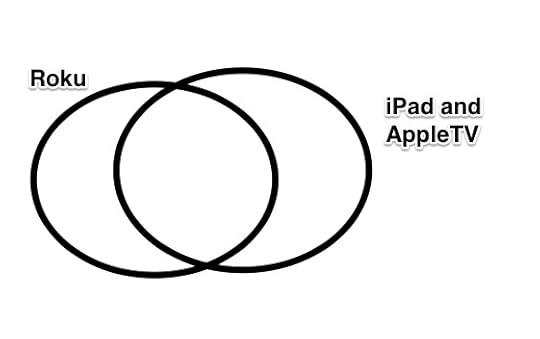 I suspect that the intersection among these two services will only increase in the future. That is, I’ll be able to do what I want when I want on whatever device I want. Call it the Netflix Effect.
I often wonder how many employees can say the same things about their enterprise data. Is the data synchronized? Security restrictions aside, are all users looking at the same information? And, while probably not fun, are the applications at least passable?
Adding a data source ought to be as easy as downloading an app. Period.
Yet I still speak with many professionals (techies and non-techies alike) who still cannot access real-time enterprise data. Far too often, IT still has to release data to the line. The notions of self-service and true data integration are still a ways off. ETL processes run to populate data warehouses in the wee hours of the morning. I for one don’t see that changing anytime this decade.
Simon Says
Am I saying that adding a data source ought to be as easy as downloading an app? Well, depending on the situation, yes. Of course, we shouldn’t ignore SOX, HIPAA, and other regulations–and let’s not forget privacy and security concerns. Still, the way that things are moving with APIs, open standards, and agile development, it’s not exactly hard to envision a future in which adding integrated data sources resembles downloading an app.
Feedback
What say you?
This post was brought to you by IBM for Midsize Business, but the opinions in this post are my own. To read more on this topic, visit IBM’s Midsize Insider. Dedicated to providing businesses with expertise, solutions, and tools that are specific to small and midsized companies, the Midsize Business program provides businesses with the materials and knowledge they need to become engines of a smarter planet.
The post Adding New Data Sources: An App-Like Future appeared first on Phil Simon.
November 30, 2014
My Most Popular Posts from 2014
 Since traffic starts to wane about now on the Interwebs ever year, now’s as good a time as any to post my most popular posts this year. (No surprise that my interview with a certain drummer was the runaway winner.)
Without further ado, here they are in descending order of popularity:
My Interview with Neil Peart (Props to @rushisaband for the link love here.)
Big Data and Teenage Sex
What Should I Ask Neil Peart?
Reporting vs. Analytics
Book Trailer for The Visual Organization
The Myth of the Data Scientist
Last to Cool
Three Ways Writers Evolve Over Time
The Visual Organization Book Tour: San Fran
Should Training be Role- or Process-Based?
Social Networking in the Workplace
Why Microsoft Access 2007 Sucks
Why Big Data Is Like Porn
Six Archetypes of Bad Project Managers
Dilbert and Big Data
My Interview with Steve Hogarth of Marillion
Refine Your Data the Google Way
Travails of a Technology Consultant #5: Scope Creep
Four Big Data Models
The post My Most Popular Posts from 2014 appeared first on Phil Simon.
November 24, 2014
Complacency and Communication
 In an era of pervasive communication, it’s downright common to feel that there’s just too much out there. We are deluged by tweets, blog posts, social networks, articles, podcast, videos, and the like. We can’t possibly consume even a tiny fraction of the content generated every day on even an arcane subject.
Paradoxically, though, there’s remarkably little information at key times from complacent people and organizations that ought to know better. Yes, I’m talking about the cable companies. Case in point: I am writing these words from a local Starbucks because of a Cox Internet issue.
I suppose that I can take some perverse solace in the fact that I have plenty of company this morning. A quick Twitter search reveals that others in the Las Vegas area are experiencing the same problem. I called Cox’s 1-800 number to confirm the issue and request an ETA on its resolution. Initial estimates proved wrong (surprise), so I started venting on Twitter:
.@CoxLasVegas @CoxComm – set up a Twitter account to communicate network issues. It’s. Not. That. Hard. #fail
— Phil Simon (@philsimon) November 24, 2014
Acceptable downtime may be a contradiction in terms. No ISP will guarantee anything near 100% uptime. Most intelligent consumers understand that things sometimes break bad. Still, there’s no excuse for laziness and just plain bad customer service, both of which Cox clearly excels. (Maybe if these companies didn’t act as de facto monopolies things would be different.)
Exhibit A
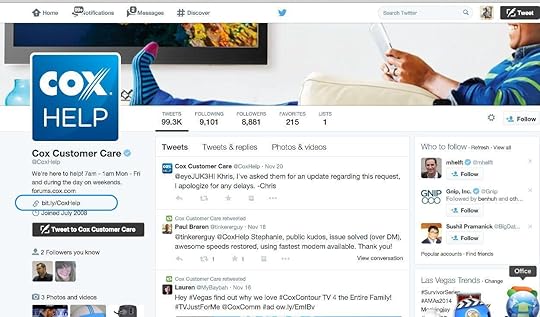
The Twitter page for @CoxHelp links to a broken URL, a clear sign that customer communication isn’t exactly a high priority to the company.
That’s just plain lazy.
Exhibit B
Recent tweets from the CoxHelp account don’t provide an ETA to the resolution, a question burning in most customers’ minds at the moment.

Simon Says: Customers Are Like Elephants
No one is supplanting the cable companies completely at this point. (Broadband is like oxygen.) Note, though, that Blockbuster, Kodak, Polaroid, and other once-powerful companies are now historical footnotes. Rest assured that more and more consumers are cutting the cord every day, especially Millennials.
Like elephants, customers have long memories.
By communicating poorly—or not at all—during outages and crises, companies infuriate their customer bases. Of course, there’s not too much that we can do about this—at least right now. Those who want to disrupt the cable providers can’t just lay down billions of dollars worth of pipes during a weekend hackathon.
Foolish is the cable exec who thinks that customers will forget moments like these when legitimate alternatives like Google Fiber become available. Like elephants, we have long memories.
Feedback
What say you?
The post Complacency and Communication appeared first on Phil Simon.
November 18, 2014
Dataviz, Design, and the Smaller Screen
In a world of Big Data, data visualization serves as an indispensable tool. Along with human judgment, it is perhaps the most valuable means of comprehension. Generally speaking, we understand data presented in a visual format much faster and better than when it’s presented in a raw form. That doesn’t mean, though, that all data visualizations are good ones. In fact, nothing could be further from the truth.
Consider this one: Is social segregation rising across English universities?

Different Dimensions Require Different Design
The need for intelligent design has become far more pronounced in the last five years. Back in 1998, mobility as we know it simply didn’t exist. We used to look at information either on fairly large monitors or on 8″ x 11″ paper. We could effectively build dashboards, reports, and data visualizations with a “one size fits all” mentality.
Today screen real estate is often a fraction of its former self.
Not today.
PC sales have been consistently declining with no end in sight. The number and types of different devices has exploded—whether owned by employees (BYOD) or provisioned by central IT departments. Screen real estate is often a fraction of its former self, and this has major ramifications for dataviz design.
Forget monstrosities like the one above. Tiny graphics frustrate users on tablets and mobile devices. Forget Big Data; they can’t even see the small stuff. They lead to user errors and inhibit data discovery. Imagine trying to touch an icon or data point but consistently hitting the wrong one because it’s smaller than your even your pinky finger.
Simon Says
Mobility has forced many organizations have had to either redesign existing data visualizations or build new ones from scratch. Many others have pretended that the world hasn’t changed—and suffered for it.
It’s essential to remember the unique design and presentation challenges posed by smaller screens. Just because a dataviz looks great on a 22-inch monitor doesn’t mean that it will represent well on a smartphone or tablet. Don’t expect a confusing, ugly, or microscopic data visualization to yield better decisions.
Feedback
What say you?
 This post is brought to you by SAS.
The post Dataviz, Design, and the Smaller Screen appeared first on Phil Simon.
November 14, 2014
Data-Based Design: Ignore at Your Own Peril
 There’s always been more than a bit of tension between data folks and their design brethren. Perhaps the most famous example in recent memory took place at Google in 2009. Designer Douglas Bowman resigned his position at the company over its over-reliance on data. In his words:
Yes, it’s true that a team at Google couldn’t decide between two blues, so they’re testing 41 shades between each blue to see which one performs better. I had a recent debate over whether a border should be 3, 4 or 5 pixels wide, and was asked to prove my case. I can’t operate in an environment like that. I’ve grown tired of debating such minuscule design decisions. There are more exciting design problems in this world to tackle.
Since its inception, Google hasn’t been the ideal place for design purists. After all, the company has always been all about data. Up until recently, it did not sell any tangible products. Without perhaps the world’s largest trove of information, Google’s might not even exist. One can make the same claim about Facebook. These companies live and die by their data.
That’s one way to run a business—and today it’s hard to argue with a data-oriented approach. Both Google and Facebook have been extremely successful. A “data-first” approach just makes sense for each company.
Of course, not every company works this way. Exhibit A: Apple is decidedly anti-data. Steve Jobs believed that it was “really hard to design products by focus groups. A lot of times, people don’t know what they want until you show it to them.” Tim Cook has continued his iconic predecessor’s design-centric vision.
All Design Is Not Created Equal
It’s disingenuous to frame the contemporary argument over design as either pro- or anti-data because all design is not created equal. Netflix uses data to inform its marketing, but “data” doesn’t drive character development in its original shows. A painting or a book of fiction is hardly the same as an airline engine.
More than ever, highly technical design is becoming more data-driven, faster, and smarter. As I learned at the Dassault Systèmes’ 3D Experience Forum in Las Vegas this week, engineers are increasingly using virtual test benches, new data sources, advanced computer simulations, and extremely sophisticated 3D modeling software to build much better mousetraps.
“It’s hard to argue with physics,” Simon Briceno, Ph.D. tells me. Briceno works at the Georgia Institute of Technology’s Aerospace Systems Design Laboratory. Founded in 1992, ASDL was created to bridge the gap between academia and industry’s research perspectives. Briceno continues: “Our research goal is to enable the design of next-generation systems that offer new capabilities while being more robust, efficient, affordable, and intelligent than ever before.”
Thanks to advancements in computational fluid dynamics, finite element analysis, and other computational methods, engineers are leaving less and less to chance. They can more accurately quantify risk. They are identifying structural problems far earlier than in previous years. They are able to translate requirements into computer-generated product models. Innovations such as these are allowing Boeing and Airbus to create more fuel-efficient engines.
Simon Says: Data and Design Can Coexist
Jobs wasn’t alone in his unwavering belief in the importance of good design, data be damned. To be sure, relying too heavily on data minimizes—if not eliminates—human creativity. As Nick Carr manifests in his new book The Glass Cage, automation is encroaching on more and more aspects of our lives, a trend that shows no signs of abating. More automation isn’t necessarily a good thing.
Objections like these notwithstanding, we’re seeing the next wave of computer-aided design (CAD) unfold before our very eyes. Some of these new technologies are downright fascinating. (Beyond airplane engines, computer modeling may change heart surgery as we know it.)
Brass tacks: More than ever, data and technology will continue to drive innovation and design improvements. Data may not play a prominent role in your company’s next product, but those who ignore these advancements do so at their own peril.
Feedback
What say you?
This post originally ran on Wired.
The post Data-Based Design: Ignore at Your Own Peril appeared first on Phil Simon.
November 13, 2014
Twitter’s New Message: Not Received
 Ever hear two execs disagree about a company’s raison d’etre? I have—and it’s not pretty. It raises red flags every time. How can an organization accomplish its goals when its key people aren’t on the same page?
The short answer is that it can’t.
Along these lines, did you happen to see Twitter’s new “strategy statement”?
Reach the largest daily audience in the world by connecting everyone to their world via our information sharing and distribution platform products and be one of the top revenue generating Internet companies in the world.
Huh?
People aren’t reacting well to it, and why should they? It’s utter nonsense and, ironically, a full 80 characters over Twitter’s tweet maximum. Some of the tweets are pretty clever:
Twitter's new mission statement: 35 words, 62 syllables, 4 clauses, 2 grammatical errors. pic.twitter.com/QhUgqE3zZ2
— Dennis K. Berman (@dkberman) November 12, 2014
Some have pointed out that a “strategy statement” (whatever that is) should never be confused with a mission statement. It’s a weak argument and I couldn’t disagree more. One statement needs to be clear while it’s acceptable for the other to be riddled with jargon? How does that work?
You can tell quite a bit about a company’s culture from how it attempts to define itself.
Lamentably, this type of gobbledygook is par for the course at the social network. Twitter is a very powerful and important company despite itself. Its culture is riddled with problems. Read Nick Bilton’s excellent book and you start to get a sense of how screwed up Twitter is. (My review is here.)
Simon Says
As I point out in Message Not Received, you can tell quite a bit about a company’s culture from how it attempts to define itself. If you can’t communicate clearly to the outside world, what are the odds that you’re doing a good job inside your organization’s walls?
Feedback
What say you?
The post Twitter’s New Message: Not Received appeared first on Phil Simon.