Phil Simon's Blog, page 68
January 28, 2015
3 Things that Marketers Can Learn from Message Not Received
 More than my other books, I truly believe that Message Not Received offers the most widespread appeal. It is not intended exclusively for one level of the organization. Everyone from an entry-level employee all the way up to the CEO can benefit from the book. Effective communication matters at all levels of an organization. Period.
By the same token, the book transcends functions. Perhaps some of my previous efforts primarily served IT folks (The Next Wave of Technologies comes to mind), but Message Not Received is certainly different. Employees in HR, finance, R&D, sales, and other areas will benefit from its advice. And that goes double for marketers.
Here are a few points that I’ve already shared with several marketers about my forthcoming book.
People Get Way Too Much E-Mail Today. Really.
Overwhelmed by your inbox? At least you’re not alone in the deluge.
In an oft-cited study, The Radicati Group reports that employees receive and send an average of 121 business messages every day. Do the math. That means that employees are receiving e-mails about once every four minutes. And guess what? The people who make major purchasing decisions are typically more senior. That means that they receive even more e-mails than average.
It turns out that e-mail overload is the single biggest reason that people unsubscribe from mailing lists. Yes, there is such a thing as too much communication. Of course, plenty of marketers ignore this fact. I wonder if some are paid by the e-mail.
For instance, I recently applied to be a consultant on Clarity. After successfully completing my registration, I expected a welcome e-mail and even a follow-up note a few days later, but receiving five lengthy e-mails in the first eight days was overkill. Tl;dr. I promptly unsubscribed.
Tip: Ask yourself if sending another e-mail is likely to do more harm that good. You may sign up a new customer, but will you alienate five in the process?
Not Everyone Knows What You Know
Ask yourself if sending another e-mail is likely to do more harm that good.
Your company has developed a next-generation cross-platform communications app? Congratulations. I’m sure that you and your colleagues are excited about it, but most of your prospects don’t even know what a next-generation cross-platform communications app is. Too many marketers forget the curse of knowledge. Don’t. Beyond that, remember that simplicity in language has never been more essential.
Tip: Explain your product/service to a few teenagers. Do they understand what you’re pushing? If not, revise. Repeat.
At Least Make Your Messages a Little Bit Personal
First, realize that generic language like “Dear Customer” is beyond lazy. Second, an organization should know if a prospect has previously provided a valid e-mail address. Words like if don’t exactly inspire confidence in communications. (How hard is it to validate an e-mail address?) Third, the lack of a proper pronoun can signify that the organization doesn’t really understand its users and/or customers. My name isn’t Kelly and I’ve never met a woman named Phil. It doesn’t exactly inspire confidence if a company doesn’t even know my gender or mistakes me for a female.
Tip: Don’t be creepy about it. There’s a middle ground between generic and overly personalized to the point of scary.
Feedback
What say you?
The post 3 Things that Marketers Can Learn from Message Not Received appeared first on Phil Simon.


January 26, 2015
What Makes Message Not Received Different?
 Message Not Received is both very similar to—and different than—the other six books that I’ve written.
Let me explain.
Most of my other six texts were the first in their sub-genres—or very close to it. (More on that below). A few examples will illustrate the point.
Let’s go back to 2009. Sure, many books had been written about IT project failures, yet Why New Systems Fail was anything but a copycat text. As Bruce Webster pointed out in the foreword to the book’s revised edition, it was (at least to our knowledge) the first that looked at the pervasive failures of COTS applications—specifically, enterprise resource planning (ERP) and customer relationship management (CRM) systems. As for The Next Wave of Technologies, no book had taken a similar approach to emerging enterprise technologies.
Books on small businesses are a dime a dozen. Again, as far as I know, The New Small was the first that examined how the smallbiz community was benefitting from emerging technologies like open-source software, cloud computing, and the like. A few mostly academic books had been written about platforms prior to 2011, but The Age of the Platform explored platforms and the Gang of Four through a unique lens. Even The Visual Organization attacked data visualization from a very different perspective than books by Tufte, Few, and others. I’m unaware of any prior text that took a case-study approach and incorporated what we now call Big Data.
The Evolution of the New Book: A Look at My Writing Process
At a high level, a great deal of my job entails communication. I explain technology, language, disruption, management, history, and other potentially complex subjects to people in plain English. I can do this because I spend a great deal of time staying on top of current trends and, less frequently, attempting to predict where we are going. In short, I separate the signal from the noise. I simplify.
To be sure, it’s not the ideal career for everyone. With each new year and book, there are few guarantees. How will I know that others will still want to hear or read my thoughts—and, to boot, to pay for them?
Still, it’s a good fit for me for several reasons:
It doesn’t feel like “work” because I am a student of these very disciplines. I collect ideas. I devour books, blog posts, podcasts, videos, tweets, and other forms of content. I live a sponge-like life.
I accept that all professions inhere uncertainty. I’ve said many times that safe is the new risky.
I enjoy having the freedom to explore any subject. It’s great to possess a deep knowledge about one particular area, but there’s a great deal to be said about breadth as well. I have chosen a career that encourages and even requires a profound level of knowledge as well as the ability to effectively communicate that knowledge.
Once I begin the writing process in earnest, though, my job changes. The sponge needs to be squeezed; it can’t hold any more water. I move from exploration and idea-gathering to analysis and synthesis. In this way, I’m a bit like a musician writing and recording an album who ironically doesn’t listen to any music. Perhaps the fear is being unduly influenced and/or subsequently accused of stealing ideas.
So what makes this book different than all of the rest?
With Message Not Received I have written a book about a subject that isn’t exactly neglected. Far from it. A quick search on Amazon for “business communication” books yields more than 30,000 results.
To my knowledge, no previous book has ever attempted to fuse four critical and interrelated areas: business, contemporary technology, language, and communication. Many classic books on communication by Dale Carnegie and others predate the collaborative technologies upon which Message Not Received so heavily relies by decades.
A book need not be unique to be good, valuable, or successful.
Even though I’m an avid reader, I won’t claim to have read even one percent of the myriad books on the subject. Make no mistake: There is such a thing as doing too much research, never mind the law of diminishing returns.
Simon Says
Many would-be writers never get serious because they’re intimidated by the fact that others have already penned well-regarded books about their proposed subjects. So what? My advice to those who express these types of reservations is simple: A book need not be unique to be good, valuable, or successful.
Feedback
What say you?
The post What Makes Message Not Received Different? appeared first on Phil Simon.
January 21, 2015
Smartsheet to Sponsor First Leg of the Message Not Received Book Tour
 I’m a big believer in case studies. Show me don’t tell me, to steal from a fantastic Rush song. All of my books contain a minimum of three real-world examples of companies doing the very things that I recommend. Message Not Received is no exception.
In my next text, I rail against the overuse of e-mail. More specifically, there are far better ways to communicate, manage projects, and work than relying on torrents of discrete messages.
During the course of researching the book, I had discussions with more than a few software vendors about how to wean Corporate America from its e-mail addiction. One of those vendors was Smartsheet. (Its ability to visualize employee interactions would have made for great fodder in The Visual Organization as well.)
Although a proper case study with the company didn’t work out because of timing issues, I enjoyed our talks. I suppose that the feeling was mutual. Today, I am pleased to announce that Smartsheet has agreed to sponsor the first leg of my forthcoming book tour. If you want me to speak to your organization as part of the tour, click here.
I will be announcing the second sponsor soon—probably next week.
The post Smartsheet to Sponsor First Leg of the Message Not Received Book Tour appeared first on Phil Simon.
Looking for Stops on the Message Not Received Book Tour
 Three weeks ago, I announced that I wanted to do a book tour for Message Not Received and, to that end, would be seeking sponsors. I have good news to report. I’ll be announcing the first sponsor very shortly and the second next week. The tour is a go. Now I just need to book actual dates.
With that in mind, here’s a little FAQ for organizations interested in hosting me.
What dates do you have in mind?
I’m thinking about mid- to late-March. Early April is also a possibility.
Where?
I’m still debating which city/cities to hit. I’m leaning towards San Francisco, Manhattan, and perhaps a city in Texas. I’ll go where there’s the strongest interest. I’d rather go to a city and speak three times than to three different cities, speaking once at each stop.
How long are the talks?
About 45 minutes, plus 15 minutes of Q&A. Ideally the talks will take place over breakfast or lunch. That way, we can maximize attendance.
Is each talk customized to the specific audience?
No. I won’t be developing a customized presentation for each talk. Each will be based upon the book. By way of background, I typically develop a few talks on my books, kind of like my own “A” and “B” sets. There’s plenty of material to support different versions. Trust me: I like to refine and improve my talks based on what works and what doesn’t.
After the talks, I will gladly answer questions for as long as you like and I can (hinging on where I need to be next).
Do we have to buy any books?
No. My sponsors will be providing about 15 free copies per stop. If you’d like to buy more, I can arrange for a bulk purchase through my publisher.
Is there any cost to our organization?
Zero. My sponsor(s) are taking care of the travel expenses.
What kind of equipment does our organization need?
A projector and a decent A/V system. I’ll use my own computer.
Are you providing your own videographer?
No. I’d like the hosting company or sponsor to provide one, or at least someone who knows how to work the equipment. I don’t suspect that this will be a problem.
Remember: I’m talking about ideas more than features.
Are you charging for the talks?
No.
Next Steps
If you’re interested in having me speak at your organization about the book, then please connect here.
The post Looking for Stops on the Message Not Received Book Tour appeared first on Phil Simon.
January 20, 2015
Should Speakers “Wing It”?
While I’m not a formal, dues-paying member, I do belong to the Facebook group for the National Speakers Association. I often find the discussions valuable, although there’s a good bit of overlap, especially among newbies. I agree with the majority of the comments from true professionals. When I’m so inclined, I’ll chime in with my own thoughts.
This is one of those times.
From a recent group discussion on the merits of handing out materials to your audience ahead of time:
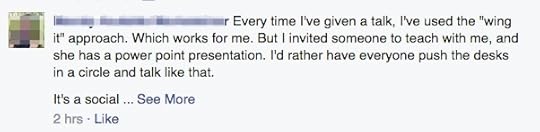
This made me think about the merits of “winging it”, which I’ll define as “speaking in a very extemporaneous style.” Note that “winging it” doesn’t mean avoiding the use of notes altogether. There’s absolutely nothing wrong with occasionally referring to notes, both written and/or digital.
I’ve been to more conferences than I can count, and here’s the brutal truth: Very few speakers can successfully pull off a completely impromptu talk. There are just too many dangers, including:
Will you omit a topic that you meant to cover?
Will you mention things that you should not have mentioned? (I always ask my speaking clients if anything is off-limits.)
Will you forget to define a key term?
Will you go out of order?
Will you adhere to your time limit? (This is a huge pet peeve of mine. It’s disrespectful to everyone at the conference.)
Will you end too soon?
Will you set the right tone with your audience?
Many people recognize the dangers of a completely unstructured talk and overcompensate. As a result, their talks come off as overly rigid, their humor contrived. And forget about eye contact and genuine enthusiasm. I’ve seen people routinely read off of their slides for the duration of their talks. Others regularly turn their backs to their audiences. These are big no-no’s, as Scott Berkun points out in his excellent book (affiliate link).
Very few speakers can successfully pull off a completely impromptu talk.
Is a talk structured or unstructured? In fact, this is a false dichotomy. Structure is not a binary, and there are degrees. I’d describe my own style as a mix of composition and improvisation. I know what I’m going to say, but not necessarily how I’ll say it—and this is a good thing. Before I spoke at Zappos last July, I walked right into the middle of a water balloon fight. (Hey, it’s Zappos.) Rather than play the diva, I chuckled, grabbed a towel, and worked that misadventure into my opening. In the process, I set the tone with the audience from the get-go: I had a sense of humor, and I wasn’t going to bore them for an hour.
In this way, I take my cues from a Neil Peart drum solo. (Peart famously leaves room for him to “riff” within the context of a ten-minute solo.)
Simon Says
There’s no one key or secret to dazzling an audience. Successful speakers rehearse, even if they’ve given a particular talk many times before. The best talks are the ones that naturally flow. Following a structure is not the same as being stiff. Leave yourself room to breathe.
Feedback
What say you?
The post Should Speakers “Wing It”? appeared first on Phil Simon.
January 13, 2015
What Your Website Says about Your Organization
 Nary a day goes by that I don’t see a bunch of extremely dated websites.
I’m not talking about a good site that just looks weird on my iPhone. Rather, I’m talking about sites that sport the following:
MySpace links. (No, I’m not kidding.)
Both left and right sidebars, leaving the content smushed in the middle.
A text-heavy design. (Read: a lack of images, something that Pinterest has made extremely important.)
Ugly and inconsistent color schemes.
Really tiny fonts.
Background music. (Again, I’m not kidding.)
Confusing navigation.
General sloppiness.
Glacially slow loading times.
Overall busyness/lack of sufficient space.
A slew of missing images.
Broken links and 404 errors.
Cheesy ads and pop-ups.
Excessively busy menus.
Featured clip art.
I could go on, but you get my point.
Maybe questionable and lazy design like this was excusable in the early days of the web. As I wrote in The New Small, for a long time now, it’s never been easier and more affordable to develop a professional web presence. (Small businesses are not off the hook here.) Despite this truism, it’s evident that many organizations of all sizes simply don’t consider quality web design to be a priority. I suspect that plenty of them pay the price for it in the form of lost sales, customers, inquiries, general credibility, and even occasional mockery.
But I’ve Seen Other Similar Sites…
Websites matter. Period.
Craigslist and Seth Godin can get away with extremely basic—and even ugly—websites. Remember, though, that they are the exceptions that prove the rule: Like it or not, your website says a great deal about your organization to the outside world.
Where to begin? How about the following?
Why not start with running your site through the Hubspot Website Grader?
Assess your site’s speed with Pingdom and look at its bounce rate.
Ask a proper designer for his or her honest opinion about your site. Noodle with WordPress or another content management system.
Take a look at your competitors’ sites and ask yourself how yours compares? “Not as bad” (read: sucking less) is not an acceptable answer.
If you’re curious about how your site appears on a wide variety of devices, Responsinator is for you.
Simon Says: Ignore Appearances at Your Own Peril
Websites matter. Period. That isn’t going to change anytime soon. Stasis is simply not an option. An ugly, dated, slow, and confusing website implicitly communicates to prospective customers and the public at large to prospective customers: You just don’t care about their experience.
Why would that change when they become actual customers?
Feedback
What are some of your design pet peeves?
The post What Your Website Says about Your Organization appeared first on Phil Simon.
January 12, 2015
When One Message Yields Two Very Different Reactions
 Over the past year, I’ve become a big fan of the sketch-comedy show Key & Peele. The bits are fresh and often decidedly politically incorrect. (The Obama meet-and-greet is one of my faves.) As a result, K&P often makes many people just a little uneasy. A few months back, I asked a black friend of mine, “Should I be laughing at this?” (He said yes.)
One of the best skits from the show’s most recent season involves the dangers of communicating via text messages. It dovetails nicely into a major theme of Message Not Received. I write about how mediums such as e-mail and texts often give us the appearance that others really understand our messages. It turns out, though, that that understanding is often false.
Like this:
In their own inimitable way, K&P are making a serious point: As a communication tool, texting is vastly overrated and prone to mixed and missed signals. But let’s not take their word for it. After all, they’re comedians.
Left by themselves and devoid of their essential context, words invite widespread (mis) interpretation.
Yeah, Science!
K&P are the funniest ones to point this out. Fortunately, though, there’s no shortage of others who echo the same point. For instance, a 2006 series of studies by two psychologists, Justin Kruger, PhD of New York University and Nicholas Epley of the University of Chicago. In short, Kruger and Epley wanted to determine if people were as good as they thought they were at discerning the subtext of a message.
How did they do?
Participants were only able to accurately communicate sarcasm and humor in barely half—56 percent—of the e‐mails they sent.
And if that isn’t bad enough:
Most people had no idea that they weren’t making themselves understood.
Which brings us right back to K&P.
Notice how, in the skit above, Key is oblivious to Peele’s true message. Key only recognizes the misunderstanding after he sees Peele in person. At that point, everything quickly becomes clear to him. There never was any antagonism, any baiting. Left by themselves and devoid of their essential context, words are very open to (mis)interpretation. In this way, they invite the very conflicts that K&P so deftly demonstrate.
Simon Says
The solution is quite simple: Don’t e-mail so frequently. Ditto for texting.
Feedback
What say you?
The post When One Message Yields Two Very Different Reactions appeared first on Phil Simon.
January 8, 2015
Communication Canaries in the Coal Mine
 I’ve said for a long time that there are three types of people in this world:
Those who get it.
Those who don’t get it but want to get it. (These are some of my favorite people.)
Those who don’t want to get it and don’t want to get it.
I made the decision six years ago to work exclusively with the first two groups.
That’s all fine and dandy, but how do you know which is which?
Red Flags
The short answer is that it’s not easy. (People are much more unpredictable than technology.) I have inadvertently violated my own rule several times since my vow. In hindsight, sometimes the signs were there and I didn’t pick up on them. In other cases, there was no realistic way for me to have known that I was beginning a professional relationship that I would ultimately come to regret.
I don’t beat myself up over this. No one bats 1.000. Still, I’m not completely oblivious to warning signs that the following story illustrates.
I’ve reached out to some prominent companies about sponsoring my forthcoming book tour for Message Not Received. Nothing is final yet, but interest seems to be relatively strong. To this end, I recently exchanged e-mails with a woman whom I call Skyler here. (No, that’s no her real name.) Skyler works for a PR firm whose major client sells collaboration software. After several e-mails, I suggested that we book a time for a quick call.
Here’s her response:

The irony wasn’t lost on me, and I responded with those very words. Skyler’s client sells a product that obviates the need for the protracted e-mail correspondence like this.
Paradoxically, the outcome actually pleased me. I’m glad that Skyler showed her true colors so early in the game. After all, if she’s too “busy” to be bothered with a quick phone conversation at the beginning, what are the odds that she’ll change her tune in a few months when planning the logistics of the book tour? Not great. I shutter to think about sending and receiving eight to ten e-mails per event.
Put differently, she’s clearly in that third bucket, and I’m happy to have discovered that sooner rather than later. Fast forward two months to the book tour. I thought about what would happen—or, to be precise, not happen—if for some reason I needed to get a hold of her immediately and my only recourse was e-mail.
Simon Says: Embrace the Signal
Few if any people take a job with complete freedom. As such, they are often unable to choose their existing colleagues, clients, partners, and staff. When assessing a potential relationship, though, things are different. In these cases, pay close attention to how others communicate (read: words, methods, and the like). Ask yourself if you really want to interact with people who are averse to phone conversations and simple language.
Feedback
What say you?
The post Communication Canaries in the Coal Mine appeared first on Phil Simon.
January 7, 2015
Why I Wrote Message Not Received
 The motivations of creative types have always fascinated me.
I love and frequently watch in-depth interviews with actors, filmmakers, musicians, and authors about their creative processes. The best ones offer a great deal of honest insight into how they work. After 30 or 60 minutes, you learn how distinct scenes, songs, and overarching concepts developed and ultimately came together into a cohesive whole.
For example, I used to enjoy the VH1 Classic show Classic Albums, particularly the episodes about Dark Side of the Moon and two particularly enduring Rush records.
Think of these interviews as incredibly revealing windows, the antitheses of vacuous, link bait-ridden Buzzfeed and Gawker articles such as “The 5 Ways to Do X” or “The 7 Mistakes to Avoid Y.”
Why does a writer sit down at a keyboard and start pecking away?
It’s folly to claim that an anonymous first-time author of a children’s book operates in the same manner as a serial author like James Patterson or a CEO. Put differently, there’s no single reason for writing a book; motivations, subjects, and authors run the gamut. The following is by no means a comprehensive list of reasons:
Achieving a life goal.
Curiosity (read: Could I pull it off?)
Enjoyment of the writing process.
A publisher approached the person because of his or her “platform”, although this is exceptional. (See Gary V’s book deal.)
A desire to increase one’s professional credibility.
The need to fulfill a multi-book publishing contract.
Product promotion. (See large companies with independent presses and well-funded startups.)
Vanity. In some cases, a rock star knows that his or her book will sell irrespective of its quality and message. The book need not be appreciably different than previous books. And let’s not excoriate authors here. To be fair, many actors, musicians, and artists follow the same playbook.)
The need to play against type (read: to do something completely different).
The need to feed the beast. (That’s just what a writer does.)
Catharsis.
Some combination of the above.
Why did this writer sit down at a keyboard and start pecking away?
My own writing motivations don’t fall neatly into a single box—and they never have. Slightly and sometimes entirely different reasons have motivated me to write each of my books with one exception. I’ve said many times that I’m a sponge. Eventually, my brain gets full and I need to “squeeze” it. That squeeze eventually becomes a full-length book.
Business communication is broken—and has been for a long time.
The genesis of Message Not Received was a problem I’ve seen throughout my entire professional career: Business communication is fundamentally broken—and has been for a long time. The problem is anything but insignificant. On the contrary, it is extremely pervasive, costly, and (worst of all) exacerbating. Spend a day in your typical corporate environment and you’ll understand what I mean.
But so what? What if the problem could not be solved? What if, as many people erroneously believe, there are no suitable replacements for buzzwords and e-mail?
Nonsense.
I have long rejected the notion that business communication needs to be so damn vexing. Words should convey, not confuse. Direct, clear, simple, and straightforward communication is almost always the most effective way to go. Beyond that, engaging in faux “conversations” over e-mail isn’t just inefficient; it’s counterproductive.
Simon Says
In short, it was time for me to put up or shut up. I was unaware of an existing book that approached the issue with the same multi-faceted lens. Message Not Received sits at the intersection of language, communication, business, and technology. I simply don’t know how to write a book about a single subject in isolation.
Feedback
Why do you write?
The post Why I Wrote Message Not Received appeared first on Phil Simon.
January 5, 2015
Mark Twain and the Need to Move Beyond Simple Metrics
 I can’t speak for every nonfiction author out there, but I have always found that each book takes me in new directions and opens unexpected doors for me. Always.
To be sure, the same tenet has held true with The Visual Organization. When I reflect on the book nearly one year after its publication, I shake my head at some of my recent interactions, speaking gigs, conversations, and contact requests. Those who think they know exactly what the future holds are almost always wrong.
Moving Beyond “Metrics”
Relying upon simple “metrics” can maximize the chance of making the wrong decision.
Still, not all of these events and new relationships are completely surprising; many were downright expected. For instance, I’ve had many conversations with folks about contemporary dataviz. I’ve spoken to my fair share of executives about how they use data to do their jobs. Most use KPIs, dashboards, and other numerical ways to manage their business. The most dynamic of the lot, however, understand that relying exclusively upon quick overviews in the form of “metrics” is not only dangerous; it can maximize the chance of making the wrong decision.
Look at following charts. What do you see?

(Thanks for the photo, @pickover and @peeterskris.)
You might think that the figures above are wildly divergent. In a way, you’re right. In another, though, you couldn’t be more wrong. The mean, median, and variance of each dataset is identical. You don’t have to be Nate Silver to see that basic statistics in this case mask very different stories and trends.
Simon Says: Data Must Be Contextualized
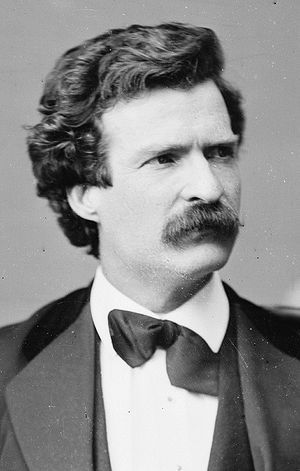 As Mark Twain once said, “There are lies, damned lies, and statistics.” It’s one of my favorite quotes, and that statement is as true today as when he said it more than a century ago.
KPIs and their ilk can certainly provide high-level overviews of the health of a business or department. Without context, however, those metrics lie somewhere between meaningless and incomplete.
Feedback
What say you?
 This post was brought to you by IBM for Midsize Business, but the opinions in it are my own. To read more on this topic, visit IBM’s Midsize Insider. Dedicated to providing businesses with expertise, solutions, and tools that are specific to small and midsized companies, the Midsize Business program provides businesses with the materials and knowledge they need to become engines of a smarter planet.

The post Mark Twain and the Need to Move Beyond Simple Metrics appeared first on Phil Simon.