Phil Simon's Blog, page 65
March 23, 2015
Has E-mail Become Too Convenient?
 Emailgate just won’t go away for Hillary Clinton.
Why the continued scrutiny? There’s no one single factor. (Is there ever?) Clinton is a polarizing political figure who maintains a high profile. (Click here for more on the “Hillary conundrum.”)
Truth be told, however, Clinton is hardly the first prominent female politician to use cause a kerfuffle by using her personal e-mail account to possibly conduct government business. See Sarah Palin in 2010.
But let’s get back to Clinton and Emailgate. In her words:
In going through the e-mails, there were over 60,000 in total, sent and received. About half were work-related and went to State Department, and about half were personal that were not in any way related to my work. I had no reason to save them, but that was my decision because federal guidelines are clear. For any government employee it is that government employees responsibility to determine what’s personal and what’s work related.
A few days later, she offered a mea culpa:
Looking back, it would’ve been better for me to use two separate phones and two email accounts. I thought using one device would be simpler, and obviously, it hasn’t worked out that way.
I’m no political expert, but I do know quite a bit about technology and communications. As such, Clinton is right about one thing: Using a single device to manage our emails is easy—too easy. And it’s this very lack of friction that causes all sorts of problems. As I argue in Message Not Received: Why Business Communication Is Broken and How to Fix It, it’s become nearly effortless to send e-mail. Technology has advanced to the point at which much communication has become frictionless. We share our thoughts and ask questions later. The poster child here is Justine Sacco, the queen of the dumb tweet.
A Trip Down Memory Lane
Of course, it didn’t used to be this way. In the mid-1990s, e-mail started to gain traction inside Corporate America. At that time, sending messages required much greater effort and, remarkably, most employees had to apply for proper e-mail addresses. Fifteen years ago, employees needed to be sitting at their computers in proper offices. Fast forward to the early 2000s, and that inconvenience subsided a bit. We could send e-mails from our laptops, but we had to dial in to our organization’s virtual private network (VPN).
Sometimes, a little friction isn’t such a bad thing in our communications.
Today, none of that friction exists. Got five minutes on line at the supermarket? Whip out your smartphone and send a message. Ditto if you’re at a red light or at the gym and bored on the treadmill. The Apple Watch just advances this trend. Why take our your phone and unlock it?
Simon Says
There’s a great line in the movie Jurassic Park: Your scientists were so preoccupied with whether or not they could that they didn’t stop to think if they should. Sometimes, a little friction isn’t such a bad thing in our communications.
Originally published on HuffPo.
The post Has E-mail Become Too Convenient? appeared first on Phil Simon.


March 17, 2015
A Note to Panelists: It’s Not Your Stage
 Twitter is humming right now at how Google Chairman Eric Schmidt repeatedly interrupted US Chief Technology Officer Megan Smith on a panel at SXSW.
All of us who have attended conferences have seen it before: people who dominate panels and, intentionally or not, disrespect the others on the stage.
I’ve been looking, but I’ve been unable to find the video of the SXSW panel. As a result, I can’t comment on specifics, but one thing is certain: Schmidt’s timing couldn’t be worse. Gender and tech are colliding as we speak, and the current Ellen Pao lawsuit is nothing less than a flashpoint. There has never been more awareness and press around the lack of diversity in Silicon Valley—and what to do about it.
Schmidt is an excellent speaker, especially on tech-related matters. Few people can explain the complexities of machine learning, network effects, and the like so well. Still, that doesn’t give him the right to dominate a panel. By all accounts, he did just that.
My question: Why wasn’t the moderator more forceful? Sure, Schmidt is worth nearly $10 billion, but none of that matters on stage. The person posing the questions should have stepped in and cut Schmidt off if, as is being widely reported, he clearly stepped over the line. Here’s another tip for moderators: To elicit a response from a specific individual, preface a question with that person’s name. For instance, Skyler, what do you think about this? This works better than general “up-for-grabs” queries that invite multiple responses.
One of the most effective things you can do as a panelist is to shut up.
Simon Says
As I write in the new book, one of the most effective things you can do on stage is to shut up (NSFW). A strategic pause after a rhetorical question can be devastating. That goes double when there are others on stage. A little consideration goes a long way.
(For more on fixing panels, see Scott Berkun’s post.)
Feedback
What say you?
The post A Note to Panelists: It’s Not Your Stage appeared first on Phil Simon.
An Intelligent Approach to Cloud Computing
 Over the last six years, the term cloud computing has gone from downright obscure to de rigueur. Just because something is commonly used, however, does not mean that it’s commonly understood. In fact, as I point out in Message Not Received, there’s often a world of difference between the two. And that gap can cause massive problems, the subject of Why New Systems Fail.
Put differently, cloud computing seems to have finally crossed to chasm, to steal from Geoffrey Moore’s iconic business book. (You see, I don’t just quote my own texts.) Visually, this can be represented below:
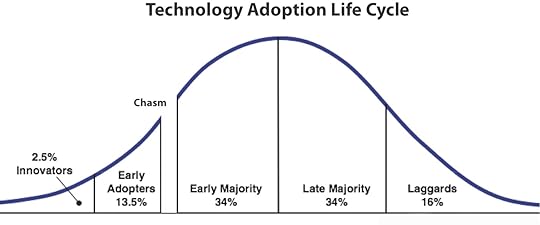
The relatively slow adoption of cloud computing stems from many factors. Many mid-level IT folks haven’t exactly spearheaded initiatives that may could have jeopardized their careers. A terrible economy certainly didn’t help. Beyond that, many organizations have historically emphasized the costs and risks of cloud computing over its benefits. Now that more success stories and case studies are available, that tide is starting to change.
Now that more success stories and case studies are available, the tide is changing.
More and more, organizations are buying into the long-term viability and potential of cloud computing. Still, there’s no one “cloud” switch, and foolish is the CIO who thinks otherwise. (For more on this, see Five Tenets of Cloud Computing.) Rare is the the executive who wants to risk even a remote chance of massive system disruption.
Where to Begin? A Few Starter Questions.
Recent research reveals that the secret to happiness seems to stem from realistic expectations. Ignore enterprise parallels at your own peril. For starters, realize the following:
No cloud (public, private, or hybrid) magically fixes dysfunctional organizations.
It does not purify bad data.
It does not fix broken business processes.
Adding new technologies without attendant subtractions (cloud-based or otherwise) only increases costs.
If you understand these precepts, then you’re less likely to be disappointed. It’s also essential to know which business goals your organization is trying to accomplish. Is it speed at all costs? Is it maximum security? Launching more modern apps? Is it a bit of all of them? Something else? Seriously think about these issues before you begin your search for partners.
Simon Says
Ask an architect to build you a house and he or she will answer with more questions: What kind of house? How many floors? How many bathrooms? Without answers to these questions, the homeowner won’t be satisfied with the end result. Understand this going in.
Feedback
What say you?
 This post was brought to you by IBM for Midsize Business, but the opinions in this post are my own. To read more on this topic, visit IBM’s Midsize Insider. Dedicated to providing businesses with expertise, solutions, and tools that are specific to small and midsized companies, the Midsize Business program provides businesses with the materials and knowledge they need to become engines of a smarter planet.

The post An Intelligent Approach to Cloud Computing appeared first on Phil Simon.
March 16, 2015
Suggestions Wanted: Which Buzzwords Irk You the Most?
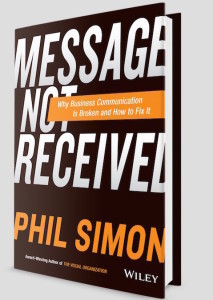 In Message Not Received I rail against buzzwords. Put bluntly, jargon sucks—and it actually hurts us at work. Specifically, by using jargon instead of simple language, other people trust us less.
At least that’s what researchers Michaela Wänke and Jochim Hansen discovered in 2010. In their words, “Statements of the very same content were judged as more probably true when they were written in concrete language than when they were written in abstract language.” More than a little ironically, in their paper they call for “linguistic concreteness.” (Doesn’t exactly roll off the tongue.)
I’m curious about which “words” irritate people the most. The misuse (pun intended) of use case drives me bonkers, never mind meaningless bastardizations like mobile social. For more of my list of the worst offenders, click here.
Go ahead and enter yours in the comments and I’ll put together a poll next week.
As an aside, I’d love to see a company implement the equivalent of Homer Simpson’s swear jar:
I’ll send a signed copy of the book to a random commenter.
Hat tip here to Scott Berkun.
The post Suggestions Wanted: Which Buzzwords Irk You the Most? appeared first on Phil Simon.
March 13, 2015
First Talk on Message Not Received
I recently spoke at the company’s headquarters on March 11th on Message Not Received. I talk about some of the research in the book and call out terrible jargon from management at Twitter, among others. Watch the video below.
The post First Talk on Message Not Received appeared first on Phil Simon.
March 12, 2015
The Case for Tweaking
 I recently wrote a guest post for Elegant Themes. It’s about my new site and how I am much more able to build and tweak things for myself since I applied one of its themes, Divi.
Here’s an excerpt.
When I’m not writing and speaking, I’m tweaking.
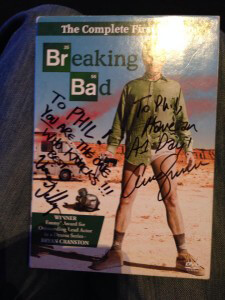
No, not the meth kind, although Breaking Bad is my favorite show. (I was even on a commercial for the show and interviewed Jonathan Banks for Huffington Post. I own a copy of Season 1 signed by Anna Gunn and Vince Gilligan.)
If tweaking means that I break a few things in the process, so be it. WPEngine provides great backup and recovery tools, not to mention first-class support. I’ve used WordPress for nearly five years now and I know enough to be dangerous.
Still, I’m not a full-time developer. Some website changes I just couldn’t make on my own. (WordPress might be open source, but there’s a world of difference between free speech and free beer.) “The community” wasn’t going to fix my website or make major changes for me.
In the past, of course, major and even some relatively minor changes to my site involved contacting my web developer. I have nothing but good things to say about him; he is a friend of mine. He responded to every one of my queries and his turnaround time was stellar. Still, I was far from his only client. Absent an emergency, he couldn’t just drop everything that he was doing because I wanted to change something on my site. Do unto others…
Read the whole thing here.
The post The Case for Tweaking appeared first on Phil Simon.
March 11, 2015
My First Quartz Piece
 My first Quartz piece is now live. Here’s an excerpt:
Email wasn’t designed as a task-management application, yet many employees use email for precisely this purpose. As a result, it is it any wonder that they become distracted? You check your inbox for an update on a key project or task only to get derailed by a stream of unrelated work or personal messages? It’s easy to get distracted and forget what you were trying to do in the first place.
Read the whole thing here.
The post My First Quartz Piece appeared first on Phil Simon.
Message Not Received T-Shirts
As part of my book tour for Message Not Received, I decided to print some comical t-shirts. I’ll be giving most of them out as prizes during my talks.
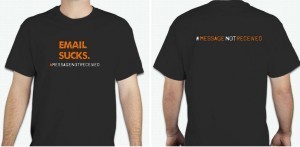
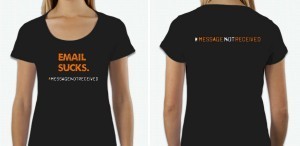
A few people have asked me about if they could buy them. If you’re interested, just connect with me. I’m selling them at my cost: $20 (USD).
The post Message Not Received T-Shirts appeared first on Phil Simon.
March 9, 2015
How to Speak Data to the Data-Challenged
 You’re all hopped up because you discovered a fascinating insight into your business—or at least you think so. Maybe it’s a previously unknown reason for employees leaving the company. Perhaps you unearthed a groundbreaking discovery on how to convert visitors to customers. You’re downright giddy, and you can’t want to tell everyone about it. You want to see the results of your epiphany as soon as possible. Riches and a promotion are sure to come your way.
Not so fast.
In their understandable excitement, far too many people ignore what is arguably the cardinal rule of business communication: Remember your audience. As a result, their findings and ideas don’t have anywhere near desired impact, a huge point in Message Not Received.
To maximize the chances that others (fully) receive our messages, consider the following advice.
Recognize that Some People Actively Hate Data
Yes, even in this era of Big Data, plenty of execs are certifiable dataphobes. Some people know what they know, data be damned. (See Moneyball.) They don’t much like others challenging their beliefs with quantitative evidence. Depending on their clout, you may have to tread lightly and follow a few of the laws of power.
The very thought of varying your approach may rankle you. After all, shouldn’t “facts” and numbers speak for themselves? To quote W. Edwards Deming, “In God we trust; all others must bring data.”
That might be true at Google, but how many companies, departments, and groups regularly operate that way?
At the risk of getting all existential, though, what’s a fact anyway?
Mark Twain was spot-on when he said, “There are three kinds of lies: lies, damned lies, and statistics.” Remember that, especially if your audience is agnostic or hostile to data. Beyond that, foolish is the soul who thinks that the business world is a meritocracy, never mind that the Constitution exists in the workplace. We usually pitch our ideas to those higher on the corporate totem pole than we are. Good things are unlikely to happen when you harp on the things that make them uncomfortable.
Use the Simplest Language Possible
“Think about the actionable synergies that will result from this cross-platform value-add!”
Foolish is the soul who thinks that the business world is a meritocracy.
Huh?
Try again in English, please. Depending on an organization’s culture, it’s unlikely that important-sounding but ultimately hollow phrases will effectively sell an idea. Still, that’s only part of the problem. Even if, by some miracle, others understand what you mean, talk like this never results in clarity. To wit, others won’t know how to do the very things that you’re advocating. You know…the stuff that will actually help the organization realize all of those benefits.
Think Pyramid
Early in my consulting career, I sometimes didn’t gave my clients the right types of synopses. Generally speaking, the more senior the person, the less she cares about details regarding how something is implemented. Start with the recommendation, not the often convoluted path to get there. Be prepared to go deeper if need be. That is, bring the data, but don’t inundate people with it from the get go. Tell a story.
Simon Says
A little strategy can go a long way, especially when any of the following is true:
You’re still taking the temperature of an organization or group of bigwigs.
You’re dealing with new partners who may not (yet) understand the intricacies of your business.
You’re replacing legacy systems with more contemporary, cloud-based ones.
Don’t make the mistake of assuming that a data-intensive message will necessarily be an effective one.
Feedback
What say you?
This post was brought to you by IBM for Midsize Business, but the opinions in this post are my own. To read more on this topic, visit IBM’s Midsize Insider. Dedicated to providing businesses with expertise, solutions, and tools that are specific to small and midsized companies, the Midsize Business program provides businesses with the materials and knowledge they need to become engines of a smarter planet.
The post How to Speak Data to the Data-Challenged appeared first on Phil Simon.
March 8, 2015
New Rule: No More Urgent E-Mails
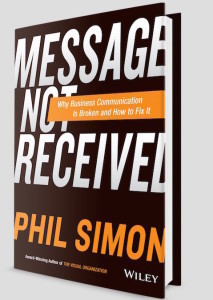 Over the last six months, some of my clients and friends had told me that I intermittently wasn’t responding to some their messages. Twitter also wasn’t alerting me to direct messages (DMs). Oddly, the problem seemed to be exacerbating, and last week I finally decided to play data detective figure out what was going on.
It turns out that Google Apps was incorrectly marking legitimate messages as spam—quizzically, these included responses to existing e-mail threads. (A very good friend of mine comically noted that Message Not Received must have angered the e-mail gods, and they were exacting their revenge.) To boot, the affected messages weren’t forwarding into my personal Gmail account as spam. (I periodically check my personal spam for false positives.) Google was blocking them.
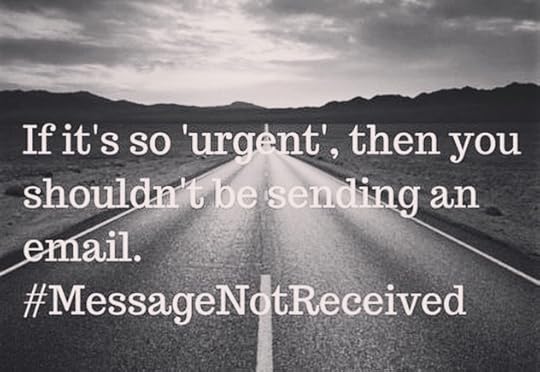
If the medium is the message, then why is there such a thing as an urgent e-mail?
I solved the problem by moving the MX records of my business e-mail account to another provider, but there are several lessons. Even mature, robust e-mail services aren’t bulletproof. Yes, e-mail is extremely reliable, but foolish is the soul who believes that it’s infallible. Sometimes, messages aren’t received.
Simon Says
Occasional and annoying glitches aside, there’s a much larger point here. Let’s say for the sake of argument that the medium is the message. If that’s the case, then why is there such a thing as an urgent e-mail?
New rule: If an issue truly is urgent, then you cannot send an e-mail. Opt instead for the phone.
I know what you’re thinking: What if things break bad and I don’t know the phone number of [insert name of person or organization]? Allow me to retort: If you’re working on a critical project, then why didn’t you ask for that number in the first place?
Feedback
What say you?
The post New Rule: No More Urgent E-Mails appeared first on Phil Simon.