Phil Simon's Blog, page 63
May 16, 2015
Audiobook Version of Message Now Available
 Five weeks ago, I announced that an audiobook version of Message Not Received was coming.
Check it out on Audible here.
The post Audiobook Version of Message Now Available appeared first on Phil Simon.


May 12, 2015
Jargon and the End of AOL
 And with that, AOL is gone.
Goodbye to one of the pioneers of the web. Who knows whether it’s the right move for all parties concerned, but one thing is certain: there has to be a better way for Verizon to describe the move to its employees and shareholders. From the NY Times’ piece:
“Verizon’s vision is to provide customers with a premium digital experience based on a global multiscreen network platform,” Lowell C. McAdam, Verizon’s chief executive, said in a statement. “This acquisition supports our strategy to provide a cross-screen connection for consumers, creators and advertisers to deliver that premium customer experience.”
A global multiscreen network platform?
Seriously?
This is exactly the type of vacuous corporate jargon that confuses others. I’d offer a few suggestions for Verizon to improve its communications but I don’t understand what it’s trying to do. Something about video, I suppose.
Simon Says
Never mistake a bunch of ostensibly important words for logic, intelligence, or clarity. A bouillabaisse of buzzwords is just that.
For those who erroneously believe that words don’t impact the bottom line, check out Nick Morgan’s post on the new CEO at McDonald’s recent rubbish.
Feedback
What say you?
The post Jargon and the End of AOL appeared first on Phil Simon.
May 8, 2015
Too Big to Ignore: Chinese Version
Of all my books, only The Age of the Platform had been translated into other languages.
No more.
Here are some pics.
Today, I’m pleased to announce that Too Big to Ignore has been translated into Chinese.
Golf applause.
The post Too Big to Ignore: Chinese Version appeared first on Phil Simon.
May 6, 2015
Communication Failures at the Collision Conference
Does the following company description make any sense to you?
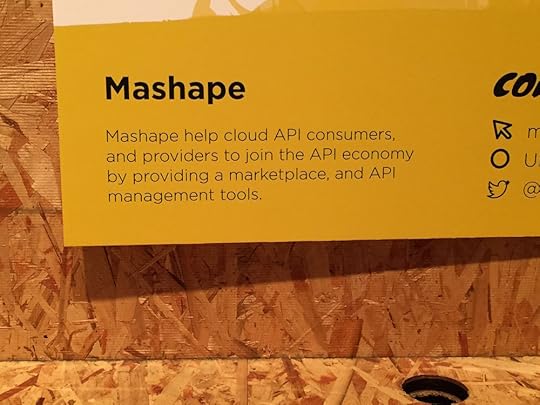
Me neither. (How does one manage to put a single term [API] in a single, grammatically incorrect sentence thrice, anyway?)
Does this make any sense to you?
Unfortunately, these types of confusing, jargon-laden company descriptions weren’t exactly rare at the Collision Conference in Las Vegas yesterday. As I walked around, I couldn’t believe how few placards qualified as clear, a point of viewed shared by others.
"Many startups lack a narrative. Focus on that narrative and sell your vision." – @msuster #CollisionConf
— Ross Simmonds (@TheCoolestCool) May 5, 2015
You have to wonder what some of these startup founders are thinking—or whether they’re really thinking at all. A mishmash of ostensibly topical buzzwords does not a compelling vision make. How some of these companies have received considerable funding is beyond me.
While I’m ranting about bad business communication, allow me to present this perhaps the single worst slide I’ve ever seen:
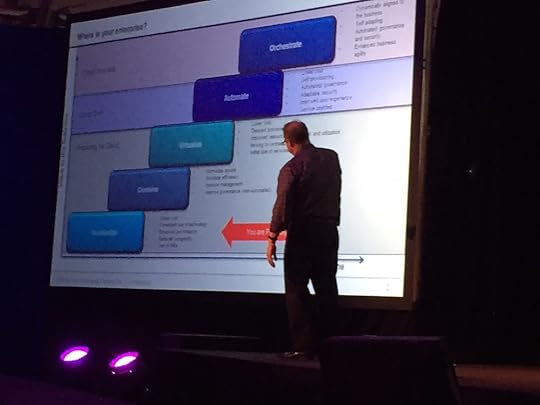
Don’t worry. I couldn’t read most of the words on that slide either, not that I tried really hard. (No audience member should ever have to squint.) Can you spot the other speaker faux pas here?
You should never turn your back on your audience. It’s the acme of unprofessionalism.
Simon Says
It’s obvious to me that most technology professionals have to make considerable strides with their communication skills.
Feedback
What say you?
The post Communication Failures at the Collision Conference appeared first on Phil Simon.
May 5, 2015
My Interview on the MIT Sloan Management Review

I recently did an interview with Jerry Kane of MIT on Message Not Received. Here’s an excerpt:
Q: Your new book is about what’s wrong with business communication and what companies can do to fix it. What is wrong with business communication today?
A: At a high level, there are two problems. Number one: we send far too much email. Number two: we use far too much jargon. That’s the book in a nutshell.
Let’s address the first issue. Email is killing us. Many employees receive 150 emails every day andthose emails are frequently rife with jargon. It’s a pernicious combination. As such, employees are very unlikely to achieve what we’re trying to achieve on time. As my research uncovered, most employees are swamped with information and email.
Fortunately, change is well within our grasp. If I can improve my own skills, then anyone can. In the book, I cover my own communications journey.
Read the whole thing here.
The post My Interview on the MIT Sloan Management Review appeared first on Phil Simon.
The Long Term Has Never Been Shorter

Don’t believe what management gurus tell you: Management is not a science; it never has been.
There are no immutable laws. No one can control every independent variable. Business is a world apart from chemistry and biology.
No, management has always been about running experiments and, at a high level, there are two types:
Small/IterativeBig
Website formatting tweaks usually measured via A/B testingSlightly different productsComplimentary acquisitionsEntirely new business models, ideas, products, internal applications, partnerships, and mind-sets (re: platform thinking)Vastly different company directionsNon-adjacent acquisitions
Success and Experimentation
Historically, successful organizations could focus on the left-hand column. That is, they have not had to make really big bets rife with uncertainty. Sure, there have been exceptions. (Exhibit A: The Time Warner/AOL debacle.) For the most part, though, profitable companies could maintain their competitive advantage for relatively long periods of time by preserving the status quo. Huge rolls of the dice have been typically reserved for companies with nothing left to lose.
No more.
We need to get comfortable with being uncomfortable.
Ours is an era of accelerating change, lean methodologies, rapid prototyping, cheap technology, constant connectivity, Big Data, and platform thinking. As such, both types of experiments are more necessary than ever, even for successful organizations. Want proof? This is why Google is embracing moonshots, Pinterest has launched an API, Amazon keeps figuring out ways to sell more stuff, etc. Put differently, the long term has never been shorter. Complacency is a cancer.
Simon Says
New directions, strategies, ideas, and business models tend to make employees uncomfortable, especially in successful, mature organizations. Here, there’s still significant aversion to risk. (Change will always be tougher at brownfield sites compared to their greenfield counterparts.)
That divide is starting to erode. We all need to get comfortable with being uncomfortable.
Feedback
What say you?
The post The Long Term Has Never Been Shorter appeared first on Phil Simon.
May 4, 2015
A Better Way to Vet Potential Partners, Part I
 I’ve said many times that I have perhaps the worst possible background for what I do. In May of 1997, Cornell University awarded me a masters in industrial and labor relations. Equipped with that degree, I promptly began working in corporate human resources.
Big mistake.
For a bunch of reasons worthy of a separate post one day, I didn’t last long in HR. Still, I remember very well many things from the experience. For instance, I learned how to conduct behavior-based interviews at CapitalOne. The theory is simple: the best performance of the future is the past. Rather than pepper people with silly theoretical questions, get specific.

To be sure, anyone can easily search for questions that individual companies ask for specific positions. It’s not hard to school yourself on what to say if you really want the job.
Brass tacks: there’s no foolproof way to assess potential employees. In hindsight, many employees only show their true colors after a year or more on the job. Still, behavior-based interviews remain popular because, generally speaking, they work better than 1970s-style queries.
This begs the question: Why not apply the same rigor to potential partners that recruiters do to candidates?
While nothing is irrevocable, the choice of the wrong partner can devastate an organization and ruin careers. I should know. I worked as a consulting partner on dozens of IT projects throughout my career, many of which informed Why New Systems Fail. Many salespeople tell clients what the latter want to hear. (Insert obligatory Glengarry Glen Ross reference here.)

Better Questions
With that in mind, what are some specific questions that prospective partners should be able to answer?
What specific tools does your organization use to manage projects? If the answer is e-mail or a 2003 version of Microsoft Project, be wary. It’s fair to ask if that prospective partner is really the progressive juggernaut that your organization requires. Communication is absolutely essential to successful engagements and e-mail invites misunderstandings.
Tell me about a specific time that you disagreed with a current or former client’s decision. What did you do to talk the client out of making what you considered a big mistake? Consultants should not be neither lackeys or yes men and women. Clients hire—or should hire, anyway—third parties precisely because of the expertise that they latter bring to the table. Yes, it’s ultimately the client’s candy store, but I’d gladly hire a partner that tried its hardest to convince one of its clients out of making a spectacularly bad decision, regardless of whether the client listened.
Tell me about a deal that your company turned down. Why did it walk away? Does your potential mate know the definition of bad business? Which red flags does it look for?
It shouldn’t be hard for a salesperson to quickly answer these questions.
Simon Says
Foolish is the soul who signs a contract based on a partner’s flashy website and self-promoting case studies. Do your own homework, and that includes opposition research. Don’t be afraid to ask hard questions before writing a big check.
I’ll return to this topic in my next IBM-sponsored post.
Feedback
What say you?
 This post was brought to you by IBM for MSPs and opinions are my own. To read more on this topic, visit IBM’s PivotPoint. Dedicated to providing valuable insight from industry thought leaders, PivotPoint offers expertise to help you develop, differentiate, and scale your business.

The post A Better Way to Vet Potential Partners, Part I appeared first on Phil Simon.
April 29, 2015
The First Rule of Platforms

Jeff Bezos understood the need to move quickly in 1995. The Internet was a land grab, and Bezos knew it. This is also known as first-mover advantage. His mantra: Get big fast. To be sure, it has served Amazon well.
Bezos was right.
In the Age of the Platform, it’s nearly impossible to play catch-up.
Contrast that with Mark Zuckerberg. Facebook was certainly not the first social network. (See MySpace, Friendster, and Classmates.com.) Zuck did not roll out Facebook to schools in 2005 willy-nilly. Rather, patiently waited until his company’s infrastructure could support more users. He cared about the user experience.
Zuck was also right.
This brings me to the first rule of platforms (hat tip to Fight Club):
You don’t need to be first, but you sure as hell can’t be last.
In a nutshell, this is the daunting problem that Microsoft, BlackBerry, Yahoo, and others face today. Make no mistake: there is no simple solution.
Brass tacks: In the Age of the Platform, it’s nearly impossible to play catch-up.
The post The First Rule of Platforms appeared first on Phil Simon.
April 24, 2015
PGI Interview on Message Not Received
 I recently did an interview with Josh Erwin of PGi on my new book. Here’s an excerpt.
JE: What was your goal with Message Not Received?
PS: There are a ton of books out there about collaboration, language and technology, but I hadn’t seen a book that explored them all together.
It’s also one of the first books written about several things—more contemporary collaboration tools, for one, and communication language and business.
It’s also important to note what the book isn’t. It’s not a guide to grammatical style or the best ways to write business email, but rather it sums up the trends that result in overwhelmed employees. Email is not a particularly good way of communicating as a default mechanism. Jargon is the same; bombarding already confused employees with confusing language isn’t going to help.
All of that ineffective workplace communication does three things: confuses people, makes them feel stupid, and causes them to tune out. None of that is a desired outcome.
We’ve been battling with communication forever. My goal with this book was to challenge people to think about the way we communicate at work. I’ve said it before but it’s worth repeating: How we’re working isn’t working.
Read the whole thing here.
The post PGI Interview on Message Not Received appeared first on Phil Simon.
April 23, 2015
Marketplaces Are Not Platforms
 The word platform has become so banal that it’s nearly lost its meaning. For example, consider ride-sharing service Lyft. Of course, the terms service and marketplace aren’t nearly as sexy as a platform. No surprise: that’s precisely how the company defines itself. From Crunchbase:
Lyft is a peer-to-peer transportation platform that connects passengers who need rides with drivers willing to provide rides using their own personal vehicles.
What exactly can external developers build on top of Lyft?
(Interestingly, Uber doesn’t brand itself on Crunchbase as a platform, but its management clearly understands the benefits of open APIs and platform thinking.)
Branding alone doesn’t mean a hill of beans.
True platforms like Amazon, Apple, Facebook, Google, Twitter, and WordPress allow third parties to take companies’ core offerings in new and exciting directions.
Simon Says
Wearing a funny hat doesn’t make you the Pope. The same bromide holds true for platforms. There’s a world of difference between talking the talk and walking the walk.
Feedback
What say you?
The post Marketplaces Are Not Platforms appeared first on Phil Simon.