Phil Simon's Blog, page 59
October 19, 2015
How to Use Data to Evade Questions
 Few things rankle me more than sweeping generalizations devoid of data and proper sources. This is the hallmark of a few prolific and well-regarded bloggers and reporters. Still, it’s folly to think that using a torrent of statistics amounts equates to really answering questions—let alone well.
Case in point: AirBNB co-founder Brian Chesky and his master spin class on Bloomberg. Armed with soundbite-friendly talking points and plenty of supporting data, he proceeds to ignore answering reporters’ simple questions. Don’t believe me, though. Judge for yourself.
By the way, incorrectly using the term use case never made anyone appear more forthright.
Finding a Happy Medium in an Era of Big Data
Incorrectly using the term use case never made anyone appear more forthright.
Somewhere in between “no data” and “all data” lies a happy medium. Used correctly and in moderation, statistics can buttress an argument. By the same token, a lack of data implies one of several things:
That the person hasn’t done his or her homework
That the data doesn’t in fact exist
That the person was lazy (read: didn’t take the time to do the research)
That the person didn’t think that data mattered
If finding relevant data were difficult and time-consuming, then perhaps these mistakes could be tolerated if not forgiven. It’s not 1970, though, and hasn’t been for a long time. Today, there’s enough data out there today to argue just about anything today. A simple Google search can seemingly prove or disprove even the most ridiculous theories.
Simon Says: Good communication involves more than merely reciting statistics and data.
To be sure, there are plenty of legitimate uses for data and statistics. Evading questions and trying to bulldoze reporters, though, don’t qualify.
Feedback
What say you?
The post How to Use Data to Evade Questions appeared first on Phil Simon.


October 14, 2015
Message to LinkedIn: This Is the 21st Century
I’ve long struggled with LinkedIn, the Cadillac of professional social networks. About a year ago, I was going to pull the plug before deciding against it. Beyond its onerous terms of service, anyone with a modicum of design sensibilities knows that its site and app are nearly indecipherable. Still, for me the squeeze was worth the juice. That’s not to say, however, that I spend much time on the app. I don’t—and plenty of others feel that way.
Hey @LinkedIn Your iPhone app sucks
— It’s Trav (@__Trav_) September 16, 2015
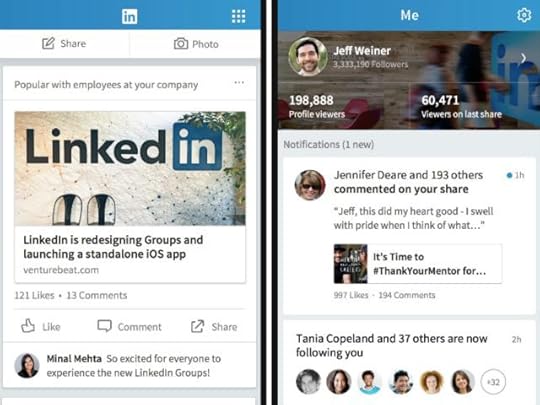
Turns out that major changes are finally coming, at least for the app. Think tabs à la HootSuite and TweetDeck. From ReCode:
LinkedIn CEO Jeff Weiner was quick to acknowledge the lag. “Welcome, LinkedIn, to the 21st century of communications,” he joked onstage Wednesday. “A little long in the making but we got there.”
I couldn’t help think of one of my very favorite Marillion songs:
x
Here’s a preview of the new app:
Simon Says
Don’t make data discovery difficult.
To the vast majority of users and customers, all of the data in the world doesn’t matter if it isn’t well organized. Presentation has never been more critical. Double that when your real estate is limited. Don’t make users hunt and peck for information.
Feedback
What say you?
The post Message to LinkedIn: This Is the 21st Century appeared first on Phil Simon.
October 5, 2015
The Electric Possibilities of Big Data

“It is better to ask some of the questions than to know all the answers.”
—James Thurber
The era of Big Data allows companies and their employees to address previously unanswerable questions. It’s one of the central points in both of The Visual Organization and Too Big to Ignore.
This is doubly true for organizations that develop interactive dataviz tools—the types that free non-technical employees from having to formally request reports from the IT department. As I know from personal experience, this is often a frustrating and laborious process that introduces superfluous friction, not to mention wastes valuable time.
Ever with the addition of just one relatively large external data source can significantly improve an organization’s ability to answer key questions and fill in key gaps.
An Electric Example
 Consider an electricity company (no, not the U2 song) that wants to serve its customers better during storms and related outages. Its management decides to tap into the Twitter API and see what its customers are saying on the social network. What could this company do with this firehose of information?
Short answer: Many, many things.
Why not prevent small issues from becoming big ones?
For starters, remember that each tweet contains critical geolocation metadata. Forget the content of the actual tweet for a moment. (We’ll come back to that a little later.) Via precise location information and the time and date of the tweet, the company can quickly determine the areas experiencing power outages without angry customers bombarding an 1-800 number.
Next, and this is a tad controversial, the company could use information such as number of followers to determine which of its customers are the most active and theoretically influential on Twitter. To be sure, all customers are important. At the same time, though, it arguably makes sense to make an extra effort to ensure the happiness of more influential customers. Further, It could use a tool like TwitterAudit to determine if someone’s ostensibly impressive numbers are legit or not.
A company could more effectively target Twitter ads to its prospective customers in areas in which it operates. Because of de facto local monopolies, consumers cannot as of yet pick any energy company to service their needs. At present, I am restricted to Nevada Energy. While I lived in New Jersey, though, my choices were more abundant. Perhaps customers with choice who complain about Company X might be persuaded to switch. Indeed, this type of attempted poaching on Twitter is already taking place.
@philsimon Service & billing issues? We understand how upsetting that can be. Join Sprint today. Visit http://t.co/RDzdiBrQ3V . AGS
— SprintSavings (@SprintSavings) August 26, 2015
Getting back to our electric company, it could easily create alerts for based on tweets containing certain incendiary words and/or hashtags. Examples include #fail, #sucks, etc. That goes double if the tweets occur in a short period of time or over an extended period of time. Maybe pay extra attention to exclamation points.
x
Why not prevent small issues from becoming big ones?
Simon Says
The possibilities for answering questions with just Twitter are limitless.
Feedback
What say you?
 This post was brought to you by IBM for MSPs and opinions are my own. To read more on this topic, visit IBM’s PivotPoint. Dedicated to providing valuable insight from industry thought leaders, PivotPoint offers expertise to help you develop, differentiate, and scale your business.
The post The Electric Possibilities of Big Data appeared first on Phil Simon.
October 1, 2015
DevOps and the New IT

Not that long ago, upgrading enterprise applications was an extremely cumbersome process. Those of us of a certain age remember visits from squirrelly IT guys who would assume control of our computers while they typed some cryptic commands into a Windows terminal window.

My how times have changed.
Thanks to the popularity of cloud computing and its cousin SaaS, installing and upgrading applications has never been easier for enterprises. In fact, for an application such as Salesforce or Workday, most non-technical users often don’t even know when or that they have been upgraded. No longer do IT guys need to visit hundreds of desks or arrange for remote dial-in sessions. Those days have long passed in many mature organizations. For their part, startups embracing lean methods almost never bought on-premise software.
Of course, this new era is changing traditional roles and creating new ones. With technology, this is always the case.
The New IT
 Many IT folks need to learn new skills and refine their existing ones. Today’s IT is in many ways different from its mid-2000s counterpart. Let me paraphrase from Jill Dyché’s new book The New IT: How Technology Leaders are Enabling Business Strategy in the Digital Age. The traditional IT organization is having an identity crisis of sorts. The usual suspects include the advent of cloud computing, the ubiquity of handheld devices, and digital everything. Information is becoming the new currency of contemporary business.
No argument here.
What’s more, CXOs are waking up to two critical facts. First, application development never ends. Second, traditional IT projects should not serve as the model on which future app development is based. The politically and financially expensive lessons of past debacles remain particularly salient. (For more on this, see Why New Systems Fail.)
Increasingly, organizations are codifying this new fast-paced reality by establishing DevOps departments. Compared to a decade ago, IT today is doing less proper software development and deployment. As I recently wrote on TechBeacon, DevOps:
…isn’t just about being “good with computers.” Team members need to bridge the IT-business divide, get out of their traditional silos, and work effectively with employees in the different lines of business. That means understanding business needs, not just hardware requirements.
Put differently, for certain roles, it’s still essential to know the ins and outs of highly technical areas such as database partitioning. In DevOps, though, this is not sufficient. One must know the business reasons behind decisions such as these.
Traditional IT today does less proper software development and deployment.
Simon Says
I could write for hours about the impact that cloud computing has had. For now, suffice it to say that the game has changed. Organizations today are requiring different services, knowledge, and recommendations from their employees, vendors, consultants, and partners. Knowing how to keep the lights on only gets you so far.
Feedback
What say you?
This post was brought to you by IBM for MSPs and opinions are my own. To read more on this topic, visit IBM’s PivotPoint. Dedicated to providing valuable insight from industry thought leaders, PivotPoint offers expertise to help you develop, differentiate, and scale your business.
The post DevOps and the New IT appeared first on Phil Simon.
Dev Ops and the New IT
Not that long ago, upgrading enterprise applications was an extremely cumbersome process. Those of us of a certain age remember visits from squirrelly IT guys who would assume control of our computers while they typed some cryptic commands into a Windows terminal window.
My how times have changed.
Thanks to the popularity of cloud computing and its cousin SaaS, installing and upgrading applications has never been easier for enterprises. In fact, for an application such as Salesforce or Workday, most non-technical users often don’t even know when or that they have been upgraded. No longer do IT guys need to visit hundreds of desks or arrange for remote dial-in sessions. Those days have long passed in many mature organizations. For their part, startups embracing lean methods almost never bought on-premise software.
Of course, this new era is changing traditional roles and creating new ones. With technology, this is always the case.
The New IT
Many IT folks need to learn new skills and refine their existing ones. Today’s IT is in many ways different from its mid-2000s counterpart. Let me paraphrase from Jill Dyché’s new book The New IT: How Technology Leaders are Enabling Business Strategy in the Digital Age. The traditional IT organization is having an identity crisis of sorts. The usual suspects include the advent of cloud computing, the ubiquity of handheld devices, and digital everything. Information is becoming the new currency of contemporary business.
No argument here.
What’s more, CXOs are waking up to two critical facts. First, application development never ends. Second, traditional IT projects should not serve as the model on which future app development is based. The politically and financially expensive lessons of past debacles remain particularly salient. (For more on this, see Why New Systems Fail.)
Increasingly, organizations are codifying this new fast-paced reality by establishing DevOps departments. Compared to a decade ago, IT today is doing less proper software development and deployment. As I recently wrote on TechBeacon, DevOps:
…isn’t just about being “good with computers.” Team members need to bridge the IT-business divide, get out of their traditional silos, and work effectively with employees in the different lines of business. That means understanding business needs, not just hardware requirements.
Put differently, for certain roles, it’s still essential to know the ins and outs of highly technical areas such as database partitioning. In DevOps, though, this is not sufficient. One must know the business reasons behind decisions such as these.
Traditional IT today does less proper software development and deployment.
Simon Says
I could write for hours about the impact that cloud computing has had. For now, suffice it to say that the game has changed. Organizations today are requiring different services, knowledge, and recommendations from their employees, vendors, consultants, and partners. Knowing how to keep the lights on only gets you so far.
Feedback
What say you?
This post was brought to you by IBM for MSPs and opinions are my own. To read more on this topic, visit IBM’s PivotPoint. Dedicated to providing valuable insight from industry thought leaders, PivotPoint offers expertise to help you develop, differentiate, and scale your business.
The post Dev Ops and the New IT appeared first on Phil Simon.
September 30, 2015
7 Rules for Fixing Business Communication
I recently spoke at Collabosphere in Austin, TX on why business communication generally fails. I have nothing but good things to say about the venue, speakers, networking, A/V, and WiFi. This was an excellent conference.
With a nod to Bill Maher, here are the last slides from my 40-minute talk.
The post 7 Rules for Fixing Business Communication appeared first on Phil Simon.
September 22, 2015
My Divi Nation Podcast with Nathan Weller

Around this time last year, I went live with Divi—a really neat WordPress theme from Elegant Themes. (Here is the post announcing it.) In the year since, I’ve become a reasonable active member of the Divi community. (The group’s Facebook page serves as a particularly valuable way to ask questions, gather feedback solve problems, and generally interact with other smart cookies.)
On a different note, those of you who follow me know that I’m a big believer in sharing knowledge. As a result, I was more than happy to talk to Nathan B. Weller for Divi Nation, the recently launched Elegant Themes’ podcast. Topics include building a personal brand, public speaking, publishing, WordPress, blogging, and Breaking Bad.
x
Watch it above or on the Elegant Themes’ site.
The post My Divi Nation Podcast with Nathan Weller appeared first on Phil Simon.
Divi Nation Podcast: My Interview with Nathan Weller
Around this time last year, I went live Divi, with a really neat WordPress theme from Elegant Themes. (Here is the post announcing it.) In the year since, I’ve become a reasonable active member of the Divi community. (The group’s Facebook page serves as a particularly valuable way to ask questions, gather feedback solve problems, and generally interact with other smart cookies.)
On a different note, those of you who follow me know that I’m a big believer in sharing knowledge. As a result, I was more than happy to talk to Nathan B. Weller for Divi Nation, the recently launched Elegant Themes’ podcast. Topics include building a personal brand, public speaking, publishing, WordPress, blogging, and Breaking Bad.
x
Watch it above or on the Elegant Themes’ site.
The post Divi Nation Podcast: My Interview with Nathan Weller appeared first on Phil Simon.
September 21, 2015
Why Analytics Matter More than Ever

Which companies today are really embracing analytics and Big Data? I’m talking about the ones who are actually walking the talk.
Think about it for a moment.
For my money, the “Big Four” of Big Data are Amazon, Facebook, Google, and Netflix. It’s not even close.
Before I go any further, I know what you’re thinking: What about the elephant in the room? In fact, Apple is the exception that proves the rule. Tim Cook, Jonny Ive, et. al pride themselves on design excellence, not monetizing its user base and questionable privacy practices. Generally speaking, comparing yourself to Apple—what with its insanely high profit margins—is almost always a fool’s errand.
A Little Yarn
 Consider Ted Sarandos, Chief Content Officer at Netflix. Sarandos knows his company’s more than 60 million customers intimately well. How well? Three years ago in an interview, he described how a mind-boggling 50,000 U.S. Netflix customers watched season four of Breaking Bad in the 24 hours before the premiere of the new season. (They call it binge-watching for a reason, right?)
I came across a slew of astonishing numbers like these while researching The Visual Organization—ones that represent the uniquely profound understanding Netflix possesses.
This begs the big question, Why? Why has Netflix so fervently embraced data and analytics? Are its employees are inherently nosy? Do they have way too much free time on their hands?
x
No, Netflix has gone “all in” here because its top brass understands following better than most senior-management teams:
Analytics are essential to understand your customers—and keep them coming back. Netflix recognizes that the best customer relationships are voluntary. Put differently, “want to” is better than “have to.” Case in point: For years, many of us have tolerated our cable companies and signed two-year contracts with telecom carriers because we lacked viable alternatives. As the rise of cord-cutting demonstrates, many of us will jump at the first chance to bolt.
Disruption due to technological change us happening faster than ever. Have you been to a Blockbuster lately? Used a BlackBerry or Kodak product in the last few years? I didn’t think so. Want more proof? Check out the excellent piece that The Economist ran celebrating the 25-year anniversary of the Web. It examines the increasingly rapid adoption of new technologies. Better understanding of a customer base means less chance of irrelevance and even obsolescence.
Analytics allow organizations to make better business decisions. Netflix can minimize and quantify risk far better than most organizations and even profit from $100-million-dollar bets like House of Cards. Equipped with fascinating stats like those from Breaking Bad, imagine how much better informed the company’s massive content-related bets are? For example, it can recommend similar series such as Narcos with greater confidence.
Simon Says: Analytics are here to stay.
Companies that embrace—and effectively use—analytics will be more successful than companies that don’t.
Can analytics do it all? Of course not. Consider the famous words of Henry Ford: “If I had asked people what they wanted, they would have said faster horses.
Still, in our era of Big Data, all else being equal, the companies that embrace—and effectively use—analytics will be more successful than companies that don’t.
Amazon, Facebook, Google, and Netflix are among the most successful and valuable companies today for many reasons. Part and parcel to this success, though, is that each uses sophisticated analytics to understand its customers, users, partners, and products exceptionally well. Make no mistake: This bell can’t and won’t be unrung.
Feedback?
Does your company know its customers as well as Netflix? If not, then why not?

This post was brought to you by Analytics@American, the online Master of Science in Analytics from The Kogod School of Business at American University, and the opinions are my own. The program offers concentrations in Business and Policy, Financial Analytics, and Marketing Analytics and requires no standardized test scores or minimum professional work experience to apply. To learn more, click here.
The post Why Analytics Matter More than Ever appeared first on Phil Simon.
September 18, 2015
Robert Reich Is Wrong

Robert Reich is at it again. The ex-Labor Secretary and unabashed free-market critic calls for breaking up Big Tech in the NY Times. From the piece:
Whenever markets become concentrated, consumers end up paying more than they otherwise would, and innovations are squelched. Sure, big platforms let creators showcase and introduce new apps, songs, books, videos and other content. But almost all of the profits go to the platforms’ owners, who have all of the bargaining power.
There are so many problems with this argument that I hardly know where to being.
Let’s start with Amazon. Does anyone really think that its customers pay more than they should? This is the same Amazon that has earned the ire of traditional publishers and many authors by insisting on lower prices.
On the innovation front, he must be ‘shrooming. The company spends more than $3B per year on R&D, one of the large percentages of sales among firms worldwide.

Say what you will about the company, but you certainly can’t fault it for its lack of innovation. In fact, I’m hard-pressed to think of another company that pushes the envelope nearly as much.
And don’t get me started on platforms and monopolies.
Simon Says
Criticize Big Tech all you want. These companies certainly aren’t above reproach. It just helps if you don’t let your ideology overlook important little things like facts.
Feedback
What say you?
Also published on HuffPo.
The post Robert Reich Is Wrong appeared first on Phil Simon.