Phil Simon's Blog, page 66
March 6, 2015
New Rule: After Three E-Mails, We Talk
 I’m not a huge fan of his show, but Bill Maher does make me think, especially when he lists his new rules.
While I don’t concur with all of Maher’s suggestions, I love the concept of codifying new—and better—behavior in light of new events, knowledge, and trends.
I’m not exactly ambivalent about why so much business communication sucks: we use far too much jargon and send way too many e-mails. Over the past few years, I’ve developed my own new rule:
After three e-mails, we talk.*
It’s in every message I send. Here’s my current e-mail signature:
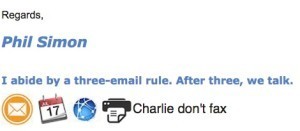
I abide by this rule and am not shy about invoking it. It has saved me a great deal of time and frustration. To be fair, though, not everyone likes it. I invoked it a few months ago and a perennially “busy” friend of mine promptly responded with, “I hate you.”
I’d love to see the rule adopted in every organization in the world. Sure, I can imagine legitimate exceptions, but it’s time to change the default means of communication from e-mail to something else—or somethings else.
Yes, there is life beyond e-mail.
* Either in person, on the phone, or via Skype.
The post New Rule: After Three E-Mails, We Talk appeared first on Phil Simon.


March 3, 2015
Message Not Received Media Roundup, Part 1
 Several Forbes’ pieces highlight the first round of media hits for the new book. Here’s the current list of stories, interviews, and reviews:
Forbes
Dorie Clark story on e-mail
Nick Morgan interview on jargon (original post on Public Words as well)
Scott Berkun interview
Todoist interview
Smartsheet guest post
BizInfoGuide interview
BannerView interview
HawkTalk Podcast
John Sonmez review
Klick Health article
Keeping Up with Krista: A Review
Management Issues interview
I’ve done several interviews and podcasts that will hit in the next few weeks.
Contact me if you’d like to discuss doing an interview about the book.
The post Message Not Received Media Roundup, Part 1 appeared first on Phil Simon.
March 1, 2015
Publication of Message Not Received
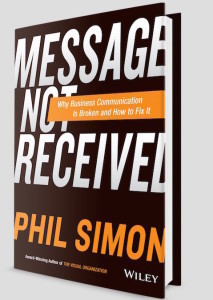 Message Not Received: Why Business Communication Is Broken and How to Fix It is now shipping.I received my first copy on Friday. (Golf clap.) Now the hard work begins: marketing. I never know how one of my books will do. Very few authors do.
At least I’m bringing a bit more perspective these days. This isn’t my first rodeo. I know enough about books and publishing not to make predictions. As the physicist Niels Bohr once said, “Prediction is very difficult, especially if it’s about the future.” It’s one of my favorite quotes. With any book you’re throwing the dice; with this one, I feel that they are loaded.
For a bunch of reasons, my previous three books have done better than my first three. The Age of the Platform remains my most popular book, and I’m glad that I followed my instinct on that one. Like music and movies, book sales adhere to a long tail. It’s pretty presumptuous of me to think that I’ll move 15,000 copies or more. Very few business books do. In short, the odds aren’t exactly in my favor.
Still, based on the feedback I’ve received and conversations I’ve had about the book, I’m guardedly optimistic. (Evidently, the secret to happiness is low expectations.) I’m getting the sense that the subject matter immediately resonates with people. We all know people who communicate poorly at work. They use far too much jargon and seem hellbent on setting records for e-mails sent in a day.
If you’re frustrated with the state of communication at your company and ever wondered if there’s a better way to communicate while on the clock, Message Not Received is worth picking up.
My Interview with Steven Wilson
 Steven Wilson is at it again. The critically acclaimed and über-prolific musician and producer has released his fourth proper solo album. His body of work is beyond impressive, especially when you factor in the albums he has remixed.
His latest effort is a full-fledged concept album. Hand. Cannot. Erase. is nothing short of an epic tale of modern-day isolation. Wilson wrote the songs from a female perspective, finding inspiration for the concept and story in the fascinating case of Joyce Carol Vincent—an attractive woman in the UK who died in her apartment in 2003. While that may not be entirely uncommon, no one missed her for three years—not her family, nor her friends. (For more on the Vincent story, see the chilling documentary Dreams of a Life.)
Here’s a snippet of the album:
Wilson’s PR team sent me an advanced copy of the album in late January. It’s beautiful and haunting. As with many great prog records, there’s no shortage of musical layers, instruments, and themes.
PS: Today I am very pleased to be joined by one of my favorite musicians, the very talented, the very prolific Mr. Steven Wilson. We are going to talk primarily about his new album Hand. Cannot. Erase. It is in my view not just a great listen but also very important social commentary. Steven, how are you doing today?
I’m very good. Thank you for that very flattering introduction.
PS: Can you talk about Joyce Carol Vincent? When and how did you come to hear of her?
SW: Joyce Carol Vincent was a story about ten years ago in the UK in 2006. She was found dead in her North London flat. Her body had been there for three years undiscovered. That’s not the sort of thing you forget in a hurry. That story was kind of very shocking, but it was only when I saw the documentary about her called “Dreams of a Life” about three years ago. I began to understand a lot more about Joyce Carol Vincent, and that she was not as I had assumed. I think most people would assume she was not a lonely little old lady. She was quite the opposite. She was a young, attractive, and popular woman who potentially had many friends and family. It kind of made the story even more strange, even more shocking, but in a way I could also understand how something like this could happen. I myself lived in London for 20 years and I never knew my next-door neighbors. I never knew what they did. I never knew their names. They didn’t know what I did for a living and they didn’t know my name. I think there’s something very peculiar about living in the city and not part of the major metropolis that actually makes it remarkably easy to disappear. And particularly, if in the case of Joyce Carol Vincent, by choice, if you deliberately kind of erase yourself in a way, it’s remarkable to do that. It’s easier to that outside of the city where everyone knows everyone else’s business. The story of Joyce Carol Vincent for me became they symbol of what it means to be living in the city in the 21st century in the age of the internet and all this other stuff that supposedly brings us closer together as human beings. But actually the way I see it is it actually makes us disconnect more and more from each other.
 PS: When you read about Joyce Carol Vincent and you saw that very moving documentary, did you immediately think that her story would serve as the basis for your next album?
SW: There wasn’t like a eureka moment, if that’s what you mean. No, I think it was more a question of once you’ve seen that documentary, once you know the story, it’s the kind of thing you do carry around with you and it’s not easy to forget. It’s not easy to brush away to a part in your mind; it stays with you, kind of haunts you. I didn’t necessarily say to myself, “OK, great, that’s the idea for the next record, that’s the story I’m going to write.” But I did carry it around with me. When I came to start writing new music about 18 months ago, I didn’t want to be pretentious and say the subject kind of chose me, but there was a sense that this was still kind of rattling around in my mind and I found myself beginning to write about, not about Joyce Carol Vincent, but about a fictional character which was very much based on her story.
PS: Okay, can you talk a little bit about the meaning of the title, Hand. Cannot. Erase.?
SW: You know what? I’m not going to say so much about that but I’m going to explain to you why I don’t want to tell you too much about the title. For me giving a title to an album is kind of a necessary evil in a way. You have to give your album a title. But one of the problems with doing that is in a way once you title your album, you are kind of telling them what the story’s about, what the album is about. You are telling them this is what the album is about. I could have very easily called this album the “Loneliness of Living in the City” or something even much more directly specific about this content of the record. And, of course, that would have been a fair enough title because it is about that, but the point is it’s all about many other things, too. In this album there are songs about loneliness, nostalgic of childhood, the internet, 21st century, isolation, alienation, lots of other things as well, lies and anger, and all these things. They are all in this album, so rather than give it a very specific title, I chose something I thought would be ambiguous. It’s still a pleasing title but still leaves things fairly open-ended and leaves it for people to make up their own mind about what the album is and what the album is about. It doesn’t have a meaning for me but I didn’t want to be too specific about it.
PS: Okay, that’s fair enough. You mentioned some of the tracks, so let’s talk about them. “Home Invasion” is a really powerful track in my opinion. Can you talk a little bit about that one and how it came together?
SW: “Home Invasion” is kind of a little bit of a musical journey within itself. I think of the album overall as kind of a musical journey but that one almost has a musical journey within it. It goes through many different changes. There’s a jazz section, and there’s funky section, and then there’s like a spacey section.
Those kind of songs are the hardest ones to put together for me because it’s almost like you’re juggling lots of different ideas, lots of different sections, and you’re trying to find the one way that makes the most logical sense from a listening point of view. I am very happy with the way it came out because it ultimately did come together in a very eying logical way for me. The song itself is about the Internet. It’s about this idea of social networking, and it’s about this idea that you can in a way redefine yourself and redefine your personality online to project an image of yourself closest to the one you would like, if you see what I mean. There’s a line in there, “download the life you wish you had.” I think there is something about the Internet which gives people almost an opportunity to role play and to create a façade, an imag. I see that as quite a dangerous development because I think what we call social networking, Twitter, Facebook, etc., is actually quite antisocial. It’s a way for people to have the illusion of communicating with each other, connecting with each other. In fact, in truth is social networking makes it easier to disconnect, to kind of hide behind social networking, Facebook, cell phones, Twitter, and all this stuff. It’s a song really about that and my concerns about that side of technology in the 21st century. It connects to my central character.
PS: The female vocals on the album are quite emotive. I was wondering if you could talk about who provided them and how you came to know that person or persons?
SW: Obviously, once I had this idea for the subject matter on the record and I knew the character would be a female character, straightaway that was a challenge for me. I had to write the lyrics and write the story and write the blog and all the stuff that goes with the album from the perspective of a female character. It is something I’ve never done before.
SW: That was my first challenge, and out of that challenge in a way came this thought: your character is female and you should have a female presence on the record—not just write through this female character but actually have a female voice literally a female voice on the record.
SW: I have two female voices on the record. First, I have the voice of the British actress who relates the story on “Perfect Life”, and then I have this wonderful Israeli singer, Ninet Tayeb. She was recommended to me by my Blackfield colleague Aviv Geffen. We’ve had a partnership and made a few records together. That was one of three singers actually that auditioned for that particular song which is the key song that the female voice sings. Hers was the voice that literally blew me away. I think I was looking for something specific and I guess I was looking for my Kate Bush or my Björk, I didn’t want such a generic female voice. I wanted someone who had more of a quirky, powerful quality to her voice, almost have control, and Ninet definitely had that so when I heard her voice I knew she was the one.
PS: You previously alluded to the blog and the website for the album. As you’ve done with previous records, on this one you included some really beautiful artwork, and extended the story in a way that a simple lyric sheet could not do the same on the website. Can you talk a little bit more about the presentation of this physical record before we talk a little bit the forthcoming tour?
SW: This is a story that mostly takes place in isolation. There is no dialogue between the character and other human beings, so much of the dialogue is kind of internal. It’s like an almost internal monologue which is happening with herself. Now how to present that—well, the answer I came up with was obviously this woman would perhaps be writing some kind of diary or the modern equivalent of course would be some kind of online blog. She may not be writing for anyone in particular. She may be writing just as a pure kind of indulgence, but having established that is the way she communicates her ideas and her thoughts and her day. That became a wonderful kind of device for, as you say, for revealing more about the character, more about the concept behind the record. We have this diary and blog which is taking place over a few years of this young woman’s life. As she gradually becomes more and more isolated, her thoughts become more and more surreal. You’re not quite sure at the end whether some of it is actually reality or if it’s fantasy. I like that kind of ambiguity. That gave an opportunity, of course, to illustrate the blog and the diary. In this whole kind of package, there are a lot of different sources. There’s photography, illustration, a child’s diary—written by a 13-year-old girl who obviously has a very different look again to the grown up blog. It has become a real gift actually for a proposition of interpretation and I’m really happy with the way it’s turned out.
PS: It looks great and that’s certainly part of the experience that you can’t get from either downloading it digitally or stealing the music outright. There’s a presentation I noticed with all of your records (including Porcupine Tree) that makes you want to own them.
SW: That’s kind of the idea. I grew up with vinyl records and remember the pleasure and the kind of buzz that I got from buying a beautiful vinyl record with the sleeve and the lyrics —all that kind of tactile experience that you could get from an old vinyl record.
I do think it’s a way to still carry that tradition forward in the packaging, not just with vinyl but also with specific editions in the way you present the digital versions, too. It’s a shame that more people don’t sort of don’t give more attention to the way they present their art. But for me it’s always been kind of synonymous with the music, the creativity doesn’t just end with you writing the songs, it carries through to the artwork, the website, and the live show, of course.
PS: I’ll get you out of here on this: Who will be joining you to play and support the album on tour this year?
SW: Well I’ve actually got a change that’s going to take place between the European and the American legs because I lose a couple of my musicians, they have their own bands, so I lose my guitar player and drummer before we come to America. The tour in America will include myself, obviously, as well as Nick Beggs on bass, stick and backing vocals, and Adam Holzman on keyboards. Both of those guys have been in my band since the beginning. And then two new guys, a guitar player Dave Kilminster who has been playing with Roger Waters for the last eight years. A lot of people would have seen him basically being Dave Gilmour, but he’s a versatile player. And there’s a new drummer called Craig Blundell, a British guy and a fantastic drummer. It’s going to be basically a five-piece band, but we’re going to have a lot of visual stuff going on, too—a quadraphonic sound system as we’ve had on previous tours. We will be running films and visuals and projections. Like I said, this concept is really a gift for vision interpretation. It’s going to be a real multimedia really immersive experience I hope.
PS: That’s great. Well I am looking forward to seeing you, hopefully in Los Angeles. Steven. I want to thank you for your time and wish you nothing but the best with the forthcoming album and subsequent tour.
SW: My pleasure, Phil. Nice to speak to you.
You can buy the album now or on Amazon here. You can also catch him on tour in 2015.
Originally published on Huffington Post. Click here to read it there.
The post My Interview with Steven Wilson appeared first on Phil Simon.
February 28, 2015
New Message Not Received GoodReads Book Group
 For a long time now, people have been engaging in discussions on different networks, websites, social-media channels, and “platforms.” Some have christened this the arrival of Web 2.0, although I don’t love the term. Regardless of your preferred nomenclature (NSFW), silly is the soul who believes that conversations are only taking place on their “approved” channels.
In The Age of the Platform, I underscore the importance of using other platforms as planks in your own. (This is why Google maintains a Twitter page, Amazon sports an official YouTube channel, and the like.) There rationale is quite straightforward: Conversations are taking place everywhere, so why try and control them? Good luck with that. Rather than resist, it’s wise to encourage these conversations. This means paying attention—and responding—to what with others are saying on site such as Facebook, LinkedIn, Google+, Pinterest, and Twitter:
@dolce4 this would be the right book to read for the topic we spoke about at the last user group http://t.co/cluLosEg8N
— Philipp Göllner (@philippgoellner) February 28, 2015
If this seems like a great deal of work, you’re right. Still, it’s one of the things that authors need to do to get their messages received (pun intended). It’s fine if you’re not willing to put the time in. Just don’t be surprised if your book doesn’t do very well.
Writing is easy. Marketing is hard.
I’ve said many times that writing a full-length book is far easier than marketing it. For a very long time now, very few writers have been able sit back and let the royalty checks fly in. Steven King or James Patterson are very much the exceptions that prove the rule. No longer can writers count on established channels. It’s a hustle, pure and simple, but it’s an enjoyable one, at least for me.
Go Where the Action Is
This begs the question: Beyond the aforementioned sites, where are people having conversations about books? Amazon is certainly a popular destination. Book reviews sometimes spark interesting debates and more than their fair share of trolls. And then there’s GoodReads, now part of the Amazon family. Authors can create book groups and invite others to discuss their texts, announce events, subscribe to updates, connect with fellow readers, ask for advice, conduct polls, post photos and videos, and more. These are some of the goals with the GoodReads Book Group for Message Not Received.
Based upon the discussions I’ve had with others, it’s evident to me that my new book broaches some important issues around business communication and why it generally sucks. That’s not to say that I have all of the answers. I don’t. Even if I did, though, there’s great value in connecting with others deluged by e-mail, confused by jargon, and frustrated by the state of communications in their organizations.
The post New Message Not Received GoodReads Book Group appeared first on Phil Simon.
February 26, 2015
Mandatory Viewing: Last Night’s Modern Family
 For my money, the greatest comedy of all time is Seinfeld. After all, it’s a show about nothing. In my books and blog posts, I frequently will drop allusions to the show.
In the post-Seinfeld era, several shows stand out. The English version of The Office and the first three seasons of Arrested Development are nothing short of brilliant. Yes, I’m a fan of dry humor and tend to believe that laugh tracks usually don’t work. They make shows feel dated and tend to detract from their overall vibe.
Modern Family is another recent gem, and last night’s show (“Connection Lost”) breaks new ground. Sure, it’s a bit of an Apple commercial. Our constant movement between mediums is disorienting, and that’s precisely the point: the way that we communicating with each other is both more frenetic and variegated than ever—at least at home. At work, though, e-mail still rules the day.
For more on the making of the episode, click here.
Simon Says
I don’t want to give away the ending of “Connection Lost”, but suffice it to say that e-mail, FaceTime, Facebook, and their ilk don’t exactly lend themselves to true understanding and communication. As much as I love technology, it’s critical to keep that in mind.
Feedback
What say you?
The post Mandatory Viewing: Last Night’s Modern Family appeared first on Phil Simon.
HipChat to Sponsor Second Leg of the Message Not Received Book Tour
 In Message Not Received, I rail against the overuse and misuse of e-mail.
That’s not to say that I’m opposed to e-mail. (Who doesn’t like unsolicited sales inquiries?) I’m just anti-inefficiency. E-mail is a particularly ill-suited tool for collaboration and project management, and that goes double in the developer world. Although that was true fifteen years ago, the same range of powerful, easy-to-use tools didn’t exist.
It’s high time to educate others on the silliness of “collaboration” via e-mail.
For a long time now, we have not been able to accurately make that claim.
Researching the new book, I came across Atlassian, an Australian enterprise software company that develops products geared towards software developers and project managers. Atlassian believes that a great deal of education is needed around workplace collaboration. Needless to say, I violently agree. After all, an Office-Space like approach to work seems so 1999.
The company has agreed to let users try one of its products, HipChat, for two months for free.
Click here to give it a shot or, if you just want a red stapler à la Milton in the movie, click here.
#workinthenow
The post HipChat to Sponsor Second Leg of the Message Not Received Book Tour appeared first on Phil Simon.
February 25, 2015
People Need Banking, Not Banks
 While it may not have been as iconic culturally significant as its 1984 Super Bowl ad, Apple’s “Think different” marketing campaign from 1997 to 2002 remains the stuff of advertising legend. (How many ads do you remember from last month’s game between the Patriots and Seahawks?)
Not surprisingly, the campaign coincided with Steve Jobs’s return as CEO, the most astonishing and oft-cited comeback story in US corporate history. More than a few ads, though “Think different” embodied a new mind-set at Apple. Looking back, it has served the company exceptionally well over the last two decades, punctuated by last quarter’s record earnings.
Apple is firing on all cylinders these days. Silicon Valley rock star Chamath Palihapitiya has called many of its recent moves brilliant, such as the introduction of ApplePay. Forget a trillion-dollar market capitalization; that seems like an inevitability at this point. (Carl Icahn says that Apple should already be there.) Some have even posited that Apple may become a $2 trillion company.
Oh, and there’s the little car rumor.
Apple and the On-Demand Economy
By itself, of course, thinking different guarantees zilch. Coca Cola may have been following that mantra by releasing New Coke. Apple is doing exceptionally well these days for all sorts of reasons. Along with Amazon, Facebook, and Google, it has embraced platform thinking. Its design is second to none. (For a fascinating look at its design guru Sir Jonathan Ive, check out this New Yorker piece.)
Perhaps most significant, though, is the rise smartphones and attendant apps, technological trends that are enabling the on-demand economy. From a recent Economist piece “There’s an app for that“:
The new opportunities that technology offers for matching jobs to workers were being exploited well before Uber. Topcoder was founded in 2001 to give programmers a venue to show off. In 2013, it was bought by Appirio, a cloud-services company, and now specialises in providing the services of freelance coders. Elance-oDesk offers 4m companies the services of 10m freelances. The model is also gaining ground in the professions. Eden McCallum, which was founded in London in 2000, can tap into a network of 500 freelance consultants in order to offer consulting services at a fraction of the cost of big consultancies like McKinsey. This allows it to provide consulting to small companies as well as to concerns like GSK, a pharma giant. Axiom employs 650 lawyers, services half the Fortune 100 companies, and enjoyed revenues of more than $100m in 2012. Medicast is applying a similar model to doctors in Miami, Los Angeles and San Diego. Patients order a doctor by touching an app (which also registers where they are). A doctor briefed on the symptoms is guaranteed to arrive within two hours; the basic cost is $200 a visit. Not least because it provides malpractice insurance, the company is particularly attractive to moonlighters who want to top up their income, younger doctors without the capital to start their own practices and older doctors who want to set their own timetables.
In other words, we need legal services, but maybe not traditional, brick-and-mortar law firms. Ditto for management consultants and doctors, but perhaps not large consulting firms and doctors’ offices—or, at least, as many of them. But let’s not stop there. As Heather Cox, Citi’s Chief Client Experience, Digital, and Marketing Officer told the audience at IBM InterConnect 2015, “People need banking, but they don’t necessarily need banks.”

Heather Cox
Think that this is crazy? Maybe, maybe not. Tony Hsieh of Zappos proved that one need not own a chain of physical stores to succeed at selling shoes. (Amazon acquired Zappos for $1.2 billion.)
Simon Says
Brass tacks: the worlds of business and technology are changing faster than ever. Old economic assumptions and bromides are starting to crack. Foolish is the organization that believes that things will remain constant. That has never been less true than today.
The most progressive organizations are embracing risks and “thinking different.” Apple has been successful because it has kept its foot on the gas, forging untraditional partnerships where and when they made sense. Case in point: Last July, Apple and one-time rival IBM announced that a partnership to jointly develop a slew of apps for the enterprise. Indeed, the first wave of business-oriented apps has already arrived.
It’s never been more critical for all business leaders to think different.
Click here to read this post on Wired.
The post People Need Banking, Not Banks appeared first on Phil Simon.
Why I Quit the Web Design Business
 By the end of 2008, I had reached a professional crossroads. After nearly a decade as an enterprise system consultant, I was on the verge of leaving the field. Blame a quickly eroding economy and my unwillingness to spend four days per week in hotel rooms for nine months at a time. Beyond that, I wanted to give writing a shot. It was time for me to shake things up and embrace uncertainty. I’ve said many times that we have to get comfortable with being uncomfortable.
In any economy, the shift from one career to another is rarely smooth. Ditto for me. I didn’t become a full-time writer and speaker overnight. From 2009 to 2010, I carefully took a limited number of consulting gigs. Sure, I was playing the long game, but I didn’t despise travel and internal politics enough to quit cold turkey and live off of pasta and tuna.
I started blogging and embracing social media in the years that followed. As such, I became pretty adept at WordPress. In fact, I was able develop sites of reasonable complexity while farming out really involved PHP, CSS, and JavaScript coding to my primary web developer. Why not make some money in the process? In my own parlance, I decided to add that plank to my platform.
From 2011 to 2012, I signed up a grand total of six clients, all of whom agreed that WordPress was the way to go. (I wouldn’t have worked with them otherwise.) All six owned small businesses. No shocker here: they were extremely budget-conscious.
By the end of 2012, though, I decided that the juice wasn’t worth the squeeze. To the extent possible, I finished up my existing projects and stopped pursuing new ones. In a few cases, I agreed to part ways with my clients before their sites went live. Two were just as unreasonable, demanding, and recalcitrant as clients that inspired my first book, Why New Systems Fail. (In speaking to other more experienced web developers, at least I could take comfort in the fact that I had plenty of company here.)
So why did I get out?
Difficulty Managing Expectations
For many small business owners, the very thought of paying for a website is anathema. After all, aren’t free sites available web.com, BannerView, and other services? Sure, but like most things in life, you get what you pay for.
High-volume factories and chop shops can quickly produce generic, low-cost websites, but quality suffers. When done right, the development process takes serious time. No one can gather requirements, develop wireframes, train clients, and make tweaks for $500. Charging $3,000 (more or less) often left my clients with unrealistic expectations. That was more than they ever spent on a website and, in their eyes, that meant that they were entitled to get whatever they wanted whenever they wanted, no questions asked.
Scheduling Complexities/Respect for My Time

I know all too well the challenges associated with running a small business. I run two of them. You wake up thinking that you will create a marketing plan. By 10 a.m., you’re knee-deep into a thorny IT issue. The fleas come with the dog, and the ability to stick to plans can be tricky. As Dwight D. Eisenhower once famously said, “Plans are nothing; planning is everything.”
Still, it’s entirely unreasonable to expect your developer—in this case, me—to routinely drop whatever he’s doing because you now have ten minutes to spare. Working in a disjointed fashion only prolongs projects, increases costs, and engenders enmity.
Unwillingness of Clients Pay for Ongoing Support
Make no mistake: a static website is very different than a content management system. The latter requires regular maintenance, updates, never mind, you know, content; it’s not a set-it-or-forget-it proposition.
Despite my initial conversations with clients (and related contract language), I just couldn’t seem to effectively get that point across. In a few cases, my work was never “finished” and never would be. Unless I was being paid for ongoing support, I wasn’t going to fix issues and make enhancements indefinitely. That’s just not how I roll.
Unwillingness of Clients to Fish for Themselves
How do I embed a YouTube video in WordPress? It’s a fair question, but hardly an uncommon one. WordPress runs more than 74 million sites on the Web. As such, it’s extremely unlikely that many others have not asked your question before. Lamentably, most of my clients didn’t grasp this. They were unwilling to do a simple Google search and watch a three-minute video on the subject.
Inability of Clients to Make Decisions and Stick with Them
Making major website changes is not as simple as editng a Microsoft Word document.
In one case, a proposed three-month project had extended to nearly a year. Months would go by without any contact from my client. My calls and e-mails went unreturned. Despite these challenges, I had finally taken her company to the five-yard line. As we were ready to launch, she told me that she no longer liked our agreed-upon design and wanted to effectively start from scratch. When I demurred, things got nasty and she promptly slammed me in several e-mails, as well as a completely inappropriate Amazon review for which she justifiably took a great deal of slack.
Game over.
Inability of Clients to Articulate What They Wanted
Ask an architect to build you a house and he or she will answer with more questions:
What kind of house?
How many floors?
How many bathrooms?
The same holds true with website design. Specificity is crucial; even tweaks to font sizes can significantly affect spacing.
With the right budget, you can pretty much build anything and make changes as frequently as you like. No client, of course, can throw unlimited funds at any project, much less a smallbiz website.
Clients Often Didn’t Know What They Didn’t Know
Tensions arise when website neophytes innocuously ask for changes that, while simple to them, actually cause a great deal of rework. Yes, WordPress is very intuitive and powerful, but many of my clients believed that making structural changes was tantamount to editing a Microsoft Word document. This caused a great deal of friction in several cases.
Only one of my clients, a landscaper, consistently trusted my advice and understood that I was building a site that he would ultimately maintain. Perhaps not coincidentally, he lived near me and we would work on his site in person. Maybe there’s something to in-person communication after all?
Simon Says: The Output-Input Ratio Just Didn’t Make Sense
Although I only developed sites for others for two years, learned a great deal about client relations and the ugly site of the business. Ultimately, I decided to get out while I still had my sanity.
For more doozies and downright horror stories, check out Clients from Hell.
Feedback
What say you?
The post Why I Quit the Web Design Business appeared first on Phil Simon.
February 21, 2015
A Favor: Help Me Launch Message Not Received
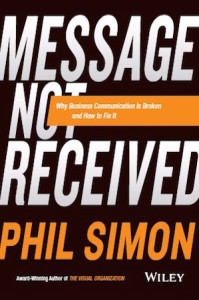 This kind of post is rare for me but, then again, I don’t write a proper book that often.
My seventh book, Message Not Received, ships on March 2nd. (Yes, the earlier date was news to me too.) I believe that it’s my best work since The Age of the Platform, and I’d love your help in making the launch as successful as possible.
Over the past six years, I’ve learned a thing or six about the book business. To maximize the chance that a book succeeds early, it’s essential for authors to encourage pre-orders. It signals to booksellers that there’s a great deal of momentum for a particular title. In turn, booksellers order more copies, and the virtuous circle begins.
I’d be so appreciative if you’d consider pre-ordering a copy (or copies!) of Message Not Received today. You can do it from Amazon, Barnes & Noble, or IndieBound (independent booksellers). It may seem early to pre-order, but these are critical. Early sales disproportionately impact future sales. To make a long story short, not all book sales are created equal.
Not all book sales are created equal.
If you’re a die-hard e-book reader, I’d be thankful if you ordered an electronic copy. If you are indifferent between the two formats, I’d be especially grateful if you could purchase a hardcover copy. For some odd reason, hardcover purchases are weighted far more heavily in rankings. (No, I don’t understand it either.)
Thanks for your consideration.
The post A Favor: Help Me Launch Message Not Received appeared first on Phil Simon.