Phil Simon's Blog, page 62
July 6, 2015
Donald Trump and the Beauty of Big Data

I’ve written before that increased transparency and data journalism will help us better understand world events. It turns out that the vast quantities of readily available information also make it easier to call out bogus claims.
Exhibit A: The recent Donald Trump fiasco. The Washington Post recently eviscerated the buffoon presidential candidate’s racist and apocryphal claims about immigrants and crime.
Was it a high-level condemnation? Hardly. The point-by-point takedown is worth a read. It conclusively proves that “The Donald” is flat-out wrong. In a way, it reminded me of the hysterical and classic scene in The Big Lebowski in which Walter and The Dude track down Little Larry Sellers (clickable link is really NSFW).

Simon Says: Data 1, Trump 0
Be careful when you open your mouth these days. Any time that you make spurious claims, you would do well to remember the immortal words of W. Edwards Deming: “In God we trust; all others must bring data.”
Feedback
What say you?
The post Donald Trump and the Beauty of Big Data appeared first on Phil Simon.


July 1, 2015
When Partners Break Bad: Lessons from the ADP-Zenefits Fiasco

I’ve said it many times: the long term has never been shorter.
You can right a book about that statement and maybe one day I will. For now, suffice it to say that fortunes, plans, and partnerships can change in the blink of an eye.
 The recent dustup between unicorn Zenefits and ADP is a fascinating case in point. No doubt that you’ve heard of the latter, a stalwart of American business for more than 60 years. But what about the former?
Not too long after receiving funding valuing the HR software company at an eye-popping $4.5B, Zenefits found itself in a very public kerfuffle with ADP, one of its key partners. It’s no understatement to say that the two are at war. The issues: products, alleged security and privacy violations, and the increasingly critical issue of data ownership.
As expected, lawyers are now involved and the PR battle has begun. Each company has issued public statements on the matter, and plenty of influential folks on social media have chimed in largely against ADP. (This shouldn’t be surprising. Sixty-year-old companies tend not to excel at Twitter and Facebook.) For instance:
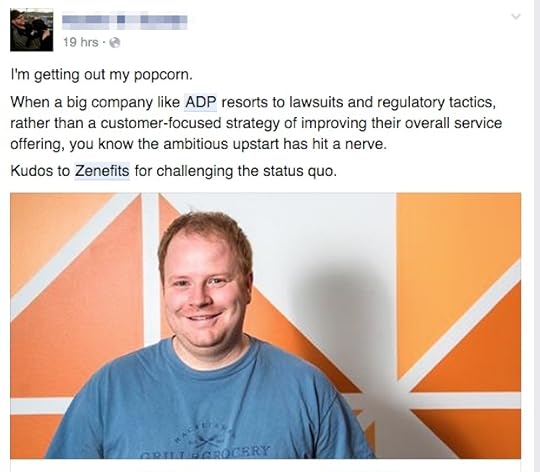
Hey @ADP it’s my account. I can invite who I want to help me manage it. @zenefits
— Mike Bergelson (@mbergelson) June 5, 2015
ADP wouldn’t sue Zenefits if they weren’t afraid of them. So you know which to choose. http://t.co/XcMN6T8qa9 — Paul Graham (@paulg) June 10, 2015
Zenefits cofounder: The CEO of ADP threatened me like ‘Dirty Harry’ http://t.co/4smDpbiqS1 pic.twitter.com/eMGcjEOBZ0
— Business Insider (@businessinsider) June 10, 2015
Who’s ultimately right here?
Lessons
If pressed, I’d go with Zenefits, not that my opinion holds any water with either party or the courts. In this post, I’m not looking to assess blame or excoriate ADP for its questionable tactics. Rather, I want to look at lessons that other companies can learn from sudden and public partner breakups.
It’s never been easier to copy products.
ADP isn’t oblivious to Zenefits’ success. The former saw that that latter was making inroads. Why forgo that revenue? Why not launch a competing service? Lesson: Change happens faster than ever.
Increasingly, data access and ownership are at the center of these fights.
As the first tweet above references, key questions today involve data, as in:
Who owns this stuff?
Is it my data or the provider’s data?
Who should be able to access it and how?
Lesson: Make sure that you ask these questions sooner rather than later.
These scrums will wind up on social media.
The question is not whether this will happen; the question is when. Try containing anything these days. Lesson: Good luck with that.
The question is not whether these scrums will wind up on social media. The question is when.
Regardless of who is right, customers will ultimately suffer.
Think about all of the small businesses that have to scramble now to run payroll and send data to insurance carriers. As I wrote in The New Small, smallbiz owners are certainly resourceful and can deal with last-minute fiascos. Still, they would prefer to work on their businesses, not in them. Remember that trusted friends can quickly become enemies. Lesson: Be prepared for exactly these types of contingencies.
(For more on this, see When Vendors Attack [Each Other].)
Simon Says: Prepare for the worst.
Hopefully your organization will never come to blows with one of its key partners, providers, and developers. Foolish is the soul, though, who believes that it simply can’t happen.
Feedback
What say you?
 This post was brought to you by IBM for MSPs. The opinions in this post are my own. To read more on this topic, visit IBM’s PivotPoint. Dedicated to providing valuable insight from industry thought leaders, PivotPoint offers expertise to help you develop, differentiate, and scale your business.
The post When Partners Break Bad: Lessons from the ADP-Zenefits Fiasco appeared first on Phil Simon.
June 29, 2015
Celebrating Post Number 1,000

When was this site born?
Let’s say 1/1/2009, but with a disclaimer. I had launched and maintained previous versions of this site dating back to 2002, but I really didn’t blog back then. Most of my writing consisted of quasi-technical user manuals for my consulting clients and internal e-mails. (Oh, the e-mails.) I did write a few articles for newsletters, but they always lived on other sites.
When I decided to try my hand at writing on a full-time basis, though, I knew that I’d have to generate a great deal of content—on this site as well as others. (Authors have to build their platforms.) To that end, over the last six and a half years, I’ve written on my site very often. In fact, as I crunched the numbers, I realized that I have posted something twice every five days. (I’ve averaged 12.61 posts per month.) I still contend, though, that you shouldn’t blog every day.
Writing about writing is very meta, but I’ll try to keep myself in check here.
Subjects
Here’s a breakdown of my posts by category:

Note that many of my posts fall into more than one category; WordPress makes that easy to do.
Looking at three of my most popular categories over time, it’s interesting to see how they’ve evolved. In short, I tend to blog more about a topic when I’m in the midst of penning a proper book. Beyond that, many of my favorite subjects are relatively nascent. For instance, I didn’t blog much about Big Data back in 2010. Was I late to the game with Too Big to Ignore? Nope. Google Trends shows that almost nobody did.

If I included every category in the line chart above, it would quickly become unreadable. Yeah, I learned a little something over the years about data visualization.
When I Blog
Some months I blog more than others. Here’s the breakdown by month:

Again, this isn’t surprising. Many of my books have been published in late winter/early spring. Conversely, the Interwebs tend to shut down a bit around the holidays. As such, I don’t blog as much when I can expect less traffic. (You could argue, though, that that’s precisely the right time to get a post out.)
The Phillies
Macro-level trends are great, but what about recognizing some individual posts? Yeah, it’s award time, baby. (The Phillies?)

Posts with the Most Comments
What Should I Ask Neil Peart? (56)
What Should I Ask Steve Hogarth? (39)
Why Microsoft Access 2007 Sucks (23)
This isn’t totally surprising. The Rush and Marillion communities are incredibly passionate ones. I got plenty of love from rabid fans and even some fan websites when collecting questions to interview real-life rock stars:
Post with the Most Page Views
My most popular post (via page views) is my interview with Neil Peart, one that I also posted on HuffPo. It’s not even close. I had to pay extra for hosting that month, but WPEngine rocks.
Biggest Gap Between Posts
24 days, July of 2009.
 I was probably binge-watching Breaking Bad that month, a frequent subject on this site. I remember that I was in New York that month visiting friends. I also wasn’t convinced that blogging was worth my time. It wasn’t easy to attract attention back then, and it’s much harder today. My viewpoint changed when Slashdot reviewed Why New Systems Fail and the book broke the top-100 on Amazon. I haven’t looked back.
My Favorite Post
Here’s to the next 1,000 posts.
I’m not arrogant enough to think that all of my posts are gold, but I have tagged a bunch that I really like.
As I writer, I’ve improved quite a bit in the last six-plus years, but some posts are clearly better than others. If pressed, though, I really like my post on the Sponge Theory of Writing. It’s not terribly long, but I find myself thinking about it quite a bit and talking about the subject with other writers.
Simon Says
Thanks for reading. Here’s to the next 1,000 posts.
Feedback
What say you?
The post Celebrating Post Number 1,000 appeared first on Phil Simon.
June 23, 2015
Message Not Received Audiobook Version Giveaway
 My publisher has given me some complimentary redemption codes for the audiobook of Message Not Received. A few went to family and friends, but I still have some extras.
If you’d like to listen to the complete audiobook for free, reply in the comments with a story of business communication that has failed. Anonymize names if you like.
I’ll pick a few winners in about a month. I’d also appreciate an honest review of the book on Amazon.
The post Message Not Received Audiobook Version Giveaway appeared first on Phil Simon.
June 18, 2015
Worth Magazine Message Not Received Feature
Worth Magazine recently did a feature on Message Not Received. It highlights some of the more salient points on the book. Check it out below.
The post Worth Magazine Message Not Received Feature appeared first on Phil Simon.
Disruption Visualized
Few things tell a story like a picture, especially an interactive one. It’s a key point in The Visual Organization. Static graphs don’t encourage data discovery and exploration as much as those that respond to your input.
To this end, check out the neat dataviz below from The Economist:
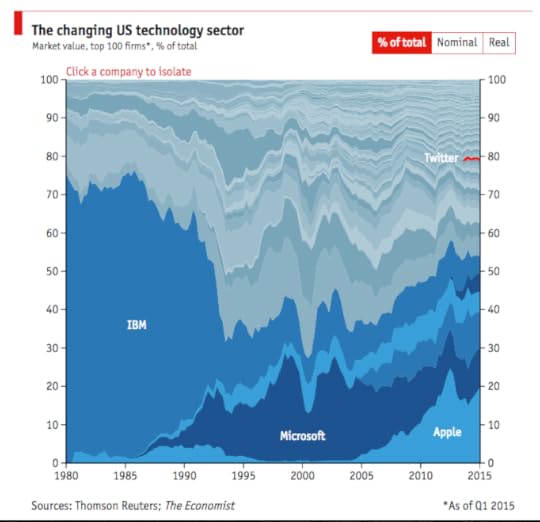
Click around and you can see how companies’ market caps changed over time. You can see absolute numbers, relative numbers, and percentages.
In short, it’s chock-full of interesting data and trends. You could easily talk for hours about all of the ideas that this dataviz sparks, and that’s exactly the point.
The post Disruption Visualized appeared first on Phil Simon.
June 9, 2015
Big Data: Necessitating New Partnerships in New Media
 How can our organization really make sense of out Big Data? And, while we’re at it, how do we make a few bucks in the process? After all, the company with the most data win. (Size is just one of many myths on the subject.)
You’re certainly not alone in asking questions such as these.
As I describe in Too Big to Ignore, the answer to each query isn’t a trite bromide. For starters, it’s imperative to recognize that finding a signal in the noise involves new technologies, not just 1990s-era reporting tools. Oh yea, and hardware requirements and storage needs have changed. New data types, mobile devices, and cloud computing have never been more important.
I could write for hours about arcane technical subjects such as these but I’m not going to. There’s so much more going on here beyond new specs. Put differently, in this post I’ll use my telescope, not my microscope. What types of strategic moves are necessary to capitalize on Big Data? Let’s discuss two biggies.
Old School Meets New School

These days, even new-school behemoths like Facebook, Google, and Twitter are discovering that they can’t do everything by themselves. To this end, the social network recently announced a partnership with IBM. From a Motley Fool piece:
The partnership will focus heavily on retailers, which can combine IBM’s data on purchase history and items viewed as well as location and weather data with Facebook’s user data, to target their ads. Facebook is hoping to show that its advertisements don’t just provide clicks, but actual sales.
Interestingly, the deal comes on the heels of similar Big Blue partnerships with Twitter and Apple. If companies such as Facebook need help, what makes you think that your organization can “do” Big Data without others? At a minimum, refusing to entertain the possibility of third-party support seems like a mistake.
Even behemoths like Facebook can’t do it all alone.
New Media Matters. Big Time.
So much of what I call Big Data exists outside of an organization’s walls. I’m talking about linked data, open data, and data from social-media sites. These can serve as extremely valuable content and sources of information. In case you had any doubt, content is king again, consider the following:
Exhibit A: Facebook’s deals with Buzzfeed and the New York Times.
Exhibit B: Buzzfeed’s recent valuation almost qualifies it as a unicorn.
Exhibit C: Verizon dropped $4.4 billion for AOL. No, not for its dial-up Internet business. Verizon understands that the need to programmatically serve up ads and video content in a timely manner, and that’s precisely what AOL provides.
Exhibit D: Google’s new deal with Twitter to search for real-time tweets.
Simon Says: Start Looking Outside
Provincial thinking is perhaps the single easiest way to fall prey to The Innovator’s Dilemma. Even historically insular companies like Microsoft are embracing new ideas and partners. There’s no formula for success today, but even successful companies are looking outside for guidance, technology, and data sources.
Feedback
What say you?
This post was brought to you by IBM for MSPs. The opinions in this post are my own. To read more on this topic, visit IBM’s PivotPoint. Dedicated to providing valuable insight from industry thought leaders, PivotPoint offers expertise to help you develop, differentiate, and scale your business.
The post Big Data: Necessitating New Partnerships in New Media appeared first on Phil Simon.
June 1, 2015
Partners Can’t Do It Alone: The Case for Removing Internal Obstacles
If I had to sum up last month’s IBM Amplify in a few sentences, it would be this: New data sources and technologies can help companies unearth fascinating insights into consumer behavior. That new knowledge can serve as the basis for better marketing, customer retention, and product development.
At least that’s the theory. In practice, however, some companies will do much better in these regards than others. That’s always the case. Business is not an even playing field—and never has been. Make no mistake: Execution is far easier said than done.
This begs the question: What inhibits successful outcomes?
The factors go way beyond a blog post of a reasonable length. For starters, though, many employees stubbornly resist new ideas, data sources, technologies, and processes. Unfortunately, I have seen this play out far too often.
A Little Yarn
For instance, back in 1998, I was working at Merck & Co. Generally speaking, employee data at Merck was a dog’s breakfast. Ascertaining headcount took a minimum of several weeks. Not exactly conducive to HR being a “strategic partner.”
A few obstructionists in key places can derail even the most promising new tools, projects, and products.
As part of a data cleansing project on which I was working, I remember very vividly a meeting I attended with a hidebound and dataphobic director. Let’s call her Roseanne. About midway through the meeting, Roseanne emphatically said, “I don’t need data to tell me why people are leaving.”
What do you say to that? If I were Merck’s CEO or even her boss, I would have fired her on the spot.
In a perverse way, objectionable comments like Roseanne’s actually benefit the organization: at least you know where these employees stand. Roseanne was horribly wrong, but she was honestly stating her opinion. To wit, she was not paying lip service to data quality while, behind the scenes, working to contravene our efforts. Far too many employees appear to embrace new ways of doing things in public. Privately, though, that’s another matter altogether.
Simon Says: Identify the Cancers and Remove Them.
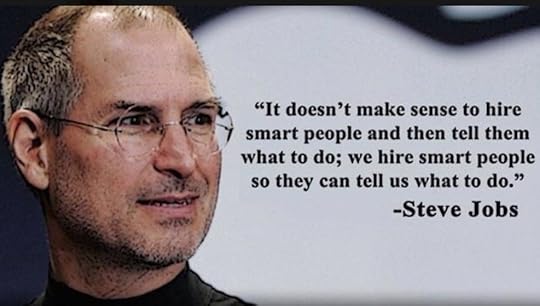
As usual, Steve Jobs was right. Organizations should not hire smart people (read: employees, partners, and independent contractors) and ignore their ideas and suggestions. It’s just plain bad business.
Of course, organizations aren’t monoliths. They don’t make decisions by themselves. They consist of people, some of whom get it and others don’t. Hopefully, there are many more of the former than the latter. Still, even a few bad apples can spoil the whole bunch.
In an era of rapidly increasing change, it’s nearly impossible to overstate the impact of cancerous employees. As such, it is imperative to separate the wheat from the chaff in your organization. A few obstructionists in key places can derail even the most promising new tools, projects, and products.
Feedback
What say you?
This post was brought to you by IBM for MSPs. The opinions in this post are my own. To read more on this topic, visit IBM’s PivotPoint. Dedicated to providing valuable insight from industry thought leaders, PivotPoint offers expertise to help you develop, differentiate, and scale your business.
The post Partners Can’t Do It Alone: The Case for Removing Internal Obstacles appeared first on Phil Simon.
May 19, 2015
Cross-Platform Data-Driven Mobile Blah Blah Blah

Look at the following 38-word monstrosity of a sentence:
Appticles is an online platform suited for content creators (bloggers, small and medium publishing houses, but also data-driven enterprises) that enables them to effortlessly reach their mobile audience by packaging their existing content into cross-platform mobile Web applications.
 Do you understand what this company does? Me neither.
So much confusion in a single sentence. Platform is in there twice. In a word, yuck.
How about this instead?
Wouldn’t it be cool to quickly reach your audience no matter it is? Appticles is just the thing for you.
Which description makes you want to know more?
Simon Says
Less is almost always more, especially when you’re trying to explain what your company does.
Feedback
What say you?
I’m not looking to irritate people with these posts. I simply want to call out confusing language. The offending parties should see better results if they simplify their messages.
The post Cross-Platform Data-Driven Mobile Blah Blah Blah appeared first on Phil Simon.
May 18, 2015
A Better Way to Vet Potential Partners, Part II
 In my last post, I listed a number of important questions to ask potential partners before signing a contract. To briefly recap here, it’s essential to move beyond looking at canned slide decks and polished methodologies. The process of asking detailed and often difficult questions increases the chances of a successful outcome.
Show Me, Don’t Tell Me
Sure, it’s one of my favorite Rush songs, but the concept is very apropos here.
Detailed queries can only get you so far. To properly assess a potential fit, it’s silly not to ask, Have you done this for a similar organization before? To state the obvious, you’re looking for more than a simple yes or no.
Yes, I’m talking about case studies. To me, the absence of one is a big bête noire.
Consider Hadoop for a moment. Sure, it’s relatively nascent, but it’s 2015, not 2012. Rare is the client that wants to be a guinea pig. If your organization is thinking about actually doing something with Big Data, it’s fair to ask prospective partners to produce something other than glossy marketing materials.
Properly vetting a partner involves more than reading a case study.
Considerations and Disclaimers
Against this backdrop, here’s my advice on how to read case studies:
I’m totally biased. All of my books contained detailed case studies. Others can learn a great deal about what to do—and what not to do—by examining in depth how organizations have tackled related issues.
Not every client wants to be named. Many partners sign partners non-disclosure agreements (NDAs) with their clients. As such, it’s possible if not likely that senior management at Partner X would love to tell you its amazing success stories but legally cannot.
Still, you can get a little bit pregnant. Not all NDAs are equally restrictive. All else being equal, a government agency is going to insist upon stricter terms than a a mid-market hospital. A case study need not detail precisely which technologies a client used and how. Yes, we live in a transparent era, but it’s reasonable to expect organizations to maintain some semblance of privacy—or at least try.
Case studies have to pass several levels of internal approval. Case studies aren’t just written willy-nilly. Senior execs at both the client and partner scrutinize every word. Don’t expect an honest and “objective” account of every challenge, political battle, and internal argument.
Be wary of availability bias. You’re not going to find detailed stories on how an engagement blew up. Expect a certain level of marketing gloss. That’s not to say that all case studies need to be either saccharine or anodyne. Be wary of those that seem overly rosy. Does something seem to good to be true? It probably is.
In this way, vetting a consulting partner is much like vetting a PR firm.
Simon Says: Case Studies Are Necessary, Not Sufficient
Properly vetting a partner involves more than reading a case study. Change is tough and technology is inherently political. Sometimes new technologies fail to take root because of toxic organizational cultures, stubborn and change-resistant execs, and other issues that have nothing to do with the partner.
Feedback
What say you?
This post was brought to you by IBM for MSPs. The opinions in this post are my own. To read more on this topic, visit IBM’s PivotPoint. Dedicated to providing valuable insight from industry thought leaders, PivotPoint offers expertise to help you develop, differentiate, and scale your business.

The post A Better Way to Vet Potential Partners, Part II appeared first on Phil Simon.