Phil Simon's Blog, page 58
November 16, 2015
Why I Despise the Term Influencer

It’s a natural human tendency to want more. It’s also apolitical. Even left-leaning labor leaders want to deliver “more” to their constituencies.
In professional settings, this often results in trying to sound more important than we are. Today there’s no shortage of new “chief officers” of one sort or another. Why describe yourself as an office manager when head of office experience seems more significant?
It turns out that I’m hardly the only one who’s noticed this. The picture below from the recent NY Times‘ piece Your Job Title Is … What? sums up our current infatuation with title inflation quite nicely:

Influence is not a binary; it’s a continuum.
Indeed, ours is an era marked by Big Data, rampant social media, and borderline-inscrutable job titles. I’ve always felt that the title on a business card should convey what the employee does to others clearly and succinctly. Sadly, many times I look at someone’s resume or job title on LinkedIn these days and shake my head. Although the intent may not necessarily be malignant, why would someone intentionally confuse others with opaque terms?
x
The Meaningless of the Term Influencer
You can put the term influencer at the top of my list for the following reasons:
It implies that influence is a binary when it’s a continuum. In fact, everyone possesses some degree of influence. Have you ever met anyone without any influence at all?
On a related note, it’s not remotely descriptive of what anyone does in a given day. I’ve never met anyone whose sole responsibilities involved influencing others.
Quite often companies determine one’s influence by simply looking at social-media numbers. The problem is that these stats are easily gamed. It’s neither hard nor expensive to buy Facebook likes, Twitter followers, etc.
Most important, people with real influence rarely brand themselves as influencers or another self-important term. This is akin to great artists, writers, actors, and musicians who generally comport themselves with humility. If you’re good at what you do, then you don’t have to tell people as much. Others know.
Feedback
What say you?
The post Why I Despise the Term Influencer appeared first on Phil Simon.


November 11, 2015
Is Your Resume Clear?

While researching Message Not Received, I found no shortage of truly awful misuses of the English language in professional settings. No book of a reasonable length, though, can begin to capture even a tiny percentage of the worst semantic atrocities. What’s more, as I argue in the book, the use of jargon is exacerbating and becoming more pervasive.
The Horror
I recently saw this doozy on LinkedIn:
Created interlock between horizontal marketing groups to help synergize and streamline marketing operations, tracking revenues and sales trends and reported on recommendations and conclusions to foster operational improvement opportunities and drive change.
WTF? It’s not the worst that I’ve seen in the last year, but I don’t have the slightest idea about what this person does. Do you?
Beyond horrible job descriptions, though, there are plenty of downright inscrutable, unnecessarily complicated job titles. Amazingly, some people actually opt for overly complex ones when given the choice. Want an example? How about the particularly icky and cringe-inducing “head of office experience” and “influencers”? (For more, click here.)
I despise the term 'influencer.' The term implies that influence is a binary, not a continuum. Everyone has some degree of influence #jargon
— Phil Simon (@philsimon) August 30, 2015
Simon Says: Clarity is necessary but insufficient for success.
Don’t get me wrong. Many if not most employees today in startups and small businesses wear a number of different hats. I discovered as much researching The New Small more than five years ago. We all want to feel valuable and important in our vocations. Perhaps we think that we’re trivializing or minimizing our contributions with relatively simple and straightforward job titles such as head of sales or office manager.
Still, unnecessarily complicating our titles and job descriptions does far more harm than good. It’s hard to imagine that people who routinely confuse others will be successful. Hire folks such as these if you like. Just don’t be surprised when you don’t understand them and things start to break bad.
As much as I rail against #jargon, it probably helps those of us who pride ourselves on actually being clear. #communication
— Phil Simon (@philsimon) November 11, 2015
Feedback
What say you?
The post Is Your Resume Clear? appeared first on Phil Simon.
November 9, 2015
Lessons from Starbucks’ New CTO Appointment

Gerri Martin-Flickinger recently joined Starbucks as the company’s first formal chief technology officer (CTO). From the New York Times‘ piece:
Ms. Martin-Flickinger, who was most recently at Adobe where she was CTO, is set to be the first chief technology officer in Starbucks’s executive suite, in a testament to the role that technology is playing in the company’s plans.
Why would a coffee titan need to drop beaucoup bucks on a CTO? And is this indicative of a larger trend?
Coffee and Technology
We know that software is eating the world. At the same time, though, we’re a far cry from the now quaint days on 1990s enterprise tech. No longer can a company create a static HTML website and call it a day. No, companies need to embrace relatively new technologies such as cloud computing, social media, mobile apps, dynamic and responsive websites, and the like. Of course, the most intelligent organizations have realized this for a while now.
Every company is becoming a tech company.
More specific to Starbucks, providing new, tech-friendly ways for customers to easily place orders for iced vanilla lattes—and pay for them—can potentially differentiate it from its competition. But make no mistake: Establishing a partnership or developing an app is no “set-it-and-forget-it” proposition. More than ever, things change without much notice—and that includes strategic partnerships. Along these lines, Starbucks recently cut the cord with mobile-payments startup Square. (The company opted to build its own “mobile-ordering solution.” There’s got to be a better way to say that, but I digress.)
Brass tacks: Tech has never been more important. Disruption is happening faster than ever; organizations that bury their heads in the sand do so at their own peril, but don’t believe me. Before departing Cisco a few months ago, retiring CEO John Chambers delivered a dire prediction: 40 percent of companies will be dead within a decade.
40 percent.
I suspect that that number is much higher among organizations that refuse to embrace tech and Big Data for that matter. Andy Grove’s views about paranoia have never been more apropos.
Simon Says
Don’t get me wrong, Much like hiring a proper chief data officer (CDO), the appointment of a CTO is no elixir. From personal experience, I can tell you that plenty of organizations with CTOs routinely fumble about with tech. Still, no longer can organizations relegate tech to a maintenance role. More than ever, consumer tech should be front and center, and that tech is becoming increasingly personal.
Feedback
What say you?
 This post was brought to you by IBM for MSPs and its opinions are my own. To read more on this topic, visit IBM’s PivotPoint. Dedicated to providing valuable insight from industry thought leaders, PivotPoint offers expertise to help you develop, differentiate, and scale your business.
The post Lessons from Starbucks’ New CTO Appointment appeared first on Phil Simon.
November 5, 2015
How to Switch Web Developers

Over the years, I’ve worked with plenty of web developers. Most ranged from good to excellent, but very few people bat 1.000 over a sustained period of time, myself included. Not that long ago, I had to sever a relationship with a WordPress shop that was doing far more harm than good to my site.
Against this backdrop, I recently penned a three-part series for WPEngine’s Torque Magazine on how to switch web developers while minimizing risk and frustration. The links are below:
Is It Time to Break Up with Your Web Developer?
How To Pick a New Web Developer: 4 Tips on Reducing the Odds that You’re Disappointed
Next Steps: What Happens After You Break Up with Your Developer
At least it’s not as hard as the roommate switch.
Happy reading.
The post How to Switch Web Developers appeared first on Phil Simon.
November 3, 2015
Paperback Version of Too Big to Ignore Released
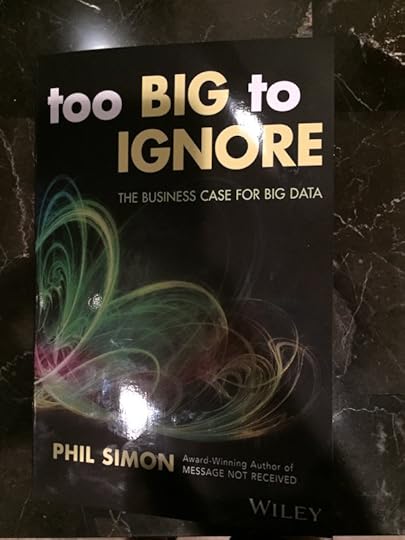 Back in July, I announced that Wiley soon planned to publish a paperback version of my fifth book Too Big to Ignore: The Business Case for Big Data. I’m pleased to announce that it’s now out.
It’s essentially the same book. I added a few footnotes to reflect recent mergers and acquisitions. I also ensured that the errata from the previous version has been fixed.
The Book’s Central Premise Still Holds Up in 2015
I won’t claim to be completely unbiased here, but I believe that the material in the book has held up very well since its March 2013 publication date. Sure, new technologies such as Spark have arrived and/or gained prominence in the past few years. Still, the central premise of Too Big to Ignore holds up nicely. In fact, I’d argue that the continued growth of related tools, methodologies, and startups only underscores the importance of Big Data.
Miscellany
In related news, Wiley finally dropped the price of the book’s Kindle version. It was originally $29.99 and now comes in at much more reasonable $13.99. I’ll be the first to admit that old price was excessive. To be fair, though, you have to pick your battles with traditional publishers. Second, this is my first book to go from hardcover to paperback. I suppose that that’s some sign of progress. Finally, the book landed me CNBC in 2013.
x
The post Paperback Version of Too Big to Ignore Released appeared first on Phil Simon.
Twitter’s Platform Problem

A while back, I posted the first rule of platforms: You don’t need to be first, but you sure as hell can’t be last. (Google+ is a case in point.)
Recent events at much-maligned Twitter illustrate the second rule of platforms: Cherish developers. Don’t piss them off.
Twitter 1.0: A Developer’s Paradise
By way of background, Twitter immediately attracted developer interest out of the gate. In fact, researching The Age of the Platform, I discovered the following fascinating statistic: Within three years of its launch, Twitter claimed that developers had created and registered more than one million apps for it.
One million.
Think about it. Let’s say that 95 percent of those apps were redundant, didn’t work, or fell into generally grey areas such as read: porn, spam, illicit goods and services. Toss those aside and what’s left? How about 50,000 apps that extended Twitter’s power, utility, and reach. Talk about externalizing innovation. This is perhaps the chief benefit of building a true platform in the first place.
The New, Developer-Unfriendly Twitter
Rebooting with developers is far easier said than done.
Fast forward to 2015.
Forget for a moment Twitter’s myriad communications issues with its users, investors, and the public at large. For a long time now, Twitter has confused and irritated one of its most important constituencies: its developers. You know, its ecosystem—the very people who can advance its offering and help the company grow.
At last the company ostensibly recognizes the enormity of its developer issue. As told by Recode, new old CEO Jack Dorsey, recently “to his credit, acknowledged the rocky relationship. He apologized, and said that he wanted to ‘reboot’ with Twitter developers.”
Easier said than done. Dorsey et. al will have to do more than just start listening to its developers. What’s more, there’s no guarantee that scorned developers will come back at all.
Simon Says: Solving Twitter’s platform problem won’t be easy.
In the Age of the Platform, companies don’t easily and often get another bite at the apple with developers. Even developer-friendly “platforms” such as app.net didn’t exactly take the world by storm.
To paraphrase a short but important e-book, developers are the new kingmakers (affiliate link). The most successful companies today understand this. Case in point: Slack, a company that truly realize how essential are developers to platforms.
It turns out that, at least in this regard, Steve Ballmer was right.
x
Feedback
What say you?
The post Twitter’s Platform Problem appeared first on Phil Simon.
November 2, 2015
How to Build a Culture of Analytics

Not too long ago, I had the pleasure of speaking to more than 400 statisticians and data scientists at a large annual confererence. My topic: how to build a culture of analytics—something that is much easier said than done.
Here are some of the most salient lessons from my talk.
Recognize that It’s Never Been More Important to Be Paranoid
 Nearly two decades ago, Andy Grove of Intel penned the very successful book Only the Paranoid Survive: How to Identify and Exploit the Crisis Points that Challenge Every Business. If you think that things have slowed down in the last two decades, think again.
But don’t believe me.
Right before stepping down as Cisco’s CEO, John Chambers told conference attendees, “40 percent of businesses… unfortunately, will not exist in a meaningful way in 10 years. If I’m not making you sweat, I should be.”
40 percent.
Lest you think that that number is overstated, have you been to a Blockbuster video lately? Do you own a Blackberry anymore? Had you heard of Uber even two years ago?
I didn’t think so. Disruption is happening faster than ever.
Analytics Cannot by Themselves Stave Off Disruption
Make no mistake: Understanding your customers, employees, users, and products are certainly important. Amazon wouldn’t be able to file patents for anticipatory commerce deep insights into who buys its stuff—and when.
Still, by themselves, a better understanding of customers et. al cannot entirely prevent disruption. Consumers (especially Millennials) have never been more fickle. What’s more, virtual barriers to entry such as cloud computing are far easier to overcome than their physical counterparts (e.g., telecomm infrastructure). Powerful analytics and insights can, however, shed invaluable light into emerging trends and patterns. The most successful companies of today and tomorrow will be equipped with—and act on—that information sooner rather than later,
Building a Culture of Analytics Takes Time
In my talk, I described an organization for which I used to work. Call it Acme, Inc. here. I didn’t last too long at the company primarily because it refused to use analytics to make better business decisions. I cited an example of how the recruiting department intentionally ignored my findings that we were wasting money by recruiting at Ivy League schools.
A decade after I left Acme, it was still struggling with analytics. My remaining friends there confirm what I had suspected: Many if not most of its important corporate decisions stemmed from gut feel—and not the very analytic rigor that would improve its bottom line.
E-Mail Is Not a Collaborative Tool
Finally, a client of mine six months ago had me speak at company headquarters about the need to improve internal communication skills. It turns out that most employees were drowning in a inbox tsunami with no end in sight. In one example, two teams from across the globe battled for two years over a thorny data issue.
Building a culture of analytics isn’t easy.
When the two groups met in person at a conference San Francisco, they solved that thorny problem in under an hour.
Sound familiar?
Simon Says
Building a culture of analytics isn’t easy. For every Amazon, Netflix, Facebook, and Google, there are hundreds or thousands of others that don’t get it. Heed the advice in this post, though, and your organization will start making better decisions.
Feedback
What say you?
This post was brought to you by IBM for MSPs and its opinions are my own. To read more on this topic, visit IBM’s PivotPoint. Dedicated to providing valuable insight from industry thought leaders, PivotPoint offers expertise to help you develop, differentiate, and scale your business.
The post How to Build a Culture of Analytics appeared first on Phil Simon.
October 29, 2015
Twitter’s New Commercial: Message Not Received
Twitter has done many things poorly throughout its chaotic history, not the least of which is communications. While early adopters and power users such as myself understand Twitter, the company’s “product”* doesn’t come close to passing the Mom Test. Moms by and large get Facebook, but certainly not Twitter.
Things are supposed to be different at Twitter under new old part-time CEO Jack Dorsey. Co-founders are supposed to bring a type of moral authority to their companies. Zuck, Steve Jobs, and Jeff Bezos are all cases in point. Yahoo’s parade of rent-a-CEOs serve as an instructive counterpoint.
Message Not Received
Against this backdrop, a new voice, stagnating user growth, and a tumbling stock price should all lead to a clearer message, right?
Think again.
Did you see the Twitter commercial last night?
Twitter is incomprehensible to outsiders, so of course they made a completely incomprehensible TV ad. https://t.co/6QJ8pnaVM7
— Tom Gara (@tomgara) October 28, 2015
Not exactly easy to follow, and I’m hardly the only one who feels that way. It reminds me of two things. First, the classic Simpson’s bit Worker and Parasite:
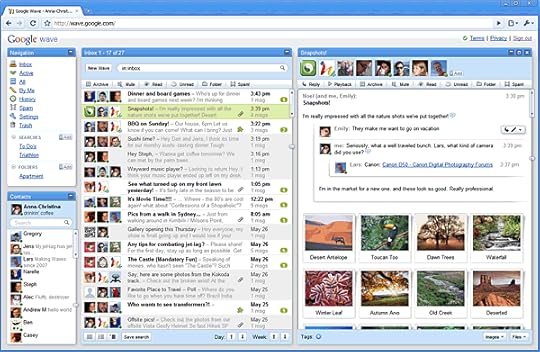
Second, the morass that was Google Wave:
x
Simon Says: Twitter’s new commercial proves that the company still doesn’t get it.
Early-stage startups often get a free pass on defining their visions, business plans, paths to monetization, and the like. The same does not hold true, though, for seven-year old publicly traded companies.
It your company can’t clearly articulate its product(s) clearly, you’re in a world of pain.
Feedback
What say you?
* I don’t like using the term product because no one has to pay for it.
The post Twitter’s New Commercial: Message Not Received appeared first on Phil Simon.
October 27, 2015
Ignore Web Data at Your Own Peril
photo: Matt Cardy
Hardly a day goes by that, for better or worse, Amazon isn’t in the news. A few months back, the New York Times’ ran a very critical article on its culture that generated a reported 5 million views. Not to be outdone, Bezos et. al fired back on Medium with What The New York Times Didn’t Tell You.
And so it goes.
 Lost in the recent hubbub over Amazon’s controversial workplace practices, though, was news of its less-heralded lawsuit over fake/purchased customer reviews. (In case you’re curious, it’s not hard to do. More than 1,000 people on Fiverr will hook you up for a mere five bucks. For their part, some unscrupulous authors as well aren’t above publicly offering bribes for positive reviews.)
Of course, Amazon has known this for a long time, but it turns out that even its sophisticated algorithms and data-management tricks can’t detect bogus, contrived, and purchased product reviews. And this poses a material harm to its business.
The Importance of Product Reviews and Web Data
Think about it. Do you regularly consult online reviews prior to making a purchase?
The answer is probably yes—and you’re hardly alone. According to a 2013 study, nearly 80 percent of consumers trust online reviews as much as personal recommendations. Let’s say that you want to purchase a toaster oven or ceiling fan via Amazon. You scour the ratings and reviews and pull the trigger. A few days later, the package arrives but the product was shoddy. How would that experience affect your opinion of Amazon? Would you be more or less willing to trust its reviews in the future?
The answers are obvious. Hence, the lawsuit.
Companies big and small are rightfully concerned about online reputation management.
Make no mistake: today intelligent companies of all sizes and individuals are rightfully concerned about related web data and its veracity. Indeed, this is a key part of online reputation management, defined by Wikipedia as:
the influencing and/or control of an individual’s or business’s reputation. Originally a public relations term, the advancement of Internet and social media use, along with reputation management companies, have made it primarily an issue of search results
 But this is not 1998. Today effectively managing a web presence today is far easier said than done. We’re not talking about merely setting up a few Google Alerts. What’s more, an entire cottage industry around negative search engine optimization (SEO) has sprung up.
Lamentably, many organizations turn a deaf ear to these types of increasingly important data sources such as Yelp, Amazon, Angie’s List, etc.—and, more specifically, web data. Perhaps this was somewhat understandable in the nascent days of the Web, but not any more. Thanks to a powerful new crop of tools that collects and analyzes web data, it’s never been easier to find the signal in the noise.
Simon Says: Web data allows companies to play offense as well as defense.
As I write in Too Big to Ignore, organizations and their employees need to stop thinking about “data” in terms of Excel spreadsheets and relational databases. Today more than ever, foolish is the company that ignores what its customers, users, and competition say about it.
Defense with data only gets you so far, though. More than ever, it’s essential to use web data and related tools. Collectively, they can increase your organization’s understanding of its customers, employees, partners, users, and competitors. Ignore this information at own peril.
Feedback
What say you?

This post was brought to you Datafiniti.
The post Ignore Web Data at Your Own Peril appeared first on Phil Simon.
October 22, 2015
Celebrating the Four-Year Anniversary of The Age of the Platform
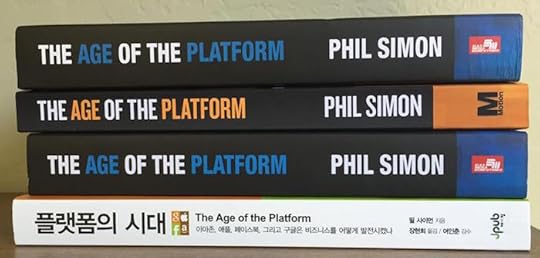
On this day four years ago, the first edition ofThe Age of the Platform was released. (A revised edition hit about 18 months later.) Now seems like as a good time as any to put a few thoughts down commemorating its anniversary.
Personal and Professional Reflections
To be sure, my previous three books had sold reasonably well despite some considerable obstacles. In hindsight, however, my timing wasn’t ideal. Technology was front and center with those three texts. Unfortunately, the US was in the midst of its greatest recession since the Great Depression. The period of 2009 to early 2011 was not the ideal time to start writing about tech. Second, I was a new author who hadn’t really established a strong personal brand or media presence.
That all changed with The Age of the Platform. The book struck a chord with readers curious about how Amazon, Apple, Facebook, Google, and many other successful companies have built their businesses. Many startups, small businesses, and mature organizations wanted to learn more about platform thinking. (Lord knows the former certainly love misusing the word.)
Even to this day, the book sells relatively well—hardly easy to do in an era marked by rampant technological change. I currently tally roughly 20,000 sales.* More than 100 people have reviewed the book on Amazon.com, the large majority of which are positive. My favorite review calls the book seminal, something that brings a smile to the face of every business author.

I find platforms inherently fascinating and have plenty more to say on the matter.
Within a month of the book’s publication, I started to break through. I began giving proper keynote talks to a wide variety of organizations, associations, and conferences. In many cases, organizations ordered hundreds of copies of the book. (For a smattering of my talks on the subject, click here.) What’s more, I met some other smart cookies who have done important research on platforms, most notably Marshall Van Alstyne. He’s currently working on his own book on the subject.) Inc. and The Huffington Post came calling with offers to write columns. The book won an Axiom Award and, at present, three international editions have followed it.
I guess that stubbornness pays off after all.
To be fair, though, there has been a downside—not that I’m complaining. None of my other books has sold as well, leading some in the publishing world to wonder if I have peaked. Maybe I’m the literary equivalent of Pearl Jam’s first album?
Jargon and Platforms
Perhaps ironically, I’m barely use the word platform in everyday conversation even though their importance today is undisputed. Many companies, consultants, and talking heads have bastardized the word and effectively rendered it meaningless. My skin crawls when I hear about next-generation omni-channel platforms and other utterly vacuous terms. (For more on this, see Message Not Received.)
Overheard last night. “We’re an ecosystem, not a platform.” #HRtech #HRTech2015 – #SMH
— Phil Simon (@philsimon) October 21, 2015
In a way, though, the fact that I can communicate simply and sans jargon about platforms has been a boon. I doubt that others would be as interested in my thoughts on the subject if they were so unnecessarily opaque.
Simon Says: It’s Not Easy
As Microsoft, Yahoo!, and BlackBerry know all too well by now, embracing platform thinking guarantees nothing. More than ever, speed ills. These companies’ missteps have cost it dearly, and they are either playing catchup or have become effectively irrelevant in key areas. (Exhibit A: Microsoft’s nearly nonexistent market share in smartphones.)
Still, I find the topic inherently fascinating. Although I’ve penned more than 240 posts on the subject on this site alone, I have plenty more to say on the matter. I’m no sorcerer, but I suspect that we’ll still be talking about platforms four years from now.
Feedback
What say you?
* Many of these are not reflected in BookScan.
The post Celebrating the Four-Year Anniversary of The Age of the Platform appeared first on Phil Simon.