Phil Simon's Blog, page 54
June 12, 2016
How Big Data Is Changing Conventional Lending

It’s no overstatement to say that new technologies and Big Data are upending many traditional industries. Sure, there are multi-billion-dollar darlings such Uber, AirBNB, and Lyft that are seemingly in the news every day. Make no mistake, though: Many other types of mature industries that usually fly under the radar are finding themselves under siege.
For instance, let’s discuss insurance. Generally speaking, it may seem stodgy, stable, and even boring. As I write in Too Big to Ignore: The Business Case for Big Data, though, it is ripe for the very type of disruption that Big Data can quickly bring. Thanks to usage-based insurance programs such as Progressive’s Pay as You Drive, many consumers are paying less for annual premiums. And the Big-Data insurance revolution isn’t stopping with car-insurance premiums.
Not Your Father’s Lender
By way of background, traditional consumer lenders have historically relied heavily upon basic financial and demographic data (gender, zip code, age, etc.) as well as Fair Isaac Corporation (FICO) scores. While not horrible across the board, it’s folly to think that these basic calculations always led to intelligent credit decisions. (Exhibit A: the recent subprime mortgage crisis.)
In the words of personal-finance expert Dan Macklin:
A growing number of lenders think that a person’s FICO score doesn’t tell the whole story and can even be misleading under certain circumstances. It’s become clear that there are more accurate ways to measure financial wherewithal—no FICO score required.
Equipped with greater access to consumer and social data than ever and more employees with analytics degrees, many data-driven startups are changing the face of consumer lending. Two of the most promising include Sofi and Earnest, but they are hardly alone. In the words of journalist Amy Cortese, “Rather than green-shaded bankers, online upstarts like Kabbage, OnDeck, and others employ data scientists who crunch hundreds or thousands of data sources to assess whether a person or a business is a good credit risk.”
Big Data has rendered many conventional approaches to business antiquated.
In some cases, these new data sources represent vast improvements over current (antiquated) data-collection methods. For instance, Josh Mitchell and Andrea Fuller of The Wall Street Journal write that the “the Obama administration is unable to get basic details about student debt due to an archaic system of data collection on its $1.1 trillion student-loan portfolio, hampering the government’s ability to help distressed borrowers and protect taxpayers.”
In an age of Big Data, this is just nuts.
Big Data and Big Money
x
These new lenders aren’t just making microloans. For instance, Kabbage has lent more than $1 billion to small businesses. The company claims that it gathers information from data sources that include Intuit QuickBooks, eBay, Amazon, and payment companies such as PayPal, Authorize.net, and others. Almost anything is fair game. Even things like shipping data or Twitter and Facebook feeds may well help paint a more complete and relevant picture for lenders attempting to make intelligent loans.
And the Internet is also enabling entirely new lending models. Peer-to-peer lending is starting to disintermediate banks altogether. The practice is taking off as new companies match those with money with those seeking it.
Simon Says
To be sure, there is a considerable upside to making decisions based upon superior information. By the same token, though, accessing more granular information opens up Pandora’s box. We’ve just begun to examine some of the fundamental security and privacy issues manifested by our increasingly digital and data-driven world.
Brass tacks: It’s unlikely that the future of lending will resemble its past.
Feedback
What say you?
Originally published on The Huffington Post. Click here to read it there.
The post How Big Data Is Changing Conventional Lending appeared first on Phil Simon.


June 10, 2016
Why Big Data Is an Increasingly Big Deal in Colleges

Not too long ago, I announced a pretty significant career change. Yes, I’m returning to academia to teach at the W. P. Carey School of Business at Arizona State University. I don’t think that I could have taught at an institution clinging to the past. Fortunately, that doesn’t apply here. It’s clear to me that ASU is one of an increasing number of colleges and universities that recognizes the importance of data, analytics, and data science.
Talking heads like me have been aware of this trend for a few years now. Still, it’s interesting to hear and read the perspectives of current students on the matter. For instance, current UNC-Chapel Hill student Jeff Duresky wrote an interesting post on how some universities are moving from theory to practice. That is, his classes are moving beyond the hype of Big Data. Students are actually operationalizing new data sources in the classroom through sophisticated tools such as JMP. They are working on both real-world and fictional datasets. In some cases, they are acquiring valuable professional experience on corporate projects. In so doing, they are complementing their academic underpinnings and making themselves considerably more employable.
Why are colleges teaching Big Data now?
It doesn’t take a rocket surgeon to understand why progressive schools are formalizing data-oriented programs.
Let’s start with the premise that one of the primary purposes of college is to enable students to land well-paying and hopefully meaningful jobs. Along these lines, I’m hard-pressed to think of hotter areas these days than analytics and data science, but don’t believe me. Management consulting firm McKinsey predicts a severe “shortage of talent necessary for organizations to take advantage of Big Data.” By 2018, the United States alone could face a shortage of 140,000 to 190,000 people with deep analytical skills…with the know-how to use the analysis of Big Data to make effective decisions.”
Money matters, but college should be about more than just landing a lucrative job upon graduation.
Make no mistake: students who can make sense out of Big Data stand to do well. In the process, they can pay back their college loans relatively quickly. Don’t get me wrong, though: college should be about more than just landing a lucrative job upon graduation. Still, this remains a critical point.
I am reminded here of something that happened to me a few months ago, I was signing books after giving a keynote in San Diego. An adjunct professor approached me and, as I was signing his copy of The Visual Organization, he asked me how he could get his smartphone-addicted and occasionally apathetic students more interested in data-related topics. I blurted out the first thing that came to my mind: Show them starting salary figures of analysts and other data types.
He smiled at my response and I have little doubt that he did just that.
Simon Says
Unlike a certain demagogue running for president, I am not certain of everything. I don’t know all of the answers, nor can I predict the future. I can, however, say two things without fear of accurate contradiction. First, Big Data has arrived. Second, as I have said many times, all companies are tech companies. Some just haven’t realized it yet.
As I start my own academic career (again), I think about the lessons I have learned in industry as they relate to future college graduates. It is simply incumbent upon institutions of higher learning to not only prepare students for today’s business environment, but for tomorrow’s.
Peering into the future, it’s obvious that the majority of white-collar jobs will require at least some facility with all things data. I just don’t see a future in which an organization will able to hide “data-challenged” folks or dataphobes. The schools most likely to succeed in this new era understand this new reality and are modifying their curricula accordingly.
Originally published on The Huffington Post. Click here to read it there.
The post Why Big Data Is an Increasingly Big Deal in Colleges appeared first on Phil Simon.
June 8, 2016
Who will run your organization’s IoT efforts?
For decades now, CIOs have argued with their brethren about whether IT should “own” enterprise data. For many years now, the IT-Business Divide has served as a major bone of contention in most large, mature organizations, something that I’ve seen firsthand in my consulting days. Given the extent of these testy historical arguments, it’s fair to ask two questions with respect to future organizations Internet of Things‘ (IoT) efforts:
Should IT run—be responsible for—these types of projects?
Will IT run these types of projects and “own” IoT-related data?
Let’s address the normative question first. On more than a few occasions in my career, I’ve seen both sides of the IT-Business Divide play out. (Consultants are often placed in the middle of thorny situations.) I’ve seen project managers excoriate CIOs and their minions over data-quality issues from prior centuries. This was the very definition of killing the messenger.
I certainly could appreciate each side’s perspective, but I’ve never believed that IT should assume responsibility for business data. The reason is simple: IT employees rarely if ever create data issues. Rather the HR or AP clerk did by fat-fingering a form or invoice or carelessly running an update or purge program. IT was merely presenting the data as it was currently stored in a database. What’s more, IT could never provide “the answer” to a business-related problem.
Nothing that I’ve learned about the IoT makes me view it any differently. HR should be responsible for HR data. Ditto for sales, marketing, finance, and the like.
IT’s Role in the IoT
Now let’s address the second query. While we’re still in the early innings of the (IoT), it’s looking like the answer to the second query will be no. That is, they are not “assigning” the IoT to their IT departments.
As Bob O’Donnell writes on Recode, “You can’t just assume that IT will be paying for all the new sensors, gateways, networking equipment, [and] analytics hardware and software.” In a prior post, he supports his assertion with some data (always a good idea):
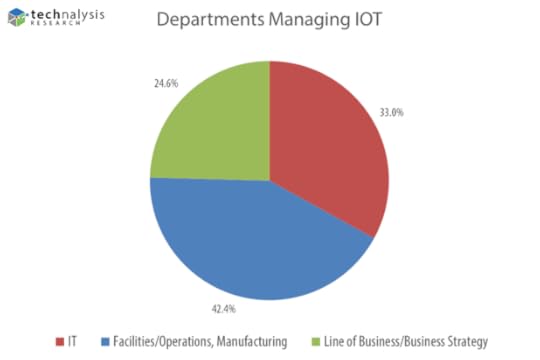
IT need not be involved in each and every technology-related decision.
You may be thinking that the average marketing, sales, or operations exec doesn’t possess the technical know-how to handle complex connectivity, networking, sensor, and data issues. Fair enough, but remember that never before have these employees had access to such a variety of on-demand and robust third-party services. Put differently, IT need not be involved in each and every technology-related decision.
Simon Says
Beyond the increasing ease with which organizations can deploy new services and connect new devices, let’s not forget the elephant in the room. IT departments still have their hands full with traditional responsibilities, not to mention a growing array of security threats. I can’t think of too many IT folks sitting around with nothing to do.
Feedback
What say you?

 This post was brought to you by IBM Global Technology Services. For more content like this, visit Point B and Beyond.
The post Who will run your organization’s IoT efforts? appeared first on Phil Simon.
June 1, 2016
The Vast Data Sources of the IoT

If you think that human beings generate a great deal of information these days, you are right. At the same time, though, as the Internet of Things (IoT) approaches, you ain’t seen nothin’ yet.
More than ever, people are quick to bandy about the term Big Data. There’s plenty more to say about the matter (hence my rationale for scribing Too Big to Ignore in 2012), but perhaps it’s best to think about Big Data in the following simple framework: people and machines.
Let me elaborate. People actively generate a great deal of data, something that social media has certainly intensified over the past decade. Today, we frequently tweet, share videos of our pets, take and post photos on Instagram and Facebook, write blog posts, and the like. To be sure, we’re talking about a boatload of data, an amount that grows every day. Still, to view Big Data exclusively through this active, human-centered lens would be incomplete.
Rise of the Machines
Machines passively generate enormous troves of data.
Machines passively generate enormous troves of data. Yes, I’m talking about the burgeoning world of the Internet of Things (IoT). A few examples will help clarify what has surely become an off-repeated business buzz phrase. Farmers will be able to easily monitor and improve in-season crop health. Progressive Insurance’s Snapshot program (formerly coined “Pay as You Drive” [PAYD]) allows drivers to lower their rates by installing a device that tracks their driving behavior. Airplane sensors provide critical in-flight information.
Of course, none of these scenarios happens without cheap, connected sensors and sophisticated networks that can support them. Simply collecting and/or storing new data sources and streams, however, isn’t enough. Mere data collection is sufficient but not necessary for success. The companies that will reap the true benefits of the IoT will do more. They will ask fundamental questions of these exciting new data sources. They include:
How can we make sense of these new streams?
Are we willing to go wherever the data takes us—even if that ultimately challenges long-held assumptions about how things work? Are we willing to embrace true data discovery?
Does our organization run the right applications to analyze and interpret this data? What about the right employees?
How can our employees embrace machine learning to make better business decisions?
Simon Says
It’s tough to overstate the potential benefits and opportunities of the IoT. I can’t predict the future, but it’s safe to say that the true winners of the IoT will be the ones that get in early on the action. This means taking part in critical discussions about forthcoming standards. What’s more, it means preparing for inevitable change and adopting new technologies.
Feedback
What say you?
This post was brought to you by IBM Global Technology Services. For more content like this, visit Point B and Beyond.The post The Vast Data Sources of the IoT appeared first on Phil Simon.
May 30, 2016
Platform Lessons from Microsoft’s Smartphone Surrender

After two largely unsuccessful years, nearly $8 billion spent, and an inconsequential market share, Microsoft has finally thrown in the towel on its smartphone ambitions.
File this under predictable.
x
(Couldn’t resist.)
Much like with search, the Internet, and social networks, the company moved so late that its entree constituted the very definition of desperation. Hail Mary’s such as these rarely pan out. This is one of the cornerstones of the Age of the Platform.
Simon Says: Remember the first rule of platforms
Hail Mary’s such as these rarely pan out.
Last-ditch gambits such as these serve as key examples of the first rule of platforms: You don’t necessarily need to be first, but you sure as hell can’t be last.
Give CEO Satya Nadella credit for understanding this brave new world. (Yahoo!’s Marissa Mayer clearly does not.) To be fair, the Nokia acquisition was not his decision. Nadella walked into his predecessor’s ill-advised effort to build a mobile presence. What’s more, now that Microsoft has 86’d smartphones, it can focus on emerging technologies without an entrenched incumbent such as virtual reality.
Feedback
What say you?
The post Platform Lessons from Microsoft’s Smartphone Surrender appeared first on Phil Simon.
May 23, 2016
Professor Simon

More than six months ago, I wrote a post expressing my interest in taking a full-time visiting-professor position. In point of fact, a position at one university almost materialized immediately before ultimately falling through. (I learned early on in my search that these types of jobs don’t come along every day. After all, I wasn’t looking for an adjunct role.)
x
Over the past three months, I intensified my search. To that end, I interviewed at a bunch of prestigious colleges and universities in the northeastern part of the country. Most of the conversations went very well, although some interviews went better than others. (Some faculty members at one university in particular spoke to me with an inexplicable heir of superiority, but I digress.)
Despite no proper employment offers, the feedback was generally very positive. Moreover, those interviews convinced me that my skills, body of work, interests, and experience would fit well in an academic environment.
The Breaking Bad parallels aren’t lost on me.
I spent last Tuesday at the Carey School of Business at Arizona State. In short, it went really well. Carey is growing quickly and embracing new subjects and learning mediums. In other words, it’s a progressive institution that believes in the seminal importance of technology—something that I’ve been preaching for my entire career. What’s more, the faculty couldn’t have been more friendly and knowledgeable. I didn’t sense a competitive, publish-at-all-costs vibe. Sure, research is important, but quality teaching matters as well. (Make no mistake: students are customers. Educational institutions that ignore this reality risk obsolescence.)
Yeah, yeah. Get to the point.
Drumroll please…
 I’m pleased to announce that I will be joining the Carey faculty this fall as a full-time lecturer.
I’m excited about this next step in my career. On a completely unrelated note, the Breaking Bad parallels aren’t lost on me. Remember that Walter White taught at a school in the southwest U.S. And yes, I look more than a little a bit like Heisenberg. I’ll have to brush up on my chemistry to complete the metaphor, never mind engaging in some other legally questionable activities. Also, Neil Peart (my favorite drummer) also went by the moniker The Professor. Long story short: I’m in good company.
I’m joining ASU at a great time. Times Higher Education—the world’s largest invitation-only academic opinion survey—recently recognized ASU as one of the top 100 most prestigious universities in the world.
Props to Terri Griffith for being an invaluable sounding board over the past months.
The post Professor Simon appeared first on Phil Simon.
May 17, 2016
BYOD: Where are we now?

Smartphones have changed, disrupted, and spawned many businesses. Without our ubiquitous handheld devices, Uber and Postmates probably don’t exist. In fact, it’s safe to say that the On-Demand Economy is a fraction of its current size (estimated at $60 billion and growing.)
As someone who remembers life before mobile devices, it’s been interesting to see how mature organizations have reacted to this new world. Specifically, many have struggled to wrap their arms around the bring your own device (BYOD) trend.
It’s been seven years since BYOD arrived in earnest, but where are we now? How have IT departments responded to this sea change? Have the benefits lived up to the hype? And what risks remain?
Where are we now?
Put bluntly, BYOD has arrived in full force. Consider the following statistics:
Eight-five percent of organizations allow employees to bring their own devices to work. (I don’t see how the other 15 percent can really stop this from happening, but that’s a separate conversation.)
More than 50 percent of organizations rely on their users to protect their own devices. (Source: SANS Institute)
Perhaps most shockingly, Gartner reports that nearly two in five (38 percent) of companies expect to stop providing any devices to workers by the end of this year.
Make no mistake: The BYOD genie isn’t going back in the bottle anytime soon.
The Benefits and Increasing Risks of BYOD
The advent of BYOD caught many budget-challenged IT departments off guard and spawned new services from established software vendors. Sure, BYOD meant that they did not need to provision mobile devices to their employees and offer training. Even today, these benefits can be considerable.
A mere half of organizations implement password protection on employee-owned devices.
Still, as I am fond of saying, technology is neither good nor bad; nor is it neutral. In the case of BYOD, organizations continue to face a slew of evolving and downright thorny legal, financial, and even workers-compensation risks. And then there’s the elephant in the room: security. As Kelley Katsanos writes, many if not most organizations are generally doing a poor job securing corporate data on employee-owned devices. She cites a recent Bitglass’ survey around BYOD security (or lack thereof):
Data leakage is the primary security concern across many sectors. This includes education (79 percent of organizations cited this concern), financial services (81 percent), and health care (90 percent).
Basic security is often neglected. In spite of these alarming statistics, all three sectors often neglect to implement basic mobile security measures. For example, only 36 percent of educational institutions support device encryption. Shockingly, a mere half of organizations implement password protection on employee-owned devices. Many choose not to include policies such as encryption and remote wipe.
Simon Says
As I’ve seen firsthand, some larger and more mature organizations are bucking the BYOD trend by providing their employees with smartphones and tablets. (People packing two smartphones typically fall into this bucket.) In theory, these company-issued devices are more secure than their consumer equivalents. To be sure, this is inconvenient for employees, but added privacy from Big Brother often justifies the annoyance.
Feedback
What say you?
This post was brought to you by IBM Global Technology Services. For more content like this, visit Point B and Beyond.
The post BYOD: Where are we now? appeared first on Phil Simon.
May 16, 2016
The Explosion of Platform Books

Prior to the release of The Age of the Platform in 2011, nearly all of the research on the topic of modern-day platforms was confined to economics textbooks and articles in obscure academic journals. Put differently, at least to my knowledge, The Age of the Platform was the first mainstream business book to address not only the platform as the most important business model of the 21st century, but the Gang of Four: Amazon, Apple, Facebook, and Google.
To this extent, it’s fair to call the book a seminal text, as a few reviewers have. An Amazon search on “platform books” reveals a burgeoning body of current and future work on the topic. Alternatively, consider the following visual that represents a striking number of related and/or derivative books:

Click image to embiggen it.
As I wrote in the foreword to the book’s revised edition (published in mid-2013):
Almost 18 months after its initial publication, The Age of the Platform remains to my knowledge the only book on the topic, although some recent texts have touched upon some of its key themes. I suspect that many more will.
It’s fair to call The Age of the Platform a seminal text, as a few reviewers have.
This wasn’t exactly an earth-shattering prediction—and this was before self-anointed platforms such as Uber, AirBNB, and other darlings of the On-Demand Economy started to gain steam. (They are not true platforms à la Amazon, Apple, Facebook, Google, WordPress, Twitter, etc., but that’s a discussion for another time.)
I don’t view other texts as copycats or knockoffs for several reasons. First, there’s a great deal more to say on the topic than any one book or mind can accommodate. Second, change happens faster than ever. Platforms are anything but static. Third and on a purely selfish level, the fact that so many other intelligent authors and thought leaders have recognized the importance of platform thinking—five years after the publication of The Age of the Platform—validates the central thesis of my book.
Simon Says
Brass tacks: Despite its undeniable entrance into the pantheon of business buzzwords, platforms matter—and that isn’t changing soon.
As I move closer to taking a break from long-form writing for a while, it’s comforting to know that at least one of my books hit the nail on the head.
Feedback
What say you?
The post The Explosion of Platform Books appeared first on Phil Simon.
May 9, 2016
Beware of Analytics in Isolation

I’m hard-pressed to think of a business term that has garnered as much attention over the past year as analytics. A search on Amazon reveals more than 12,000 books on the topic—if we only count hardcovers.
To be sure, the process of making decisions based upon numbers and solid data has become de rigueur in many industries and at many organizations. These days, it’s become downright trendy to drop that term at conferences and in meetings.
You’ll get no argument from me on the benefits of evidence- or fact-based decision making. (It’s a key point ini Too Big to Ignore.) Yet there are limitations. Specifically, analytics or “data” cannot guarantee “the right” business decision—much less a successful outcome. Still, all else being equal, decisions made by consulting analytics and data tend to result in better outcomes than those made by pure gut feel. Hence the legendary Charles Babbage quote: Errors using inadequate data are much less than those using no data at all.
Where’s the context?
But errors persist. The era of Big Data and analytics has not brought perfection and utter certainty with it. Far from it. Even with the insight that analytics typically provides, many people continue to make mistakes. There are many reasons for this, but near the top of the list is looking at analytics in isolation. Consider the following real-world examples:
Sales increase at a retail company XYZ in December (compared to August). XYZ may be doing something right, but remember that retail sales are notoriously seasonal and have been for a very long time.
Employee turnover plummets in December and January. Maybe management has improved its practices. It’s essential to remember, though, that employees rarely quit their jobs in December. To boot, many stay until their employers pay out annual bonuses.
It’s critical to benchmark numbers, and not just for seasonality.
Even if an organization theoretically measures a valid KPI, in some instances better and far more valuable ones exist. (Read Moneyball if you don’t believe me.) Because of the enormity of Big Data, it’s not only difficult to find a signal in the noise, but the right signal or signals. This is particularly true when organizations fail to embrace new, more powerful applications specifically designed to derive knowledge and intelligence from large, unstructured datasets. Ditto for simplifying unnecessarily complex systems, something that has never been more critical.
Simon Says
Simply and mechanically looking at a dashboard isn’t enough. Critical thinking is still imperative, especially with analytics. More specifically, employees, groups, departments, and organizations should view analytics within the proper business context and ask if they remain relevant.
Make no mistake: Things change faster than ever today. Even well-trodden KPIs need to continually be revisited and, as Mark Twain so astutely observed a long time ago, statistics can still lie.
Feedback
What say you?
This post was brought to you by IBM Global Technology Services. For more content like this, visit Point B and Beyond.
The post Beware of Analytics in Isolation appeared first on Phil Simon.
May 3, 2016
Why Most Business Case Studies Fail
I know a thing or six about writing effective case studies. I have asked for and written detailed case studies for all but one of my books. All told, I’ve probably penned 50 or so case studies over the years.
When I peruse the websites of most startups and established software vendors and service companies, I’m astonished at what I see. My observations typically fall into two buckets:
Those that lack proper case studies
Those with case studies that suck
Rarely have I ever seen an effective three- to four-page representation of how a company’s wares helped one of its clients. When was the last time that you read a well-written case study by a software vendor or consultancy? I’m guessing that it’s been a while, if ever. Click below to vote and see the results.
<a href=”https://www.wedgies.com/question/5728... was the last time that you read a well-written case study by a software vendor or consultancy?</a>
Why Case Studies Matter
Although the research is far from conclusive, people tend to be become more risk averse as they get older. I’d argue that this phenomenon is particularly acute in large, mature organizations. Ditto for those in relatively static industries such as at the public sector, healthcare, non-profits. Many people are scared that their decisions will result in failure. To be fair, this is an understandable concern. As I describe in Why New Systems Fail, most IT projects do.
Case studies provide much-needed social proof for ambivalent prospects.
Case studies provide social proof and decrease the level of discomfort that a decision-maker faces. For instance, let’s say that a VP at Company X sees that [insert name of prominent company] successfully uses Company Y’s product or services. All else being equal, that VP is more likely to consider Company Y’s wares for herself. Brass tacks: A good case study can close the deal.
Why do so many vendors lack proper case studies?
There are many reasons for this. Consider startups for a moment. By definition, they are just starting up. As such, it’s often impossible for them to tell the story of a client that has had success using their products and services.
For established software vendors, the problem may be similar. Some extremely successful companies have recently launched new offerings and heard nothing but crickets. Months or even years after, no organization has signed up. Then there’s the confidentiality issue. Many clients simply aren’t comfortable going on the record with a formal quote or case study. Security, privacy, and political concerns are typically at play here.
So why do so many case studies suck?
Of the case studies that I do see, the vast majority fall into the terrible category because of vagueness. By that, I meant that their write-ups often lack sufficient detail. Next, there’s the jargon issue. I’ve seen some case studies that didn’t make a lick of sense. The customer quotes just didn’t seem authentic, often due to wildly unrealistic claims. A 237.14% ROI? How can anyone be that precise about such a measure?
Finally, many gloss over everyday implementation issues. In all of my years, I’ve never seen a “perfect” deployment of any important enterprise technology or service. Ever. There’s no magic button to cleanse data, address coding issues, make disparate systems talk to each other, etc. No vendor’s case study accentuates the negative, but intelligent and informed prospects will call bullshit on Pollyanna tales. Stories that seem too good to be true probably are.
Feedback
What say you?
The post Why Most Business Case Studies Fail appeared first on Phil Simon.