Phil Simon's Blog, page 51
February 27, 2017
Announcing My Eighth Book

Introduction
For decades now, companies big and small have embraced Agile software development methods. The rationale here is straightforward:
Why take one or two years to fully deploy a system, app, or website when so many things can and do go wrong?
Why try to cook one big batch and boil the ocean?
Why not cook many smaller batches?
Double that when the world changes faster than ever. Brass tacks: It’s no coincidence that methods such as Scrum have exploded with no end in sight.
The Analytics Paradox
Yet, when developing and using analytics, many organizations paradoxically continue to think in terms of traditional, phase-gate IT projects. (I’ve argued against doing that very thing.) That is, they optimistically plan for six-month or year-long projects to launch dashboards, key performance indicator (KPIs), data-visualization tools, predictive models, and their ilk. Antiquated techniques abound. In so doing, these organizations bet—often incorrectly—that they will diligently gather every requirement and data source. In their conceit, they assume perfect conception, planning, and execution. Even if they pull off these enormous feats, it’s usually a fool’s errand for one simple fact the world is moving faster than ever.
This is insanity.
Where Motivation Meets Opportunity
In my new role at ASU, I teach CIS450, a course on enterprise analytics. In a nutshell, I show my students how organizations can apply these Agile methods and techniques to further their analytics efforts.
The way that many organizations continue to approach analytics is absurd.
To be sure, I enjoy teaching the course. (I find the capstone projects fascinating.) Still, there’s a problem: Lamentably, the current books on the subject don’t really fit the course material—at least as well as they can. (Lean Analytics is a good read but it’s targeted towards startups.)
At the beginning of last semester, I started toying with the idea of writing a book specifically designed for this course, but not a textbook per se. Given the growth of proper analytics degrees and programs, such a book seems to make sense. The notion that organizations should apply Waterfall methods to analytics today seems increasingly dated.
Book Title and Other Notes
My eighth book will be titled Analytics: The Agile Way. The book will show how intelligent organizations are approaching contemporary analytics. (TLDR: It’s vastly different from how their counterparts continue to do it.)
At a high level, the text will demonstrate how organizations are applying the same Agile techniques that software engineers and developers have successful used for years, but in a different area: analytics. In so doing, individuals at these smart companies can understand—and, most important, act upon—nascent opportunities far faster than their more traditional counterparts do. Using a combination of case studies, examples, and exercises, Analytics: The Agile Way will demonstrate how this new mind-set affords tremendous opportunity for organizations willing to embrace uncertainty and move fast.
Once again, Wiley will be publishing the book and it will be part of the SAS Business Series. Expect it later this year.
The post Announcing My Eighth Book appeared first on Phil Simon.


February 21, 2017
How Analytics Can Improve Workplace Collaboration

Introduction
For as long as I can remember, I’ve been a numbers guy. Credit my early years playing sports and collecting baseball cards or perhaps my father’s facility with math. I wouldn’t have survived at Carnegie Mellon if I were quantitatively challenged (Even the poets there know math, but I digress.) Regardless, I’ve always abided by W. Edwards Deming’s credo, “In God we trust; all others bring data.”
Analytics can make individuals, teams, and even entire companies far more efficient.
It should be no surprise, then, that my expectations for collaboration and productivity tools go beyond “getting the job done.” That is, I don’t just want to filter my inbox to see the number of messages to which I’ve replied. As I’ve said many times before, e-mail begets more e-mail. More e-mail doesn’t necessarily make you more productive. In fact, I’d argue the opposite.
Fortunately, the new breed of productivity apps provides insights that their 90s counterparts simply cannot. Consider Todoist for a moment. At the end of the year, the tool automatically generated a personalized annual productivity report. Here are a few screenshots from mine:
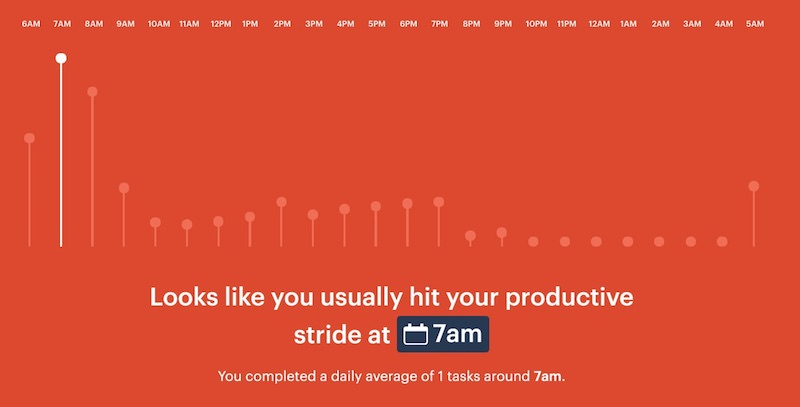
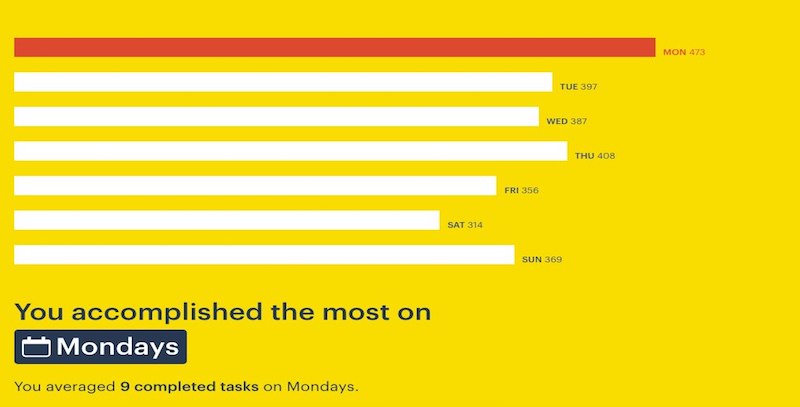
It turns out that many companies are developing features around what Becky Lawlor calls data-driven productivity. It doesn’t take a rocket surgeon to understand that analytics can make individuals, teams, and even entire organizations far more efficient.
Let me count the ways…
I start to get dizzy when I think about applying analytics to employee and personal productivity. Consider the ability to:
Visualize who interacts with whom along with when, where, and why.
Determine nodes and bottlenecks different processes.
Identify key employees not by job title, but by what they actually do in an organization. Imagine being able to retain truly key employees based on data, not on hunches or “potential.”
Quickly see which employees respond quickest to issues. (This would obviate the need of the antiquated, impersonal e-mail blast.)
Eliminate once and for all similar e-mail blasts asking everyone on a project to update a spreadsheet or other document.
Obtain real-time status updates. Managers and project managers would benefit from dashboards and real-time alerts when deadlines pass and measures reach certain thresholds.
I could go on but you probably get my drift.
Simon Says: The possibilities are endless.
More than ever, organizations are distinguishing themselves from their cohorts by virtue of their data—a trend that I expect to intensify for the foreseeable future. And that data won’t just be limited to users and customers. New productivity tools offer organizations an unprecedented glimpse into what their employees are doing and how.
Feedback
What say you?

 This post was brought to you by IBM Global Technology Services. For more content like this, visit IT Biz Advisor.
The post How Analytics Can Improve Workplace Collaboration appeared first on Phil Simon.
February 16, 2017
Workplace Collaboration: The Case for New Tools
“Well Marge, self improvement has always been a passion of mine.”
—Homer Simpson
Introduction
I like many things about my new position as a faculty member at the ASU W. P. Carey School of Business. For starters, I enjoy interacting with smart cookies on a daily basis. I’ve been called worse things than professor in my life. Next, given all of the uncertainty in the world today, a steady paycheck isn’t a bad thing.
Perhaps best of all, though, is the willingness of my students to experiment with different collaboration tools and technologies, especially on their capstone projects. That is, they are not already stuck in their ways. Unlike many if not most professionals of a certain age, my students do exclusively use one tool (e-mail) to accomplish all of their tasks. They are more than willing to embrace many of the tchotchkes that I recommend. What’s more, sometimes they’ll bring new ones to me.
New workplace collaboration tools can create exciting new opportunities and save a boatload of time.
As someone who has fought this battle myriad times (often unsuccessfully), I can’t tell you how refreshing this is.
Myriad Benefits
As I write in Message Not Received, the benefits of powerful new collaborative tools are difficult to overstate, but don’t take my word for it. As industry analyst Fran Howarth writes:
Collaboration apps can connect everyone in the organization, from the CEO to an intern or the product marketing manager to a sales representative. Increased workplace collaboration can reveal opportunities to create new efficiencies, streamline operations, and drive business growth.
You’ll get no argument from me. Radical companies such as Klick Health have eliminated e-mail altogether. Progressive organizations are eschewing e-mail for truly collaborative tools such as Slack, Asana, Trello, and countless others. In the process, they largely are freeing employees from the 14 or so hours per week that they have traditionally spent on e-mail (PDF). (If you still qualify as a skeptic and think that e-mail can still do everything, click here.)
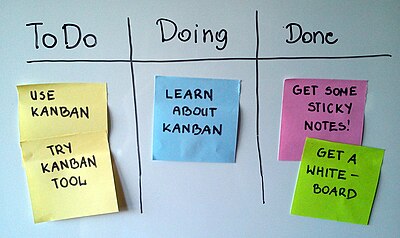
Photo credit: Wikipedia
Don’t get me wrong: Working smarter isn’t just adopting new apps. There’s a critical human element involved. Specifically, we need to ask ourselves when we should opt for decidedly low-tech tools such as in-person meetings, phone conversations, and Kanban boards.
Simon Says: What are you waiting for?
As I peer into the future, I certainly don’t see e-mail going the way of the Dodo. For certain things, it’s far too useful to die.
As I put on my swami hat, though, I envision more workplaces adopting a wide variety of tools—some old and some new. All else being equal, I’d wager that the organizations with employees who routinely embrace these new tools will do better than organizations stuck in the past.
Feedback
What say you?
This post was brought to you by IBM Global Technology Services. For more content like this, visit IT Biz Advisor.
The post Workplace Collaboration: The Case for New Tools appeared first on Phil Simon.
January 30, 2017
The Promise of the IoT
A few weeks ago, I finally moved into my new home in Arizona. Although I was tempted. I didn’t go crazy selecting features for my house. (The motorized shade for the 20-feet of glass was too cool to pass up.) To be sure, I certainly could have opted for any number of smart appliances.
While setting up my Wi-Fi network, I noticed that that I could connect my thermostat via an app for my iPhone. (Cool, I thought, and I didn’t buy a Nest.) After noodling with my settings for 30 minutes, I still couldn’t get my network to recognize my thermostat. A bit miffed, I called the manufacturer’s 1-800 number.
After navigating the phone queue, I spent 10 minutes on hold before I could diagnose the problem with a technical rep. Let’s just say that things didn’t go smoothly. Nearly an hour later, I hung up the phone in frustration at our inability to achieve our goal.
The Early IoT Verdict: Frustration Fused with Promise
Things should not be this hard. Like coffeemakers, it seems to me that thermostats shouldn’t be allowed to break.
Things should not be this hard.
That interaction summed up my own experiences with the nascent Internet of Things (IoT). (A few years ago, Bluetooth issues confounded my first foray into smartbulbs.) Despite these setbacks, I’m a big believer in the IoT for several reasons.
First, on a personal level, I’ve seen some of these devices actually, you know, work. Case in point: I stayed at an AirBNB in Austin, TX last year and didn’t need a key to enter my temporary abode. A smartlock and code obviated made the very idea of a key seem so 20th century.
 Second, let’s just say that I’m not new to the tech world. There’s always a learning curve; things never smoothly at first. Along these lines, I remember the fledgling days of the Web, search, and e-mail. I can vividly recall search results completely unrelated to my queries in 1996. I can cite many examples of webpages not rendering properly in Mosaic, if at all. And don’t get me started on the difficulty of configuring early e-mail clients, especially when search results left more than a little to be desired.
Simon Says: We’re getting there.
It’s evident to me that connecting to different IoT devices is getting easier but, at least at present, it’s hardly easy. Big difference. Remember that few people want to come home from work and tinker with settings and call tech support. If the unprecedented success of Apple has taught us anything, it’s that many if not most of us just want things to work. Period.
I suspect that, as we head towards that lofty goal with the IoT, it will start to reach its vast promise.
Feedback
What say you?
This post was brought to you by IBM Global Technology Services. For more content like this, visit IT Biz Advisor.
The post The Promise of the IoT appeared first on Phil Simon.
January 23, 2017
Last October’s IoT Hack: No Black Swan
Security breaches these days have become commonplace—almost daily occurrences. It’s a lamentable sign of the times. Still, even by today’s ho-hum standards, one in October of last year proved particularly worrisome.
 As far as we know, hackers accessed traditionally less secure devices to cause massive outages. The culprits: DVRs and CCTV video cameras. It didn’t take long before hundreds of millions of people could not access key accounts on sites that included Twitter, Amazon, Tumblr, Reddit, Spotify, and Netflix.
Here’s a heatmap outlining the attacks:
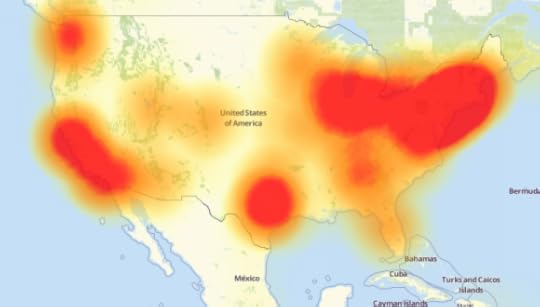
The hacks seemed to confirm the worst fears of industry experts and Internet of Things’ (IoT) skeptics. These newfangled devices that hold oh-so-much promise can also serve as tremendous weapons for bad actors.
Think about it. Those with pernicious motives can get at our technology stalwarts (read: our e-mail accounts, laptops, and desktops). What’s to stop them from accessing our smartwatches, TVs, refrigerators, locks, and even cars?
Answer: Apparently not very much.
If you think that this was a black swan, think again. In fact, expect outages such as these to continue for one very simple reason: design. To this end, as Jeff Bertolucci writes:
Legacy systems, in fact, weren’t designed to identify wireless communications protocols that modern smart devices use to share information.
Organizations face an increasingly complex array of security issues in a BYOD world.
The phrase wireless communications protocol (Bluetooth is an example here) isn’t terribly sexy but make no mistake: it’s a big deal, and you need not be a security guru to understand this. Moreover, it’s precisely these types of disconnects and mismatches that keep Chief Security Officers (CSOs) and CIOs up at nights. Collectively, these types of issues pose significant security risks to enterprises, especially those dabbling with IoT devices. What’s more, it surely deters many organizations from taking the plunge.
Simon Says
Brass tacks: organizations face an increasingly complex array of security issues in a BYOD world. (How simple do the 1990s look by comparison to today?) Adopting best practices such as two-factor authentication sure helps, but there’s no one elixir or magic wand that solves all enterprise security issues.
Still, we must march on. We cannot halt progress because some unscrupulous types wish to cause chaos. At a minimum, recent events underscore the need to establish standards.
If history is any guide, the IoT will never reach complete safety or security. Despite its considerable perils, though, the IoT also portends enormous opportunity—far too much to pass up.
Feedback
What say you?
This post was brought to you by IBM Global Technology Services. For more content like this, visit IT Biz Advisor.
The post Last October’s IoT Hack: No Black Swan appeared first on Phil Simon.
December 23, 2016
The Revenge of Analog: An Interview with David Sax
 Despite claims to the contrary, technology can only do so much. Alternatively, if you like, it’s wonderful when it isn’t in the way, to paraphrase Steve Hogarth of Marillion.
Over the past ten or so years, we’ve seen vinyl sales increase. Despite premature claims of its demise, the physical book isn’t dead. Independent book stores are popping up. Moleskin notebooks are all the rage. More and more artists are going “old school” and reverting to analog technologies.
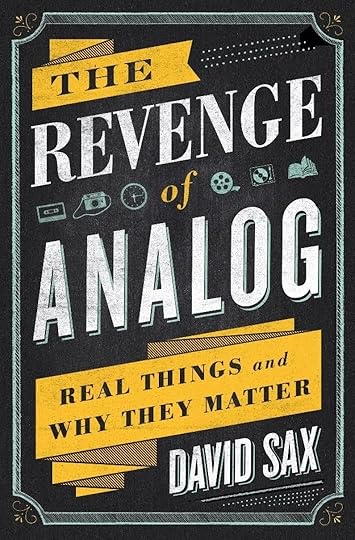
I was curious about this trend so I sat down with David Sax, author of the excellent new book The Revenge of Analog: Real Things and Why They Matter.
Disclaimer: His publisher sent me a copy of the book gratis without further obligation.
Listen to our conversation below.
Loading the player …
Originally published on The Huffington Post. Click here to read it there.
The post The Revenge of Analog: An Interview with David Sax appeared first on Phil Simon.
December 21, 2016
My Most Popular Posts of 2016
Before hitting the publish button, no writer knows which posts will find an audience and which will find crickets. Sure, there are plenty of headline-analysis tools out there, but make no mistake: blogging still inheres a great deal of unpredictability.
Blogging still inheres a great deal of unpredictability.
Plenty of times, I’ve penned what I thought was a pretty solid musing only to find its page views wanting. By the same token, some of my fairly prosaic posts have garnered far more traffic than I would have expected.
Without further ado, here’s a list of my most popular posts from this year:
Reporting vs. Analytics
Big Data and Teenage Sex
Why I Quit the Web‑Design Business
Which Is Better? Role‑ or Process‑Based Training?
Five Tips for a Successful CRP
Working with Partners: The Case for Actually Talking
Kranzberg’s Six Laws of Technology
Poker, Predictive Analytics, and Big Data
6 Radical Ways to Reduce E‑Mail
Dilbert and Big Data
In case you’re wondering, according to WordPress this was my least popular post. Feel free to show it some love by clicking on it.
The post My Most Popular Posts of 2016 appeared first on Phil Simon.
December 14, 2016
Korean Version of Too Big to Ignore


Well it took a while, but I’m pleased to announce the publication of the Korean version of Too Big to Ignore. This is the book’s second translation. Wiley produced a Chinese version back in May of 2015.
The post Korean Version of Too Big to Ignore appeared first on Phil Simon.
December 12, 2016
Traditional Data Warehouses Can’t Do it All

Introduction
As part of my new professor gig, I teach CIS405 (Business Intelligence) at the W. P. Carey School. It’s an online course that demonstrates how students can turn raw data into intelligence, insights, analytics, and, ultimately, better business decisions.
 When I think about contemporary business intelligence, data mining, data visualization, data warehousing, and analytics, I find it difficult to explain simply where one ends and the others begin. On the contrary, there seems to be a great deal of overlap among these terms and concepts. To be sure, things are muddier than ever here.
It’s more clear that ever, though, traditional data warehouses will not store every type of information relevant to an enterprise. To paraphrase Kevin Hart, let me explain why.
Limitations of Traditional Data Warehouses
I’m no expert, but I’ve worked around data warehouses (DWs) for a long time. Sure, they can store a great deal of data from different sources. Make no mistake, though: This benefit is concurrently a limitation. That is, DWs require very specific and static structures and categories. The word flexible certainly doesn’t come to mind. (This problem is more acute when organizations lack a proper data-warehousing strategy.) Collectively, these rules and decisions restrict the types of analysis that organizations can perform.
Despite their considerable warts, mature BI and DW tools will remain in place for decades.
For years, data warehouses represented the best that we could do for data storage and consolidation. Not anymore. Hadoop and other NoSQL databases inarguably represent the future of data storage. Some have even that DW appliances will go the way of the Dodo. Ditto for the “traditional” single-database implementation of a DW.
Fortunately, there’s good news for those looking for more flexible data-storage, reporting, and infrastructure solutions. New tools can handle significantly faster, larger, and more diverse datasets—and offer real-time analytics in the process. (This is essential, as data streams will doubtless increase in the future with no end in sight.)
Simon Says: Get ready to embrace new data-management tools.
Brass tacks: Despite their considerable warts, I don’t doubt for a minute that mature BI and DW tools will remain in place for decades, particularly at mature organizations that have spent millions configuring them just right. Old habits die hard.
Many CXOs of mature organizations will eventually realize, however, that new data varieties, velocities, and volumes [PDF], simply won’t play nicely—if at all—with traditional data-management and -storage tools.
Feedback
What say you?
This post was brought to you by IBM Global Technology Services. For more content like this, visit IT Biz Advisor.
The post Traditional Data Warehouses Can’t Do it All appeared first on Phil Simon.
December 6, 2016
Big Data and Hype: Where Are We Now?

Introduction
Sure, most of us have heard some fascinating success stories:
Netflix uses a fascinating pastiche of information to predict movie preferences.
Target knew about a teenager’s pregnancy before her own father did.
But are most everyday business users and organizations really doing anything with Big Data?
I’ve been saying for years that the hype exceeds the reality. I was curious to see if that remained the case at the Evanta CIO Summit in Phoenix, AZ. (I spoke there and participated in a roundtable about the adoption of Big Data—or lack thereof.)
If the attendees I met served as a representative sample, it’s clear to me that we are still in the early innings. As for why this is the case, allow me to posit a few reasons.
The Hype Lives On
First, there’s still widespread confusion about the very definition of Big Data. That’s arguably just as true today as it was when Wiley published Too Big to Ignore in 2013.
There’s been an explosion in the number of tools that can handle, process, and store unstructured data.
Second, there’s been a veritable explosion in the number of tools that can handle, process, and store unstructured data. Sure, Hadoop is the elephant in the room (pun intended), but there are many NoSQL ways to make sense of Big Data. The CIO across from me recently spearheaded his organization’s Cassandra efforts.
Third, thanks to the rise of application program interfaces (APIs), it has never been easier for organizations to capture data that lies outside of their perimeters. That’s all fine and dandy, but what do you do with it? Isn’t that the more important question?
Here’s where things at the conference got pretty interesting. The CIO from Republic Services mentioned how the company grabs information from the Twitter firehose. During a winter storm last year, a customer tweeted a picture of an overturned trash container with the note “Thanks #Republic.”
What type of signal does that represent? Was the customer thanking Republic for doing its best to pick up trash under wintry conditions? Or was the customer ridiculing the company for turning over its container and forcing her to pick it up? Put differently, was said tweet praise or criticism? If a human being can’t make this determination, then how can a computer? (One thought: Perhaps subsequent tweets or mentions on other social-media sites might provide clues as to her intent.)
Simon Says: We’re getting there…slowly.
Brass tacks: Despite claims still contrary, “everyone” is most certainly not “doing” Big Data—and I don’t see that changing soon. It’s evident to me, though, that more organizations that ever are considering taking the plunge. In my view at least, that represents some form of progress. We’ve still got a long way to go.
Feedback
What say you?
This post was brought to you by IBM Global Technology Services. For more content like this, visit Point B and Beyond. The post Big Data and Hype: Where Are We Now? appeared first on Phil Simon.