Phil Simon's Blog, page 52
November 25, 2016
Reflections on 2016
To say the least, 2016 has been an interesting year on many levels. For starters, I wrote less that at any point since 2007. (As usual, I churned out a bunch of data-related posts for SAS.) New friends came and some departed.
I have a great deal to be thankful for.
Brass tacks, I have a great deal to be thankful for. Highlights include:
I started my new position as a lecturer at ASU. About a year ago, I set out to obtain a full-time professor position at a progressive school and I did just that.
Message Not Received won an Axiom Award.
The publication of the Chinese Version of The Visual Organization.
Having coffee for an hour with Steve Hogarth of Marillion was surreal. I had interviewed him before a bunch of times for The Huffington Post, but I’ll never forget the happenstance of seeing him on the street that Saturday morning in San Francisco. For an hour at Starbucks, we talked about politics and life.
Interviewing Steve Rothery, Mark Kelly, Roger Hodgson and John Petrucci didn’t suck either. HuffPo may not pay me a nickel, but there are forms of payment beyond money.
Click to view slideshow.
On the downside, the US presidential election left me gutted, scared, and confused. Now that I’m past the shock, I need to understand the outcome. To this end and on a friend’s recommendation, I am reading The Righteous Mind: Why Good People Are Divided by Politics and Religion.
The post Reflections on 2016 appeared first on Phil Simon.


November 10, 2016
Compliance: Boring but Essential

This August I joined the faculty at the W. P. Carey School Business at Arizona State University. Along with a course on analytics, I also teach the capstone course CIS440: Systems Design. In a nutshell, this means that students (all seniors) work on real-world projects throughout the semester. Put differently, this is no theoretical course. My students are developing valuable experience that will not only help them interview for full-time positions, but help them throughout their careers.
As part of the course, I’m stressing the importance of effective communication skills. Of course, I want my students to develop neat apps, websites, and/or databases for their project sponsors. Still, that is unlikely to happen if the former can’t articulate themselves to the latter.
And it’s no overstatement to say that they have wowed both their de facto clients and me. In only one month, these groups of students built some pretty powerful and visually appealing prototypes. No, they weren’t perfect, but Agile methods such as Scrum don’t aim for perfection—especially at the beginning.
Compliance: An Essential Hygiene Factor
I’ll be the first to acknowledge the wow factor of spiffy website design and functionality. While not sexy, though, I’ve also made sure that my students understand the importance of hygiene factors such as compliance.
Few companies brag about compliance-related matters. That doesn’t make them any less critical, though.
Admittedly, this isn’t the first thing on my students’ minds as they roll up their sleeves eager to code. Today there is no shortage of rock-star developers and code ninjas, but their compliance counterparts remain few and far between. What’s more, few companies brag about their compliance. Ditto for different forms of governance and risk management. Generally speaking, executives consider these areas to be necessary evils—i.e., costs of doing business. They really don’t serve as true differentiators or ways of sustaining competitive advantage.
But that’s not the right—or, at least, the entirely right—way of looking at things. Here’s a better question: What are the costs of not taking compliance and governance seriously?
High-profile compliance scandals over the last year, however, make it easy for me to underscore their import. To boot, we read The Phoenix Project by Gene Kim midway through the semester. Among other things, his book emphasized the costs of ignoring compliance- and governance-related matters.
Simon Says: Ignore compliance at your own peril.
You don’t have to be a career auditor or compliance expert to understand that compliance matters more than ever. In fact, some of the same analytic and technology tools can decrease the chances that organizations find themselves in hot water.
Feedback
What say you?

 This post was brought to you by IBM Global Technology Services. For more content like this, visit Point B and Beyond.
 The post Compliance: Boring but Essential appeared first on Phil Simon.
November 3, 2016
An Interview with Roger Hodgson

Roger Hodgson has been at it for a long time. The ex-Supertramp member and über-talented multi-instrumentalist has been touring North America to the delight of fans everywhere.
I discovered Hodgson’s music at an early age. (As a kid, my first four albums were Rush’s Moving Pictures, Genesis’ Abacab, Styx’s Paradise Theater, and Supertramp’s Breakfast in America.) Since the time that he departed Supertramp, I have enjoyed his solo material.
Today I have the honor of speaking with him about his current lineup and tour, future plans, and the music industry.
Loading the player …
Check out one of his clips here:
The post An Interview with Roger Hodgson appeared first on Phil Simon.
How Basic Analytics Can Prevent Compliance Debacles
Not that long ago, Zenefits was nearly a five-billion-dollar unicorn. It could seemingly do no wrong until things broke bad. Really bad—as in we need a new CEO, message, and culture.
It’s unfair to demonize—or at least single out—Zenefits. Plenty of companies have caused themselves, employees, customers, and shareholders a great deal of grief by pooh-poohing compliance. SOX may not be perfect, but rest assured: As recent events prove, corporate fraud is lamentably alive and well.
Technology and Data Can Improve Organizations’ Compliance Efforts
As much as I believe in the twin powers of technology and data, make no mistake: They alone will never eliminate greed. All of the software and analytics in the world can’t possibly stop certain employees and corporate officers from either looking away or failing to investigate ethics claims. Still, it’s folly to believe that organizations’ compliance efforts would not benefit from enhanced technology and data.
In fact, in many cases, astonishingly simple database queries can prevent major crises. For instance, consider the following fictional data on new accounts set up at bank XYZ:
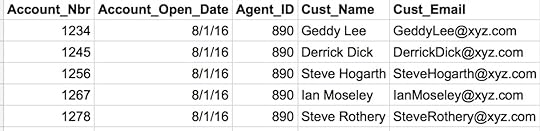
Data and audits may not prove anything, but they often serve as warning signs of potential internal fraud.
It doesn’t take a data scientist to see what’s going on here. Rep #890 seems to be setting up quite a few accounts for XYZ employees. Either he is particularly good at networking or something untoward is going on. If it’s the latter, then this rep isn’t adept at covering his tracks. (E-mail domain is remarkably suspicious here.)
Note that the data above doesn’t “prove” anything, but it should certainly serve as a warning sign of potential fraud and abuse.
Along these lines, why not set up alerts on similar types of potential issues? Off the top of my head, they may include:
Reps who set up an inordinate number of accounts in a single day.
Reps who set up an inordinate number of accounts from a single organization in a single day.
Reps who set up an inordinate number of high-margin accounts in a single day.
Simon Says: Reduce the odds of fraud with simple analytics.
I could go on but you get my point: Equipped with even basic reporting and analytics, audit and compliance personnel can prevent an organization from PR nightmares, lower stock price, and client lawsuits. Collectively, they’ll reduce the odds of employee fraud and the severity of it when it does take place.
Feedback
What say you?
This post was brought to you by IBM Global Technology Services. For more content like this, visit Point B and Beyond. The post How Basic Analytics Can Prevent Compliance Debacles appeared first on Phil Simon.
October 23, 2016
The Visual Organization: Chinese Version
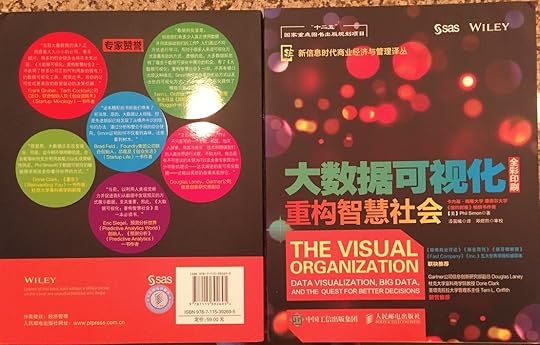
I’m pleased to announce that The Visual Organization is now available in Chinese. Props to the folks at Wiley and SAS Press.
好消息
The post The Visual Organization: Chinese Version appeared first on Phil Simon.
October 10, 2016
The Case Against Analytics Projects

 Back in 2014, I spoke at Netflix headquarters about The Visual Organization. From the moment I entered the building, I detected a decidedly different vibe compared to most organizations on my book tour.
Perhaps it began with boldly displayed Tech Emmy in the company’s lobby. (See selfie.) It continued with the data visualizations on the wall and the overall tech-savviness of the employees to whom I spoke. To be sure, it was an unforgettable experience.
Since that time, I have reflected on the two hours I spent at the streaming-video giant quite a bit. Put simply, Netflix made quite an impression on me. No wonder that it’s one of the most successful companies of the Internet Age. Sure, it built a better mousetrap, although it hasn’t batted 1.000. No doubt that Blockbuster (remember Blockbuster?) grossly misjudged consumer trends. Still, something about my Netflix experience stuck with me.
A Different Mind-Set
Compared to the many organizations that approach analytics as traditional IT or business “projects.” Netflix does not. It goes against the grain—and it’s hard to argue with its results. I’d also put Facebook, Amazon, and Google Alphabet in the same boat. These companies routinely use analytics to make decisions. Put differently, they don’t treat analytics as one-time projects. They consistently build upon—and augment—their knowledge by embracing new data sources. They have built infrastructures that support instant analysis of complex data sources and types.
Is the project mentality so prevalent in most organizations understandable? Sure, but it’s also pernicious. The project mind-set actually encumbers organizations from embedding analytics into their cultures—something that has never been more essential.
Companies such as Netflix routinely use analytics to make decisions.
For starters, projects by definition inhere beginning and end dates. Make no mistake: this is a problem in the context of analytics. All too often in decade of experience working on IT projects, employees pooh-pooh new responsibilities and ways of working because “things will go back to normal” when the project concludes. This is especially true if the project doesn’t go as planned. (If you think that that’s a trivial concern, let’s not forget the dismal record that companies sport implementing new technologies.)
Beyond that, a project mindset contravenes the notion of continuous delivery, something that more and more organizations are rightfully adopting. Management at intelligent organizations—such as the ones referenced above—recognizes that analytics are never “finished.” Rather, they need to be consistently refined, audited, expanded, and even retired.
Simon Says
This is not to say that organizations should embrace Waterfall-like methods to creating new analytic tools. On the contrary, Agile methods are far better suited for this type of work precisely because they recognize that the work is never done.
Feedback
What say you?
This post was brought to you by IBM Global Technology Services. For more content like this, visit Point B and Beyond. The post The Case Against Analytics Projects appeared first on Phil Simon.
October 3, 2016
What’s holding back organizations’ analytics efforts?

I’m knee-deep into my new position teaching at the W. P. Carey School at Arizona State. One of my courses is CIS450: Enterprise Analytics. In it, seniors undertake a capstone project designed to provide real-world experience. They work with organizations that want to delve into their data and understand their businesses better. It’s a group-based internship on steroids.
Sounds promising but, since I’m new to the Phoenix area, I wondered whether or not I’d be able to wrangle together a sufficient menu of projects for my students. It turns out that my concerns were misplaced. On the contrary, there was no shortage of organizations whose representatives were willing to volunteer their organizations. In fact, I had to reject several companies’ proposals. (No bother. There’s always next semester.)
My students will soon enter what appears to be a great job market for those with advanced quantitative skills. Based upon their somewhat limited experiences, though, they may walk away with the impression that all companies want to use data and analytics to garner valuable insights. Unfortunately, nothing could be further from the truth. The term selection bias certainly comes to mind.
Unmistakable Trends
The trend towards analytics is unmistakable. Exhibit A: Google Trends over the past twelve years:
Clearly more people are searching on the term analytics compared to the mid-aughts. But are more organizations actually making data-based decisions? The evidence points to the affirmative. Consider this IBM report that suggests as much:
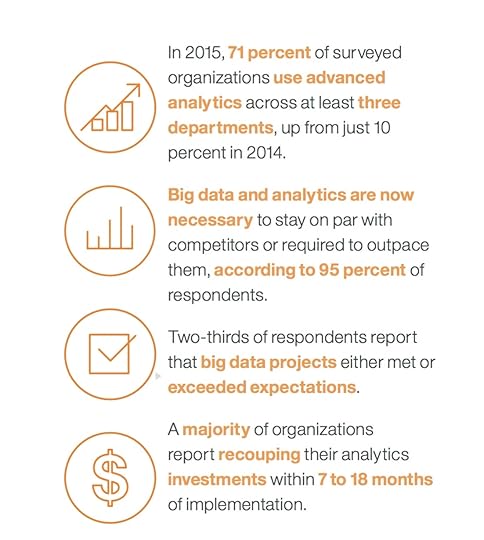
These types of numbers don’t surprise me, but I started thinking about why even more organizations haven’t taken the plunge. I’ve not seen compelling data on why so many laggards remain, but I can say this: the reasons clearly aren’t technological or even financial. (Data storage has never been cheaper.) They’re human, cultural, and organizational.
Make no mistake: the trend towards analytics is unmistakable.
As I know from my research and consulting experience, plenty of people are embracing analytics. Perhaps we’ll get to a point at which we’ll use analytics as frequently as we send e-mail. We’re certainly not there yet, though. Far too many folks at successful and mature organizations are unable—or, more likely unwilling—to look at issues through a data-oriented lens.
In no particular order, these folks fall into the following buckets:
Some are dataphobes and have been ever since they began their careers.
Others generally fear change and what data may manifest. Maybe they’re not doing their jobs as well as they can. Maybe their decisions don’t stand up to scrutiny—and they don’t want to ask the question.
Then there are those who claim to be “too busy” to learn new applications and methods, but odds are that they’re just trying to bide time.
Simon Says: As usual, the soft stuff is the hard stuff.
For a long time now, progressive organizations have been using data in interesting ways. Does that mean that everything can be quantified? Of course not, while rare, data-centricism can drive good employees to quit. Finally, there’s still a case to be made for strong product leadership and risk-taking irrespective of what “the data” suggest. (Cue alleged Henry Ford quote.)
Until senior managers force recalcitrant employees to get with the analytics program, expect more excuses than action from groups, departments, and entire organizations convinced that analytics doesn’t apply to them.
Feedback
What say you?
This post was brought to you by IBM Global Technology Services. For more content like this, visit Point B and Beyond. The post What’s holding back organizations’ analytics efforts? appeared first on Phil Simon.
September 17, 2016
A Life in Parts by Bryan Cranston

Bryan Cranston’s journey as an award-winning and critically acclaimed actor has been anything but linear. Long before he ascended to the top of his profession, Cranston faced no shortage of personal and professional challenges—including many lean years when the phone wasn’t ringing nearly as often as it is today. As an enormous fan of Breaking Bad and his work since then, I had heard him talk about many aspects of his life during in-depth interviews. (His two-hour chat with Kevin Pollak was particularly enlightening.) Still, I wanted to know more about how he became, well, him.
Against this backdrop, I recently finished Cranston’s memoir A Life in Parts. (Disclaimer: Cranston’s publisher Scribner sent me an advanced review copy sans obligation.) In a word, it’s excellent.
From the first few pages (not unlike the pilot of Breaking Bad), Cranston draws the reader in. He begins not in chronological order, but by detailing one of the series’ most gruesome scenes. (Spoiler below.)
The words emotionally draining don’t begin to describe what he was feeling. He imagined not letting an actress choke to death on her on vomit, but his own daughter. It turns out that Cranston regularly draws upon his own demons and rich array life experiences to bring his characters to life. Throughout the book, Cranston fuses his personal and professional life in a way that’s nothing short of riveting. For instance, he describes how a toxic relationship with an unstable woman in Manhattan served as acting fuel years later when he inhabits the increasingly dangerous Heisenberg. Cranston notes that we all have the ability to break bad under the right circumstances.
This is an engrossing first-person account by one of our finest actors and I couldn’t put it down.
A Life in Parts is anything but juicy tell-all. Cranston doesn’t superfluously dish dirt about petty behind-the-scenes skirmishes. At the same time, though, he’s not afraid to detail a conflict about a small but critical acting-related disagreement. As one might expect, not everything was hunky dory all the time on his shows and movies. For instance, there were plenty of politics and back-and-forth on the soap opera Loving. Cranston also reveals a few pointed conflicts about specific lines and plot points on Breaking Bad.
Fascinating Insights into the Creative Process
The insights into his mind-set as an actor are fascinating. Cranston is no method actor, but you get a sense of just how much he inhabits or occupies the person of his characters. The man is nothing but committed, and in the book you get a sense of just how much. To this end, I found his approach to different acting roles and auditions fascinating. (It turns out that he uses a very simple but effective system for evaluating his next move.)
All throughout the book, one gets the sense of an honest and humble yet confident actor, son, husband, and father. On his first marriage, Cranston writes that he was just too young. What’s more, as he’s mentioned in interviews, Cranston believes firmly in luck. Looking for a five-point plan to become a successful actor? Good luck with that. It just doesn’t exist. Working hard is necessary but not sufficient to achieve one’s goals. Put differently, A Life in Parts is no preachy, “how to be like me” memoir. It’s an engrossing first-person account by one of our finest actors and I couldn’t put it down.
Rating: 5/5 stars
Originally published on HuffPo. Click here to read it there.
The post A Life in Parts by Bryan Cranston appeared first on Phil Simon.
September 8, 2016
Does your organization’s infrastructure support Big Data?

In my last post, I argued that many organizations suffered from antiquated tech infrastructures that enhanced startups’ inherent advantage. The results are often disastrous: The recent Yahoo! deal proves that no company—no matter how iconic—is guaranteed a permanent seat at the table.
I’ll be the first to admit that organizations cannot significantly alter their tech infrastructures overnight, much less willy-nilly. Contrast this with the widespread software development orthodoxy. Agile methods and lean principles allow proper developers and DevOps folks to add features in an iterative way. If something breaks, then they fix it. It’s hard to think of complex “back ends” in a similar manner.
Still, there’s no doubt that, compared to prior decades, infrastructures are more flexible than ever—or at least they can be. To explain why, a little history lesson is order.
The Rise of Cloud Computing
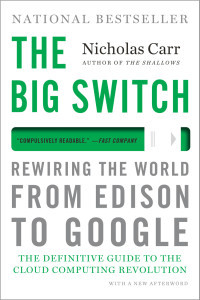 Remember that up until the early 20th century, most large American companies produced their own electricity. (No, I’m not kidding.) Eventually, however, they realized the silliness of this practice and relented. Rather than worrying about power supplies, they generally focused on their core competencies. (For more on this, see The Big Switch: Rewiring the World, from Edison to Google by Nicholas Carr.)
A similar shift is taking place thanks to the rise of cloud computing—and has been for a decade now. Today, it’s never been easier and less expensive for organizations to add compute power. With a few clicks of a mouse, organizations can provision additional resources. What’s more, unlike the 1980s and 1990s, they need not host all of their own servers onsite. Finally and perhaps most important, organizations can change the way in which they account for their technology. Operational expenses replace capital expenditures. (If you think that this is simply a meaningless accounting exercise, think again.)
All of this beg the questions, So what? Why does any of this even matter?
Simon Says
All companies are becoming tech companies.
Put simply, the business world has never moved faster. All companies are becoming tech companies. Also, as I write in Too Big to Ignore, Big Data is no longer the luxury that it once was—and I’d put its cousin analytics in that same boat.
Playing around in Excel with lists of customers, sales, employees, and other structured transactions simply won’t cut it anymore. Without tapping into large amounts of unstructured data, organizations will not be able to understand critical customer, employee, product, and business trends. Ditto for new data sources. But how many organizations’ current infrastructures can store this data—much less analyze it—in a meaningful way?
Not enough.
Feedback
What say you?
This post was brought to you by IBM Global Technology Services. For more content like this, visit Point B and Beyond. The post Does your organization’s infrastructure support Big Data? appeared first on Phil Simon.
September 1, 2016
Why Legacy Infrastructure Holds Large Organizations Back

Throughout history, many organizations dominated their industries by virtue of their sheer size. That is, organizations that reached a certain level of revenue and/or market share could expect to realize some level of prolonged success—even with legacy infrastructure and technologies. To paraphrase from Seinfeld, to the victor belonged the spoils.
By and large, however, this is no longer the case. Today and often without much warning, startups and small companies disrupt incumbents quickly. (For more on this, see The New Small.) Uber, AirBNB, and other on-demand companies are cases in point.
Thorny People Issues
At a high level, these upstarts often do many of the same things as their larger brethren do. These ambitious newbies just do them better, quicker, and/or cheaper. For instance, Uber provides quick and affordable rides without the hassle of calling a cab and coordinating location.
Of course, in a fundamental way, it’s always been easier for startups to usurp or leapfrog incumbents. Has this always been the case? Sure. For instance, by starting over after World War II, Japan was able to quickly modernize its infrastructure, grow like a banshee, and establish itself as a manufacturing behemoth. It didn’t have to supplant legacy technologies.
At an enterprise level, greenfield sites need not deal with employee training, thorny data and integration issues, etc. I’ve said many times that there’s no magic “cloud” switch that ports mature applications to more modern delivery methods. Mature organizations further suffer from an ability to subtract and simplify. That is, they’ll add new applications, technologies, and components without retiring antiquated ones. The resulting morass of system eye charts and drive many CIOs to drink.
And let’s not forget the other elephant in the room: aversion to change, especially at high levels. As I’ve seen firsthand, plenty of CXOs are loathe to retire “their” applications. Personal pride stands in the way of updating antediluvian applications and technologies. These execs often block any attempt to modernize a company’s infrastructure.
Cultural, regulatory, and internal political issues impede many organizations.
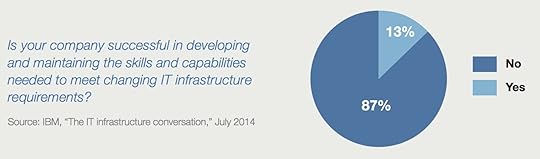
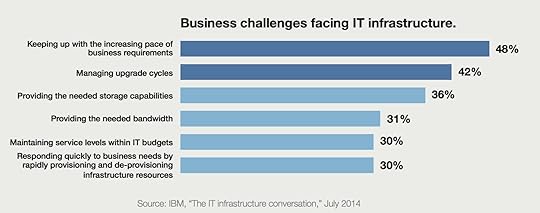
Brass tacks: Lamentably, many organizations these days today can’t act quickly enough to respond to market conditions, but don’t take my word for it. IBM’s white paper makes the case that IT infrastructure prevents quite a few companies from meeting new business requirements and capitalizing on new opportunities.
For more on allow IT to live up to its promise, click here.
Simon Says: Consider subtraction as well as addition.
There’s no simple solution to this problem. Cultural, regulatory, and internal political issues hamstring many organizations and enhance startups’ inherent advantage. Perhaps its best for C-level execs to think about how quickly their organizations can respond to new opportunities. If it takes too long, then adding more complexity only exacerbates matters. Consider subtraction by subtraction, not by addition.
Feedback
What say you?
This post was brought to you by IBM Global Technology Services. For more content like this, visit Point B and Beyond. The post Why Legacy Infrastructure Holds Large Organizations Back appeared first on Phil Simon.