Phil Simon's Blog, page 57
January 11, 2016
The Perils of Jargon and Excessive E-Mail
A few months ago, I stumbled across Josh Bernoff’s excellent blog Without Bullshit. Josh writes frequently about a subject near and dear to my heart: the prevalence and inimical effects of jargon.
x
Needless to say, we hit it off.
 Josh recently interviewed me about my most recent book Message Not Received. I’ve done probably 30 interviews since the book hit the shelves last March, but his questions were particularly astute:
Your main point is that most business communication does not work. Explain what you mean by that.
You and I agree that most workers these days are overwhelmed with information. What’s your evidence? And if you’re right, what does that mean for the work they do?
You may be the most intrepid jargon fighter out there. Why do you think there is so much jargon in our workplace communication?
What jargon have you noticed lately that’s especially pernicious?
E-mail is basically the circulatory system of most organizations. Everything flows through it. And yet, you say it’s not a good tool for collaboration or efficiency. What’s wrong, and how should we fix it?
You’re a fan of inbox zero. I just let it all flow by me—my inbox is where I find whatever I need. What’s wrong with my strategy?
What’s the worst sentence you’ve ever read in a business setting? And how would you reword it?
Since you published your book, have you seen any hopeful signs that the world is getting better?
To read my hopefully informative answers, click here.
The post The Perils of Jargon and Excessive E-Mail appeared first on Phil Simon.


January 8, 2016
6 Radical Ways to Reduce E-Mail

The word radical is one of my favorites. It stems from the Latin word for root, radix. In fact, the English term doesn’t veer that far from its Latin origins. Among its meanings is “arising from or going to a root or source; basic: proposed a radical solution to the problem.”
To be sure, some ostensibly intractable business problems require radical solutions—and e-mail is a perfect case in point. As the statistics below manifest, it’s no overstatement to call e-mail an epidemic in many organizations.

Click to embiggen.
“E-mail today is like playing whack-a-mole on groundhog day,” says Graeme Bodys, CEO of nooQ, a communication platform that collects and stores the powerful knowledge of your team.” Trying to keep on top of it is never-ending. We need to change that.”
It’s obvious that traditional e-mail prevention and minimization methods just aren’t working in many if not most organizations. Although far superior tools for collaboration and communication have existed for years and new ones show great promise, employees by and large frequently opt not to use them. Maybe it’s time for something more draconian. Even radical.
Without further ado, here are six some not-so-subtle methods that organizations can employ to reduce employee inboxes:
Mandatory Employee Per-Message Deductions
What if we effectively taxed those who e-mail too much?
Imagine a five-cent per-message “tax” of sorts. If you send 100 per day, then you’ll be fined $5. After two weeks, you’ll see a $50 deduction on your paycheck. (Think of this as a swear jar of sorts.) All money goes to charity.
Variations
Employees are only taxed above a reasonable and pre-defined number, say 50 e-mails per day.
Employees are taxed 10 cents each for all messages sent after normal work hours and on weekends.
Public Praise (The Carrot)
Award prizes for employees who reduced their sent messages by the greatest number or percentage from the previous week, month, or quarter.
Public Shaming (The Stick)
This is the antithesis of number two. Post the names of the worst offenders (e.g., those who send the most internal e-mails) in a public place. This can be a physical lobby of public area, an intranet or collaboration cool, or, better yet, both.
Remove the “Reply All” Button from Your E-Mail Software
“Reply all” just plain sucks. By all accounts, that scourge costs companies millions of dollars per year. Fortunately, you can kill it relatively easily in at least one mainstream application: Microsoft Outlook. Alternatively, you can tweak the button to theoretically discourage the behavior via a plug-in.
Eliminate E-Mail for Internal Use Altogether
Sounds impossible, right? Nope. That’s exactly what Klick Health did more than a decade ago. I learned about the company researching Message Not Received: Why Business Communication Is Broken and How to Fix It. (Read about its innovative e-mail alternative and incredible results here.)
This begs the natural question: What replaces e-mail?
“We need an entirely new design,” Bodys tells me. “We need to make people more productive—not less.” For its part, Nooq’s software automatically filters, sorts, and processes messages for employees.
Intentionally Antagonize Colleagues via Your Auto-Responder
This might get you in hot water, but I know of a few techies who have done exactly that in their companies. They’ve declared e-mail amnesty in their auto-replies and ask people to either call them (remember the phone?) or walk over to their desks. And, best of all, they actually mean it.
Originally published on Huffington Post. Click here to read it there.
The post 6 Radical Ways to Reduce E-Mail appeared first on Phil Simon.
January 5, 2016
Big Data and Confirmation Bias

“If you torture the data long enough, it will confess.”
—Ronald Coase
The new year has arrived. As such, it’s tough to call Big Data new anymore. (It’s been on my radar a tad under five years, and Wiley published Too Big to Ignore in March of 2012.) Recent technologies such as Hadoop have matured during that time. Still, tech alone only gets us so far. The need for education on the topic is as strong as ever—if not more so.
Put differently, there’s no shortage of widely held myths around Big Data. Perhaps the most dangerous is that Big Data knows all and that it obviates the need for human judgment. The almighty “data” will unequivocally tell us what do do and when and how to do it. In this way, data is like Gabbo from The Simpsons.
x
Nothing could be further from the truth, but don’t take my word for it.
The Essential and Oft-Ignored Human Element of Big Data
Speaking at the recent Rich Data Summit, Nate Silver of 538 said, “Data is a lot messier and noisier than people want to acknowledge.”
I’ll let that sink in for a moment.
 As anyone with a modicum of statistics knowledge knows, even mature, ostensibly “objective” statistical and quantitative methods such as regression analysis don’t run themselves, even on small datasets. They require key human elements (read: judgment and decision making). This is why there’s a world of difference between an analyst and a true data scientist. Because of this, they are far from perfect. With regard to regressions, frequent errors from newbies include:
Neglecting key independent variables.
Stating that a relationship exists among variables when one does not (and vice-versa).
Getting the causal chain completely wrong. (For instance, saying that A causes B when B causes A.)
What’s more, we make these mistakes both inadvertently and intentionally. (For more this, see Eli Pariser’s excellent book The Filter Bubble [affiliate link].)
This begs the question, How do we square this circle? How can we realize the legitimate benefits of Big Data while minimizing the chance for error?
Simon Says: Big Data and confirmation bias go hand in hand.
Big Data does not obviate the need for human judgment.
Remember the following when getting started with Big Data. First, recognize that confirmation bias is alive and well. If you’re intent on finding something, you will. The more important question is, What else are you missing?
Second, question everything. Far too few people are willing to go where the data takes them. This is especially pronounced as they ascend to senior levels within organizations. Many senior folks are loathe to challenge preexisting assumptions and to question what they know. At the same time, though, Big Data does not negate or minimize the importance of intuition.
Feedback
What say you?
The post Big Data and Confirmation Bias appeared first on Phil Simon.
December 8, 2015
How Big Data Enables Competitive Intelligence
Six months ago, embattled social network Twitter was set to announce its quarterly earnings. As is custom for publicly traded companies, the investor call was scheduled to take place after the markets closed (read: 4 pm EST and 1 pm PST). Yet, a company named Selerity somehow tweeted the following nearly an hour before the bell rang:
#BREAKING: Twitter $TWTR Q1 Revenue misses estimates, $436M vs. $456.52M expected
— Selerity (@Selerity) April 28, 2015
Make no mistake: This was no minor incident. Spooked investors fled the stock and Twitter’s market cap plunged by $8 billion.
Don’t Call it a Hack
The obvious question is how? By way of background, as Dan Simmons wrote, Selerity is:
a tech start-up running a very specific service catered to investors. It automatically scans all sorts of documents, press releases, and social media online and looks for anything that could prove useful to investors. It then reports back to subscribers with what it describes as real-time actionablea word that I truly despise intelligence.
(That’s a far better description of Selerity’s raison d’etre than the jargon-laden one on its website: “Drive engagement by integrating high-quality content into your enterprise application personalized to your user’s workflow and interests.” But I digress.)
Put crudely and in plain English, Selerity makes money by scraping web data, a business that other companies have entered.
This begs some ethical questions: Were Selerity’s actions tantamount to hacking or corporate espionage? Or were they just due diligence and even good business?
However embarrassing for Twitter, the case for malfeasance is weak. After all, someone at Twitter had foolishly posted this vital financial information on a fairly obscure web page. (For a detailed timeline of the events behind the Selerity research and tweet heard around the world, click here.)
Today’s $TWTR earnings release was sourced from Twitter’s Investor Relations website https://t.co/QD6138euja. No leak. No hack.
— Selerity (@Selerity) April 28, 2015
Nope, actions such as these represent smart business in an era of Big Data. In this case, Selerity obtained this publicly available information and promptly alerted its clients. Let’s not kill the messenger. Shame on Twitter for making yet another costly mistake.
The Apple Car: No Surprise at All
 And this is hardly an isolated case of how Big Data enables competitive intelligence. Before Apple officially announced its plans to build an electric car by 2019 in September, The Financial Times reported the following (paywall):
Apple is recruiting experts in automotive technology and vehicle design to work at a new top-secret research lab, according to several people familiar with the company, pointing to ambitions that go beyond the dashboard.
Play offense and defense with your data.
Kudos to FT, but most business journalists pay attention to the world’s most valuable company. Plenty of other media outlets were gathering evidence and connecting the dots as well. For instance, a series of job postings may provide a valuable window into an organization’s future strategy, product launch, or acquisition.
Simon Says: Play offense and defense with your data.
As I write in Too Big to Ignore, intelligent companies of all sizes are increasingly using new data types and sources to find the signals in the noise. Competitive intelligence is potentially more valuable than ever. In this case, Twitter investors who acted on timely information by selling saved themselves a great deal of money. For its part, Selerity received extremely favorable publicity that no press release or PR campaign could approximate.
For more on this, see The Electric Possibilities of Big Data.
Feedback
What say you?
 This post was brought to you by IBM for MSPs and opinions are my own. To read more on this topic, visit IBM’s PivotPoint. Dedicated to providing valuable insight from industry thought leaders, PivotPoint offers expertise to help you develop, differentiate, and scale your business.
The post How Big Data Enables Competitive Intelligence appeared first on Phil Simon.
December 7, 2015
Looking to Teach as a Visiting Professor in 2016

It’s been nearly two decades since I left academia, although I’ve come back a few times over the past five years. For instance, I’ve done a some book-related guest lectures and webinars at Carnegie Mellon University (Silicon Valley campus), the Santa Clara University, and Seton Hall University—among others. It’s fair to say, though, that I’ve spent most of the last 20 years of my professional life ensconced in the business world, not the academic one.
That’s not to say, though, that I haven’t disseminated more than my fair share of knowledge over the years in corporate settings. Nothing could be further from the truth. I’ve coached plenty of professionals on an individual basis. Beyond individual interactions, I’ve taught scores of formal classes and held seminars. In my conference talks and webinars, I’ve addressed tens of thousands of people.
And then there’s the body of work that I have amassed in the last six years. I like to think that it’s more than respectable. I’ve penned seven proper books and thousands of blog posts, articles, and white papers. (Idle hands are the devil’s workshop.) To be sure, as an autodidact, it has been quite the ride and I have learned a great deal about many topics.
Teaching for a few years would be a very rewarding experience.
Still, I’ve been thinking for a while now about shaking things up professionally. To this end, I have started searching for a full-time, multi-year position as a visiting professor or non-tenure-track faculty member at a prestigious university.
Why do this?
In no particular order, here’s a list of my main motivations:
My experience, research, and message and would benefit students right school and program. I can think of several types of programs whose students would find the message and lessons I can deliver valuable. Examples include MBA, information systems, data science, and/or analytics programs. Based upon some very encouraging exploratory discussions with a few professors and associate deans whose opinions I respect, I don’ think that I’m way off base here.
Teaching for a few years would be a very rewarding experience. I like teaching and the classroom environment. I always enjoyed my time in the classroom on both ends, and nothing has happened in the last two decades that makes me think that it would be any different this time.
Aside from just the general idea of teaching, it would be fascinating to explore contemporary platforms, management, technology, Big Data, and other topics of personal interest in an academic setting. It’s no overstatement to say that we are living in extraordinary times—ones that are challenging many traditional management and technological orthodoxies. I can think of no better time for detailed case studies, projects, discussions, and in-classroom exercises.
I know that I am a good teacher and public speaker. In grad school, I taught courses for three semesters as a teaching assistant. Upon graduation, I taught sexual harassment at CapitalOne and then moved on to software courses at Merck, Lawson Software, and as an independent consultant. As for public speaking, I would not be able to make a living it if I sucked at it.
Ideal Scenario and Other Logistics
I’m trying to be intelligent about my search. I want to find the right position, not just any one. With regard to location, I am pretty flexible. Ideally, I would begin in 2016. I would teach several classes per semester on my areas of interest and expertise. It would be great to either develop a new course or, at a minimum, participate in the creation of the syllabus for an existing course. Finally, for a bunch of reasons, I am not looking for a role as an adjunct professor.
Potential Course Subjects
I have broken potential course subjects into the following two areas:
Primary Topics
I believe that I am particularly well-suited to teach courses focused in the following areas:
platforms
management
The On-Demand Economy
collaboration
communication
business writing
public speaking and presentation skills
analytics
Big Data
data visualization
data management
project management
enterprise technologies (read: enterprise resource planning [ERP] and customer-relationship management [CRM]), cloud computing, open-source software, and SaaS.
Secondary Topics
I have researched and written extensively about the following topics, but not nearly as much as the ones on the left:
innovation
web design
disruption
data mining
business intelligence
mobility
social networks
consumer technologies
startups
small businesses
entrepreneurship
Feedback
Got any ideas or connections at schools? I’d love to chat with professors, deans, and their ilk. Contact me if you have any ideas.
The post Looking to Teach as a Visiting Professor in 2016 appeared first on Phil Simon.
December 4, 2015
The Relationship between Jargon and Credibility
Fifteen years ago, I worked for a particularly bad manager. Call her Dorothy here. She would consistently arrive late at client meetings. Once, she left a voicemail for a distraught client and lied about when she was calling. She forgot that voicemails are time-stamped, irritating the client further (The client soon had her removed from our project.)
Among Dorothy’s most egregious deeds, however, was her consistent and unnecessary use of jargon. I would see the looks on our clients’ faces when she would speak. She would condescend. She would talk “at” and “around” her audience, not to them. Big mistake. Dorothy soon took maternity leave and eventually left the company.
The more jargon you use, the more your credibility suffers.
My new manager Gary (again, a pseudonym) was a former application consultant. As such, he communicated in a simpler, far more forthright manner than Dorothy. Clients and employees just responded differently to Gary. He came across as less suspicious, even when he had to convey bad news.
This leads me to Simon’s Law of Jargon, graphically expressed as follows:
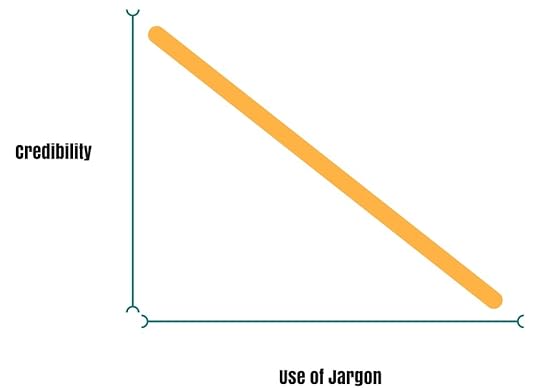
Put as simply as possible: the more jargon you use, the more your credibility suffers. (For recent research and a much more academic interpretation of this concept by Jochim Hansen and MichaelaWänke click here.)
Simon Says
Think about the next time you drop silly phrases such as “an experience flow seamlessly brings together all of the experiences throughout the infinity loop of customer engagement.”
Feedback
What say you?
The post The Relationship between Jargon and Credibility appeared first on Phil Simon.
December 1, 2015
An Open Letter to All Technology Partners

Dear CEO/CMO:
I get it. Really.
You believe that your products and services are best-in-breed. What’s more, they play nice with other enterprise technologies. That is, with a few mouse clicks, they can easily integrate with other important services such as Dropbox, Slack, Salesforce, and scores more. You know with every fiber in your being that every potential client out there would benefit a great deal from your offerings. They would dramatically reduce costs, understand its customers better, and ultimately increase revenue and profits.
Based on your role and your compensation, you want—nay, need—to sell your wares. If only those prospective clients could discovery your company, your know that your sales team could take care of the rest.
And therein lies the problem.
A Quick SEO Primer for Technology Partners
Search engine optimization (SEO) has always been important, and that’s certainly still true today. In case you’re unfamiliar with SEO 101, here’s a primer from Chitika, an “online ad network that delivers more than 4 billion strategically targeted ads each month to a network of more than 250,000 websites.” In June of 2013, the company released a study that proved what many marketers and technologists already knew: There’s tremendous power in occupying the top spot in Google’s organic search results. Consider the following data:
The top 10 results drive nearly 92 percent of all search traffic.
Results 11 through 20, inclusive drive another 4.8 percent.
Collectively, all of the remaining results drive less than 4 percent of Google search traffic.
Here’s a figure manifesting the enormous importance of rank from Message Not Received: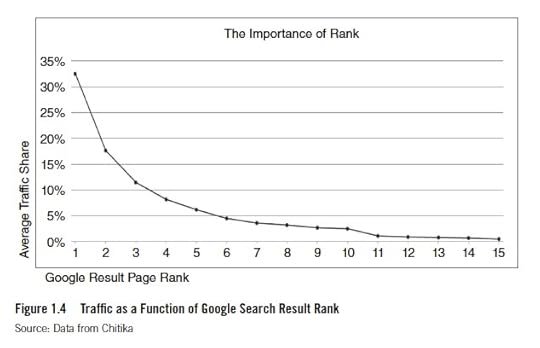
There’s tremendous power in occupying the top spot in Google’s organic search results.
To paraphrase William Gibson, SEO isn’t evenly distributed, nor is it remotely democratic. (Notice the fade to virtual oblivion.) As the data above shows, SEO is a classic power law. The lion’s share of the traffic goes to the top few sites.
 Put differently, for the vast majority of searches, your company website all but certainly falls in the long tail. Google a mainstream term such as Big Data or analytics. Your company’s site or blog post is most likely not going to magically appear on page one. It’s really hard to occupy the cherished real estate that is the top of organic results. Buying ads to rise to the top of results gets really expensive.
Against the backdrop of a cold, dispiriting algorithm, what should you do? As I see it, you have two choices:
Option A: Create new jargon-filled monstrosities such as Next-Generation Big Data Platform as a Service. That way, if a prospect searches for that very specific yet incomprehensible term, you’re very likely to get some clicks.
Option B: Use simple and straightforward language. Build your SEO organically. Embrace content marketing. Play the long game. To be sure, you may very well get fewer hits—at least at first. I’d wager, though, that those sessions will be longer and ultimately prove more fruitful. Yes, clarity has never been more important.
The Choice Is Yours
Option A might be tempting, but ask yourself about the quality of those clicks. Will they convert? Will a buzzword-fueled landing page result in meaningful leads, conversations, and conversions? I suspect that the more likely scenarios are user confusion and inaction. After all, who’s going to sign a contract with a partner without understanding what’s being purchased? Also remember that even well understood words such as diversity can lose their meaning. What does that say about newfangled ones that no one really understands?
The choice, though, is ultimately yours. What are you going to do?
Sincerely,
Phil Simon
This post was brought to you by IBM for MSPs and opinions are my own. To read more on this topic, visit IBM’s PivotPoint. Dedicated to providing valuable insight from industry thought leaders, PivotPoint offers expertise to help you develop, differentiate, and scale your business.
The post An Open Letter to All Technology Partners appeared first on Phil Simon.
November 23, 2015
Yahoo’s New Exec-Retention Strategy: Free Cookies

Things aren’t looking good for Yahoo!
Employees and investors alike are losing patience with the beleaguered company, and some industry types are speculating that CEO Marissa Mayer may soon depart. The former tech titan faces no shortage of challenges these days: a floundering stock price, a possible revolt from activist shareholders, and a mass exodus of executives. With regard to the latter, Mayer recently asked her lieutenants to pledge their loyalty to the company. As another subsequent high-level departure proves, however, the plea clearly fell on deaf ears.
Up against the wall, Mayer on Monday announced a bold new stratagem designed to curtail the company’s alarming level of executive attrition: free daily cookies.
Mayer believes that the cookie-based strategy represents a significant refinement over its recently announced MaVeNS strategy. “We see CMaVeNS (cookies, mobile, video, native advertising, and social) as a game-changer,” said Mayer when asked for comment. “This is the type of unique, out-of-the-box recruiting and retention tool that Yahoo needs.” She expressed confidence that her free-cookie strategy would quickly pay dividends: “I mean, no one else is doing this.
 As for which type of cookie its remaining execs could expect, Mayer said that she didn’t arrive at her decision lightly. Over the course of several grueling weeks, the notorious micromanager split tested more than 200 different types of cookies, including ginger, peanut butter, and oatmeal raisin. In the end, though, Mayer followed the data and decided on chocolate chip.
“We feel it’s clearly the way to go,” said its newly hired Chief Pastry Officer Émile Marchessault before abruptly taking a call that was “definitely not from a recruiter.”
Yahoo shares were flat on the cookie news.
The post Yahoo’s New Exec-Retention Strategy: Free Cookies appeared first on Phil Simon.
November 18, 2015
Why is Google resurrecting Plus? In a word, data.

Google Plus just won’t die.
The company announced yesterday that it was revamping it long-suffering social network with a focus on a communities and photos. The obvious question is why? In Four Reasons Why Google Is Bringing Google Plus Back to Life, Mark Bergen of Re/Code offers some theories but omits the biggest reason of all: data.
The Data Wars Are Alive and Well
Pinterest and Instagram continue to gain traction and the attention of advertisers. The growth rates of Facebook and Twitter may be slowing down from years past, but make no mistake: these social networks are still growing. See for yourself:
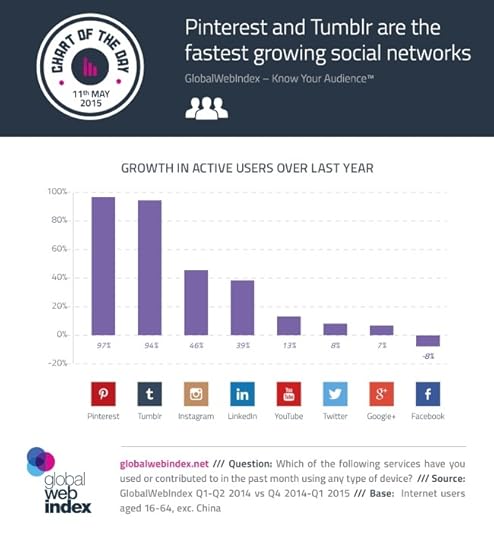
Source: AdWeek
Every day, these sites, apps, and social networks amass more and more data on user preferences—data that Google can’t necessarily index and, more important, monetize.
Simon Says: Technology + Data = Quick Disruption
Even a diluted or limited Plus can gobble up valuable social data.
The top brass at Google understands three critical things that many companies don’t.
First, the Matthew Effect for tech companies is stronger than ever. It’s never been more difficult to overcome a lead. Ask Yahoo! and HP.
Second, data changes. As I describe in Too Big to Ignore, new sources and types of data arrive faster than ever. Dismissing their importance is a surefire way to become complacent and less relevant.
Finally and most germane to this post, the data wars are here to stay. No, the new Plus won’t take the world by storm but even a diluted or limited version of it is better than throwing social-media towel. After all, through Plus, perhaps Google can gobble up at least a sliver of increasingly valuable social data.
Feedback
What say you?
The post Why is Google resurrecting Plus? In a word, data. appeared first on Phil Simon.
November 16, 2015
Why I Despise the Term ‘Influencer’

It’s a natural human tendency to want more. It’s also apolitical. Even left-leaning labor leaders want to deliver “more” to their constituencies.
In professional settings, this often results in trying to sound more important than we are. Today there’s no shortage of new “chief officers” of one sort or another. Why describe yourself as an office manager when head of office experience seems more significant?
It turns out that I’m hardly the only one who’s noticed this. The picture below from the recent NY Times‘ piece Your Job Title Is … What? sums up our current infatuation with title inflation quite nicely:

Influence is not a binary; it’s a continuum.
Indeed, ours is an era marked by Big Data, rampant social media, and borderline-inscrutable job titles. I’ve always felt that the title on a business card should convey what the employee does to others clearly and succinctly. Sadly, many times I look at someone’s resume or job title on LinkedIn these days and shake my head. Although the intent may not necessarily be malignant, why would someone intentionally confuse others with opaque terms?
x
The Meaningless of the Term Influencer
You can put the term influencer at the top of my list for the following reasons:
It implies that influence is a binary when it’s a continuum. In fact, everyone possesses some degree of influence. Have you ever met anyone without any influence at all?
On a related note, it’s not remotely descriptive of what anyone does in a given day. I’ve never met anyone whose sole responsibilities involved influencing others.
Quite often companies determine one’s influence by simply looking at social-media numbers. The problem is that these stats are easily gamed. It’s neither hard nor expensive to buy Facebook likes, Twitter followers, etc.
Most important, people with real influence rarely brand themselves as influencers or another self-important term. This is akin to great artists, writers, actors, and musicians who generally comport themselves with humility. If you’re good at what you do, then you don’t have to tell people as much. Others know.
Feedback
What say you?
The post Why I Despise the Term ‘Influencer’ appeared first on Phil Simon.