The Relationship between Jargon and Credibility
Fifteen years ago, I worked for a particularly bad manager. Call her Dorothy here. She would consistently arrive late at client meetings. Once, she left a voicemail for a distraught client and lied about when she was calling. She forgot that voicemails are time-stamped, irritating the client further (The client soon had her removed from our project.)
Among Dorothy’s most egregious deeds, however, was her consistent and unnecessary use of jargon. I would see the looks on our clients’ faces when she would speak. She would condescend. She would talk “at” and “around” her audience, not to them. Big mistake. Dorothy soon took maternity leave and eventually left the company.
The more jargon you use, the more your credibility suffers.
My new manager Gary (again, a pseudonym) was a former application consultant. As such, he communicated in a simpler, far more forthright manner than Dorothy. Clients and employees just responded differently to Gary. He came across as less suspicious, even when he had to convey bad news.
This leads me to Simon’s Law of Jargon, graphically expressed as follows:
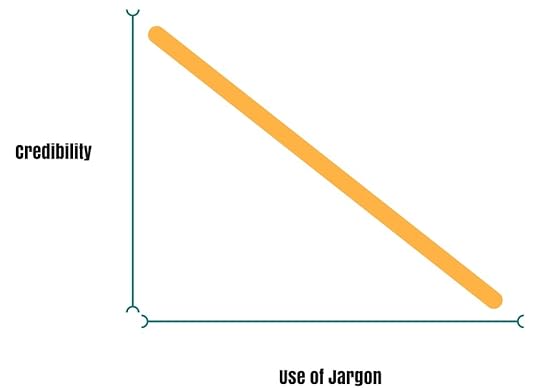
Put as simply as possible: the more jargon you use, the more your credibility suffers. (For recent research and a much more academic interpretation of this concept by Jochim Hansen and MichaelaWänke click here.)
Simon Says
Think about the next time you drop silly phrases such as “an experience flow seamlessly brings together all of the experiences throughout the infinity loop of customer engagement.”
Feedback
What say you?
The post The Relationship between Jargon and Credibility appeared first on Phil Simon.