Phil Simon's Blog, page 72
September 20, 2014
What Should I Ask Neil Peart?
Please see updates below.
 On Wednesday, I’ll be interviewing Neil Peart of Rush, my favorite band. Our interview will run The Huffington Post next Wednesday. I’ve drawn up some questions. I would like to ask him The Pivot Questionnaire. Still, I would love to hear your suggestions. Just put them in the comments. (I solicited fan input in a similar way when I first interviewed Steve Hogarth.)
I’ll put the top six or seven up for a Wedgies survey and then create a poll. I’ll ask him the two questions with the most votes, time permitting.
Update: 09.20.14, 8:27 am PST
Great response so far. I’ll approve the comments throughout the day. Don’t worry if you don’t see your comment/question up immediately. I promise that they’ll all show up. In the meantime, leave that thing alone.
Leave That Thing Alone (Live) by R U S H on Grooveshark
Update: 09.20.14, 6:27 pm PST
I am closing the comments now. I have more than 40 questions. Please vote below. I’ll see if he’ll go for the top two. Thanks everyone for the input. There are some great ones here.
I’m limiting votes to two per person.
Update: 09.22.14, 8:27 am PST
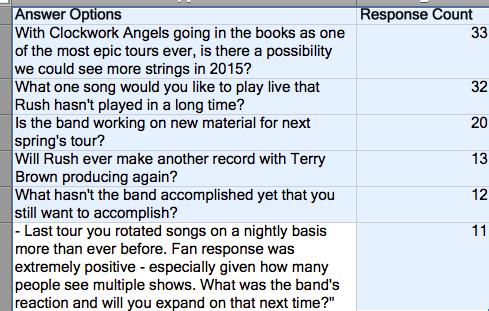
Update on the winning questions so far:
Update: 09.22.14, 8:27 am PST
It looks like these two are going to win:
What one song would you like to play live that Rush hasn’t played in a long time?
With Clockwork Angels going in the books as one of the most epic tours ever, is there a possibility we could see more strings in 2015?
Create your free online surveys with SurveyMonkey , the world’s leading questionnaire tool.
The post What Should I Ask Neil Peart? appeared first on Phil Simon.


September 16, 2014
Calling Bullshit on Authors United
 The Amazon-Hachette dispute continues to play out, and yesterday Authors United tried to circumvent Jeff Bezos by going directly to Amazon’s board. From their letter:
Amazon has every right to refuse to sell consumer goods in response to a pricing disagreement with a wholesaler. We all appreciate discounted razor blades and cheaper shoes. But books are not consumer goods. Books cannot be written more cheaply, nor can authors be outsourced to China. Books are not toasters or televisions. Each book is the unique, quirky creation of a lonely, intense, and often expensive struggle on the part of a single individual.
This argument not only smacks of self-interest, but it’s demonstrably false.
Each book is unique.
This in nonsense. For instance, there are more than 1,000 books on Amazon for just “business writing.” I haven’t read them all, but I guarantee you that there’s a good deal of overlap among most of them—especially those written in the last decade.
Authors United is making all authors look silly with these nonsensical and cavalier arguments.
Rare is the book that redefines a genre or even stands out from the crowd. Most books fall into one or more buckets. To imply that each is unique and the “quirky creation of a lonely, intense, and often expensive struggle on the part of a single individual” shows zero knowledge of the publishing business. Single individual? What about the copyeditors, proofreaders, cover designers, indexers, layout specialists, to say nothing of the publishers’ marketing staff and acquisition editors? As someone who runs a small micropublisher, make no mistake: authors don’t do it alone.
Books aren’t a normal business. They belong to a special category.
Again, bullocks. How are books more special than albums, films, TV shows, documentaries, plays, paintings, sculptures, and other forms of art? They aren’t. Each is a form of entertainment, pure and simple. It’s the acme of arrogance to claim that the craft of writing is somehow objectively more important or valuable than other forms of creative expression.
Many books suck.
Books are like any other form of art. Some are better than others, and some come nowhere close to being “quirky creations.” I haven’t read it, but I doubt that Snooki’s book would qualify. Let’s not put reality stars on par with Ernest Hemingway.
Simon Says
I’m not taking sides here. Amazon may well be wrong in this brouhaha. Authors United is making all authors look silly with these nonsensical and cavalier arguments.
Originally posted on HuffingtonPost.
The post Calling Bullshit on Authors United appeared first on Phil Simon.
September 13, 2014
Book Review: Dataclysm
 Many books have been written about Big Data, and I’m the author of two of them. While the topic is well trodden, we understand far less about what companies are actually doing with this information. As I know all to well, Amazon, Apple, Facebook, Google, Netflix, and their ilk don’t exactly share their secret sauces. Each takes pretty drastic steps to lock down their data. Individual privacy may be dead, but the same can’t be said of the corporate realm.
Enter Christian Rudder, the co-founder free dating site OkCupid. (Yes, I’ve been a member in the past.) By virtue of his role, Rudder is in the rare position to shed light on what a data-intensive company is doing. His new book Dataclysm: Who We Are (When We Think No One’s Looking) doesn’t disappoint. In fact, it’s is downright fascinating. Think of it as a exceptionally well written insider’s account of the Big Data revolution.
Rudder’s text emphasizes practice over theory. He splices in a bit of statistical, psychological, and sociological theory, but only in his quest to prove what data can do.
The short answer is: A whole hell of a lot.
Sure, some of Rudder’s stories have been told before. Target’s famous pregnancy prediction and the ability of Google Trends to predict flu incidence aren’t exactly revelations. Rudder, however, goes far beyond retelling these anecdotes. Because of his role, he has access to a swath of user data—and he’s not shy about using it to ask very penetrating questions about who we are and what we want.
Dataclysm uses OKC’s data to confirm that men never grow up. We like women in their early twenties—and that doesn’t change when we hit our forties. Women’s taste in partners, however, changes with time. They’re much more reasonable. Maybe you knew that, but Rudder offers plenty of new insights into what we want. His breakdown of the specific words and phrases used by whites, blacks, Latinos, and Asians in their profiles makes for a compelling read.
This is the best book that I’ve read on data in years, perhaps ever.
Most people who work with numbers don’t write good. Rudder’s writing style is remarkable for a statistician. His use of data visualizations buttress his larger points and the book’s overall theme. They tell stories in ways that words simply cannot. And I’d be remiss if I didn’t compliment Crown on the book’s design. The graphs and charts would be much less clearer if done in black and white. A tinge of color makes a world of difference.
Simon Says
This is the best book that I’ve read on data in years, perhaps ever. If you want to understand how data is affecting the present and what it portends for the future, buy it now.
Disclaimer: The publisher sent me a copy gratis with no further obligation. This post originally ran on HuffPo.
The post Book Review: Dataclysm appeared first on Phil Simon.
September 12, 2014
Thoughts on Ballmer, the Consumerization of IT, and Platforms
In the book, I write about the cardinal importance of the Consumerization of IT. In short, it’s been huge.
Think about that in the context of the forthcoming retirement of Steve Ballmer. As Derek Thompson writes in The Atlantic:
Steve Ballmer made some very bad things. But his tenure will probably be judged by the things he didn’t make and the big picture he didn’t see. Microsoft used to be huge, and then the computers got small.
Or this line from Stratechery:
Yet, it’s hard to imagine living without Amazon, or Apple. It’s far too easy to imagine living without Microsoft.
Want to vs. Have to
This chart from The Atlantic article pretty much sums it up.

Brass tacks, today Microsoft remains an incredibly powerful, profitable, and important business. Much of corporate America relies upon Microsoft to fulfill critical business needs. Yet, it just doesn’t have anywhere near the same of sizzle Amazon, Apple, Facebook, and Google. In that sense, it’s the antithesis of the Gang of Four. Or as Google Chairman Eric Schmidt said of Microsoft: “They’re a well-run company, but they haven’t been able to bring state-of-the-art products into the fields we’re talking about.”
In the Age of the Platform, try to build products that people want to use; not that they have to use. Huge distinction.
The post Thoughts on Ballmer, the Consumerization of IT, and Platforms appeared first on Phil Simon.
September 11, 2014
How We’re Working Isn’t Working
 My latest post is now on Wired. In it, I discuss e-mail and our overreliance upon it.
Here’s an excerpt:
It’s easy to blame software applications for exacerbating business communication. For instance, Microsoft PowerPoint often takes a bad rap, but it’s a perfectly serviceable application. In fact, it is my presentation tool of choice. (I find its Presentation View to be exceptionally useful.) As much as we may like to criticize it, PowerPoint does not automatically generate dozens of inscrutable slides and force its users to read off of them. The problem lies in how people use it. Prezi, Keynote, and other presentation applications may offer different bells and whistles, but don’t change badly designed slides.
Email’s Cross-Purposes
We have long since solved e-mail’s nascent problems: reliability, dependability, and interoperability. None of which alters the fact that e-mail remains a fundamentally limited medium, and sending more messages only exacerbates its limitations. Most germane here, an increase in the number of e-mails often enhances the extent to which employees feel overwhelmed. Employees frequently use their inboxes as catchalls for absolutely everything work-related and even some non-work purposes.
To read the whole thing, click here.
The post How We’re Working Isn’t Working appeared first on Phil Simon.
September 10, 2014
e-Book Price Drop
 I for one think that pricing is much more of an art than a science. (See price elasticity.) To that end, it’s time to run an experiment. The prices of The New Small and The Age of the Platform are now $4.99.
Let’s see if less really means more.
The post e-Book Price Drop appeared first on Phil Simon.
September 9, 2014
The Organized Mind
I just finished Daniel Levitin’s The Organized Mind: Thinking Straight in the Age of Information Overload. Disclaimer: I received a review copy gratis via the publisher.
Here’s my review.
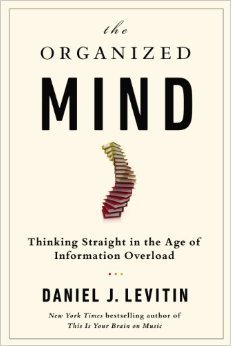
Levitin’s topic is certainly a worthwhile one and he writes in an approachable style. I for one appreciated some of his references and personal stories. What’s more, Levitin has done his homework. I’m all for citing the works of others, and Levitin extensively references the work of plenty of prominent researches writers. (More on that below.)
At times, though, the book tends to wander. The Organized Mind doesn’t read like a single text. It is part business book, part decision making book à la Thinking, Fast and Slow, part science/neurology book, and part self-help book. Sure, it’s well written, but I would read twenty interesting pages on how the brain works only to get back to where he left off before. I was left wondering if less would have been more. That is, would a shorter but more focused book worked better? I suspect that the answer is yes.
There’s nothing wrong with The Organized Mind. It’s enjoyable enough. I’d stop short of calling it a must-read, though. This goes double if you’re caught up on Mihaly Csikszentmihalyi, Daniel Kahneman, Daniel Gilbert, and Dan Ariely.
Rating: 3.5/5 stars
Cross-posted on Huffington Post.
The post The Organized Mind appeared first on Phil Simon.
September 8, 2014
The Folly of Blaiming Excel
“The real problem is not whether machines think but whether men do.”
—B. F. Skinner

The three killer apps of the Internet era are e-mail, the browser, and Microsoft Excel. Go into just about any office in the corporate world and you’re likely to find them all not only installed on laptops and desktops, but concurrently in use.
When an application reaches critical mass, you’ll find no shortage of detractors. Excel is no exception to this rule. Add Stephen Gandel to the list. As he writes on Forbes in Damn Excel! How the ‘most important software application of all time’ is ruining the world:
In the wake of last year’s $6.2 billion JPMorgan Chase trading loss, traders have been fired, top executives have been hauled in front of Congress, and the FBI, among other regulators, is investigating. But you know who really needs to be questioned? Bill Gates. According to an internal report on the trading loss released in February, the model that was supposed to monitor and limit the amount of risk the bank’s London traders were taking was “operated through a series of Excel spreadsheets, which had to be completed manually, by a process of copying and pasting data from one spreadsheet to another.” One key measure was added when it should have been averaged. [Emphasis mine.] The result: Risk officers at JPMorgan believed the credit derivatives bets were half as risky as they actually were. So, I guess, CEO Jamie Dimon can pass $3.1 billion off on Excel. The rest is still on him.
Microsoft’s Mixed Bag
Microsoft birthed Excel in 1987, and it became part of the Office productivity suite in 1998. In the last 16 years, Microsoft has added many features. Some have been amazingly useful (e.g., 1993’s introduction of pivot tables), but others have failed, quietly moved to the morgue. I’d argue that the term bloatware isn’t totally inapplicable. Design-wise, Microsoft is the antithesis of 37Signals.
For my part, I’ve been been critical of Microsoft products in the past and of Excel in particular. In The Visual Organization, I argue that Excel doesn’t promote true data discovery. I hate the new UI. The ribbon (introduced in in 2007) sucks, a sentiment shared by others.
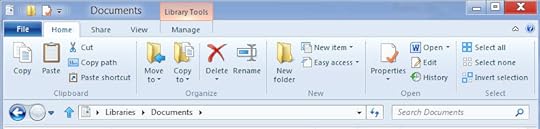
I could go on but you get my point.
We can debate the merits of different features, but the fact remains: Office today is a multi-billion dollar franchise with more than 1.1 billion users. I challenge you to name three tools that have lasted as long as Word, Excel, and PowerPoint. You can bet that, if developed today from scratch, these applications would look very different and do things differently. The ability of users to make their own mistakes, though, would still exist. There’s no way around that one.
Either get people to look at key spreadsheets or build something with greater controls.
Articles with titles like Gandel’s minimize the much larger and critical point: it’s not the tools; it’s us. It’s easy to blame Excel; it can’t very well blame us back. (If only computers could talk to us.) It just has to sit there and take it.
Simon Says: Look in the Mirror
You can’t design a spreadsheet—much less an enterprise system—without people. People sometimes make mistakes. Mature programs like Excel sometimes don’t work as expected. The culprit the majority of the time is the user, a not true bug. (See PICNIC.) Demonize Microsoft all you want, but no program is foolproof.
Intelligent systems and applications contain safeguards, audit trails, and feedback mechanisms. Relying upon manual data entry and copying and pasting, as JPMorgan employees did, only maximizes the chance of user error. Either get people to look at key spreadsheets or build something with greater controls.
Feedback
What say you?
 This post was brought to you by IBM for Midsize Business, but the opinions in this post are my own. To read more on this topic, visit IBM’s Midsize Insider. Dedicated to providing businesses with expertise, solutions, and tools that are specific to small and midsized companies, the Midsize Business program provides businesses with the materials and knowledge they need to become engines of a smarter planet.

The post The Folly of Blaiming Excel appeared first on Phil Simon.
September 6, 2014
Message Not Received Now Available for Pre-Order on Amazon
 Message Not Received: How New Technologies and Simpler Language Can Fix Your Business Communications is now up on Amazon.
It’ll be out in February of 2015.
Don’t worry about the price. It is always higher at first. It’ll be $23 or so by the time it hits.
The post Message Not Received Now Available for Pre-Order on Amazon appeared first on Phil Simon.
September 4, 2014
The Case for Interactive Data Visualizations
 So writes Colin Ware in his in his classic book Information Visualization: Perception for Design. We humans have always processed information in different ways. Many neurologists, academics, and researchers have proven what most of us intuitively have known for a long time: data visualization matters. In other words, there is something very powerful about how we see information in graphical formats. But don’t think for a minute that all data visualizations are created equal.
Getting Interactive
All data visualizations are not created equal.
Our brains are wired to process information faster and better if it’s represented a visual manner. As I write in The Visual Organization, though, one-time, static data visualizations can only get us so far. Even dashboards replete with KPIs and pre-configured charts don’t lend themselves to true data discovery. (For more here, see The Case for Data Discovery.)
Perhaps my favorite example of an interactive dataviz is OrgOrgChart, a fascinating visual representation of employee movement at Autodesk over a four-year period:
I’ve written tens of thousands of reports for my clients over the years, many of which addressed employee movement. It wasn’t too hard to query a relational database and present detailed and summary statistics for hires, transfers, leaves of absence, and terminations. I became proficient at building reports to meet my clients’ specifications–and telling them when the organization’s new system stored data in such a way that we’d have to write different reports.
Despite my reporting chops, though, nary one could even remotely do what OrgOrgChart does. No summary table could let users see trends so vividly and ask penetrating questions. Beyond that, OrgOrgChart provides the ability to stop, rewind, fast forward, pause, and drill down. As a result, Autodesk employees can ask better questions of their data and, at least in theory, make better business decisions.
Simon Says
Now, a fancy, interactive dataviz does not obviate the need for standard reports, KPIs, and additional queries. They should be considered complements, not substitutes. In this era of Big Data, data-exploration tools will become increasingly important clubs in the bag. Get used to using them.
Feedback
What say you?
 This post is brought to you by SAS.
The post The Case for Interactive Data Visualizations appeared first on Phil Simon.