Phil Simon's Blog, page 73
September 3, 2014
Book Trailer for Message Not Received
 I’m a big believer in book trailers. If they result in one speaking gig or mass book sale, then they pay for themselves several times over.
With that in mind, Here’s the trailer for my forthcoming book, It’s a three-minute overview of the book with some nice effects and a little Thoreau to boot.
Major props to my spectacular video guy, Joe Buquicchio of Chrome Video Productions.
The post Book Trailer for Message Not Received appeared first on Phil Simon.


September 1, 2014
Five Tenets of Cloud Computing
 A relatively young friend of mine recently asked me to make the case that “the cloud” was secure. We talked for ten minutes and, a few days later, I was still thinking about our conversation.
Here are some thoughts on what I consider to be the “right way” to think about cloud computing:
There is no one “cloud.” This is perhaps one of the largest misconceptions among many business folks and even some relatively technical ones. As a DropBox user, I am relying upon a public cloud. That’s a far cry from the expensive private clouds that many companies are building to power their businesses and protect valuable corporate data. Hybrids or semi-private clouds also often viable options when no single organization can afford to pay for the whole infrastructure. (See multi-tenancy.) That is, they only pay for the time they spend “on the cloud.”
There is no such thing as absolute or complete security.
Don’t think of security as a binary. When you understand the above, then security starts to make more sense. I don’t like to think about security in an abstract sense. There is no such thing as absolute or complete security, and that includes keeping your data entirely offline (read: in paper files in an office or physical storage facility.) Make no mistake: fires, floods, and theft have destroyed a great deal of critical corporate data in their day. Perhaps keeping apps and data on-premise is more secure than a generic “cloud.” Perhaps not. Too many other factors are at play to make blanket generalizations about that those.
Cloud computing is an increasingly busy and crowded place. Even established vendors like Amazon are introducing new services–and augmenting current offerings. See Amazon’s recent Zocalo announcement. What’s more, large companies are buying smaller ones at a rapid rate. Case in point: IBM gobbling up Cloudant. Rackspace may go poof by the time that you read this post.
Not every application can be ported to “the cloud.” As I know all too well, plenty of organizations have not retired legacy applications that are, well, long in the tooth. For this reason, marching entirely toward cloud computing may not be an option.
Savings comes via subtraction, not addition. Adding new cloud-based services without removing existing and expensive components doesn’t drop total IT costs. Addition by addition means more. Period.
Simon Says
There’s a great deal more to say about the subject of cloud computing. I’ve addressed it in several of my books. If you’re new to the area, though, it’s wise to start with these fundamental tenets.
Feedback
What say you?
 This post was brought to you by IBM for Midsize Business, but the opinions in this post are my own. To read more on this topic, visit IBM’s Midsize Insider. Dedicated to providing businesses with expertise, solutions, and tools that are specific to small and midsized companies, the Midsize Business program provides businesses with the materials and knowledge they need to become engines of a smarter planet.

The post Five Tenets of Cloud Computing appeared first on Phil Simon.
Five Tenants of Cloud Computing
A relatively young friend of mine recently asked me to make the case that “the cloud” was secure. We talked for ten minutes and, a few days later, I was still thinking about our conversation.
Here are some thoughts on what I consider to be the “right way” to think about cloud computing:
There is no one “cloud.” This is perhaps one of the largest misconceptions among many business folks and even some relatively technical ones. As a DropBox user, I am relying upon a public cloud. That’s a far cry from the expensive private clouds that many companies are building to power their businesses and protect valuable corporate data. Hybrids or semi-private clouds also often viable options when no single organization can afford to pay for the whole infrastructure. (See multi-tenancy.) That is, they only pay for the time they spend “on the cloud.”
There is no such thing as absolute or complete security.
Don’t think of security as a binary. When you understand the above, then security starts to make more sense. I don’t like to think about security in an abstract sense. There is no such thing as absolute or complete security, and that includes keeping your data entirely offline (read: in paper files in an office or physical storage facility.) Make no mistake: fires, floods, and theft have destroyed a great deal of critical corporate data in their day. Perhaps keeping apps and data on-premise is more secure than a generic “cloud.” Perhaps not. Too many other factors are at play to make blanket generalizations about that those.
Cloud computing is an increasingly busy and crowded place. Even established vendors like Amazon are introducing new services–and augmenting current offerings. See Amazon’s recent Zocalo announcement. What’s more, large companies are buying smaller ones at a rapid rate. Case in point: IBM gobbling up Cloudant. Rackspace may go poof by the time that you read this post.
Not every application can be ported to “the cloud.” As I know all too well, plenty of organizations have not retired legacy applications that are, well, long in the tooth. For this reason, marching entirely toward cloud computing may not be an option.
Savings comes via subtraction, not addition. Adding new cloud-based services without removing existing and expensive components doesn’t drop total IT costs. Addition by addition means more. Period.
Simon Says
There’s a great deal more to say about the subject of cloud computing. I’ve addressed it in several of my books. If you’re new to the area, though, it’s wise to start with these fundamental tenants.
Feedback
What say you?
This post was brought to you by IBM for Midsize Business, but the opinions in this post are my own. To read more on this topic, visit IBM’s Midsize Insider. Dedicated to providing businesses with expertise, solutions, and tools that are specific to small and midsized companies, the Midsize Business program provides businesses with the materials and knowledge they need to become engines of a smarter planet.
The post Five Tenants of Cloud Computing appeared first on Phil Simon.
August 25, 2014
Infographic: E-Mail, Goldfish, and Technology
I’m not a big infographic guy, but I decided to create a few for Message Not Received based on my research so far.
Long story short, people are incredibly overwhelmed at work. We’ve never lived in busier times.
Technology, speed, and communciation | Create Infographics
The post Infographic: E-Mail, Goldfish, and Technology appeared first on Phil Simon.
August 21, 2014
Zappos Talk on The Visual Organization

I recently gave a talk at Zappos headquarters in Las Vegas about the new book, Twitter, and data visualization. In the first few minutes, I talk about getting hit with a water balloon there. (True story.)
You can watch it below.
The post Zappos Talk on The Visual Organization appeared first on Phil Simon.
August 20, 2014
Review Copies of Message Not Received
 I’ll be giving away a few review copies of Message Not Received. There are only a few requirements:
You give the book an honest review on your blog/site.
You put that review on Amazon.
You do so in a timely manner. (The book will be released in March of 2015.) I should have a near-final galley in January.
If you’re interested, fill out the form below. I’ll be in touch.
Fill out my online form.
The post Review Copies of Message Not Received appeared first on Phil Simon.
August 11, 2014
To Store or Not to Store
 You’ll get no argument from me on the general import of Big Data, but I’ll also be the first to admit that one size certainly does not fit all. (See Four Big Data Models.)
Beyond strategy, there’s a critical operational aspect of Big Data: storage. To this end, I found Big Data: No Hoarding Allowed particularly interesting. In the words of Dane Atkinson, CEO of SumAll, a three-year-old data analytics startup based in New York City:
We would highly discourage storing [data] in a fashion that’s sort of the definition of Big Data–where you have it in some SSD environment on Amazon, or on a rack of servers that are costing you a fortune–because you’re not getting value out of it,” he said. “You’re not asking questions because it’s just too big.
The Paramount Question: Are You Asking Questions?
Atkinson hits the nail on the head. Storing data for the sake of doing so is utterly meaningless. I can just see some CXO now bragging to his friends on the golf course about how his organization successfully deployed Hadoop, MongoDB, or another NoSQL database. “We generate one petabyte of data per week”, he proudly says before taking out his driver.
So what? How is your organization using that data to make better decisions? Predictions? Insights?
Storage for the sake of storage is utterly meaningless
Look at companies that successfully use what we now call Big Data. Amazon, Apple, Facebook, Google, and Netflix easily come to mind. At these companies, employees ask fundamental questions of their data and test where appropriate. (In the case of Facebook, maybe this takes place too often and under less than transparent circumstances, but that’s fodder for another post.)
I’m reminded here of my time at Merck in corporate HR back in the late 1990s. The SVP of HR liked to tell others that the company had implemented PeopleSoft, then a best-of-breed enterprise resource planning system. All else being equal, it’s better to keep all of an enterprise’s information in one central repository. That, however, is neither a necessary nor sufficient cause for success. Merck’s HR folks routinely ignored data when making important decisions. What’s more, those like me interested in making data-based decisions often struggled due to rampant data quality issues.
Simon Says: Ignore Culture at Your Own Peril
Strategy without execution is meaningless. In the same vein, the very act of storing vast troves of data doesn’t magically transform it into insights, much less make them happen. Make sure that your organization’s culture embraces data, or at least isn’t allergic to it. Only then will Big Data move the needle, regardless of how it’s stored.
Feedback
What say you?
This post was brought to you by IBM for Midsize Business, but these opinions are my own. To read more on this topic, visit IBM’s Midsize Insider. Dedicated to providing businesses with expertise, solutions, and tools that are specific to small and midsized companies, the Midsize Business program provides businesses with the materials and knowledge they need to become engines of a smarter planet.
The post To Store or Not to Store appeared first on Phil Simon.
August 7, 2014
Cover of Message Not Received
The central premise of my forthcoming book is many if not most business communications don’t achieve their desired objectives. In other words, messages are not received. There are many reasons for this. An excessive use of jargon and a tendency to rely far too much on e-mail are high on the list. Brass tacks: many employees are overwhelmed and near the breaking point. There’s plenty of research for this, some of which I quote in the book.
The cover of the book needs to reflect all of this, ideally in a way that compels you to want to know more. Whether you’re clicking on an image on Amazon or picking it up in a book store is immaterial. I’m a big believer that people do judge books by their covers. What’s more, covers are hygiene factors. A good one guarantees absolutely nothing; an ugly cover can pretty much render a book DOA.
Thanks to all of you who voted on your favorite cover. That information was certainly helpful. Along with my own thoughts and those of my publisher, my awesome cover guy Luke Fletcher and I spent the last few days making tweaks.
I am pleased to present cover for the book:
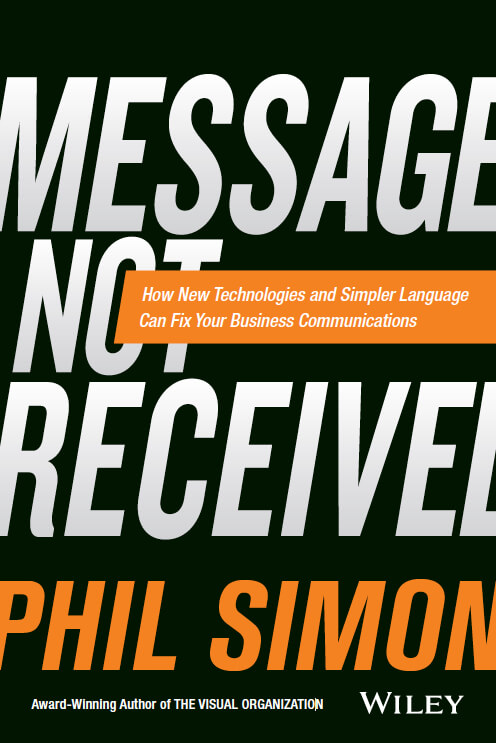
Click on the image to embiggen it.
What do you think?
The post Cover of Message Not Received appeared first on Phil Simon.
How to Break into Dataviz
One of my LinkedIn connections recently contacted me about getting started with dataviz. Here’s a modified version of his question:
I am writing to you to seek a guidance as to how I can diversify my career in business intelligence. I want to visualize data more. By way of background, I have ten years of work experience, including eight in IT.
What is the best way for me to get a job in data visualization given my past work experience?
Here’s my response.
Start by trying to incorporate data visualization into your current job. Data is becoming more important than ever. If you show management in your organization that you can do some interesting things with data, I’ll bet that others will come to you. They will let you do more in this vein. Your job will eventually change for the better.
If that’s not possible for whatever reason, then you may want to look for a new job within or outside of your current company. It sounds like you want more flexibility to work on things that are more interesting to you. Sometimes you have to make a move to do that. I did—several times.
You’re the CEO of your own career.
Also, you could always work independently with datasets, publish them on a website or on others, and try to get noticed that way. If you take this route, then you will have developed a public portfolio for others to discover and view when you interview for that new job.
Simon Says
You’re the CEO of your own career. Now, what are you going to do?
Feedback
What say you?
The post How to Break into Dataviz appeared first on Phil Simon.
August 5, 2014
How Much Time Have You Spent Sending E-Mail?
 In Message Not Received, I argue that business folks e-mail too much.
Way too much.
How much? We send 144.8 billion e-mails every day. No, not all of them are business-related, but I’ve yet to meet a professional who complains that he or she doesn’t receive enough e-mails.
Am I against e-mail? Hardly. E-mail is an indispensable tool for business communications, but we misuse and overuse it.
E-mail as a medium suffers from massive limitations. It does not foster true collaboration. It cannot supplant in-person communications. Checking it incessantly takes more points off our IQs than smoking pot does. It’s terrible for project management. Many far better tools exist and have for a great deal of time.
I thought that it would be interesting and even a bit scary to estimate how much time I’ve spent just sending e-mails.
Go ahead and plug in your own numbers above. Microsoft’s SkyDrive makes this pretty easy to do.
What are your results? How many months have you spent just sending e-mails?
Vote on our poll!
Want the spreadsheet? Go for it.
The post How Much Time Have You Spent Sending E-Mail? appeared first on Phil Simon.