Phil Simon's Blog, page 77
April 29, 2014
The Future of Retail and the Cloud Wars
Retail is undergoing a massive transformation as we speak. Thanks to the rise of smartphones and apps, constantly connected customers are now able to do what was once pure fantasy. Every day, millions walk into traditional big-box retailers. After finding what they want and intend to buy, they are whipping out their iOS and Android devices and comparing in-store prices with those of online giants, most notably Amazon. If the price is lower online, then they make their purchases via their smartphones and promptly leave the store.

The name for this retailing scourge is showrooming. It’s no understatement to say that it represents a herculean challenge to brick-and-mortar giants like Wal-Mart, Target, Home Depot, and others. The stakes have never been higher. We all saw what Netflix did to Blockbuster–or, rather, what Blockbuster did to itself.
What’s a traditional retailer to do? Nearly two years ago, Target stopped selling Kindles in its stores, not that that move alone would stop consumers eager to find the best possible prices. That move certainly didn’t deter customers from the practice.
For traditional retailers, perhaps the answer will stem from an early-stage startup with cutting-edge technology. Austin-based eyeQ seeks to do nothing less than reinvent the in-store shopping experience. From its website, the company:
provides brick-and-mortar retailers with innovative methods for understanding and engaging their customers. We provide leading retailers the ability continually learn about consumer purchasing behavior, generate business intelligence, and influence consumer purchasing in-store. eyeQ’s solution utilizes patent-pending algorithms to create at-shelf behavior information for the retailer while providing the shopper a content-rich, efficient buying experience.
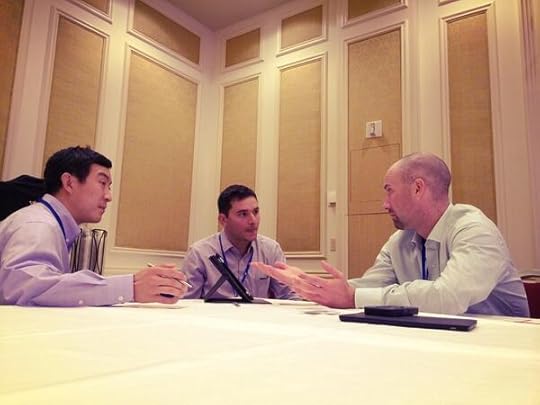
I had a chance to interview eyeQ founder and CEO Michael Garel and CTO Jim Wang at IBM Impact 2014. If eyeQ seems a little bit like the futuristic advertising in Minority Report, you’re absolutely right. I walked away very impressed at what the startup has been able to accomplish is such a short period of time. The company’s product is extremely interactive and visual, essential features in today’s data-driven world, a point that I make in The Visual Organization.
Now, eyeQ is hardly the only startup with grand ambitions like transforming retail. Unlike many, though, eyeQ does not rely upon Amazon Web Services (AWS), a $5-billion division within Amazon. Rather, eyeQ is one of the first startups to power its business via IBM BlueMix, a “platform where developers can act like kids in a sandbox, except this box is enterprise-grade.”
In practical terms, this means that cloud applications built on BlueMix will help developers quickly build and integrate new applications. What’s more, BlueMix is designed speed deployment of new cloud services.
IBM hopes that BlueMix will become a viable option for startups like eyeQ and the more than 20 million small businesses in the US alone. Admittedly, the vast majority of IBM clients have historically been large and medium-sized enterprises, a point that I made while speaking with Nancy Pearson, IBM Vice President, Cloud Category Marketing. Getting small business owners and entrepreneurs to think about IBM’s offerings is perhaps one of Big Blue’s biggest challenges.
Nor is IBM the first enterprise software giant to court developers. Who can forget Steve Ballmer’s vociferous “developers” chants of 2000 and 2008?
The race for cloud-computing dominance is heating up.
Simon Says
It will be interesting to see how the cloud wars play out over the next five years. Behemoths like Oracle, Amazon, Microsoft, Google, and Rackspace are just a few of the other players in this increasingly important game.
Feedback
What say you?
Originally published on HuffPo.
The post The Future of Retail and the Cloud Wars appeared first on Phil Simon.


April 24, 2014
Fleas, Dogs, and Why I’m Sticking with LinkedIn
 I thought long and hard last weekend whether to delete my LinkedIn account. Heather Bussing’s excellent post on killing hers got me thinking. Here’s an excerpt:
Here are the Terms of Service in LinkedIn’s User Agreement that I don’t agree to:
LinkedIn’s Unlimited License to Sell My Information to Anyone: Section 2.2 of the user agreement grants Linked an unlimited license to do whatever it wants with thea information you post on LinkedIn, including the right “to use and commercialize, in any way now known or in the future discovered . . . without any further consent, notice and/or compensation.”
LinkedIn’s Right to Control Who Sees My Information: Section 2.2 also gives LinkedIn the right to control other users’ “access and share rights to your content and information.”
Competitors Aren’t Eligible to Join LinkedIn: Section 2.3 says that you are not eligible to join or use LinkedIn if you are a “competitor of LinkedIn” or if you are “using the Services for reasons that are in competition to LinkedIn.” LinkedIn is the one who gets to decide who is in competition. And LinkedIn can pretty much decide that anyone who is not paying them is a competitor. This provision is probably illegal in California under Business and Professions Code section 16600 which says “every contract by which anyone is restrained from engaging in a lawful profession, trade, or business of any kind is to that extent void.” LinkedIn can charge people or be free to everyone, but it can’t be free to everyone except the people it thinks might compete with it.
LinkedIn Puts All Liability on Me: Section 2.4 explains that you own your content, but LinkedIn owns your Profile, which basically means that LinkedIn owns the presentation of your information on their website. This is fine and legal once you can wrap your brain around the idea.
Bussing is a smart cookie. In her post, she makes some great points and I don’t disagree with any of them. I’ll be the first to admit that LinkedIn’s language just feels icky to me, not that I routinely read the legalese in these companies’ terms of service. What’s more, the ToS isn’t my only issue with LinkedIn. I have major issues with its current user interface, but I’ll save that rant for another post.
Still, I won’t be quitting LinkedIn anytime soon. Here’s why.
With Twitter, Facebook, LinkedIn, and Google, the users are the product.
Cui Bono?
If I were a LinkedIn customer, its ostensibly one-sided ToS would certainly bother me. But I’m not, and I’m guessing that you’re not either. Roughly 90 percent of LinkedIn users opt for the free version. In other words, we’re users, not customers. And make no mistake: there’s a world of difference between the terms. They are anything but synonyms.
Ditto for Facebook, Google, Twitter, and scores of other companies that embrace the Freemium model. These companies have to monetize their users. Like it or not, we are the product. And who knows? Maybe we are giving up too much for free e-mail, cloud storage, and social networks. Jaron Lanier believes so. That’s a key point in his new book Who Owns the Future? Here’s an interview with Lanier on Charlie Rose.
Now, LinkedIn is not nearly as important for me as a source of lead generation as my website, books, word of mouth, and other talks. Still, I’d be lying if I claimed that LinkedIn was inconsequential to my professional livelihood. As a result, I will tolerate its ToS.
This begs the question: Is there a line that LinkedIn can’t cross with its users? I suppose so, but I don’t quite know where I would draw it. I would gladly pay to join a comparable professional social networking site with more equitable less draconian terms of service, but nothing approaches LinkedIn’s scale and import. And trust me, LinkedIn is acutely aware of this. It’s highly unlikely that the company would put such language in its ToS if doing so posed a material risk to its business. I’d bet my house that a team of lawyers reviews each version of its ToS.
Simon Says: The Fleas Come with the Dog
Recognize that there’s no such thing as a free lunch. The fleas of the freemium model come with the dog.
Feedback
What say you?
Originally published on Wired.
The post Fleas, Dogs, and Why I’m Sticking with LinkedIn appeared first on Phil Simon.
April 23, 2014
Four Options for Dealing with XP’s Decommission
Up until April of 2010, I was exclusively a Windows guy. My PC ran Windows XP and, based upon what my friends and the experts told me, I was in no rush to upgrade to the much-maligned Vista. In that month, I bought my first Mac in over a decade and began the move away from Microsoft products.
Fast forward to 2014. Despite the fact that Microsoft finally and formally decommissioned XP as of April 8, a stunning number of computers still run the operating system. Microsoft supported XP for nearly 13 years and pushed the decommission date back several times.
Now, seeing computers running XP isn’t particularly rare. Every day I see several at my gym. But that’s an anecdote. Let’s look at the plural of anecdotes (read: data). As Andrea Petersen writes in the Washington Post:
While estimates vary, XP consistently ranks as the second most popular operating system worldwide. Analytics firm StatCounter says that nearly 17 percent of desktop, tablet, and console users are on XP, while Net Marketshare puts the desktop use even higher at nearly 28 percent.
Dealing with a Forced Upgrade
Mac users like me don’t have to deal with XP’s demise, but I touch upon forced upgrades in Why New Systems Fail. (Long story short, nobody likes them.) I have worked extensively with enterprises that have had to retire ERP applications and versions that are long in the tooth.
There’s no easy answer here.
So, what to do if your organization is still running XP? At a high level, businesses of all sizes and kinds can do one of four things:
Do nothing. This is a particularly bad idea. As Laura Lee writes on the HP XP website, “Continuing to run Windows XP SP3 in your environment after April 8 exposes you to potential security risks – since unsupported and “unpatched” environments are vulnerable to security threats. But that’s an easy fix with Microsoft’s migration website. It details all the steps required to help you migrate, and shows which tools and resources are available to make the process smooth and efficient.”
Purchase extended support from Microsoft or go the third-party route. Recently, some high-profile UK banks and even the Dutch government announced that they are paying millions of euros to extend Microsoft XP support for at least a year. Admittedly, purchasing an expensive support agreement isn’t an option for many if not most small businesses.
Upgrade to a newer version of Windows. There’s a direct upgrade path from XP to 7. Upgrading to 8.1 is also an option. In the software world, this is called a skip upgrade. That is, Vistaphobes need not move to the OS in order to get to Windows 7.
Move to a new OS. Nowhere is it written that an enterprise must use a PC with Windows. Macs certainly cost more than their Windows’ counterparts, although I have no complaints. The more technically inclined may want to consider Ubuntu, an open-source operating system that’s gaining steam.
Simon Says
There’s no easy answer here. When deciding on what to do, consider the following questions:
How many computers in your organization currently run XP.
How robust is your IT staff?
Are there any other key projects diverting IT’s resources?
Ask yourself if any mission-critical applications will only run on XP. And, above all, test, test, and test some more if you pick the upgrade path.
Feedback
What say you? Have you upgraded yet?
Vote on our poll!
This post is sponsored by HP XP Migration.
The post Four Options for Dealing with XP’s Decommission appeared first on Phil Simon.
April 22, 2014
A Visual Look at Ray Allen’s Stats
 When I was a kid, I loved sports. I would religiously look at box scores and at the backs of baseball cards to see who was good at what. I didn’t really create graphs or data visualizations until college.
Today, there’s no shortage of tools to visualize data and create interactive tools. It’s a key point in The Visual Organization. Sure, static bar and pie charts often get the job done on simple tasks, but they don’t promote data discovery to the same extent that their interactive counterparts do. By and large, these new tools are portable (read: device-agnostic) and incredibly user friendly, both of which are imperative in an era of mobility and BYOD.
For instance, I’ve been playing around with Datawrapper, a neat free and open-source tool for visualizing data. I grabbed some data from BasketballReference on Miami Heat shooting guard Ray Allen and presented it below:
Static box scores seem so 1998.
It’s interesting to see how Allen’s minutes played (MP) and, by extension, field goal attempts (FGA) have varied over the years. Although his minutes have declined as of late, his shooting percentage has not. The man is remarkably consistent.
Creating the interactive dataviz above just took a few minutes. To be sure, it is interesting on some level, but it doesn’t answer the question Where does Allen most often shoot? For that, we can go to Vorped.
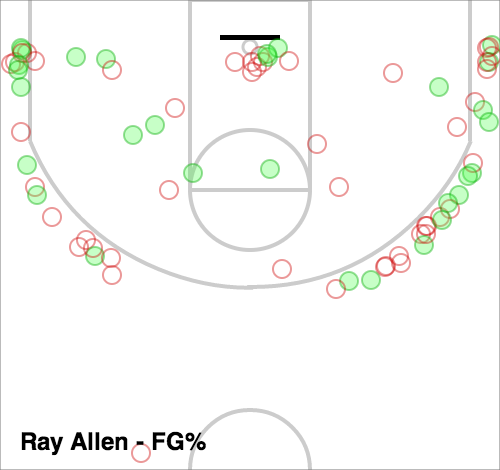
Click to embiggen.
Simon Says
I can geek out all day here but you get my point: There have never been more ways to ask questions of our data. To boot, it’s never been more important to do so. Even single-purpose bar and column charts can be integrated into more holistic views of statistics.
The post A Visual Look at Ray Allen’s Stats appeared first on Phil Simon.
April 19, 2014
Open Data Now
Big Data is a big deal, but what about Open Data? That is, the idea that certain data should be freely available to everyone to use and republish as they wish, without restrictions from copyright, patents, or other mechanisms of control.
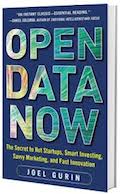 I was curious about it and, against that backdrop, read Open Data Now: The Secret to Hot Startups, Smart Investing, Savvy Marketing, and Fast Innovation (affiliate link) by Joel Gurin. Admittedly, I was a bit skeptical of the premise behind this book. There’s so much hype about data-related matters and much of what’s written is either way too technical, theoretical, and/or just not very good.
Not this book.
Gurin takes the reader on an exciting, example-laden journey. To be fair, since I play in this area, I had heard of Kaggle, Innocentive, TopCoder, and a few of the other companies profiled. (I touch upon each of those in Too Big to Ignore.) Gurin does much more than merely list startups, though. He explains what they’re doing, why, and the long-term impacts on all sorts of industries (read: green tech, pharama, financial services, and scores of others.)
Gurin’s wide, not deep approach works here. To the extent that Open Data is a relatively new phenomenon–at least on this scale, accentuating on only several examples wouldn’t have been as effective. By demonstrating the variety of industries and companies benefiting from Open Data, the read walks away excited about the possibilities and, later in the book, the challenges.
Excellent. This one’s a keeper.
The post Open Data Now appeared first on Phil Simon.
April 17, 2014
IBM Podcast on The Visual Organization

I recently spoke with with host David Pittman (@TheSocialPitt) of IBM about the new book. I touch upon how small organizations can benefit from a visual approach to data. Click here to listen to it or just play it below.
The post IBM Podcast on The Visual Organization appeared first on Phil Simon.
April 16, 2014
U.S. Income Inequality: A Compelling Dataviz
When asked about his refusal to make a formal political endorsement in a Senate race, Michael Jordan famously said “Republicans buy shoes too.” It’s a great quote, although prominent black athletes like Jim Brown were none too pleased at Jordan’s apolitical stance given his stature.
Today, simple pie charts and spreadsheets can’t tell the same stories that interactive data visualizations can.
I intentionally avoid overtly political discussions on my blog and in my talks. Sure, I have my own beliefs, but my clients don’t hire me to wax philosophical on the way the body politic ought to operate.
Bring Data or Go Home
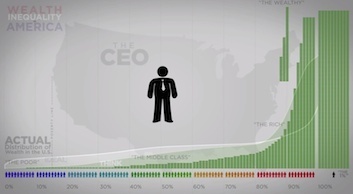
Regardless of your political leanings, though, it’s never been easier and arguably more important to convey those beliefs via effect data visualizations. (For more, see Data and Politics.) In this vein, the pseudonymous filmmaker Politizane created the amazing video below that displays income inequality in the U.S. Given the subject and the quality of the video, it’s no surprise that it went viral with more than 15 million views as of this writing.
I won’t open up Pandora’s box here, but it’s hard to watch this video and not feel something. Simply put, a basic spreadsheet cannot evoke the same emotions as a compelling data visualization.
The post U.S. Income Inequality: A Compelling Dataviz appeared first on Phil Simon.
April 15, 2014
Between Two Fern-like Plants: An Interview with VizWorld on The Visual Organization

Dean Myers of VizWorld and I talk about my new book, The Visual Organization at NAB in Las Vegas. No, were weren’t as funny as Zach Galifianakis and Sean Penn. Watch our 18-minute chat below:
The post Between Two Fern-like Plants: An Interview with VizWorld on The Visual Organization appeared first on Phil Simon.
April 14, 2014
Big Data, Risk, and The Matrix
I’ve written before on this site about the inherent uncertainty around Big Data. In short, the same ROI calculations that justified many 1990s and 2000s ERP, CRM, and BI purchases are unlikely to work this time around. With so much data, how can an organization, consulting firm, or CXO even attempt to accurately predict what will be found, much less the potential savings, innovation, and sales?

Doug Bonderud writes about the need to take a “big” leap of faith of sorts in his post Big Data Visualization: Just the Beginning. Bonderud writes:
As analytics tools become more powerful and as expectations increase, risk is the most likely limiting factor. Ultimately, senior business stakeholders will have to decide whether the risk of experimentation justifies the reward. Right now, companies can make do by using simple visualizations of quickly mined data, but this will not work for long. Digging deep is the next step in the utilization of Big Data.
Put differently, Bonderud is asking, How much risk can an organization stomach? It’s an age-old question. When it comes to Big Data, there’s plenty here to be learned from companies like Twitter, Facebook, Netflix, and Amazon. Each publicly traded company faces significant detractors. Activist investors often think that they know how to run the ship better than the current captains.
How much risk can an organization stomach?
Take Amazon for instance. The company famously plows most of its scant earnings back into its business, making billion-dollar bets on new product lines and, as we learned recently, even drones. Against this backdrop, there’s no dearth of those shorting the stock. That is, many stockholders want CEO Jeff Bezos to, you know, actually make more, er, profits.
Amazon’s risk profile is off the charts, and it’s doubtful that most organizations can afford to routinely ignore investors’ qualms. Bezos is the exception that proves the rule. Brad Stone’s excellent book The Everything Store: Jeff Bezos and the Age of Amazon (affiliate link) manifests the extent to which Amazon embraces ambitious projects and long-term thinking.
Yet it is precisely this willingness to embrace outsize risks that has spawned Amazon Web Services. By 2020, AWS may be a $20 billion business.
Simon Says: Take the Red Pill
Recognize the inherent risks in all new technologies, especially with Big Data. Sure, there is a slew of justifiable, conservative reasons not to take the red pill, as Neo does in The Matrix. With Big Data, though, the same bromide applies: nothing ventured, nothing gained.
Feedback
What say you?
 This post was written as part of the
IBM for Midsize Business
program, which provides midsize businesses with the tools, expertise and solutions they need to become engines of a smarter planet. I’ve been compensated to contribute to this program, but the opinions expressed in this post are my own and don’t necessarily represent IBM’s positions, strategies, or opinions.
This post was written as part of the
IBM for Midsize Business
program, which provides midsize businesses with the tools, expertise and solutions they need to become engines of a smarter planet. I’ve been compensated to contribute to this program, but the opinions expressed in this post are my own and don’t necessarily represent IBM’s positions, strategies, or opinions.

The post Big Data, Risk, and The Matrix appeared first on Phil Simon.
April 8, 2014
Audio from Carnegie Mellon–Silicon Valley Campus Talk

Here’s my talk at Carnegie Mellon–Silicon Valley Campus. I talk about The Visual Organization, Netflix, Twitter, dataviz, and why I decided to write the book.
The video recording left a bit to be desired so I worked my magic in GarageBand. At least the audio is decent.
The post Audio from Carnegie Mellon–Silicon Valley Campus Talk appeared first on Phil Simon.