Phil Simon's Blog, page 81
February 21, 2014
Visualizing Mice and Rats in Manhattan
Last time I was in Manhattan, I couldn’t help but notice this Yelp dataviz for a dry cleaner. As one might expect, there are plenty of other ways to visually represent interesting data in a city as big as New York. What about looking at the concentration of reported mice and rats by zip code?
Over at The Gothamist, Steven Melendez did that very thing. Melendez created the appetizing map shown below:

Click on the image to go to the live, interactive dataviz.
From the article, here’s a bit on Melendez’s methodology:
(He) took restaurant inspection data from the Health Department and looked at all the inspections since Jan. 1, 2013. Then he counted the total number of inspected restaurants and number of restaurants that received citations for “evidence of mice or live mice” or “evidence of rats or live rats” in that time period for each zip code. Then, for each zip code, he added to the info window any restaurant that currently has a C grade and was cited for mice and/or rats in its most recent graded inspection.
This type of data simply wasn’t accessible even five years ago.
Simon Says
As I write in The Visual Organization, the notion of open data has been gaining traction for a while now. Foolish is the organization that only looks at data within its walls. It’s never been easier and more important to augment traditional data sources with supplemental ones external to the enterprise.
Feedback
What say you?
The post Visualizing Mice and Rats in Manhattan appeared first on Phil Simon.


February 20, 2014
The Case Against a Full-Time Internship
The NY Times recently ran a piece on an increasingly common practice: college graduates taking internships in lieu of proper jobs. In For Interns, All Work and No Payoff, Alex Williams explores the pros and cons of essentially working for free, especially among college graduates with oodles of debt.

Breanne Thomas is interning for a tech company in New York. Karsten Moran for The New York Times
The article was of particular interest to me, as I too am an ex-intern with no shortage of thoughts on the matter. In my twenties, I interned several times–once when I was 20 for three months as an undergrad and again at 23 for three weeks during my first winter at grad school. In each case, I lacked relevant experience for what I thought I wanted to do upon graduation. I figured that the juice was worth the squeeze. I took a paid internship at the age of 24 for the now-defunct Data General.
Why not hedge your bets and start your own shop?
The idea of working for free post-graduation never occurred to me. I didn’t spend a tremendous amount of time and money on my education to volunteer my time and skills. I am not passing judgment here; I am not better than those who have made this choice.
Simon Says: Find a Middle Ground
If you want to give away your time, go right ahead. No one is stopping you. It’s not hard to understand the motivation of even highly skilled and educated folks to get their feet in the door. That goes triple for highly desirable companies and industries like sports entertainment, Hollywood, etc. Many if not most organizations will gladly accept the toils of those who want to work for free. But before doing so, ask yourself a few key questions:
Is that sacrifice likely to result in your desired reward?
What happens if your best-case scenario doesn’t unfold?
Can you afford to be wrong?
Instead of working as a full-time intern, why not hedge your bets? How about two or three days of interning while you start your own shop? These days, it’s not terribly difficult or expensive to set up your own company. In The New Small, I explain how the cost of powerful technologies have dropped by orders of magnitude. The benefits here do not accrue exclusively to existing small businesses. For well under $2,000, anyone can incorporate, register and build a functioning website, purchase a customized logo, and the like. Putting all of your eggs in one basket is extremely risky, especially when it’s an unpaid basket. Several irons in the fire may very well increase the likelihood of a desired outcome, whether that’s working for a particular company, in a particular industry, or something else. While unlikely, if your own venture takes off, would you even need a “real” job?
Feedback
What say you?
Vote on our poll!
Cross-posted on Millennial CEO.
The post The Case Against a Full-Time Internship appeared first on Phil Simon.
February 18, 2014
Big Data in the Enterprise: Mostly Lip Service
These days, it’s not hard to find surveys, polls, and reports saying that “most” organizations are embracing Big Data. For instance, as Matt Asay onReadWriteWeb writes:
According to a recent Gartner report, 64% of enterprises surveyed indicate that they’re deploying or planning Big Data projects. Yet even more acknowledge that they still don’t know what to do with Big Data. Have the inmates officially taken over the Big Data asylum?…
That’s a big jump (64% in 2013 compared to 58% in 2012), and it reflects a growing confidence that Big Data can help enhance the customer experience (54% cited this as their driving motivation), improve process efficiency (42%) and launch new products or business models (39%).
So, slowly but surely, Big Data is making significant inroads in the enterprise, right?
Organizations would benefit a great deal from the advice of independent thought leaders.
Not so fast. I had my doubts about big-data enterprise adoption when I wrote Too Big to Ignore and, if anything, they’ve only solidified in the past year. For every Amazon, Apple, Facebook, Twitter, Netflix, and Google, I would wager that thousands of midsized and large organizations are doing nothing with Big Data beyond giving it lip service. That is, the fact that a CXO has heard of Big Data is hardly to the same thing as her company actually doing anything with the massive amounts of unstructured data flying at us faster than ever.
This begs two simple yet critical questions: Why the lack of adoption? And how can organizations overcome the obstacles currently impeding them?

In short, most organizations today are making one or more of the following mistakes around Big Data:
They are trying to ascertain the ROI of Big Data. That’s a big mistake (pun intended). They need to embrace uncertainty and data discovery. They need to disabuse themselves of the notion that they know what they’ll find. Certainty is a myth.
They don’t know where to start. Sure, anyone can go to Kaggle and post a project. For a relatively small amount of money, you can crowdsource a sea of data scientists. But to fully unleash the power of Big Data throughout the organization, though, one needs the commitment of everyone. Digital advertising company Quantcast (covered in Too Big to Ignore) spend a great deal of financial resources to fork Apache Hadoop‘s distributed file system HDFS to make Hadoop even bigger, improve its performance, and meet Quantcast’s specific needs. (For more on the project, click here.) Forking Hadoop in this manner certainly isn’t for the faint of heart and demonstrates the executive commitment at Quantcast to Big Data.
They are failing to embrace new technologies. Many companies erroneously believe that traditional BI tools and relational databases can handle Big Data. They can’t. They need to make some new investments (re: Hadoop, NoSQL databases, etc.).
They are thinking of Big Data as “IT projects” and, as I know all too well, organizations’ batting averages with IT projects are abysmal. Healthcare.gov only differs from thousands of CRM and ERP failures by a matter of degree.
They are looking at what big-data heavyweights like Amazon, Apple, Facebook, Google, Twitter, and Netflix do and are justifiably intimidated. They are thinking that they cannot begin to do the same things. They fail to realize, however, that these companies have built their internal data management and discovery capabilities over the course of more than a decade. You don’t go from zero to Google overnight.
They are confused (again, justifiably) by the incessant noise around Big Data. Social media has given every software vendor a “platform” to tout its wares. This is a bit self-serving, but I believe that organizations would strongly benefit from the advice of independent thought leaders with zero skin in the game.
Feedback
What say you? Are you implementing Big-Data tools and strategies or just talking about them?
This post originally ran on InformationWeek.
The post Big Data in the Enterprise: Mostly Lip Service appeared first on Phil Simon:.
February 11, 2014
Dataviz, Twitter, and the State of the Union
Few things lend themselves to interactive dataviz more than Twitter. Pick a mainstream topic, and it’s likely that thousands or millions of others are tweeting about it, perhaps even while watching television.
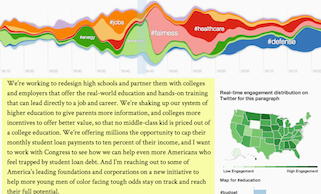
Quadruple that for something as highly watched as the Presidential State of the Union address. But what do those tweets look like? How are they evolving over time?
These are great questions and I couldn’t imagine attempting to answer them via traditional reporting tools. Fortunately, I don’t have to. The figure on the right is just one of the fascinating data visualizations on the Twitter GitHub page. Aside from the #SOTU, you can find neat visual representations on the Sochi Olympics, Nelson Mandela, Steve Jobs, and other notable events and celebrities.
Simon Says
Static and traditional business intelligence or reporting tools are still very important. They aren’t going anywhere, but they are necessary–not sufficient–for dealing with Big Data.
Pretty data visualizations today often don’t lead to simple answers. This does not necessarily mean, however, that they are wastes of time. Visual Organizations embrace new dataviz tools because they enable data discovery and exploration.
The post Dataviz, Twitter, and the State of the Union appeared first on Phil Simon:.
February 10, 2014
Big Data Is Nothing If Not Visual
My interview on InformationWeek on The Visual Organization is now live. Here’s an excerpt:

IW: In most cases, the C-suite isn’t going to initiate the deployment of dataviz tools. Should a small team pitch a dataviz strategy to senior leadership to get the ball rolling?
PS: Well, that’s one option, but employees at visual organizations tend not to ask for permission. The rise of cloud-based, SaaS, and open-source software collectively mean that a top-down deployment process is no longer required. This is not 1998. Drawn-out RFI and RFP processes lead to missed opportunities.
While it’s important to follow internal governance rules, waiting a year or more to deploy a new dataviz tool can cost a business dearly. Bottom-up approaches can quickly generate results and excitement throughout the company.
IW: So it does not have to start with the IT department?
PS: Absolutely not. I believe that the lines of business should “own” their data.
IW: You begin the book with the story of the dataviz vendor Tableau’s IPO. Smaller vendors are developing powerful dataviz tools, but Microsoft, Oracle, and IBM are in the dataviz game too. What are the pros and cons of going with a large vendor?
PS: Well, there’s something to be said for one-stop shopping. All else being equal, it shouldn’t be too hard to get a single vendor’s products to talk to each other, although I’ve seen completely disparate systems and applications stitched together in my years as a consultant.
Adding a new vendor into the equation means signing new contracts, incurring risk, developing new relationships, and (potentially) fulfilling new integration requirements.
However, large vendors like Oracle, Microsoft, and IBM have their hands in many pots. It doesn’t mean that they make “bad” dataviz products. It only means that their priorities aren’t concentrated on one area. Best-of-breed vendors, however, have but one mission: To improve the functionality of their tools.
Read the whole thing here.
The post Big Data Is Nothing If Not Visual appeared first on Phil Simon:.
The Case for Guidelines Over Rules
I remember it like it was yesterday.

In 2001, I was working for Lawson Software (since acquired) on a project in New York City. One Friday, I routinely submitted my expense report that included travel and meals. My total expenses for the week fell under $200 since I lived in New Jersey and commuted daily into The Big Apple. Yet, next week, my manager rejected my expenses. The reason? My lunch one day cost a staggering $18. Evidently, that broke some rule and I had some ‘splaining to do.
Now, go to lunch one day in Manhattan, but skip the posh restaurant. Let’s say that you’re pretty hungry. Even at a take-out place more than a decade ago, you would easily drop at least ten bucks on lunch, and $20 is not out of the question with a beverage with delivery charges and tips.
Punishing the Many for the Sins of the Few

The rule in question was bogus. It doesn’t take an economist to realize that lunch in NYC costs far more than lunch in Omaha, NE. And what if an employee skipped breakfast? Isn’t it reasonable to conclude that one big meal should supplant two normal-sized ones? (Interesting backstory: Lawson’s silly lunch rule stemmed from one ethically questionable employee’s decision to routinely “max out” his lunch expense by buying cases of bottled water to take home with him every day until he was caught.)
Eventually, my manager approved my lunch expense. He knew that I was a big eater, not a scammer. What’s more, he realized that our collective time was more valuable than debating just how much a grilled chicken sandwich cost.
Ah, rules. Lovely rules. Where would most companies be without them?
It’s a subversive question in many organizations, a sign that you don’t know how to play ball. But it’s often a very good question to ask. After all, rules often don’t accomplish what they set out to do. (See the law of unintended consequences.) By trying to articulate exactly what is and what is not permitted, organizations allow for massive loopholes, not to mention a general feeling of “management doesn’t trust us” by the rank and file.
It’s usually more effective to convey general principles that govern our behavior. So argues Dov Seidman in his excellent book How: Why How We Do Anything Means Everything.
Rules often don’t accomplish what they set out to do.
It turns out that a few companies have realized the inefficiency of trying to write a rule to manage everything. Brazil’s Semco S.A. is perhaps the most extreme example of this since it forgoes traditional management, relying upon employees to use their own discretion. Semco is hardly alone, though. In How Netflix Reinvented HR, Patty McCord details the company’s über-progressive view on policies:
We also departed from a formal travel and expense policy and decided to simply require adultlike behavior there, too. The company’s expense policy is five words long: “Act in Netflix’s best interests.” In talking that through with employees, we said we expected them to spend company money frugally, as if it were their own. Eliminating a formal policy and forgoing expense account police shifted responsibility to frontline managers, where it belongs. It also reduced costs.
Simon Says
Of course employees will occasionally exploit guidelines, but isn’t it easier and more efficient to deal with the two or three percent who do violate them as needed?
Feedback
What say you?
 This post was written as part of the
IBM for Midsize Business
program, which provides midsize businesses with the tools, expertise and solutions they need to become engines of a smarter planet. I’ve been compensated to contribute to this program, but the opinions expressed in this post are my own and don’t necessarily represent IBM’s positions, strategies, or opinions.
This post was written as part of the
IBM for Midsize Business
program, which provides midsize businesses with the tools, expertise and solutions they need to become engines of a smarter planet. I’ve been compensated to contribute to this program, but the opinions expressed in this post are my own and don’t necessarily represent IBM’s positions, strategies, or opinions.
The post The Case for Guidelines Over Rules appeared first on Phil Simon:.
February 7, 2014
Celebrating the Five-Year Anniversary of My First Tweet
I have always been a bit of an early adopter when it comes to technology. More than ever, it’s impossible to know what will become important and what won’t. Why not arrive early at the ballpark? After all, there’s often a first-mover advantage.
Against that backdrop, on this day five years ago I created my Twitter account and promptly tweeted.
celebrating the publication of my first book. http://tinyurl.com/dcpza6
— Phil Simon (@philsimon) February 7, 2009
Since that one, I’ve tweeted 18,000 more times.
These days, Twitter claims that roughly 230 million people use the service–although I seriously doubt the veracity that number. (What the hell is an active user anyway?) Still, Twitter is an important company for all sorts of reasons. Think Arab Spring for one.

Over the years, I learned the rules of the game. I dabbled with #FF for a while. I used to thank everyone who retweeted my tweets. At first, I followed everyone who followed me. That was then. I gave myself a Twitter tuneup a few years ago, and I now use Twitter more selectively and intelligently.
Want to know the date of your first tweet? It’s not too hard to discover. See how to search the Twitter archives here. And you can geek out way beyond that. Vizify excels at Twitter data discovery. To see an interactive dataviz of my tweets, click here.
The post Celebrating the Five-Year Anniversary of My First Tweet appeared first on Phil Simon:.
February 4, 2014
9 Things I’ve Learned as a Published Author
Five years ago today, Why New Systems Fail (my first book) was released. Since that time, I could call myself a professional writer. (A little over a year later, Cengage published a revised edition of that book.) 
It seems like a propitious time for personal reflection. In no particular order, here are nine things I’ve learned over the past five years:
Writing a book of substance is hard work. Sure, it’s not difficult to turn a blog into a book. Ditto for writing 70-page texts. Writing what you think is a quality book of any reasonable length, however, takes a great deal of time and effort. Don’t let anyone tell you otherwise.
But it gets easier. I can’t speak intelligently about fiction. I am a non-fiction guy. Since 2009, I have improved my ability to assess what pages, sections, and chapters of my books are working, what needs tweaking, and what needs to be junked. On a different note, the Internet has made research easier–not easy. Finding out who runs any company is only a few clicks away, and contacting any expert, author, executive, or reporter isn’t terribly difficult either.
Writing is extremely rewarding. It’s hard to describe the feeling I get that when first box of books arrives in the mail. A tremendous amount of work finally comes to fruition in a tangible way. Beyond the initial thrill, there’s the satisfaction of knowing that I put something out there. No book is universally acclaimed, and mine are no exceptions to that rule. Still, a genuinely compliment in the form of an e-mail or comment never gets old.
Writing is addicting. Since the publication of the first, I have penned five more and edited a sixth all while blogging extensively on my site and others. Because of the previous two points, I can understand why so many authors get the writing bug.
Writing is cathartic. Arrogance and idiocy have always annoyed me. Writing has provided a much-needed way for me to express myself. Even if a book or post doesn’t receive a great deal of attention, merely writing it down just plain feels good.
Writing books adds boatloads to your credibility. This one goes without saying. In fact, these days it’s a bit surprising when I meet a prominent thought leader who hasn’t written or co-written one.
Writing opens doors; you just can’t predict know which ones. I have had many discussions with prospective writers about the ROI of a book, and frequently I’ve walked away shaking my head. The whole notion of a definitive and precise ROI is misplaced. Too many writers only look at the costs (money, time) and not the significant potential advantages, especially the long-term ones. Not every benefit can be quantified, and there’s a still the great unknown.
Writing raises the bar on the books you read. When you know how the sausage is made, it makes you a more informed reader. I for one pay greater attention to a book’s content and its design elements than I did ten years ago. This isn’t about the logo on the spine of the book. It just means that glorified pamphlets and stream-of-conscious “manifestos” don’t resonate with me as much as those by writers who took the time to develop and present cogent theses, arguments, and examples.
The book business is a fickle one. There are no guarantees for success. Writing only increases the chances that good things happen. As Wayne Gretzky once said, “You miss 100% of the shots you don’t take.”
Here’s to the next five years of writing.
Cross-posted on Huffington Post.
The post 9 Things I’ve Learned as a Published Author appeared first on Phil Simon:.
February 3, 2014
Jeopardy!, Game Theory, and Data
As a kid, I would often watch Jeopardy! with my family after dinner. The four of us would race to see who could first shout out the question to Alex Trebek’s answers. It was more than a little competitive.
On a good day, I’d get twenty percent of the questions right. I did much better in certain categories than others. For instance, I don’t think that I ever scored any points on anything related to classic literature.

With rare exceptions, the real contestants followed virtually identical strategies. They would start at the top of each category and dutifully work their way down. They would effectively try to run the table in sports, movies, or potpurri. If down by vast amounts or in the negative, many in the second round would move directly to the higher-value answers. By then, though, it was almost always too late for them. Desperation is rarely a good strategy.
Recently, 30-year-old Andrew Chu has been using game theory to buck Jeopardy! convention. This Business Insider article breaks down Chu’s controversial methods. I am particularly fond of his decision, when the situation warrants, to play Final Jeopardy! not to win. That is, he has played for a tie (when warranted) because both players come back the next day. With a nod to Mr. Trebek:
Answer: None.
Question: What’s the point of winning an extra $1 and risking losing?
This is just plain smart. (For more on this, see The Final Wager and the video below.)
Simon Says
I find Chu’s approach fascinating. He’s completely willing to do research and use data in ways not considered by the thousands of previous contestants. Somewhere Billy Beane and Michael Lewis are smiling. Chu’s approach has Moneyball written all over it. Like many people his age, Chu is not bound by convention. He knows that we have entered an era in which data is becoming the lingua franca. Why not use it?
Whether you like Chu’s approach or not is immaterial. There’s a general lesson here for all of us: Everyone can use new data and strategies, often with amazing results.
Feedback
What say you?
The post Jeopardy!, Game Theory, and Data appeared first on Phil Simon:.
February 2, 2014
Data and Politics
When people ask me what I write about, I tell them that I focus on the intersection of people, technology, business, and data. It’s a short, accurate, and (I hope) intriguing description of my work.
The Visual Organization explores Big Data and data visualization in business contexts. That hardly means, though, that there aren’t myriad non-commercial uses for dataviz. Far from it. As I write in the book, we’ve not only seen the rise of visual organizations. Visual consumers, visual citizens, visual journalists, and visual governments have also arrived in full force. In short, ours is a much more visual and data-oriented world than even five years ago. The same will be said in five years.
Data and dataviz can tell powerful stories and inspire citizens to take action.
Democratizing forces like the Internet, open data, cloud computing, the ever-declining cost of data storage, greater transparency, and mobility are making it easier than ever for laypeople to visually represent just about everything, including thorny societal problems.
This begs the question, Why visualize? For starters, it’s tough to address certain problems if they aren’t entirely understood. And, more than ever, organizations of all types are pulling out the data and dataviz clubs from their bags. The reason: Data lets them tell powerful stories and inspire people to take action.
Example
For instance, consider income inequality, a topic of President Obama’s January State of the Union Address. Now, you may not believe that the current distribution of wealth is a problem. Maybe, like legendary venture capitalist Tom Perkins, you think that the rich are being persecuted in this country. If that’s the case, then it’s unlikely that anyone or anything is going to convince you otherwise.
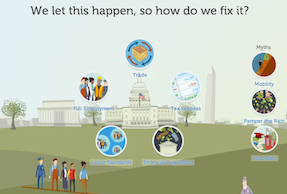
But if you do, you might want to use data to make your case. And that’s exactly what socially conscious data-visualization firm Periscopic did. The company created Inequality.is for the Economic Policy Institute, a left-leaning think tank based in Washington, DC. (Interesting side note: I attended a lecture at EPI more than 20 years ago.) EPI wants to demonstrate the gap between the rich and poor–and why this gap is a problem. Beyond raising awareness, EPI wants people to take action. EPI knows that data and data visualizations represent viable means to this end.
Simon Says
No dataviz can solve all of the world’s problems or build consensus among warring factions. That day may never come. Still, today dataviz is no longer the exclusive purview of the private sector. On the contrary, citizens, journalists, and government agencies are increasingly using data and data visualizations to make their cases and advance their agendas.
Feedback
What say you?
This post was written as part of the
IBM for Midsize Business
program, which provides midsize businesses with the tools, expertise and solutions they need to become engines of a smarter planet. I’ve been compensated to contribute to this program, but the opinions expressed in this post are my own and don’t necessarily represent IBM’s positions, strategies, or opinions.

The post Data and Politics appeared first on Phil Simon:.