Phil Simon's Blog, page 85
November 26, 2013
Dogfight by Fred Vogelstein
Originally published on Huffington Post.
When I wrote The Age of the Platform, I knew that I was just skimming the surface. There was so much to more to cover on Amazon, Apple, Facebook, and Google on so many levels. The platform was a big idea, and I knew it. Whats more, the “Gang of Four” was starting to dominate business, especially on the consumer side.

One particularly thorny collision is taking place in the world of mobility, with Apple and Google squaring off with Samsung. This is the starting point for the Dogfight: How Apple and Google Went to War and Started a Revolution, the new book Wired correspondent Fred Vogelstein. (Disclaimer: I received a free media copy.)
In a word, Dogfight is excellent. Vogelstein makes you feel like you’re sitting in key meetings with senior execs like Steve Jobs, Andy Rubin, Sergey Brin, Eric Schmidt, Larry Page, and others intricately involved in the development of the iPhone and Android. While neither Apple nor Google would make the top brass available for the book, Vogelstein clearly did his research. Some of the inter- and intra-organizational make for great theater. Egos are massive at that level, and not just if your name is Steve Jobs.
There are nuggets buried throughout the text, including Jobs’s surprise (naiveté?) on Google’s plans for Android to compete with the iPhone. The chapter “I thought we were friends” is particularly strong. And Vogelstein places the mobility wars in the proper technological and historical contexts. That is, he draws compelling similarities between the existing battles and those of the PC/Windows’ age. The guy’s got big writing chops.
Most fascinating to me was the exploration the two companies’ disparate platform strategies. In short, Apple/iOS is largely closed while Android is the epitome of open. Some have even called the latter the Wild Wild West. Brass tacks: There’s no one right way to build a platform, as we’re seeing now.
I follow tech very closely as part of my job and life, so no many of the facts and anecdotes weren’t entirely new to me. Still, it’s silly to fault an author for covering important trends. This is a great read.
Rating: 5/5 stars.
The post Dogfight by Fred Vogelstein appeared first on Phil Simon:.


November 22, 2013
Big Data and Cloud Computing: Not Just for Big Companies
Originally published on HuffPo.
It’s hard to talk about technology today without at least tangentially mentioning cloud computing. It turns out that Larry Ellison was no sorcerer when he compared it to women’s fashion in 2008.

Whoops.
Today, cloud computing is alive and kicking. For instance, I live in Las Vegas, a city rife with startups, most of which are up and running in a very short period time thanks in large part to “the cloud.” Look around the country, and really he world. Millions of small, mid-sized, and large organizations have embraced it and are seeing vast rewards in the process.
Or look at your phone and you’ll see the usual suspects. Consumer-oriented companies like Amazon, Apple, Facebook, Google, Twitter, and Netflix run largely or exclusively on cloud computing. You’ve probably heard of these behemoths. but they have plenty of company: Salesforce.com, DropBox, Box.Net. and scores of other apps enable individuals and organizations of all sizes to do things better and cheaper.
While we’ve seen increased adoption of cloud computing over the past five years, by no means are we finished. This was one of the themes discussed at yesterday’s IBM Cloud Forum held in New York’s Science House. (This was not your ordinary venue.)
Cloud computing is no elixir.
I attended, along with a collection of analysts, futurists, authors, practitioners, and generally smart cookies. To be sure, opinions on “the cloud” varied. It’s clear that one size does not fit all here. I could write a book about the diversity of opinions on the topic, but one thing was readily apparent: Cloud computing is not the solve purview of large organizations, a point that I made in The New Small. Others echoed my own thoughts, including Derek Schoettle of Cloudant, a Big Data company that provides distributed databases over the Web. But here’s the rub: His is an 80-employee company. Brass tacks: Big Data is not just for big companies.
Simon Says
There’s no shortage of benefits when it comes to moving away from on-premise applications, but don’t think for a minute that the mythic cloud solves business problems all by itself. It doesn’t. Cloud computing is no elixir. It doesn’t magically fix bad data, dysfunctional organizational cultures, or automatically integrate with legacy applications.
The post Big Data and Cloud Computing: Not Just for Big Companies appeared first on Phil Simon:.
The Age of the Platform: Indonesian Version

Last year, I announced that the book will be translated into Korean. I was pretty psyched because my other three books had never made it out of English. Today I’m pleased to announce that the book will be translated into Indonesian some time in 2014.
PT Elexmedia Komputindo is the publisher.
The post The Age of the Platform: Indonesian Version appeared first on Phil Simon:.
November 20, 2013
Healthcare.gov and the Importance of System Testing

I’ve written before on this site about root causes of the Healthcare.gov debacle. Now and as expected, plenty of government officials are chiming in. Consider the folks at the Energy and Commerce Committee:
In the letters, the committee leaders write, “We are now seeing the results of HHS’ (Health and Human Services) failure to conduct adequate end-to-end performance testing of HealthCare.gov prior to its launch on October 1. [Emphasis mine.] Almost one month after open enrollment began, the website continues to suffer from glitches and is often unavailable to the public to shop for plans.”
I’ve seen time and time again the failure of organizations to adequately test new systems before launch. (It’s a major theme in Why New Systems Fail.) Lack of sufficient system testing tends to result in even more pernicious outcomes when the system is essentially created from scratch. Yes, it is essential to test COTS systems, but many of those systems’ features are already “tested” by the vendor in each release. The same cannot be said about homegrown applications and websites, a lesson that HHS has learned the hard way.
Compared to COTS systems, it’s even more important to test homegrown ones.
While not definitive, testing is designed to discover the following types of issues before going live:
Data Issues: Did we load what we thought we did? Did everything migrate in the correct format? What’s missing? What’s duplicated?
Configuration Issues: Did we set up the system as desired? Building a system is analogous to building a house. Problems in the foundation are much harder to fix than repainting the upstairs bathroom.
Security Issues: Can people see what they are supposed to see? Are they prohibited from seeing what they shouldn’t? Who has read-write access? Who doesn’t? Who can run the requisite reports? Who can “back into” things that they shouldn’t be able to see?
Software Issues: Also known as bugs, sometimes applications don’t work as vendors claim. Testing can manifest these issues, especially when users run detailed scripts on everyday interactions.
Reliability and Performance Issues: Does the site stay up? Is the speed acceptable? How many concurrent users can it support? What crashes when?
Simon Says: You Can Never Test Too Much
Even in the rare event that testing manifest zero issues (and I’ve never seen it happen, even on relatively minor upgrades), it behooves organizations to extensively kick a system’s tires. In my next post on this subject, I’ll discuss why testing is often minimized and overlooked.
Feedback
What say you?
 While the words and opinions in this post are my own, Corvil has compensated me to write it.
The post Healthcare.gov and the Importance of System Testing appeared first on Phil Simon:.
November 18, 2013
Early Thoughts on the iPad
I’ve had my new iPad for a few weeks now and it’s time to give some feedback. I really like it, but…
Buying Kindle books isn’t nearly as frictionless as it should be. You can’t just read a sample of a book in the Kindle app and then buy the rest. Rather, you must exit the application and buy it from a browser. Of course, this isn’t an Amazon limitation. I’ll bet you $100 that Apple removed “buy now” functionality in the app for users read samples of Kindle books. Annoying, but I understand Apple’s desire to push iBooks.
Watching DVDs on your iPad isn’t as easy as it should be. Yes, you can noodle with HandBrake and create M4P files to play in iTunes, but it’s a clunky process that doesn’t always work. Seems like this problem should be solved at some point.
Riddle me this: Why can I stream Amazon Prime movies for free but only download movies that I pay to watch? I’d love a simple button to temporarily download a movie. Again, this might be by design. The simplest way to watch movies (sans WiFi) is to download them via iTunes.
Battery life is good but, like the iPhone 5 and 5s, you’re best off turning off a few of the battery-sucking options.
Voice dictation with iOS 7 is great.
Brass tacks: this is a great device. I’m glad that I waited. It seems like the iPad has evolved tremendously since its inception.
Feedback
What say you? Do you own an iPad? Any tips?
The post Early Thoughts on the iPad appeared first on Phil Simon:.
November 13, 2013
Book Review: Automate This
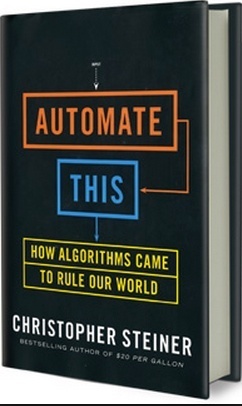 Now that I’ve joined the iPad crowd, it’s easier than ever for me to peruse books and buy what looks interesting. Kindle recommended Automate This: How Algorithms Took Over Our Markets, Our Jobs, and the World
 by Christopher Steiner (affiliate link), so I decided to read the sample.
Immediately, I was hooked. I bought the book and breezed through it in a little over a day.
Steiner has a gift for storytelling and he certainly did his research. I was familiar with many of the concepts and companies discussed in the book. I knew about IBM’s Watson, evidence-based medicine, and high-frequency trading, so not all of the material was new to me. At the same time, though, I learned a great deal.
At the heart of many algorithms is the desire to make money–and Wall Street in particular. I also didn’t know that the same aversion to new trading technologies today existed in the 1960s. The more things change…
I can see why this book has done so well. My only regret is that it ended. I want to see more from Steiner.
The post Book Review: Automate This appeared first on Phil Simon:.
November 12, 2013
An Update on The Visual Organization
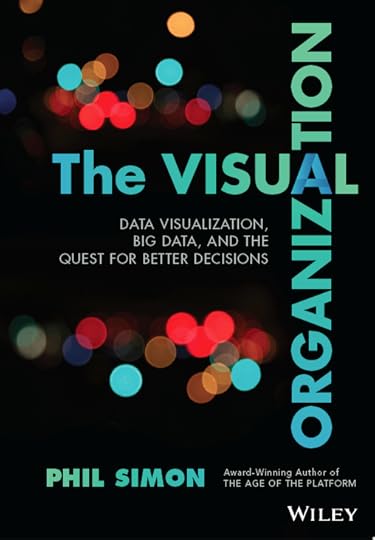 Six weeks ago, I submitted the manuscript for the new book. It came in at roughly 62,000 words with 48 images and six tables. The book is arranged in four parts with nine chapters, a coda, an afterword, and my first ever appendix.
The book has passed its developmental edit and has moved on to copyediting.
After some thinking, my editor and I decided on a new subtitle. The old one was more of a filler until something better came along.
Something finally did.
The full title of the new book is now The Visual Organization: Data Visualization, Big Data, and the Quest for Better Decisions. Yeah, it’s still a bit of a mouthful, but it accurately describes the 300 or so pages that will go to print in March of next year. It was important to me to express the book in the form of a quest or a journey. Like all of my books, there are plenty of tips, but (as you’ll hopefully read in a few months) visual organizations evolve. They are not born overnight.
I’m most excited about the interior design of this book. Before inking the deal, I insisted that Wiley publish The Visual Organization in color. Black and white could only do so much and, after all, this is a book on data visualization. My editor agreed. Fast forward seven months and I’ve seen samples of the design and the paper to be used. In a word, wow. The images just fly off the page.
The post An Update on The Visual Organization appeared first on Phil Simon:.
November 11, 2013
Amazon and the Importance of a Data Culture
Having watched and participated in the dot-com boom, I have known a great deal about Amazon for a long time. (Ditto for eBay, Google, and the like.) Today, though, I consider myself vastly more informed about Amazon than ever. For that, I have to thank Brad Stone for writing the excellent book The Everything Store: Jeff Bezos and the Age of Amazon (affiliate link).

This is a landmark text. The others written about Amazon have been too brief, lacking in some critical ways, and/or incomplete.
Not this one. Stone’s research is comprehensive, his story telling masterful. Bezos wouldn’t give his imprimatur on the book, but that didn’t deter Stone in his quest to write the closest thing to a definitive book on the company. He tracked down key former employees. He pieced together heretofore unknown parts of the company’s success. The Everything Store tells stories that few outside of Amazon have known up to this point. And this is no puff piece. Stone justifiably questions the actions of his subject when called for. (There are many times when Amazon has crossed the line with governments, publishers, supplies, and others.)
The Everything Store ranks among my top five company profiles. Reading the book gave me a new appreciation for the ruthlessness of Amazon and Jeff Bezos in particular. Like Stone, I admire what Bezos and Amazon have done, but not always the way that they have done it. (That’s a post for another day.)
The Data Element
Those who haven’t paid a great deal of attention to Amazon over the years may not realize the extent to which it uses data. (To be fair, data per se was not a major focus of Stone’s book. His is a business text first and foremost.) Still, reading the book confirmed how profoundly the Amazon culture embraces data for both daily and strategic decision making. Just about everything at Amazon is quantified, examined, analyzed, and split-tested. Decisions are best made by data. Employees need to bring data or go home.
Bezos understands that data is increasingly valuable and a source of competitive advantage.
In one of the most harrowing examples from the book, Bezos steamed while calling Amazon.com’s 800 number to question an employee’s claims about short hold times. Two excruciating minutes passed when an Amazon rep finally answered, “Amazon.com.” Bezos’s terse, intense reply: “Just checking.” He then hung up.
Simon Says
Does Amazon sometimes take data-driven management too far? Yes. For instance, I was unaware of the persistent conflict between the data wonks and editorial folks. And I’d hate to be a designer have my creativity constantly devalued in the face of cold, hard data. Amazon is no picnic, as evinced by its high employee turnover rate.
Still, I’d argue that most companies could use a little more Amazon in them: manage data well, quantify whatever you can, routinely test key business processes, and see what can be improved and how.
Feedback
What say you?  This post was written as part of the IBM for Midsize Business program, which provides midsize businesses with the tools, expertise and solutions they need to become engines of a smarter planet. I’ve been compensated to contribute to this program, but the opinions expressed in this post are my own and don’t necessarily represent IBM’s positions, strategies, or opinions.

The post Amazon and the Importance of a Data Culture appeared first on Phil Simon:.
November 7, 2013
Hatching Twitter
Originally published on HuffingtonPost.
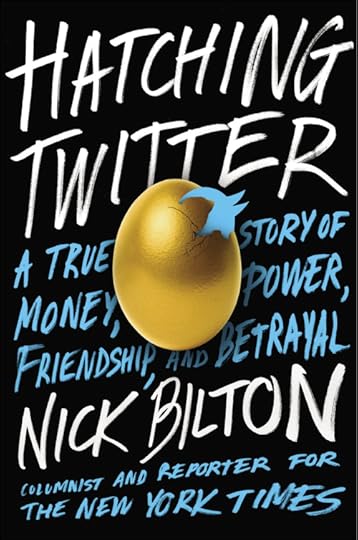
I’ve followed Twitter from its inception, but there was plenty about the company that hasn’t been revealed–at least until now. Nick Bilton’s opus Hatching Twitter: A True Story of Money, Power, Friendship, and Betrayal (affiliate link) goes where no book has gone before. And the timing couldn’t be more propitious. Twitter goes public in a few hours.
Bilton’s excellent book rivals The Everything Store: Jeff Bezos and the Age of Amazon (affiliate link) in its scope and unflinching honesty. Through copious research and interviews, Bilton weaves together the heretofore untold story of one of the most influential companies of our times.
I know that things can be chaotic at successful startups, but Bilton describes how Twitter was a complete mess early on–and even as recently as 2011. Its core technology, strategy, finances, and management were anything but settled. Even many employees didn’t know who was minding the store. Against that backdrop, it’s amazing that the company will soon be worth nearly $15B.
Dorsey often comes across as petulant, egomaniacal, and cunning.
I like the fact that Bilton pulls no punches, calling out self-anointed Steve Jobs’s successor Jack Dorsey often and not without justification. Dorsey often comes across as petulant, egomaniacal, and cunning. I had doubts that he was the second coming of Apple’s iconic leader, and the book only confirmed my suspicions.
Platform Thinking
On a totally different level, it was interesting to see how Twitter has embraced platform thinking. Twitter’s cofounders understood that the success today often hinges upon rapid innovation from a company’s ecosystem. (Amazon, Apple, Facebook, and Google are just a few of the most prominent examples of this critical business trend.) In the case of Twitter, the @ symbol, retweet button, and hashtag are just a few of the recommendations that others proposed to the core Twitter product. It didn’t matter if Jack, Ev, or Biz found a particular enhancement, feature, or suggestion useful. Millions of Twitter users did.
Bilton’s book is informative on many levels and I can’t wait for his next one.
Rating: 5/5 stars
The post Hatching Twitter appeared first on Phil Simon:.
November 4, 2013
AllAnalytics Interview on The Visual Organization
I was recently a guest on AllAnalytics Radio. I spoke about the new book and how organizations can embrace comtemporary dataviz. I threw in some examples from the book, like Netflix and Wedgies.
Questions include:
Why did you decide to write the book…and why now?
You start the book’s intro with a quote from Henry David Thoreau, “It’s not what you look at that matters, it’s what you see.” Can you explain that?
You suggest many—if not most—companies aren’t prepared for data visualization. Why not? And, what does it take to get ready for data visualization?
What is “The Visual Organization?”
What is a visual mind-set? Is this something that a person can grow into or is it more innate?
Listen to the whole interview here.
The post AllAnalytics Interview on The Visual Organization appeared first on Phil Simon:.