Phil Simon's Blog, page 89
August 25, 2013
Catching Up with Jordan Rudess
Originally published on Huffington Post.

I recently sat down Jordan Rudess in Las Vegas before the Vegas Rocks! show. Yes, Rudess is primarily known as the keyboardist, Continuum-player, multi-instrumentalist for the Grammy-nominated prog rock/metal icons Dream Theater. The band is releasing its new, self-titled studio album next month. But the man at any given time has a bevy of projects going on. I wonder if he ever sleeps.
He recently funded a project via PledgeMusic called “Explorations.” We also talked about his collaboration with Tony Levin and Marco Minneman and his iOS latest app, EarWizard.
You can watch the video below.
The post Catching Up with Jordan Rudess appeared first on Phil Simon:.


August 15, 2013
The Visual Organization Now Available for Pre-Order on Amazon
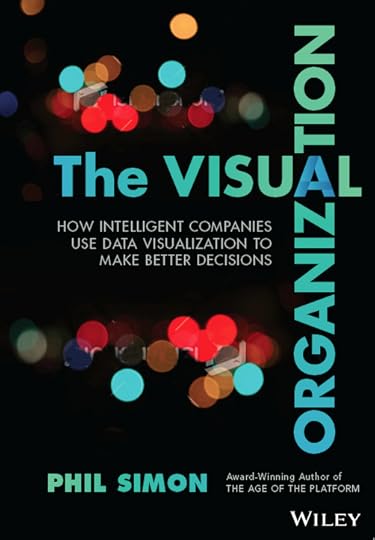
The Visual Organization: How Intelligent Companies Use Data Visualization To Make Better Decisions is now on Amazon.
It’ll be out in March of 2014.
Don’t worry about the price. It is always higher at first. It’ll be $25 or so by the time it hits. Like my last book, Too Big to Ignore, it will be part of the SAS Business Series.
The post The Visual Organization Now Available for Pre-Order on Amazon appeared first on Phil Simon:.
August 14, 2013
Content and Context: Kissing Cousins

These days it’s not uncommon to hear the bromide “Content is King.” That may be true in certain circles, but context is probably the queen–or at least a duke.
As I continue researching the new book, it’s obvious to me that many data visualizations lack (the proper) context and suffer as a result. They leave the user asking, Compared to what?
David McCandless is a London-based author, data journalist, writer, and designer. In 2010, he gave a fascinating TED talk called “The Beauty of Data Visualization” in which he made this very point:
In creating effective data visualizations, it’s impossible to overstate the value and importance of context. (This was true well before we ever heard the term Big Data.) It starts with the user, the ultimate consumer of the dataviz. How can employees or clients act upon a data visualization if they don’t understand what’s in front of them? Without understanding, an informed business decision is unlikely to result.
But it goes deeper than that. As Drew Skau writes on the Visual.ly blog, “There is hidden context in many visualizations, and [context] helps give an accurate depiction of the data, even if the viewer is unaware that the context exists.” [Emphasis added.]
Context: Everybody Wins
In creating effective data visualizations, it’s impossible to overstate the value and importance of context.
But context also helps developers considerably. I think back to my consulting days. Often, I would create a slew of reports for my clients. For instance, at one engagement with a large retailer in New York City, I built more than 300 separate reports, with more than half payroll-related. I tracked all reports in an Excel workbook and assigned each report a unique number to keep my sanity.
Yet, at least at first, my clients didn’t appreciate the importance of context when we developed the reports. For example, in the elevator, the payroll manager, Glen (not his real name), would tell me that he had a question about “that payroll report.” I would smile and politely remind him that, at any given point, I was working on a three or four dozen reports for his department. I was pretty sure that I hadn’t named any one That Payroll Report. (That actually would have been pretty funny, come to think of it.)
Eventually, Glen got the hang of it. On my way to lunch in that same elevator a few weeks later, he started the conversation with me differently. “Phil, do you have a few minutes to talk about Report 123, the one that breaks down employee wages by state and pay period?”
I winked. He got it.
Ahhh…the beauty of context.
Simon Says:
Whether creating a simple listing or an interactive dataviz, remember that both content and context matter. Put the two together, and good things can happen. One without the other will leave users wanting.
Feedback
How does
 This post was written as part of the
IBM for Midsize Business
program, which provides midsize businesses with the tools, expertise and solutions they need to become engines of a smarter planet. I’ve been compensated to contribute to this program, but the opinions expressed in this post are my own and don’t necessarily represent IBM’s positions, strategies or opinions.
This post was written as part of the
IBM for Midsize Business
program, which provides midsize businesses with the tools, expertise and solutions they need to become engines of a smarter planet. I’ve been compensated to contribute to this program, but the opinions expressed in this post are my own and don’t necessarily represent IBM’s positions, strategies or opinions.
The post Content and Context: Kissing Cousins appeared first on Phil Simon:.
August 10, 2013
My Interview with Jonathan Banks of Breaking Bad
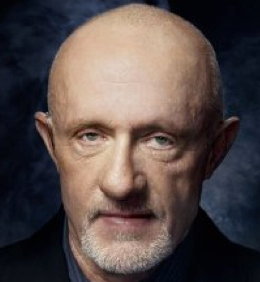
Article originally appeared on Huffington Post. Click here to read it there.
Readers of this site know how much I love Breaking Bad, for my money the single greatest drama in the history of television. I recently sat down with the versatile and accomplished actor , who plays dead-eyed hitman Mike Ehrmantraut.
Warning: there are spoilers in the interview.
Congratulations on your recent Emmy nomination. Does it mean anything different to you than the the one you received from Wiseguy?
I’ve listened to and watched many interviews on Breaking Bad. It seems that the actors, writers, producers, and entire staff were exceptionally well prepared before coming to work. Can you talk a little bit about that?
Breaking Bad does an exceptional job of not explaining everything. For instance, your character’s history in Philadelphia was never fully clarified. Did you make up your own back story for Mike? Did you ever talk about Mike’s background with Vince Gilligan?
Did you have a favorite scene from your four seasons on the show?
What do you have planned for the rest of 2013 and beyond? Can we expect to see you again on Modern Family?
Listen to the interview below.
http://simonsandbox.wpengine.com/wp-content/uploads/2013/08/banks_trimmed.mp3
The post My Interview with Jonathan Banks of Breaking Bad appeared first on Phil Simon:.
August 8, 2013
Four Big Data Imperatives: My Other Forbes’ Interview

I recently gave an interview to Forbes and Dorie Clark about Big Data and my new book. Here’s an excerpt:
Data Visualization may be the Next Big Thing. You have massive amounts of data – how can you possibly comprehend it? Enter data visualization, which Simon believes is “absolutely essential for organizations…[These tools] are helping employees make sense of the never-ending stream of data hitting them faster than ever. Our brains respond much better to visuals than rows on a spreadsheet. This goes way beyond Excel charts, graphs, or even pivot tables. Companies like Tableau Software have allowed non-technical users to create very interactive and imaginative ways to visually represent information.”
Intuition isn’t Dead. It turns out Big Data and the certainty of numbers hasn’t killed intuition, after all. “Contrary to what some people believe,” says Simon, “intuition is as important as ever. When looking at massive, unprecedented datasets, you need some place to start. Intuition is more important than ever precisely because there’s so much data now. We are entering an era in which more and more things can be tested.
Big Data has, at least not yet, replaced intuition; the latter merely complements the former. The relationship between the two is a continuum, not a binary.
To read the whole interview, click here.
The post Four Big Data Imperatives: My Other Forbes’ Interview appeared first on Phil Simon:.
Visualizing Synonyms
I’m old enough to remember physical dictionaries and thesauri. I even have one of each on my bookshelf in my living room, although I rarely open these days.
We all know the process. Open book. Look up word. See what’s similar. Repeat as necessary.
Except it doesn’t have to be. Check out the Visual Thesaurus, a completely innovative way of thinking about synonyms. Typing in confuse gives you this:
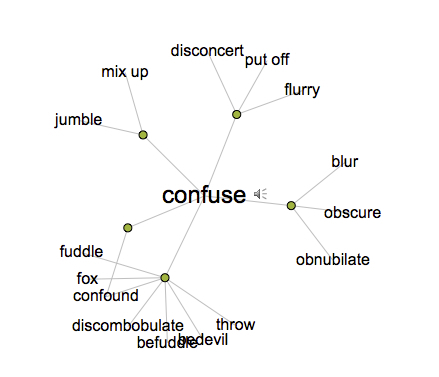
Simon Says
You. Can. Visualize. Just. About. Everything.
Feedback
What say you?
The post Visualizing Synonyms appeared first on Phil Simon:.
August 6, 2013
Should You Self-Publish? My Forbes’ Interview
[image error]
I recently gave an interview to Forbes about a wide variety of topics. Here’s a sample:
What’s micropublishing?
It’s important to distinguish micropublishing from self-publishing. That is, all self-publishing is not created equal. There are degrees. If I showed you the self-published version of Why New Systems Fail and Motion’s The New Small, you would immediately see and feel a difference.
Micropublishers can move fast and stay flexible. They can take on only the projects that make sense. In a very real way, they are not full-time operations. In my case, Motion is a bit of a side project. I focus most of my time on my own writing, speaking, and consulting. Motion has released three additional books beyond my two. Two came from companies and one came from a first-time author who knew that he would have a hard time procuring a deal from a traditional publisher. When a Motion is not in process, the company is effectively on hiatus. It ramps up as necessary.
To read the whole interview, click here.
The post Should You Self-Publish? My Forbes’ Interview appeared first on Phil Simon:.
The Age of the Platform: Korean Cover
Last month, I announced that the Korean translation of The Age of the Platform has been completed. Here’s the cover of my first translated book: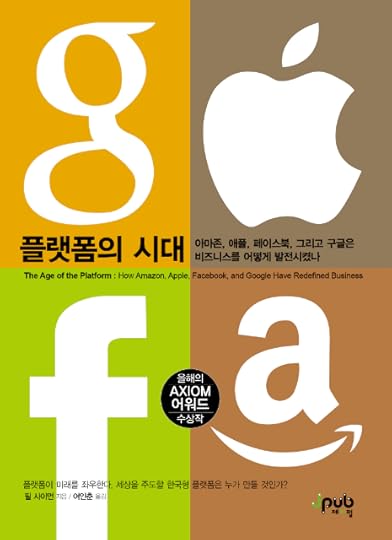
The post The Age of the Platform: Korean Cover appeared first on Phil Simon:.
August 1, 2013
On Caveman, Big Data, and Pie Charts
Today, consumers are bombarded with choice. Design sensibilities have never been more important than they are today. Generally speaking, less is more. Admittedly, though, this is a fine line to walk. Being able to draw the line between too much and not enough takes skill and, to be sure, it’s much more art than science. It’s a mistake for companies to add superfluous “features” to their products just because they can. Typically, 80 percent of the users of a product take advantage of 20 percent of its features, a true power law. Companies like Apple and 37Signals have shown us that simple is good.
Simple is good–and that goes for dataviz as well.
And the same holds true with data “products.” In an era of Big Data, it’s easy to become overwhelmed. Powerful data visualization tools don’t change that fundamental fact. It’s evident that there’s no shortage of ways to visually represent data, although some are much more effective than others. The right dataviz can lead to better business decisions, but how do we strike the balance between too much and not enough?
Udhaya Padmanabhan and Shilpi Choudhury express some thoughts on that very question in their excellent piece, “How to Make Data Visualization Better with Gestalt Laws.” They use a multi-level pie chart to group related entities and differentiate them from other groupings:
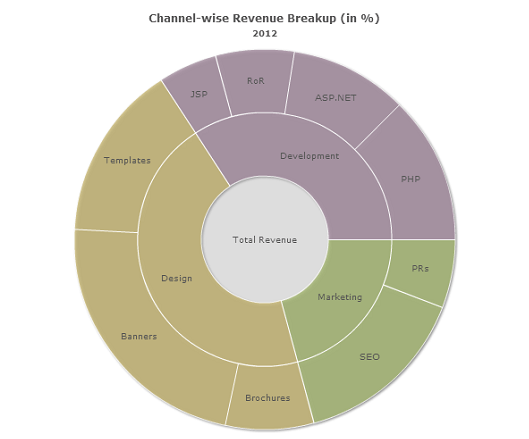
Padmanabhan and Shilpi Choudhury recommend using “similar characteristics and attributes (color, size, shape, etc.) to establish relationships between objects and to reinforce groupings.” In the end, doing so will increase the chances that the dataviz–and the data–are understood, and better business decisions result. And that’s the whole point!

The era of Big Data requires us to ask ourselves, What’s the best way to represent information? In some cases, this means that we have to question tried-and-true assumptions. Yes, the pie chart has been with us since the dawn of man. Several ancient caveman paintings reflected circular percentage breakdowns of hunter yields by family. (Alright, I’m joking about that, but pie charts aren’t exactly new phenomenon.)
Simon Says
Even stalwarts like pie charts and bar graphs can be improved. Combining two charts into one certainly qualifies as an improvement. It conveys information in a logical way.
Feedback
How does your organization routinely represent data? Are you stuck in 1998?
This post was written as part of the
IBM for Midsize Business
program, which provides midsize businesses with the tools, expertise and solutions they need to become engines of a smarter planet. I’ve been compensated to contribute to this program, but the opinions expressed in this post are my own and don’t necessarily represent IBM’s positions, strategies or opinions.
The post On Caveman, Big Data, and Pie Charts appeared first on Phil Simon:.
July 31, 2013
Best Thing/Worst Thing: Writing a Book
I tend not to like anodyne things.
My favorite bands, movies, TV shows, and books often have one thing in common: They polarize. For instance, I don’t know too many people who are on the fence about Rush. You either love Canada’s finest power trio or hate it.
And that’s fine.

So, in the spirit of polarization, I’m going to be writing a number of posts over the next few months that take something and crystallize it. I’m even using a hashtag: #btwt. I suspect that I’ll cover a wide range of personal and professional topics.
I’ll kick off the series with something near and dear to my heart: writing a book.
Best Thing
It’s tough to pick a single best thing about creating a text from scratch. To be sure, for digital men like me, it feels great to hold one of my books in my hand. I’m not a carpenter or mason. There’s a feeling of accomplishment that I just don’t get from blog posts. And, at speaking events, book signings are great. Few people stand on line to tell you how much you suck.
And writing books helps increase your industry credibility. There are worse things to tell people that you write for a living. (Hey, at least I’m not Ryan Braun or Alex Rodriguez.) Monthly royalty checks don’t hurt, although some people believe that there’s no such thing as passive income.
At least to me, the ability to connect with completely random people represents the best thing about writing a book. I was reminded of this on Saturday here in Las Vegas. I met with a representative from Vista Expo, a conference that I will be keynoting in October. Attendees will receive copies of The Age of the Platform. Without the book, I don’t get the speaking gig. It’s that simple.
Of all of the speakers in the world, a conference organizer picked you.
I’m always curious about a how conference organizer finds out about me, and every speaker should ask that question. Someone at DSS had heard of the book and, yadda, yadda, yadda, there I was. It’s downright amazing to think about the fact that, of all of the speakers in the world, a conference organizer picked you–and bought a bunch of copies of the book to boot. Adding to the ego boost, it feels good to have written a tech/business book that others still deem relevant nearly two years after its publication.
Listening to people talk about how they’re trying to implement your ideas is an extremely powerful rush, maybe even meth-like.
Worst Thing
In a word, uncertainty. Irrespective of genre, writing a book is a great deal of work. Publishing options have proliferated over the past decade, it’s never been easier for anyone to get published. Because anyone can do it, just about everyone is.
Unless your name is Stephen King, getting your book noticed is no small endeavor. Most books sell fewer than 250 copies. All else being equal, authors who sell more copies actively market themselves and their work. If you think that a major publisher will spend thousands of dollars promoting you, think again. And speaking gigs, while potentially lucrative, are not guaranteed.
Put differently, there’s no guarantee that any of this will pay off: interviews you give, the freebies you send, the characters you tweet, the guest posts you write, or the PR firms you hire, and the time you spend. While I write with a purpose, on occasion I envy those with steady paychecks. If they work 40 hours, they’ll get paid for 40 hours. Writing a book offers no such guarantee.
Feedback
What say you?
Photo Credits: Ana Belén Ramón via Compfight
The post Best Thing/Worst Thing: Writing a Book appeared first on Phil Simon:.