Phil Simon's Blog, page 92
June 20, 2013
Youtility: An Interview with Jay Baer
Originally published on Huffington Post.
Jay Baer is one of the foremost authorities on marketing and social media, as well as a friend of mine. I’ve quoted him in two of my books. I sat down with him to talk about his new book, Youtility: Why Smart Marketing Is about Help Not Hype.
PS: Other than a nifty word, what is Youtility, really?
JB: Youtility is marketing so useful, people would pay for it. Of course, you probably won’t actually ask customers or prospects to pay, but it’s marketing that has so much inherent value, they would fork over a few dollars if you insisted.
PS: Why would companies want to spend time and money on this, given the number of other priorities they have?
JB: Youtility will not be optional; it will be required. All businesses are now in an unprecedented, hyper-competitive environment where they are competing for attention not just against other businesses, but against EVERYTHING. Think about your Facebook feed, or Twitter feed, or Instagram, or even your email inbox. What you find there is a confluence of personal and professional relationships. Companies are side-by-side with messages from your real friends and family members. That’s an extraordinarily tough marketing environment, having to use the same venues and technologies that we’re using to connect authentically to people we actually cherish.
So, in this information overload arena, companies only have two options to break through that clutter. They can be “amazing” or they can be useful. To me, the culture of “just be amazing” and “be viral” has gone too far. Most companies aren’t amazing, and viral is a strategy of hope. Being truly, inherently useful and creating Youtility is a repeatable, trackable, marketing approach that works.
Companies that are embracing Youtility – and I profile dozens of them in the book – are being rewarded with attention, sales, loyalty and advocacy.
PS: Can you give me an example?
JB: One of my favorites is Columbia Sportswear, the Portland, Oregon–based manufacturer and retailer of outdoor wear and gear. They have a super useful free app called “What Knot to Do in the Greater Outdoors.” It provides detailed instructions for how to tie dozens of knots, including which to use when. The app has forty-eight five-star reviews out of fifty-three total reviews in the Apple iTunes Store. With little marketing support, it’s been downloaded 351,000 times in approximately twenty months.
They conducted research and found it is very common for outdoor enthusiasts to carry smartphones on excursions, thus they built the app to provide useful information to their customers. But this is the key: Columbia doesn’t sell rope.
A big part of Youtility is to transcend the transactional. A app about how to pick out the best jacket isn’t particularly interesting, or useful. But an app that shows you how to tie knots is. Even though it’s not about Columbia products per se, it still matters within the lifestyle context of their customers. You have to give your company permission to make the story bigger, and create Youtility that’s tangential, yet relevant.
PS: It seems like there would be a great deal of doubt in organizations looking to do this, no?
JB: Absolutely. In most organizations, there are two barriers standing in the way of this new type of marketing. One is psychological, and the other is operational.
On the psychological front, the truth is that the tenets of Youtility—making your company inherently useful without expecting an immediate return—is in direct opposition to the principles of marketing and business deeply ingrained in practitioners at all levels. We’ve been trained to think that marketing activities and outcomes follow a linear progression. We’ve been told over and over that we sell more with bigger budgets and better targeting, and by perfecting the crafts of interruption and inbound marketing. Youtility is something entirely different. It requires companies to intentionally promote less at the point of consumer interaction, and in so doing build trust capital that will be redeemed down the road.
In most companies, creating marketing that customers want is a colossal shift from the norm. As a result, many current programs of this type represent the first time the business has tried useful marketing. Because there is no internal history with it, the operational barrier to Youtility centers on roles and responsibilities. Who should be in charge of this? Marketing? Guest Relations? Some other department?
But once you get your organization aligned, you’ll find that Youtility pays dividends over the long-term. Especially since creating programs of this type typically isn’t very expensive.
PS: How important is mobile to programs of this type?
JB: Critical. In fact, the prevalence of smartphones and the fact that always-on Internet access has made us all passive-aggressive is one of the key drivers of the Youtility trend.
It used to be that we created relationships with people. Increasingly, we now create relationships with information, because engaging in a synchronous exchange via phone (or even email) is too much of a hassle for both parties. Customers want to do the research online themselves, because they have the ability to do so at any time from the palm of their hands. Why would you want to have a sales rep call you until you’ve exhausted all the freely available online information first?
And in fact, Sirius Decisions’ research finds that in B2B – where this trend is most impactful today – customers contact a company only after 70% of the purchase decision has been made. The sales team used to be top of the funnel. Now they get involved mid-funnel or later. It’s a huge shift.
Read more about Jay at his site.


June 19, 2013
Writing and Publishing Options for First-Time Authors

Here are the slides from the recent writing and publishing seminar that I recently gave in Las Vegas. Enjoy.
Big Data and Health Care: An Interview with Rod Smith

This post also ran on Huffington Post.
I know a thing or two about data, especially the big kind that is so popular today. Far too many people, however, still think of data as rows as columns in a spreadsheet.
Sure, that type of structured data is important. Big Data doesn’t change any of that. The power of unstructured data is hard to dismiss, especially given the proliferation of powerful text-, photo-, and video-mining tools being developed.
I’m hard-pressed to think of an industry that could benefit more from mining unstructured data than health care. The power of this type of information is a major emphasis in Too Big to Ignore. Along those lines, I recently sat down with Rod Smith of IBM. In his role, Smith serves as the VP of Internet Emerging Technologies to talk about how Seton Health Care used the unstructured data on patient records in fascinating ways. We also discuss how to get doctors on board with emerging technologies.
Watch the video here.
Feedback
What say you?
 This post was written as part of the
IBM for Midsize Business
program, which provides midsize businesses with the tools, expertise and solutions they need to become engines of a smarter planet. I’ve been compensated to contribute to this program, but the opinions expressed in this post are my own and don’t necessarily represent IBM’s positions, strategies or opinions.
This post was written as part of the
IBM for Midsize Business
program, which provides midsize businesses with the tools, expertise and solutions they need to become engines of a smarter planet. I’ve been compensated to contribute to this program, but the opinions expressed in this post are my own and don’t necessarily represent IBM’s positions, strategies or opinions.
June 18, 2013
Upcoming Webinars on Big Data

I’ll be hosting two webinars in the next few months on Too Big to Ignore: The Business Case for Big Data:
08.28.2013 at 5:00 pm PST
Sponsored by 12Books
07.11.2013 at 11:00 am PST
Sponsored by Carahsoft. Click here to register. The first 100 live attendees will receive a copy of Too Big to Ignore: The Business Case for Big Data.
June 17, 2013
Enterprise 2.0: A Report Card

hobvias sudoneighm via Compfight
Disclaimer: The following post is based exclusively on my own observations and discussions with colleagues. In other words, this post is not a to be a survey or scientific study.
As I write in The Next Wave of Technologies, sometime toward the latter part of the last decade, we entered Enterprise 2.0. Monikers aside, new enterprise technologies have been with us for a while now and it’s high time we ask, “How are organizations doing so far?”
First, let’s take a step back first and discuss the precursor to Enterprise 2.0: Its 1.0 equivalent. At a high level, in the mid-1990s, many companies began deploying ERP and CRM applications. Most organizations moved from mainframes to relational databases like Oracle, SQL Server, and dB2. They introduced e-mail, ecommerce, and relatively simple websites. A relatively brave few dabbled with business intelligence and data mining. Unfortunately, far too often, data silos hamstrung organizations and their employees.
As I write in The Next Wave of Technologies, sometime toward the latter part of the last decade, we entered Enterprise 2.0. Today, organizations have at their disposal new, far more powerful, and much cheaper technologies. Examples include cloud computing, MDM, more mature open source applications, and the like. What’s more, if you can’t find what you need, it’s never been easier to just build it. ISVs have proliferated, as have APIs, SDKs, and platforms.
Diffusion of Technologies
Generally speaking, organizations today are using better technologies than fifteen years ago—and are spending less money in the process. Most organizations have improved upon their initial websites, often integrating web services. While some enterprises continue to resist the cloud, many have realized that the benefits (cost, near-constant uptime) far exceed their downsides (primarily security)
Grade: B.
Data Management
My consulting clients vary across a number of different dimensions. I can, however, say one thing about just about every enterprise I’ve worked with over the past ten years: A plurality has failed to recognize the importance of increasing the quality of—and access to–enterprise data.
This is unfortunate. There’s so much power in the data—if it’s unleashed. As Tony Fisher writes in The Data Asset, most organizations need to change their focus. That is, far too many are stuck in a department- or application-specific mind-set, not an organizational one. Doing so will enable them realize many benefits, including:
To increase communication and collaboration among employees
To improve the rate of innovation
To procure deeper customer and employee insights
Grade: C+.
Simon Says
To be sure, there are technology and data exemplars like Amazon, Apple, Facebook, and Google. For most of the rest of the pack, however, there’s still a great deal of work to do, particularly with respect to data management. To paraphrase Alan Kay, Enterprise 2.0 has arrived; it’s just not evenly distributed.
Feedback
What say you?
This post was written as part of the
IBM for Midsize Business
program, which provides midsize businesses with the tools, expertise and solutions they need to become engines of a smarter planet. I’ve been compensated to contribute to this program, but the opinions expressed in this post are my own and don’t necessarily represent IBM’s positions, strategies or opinions.
Visualizing Twitter
I’m knee-deep into research for the new book and there’s no shortage of fascinating examples of data visualizations. Here’s one of several neat infographics on Twitter from 2009.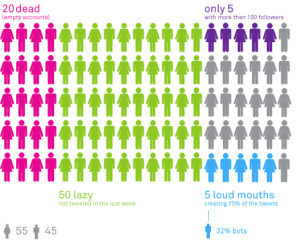
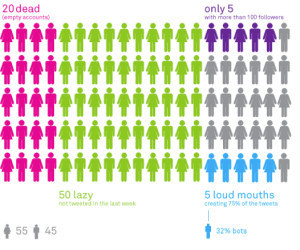
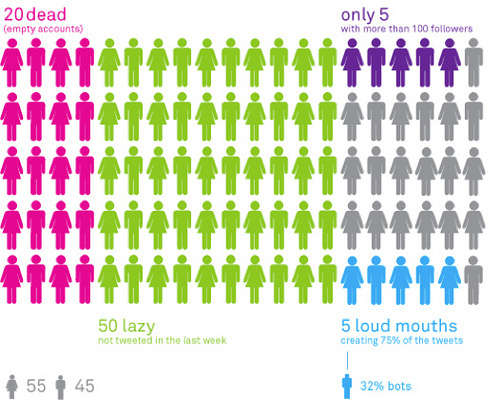
So far, the most interesting visualizations are the interactive ones. While early, it’s clear to me that there are myriad ways to make data tell a story. To paraphrase Hans Rosling, “Let the dataset change your mindset.”
June 11, 2013
ERP: It All Starts with the “E”
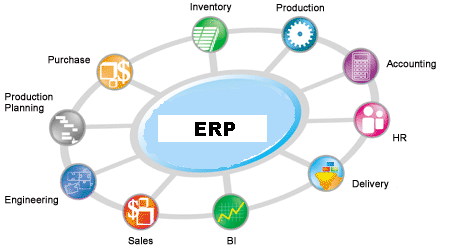
I spent a decade working on large scale ERP projects, many of which informed my first book, Why New Systems Fail. It astonished me then—as it does today—that so many organizations of all sizes continue to struggle implementing and maintaining their HR, payroll, financials, and other “back office” functions. After all, ERP isn’t exactly not “rocket surgery”, and many specific solutions have been with us for decades.
In his recently published a report titled “A Guide for a Successful ERP Strategy in the Midmarket: Selection, Services, and Integration”, Nick Castellina emphasizes the need for an “integrated approach to ERP.” By this, he refers to “the integration of processes, employees, technologies, and business partners.” (I would add data as well, but that’s fodder for another post.) Such integration results in “an organization that is efficient, cohesive, and ready for growth.”
Many a CXO assumes that her data and business processes are integrated because her organization now runs one ERP.
You’ll get now argument from me about the importance of integration and cohesion. After all, the “E” in ERP stands for “Enterprise.” In other words, it behooves organizations to truly integrate their enterprise data, technologies, and the like. Maintaining standalone applications and data silos only serves to encumber the organization. Efficiency suffers, and employees make suboptimal business decisions.
Lamentably, however, many midsized organizations continue to support disparate applications years after the new ERP goes live. Broken business processes exhibit remarkable staying power, even in the face of a system that theoretically converges the enterprise. In the immortal words of Craig Bruce, “Temporary solutions often become permanent problems.” Exceptions are made too frequently, often enabled by powerful MDM solutions.
Simon Says
Many a CXO assumes that her data and business processes are integrated because her organization now runs one ERP. Don’t make that mistake.
Challenge those who believe that their data, applications, and processes need to be treated specially. Perhaps that’s the case, but too many exceptions only serve to defeat the very purpose of a true ERP in the first place.
Feedback
What say you?
This post was written as part of the
IBM for Midsize Business
program, which provides midsize businesses with the tools, expertise and solutions they need to become engines of a smarter planet. I’ve been compensated to contribute to this program, but the opinions expressed in this post are my own and don’t necessarily represent IBM’s positions, strategies or opinions.
June 6, 2013
Looking for Data Visualization Case Studies for My Next Book
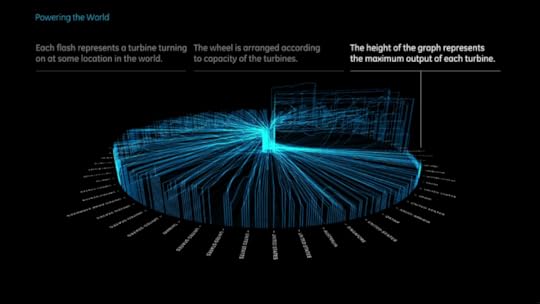
Over the course of writing Too Big to Ignore and The Age of the Platform, it became evident to me that progressive organizations were using different types of data in fascinating ways. Yes, they were making better decisions because employees had access to better information, but often that data was presented in innovative and compelling ways.
There’s a term for this type of thing these days–data visualization–and it’s huge. Exhibit A: Tableau Software recently went public, and the results have been amazing.
While I touched upon data visualization in Too Big to Ignore, I quickly learned that there’s a great deal more to write about the matter. A whole book’s worth… And John Wiley & Sons (publisher of two of my five books) agrees with me. My new book has a current working title of The Visual Organization. It will be out in early 2014. We’re still playing with the subtitle.
Story Matters Here
 AMC’s motto is “Story Matters Here.” I like that.
I believe strongly that business and technology books ought to tell stories, and good ones at that. Today, data visualization isn’t hypothetical; many people and organizations are using it as we speak. To that end, I am looking to interview people at organizations that are routinely doing interesting things with data visualization. I’m not talking about one-off PowerPoint presentations for quarterly reports. I am interested in speaking with progressive companies that routinely visualize their data–and make better business decisions as a result.
A few guidelines:
I’m open to hearing from software vendors, but I’ll want to talk to real-world users of your products.
Case studies will contain real company names and results. This isn’t Why New Systems Fail.
This will be a color book and I want to include many visualizations. I’ll need hi-res photos (at least 300 DPI). If I can’t get these, then I’ll have to pass. The whole point is to show data represented in interesting ways.
My sixth book will contain examples from multiple functions, including HR, sales, finance, IT, marketing, and others. I’m not looking to write about the same function over and over again.
Contact me if you’re interested.
June 1, 2013
On Big Data, Privacy, and Transparency

Concerns about privacy did not begin with the era of Big Data or the advent of Facebook. They’ve been with us since the advent of the Internet. For instance, during the dot-com boom, companies like DoubleClick (now owned by Google) pushed the privacy envelope as it attempted to serve up relevant ads via cookies.
In August of 2012, the Federal Trade Commission “fined Google $22.5 million…to settle charges that it had bypassed privacy settings in Apple’s Safari browser to be able to track users of the browser and show them advertisements, and violated an earlier privacy settlement with the agency.” As The New York Times’ article points out, the fine represents “the largest civil penalty ever levied by the commission.”
Nothing’s Shocking
This should shock no one. Increasingly, the FTC has been cracking down on tech companies for privacy violations. (The European Union has been even more vigilant vis-à-vis privacy breaches.) What’s more, the FTC continues to monitor Google for antitrust violations. And let’s be honest here: Given Google’s recent track record on privacy, the FTC certainly should keep its eye on Larry and Sergey’s company.
Ignore privacy issues at your own peril.
Now, Google can afford to pay the fine–and then some–but that’s hardly the point. And the fine and resulting negative press didn’t make a dent in Google’s stock price or brand. After all, Gmail, YouTube, and the other planks in its platform have become indispensable tools for far too many of us. Whether it can sustain further hits to its reputation is another matter. Remember, people don’t have to use Google products and services; it’s a matter of user and consumer choice. In each case, alternatives exist to Google’s products.
Organizations with much less traction and stickiness than Google should pay particular attention to transparency. A customer whose privacy has been violated may well not come back, not to mention tell her friends.
Simon Says: Start with Transparency
Today, organizations can do amazing things with Big Data. Foolish is the CXO, however, who doesn’t recognize the very real issues posed by our ability to track just about everything. While there’s no secret sauce to avoiding the pitfalls of Big Data, lack of transparency is ill advised. Better to ask for permission rather than forgiveness.
Feedback
What say you?
This post was written as part of the
IBM for Midsize Business
program, which provides midsize businesses with the tools, expertise and solutions they need to become engines of a smarter planet. I’ve been compensated to contribute to this program, but the opinions expressed in this post are my own and don’t necessarily represent IBM’s positions, strategies, or opinions.
May 30, 2013
Too Big to Ignore and 12Books

I’m pleased to announce that Too Big to Ignore: The Business Case for Big Data will be 12Books’ featured text for August of 2013. The GoodReads group attracts some great discussion on the most important business topics of the day.
I’ll be hosting a webinar on the book on August 28, 2013 at 5:00 pm PST.