Phil Simon's Blog, page 95
April 13, 2013
Think Web
I was talking the other day to a friend of mine recently starting his own company when he asked me the following fairly innocuous question:
How do I email a PowerPoint presentation while protecting it?
My friend merely wanted to protect his intellectual property. Fair enough, although I told him that just about every means of locking down a document could be circumvented one way or another. But why the focus on email?
Instead, why not put it on your site via Scribd, set desired permissions, and draw people to your new (and content-challenged) site? They may actually stay there and share that presentation–and others–with people in their tribes. You may get discovered by others. Who knows what will happen? Not me.
Simon Says
To the web-challenged, here’s some unsolicited advice: Stop thinking about old tools like email. Start thinking web. It’s not going anywhere.


April 12, 2013
Business Continuity: The Response Is Essential

As I write these words, Rutgers University is in the midst of a major kerfuffle. The abusive actions of basketball coach Tim Rice are almost impossible to believe. But something made the outrage metastasize: the lack of initial recognition by key people (Athletic Director Tim Pernetti and school president Robert Barchi) of the severity of Rice’s actions:
But crises are nothing new, even if being caught on video posted YouTube is. More than 30 years ago, for instance, J&J found itself at a crossroads. From a 2002 New York Times‘ piece:
It has been almost two decades since a consumer products company’s worst nightmare became tragic reality for Johnson & Johnson. In the space of a few days starting Sept. 29, 1982, seven people died in the Chicago area after taking cyanide-laced capsules of Extra-Strength Tylenol, the painkiller that was the drug maker’s best-selling product.
The debacle led many to predict the ultimate demise of Tylenol, a brand that “accounted for 17 percent of the company’s net income in 1981.” Astonishingly, “only two months later, Tylenol was headed back to the market, this time in tamper-proof packaging and bolstered by an extensive media campaign. A year later, its share of the $1.2 billion analgesic market, which had plunged to 7 percent from 37 percent following the poisoning, had climbed back to 30 percent.”
It’s an amazing story and has been the subject of many an MBA case study. As many people have said, never waste a good crisis.
Social Media: Accentuating the Need for an Immediate Response
Fast forward three decades and the Internet has resulted in more than its fair share of damaging business crises. Last year, web hosting provider GoDaddy experienced a highly public outage that took down millions of sites. For many reasons, GoDaddy has plenty of critics, many of whom weren’t shy about using social media sites to vent their frustration. The barbs started almost immediately. My personal favorite is below:
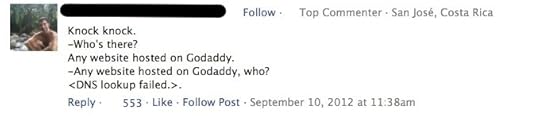
On a broader level, regardless of the timeliness of a company’s response, people will start tweeting and venting almost immediately. You can’t put the genie back in the bottle.
Simon Says
Mistakes happen. Systems crash. Even expensive private clouds hosted by top-tier vendors experience problems. The question is not will your system or app go down. Rather, one should ask, “How will your organization respond when it does?”
Feedback
What is your company doing to maximize up-time?

This post is sponsored by the Online VMware Forum 2013. To learn more, register for a VMWare webinar on this subject: Unleash the Power of Virtualization to Simplify IT.
April 11, 2013
The Sponge Theory of Writing

“What’s your writing process?”
It’s one of the questions that I’m most frequently asked. I explain to people that my writing process best described as sponge-like. Let me explain.
I’m constantly absorbing material, whether it’s blog posts, videos, podcasts, books, or actual in-person conversations. (Remember those?) More often than not, that material tends involve data, management, technology, and people. (See tagline of this site.) It’s not as if I read a great deal about 17th-century French poetry, reality television, or life in Madagascar. There’s a high degree of overlap between what I read and what I write. Finally, it doesn’t hurt that I speak about these topics.
Let’s just say that the contents of my brain are not equally distributed.
Eventually, the sponge gets full. It can’t hold any more water and I have to squeeze it. Keeping with the metaphor, out comes a book in a relatively short period of time. It’s not that I sit down to do research; it’s that I’d actually been doing the research for a relatively long time.
Simon Says
Different writers follow different processes, and one way is not fundamentally better than any other. For me, though, the sponge method is just natural and intuitive.
Feedback
What’s your writing process?
April 10, 2013
Is Your Writing Understandable?
Originally published on Huffington Post.
I didn’t know what I wanted to study in college. When forced to declare a major in my sophomore year, I ambivalently chose English.
I remember taking several English theory classes. Some of the texts that I had to read were beyond intimidating, confusing, and incomprehensible. Long, drawn-out sentences with more 50-cent words that I count bewildered this 19-year-old student. When my professors asked me to write in a similarly opaque style, I had to ask my older friends for help. I once turned in a short essay that pleased one teacher so much that she read part of it aloud to the class. Rather than feeling pride, I couldn’t help but be embarrassed. I didn’t know what I had “written.”
Back then, I had very little choice about what I had to read. Well, almost. I ultimately switched majors later that year.
The Content Deluge
The point is that students represent just about the only group forced to read certain material. Professionals have a great deal of choice about what they want to read. I am not compelled to read anything. In all likelihood, neither are you.
Make your words understandable or risk irrelevance.
What’s more, choice abounds. Over the past two decades, we’ve seen deluge of content on just about every topic. Pick a niche subject like “Big Data in healthcare” and your search results will quickly bombard you.
I think about these things quite a bit. Even if you fancy yourself a good writer (and I certainly do), it’s very tough to build a tribe. Often I’ll peruse a business book replete with jargon and wonder, “What was the author thinking?”
Simon Says
Now, I’m not the final arbiter on jargon. Plenty of people speak and probably think in terms of buzzwords. Still, as a voracious reader, I wonder if many speakers and authors realize this: Just about nobody is required to read your work.
My advice to current and aspiring writers: Make your words understandable or risk irrelevance.
Feedback
What say you?
Data Visualizations: This Isn’t 1996
Originally posted on MIKE2.0.
During the summer of 1996, I interned at a high-tech company near Boston, MA. I played with data for most of the day, occasionally sneaking in looks at these cool new things called web sites. Rather than presenting my data in basic spreadsheets, I would throw it into a graph or chart. In Microsoft Excel, that was easy enough to do.
Fast forward 17 years and the state of data visualization is orders of magnitude more advanced. Yet, many presentations still contain slides like this one:

In a word, yuck.
The vast majority of the time, spreadsheets make for truly awful slides. What’s more, as I write in Too Big to Ignore, today there are so many neat ways to visualize data. Forget basic pie charts and bar graphs. They’re better than the slide above, but we’re not limited to Excel when telling our stories. It’s not 1996 anymore.
I recently started playing with Easel.ly, a drag-and-drop tool that allows users to create sunning, visually compelling infographics. You can see from the objects above that customization is very WISYWIG. See below:
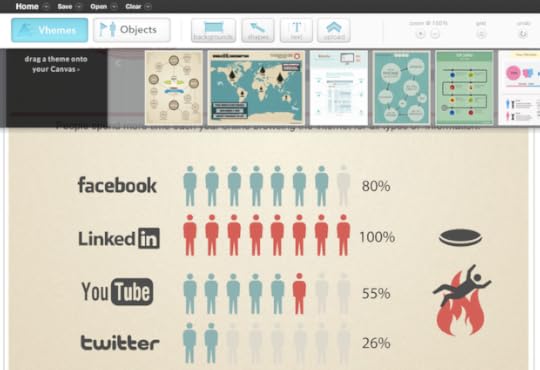
Why should we spend the time sexifying our data? Many reasons come to mind. For one, infographics let you’ll tell a much better story with data. And let’s not forget our ever-declining attention spans. When we see hard-to-read (let alone understand) slides like the spreadsheet above, how many of us just tune out? I’ll cop to it. We’re carrying around mini-computers in the way of tablets and smart phones. It’s not difficult for us to sneak a peak at our e-mail or text someone if a slide bores or confuses us, especially at a conference.
Bottom line: it’s just plain lazy to present data like this–whether or not that data is structured or not. Lamentably, though, that doesn’t stop making that mistake. The result: people look down at their devices, not up at the speaker. Is that really what you want?
Simon Says
Some people say that you shouldn’t include data in presentations, period. They cite horrible slides and tables like the one above.
While I concur about ugly slides, I couldn’t disagree with the “no data in presentations” argument more. We live in an era of Big Data. If you want to make an argument to do–or not do–something, data can certainly help, with one major caveat: that data needs to be presented in a compelling fashion. Confusing your attendees or colleagues with impenetrable spreadsheets and tables is unlikely to achieve the desired results.
Feedback
What say you?
April 8, 2013
Android, Google, and Frenemies

Originally published on Huffington Post.
In its quest to kill Apple, has Google inadvertently empowered its rivals-and created new ones?
We know that Google has created a monster in Samsung. Giving away Android has certainly hurt Apple, but what are the other consequences of the move? Amazon has benefited: Kindle runs on a forked version of Android. Now add in Facebook Home. I’m wondering if Larry Page now thinks Android is too open?
The notions of coopetition and frenemies are as involved and nuanced as ever. Nowhere is this more evident than how Android is playing out. The following text is excerpted from The Age of the Platform.
Frenemies and Coopetition
“The man of knowledge must be able not only to love his enemies but also to hate his friends.”
–Friedrich Nietzsche
The tendency for the Amazon, Apple, Facebook, and Google (aka, the Gang of Four) to collide with one another shouldn’t surprise anyone. These battles bring to mind two relatively new terms. The Merriam-Webster Dictionary defines a frenemy as “one who pretends to be a friend but is actually an enemy.” Also, the term coopetition has recently entered the business vernacular–a word that describes concurrent cooperation and competition.
Both labels are completely apropos in understanding the relationships among Amazon, Apple, Facebook, and Google. Like five-year-olds in a sandbox, they sometimes play nicely together, but aren’t above knocking over each other’s sandcastles. That is, companies that have built powerful platforms and planks do not always see eye-to-eye.
Platform companies have to walk a fine line. On the one hand, each company wants to steal users and customers from other platforms to switch to theirs. On the other, each doesn’t want to be known for being aggressive, greedy, and restrictive.
Let’s look at a few examples. Apple allows its customers to read books on their iPhones and iPads via Amazon’s Kindle app. Apple does not force its customers to buy the same books again in Apple’s iBook format. For its part, Facebook makes it very easy for users to find individual friends with a few clicks, or friends en masse via importing Yahoo!, Gmail, and Hotmail email addresses.
But the opposite isn’t true. Facebook does not reciprocate with these other services–unless they are partners. As Ryan Singel of Wired writes, “If you are also a Twitter or Buzz user and want to find out which of your Facebook friends were also using those services, Facebook will not let you.”
Perhaps a better metaphor is the game Risk, in which players form temporary alliances, only to turn on one another when they have the ability to conquer a continent.
Feedback
What say you?
April 7, 2013
Big Data: A Big Opportunity for HR
Originally published on HuffPo.
In many organizations, Human Resources (HR) remains the redheaded stepchild. Typically seen as the organization’s police department, HR rarely commands the internal respect that most SVPs and Chief People Officers believe it does. I’ve seen companies place poor performers in HR because they couldn’t cut it in other departments. However, I’ve never seen the reverse occur (e.g., “Steve was horrible in HR, so we put him in Finance.”). For all of their claims about being “strategic partners,” many HR departments spend the majority of their time on administrative matters like processing new hire paperwork and open enrollment. While rarely called Personnel anymore (except on Mad Men), many HR departments are anachronistic: they operate now in much the same way as they did four decades ago.
 My own theory about the current, sad state of HR is as follows: As a general rule, HR folks tend not to make decisions based upon data. In this way, HR is unique. Employees rely almost exclusively on their gut instincts and corporate policy. What if employees in other departments routinely made important decisions sans relevant information? Absent data, the folks in marketing, sales, R&D, and finance wouldn’t command a great deal of respect either. W. Edwards Deming once said, “In God we trust, all others must bring data.” Someone forgot to tell this to the folks in HR, and the entire function suffers as a result.
I wrote a book on botched IT projects and system implementations, many of which involved HR and payroll applications. Years of consulting on these types of engagements have convinced me that most employees in HR just don’t think like employees in other departments. Most HR people don’t seek out data in making business decisions or even use the data available to them. In fact, far too many HR folks actively try to avoid data at all costs. (I’ve seen HR directors manipulate data to justify their decision to recruit at Ivy League schools, despite the fact that trying to hire Harvard and Yale alumni didn’t make the slightest bit of financial sense.) And it’s this lack of data—and, in that vein, a data mind-set—that has long undermined HR as a function. As we’ll see throughout this book, however, ignoring data (big or small) doesn’t make it go away. Pretending that it doesn’t exist doesn’t make it so. In fact, Big Data can be extremely useful, even for HR.
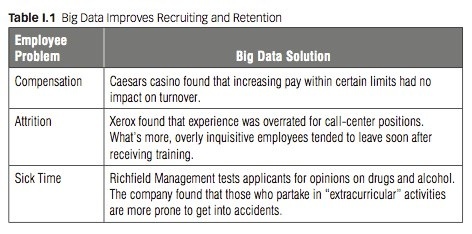
As the Wall Street Journal recently reported, progressive and data-oriented HR departments are turning to Big Data to solve a long-vexing problem: how to hire better employees and retain them. It turns out that traditional personality tests, interviews, and other HR standbys aren’t terribly good at predicting which employees are worth hiring—and which are not. Companies like Evolv “utiliz[e] Big Data predictive analytics and machine learning to optimize the performance of global hourly workforces. The solution identifies improvement areas, then systematically implements changes to core operational business processes, driving increased employee retention, productivity, and engagement. Evolv delivers millions of dollars in operational savings on average for each client, and guarantees its impact on operating profitability.”
Millions in savings? Aren’t these just lofty claims from a startup eager to cash in on the Big Data buzz? Actually, no. Consider some of the specific results generated by Evolv’s software, as shown in Table I.1.
The lesson here is that Big Data can significantly impact each area of a business: its benefits can touch every department within an organization. Put differently, Big Data is too big to ignore.
April 6, 2013
The Different Types of Conference Speakers

Originally published on Huffington Post.
I’ve been attending and speaking at conferences for a while now. I’ve noticed over my career that speakers tend to fall into one of three buckets:
Sponsor
Practitioner
Professional Speaker/Thought Leader
In this post, I’ll examine each type of speaker, laying out the pros and cons of each.
Disclaimer: I fall into third bucket, although I have tried to write this post in a more informative than self-promotional manner.
Type 1: Sponsor
Most of us have attended conferences in which an organization’s VP of Marketing or CXO has taken the stage to give the keynote. From the standpoint of the conference organizer, this is entirely understandable. After all, Company XYZ has paid a sizable amount of money as a sponsor, typically with the expectation of some prime time on stage. And the “sponsor” speaker costs the conference nothing extra.
Aside from costs, many CXOs are rock stars. Speaking to large groups isn’t exactly old-hat to them. Presidents, company founders, and senior executives come with a certain amount of cache.
As a general rule, however, the sponsor comes with a pretty obvious agenda: marketing. In my experience, I find that more often than not attendees look down (at their devices), not up (at the speaker). This is not a good thing. Sponsors almost always promote their companies’ products and services, some more overtly than others. Finally, they are only speaking about their companies, and usually at a high level. They often lack a broad perspective.
Type 2: Practitioner
Practitioners are a different breed of cat. They often speak about what they themselves have done on particular projects. They rarely talk about strategy and 30,000-foot views. They’ll describe specific outcomes, challenges, and results. To be sure, attendees can learn a great deal from these folks, with the caveat that the speaker’s industry and/or project matches theirs.
On the downside, practitioners do not speak to large groups frequently, and this almost always shows. Over-reliance upon complicated slides is not uncommon, and speaker voice projection tends to be less than ideal. (Case in point: In 2010, I saw a brilliant Yahoo! scientist speak about data, but attendees’ attention waned as he presented very busy slides and rarely looked at his audience.)
Also, attendees get less out of the talks if the practitioner’s case study or examples drastically differ from their own professional lives. For instance, the ins and outs of Hadoop implementation in a retail environment probably won’t resonate very much with healthcare professionals who don’t understand the very idea of Big Data. Here, the cart is clearly before the horse.
Type 3: Professional Speaker/Thought Leader
Professionals speak for a living. As a result, they typically bring to the table more enthusiasm. They take time to prepare each talk, customizing it as necessary. They can sustain the attention of large audiences better than most.
Thought leaders don’t have a horse in the race; they are not there to hawk a specifically company’s wares. Some speakers focus on specific industries, but they can often bring lessons from unconventional places. For instance, MIT Blackjack team member Jeff Ma spoke at a data management conference that I attended in 2012. His gambling stories accentuated points made by other speakers, but in a very different way. In short, thought leaders tend to have a more global view than the other two types of speakers.
The primary drawback to using professionals is that we add to the overall cost of the conference. (The very definition of a professional is someone who charges for his/her services.) In the course of booking events, I’ve sometimes had to answer questions from organizers like, “How many people did you personally sign up?” I typically can’t answer that question in an accurate manner. The ROI of an individual, professional speaker is tough to discern, although I’d argue that mediocre speakers don’t auger well for future conference registration.
Simon Says
There are pros and cons to using all types of speakers. Understanding them helps conference organizers make necessary tradeoffs, striking the balance between cost and quality.
Feedback
What say you?
April 4, 2013
Early Reviews: Too Big to Ignore
Too Big to Ignore has been out for a few weeks now and reviews are starting to trickle in. I’m happy to see that they’re very positive. For instance, Brian Sommer on ZDNet writes
Phil Simon’s made a digestible book on the big data technology space. Yes, you could even give this book to your CEO and he/she will get it. It’s a well-written piece that does what it advertises: it creates the business case for big data.
Big Data is related to technologies that can really widen the gap between the technology sophisticated organizations and those that lag or are naïve. If your organization falls in the latter camp, get a couple dozen copies of Phil’s book and make them required reading for your leadership group.
Read the whole review here.
On her site, Daria Steigman writes:
Writing a readable book about data isn’t easy, but Simon has done a terrific job of tackling a difficult topic with his eye on the prize. It’s not the data itself that matters, it’s what we do with it. It’s about how we can take the data and make it actionable.
Read the whole review here.
April 3, 2013
Big Data Is Additive

What’s the ROI on Big Data?
I hear that question and I cringe. You might as well ask:
What’s the ROI technology?
On making better decisions?
On developing new customer insights?
There are no accurate or great answers to questions like these, and I can build a model that can show astounding results. That’s all well and good, except that model will be wrong.
Really wrong.
Think about it. Let’s say that both Company ABC and Google both deploy the same new Big Data solution. By definition, the “ROI” that each company realizes by developing or deploying the same solutions will differ. Ditto hiring data scientists, using gamification sites, and the like.
Simon Says
All companies continually build on what they have created. Just like platforms, Big Data is additive. Don’t let anyone tell you any different. ROI estimates should be taken with a 50-lb. bag of salt.
Feedback
What say you?