Phil Simon's Blog, page 98
March 11, 2013
Publication of Too Big to Ignore
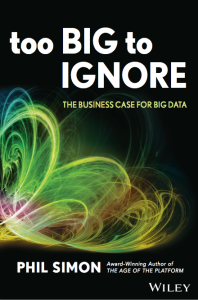
I am pleased to announce the publication of my fifth book, Too Big to Ignore: The Business Case for Big Data. I’m very pleased whenever I publish a book, and today is no exception. It takes a tremendous amount of work, and I hope that this one does as well as The Age of the Platform.
Check it out on Amazon if you like. On Twitter I’ve been using #toobigtoignore.


March 8, 2013

March 5, 2013
Top Coder Interview on Big Data
I recently sat down with Clinton Bonner of Top Coder to talk about open innovation, Big Data, and my new book. Check it out here:
Video by Chrome.
March 4, 2013
Why Too Big Will Do Better than Platform: A Theory
For a bunch of reasons, I wouldn’t have bet that sales of my new book would ultimately exceed sales of my fourth.
And I might be wrong. Really wrong.
I found out the other day that pre-orders of Too Big to Ignore are good. Really good.
I was talking about this with my friend Terri Griffith. As she is wont to do, Terri made an incisive observation: All organizations can theoretically use Big Data, but how many of them are wiling and able to blow up their business models? In other words, how easy is it for large, mature companies to redefine themselves? Poseurs can drop the word platform all they want at conferences and in the marketing copy, but calling it a duck isn’t the same as being a duck. Amazon, Apple, Facebook, Google, Twitter, and other companies mentioned in The Age of the Platform are still the exception, not the rule.
On the other hand, embracing Big Data doesn’t require organizations to adopt an entirely new modus operandi. Big Data doesn’t necessarily force organizations to attempt to make money in fundamentally different ways, although it may prove find that old methods no longer function as well as they once did.
Now, don’t get me wrong. I’ll still bet on companies that function as true platforms over those that don’t. Maybe, from a book sales’ standpoint, Big Data is easier for CXOs to get behind. Note, however, that it’s flat-out wrong to think of Big Data as a standalone project (IT or otherwise). And if more people view Big Data as a big deal, then maybe sales of Too Big to Ignore will surprise me.
They have so far.
March 3, 2013
The First Big Big Data Myth
You’re probably hearing more and more about Big Data. Given it’s name, it’s pretty logical to assume that it’s the exclusive purview of large organizations.
And you’d be wrong. Small and mid-market organizations can benefit from Big Data without breaking the bank. Watch the video below to learn a bit more.
Feedback
What say you?
 This post was written as part of the
IBM for Midsize Business
program, which provides midsize businesses with the tools, expertise and solutions they need to become engines of a smarter planet. I’ve been compensated to contribute to this program, but the opinions expressed in this post are my own and don’t necessarily represent IBM’s positions, strategies or opinions.
This post was written as part of the
IBM for Midsize Business
program, which provides midsize businesses with the tools, expertise and solutions they need to become engines of a smarter planet. I’ve been compensated to contribute to this program, but the opinions expressed in this post are my own and don’t necessarily represent IBM’s positions, strategies or opinions.

March 1, 2013
Big Data Is Mostly Deep and Dark
While researching the new book, I was shocked to discover that we can only see the tip of the Big Data iceberg. InfoSys has put together a visual on the “dark” nature of Big Data. How deep and dark? Extremely.
The lesson here: Think about the enormity of the data out there. What you can’t see is actually much bigger than what you can see.

Big Data Is Mostly Dark
February 28, 2013
Carnegie Mellon Interview on Big Data
My alma mater interviewed me about the school, the new book, and a few other topics. Here’s an except:
Phil Simon (DC’93) received his degree in policy and management. Since then, Simon has built an impressive career as a technology consultant working to help companies optimize their use of technology. He has written five books, including 2011’s “The Age of the Platform.” He also frequently gives talks on technology and has contributed to Inc. Magazine, NBC, CNBC, The Huffington Post, Fast Company, BusinessWeek, the New York Times and many other top media outlets. Simon’s latest book, “Too Big To Ignore: The Business Case for Big Data,” will be published in March.
Dietrich College News recently talked to Simon about his career and how he worked with several people with Carnegie Mellon connections for his upcoming book.
Your book that will be published next month focuses on Big Data. What is it about Big Data that companies don’t understand?
Many things. That’s why I wrote the book. For starters, Big Data isn’t a fad. It’s here to stay. Second, old standbys like relational databases just don’t play well with petabytes of tweets, YouTube vides, blog posts, customer reviews, and other forms of unstructured data, Third, Big Data isn’t a tool exclusively for big companies. Small companies, government agencies, and even individuals can harness the power of Big Data.
Who from Carnegie Mellon did you work with on “Too Big To Ignore: The Business Case for Big Data” and what did they contribute?
In the course of my research, I came across the work of Tom Mitchell, head of the Machine Learning Department at Carnegie Mellon. I quote him in the book. As I write in the book, “Computer model predictions based on historical evidence represent ‘one of more positive trends we’re going to see this century,’ he says. ‘We’re just beginning.’” I also gave some props to CMU’s data science program.
For informally, fellow Tartan Scott Berkun (MCS ’94) has been a valued friend and source of inspiration for me over the years. Early in my writing career, he answered many of my questions and I read his blog frequently.
Your Twitter bio (@philsimon) says that you “focus on the intersection of people, management, and technology.” What exactly do you mean by that?
All of these are levers to achieve the same business end: lower costs, increase profits, innovate faster, and the like. It’s never about one thing. Take an organization with “perfect” technology but a dysfunctional corporate culture. I’d bet against that company any day of the week. The best companies understand that everything works as a system. In my writing, speaking, and consulting, I try to focus on those elements—and how they interact.
To read the whole thing, click here.
Big Data Is Often Counter-intuitive
How do songwriting collaborations start? And what does the data tell us about who’s likely to work together? Researchers at Carnegie Mellon University analyzed an online songwriting community to shed light on this subject, and what they discovered may surprise you. From the article:
The technique could one day further social science research involving Big Data.
Based on four years of data collected though an international songwriting challenge called February Album Writing Month, or FAWM, the CMU team found that common interests or skills do not cause collaborators to seek each other out.
The researchers found, for instance, that two people were actually less likely to collaborate if they liked the same songs. More likely would be a writer in one genre seeking out a collaboration with someone who works in a less familiar genre.
In a word, wow. Visions of Aerosmith and RunDMC come to mind:
Bottom line: As Amazon, Google, Netflix, and scores of other companies can attest, Big Data is taking us in very different directions. It is debunking many preconceived myths and assumptions.
February 27, 2013
Yahoo!: Punishing the Many for the Sins of the Few?
Looks like Marissa Mayer banned telecommuting at Yahoo! armed with data from related to how employees were (not) the company’s VPN.
Kudos to Mayer for using data to make her decision, but data alone should never set company policy. I can’t help but wonder if those employees legitimately working while not at Yahoo! headquarters now have to pay for the sins of slackers. And, as I’ve seen first-hand in my career, slackers will always find a way to slack off. That’s what they do.
That goes double in an era of BYOD and constant connectivity.
Something tells me that Mayer will regret her decision.
February 26, 2013
Netflix, Big Data, and Art
How should you use Big Data?
It’s a big question. In my new book, I provide specific examples of how progressive organizations are leveraging Big Data to launch new products, increase insights into consumer behavior, and reach desired demographics.
And Netflix is one of the companies at the forefront of this movement precisely because it has so much data. Even trailers are customized to different types of audiences, as this New York Times’ piece points out.
Simon Says
I have decidedly mixed feelings about this. Big Data may let filmmakers, authors, musicians, and artists create more relevant work. At the same time, though, imagine having very strong opinions about the direction of your book or album only to have “the data” tell you that you’re wrong.
Feedback
What say you?