Phil Simon's Blog, page 101
January 17, 2013
BYOD 2.0: A More Holistic Perspective
For the last two years, I’ve found myself completely overwhelmed by CES with its seemingly interminable array of gadgets, doohickeys, and gizmos. While many if not most of these products will ultimately fail, it’s not hard to see the high-level trend: more and more things are connected to the Internet. Hence, the Internet of Things.
This has vast implications for many areas of society, not the least of which is business. Over the last few years, we’ve heard more and more about how many organizations are allowing employees to connect to corporate networks with their own phones and tablets. Why make employees carry around “loaners” when they already are packing their own smartphones? Times are tight, and the cost savings are potentially huge. The term for this nascent trend: bring your own device (BYOD).
Early BYOD efforts have focused on securing the device, not the user. Big difference.
Early BYOD adopters primarily had to worry one device: the smartphone. Think about it. Circa 2009, did you know anyone with a tablet? The iPad debuted in 2010 and, after that, the rest is history. Today, more and more of us carry around multiple devices. iPads and other tablets are anything but rare these days. Amazingly, the number of connected wireless gadgets could triple by 2015.
Explaining the Disconnect
Despite the proliferation of multiple-device employees, most BYOD efforts continue to focus on securing the device, not the user. Today many organizations still operate under the mistaken notion that all employees bring a single device to work. While more people own smartphones than tablets, the latter clearly represents the future of enterprise computing. Case in point: Holiday sales of PCs disappointed, despite Microsoft’s aggressive–and some would say desperate–marketing efforts with Windows 8.
This is slowly changing and, quite frankly, it’s about time.
Looking Beyond the Device
On January 8 of this year, security company Sophos launched BYOD-specific EndUser Protection. From the MSNBC article:
Unlike traditional security products, which are licensed for each device separately, Sophos EndUser Protection provides consolidated protection for every device on a network by securing per-user rather than per-device. This means the organization receives protection for all of a user’s devices–from Windows and Macs to mobile devices like iPhones, iPads, and Android devices–wherever users go.
This is the next logical step in BYOD, and Sophos’ holistic approach is the more intelligent one. I’m not going out on a limb by predicting that people will only bring more and more devices to work with them. For instance, Google and Apple are both rumored to be working on Web-enabled watches. Google Glass might be a few years away, but wearable technology is here to stay.
Simon Says
It’s high time that organizations realize that the days of the single-device employee are coming to an end. What do we call the next phase of BYOD? Perhaps BYODs is apropos.
Whatever you call it, focus on the user, not the device.
Feedback
What say you?
This post is sponsored by Dell Tablets. Follow@dellhomeus for more information.


January 16, 2013
Inc. Article #20: The Real Reason Your Inbox Is Overflowing
My 20th Inc. Magazine article is now live. Here it is.
I get too much email. Way too much. And I’m hardly alone in this regard. A few months ago I read The Tyranny of E-mail: The Four-Thousand-Year Journey to Your Inbox, and then I decided to do something about it.
As a technologist, I started there. What apps and services would help me manage the deluge of messages I receive every day? Sure, there are useful tools out there like AwayFind and Boomerang for Gmail, but I’d argue that they’re Band-Aids. The core problem is us, not email. Solving this problem requires an entirely different mind-set. Rather than looking outward, why not look inward? What was I doing wrong?
No one forces us to immediately respond to any given email. We choose to reply a message. If we do that immediately to each email, then we effectively condition others to expect more of the same. It’s all very Pavlovian.
Jon Mitchell of ReadWriteWeb makes some great points in How To Train Your Internet Friends. We complain about the problem, yet we effectively enable it by checking messages constantly and replying as soon as they arrive.
So don’t.
Prepare for Fallout
Over the course of the last few months, I’ve tried to stop this cycle. I have intentionally left my phone at home while going to the gym to resist the temptation to quickly check messages while at a red light.
At first, this was downright weird, but I’m getting used to it. This is just part of a pretty neat 21-step program for reviving your inbox.
But be warned: A few people have sent me confused messages because they didn’t receive the normal immediate reply to which they had become accustomed. Growing pains are inevitable and old habits die hard.
Simon Says
Email is addicting and it has become the default means of communication–but it’s folly to think that it’s the only one or even the best in each circumstance. Getting people to recognize its limitations is difficult. This will take time. I’m convinced, however, that the squeeze is worth the juice.
How do you keep your inbox under control?
Click here to read the article on Inc.
Sneak Preview of New Book
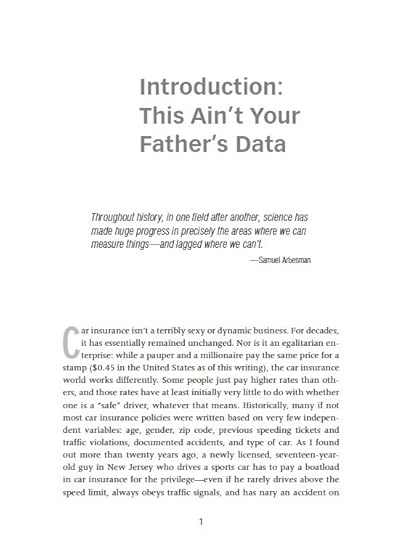
Here’s a little sneak preview of the new book. This is just a picture of the first page of the near-final Introduction. I promise: I make car insurance and potholes interesting.
//
January 15, 2013
Win a Copy of My Next Book
I’m giving away a few media copies of Too Big to Ignore: The Business Case for Big Data. There are only a few requirements:
You promise to give the book an honest review on your blog/site.
You promise to do so in a timely manner.
If you’re interested, fill out the form below for consideration. I’ll be in touch.
January 14, 2013
On Doctors, Planes, and Dataphobes
“Unlike pilots, doctors don’t go down with their planes.”
So writes Ian Ayres in his excellent book Super Crunchers: Why Thinking-By-Numbers is the New Way To Be Smart (affiliate link). Ayres is making the point that airline pilots have for decades relied upon the recommendations of computers, systems, other technologies, and data. By contrast, historically, many doctors have fought the move to evidence-based medicine because they think that their expertise obviates the need for them to look elsewhere when making medical decisions.
This is unfortunate because medical misdiagnoses cause tens of thousands of deaths per annum. To be sure, many doctors routinely ignore tools and data that can help them make better, life-saving decisions. What does that mean for those of us whose actions–and inactions–aren’t a matter of life and death? Toss in a healthy dose of false confidence, and it’s no surprise that far too many decisions are made in a vacuum, or at least without a great deal of relevant information.
Data Data Go Away
Ayres rightly points out intuitivists don’t like to have their authority challenged, even in the fact of incontrovertible proof that a better way exists. (It tends to get worse as you go up the corporate totem pole.) Think of the CMO who relies far too much on gut instincts. The HR director who doesn’t need data to tell him why people are leaving. The founder who likes to run her company the way she’s always run it (although the world has changed). These people are dataphobes, and there’s not much hope of convincing them that they need to change their ways.
Big Data is here to say, and one can follow, lead, or get out of the way.
Think about it. Many people chose certain fields during and after college precisely because they weren’t “numbers people.” Now, when they hear all this talk about data (Big or otherwise), they become apprehensive. Maybe, they think, they can ride it out a few years until all of this data goes away.
Simon Says
Except it won’t.
As I write in Too Big to Ignore, Big Data is here to say, and one can follow, lead, or get out of the way. According to Ayres, the arrival of the Information Age does not mean the end of intuition. In fact, to be successful these days, you need to alternate between situations in which analyzing data makes sense and those in which it doesn’t. And it doesn’t hurt to know the difference between the two.
Feedback
What say you?
 This post was written as part of the IBM for Midsize Business program, which provides midsize businesses with the tools, expertise and solutions they need to become engines of a smarter planet.

January 11, 2013
Inc. Article #19: So You Want to Write a Business Book
My 19th Inc. Magazine article is now live. Here it is.
My fifth book is going through final edits as I type. I’m not going to lie: Even the fifth time around, the process is still hard. But I’ve picked up a few hard-won lessons along the way.
So if you’ve ever thought about blogging or authoring a business book about your experiences as an entrepreneur, here are some thoughts to consider.
Writing is a skill that requires practice.
I have no doubt that some people are born with the an innate ability to communicate, whether via a keyboard, the spoken word, or some other means. To say that it’s 100% nature and 0% nurture just isn’t true. I look back at my writing from 2008 and see vast improvement today.
I didn’t take a course. I just kept at it. When you do something every day, you’re bound to get better at it. Period.
The Web makes writing easier, not easy.
I’m old enough to remember card catalogs, microfiches, and needing to go to a library to find what I needed–and even then I was sometimes disappointed. Not anymore. I have at my fingertips the largest trove of information the world has ever seen.
But let’s not overdo it.
You still have to do the work. Research doesn’t come to you. I’ll never say it’s easy to write a good book of any reasonable length, but today it certainly isn’t as hard as it was before the Web.
Writing is educational.
There’s long been an adage: If you want to learn something, teach it.
Very true.
I have no desire to write the same book again because I like to learn. Scratch that. Ineed to learn. I won’t judge authors who churn out essentially the same text or bands that don’t mess with their formula. If it works for them, so be it. There’s something to be said for giving your fans what they want, right?
I just can’t. I have to extend and stretch myself. There’s something gratifying about going to sleep knowing something you didn’t know in the morning.
Good writers read.
When I meet other authors, the topic invariably turns to books at some point. Scott Berkun and Matthew May are bibliophobes, and their writing benefits as a result.
Writing is cathartic.
There’s something satisfying about putting your words to paper or screen. Beyond that, you save money on shrinks. Workplace nonsense used to bother me because I would usually internalize it. Now, with writing, I have an outlet for my frustrations. As events are taking place, I often think about how I’ll write about them one day.
Click here to read the article on Inc.
January 8, 2013
Cover of Too Big to Ignore
Here we go:
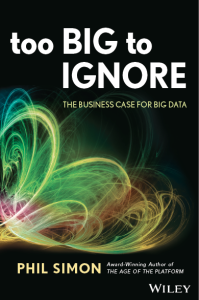
I suspect that I’ll be holding a physical copy of the book in the next seven weeks or so.
January 2, 2013
Top Coder Roadshow
I’m pleased to announce that I’ll be speaking a Top Coder Roadshow in Houston, TX on March 13, 2013. I’ll be talking about my new book, Too Big to Ignore: The Business Case for Big Data.
Top Coder Conference
I’m pleased to announce that I’ll be speaking a Top Coder conference in Houston, TX on March 13, 2013. I’ll be talking about my new book, Too Big to Ignore: The Business Case for Big Data.
Poker, Predictive Analytics, and Big Data
I’ve been playing poker ever since I was a kid. Since that time, I’ve become pretty good at it. Since moving to Las Vegas about 18 months ago, I’ve won more than I’ve lost. I’m just lucky, right?
Probably not. Many people fail to understand that the odds in a casino vary tremendously. It all depends on what you’re playing. Some games represent much better bets than others. Let’s say that you play blackjack by the rules (read: not hitting on 18 when the dealer is showing a six). In this scenario, the house still holds an eight percent advantage. In roulette, if you bet on black or read, you have a 47.3 percent chance of winning (18/38). (You’ll never find favorable odds in a casino, at least by “legal” means.)
Playing the Odds
Now, poker is not roulette. The latter is pure luck; there’s no “strategy” here. By contrast, poker is as much about skill as it is luck, and people much better than I will tell you the same thing. Pros like Johnny Chan (pictured above) don’t get dealt pocket aces more often than your average player. They succeed because they play different types of hands, mix up their strategies, know when to lay down their cards, and, most important, routinely pick up valuable information about other players at the table. And, more often than not, it’s this valuable data that helps them win tournaments.
Now, even perfect information will not guarantee a favorable result. For instance, in Texas Hold’em, let’s say that I’m holding pocket Kings (aka, “cowboys”) and I correctly surmise that my opponent is holding Jacks (“hooks”). He goes all-in and I quickly–and properly–call. I have an 81 percent chance of winning the hand. That is, four out of five times, I’ll win that showdown. Of course, 20 percent of the time I’ll lose. (Over the years, I’ve been “rivered” more times than I can count.)
Simon Says: Embrace the Poker Metaphor
The lesson here for mid-market organizations is that, while information inheres tremendous value, it guarantees nothing. In poker, even the worst hand in Hold’em (deuce-seven off-suit) can still “crack” the best hand (Aces–aka, “rockets”). However, over time, if you consistently play “premium” hands properly, you stand a much better chance of winning than if you play marginal hands in a sloppy manner–or worse, go on tilt.
Organizations that use Big Data well are tantamount to the Johnny Chans of the world. No, they won’t always win, but I’ll bet on these progressive companies every day of the week.
Feedback
What say you?
 This post was written as part of the IBM for Midsize Business program, which provides midsize businesses with the tools, expertise and solutions they need to become engines of a smarter planet.