Phil Simon's Blog, page 105
September 13, 2012
My Interview with Steve Hogarth of Marillion
Originally published on HuffPo.
The 1970s represented the halcyon days for progressive rock. Back then, bands like Genesis, Rush, ELP, Pink Floyd, Yes, and others regularly churned out ambitious concept albums rife with 20-minute songs, superior musicianship, and a dizzying array of time signatures.
Born out of this era is the English band Marillion. Formed in 1979, the band has for more three decades routinely pushed the musical envelope. One of the UK music scene’s best kept secrets, Marillion has consistently bucked popular trends and ignored often nasty media criticism with one overarching goal in mind: to make the music that it wants to make.
The band’s latest release and seventeenth studio album, Sounds That Can’t Be Made, is out, and the band is about to embark on a tour of the United Kingdom. I recently sat down with lead singer Steve Hogarth to talk about the new album, the state of the music industry, and how the Internet now allows bands to reach their fans directly. The following is an excerpt of that conversation.
To watch the entire video, click here.
PS: Is Sounds That Can’t Be Made more of a departure or evolution from the band’s most recent efforts?
SH: Well, hopefully it’s a departure and an evolution in the sense that we’ve kind of evolved by departing–to date, anyway. We’ve made a conscious effort, at least by our own standards, not to stay the same from one album to the next. People will sometimes say, “Why haven’t you split up yet?” What splits bands up is two things really: a lack of forgiveness on a personal level; we’re quite forgiving people. More importantly, if you feel you’re in a rut creatively then at some point you’re going to have to run away from it. We’re in the fortunate position of creatively being able to do what we like. We have the freedom to take on new forms of inspiration and go to new places musically. I have total freedom lyrically to write about anything I like. No one in the band tells me what to write and not write.
We take each album as an opportunity to redefine ourselves. For instance, the opening track on this album, “Gaza” is a foray into Arabic melodies and Arabic rhythms. It would be a simplification to say that it’s Arabic because it’s moving around musically all of the time. But we’ve not really been in that area before.
PS: The album’s first track, “Gaza”, has an epic feel to it. Did the band make a concerted effort to write about Palestine and the situation in the Middle East?
SH: I’m not entirely sure how it came together. I had started writing words about Gaza and the situation there. The more I’ve read and heard about the situation in Gaza, the more I felt that someone, that I, should open my big mouth and say something. The subject matter has made it the major headache of my career, really. I feel a great weight of responsibility on me for saying what I’ve said. It also had to be an accurate representation of the place so I spent my weekends Skyping Gazans and Israelis to try and paint a true feeling of life there and to hear points of view from both sides.
We have a lot of trust out there amongst our fans. If I open my mouth and say something, they don’t necessarily agree with it, but they’ll go and check it out and get online and open some newspapers. Why is Steve H suddenly going on about this place? What’s really going on there? What’s upsetting him?
What I’m hoping this song will do is raise awareness of what’s going on in Gaza, what Gazans are having to endure. Then, beyond that, perhaps people will get into reading about its history. It’s not an anti-Jewish song. I must stress that. I was careful not to say anything that condemns the state of Israel although I’ve already started getting some pretty angry criticism.
The song simply outlines the stark reality of daily life in that prison-of-a-city and says “People shouldn’t have to live like this.”
Gaza is a situation that’s worsening year-on year and the world needs to get in there and do something about it because it’s becoming a breeding ground for hatred and we all need to pour a whole lot of positivity into that place. I genuinely and passionately believe that empathy and caring can move mountains. Governments seem to look at everything from a point of view of mutual suspicion. Well, we all know where that gets us. It gets us here.
PS: Over the years, Marillion has utilized the Internet to directly reach its fans, in some cases to successfully finance the making of new albums. Why aren’t more bands doing this type of thing?
SH: Well, they must be crazy because it is the way to go. It’s not an easy path to tread; it involves you doing a lot more than being a musician which, of course, most musicians don’t want to do. Most people get into a band so they don’t have to do mundane work. I think mundane work is going to be with you at some point in your life whether you like it or not.
We have the Americans really to thank for the whole Internet thing that we embraced. The Americans brought it to us. Some of our Americans fans started it all off and raised a bit of money to go and play in the USA back in 1997. This was the first I knew about it. They already had $60,000 in a bank account somewhere. They would give us a big bag of money to go and tour America. I certainly had no idea. Most people in 1997 in Europe thought that the Internet was some weird thing that people did in sheds if they had a computer. They really didn’t imagine that it would become part of everyday life in the way that it has – seemingly in no time at all.
We were fortunate that the American tour fund woke us up. Whatever this Internet thing was, we had better get on to it. Secondly, our fans would put their money where their hearts and mouths were–no problem. It woke us up to the fact that we really didn’t need a record label. The realization that we could ask our fans to buy a record we hadn’t recorded yet was really the key that unlocked it.
PS: What’s your take on the state of the music industry? Its future?
SH: It’s obviously changing almost by the second. I’ve watched all of the major labels come crashing down. I’ve watched them moving out of their shiny high-rise buildings in London and taking up evermore modest premises. It’s definitely changing.
CD sales are in free fall. Our CDs sales are in free fall just the same. People are getting to listen to their music for free. They’re starting to expect that. No one going’s to pay for anything they don’t have to, are they? If cars were free, you’d probably go get a free one, wouldn’t you?
Music piracy isn’t legal but no one’s going to arrest you for it. You can’t blame people for stealing music. From my own perception, if you’re in a new band and you’re trying to forge a career it’s like it exists on two levels. You can do it in-house which is what we’re doing. And then there’s the Simon Cowell TV talent show “instant fame” thing. I can see a time in the future when it becomes more like subscription and licensing; you’ll maybe pay for a license and then all the music and entertainment content will be free as part of the package. You don’t have to buy and own music anymore. Let’s hope they find a way of automatically paying a royalty to the artists who create what you hear – that’s the tricky bit. Complicated, but perhaps no harder than automating the congestion charging system in London. They managed that alright..
PS: Who inspires you as an artist?
SH: I don’t know if I am inspired that much by artists anymore. Neil Armstrong inspired me. Nelson Mandela inspires me–people who put missions ahead of their own well-being. People who have agendas beyond their own egos are my inspiration.
If you had asked me a few years ago, I’d have told you that The Blue Nile is a huge inspiration and their singer Paul Buchanan. I would have said Paddy McAloon, Mike Scott, John Lennon and David Bowie, of course. It’s very hard to pick them out. I love Joni Mitchell and great wordsmiths.
PS: Are there any artists with whom you’d like to work?
SH: I’d love to sing a backing vocal for Peter Gabriel even if he didn’t credit me. I’d love to put a little ghost of a thing above his voice. That would be lovely. I don’t know why but it would. I feel the same about Sting. I’d love to sing a backing vocal on a Sting track. It’s weird how few artists mention Sting and pull him out but he’s such a brilliant talent. And, most of all, I’d like to sing with Massive Attack. I’d drop everything right now to do that!


The Enterprise Risk Pendulum
I have been giving quite a bit of thought lately to the topic of enterprise risk management. In large part, this stems from the fact that I have worked on more than a few projects in which my client’s risk tolerance was off the charts. I mean crazy. In this post, I discuss three types of organizations with respect to risk tolerance:
The Oblivious Enterprise
The Zero-Risk Enterprise
The Acceptable Risk Enterprise
The Oblivious Enterprise
This type of organization is perhaps best epitomized by a client of mine (call it ABC here). The company’s mind-set could be epitomized as follows: There was no such thing as risk. Period.
Here’s the crazy thing, though. ABC routinely addressed IT projects in this manner. According to lifers, every piece of software and hardware that ABC deployed in the last ten years was managed the same way. Proceed as if nothing is wrong. Ever.
This was a shock to just about every external consultant who showed up to work at ABC. You see, good consultants have been trained to identify and minimize risks throughout projects–at least, as much as they can, anyway. Sadly, the ABC’s CIO did not want us “editorializing.” Translation: keep your mouths shut. We don’t like naysayers.
From the consultant’s perspective, you can’t win on projects like these. If you broach a legitimate issue, you’ll be silenced and possibly removed from the project. If you don’t, then you’ll invariably be asked, “Why didn’t you tell us about this?” Organizations like these have high employee rejection rates; it takes a certain personality type of accept the risk of lawsuits, audits, and generally appearing foolish as you expose yourself and others to excessive levels of risk.
The Zero-Risk Organization
Now, let’s turn to the other end of the spectrum. Several years ago, I worked on a project for an organization that would not do anything when faced with even the smallest risk. To that end, it employed a full-time internal auditor to carefully monitor all IT projects. He would report his findings to the CIO.
So, you may ask. What’s wrong with this?
In the abstract, nothing. But IT projects are never abstract. Actions have consequences. The project consistently suffered as the implementation team attempted to address his concerns, and he had a bunch. Sure, many of them were well-founded, but how do you concurrently assuage an auditor’s concerns and make up time on a delayed project?
You don’t.
If your organization is not ready to take on some level of risk, then don’t start a major systems or IT initiative. Ever. All projects come with some degree of risk. It’s that simple.
The Acceptable Risk Organization
Ah, I can’t tell you how much I enjoy working with companies and people who understand risk. They possess a modicum of perspective. Serious risks are actually taken, well, seriously. Further, key people understand the time-sensitive nature of many problems. They understand that, as prolific author Bob Charette has said, risk is always a function of information, time, and money.
Of course, no organization has unlimited information, time, and money. Trade-offs need to be made, as I point out in what I call the Enterprise Risk Pendulum:
Executives at acceptable risk organizations understand the relationship between risk and cost. As such, I’d argue that they are likely to make the right calls most of the time. Things won’t always go perfectly, but these realists create contingency plans in the event that things go awry.
Feedback
I have a few questions for you.
What’s your organization’s risk tolerance?
What causes some organizations to accept so much risk?
Can people with one risk tolerance be successful at organizations with vastly different risk tolerances?
 This post was written as part of the IBM for Midsize Business program, which provides midsize businesses with the tools, expertise and solutions they need to become engines of a smarter planet.

September 12, 2012
The World of No
Without question, my least favorite word in the English language is usually “no.” I’d tell James Lipton as much if asked on the sometimes pretentious show Inside The Actors’ Studio. Now, there’s a reason that I qualify that statement with “usually.” In this post, I’ll tell you why not all “no’s” are created equal.
Appropriate No’s
Sometimes, no is the only legitimate response to a question. Consider the following:
It’s alright to steal music, right?
Are you going to miss Rush on this tour? (Hells no!)
Will you shoot par today?
Did you sleep past 5 am today?
These are examples of “appropriate no’s.” In each case, no is the only answer.
But alas, dear reader, there are other kinds of no’s.
Contemplative No’s
Let’s say that I propose a solution to a problem on a consulting gig that seems to make sense–at least to me. The decision maker listens to me and considers the idea. After careful thought, though, she decides against it and tells me why my idea won’t fly. She thanks me for the effort and appreciates my enthusiasm.
Contemplative no’s don’t bother me much. After all, I’m a consultant with no real authority. It’s their world; I’m just playing rent. They know what’s best. My advice is always theirs to take or leave.
Reflexive No’s
Again, let’s say that I’m trying to solve a problem. Maybe I’m trying to do something productive or try to make one of my partners, publishers, or clients money. Here are a few specific examples:
While working with one of my publishers, I have routinely proposed what I considered to be good ideas to promote our book. These include greater use of social media, book signings, other events, and book reviews.
When confronting an issue on a new system implementation, I’d figure out a “work-around” that would in no uncertain terms solve the problem.
Often I’ve dealt with wholly inefficient business processes and suggested reasonable alternatives to expedite things.
In each case, the decision maker didn’t bother to fully consider my ideas, often barely listening to my suggestions. The response was almost always something along the lines of “that’s not how we do things around here.” I call these “reflexive no’s” and I’ve come across them many times in my career.
And these bother me the most because those who give me “the reflexive no” just don’t try. They don’t care. They’re apathetic. They don’t want to learn or experiment. These people are stuck in their comfort zones and, as my friend Scott Berkun has written many times, this is exactly how mediocrity persists. That mentality stifles innovation and, ultimately, success.
Feedback
Am I just stubborn, cranky, and cantankerous? Does the reflexive no bother you as much as it does me?
September 10, 2012
Inc. Article #14: A Smarter Mobile Strategy
My 14th Inc. Magazine article is now live. Here it is.
No one can argue that mobile is one of the hottest areas of technology. The global market for consumer spending on mobile content, apps, games, and services is expected to grow to $138.2 billion this year.
But most companies large and small are struggling to grasp this technology as it changes seemingly overnight. Even businesses rife with resources and cash struggle to put a solid mobile strategy in place. Facebook is an excellent case in point and its mobile issues have been well documented.
How well is your company responding to mobile? Read on for a brief look at the state of mobility–and how you can take better advantage of it.
The State of Mobility
When the iPhone hit the marketplace in 2007, the AppStore didn’t exist. Of course, that soon changed. Companies entered the first phase of the mobile revolution with rudderless strategies based on a follower strategy (Read: My competitor has a mobile app, so I need one too).
This soon evolved into the second phase: Large companies developed bulky and overpriced mobile apps as expensive business cards. For their part, small, independent developers played the app lottery in the hopes of finding new streams of revenue in a quickly burgeoning marketplace.
Now we have entered the next phase of mobile, a more democratic phase. Just about every large company is attempting to leverage mobility across the entire enterprise. From the perspective of many, the marketplace seems just as lost and confused as ever. But out of this chaos, the co-founders at mobile studio Chaotic Moon have found a clarity that’s propelled the company to the top of the mobile industry. (I profiled the company in my third book: The New Small: How a New Breed of Small Businesses Is Harnessing the Power of Emerging Technologies.)
Here are three lessons on mobility from one of the market leaders.
It’s not about apps, it’s about experiences.
Most companies playing in the mobile space aren’t really mobile software companies at all. This has resulted in a sea of worthless applications flooding marketplaces worldwide. “Not a day goes by that we don’t get a call from a panicked executive who’s blown his budget on a mobile strategy or app that has produced zero results,” says Ben Lamm, co-founder and CEO of Chaotic Moon. Lamm says it reminds him a bit of the web boom during the dot-bomb days.
One of the things that has made Chaotic Moon so successful out of the gate is its focus on producing well conceived, useful applications. “We take the focus off of the app,” Lamm says. “We emphasize overall user experience. The technology is important but the content and user experience are paramount. Are you giving users something useful? If not, then you don’t need an app.”
Get involved in the development process.
To date, the company remains hyper-selective on its choice of clients and applications. Chaotic Moon often tells Fortune 500 companies with large budgets, thanks but no thanks. This selectivity and commitment to excellence are what both Lamm and co-founder William Hurley agree drives the company’s success. “I believe that one of the secrets to our success is not fearing being fired. Our company is bold and opinionated. We are not afraid to tell customers and partners what is great and what is truly awful.” says Lamm. “We only work with clients that meet a very specific list of requirements. If we can’t be passionate about a project and make it a success, it’s a nonstarter. Every project is a true partnership or we simply don’t take it.”
The flip side of this coin is that, for mobile apps to truly be successful, clients must be involved in the development process. An indifferent or recalcitrant client is probably not going to be happy with the end-result. Yes, trust your mobile app development firm, but find a happy medium between trust and micromanagement.
Understand that the next big thing in mobile isn’t mobile at all.
In January Chaotic Moon shocked the Consumer Electronic Show with its “Board of Awesomeness,” a Kinect-controlled skateboard with a top speed of 32 mph. The company followed this up with the mind-controlled “Board of Imagination.”
Many people have asked what this has to do with mobile. Some went so far as to claim it was simply a PR stunt. Chaotic Moon disagrees. “There’s no such thing as mobile” Hurley says. “There’s simply not a mobile industry. Computing has just become mobile because that’s where people are: out and about living their lives.” So Hurley and his cohorts at Chaotic Moon’s new labs division spend their time thinking about what’s next–currently that includes predictive, perceptive, and pervasive computing technologies.
Businesses of all types would be well advised to do the same. Don’t build an app for the sake of building one. Wherever mobile goes next, the same principle always applies: Start with a purpose, then worry about the technology.
Click here to read the article on Inc.
September 7, 2012
What Should I Ask Steve Hogarth?
On Sunday, I’ll be talking to Steve Hogarth of Marillion, one of my favorite bands. Our interview will run The Huffington Post sometime next week. I’ve drawn up some questions but would love to hear any suggestions. Just put them in the comments.
September 6, 2012
The Social Data Police
I awoke bright and early Wednesday morning and engaged in my regular routine. After firing up the coffee maker, I started checking email, Twitter, Google Analytics, and Amazon. Why Amazon? I compulsively like to know how my books are selling.
Occupational hazard, I suppose.
My second book, The Next Wave of Technologies, doesn’t get too many reviews. I won’t tee off on the publisher here, but let’s just say that I didn’t think that the book was priced at a reasonable number. As a result, sales haven’t been explosive.
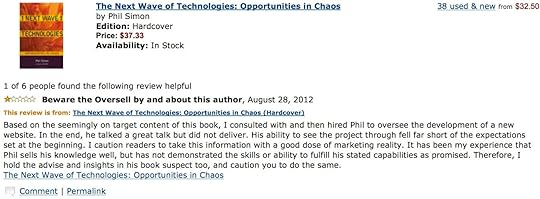
That’s all in the past and I’ve come to terms with it. Onward and upward, right? But I noticed a new review from 8/28/2012 and it wasn’t particularly flattering:
Click for larger image.
Now, I know the person who wrote this review, even though she cloaked her name with “Last Licks.” The details of our specific engagement aren’t terribly important, but let’s just say that her version of events isn’t remotely close to mine. Also, let me state unequivocally that I have no problems with critical reviews. I’ve left a few myself on products that didn’t satisfy me–and I’ve received some for my last book, The Age of the Platform. But these reviews were at least related to the product itself. By contrast, the review by “Last Licks” had nothing to do with the actual book. In fact, I sincerely doubt that she bought it, much less opened it.
Can Amazon Improve its Review of Reviews?
Now, I’ve praised Amazon.com on this site many times before about the company’s fascinating use of different technologies. Fascinating and perfect are two entirely different things, however. The review in question wasn’t really a review at all; it was an indictment of my business and web design skills. In an ideal world, Amazon would use semantic technologies to (better) determine if a book review was truly about, well, the book itself!
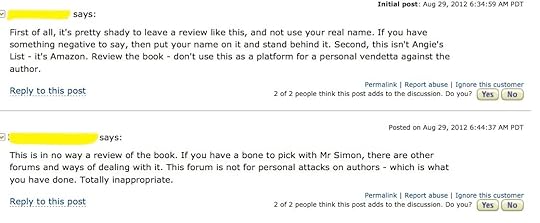
And here’s where the social data police come in. (By the way, is anyone else conjuring up the image of Jim Harris singing a version of Cheap Trick’s “Dream Police” right now?) The social data police help other potential buyers of the book understand that not all reviews are equal or even relevant. Not all one-star reviews are equally meritorious.
Just look at the work of the social data police in the comments:
Click for larger image.
I’ve seen the same thing happen with other books. The community chimes in and generally calls out these type of “non-review reviews.”
Simon Says
Advanced technology like that of Amazon.com has certainly benefited the company. But technology itself hasn’t yet (and may never) replace the social aspect of data. Brass tacks: people can improve enterprise data, give it context, and make it more relevant.
Is your organization embracing the social data police?
Feedback
What say you?
September 3, 2012
Big Data and Hadoop
In this three-minute overview video, I explain Apache Hadoop and touch on some of its functionality.
What say you?
This post was written as part of the IBM for Midsize Business program, which provides midsize businesses with the tools, expertise and solutions they need to become engines of a smarter planet.
August 30, 2012
A Clarification on My Inc. Facebook Post
My Inc. post yesterday suggested that Facebook implement a Freemium model seems to have caused a bit of a maelstrom. I tried to make it clear in the article that I was advocating a “Facebook Plus”/Freemium option. That is, those who want to pay for a premium (read: ad-free) experience could so so while non-payers could continue to use the service.
To me, this is hardly heresy. I can name 100 sites or apps that operate under this model. Pandora might be the most popular. Just about every app on my iPhone offers a free version.
August 29, 2012
Inc. Article #13: An Open Letter to Mark Zuckerberg
My 13th Inc. Magazine article is now live. Here it is.
Dear Mr. Zuckerberg:
You’re clearly one of the smartest entrepreneurs around today. Despite that (or maybe because of it), there’s no shortage of talking heads giving you unsolicited advice. Add me to that list.
With Facebook closing in on one billion users, kudos are in order. You’ve built the single most popular website (nay, company) in history. To your credit, you’ve consistently put the user experience at the top of your priority list ever since you founded The Facebook back at Harvard.
But you’re not in Cambridge anymore.
The Tide Is Turning
The user experience doesn’t appear to be at the top of Facebook’s priority list anymore. To be sure, that list is no longer just yours, even though you control 57% of your company’s voting shares. Your company needs to make more money–and fast. Many people are telling you that you have to run more ads, especially on mobile devices. Historically, you’ve resisted this but Facebook’s recent actions and changes indicate that you’re softening your stance here. Some portend that if you don’t crack the nut on monetizing mobile, Facebook will go the way of MySpace.
While admirable, your company’s quixotic mission to connect the world has to be tempered with the short-term financial realities that all publicly traded companies face. And that’s why the Facebook user experience is being compromised.
You might have read the TechCrunch piece on the subtle design and semantic methods that your company has adopted to trick users into giving up even more personal data. For two reasons, I’m not contending that this practice is illegal or even unethical. First, everyone uses Facebook voluntarily. No one is compelled. Second, Facebook has every right to attempt to make money. It isn’t a government utility; it’s a business. Real estate, employee salaries, and data centers cost money.
However, there’s a growing backlash amongst many users that Facebook has gone too far, even among Generation Y. Start-ups like App.net aim to create ad-free social networks, even if that means charging users a modest annual fee (in this case, $50).
Which brings me to a modest proposal: Charge me.
Simon Says
Yes, you’ve always said that Facebook was, is, and will always remain free. That’s fine, but I don’t mind paying for greater control of my data. I’d love to opt out of sponsored stories in my news feed, downright ugly and space-consuming ads on the right-hand side of Facebook, and other potentially unscrupulous things of which I’m not aware.
My hunch is that I’m not the only one who feels this way. Let’s say that one percent of Facebook users (about 10 million) pay $25/year for a premium (read: ad-free) experience. That’s $2.5 billion in revenue.
Will a Facebook Plus/Freemium model solve all of your company’s problems? Of course not. There’s no easy solution. However, I’d argue that this new revenue source would stem the decline in your stock price and, for a modest fee, allow others to buy a better user experience.
Sincerely,
Phil Simon
Click here to read the article on Inc.
August 20, 2012
An Interview with Kevin J. Anderson
Originally published on Huffington Post. Click here to read it there.
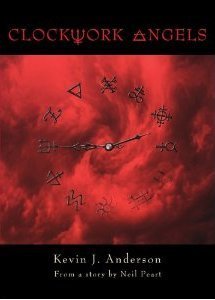
In the dictionary under the word prolific, there ought to be a picture of Kevin J. Anderson. The science fiction author has penned no fewer than 115 books over the past 25 years. His most recent, the much-anticipated Clockwork Angels (a novelization of the recently released and eponymous Rush album) will be released next month along with two other novels.
I recently sat down with Anderson to talk about how Clockwork Angels came about, the publishing industry and how it has changed over the course of his career, and a few other topics. The following is an excerpt of that conversation.
Clockwork Angels by Kevin J. Anderson
We spoke about how certain types of music inspire your and inform your writing process. Can you elaborate?
I’ve always been inspired by music as I envision and write my stories, and the music of Rush has been a particularly strong influence. Listening to the music, along with innovative or thought-provoking lyrics, was like a catalyst for my imagination, triggering scenes or whole plots. My first novel Resurrection, Inc. (1988, and just reissued) was almost entirely inspired by the Rush album “Grace Under Pressure.” As I was developing the framework of the novel, listening to that album, it seemed as if the songs drove my plotting. Because of that novel (and a nod to the inspiration of Rush in the acknowledgments), I got to know Neil Peart, who writes the lyrics for Rush. We’ve known each other for more than twenty years, interacted in our separate creative fields—his music, my fiction—and we even wrote a short story together. When Neil began to conceive the steampunk fantasy story that eventually became “Clockwork Angels”, he used me as a sounding board for some of his ideas, since he had read some of my earlier fantasy novels that had steampunk elements, Eventually, as the story of the album—as told in snapshots of the music tracks—grew, Neil asked me to work on the novel.
We brainstormed the structure of the story, the characters, the sequence of events, while we spent a day together climbing a 14,000-ft peak in Colorado (because what could be a better place for brainstorming?); the ideas kept flowing even as the oxygen level decreased. Later, as Rush continued on tour and I worked on other deadlines, and Neil kept writing the lyrics for other pieces of the story, we let the story lie fallow for a while, but when he had all the songs written, then I could start working. But the album is more than just words set to music; it wasn’t until I finally heard the rough cuts of the tracks, with Neil’s drums, Geddy Lee’s (Rush’s lead singer) vocals and bass, Alex Lifeson’s guitars, that it all changed from black-and-white Kansas to Technicolor Oz. Then the story was real, and I was able to get to work, writing chapter after chapter as I listened to song after song. I would send the very rough drafts to Neil for his input, and he was like a conductor taking it to a higher level, suggesting changes and additions that tied strands together and pumped up the story.
Music has always been like that to me, fuel for imagination’s rocket, and I can think of many stories, scenes, chapters, whole novels that were inspired by songs.
In Clockwork Angels and some of your books you’ve touched upon a steampunk motif. Can you explain that and why are you attracted to it?
I grew up fascinated by the work of Jules Verne and HG Wells, and I added those ingredients into my fantasies—steam-engine cars, hot-air balloons, clanking automatons, chemistry that worked more like magic than science. I even had a steam-powered atomic bomb in my first fantasy trilogy. Of course, back in 1989 nobody called it “steampunk,” I just thought it was cool. To me, there’s something wondrous about the technological optimism of the subgenre, where science works and quirky inventors can save the world. In recent years, steampunk has become a huge and colorful subculture.
You are primarily a science-fiction writer. Has being associated with one genre helped or hurt your career. Why?
I’ve always written the stories that most attracted me, and in many cases the huge galaxy-spanning canvas gave me enough room to tell the big stories I had in my head. My 7-volume space epic The Saga of Seven Suns is a particularly good example of that, spanning so much distance and so many characters that I don’t think it could be contained in any other genre. However, I’ve also written lots of fantasy, from high-fantasy epics to steampunk and urban fantasy, to horror . . . even humorous horror, with my new Dan Shamble, Zombie PI series that comes out the same week as Clockwork Angels. I think if I only wrote one specific type of novel, I’d be easier to label and the publishers and booksellers might feel more comfortable, but fortunately I have a diverse and dedicated fan base that follows whatever I write.
How has the publishing industry changed over the course of the last 25 years? Is it easier or harder for first-time authors to get their work out and get noticed?
One thing to remember, when looking at the turmoil and rapid change in publishing and bookselling—the closing down of the Borders chain, the rise of eBooks, the domination of amazon—is that while the delivery vehicle for books may be undergoing a lot of upheaval, the stories are still the stories, and the beloved characters are still the characters. People often ask me if I prefer to read an eBook or a “real” book, and my answer is that I prefer to read. Some part of me still loves the tactile sensation of holding a paper book and turning the pages, but I also travel a lot, and I love being able to carry a lightweight eReader in my computer case; and I love to listen to an audiobook when I’m driving or working out in the gym. All of those are simply ways to convey the story to me, and a reader has options now that were never available before. I used to volunteer my time to record some of my stories (at home, with a personal cassette recorder) for the blind & dyslexic, because recorded books were such a rarity. Now virtually all of my titles have been made available in audiobook form; Neil Peart read the novel Clockwork Angels, so his voice delivers the words we created. I myself just recorded my first professional audiobook, a short science fiction novel I wrote last year. There are so many more options available now. So, to answer your specific question, it’s easier for a first-time author to get his or her work out . . . but because so much is out there, it’s even harder to get noticed.
Anderson will be appearing at a number of locations to sign copies of his new books. Click here to see them.