The Social Data Police
I awoke bright and early Wednesday morning and engaged in my regular routine. After firing up the coffee maker, I started checking email, Twitter, Google Analytics, and Amazon. Why Amazon? I compulsively like to know how my books are selling.
Occupational hazard, I suppose.
My second book, The Next Wave of Technologies, doesn’t get too many reviews. I won’t tee off on the publisher here, but let’s just say that I didn’t think that the book was priced at a reasonable number. As a result, sales haven’t been explosive.
That’s all in the past and I’ve come to terms with it. Onward and upward, right? But I noticed a new review from 8/28/2012 and it wasn’t particularly flattering:
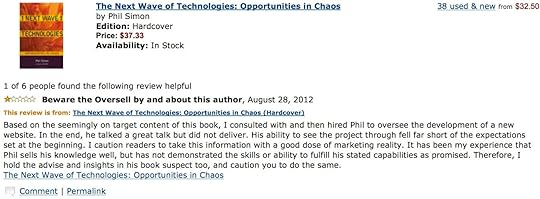
Click for larger image.
Now, I know the person who wrote this review, even though she cloaked her name with “Last Licks.” The details of our specific engagement aren’t terribly important, but let’s just say that her version of events isn’t remotely close to mine. Also, let me state unequivocally that I have no problems with critical reviews. I’ve left a few myself on products that didn’t satisfy me–and I’ve received some for my last book, The Age of the Platform. But these reviews were at least related to the product itself. By contrast, the review by “Last Licks” had nothing to do with the actual book. In fact, I sincerely doubt that she bought it, much less opened it.
Can Amazon Improve its Review of Reviews?
Now, I’ve praised Amazon.com on this site many times before about the company’s fascinating use of different technologies. Fascinating and perfect are two entirely different things, however. The review in question wasn’t really a review at all; it was an indictment of my business and web design skills. In an ideal world, Amazon would use semantic technologies to (better) determine if a book review was truly about, well, the book itself!
And here’s where the social data police come in. (By the way, is anyone else conjuring up the image of Jim Harris singing a version of Cheap Trick’s “Dream Police” right now?) The social data police help other potential buyers of the book understand that not all reviews are equal or even relevant. Not all one-star reviews are equally meritorious.
Just look at the work of the social data police in the comments:
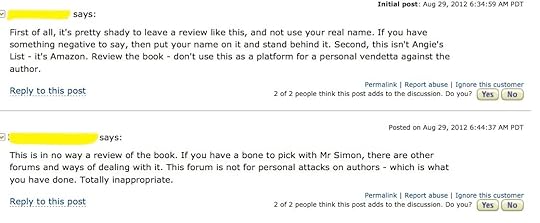
Click for larger image.
I’ve seen the same thing happen with other books. The community chimes in and generally calls out these type of “non-review reviews.”
Simon Says
Advanced technology like that of Amazon.com has certainly benefited the company. But technology itself hasn’t yet (and may never) replace the social aspect of data. Brass tacks: people can improve enterprise data, give it context, and make it more relevant.
Is your organization embracing the social data police?
Feedback
What say you?