Phil Simon's Blog, page 107
July 26, 2012
My Interview with Noah Dentzel
Originally published in HuffPo. Click here for the original post.
I recently sat down with Noah Dentzel to talk about his exciting new Kickstarter project: ChargeCard.
How would you describe the ChargeCard to your grandma?
ChargeCard is really simple. It’s a USB cable, just like the cable you use to charge your phone, but it’s in the shape of a credit card. Because it’s only 0.1” thick, you can easily stow it in your wallet. And because it fits in your wallet, you’ll always have it on you whenever you need to plugin, to charge.
Where did you come up with the idea for ChargeCard?
After college, I worked at an internet company in Madrid. We were always on our phones and our phones were always dying on us. We had Blackberries. When we went out on the town, one of us would often bring a charger or a micro USB cable. Everyone was always looking for a charge — we were BlackBerry addicts after all. But there was something wrong with this scenario. So I began pushing around the idea of a tiny micro USB to USB connector, something portable enough to always have on you. But then I was talking with a friend who was working in the mobile division of our company, he was launching a mobile operator at the time and was working with SIM cards. He mentioned that shaping the device in the form-factor of a credit card would allow the user to always have it on them. The idea stuck.
Why Kickstarter?
The Kickstarter platform is as brilliant as the projects that launch on it. Kickstarter allows entrepreneurs to gauge market response for their product before committing to costly tooling and manufacturing, which in our case can run tens of thousands of dollars — quite a stretch for a couple of recent college grads. We considered the options of taking on more traditional financing, but we were excited to be part of this new movement. Much the way venture capital changed startup financing 50 years ago, crowdfunding sites like Kickstarter are once more changing the way finance works. It’s no longer necessary to seek the funding (and control) that comes from angel investors and venture capital (VC) firms now that the general public can take part in supporting and financing new products and creative projects. After all, the fun of investing in cool creative projects should be open to all.
What’s it like in the life of a Kickstarter entrepreneur?
Hectic, exhilarating, and (when I’m not stressing out over something) fun, too! As anyone running a project or starting a business knows, you’ll have to wear many hats throughout the course of the day. There is no marketing department, sales team or customer support group, it’s all you. It’s like some sort of an MBA crash course or perhaps even something more considering that we’re spanning the gamut of product development, manufacturing, and, of course, delivering the product.
What have you learned? Any tips to someone aspiring to launch a Kickstarter project of their own?
If you’ve already got the project or product in mind, then great. Otherwise, keep your eyes and ears open. Listen, watch and observe your surrounding. ChargeCard was inspired through the repeated first hand experience and observation of a really annoying problem, dead phone battery. There are a lot of big (and small) problems in this world that could use some ambitious and creative energy. Of course Kickstarter is a great place for the arts, too. When you do get going though, my one piece of advice is to lose the ego — recognize what you’re not good at and focus on adapting, improving or getting help. That’s the best way to ensure that you’re doing your best work.
Any last words?
Execution is key. Many things sound easy, and indeed they might be simple, but the test of success is in executing and delivering. I used to meet with one of our team members every morning at 8.00 a.m. One day he was an hour late. It’s easy to set an alarm and wake up on time, anyone can do it. But sometimes it can be tricky to execute, and I’m sure we’ve all failed here once or twice before. Lastly, communication is crucial. Communication within your team and outside of it. Be transparent, bring up issues early, and be sure to follow up.


July 25, 2012
Green IT and 3D Printers
I recently wrote an article for SearchCIO on how additive manufacturing delivers unexpected green benefits for CIOs. Here’s an excerpt:
Many CIOs these days talk about how their companies are “going green.” These days, it’s downright hip for people to showcase their organizations’ environmentally friendly and new emerging technologies. But what is green IT? Green computing is generally agreed, as explained on Whatis.com, to be the “environmentally responsible use of computers and related resources … as well as reduced resource consumption and proper disposal of electronic waste (e-waste).”
What if transportation costs and manufacturing waste on certain products could be not just reduced, but altogether eliminated? What if your home or office became a de facto manufacturing plant? Products would not have to be shipped to stores — and you wouldn’t have to drive to pick them up. It’s this thought process that drives the green IT initiative, with CIOs using technology to reduce their impact upon the planet’s resources, whether it’s through the use of solar keyboards or dunking the data center into a vat of oil.
Click here to read the entire SearchCIO article. Registration required.
July 19, 2012
July 17, 2012
Now on VYou
vYou is a service that allows you to simply ask and answer questions via video. Think of it like SocialCam meets Quora.
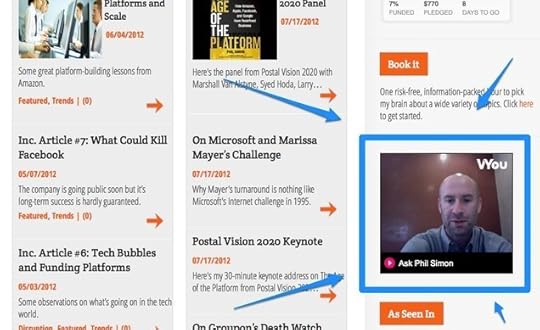
It seems like a potentially promising site (let’s not call it a platform just yet, please). To ask me whatever you like, click here or just click on the link in the sidebar of this blog (pictured below).
Last to Cool
In the current issue of Vanity Fair, Kurt Eichenwald writes about Microsoft’s Lost Decade (the naughts). In case you’re wondering, in the 2000s the company’s stock flat-lined. In an interview about the fascinating article, Eichenwald talks frankly about CEO Steve Ballmer and the company “not having a vision.” At one point, Eichenwald says:
Starting in the early 2000s, the man who now is their chief executive–Ballmer –would say we are going to be last to cool, first to profit. And last to cool, what that means is, we’re not going to be cutting edge. We’re going to look at what other people do and we’re going to do what they do. For example, the people in the search engine division, Bing, were always telling me, all we did was just follow Google. Nobody had time to come up with their own ideas because because there is so much bureaucracy. One of the things I mention in the article is that the iPhone right now, something that didn’t exist five years ago, has more in sales than all of Microsoft combined. And you look at that and say what last to cool means is also last to profit.
In a Charlie Rose interview on July 10th, Eichenwald goes into a great deal more depth about Ballmer’s pledge to be “last to cool, first to profits.” Translation: Microsoft would be a follower, not a leader. It wouldn’t chase hip products or categories until they were mature. Only then would the company jump in and, in theory at least, make a bunch of money.
Except it didn’t.
Case in point: the Zune, Microsoft’s clunky MP3 player finally put out of its misery in October of 2011. For every Xbox (a consumer success), Microsoft has had to euthanize many others. (Don’t believe me? Check out The Microsoft Morgue, a borderline-painful Pinterest board.)
Lessons for Mid-Market Companies
OK, enough Microsoft bashing. What can mid-market companies learn from the mistakes of the world’s once-dominant software company? Many things, actually, but first and foremost is “don’t be last to cool.”
Every company is becoming a tech company.
Retail companies have launched their own apps. Wearable technology is already here. Libraries are doing cool things with platforms and APIs. Every company is becoming a tech company.Because of funding platforms like Kickstarter, products are reaching the zeitgeist before they are launched. Tech is changing faster than ever–and that’s not stopping anytime soon.
Simon Says: Don’t be “last to cool.”
It may not be possible for your organization to blaze a trail to cool. After all, not every company can be Apple, right? Still, it’s never been more dangerous to wait until a product is already mature before deciding to jump into the fray. Minimizing risk is one thing, but eliminating it altogether is impossible and even ill-advised. As I write in The Age of the Platform, the costs of inaction almost always exceed the costs of action. Alternatively stated, safe is the new risky.
Just ask Microsoft.
Feedback
What say you?

This post was written as part of the IBM for Midsize Business program, which provides midsize businesses with the tools, expertise and solutions they need to become engines of a smarter planet.

July 12, 2012
On Platforms and Stickiness
Originally published in HuffPo. Click here for the original post.
Tim O’Reilly recently started an interesting thread on Google Plus. His central argument: I want to spend as little time as possible on Google. In his view (and that of many others), Google should take people someplace else. Maximizing “time on site” is very un-Google.
Sure, for years Google has been essentially a means to an end. But should it remain that way? Why is Google trying to become stickier?
Let’s distinguish search from the overall Google platform. With respect to search, results take users in many if not most cases away from a proper Google site — and I don’t see that changing in the near term. But it’s high time that we begin thinking of Google as a platform, not merely as the dominant search engine.
Google no longer aims to be (primarily) just a conduit to another platform or network or website — and the company is hardly alone here. The Gang of Four (Amazon, Apple, Facebook, and Google) and other emerging platforms are building different planks precisely because they want to be seen as ultimate destinations, not merely and exclusively as interim stops to somewhere else. The strategy here is both offensive and defensive — every minute spent on Google represents a minute not spent on Facebook.
So, at a higher level, what are Amazon, Apple, Facebook, and Google are trying to do? That’s a huge question worthy of a pretty big book. Perhaps that question is best answered in the negative. What don’t they want to do? In short, push you off of their platforms (to those of competitors).
Brass tacks: Use Google as sparingly as you like, but don’t be surprised by its increasing attempts to become stickier.
July 10, 2012
The Inevitability of Negativity
Image credits: Vetustense Photorogue via Compfight
Creative types like me put ourselves out there. We site down with a blank screen and canvas and try to do our best work. Are we successful? It depends on whom you ask.
With the release of a new album or movie or piece of art, one of four things is certain to happen:
No one notices the work (typical, especially for people just starting out)
Everybody hates the work (unlikely)
Everybody loves the work (suspect)
Opinions vary (typical, once the work or the creator reaches a certain level of prominence)
For just about every one of my favorite albums, movies, books, etc., there are those in the opposing camp. That’s always been the case.
Of course, it wasn’t always so easy to find like-minded folks. Do you hate John Grisham’s new book? Click on the one-star Amazon reviews. Think that Van Halen sucks? Join the Facebook group devoted to that very, er, cause. Didn’t care for the latest Spiderman flick? Tweet about it. You’re not alone. Despise Breaking Bad? Not so remarkably, there’s a website just for you.
Simon Says
Negativity is inevitable unless you choose to remain anonymous. For those committed to doing great work, anonymity is not an option. Pay the trolls no heed.
Feedback
What say you?
Data is not a Platform
Ken Oestreich on GigaOM writes about data as a platform. From the piece:
And, if the data is becoming so valuable, then analyzing and mining it ought to provide incremental revenue streams beyond the traditional product-based business model. But consider going one step further: If treated right, access to enough quality data would be valuable to others outside of your enterprise too — assuming the correct federation and business models were constructed.
All true, but I disagree with the notion that data is a platform. True developers build on top of platforms. Without tools and platforms, data is just, well, data.
Plus unlike platforms, data can still be wildly misinterpreted, as a a recent Wired piece on the demise of the BlackBerry proves. It turns out that the election of a certain US president “caused” a once-dominant handset maker to fall from grace:
Blame Barack Obama. Research in Motion might do well to pick on the president, if only to distract from the other reasons for its rapidly declining fortunes. After all, it was around the time then President-elect Obama came out as a BlackBerry addict that the once-dominant mobile company’s slide really began.
But it hasn’t been just Tea Partiers who have defected from the president’s preferred mobile platform in the years since he took office. The Waterloo, Canada-based maker of BlackBerry smartphones has lost customers of all kinds while erecting multiple milestones of failure along a path toward seeming disintegration.
The chart below visually represents “The Obama Effect” with respect to RIM:
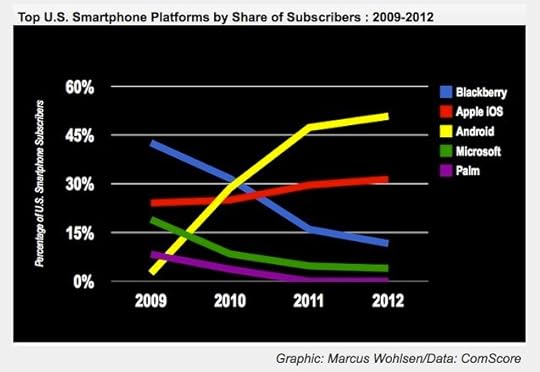
Except it doesn’t.
Books like The Halo Effect…and the Eight Other Business Delusions That Deceive Managers illustrate the false causality so prevalent in the business world. Just because a company ABC did X does not mean that X caused success. It might have been Y resulting in increased revenue or profits. Perhaps Z caused both X and Y, to say nothing of what companies DEF and XYZ didn’t do. And let’s not forget about plain old-fashioned luck.
In the case of RIM, was the design of the BlackBerry flawed? Perhaps. But I’d argue that RIM’s lack of (decent) apps more than any other factor caused its demise. With no end to the app nightmare in sight, people like me decided in droves to move in a different direction (the iPhone)–and not wait for a complacent company to finally embrace the essential notion of ecosystems.
There’s no way to know for certain what caused the demise of the once über-popular CrackBerry. Other than running true scientific experiments, even the smartest among us can only offer our (hopefully informed opinions). Never let data completely substitute for common sense and judgment.
Simon Says
The larger lesson for organizations of all sizes is that data is not the end-game.
Feedback
What say you?
This post was written as part of the IBM for Midsize Business program, which provides midsize businesses with the tools, expertise and solutions they need to become engines of a smarter planet.
July 9, 2012
Keynote at OpTech
I’m pleased to announce that on DATE, I’ll be giving the keynote address at OpTech, the annual national event of the National Multi Housing Council. NMHC is represents the interests of the larger and most prominent apartment firms in the U.S.
I’ll be talking to about 1,000 people about platforms, emerging technologies, and future trends.
July 6, 2012
Inc. Article #10: Grow Your Business by Buying Domain Names
My 10th Inc. Magazine article is now live. Here’s an excerpt:
Many businesses operate on what I call the “one website theory.” That is, they buy a single domain, add content on a regular basis, and try to drive as much traffic to that domain as possible.
To be sure, this is a tried-and-true strategy. In fact, compared to the more than 60% of all small businesses that don’t even operate proper websites, buying one domain would be a vast improvement over waiting for the resurrection of the Yellow Pages.
But for many entrepreneurs, spreading their Web presence across more than one url makes more business sense.
Click here to read the whole thing.