Phil Simon's Blog, page 108
July 3, 2012
Understanding The Fancy
Originally published in HuffPo. Click here for the original post.
I recently sat down with Joseph Einhorn, founder of The Fancy. His company seeks to be a next-gen Amazon. Rather than starting with the product, it’s starting with the person.
In a nutshell, what’s The Fancy about?
We wanted to build a website that would be as fun to shop on the web as your favorite store is in real life. A place where you could easily find all the coolest things in one place and be able to buy them right there without having to click out to other websites. For example, I love to go to the apple store in real life. But there is nothing on the web, not even Apple’s on site, that feels as good. Hopefully we can be that site.
You and I talked about the misuse of the term platform? Do you see The Fancy as a platform? If so, how?
Think about it from the perspective of an emerging fashion or product designer. What do they get from us? They get distribution. They get merchant tools (manage inventory, manage orders, calculate shipping and taxes, etc.). They get great visual representation of their products (stuff on our site looks its best) That sounds like a cool platform to me.
Why do you pay users to join? How long can that last?
The invite incentive program we have in place can last as long as we want it to. We are giving people credit towards purchases on our site. We make a cut from stuff we sell on the site. The incentives are tied towards bringing on more users who are buying more things generating more commission for us.
The Fancy seems to be based upon a fundamentally different model than other “ecommerce sites.” When I heard about it, I thought of The Experience Project, a Facebook alternative that seeks to organize people on the basis on interests, not personal connections. Seems like the Fancy’s approach to commerce is based comes from an equally different place. Yes?
Let me simplify. Online shopping is broken. In real life I go to an amazing store like the Apple store or Barney’s and I see all the coolest stuff in the world and have a great experience. But even my favorite stores don’t have a great online experience. When you go on Fancy you are looking at the coolest stuff in the world selected by the coolest people in the world and one click and you buy it.
The Fancy offers a wide array of merchant tools to facilitate product distribution, sales reporting, and representation of their products. Talk about how these tools encourage innovation and your company’s growth.
In order to make a marketplace work you need cutting edge tools for sellers. Manage your inventory, manage your orders, calculate shipping, taxes, etc. Print shipping labels.. whatever our merchants and brands need in order for this to be convenient for them. Want this to be as easy or easier than any other setup they might be using. And of course free.
Talk to me about curation. What’s The Fancy’s philosophy towards selecting content? How does your platform enable this?
Our community is self-teaching. When a new user signs up for the site they see the best posts with the best images, links, titles, naming conventions, etc. So should they decide to contribute they have the blueprint. We just provide the platform. Our top users see something they like added by a new user, they fancy it which means all of their followers see it, and all of a sudden the new user is a superstar.


June 26, 2012
An Interview with Terri Griffith
Originally published in HuffPo. Click here for the original post.
My friend, Santa Clara professor Terri Griffith, has published her first book, The Plugged-In Manager: Get in Tune with Your People, Technology, and Organization to Thrive. I sat down with her to talk about the book and the motivations behind writing it.
The Plugged-In Manager sounds like a book about social media, but it’s not. Why the title?
My publisher and I loved the double entendre. Yes, the book has a technology angle and people find the ideas valuable for making social media decisions, but it’s more about awareness: being “plugged in” or “in the loop” with your opportunities across the dimensions of people, technology, and organizational process and being able to understand the outcome of different combinations.
What do you mean by plugging in?
People who are plugged in never make a move that doesn’t at least consider the human, technical, and organizational trade-offs. They may not do it consciously, but they are masters of orchestrating actions that are a solid blend of the three dimensions. Steve Kerr, a former professor who ended up leading GE’s Crotonville learning center and then served CLO at Goldman Sachs, talked in the late ’70s about “substitutes for leadership.” He spoke about how organizational design could substitute for some aspects of leadership. I take it a touch further and add technology as one of those design aspects, and go broader than just for leadership. Our personal and organizational outcomes result from a combination of human, technical, and organizational dimensions. There is never one right way so we need to be aware of our choices across situations.
Why is plugging in hard? Why don’t people just do it?
People naturally are drawn to problem solving using their personal expertise and available tools — if I have a hammer, then all problems look like nails. Our world is too complex (and really always has been) to believe that any one of the three dimensions can provide an effective solution. No one person, technology tool, or organizational practice is likely to be as powerful as some thoughtful combination. You don’t have to be an expert across all the dimensions, but you have to respect them and know how to discover the possibilities.
Okay, I get how to be more plugged in. Why don’t I want to keep it to myself?
We know from research in teams that performance is higher when members have similar understandings of who knows what, who needs what information, and how coordination should proceed. If people have a shared understanding around the value and methods of plugging in, then they can support the process rather than work at cross purposes.
In the Age of the Platform, how does plugging in work?
There are two issues that have come up since the book was published. The first is that plugged-in people also seem to be more comfortable with letting methods, strategies, and processes emerge. I don’t have that in the book, but the importance of emergence is an additional aspect we are seeing as we continue to collect new data. I expect it’s because plugged-in people are confident that they will notice if something is going astray and be able to intervene if need be.
This support for emergence may also be an indication that plugged-in managers will be more successful in the Age of the Platform. They may have the vision to see that people, technology, and organization shouldn’t be restricted to the people, technology, and organizational process inside their own organization’s walls — and are also confident enough to rely on partners in building success, knowing that how all the efforts mix together will be at least in part an emergent process.
An Interview with Terri Griffith
Originally published in HuffPo. Click here for the original post.
My friend, Santa Clara professor Terri Griffith, has published her first book, The Plugged-In Manager: Get in Tune with Your People, Technology, and Organization to Thrive. I sat down with her to talk about the book and the motivations behind writing it.
The Plugged-In Manager sounds like a book about social media, but it’s not. Why the title?
My publisher and I loved the double entendre. Yes, the book has a technology angle and people find the ideas valuable for making social media decisions, but it’s more about awareness: being “plugged in” or “in the loop” with your opportunities across the dimensions of people, technology, and organizational process and being able to understand the outcome of different combinations.
What do you mean by plugging in?
People who are plugged in never make a move that doesn’t at least consider the human, technical, and organizational trade-offs. They may not do it consciously, but they are masters of orchestrating actions that are a solid blend of the three dimensions. Steve Kerr, a former professor who ended up leading GE’s Crotonville learning center and then served CLO at Goldman Sachs, talked in the late ’70s about “substitutes for leadership.” He spoke about how organizational design could substitute for some aspects of leadership. I take it a touch further and add technology as one of those design aspects, and go broader than just for leadership. Our personal and organizational outcomes result from a combination of human, technical, and organizational dimensions. There is never one right way so we need to be aware of our choices across situations.
Why is plugging in hard? Why don’t people just do it?
People naturally are drawn to problem solving using their personal expertise and available tools — if I have a hammer, then all problems look like nails. Our world is too complex (and really always has been) to believe that any one of the three dimensions can provide an effective solution. No one person, technology tool, or organizational practice is likely to be as powerful as some thoughtful combination. You don’t have to be an expert across all the dimensions, but you have to respect them and know how to discover the possibilities.
Okay, I get how to be more plugged in. Why don’t I want to keep it to myself?
We know from research in teams that performance is higher when members have similar understandings of who knows what, who needs what information, and how coordination should proceed. If people have a shared understanding around the value and methods of plugging in, then they can support the process rather than work at cross purposes.
In the Age of the Platform, how does plugging in work?
There are two issues that have come up since the book was published. The first is that plugged-in people also seem to be more comfortable with letting methods, strategies, and processes emerge. I don’t have that in the book, but the importance of emergence is an additional aspect we are seeing as we continue to collect new data. I expect it’s because plugged-in people are confident that they will notice if something is going astray and be able to intervene if need be.
This support for emergence may also be an indication that plugged-in managers will be more successful in the Age of the Platform. They may have the vision to see that people, technology, and organization shouldn’t be restricted to the people, technology, and organizational process inside their own organization’s walls — and are also confident enough to rely on partners in building success, knowing that how all the efforts mix together will be at least in part an emergent process.
The NFL and Data Resistance
The National Football League is nothing less than the acme of contemporary American sports. Ratings are off the charts and the league’s recent TV deal represents the standards by which other leagues are ultimately judged. (Spoiler: they wish that they could do half as well as the NFL)
Yet all is not well for the NFL. Ask league Commissioner Roger Godell. Specifically, the NFL has a high-profile and particularly thorny problem: concussions. Lawsuits abound. In fact, if you’re a former player and suspect that your post-career physical ailments stem from concussions, there’s a website just for you.
Yet for years there has been technology that can measure the impact of blows to the head. Certain colleges and universities have been utilizing it for years. Small chips in helmets can measure the strength of head blows and send that data to team physicians who can pull someone from the game with an elevated risk of head trauma. In the end, concussions can be minimized, if not prevented altogether.
So, why isn’t the NFL using this technology right now?
Understanding the Data Resistance
This was the question posed on a recent edition of ESPN’s Outside the Lines. Watching the program, I was surprised at that the level of resistance that this technology currently faces–and, more astonishingly, at the source of this resistance The NFL brass actually favors it. It’s the players and their union (the NFLPA) who don’t want to see it.
Huh?
The NFLPA declined to comment for the ESPN piece, but former Steelers’ wide receiver Hines Ward summed up the potential objections of those who don uniforms and hit each other for 60 minutes. What if this technology and the data that it generates keep a player from making a bonus? What if computers and data usurp the judgment of individual players?
And let’s not just demonize NFL players for their resistance to technology and data. Major League Baseball umpires are anything but open to reviews of their calls. With instant replay, data could be used to weed out less accurate umpires from the pack.
Simon Says
I certainly can understand the general creepiness of having machines assess your level of competence. I can just see some 300-lb. offensive lineman saying, “I don’t need no stinkin’ data. Put me in, coach!”
At the same time, though, data can make our lives better and, in the case of NFL players, safer. Failure to recognize the importance of data not only hampers many an organization, but scores of individual employees. Bad business decisions are one thing, but lives lost or adversely affected are completely different.
Ignore the data at your own peril.
Feedback
What say you?

This post was written as part of the IBM for Midsize Business program, which provides midsize businesses with the tools, expertise and solutions they need to become engines of a smarter planet.

June 25, 2012
Kickstarter #3: Breaking Bad Book
I am a huge Breaking Bad fan. I mean borderline-psychotic. Don’t believe me? Check out the contest I won to be in a commercial for the show. I also reference it quite a bit on this site. I’ve converted friends.
Vince Gilligan’s epic show asks more questions than it answers. (For those of you who don’t know here’s the show in a nutshell. Walter White is a 50-year old law-abiding high school chemistry teacher who finds out that he has terminal lung cancer. His wife is pregnant and his son has CP. He decides to “break bad” and manufacture crystal meth. Things get very interesting from there.)
The acting is nothing short of extraordinary. Ditto the writing and cinematography.
About the Book
I have many thoughts about this fascinating show and the fundamental questions that it asks, including:
What does it mean to be a man?
How far should you go to protect your family?
Where do you draw the line between right and wrong?
Does Walter White exist in all of us?
I want to write a book about the show and attempt to answer these questions–at least as much as I can. As I’ve done in my previous books, I’ll be pulling from interviews, conducting my own, and offering my own analysis and interpretation.
Like my other books, I expect this one to come in at about 300 pages. This will be no pamphlet, I assure you.
About Me
I’ve worked with traditional publishers on my first two books: Why New Systems Fail and The Next Wave of Technologies. For my third and fourth books (The New Small and The Age of the Platform, respectively), I started Kickstarter projects. The results were amazing. I had much different (read: better) experiences. I’m all about platforms these days, and Kickstarter is perhaps the coolest funding platform out there today. Aside from generating funds and awareness for my own books, I enjoy backing other projects in which I believe.
About the Funds
You may be thinking that $10,000 seems like overkill to create a book these days. After all, isn’t it easier and cheaper than ever to publish a book? Well, yes and no. Let me explain.
I’ve run four books through my publishing company and know what it takes to create a professional book. Quality editors, cover designers, graphic designers, proofreaders, and production folks aren’t cheap. As with anything in life, you get what you pay for. I won’t put my name on a book unless it is completely professional. I’ve seen quite a few self-published books of questionable quality from subsidy presses like Lulu and iUniverse.
Like The New Small and The Age of the Platform, the Breaking Bad book will look and feel just as professional as any title released by a “proper” publisher. My goal: that the quality of the book measures up to the quality of the show and its acting and writing. In short, quality costs money.
About the Process
In my prior two Kickstarter projects, I involved the community in key design elements of the book, including the cover. I’ll be doing the same thing here. I’ll be reaching out through polls and for individual suggestions. Even the title is hardly settled at this point; I can do much better than “Breaking Bad Book.”
About the Publishing Team
I’ll be working with the following publishing professionals. I’ve worked with these folks before and have nothing but great things to say about them.
A Word of Thanks
While I’ve written four other books and am proud of all of them, this one is different: to me this is a complete passion project. Thank you for considering backing it.
A New Kind of Social Network
Originally published in HuffPo. Click here for the original post.
Facebook is facing a number of challenges these days, not the least of which is from upstarts set on usurping the company as the preeminent social media destination. Once such start-up is Experience Project, a company with a very different take on social media. I recently sat down with Armen Berjikly, company founder. Experience Project bills itself as the world’s largest community of life experiences and is centered around a very different model than Facebook.
In a nutshell, what’s Experience Project about?
Experience Project is the leading online network of people who share life experiences. Every person starts gathering experiences from the moment from birth until death. Our experiences represent an always increasing, infinitely interesting set of things; they are likely the single best manifestation of who we truly are. Experience Project is the optimized platform that connects folks that understand each other. Its fundamental tenet is that people who share your experiences “just get it.”
Do you see Experience Project as a platform? If so, how?
Certainly it is a platform for brands to represent themselves, but more interestingly, I also think it can be a platform for people. Any place where you have the ability to represent some important aspect of yourself, your mind, and your desires is a platform for you to express and connect.
Experience Project seems to be based upon a fundamentally different model than other social networking sites. When I heard about it, I thought of The Fancy, a social ecommerce site based upon people — not products per se. Seems like Experience Project’s approach to social networking is based comes from an equally different place. Yes?
Absolutely. One of our core driving forces is to create something special, something different, and most critically, something meaningful and lasting. Technology can be an incredibly positive thing, especially when it unites people. It can eradicate feelings of isolation, and disseminate knowledge to anyone, anytime. With billions of people on Earth at the same time, it is outrageous to think that you are truly ever alone in what you’re going through, whether it be a really exciting opportunity, or a difficult life challenge. Connecting people who have the same situations and the wisdom gained from going through them is incredibly empowering. Purpose building a place where you can be yourself — pros and cons, challenges and triumphs — means that we have to appreciate the vulnerability in everyone, and earn long lasting, authentic, and trusting relationships with our users.
Monetization is still a challenge for companies in your space. What’s the plan at Experience Project?
Building an innovative and fundamentally sound business model is incredibly important to us. First, there’s the obvious reason of achieving business success. Second, it ensures that this property, which at this point contains perhaps the most complete view of the human experience found anywhere, is here for the long run.
We have a (probably) unique situation where our members get so much value out of the site (four out of five say the site has changed their life for the better) that members in the early days would actually send us money without expecting anything in return– “use this to keep building the site!” In response to that, we’ve built a subscription model that rewards paying members with additional functionality and exposure of content across the site.
Over time, we’ve also developed our own unique “ad unit” with which our brand partners like Chevy, Wal-Mart, and JC Penney have had incredible results. We are experts in generating and consuming personal, emotional stories. The holy grail of marketing is to tell a story, and through that story, engage your customers emotionally — that is engagement and conversational marketing at its best. So brands come to us when they want a huge audience creating and reading personal stories that reflect the values of a brand. Think about the causes a company supports or the communities their products benefit. When deployed on a community about life experiences, that approach is incredibly successful at improving brand preference, and, affinity. Ultimately, this drives loyal customers because it gives them a chance to connect emotionally with the brand.
Finally, over time we’ve built a massive and proprietary database mapping specific human emotions to the content. Using that insight, we’ve recently released Crane, a groundbreaking product called that allows our customers to take any content anywhere. Crane allows us to look at tweets, customer service emails, and the like, and detect the emotions and sentiments contained in the content. When you can map certain “emotional signatures” to certain outcomes, like a customer completing a purchase, you have a new and very powerful way to understand your customers. We have found that emotion drives decisions, whether they are purchases or cancelling subscription. This is the first automated, highly accurate signal that can provide granular insight into how a single customer is actually feeling.
Where do you see Experience Project going from here? Are there any practical limits?
As long as people keep having experiences and want to talk about them, Experience Project will grow and thrive. We provide a safe, comfortable, and trustworthy platform to share those experiences with millions of others. As a result, there is no ceiling to our opportunity. In fact, the larger our reach has become, the faster we’ve grown. Also, we don’t want to grow just for growth’s sake. We know our property helps people. The more people who come across it, the more good we can help do.
A Different Kind of Social Network
Originally published in HuffPo. Click here for the original post.
Facebook is facing a number of challenges these days, not the least of which is from upstarts set on usurping the company as the preeminent social media destination. Once such start-up is Experience Project, a company with a very different take on social media. I recently sat down with Armen Berjikly, company founder. Experience Project bills itself as the world’s largest community of life experiences and is centered around a very different model than Facebook.
In a nutshell, what’s Experience Project about?
Experience Project is the leading online network of people who share life experiences. Every person starts gathering experiences from the moment from birth until death. Our experiences represent an always increasing, infinitely interesting set of things; they are likely the single best manifestation of who we truly are. Experience Project is the optimized platform that connects folks that understand each other. Its fundamental tenet is that people who share your experiences “just get it.”
Do you see Experience Project as a platform? If so, how?
Certainly it is a platform for brands to represent themselves, but more interestingly, I also think it can be a platform for people. Any place where you have the ability to represent some important aspect of yourself, your mind, and your desires is a platform for you to express and connect.
Experience Project seems to be based upon a fundamentally different model than other social networking sites. When I heard about it, I thought of The Fancy, a social ecommerce site based upon people — not products per se. Seems like Experience Project’s approach to social networking is based comes from an equally different place. Yes?
Absolutely. One of our core driving forces is to create something special, something different, and most critically, something meaningful and lasting. Technology can be an incredibly positive thing, especially when it unites people. It can eradicate feelings of isolation, and disseminate knowledge to anyone, anytime. With billions of people on Earth at the same time, it is outrageous to think that you are truly ever alone in what you’re going through, whether it be a really exciting opportunity, or a difficult life challenge. Connecting people who have the same situations and the wisdom gained from going through them is incredibly empowering. Purpose building a place where you can be yourself — pros and cons, challenges and triumphs — means that we have to appreciate the vulnerability in everyone, and earn long lasting, authentic, and trusting relationships with our users.
Monetization is still a challenge for companies in your space. What’s the plan at Experience Project?
Building an innovative and fundamentally sound business model is incredibly important to us. First, there’s the obvious reason of achieving business success. Second, it ensures that this property, which at this point contains perhaps the most complete view of the human experience found anywhere, is here for the long run.
We have a (probably) unique situation where our members get so much value out of the site (four out of five say the site has changed their life for the better) that members in the early days would actually send us money without expecting anything in return– “use this to keep building the site!” In response to that, we’ve built a subscription model that rewards paying members with additional functionality and exposure of content across the site.
Over time, we’ve also developed our own unique “ad unit” with which our brand partners like Chevy, Wal-Mart, and JC Penney have had incredible results. We are experts in generating and consuming personal, emotional stories. The holy grail of marketing is to tell a story, and through that story, engage your customers emotionally — that is engagement and conversational marketing at its best. So brands come to us when they want a huge audience creating and reading personal stories that reflect the values of a brand. Think about the causes a company supports or the communities their products benefit. When deployed on a community about life experiences, that approach is incredibly successful at improving brand preference, and, affinity. Ultimately, this drives loyal customers because it gives them a chance to connect emotionally with the brand.
Finally, over time we’ve built a massive and proprietary database mapping specific human emotions to the content. Using that insight, we’ve recently released Crane, a groundbreaking product called that allows our customers to take any content anywhere. Crane allows us to look at tweets, customer service emails, and the like, and detect the emotions and sentiments contained in the content. When you can map certain “emotional signatures” to certain outcomes, like a customer completing a purchase, you have a new and very powerful way to understand your customers. We have found that emotion drives decisions, whether they are purchases or cancelling subscription. This is the first automated, highly accurate signal that can provide granular insight into how a single customer is actually feeling.
Where do you see Experience Project going from here? Are there any practical limits?
As long as people keep having experiences and want to talk about them, Experience Project will grow and thrive. We provide a safe, comfortable, and trustworthy platform to share those experiences with millions of others. As a result, there is no ceiling to our opportunity. In fact, the larger our reach has become, the faster we’ve grown. Also, we don’t want to grow just for growth’s sake. We know our property helps people. The more people who come across it, the more good we can help do.
June 22, 2012
Amazon: A Life Saver?
Originally published in HuffPo. Click here for the original.
As I write in The Age of the Platform, Amazon takes a great deal of flak these days for a wide variety of reasons. Many think that it’s a de facto monopoly. Independent book store owners are rife with contempt for the Seattle-based giant. For their part, investors wonder why CEO and founder Jeff Bezos seems allergic to a little thing called profits.
Say what you will about the company but many authors find it increasingly empowering. Case in point: Jessica Park. She had published five books with traditional publishers and felt depressed when they wouldn’t pick up Flat-Out Love. She did it herself via Amazon and you can read her incredibly inspirational tale here. (You can read the letter on the front page of Amazon.com below)
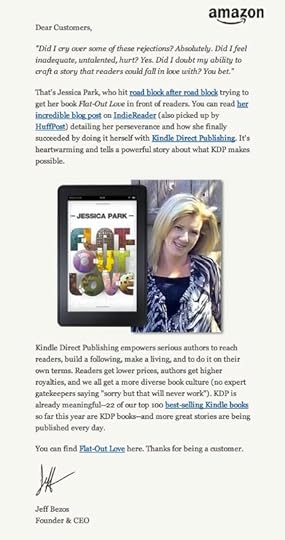
I’ve said it before and I’ll say it again: Today’s powerful platforms disintermediate established powers-that-be. In the case of Amazon, count bookstores and traditional publishers among the many with axes to grind. And Amazon is continuing the disruption in the publishing arena, signing big-name authors like Tim Ferris to book deals.
Amazon, Apple, Facebook and Google (the Gang of Four) each has many detractors. However, I’d bet that they’re probably many more advocates. Regardless of your stance, when you read a story like Jessica Park’s, how can you not be moved?
June 19, 2012
The Technology Pendulum
Imagine that it’s 1997 for a moment and you’re the CIO of a medium-sized company. The Internet has arrived–sort of. Your organization has started an ERP project. Mainframes are being replaced with a client-server setup. Some employees are using laptops and a few executives even require cellular phones. The relatively peaceful world as you knew it is being disrupted right before your eyes. You probably thought that the tech world couldn’t possibly get any crazier, but at least you were somewhat in control.
Fifteen years later, you’re probably pining for those halcyon days. The Consumerization of IT has left you downright dizzy. Forget laptops. They’re passé. Cell phones have given way to much more powerful smartphones with oodles of functionality. Tablets are making inroads inside your oragnization and BYOD is all the rage. Social media means that employees can reach anyone anywhere, increasing data leakage and security concerns. And a company snafu might mean that you’re trending on Twitter whether you like it or not.
A Whole New Ballgame
CIOs used to approve who gets to do what are finding that they can’t possibly lock everything down. Try too hard to secure the enterprise and you may well find an employee revolt on your hands, especially among Millenials.
On his blog recently, my friend Alan Berkson asks the question, “Who’s Dictating Cloud Apps in the Enterprise?” From his post:
Are individual consumers dictating best practices for the corporations they work for? You don’t have to be a technology person to find a solution anymore. This is not new. For decades we have seen pockets of technology within the enterprise. However, today, as a corporate CIO/CTO/CEO you can no longer ignore it or avoid it. Employees have greater than ever access to possibly superior tools to do their work. How do you keep up with that?
As usual, he’s spot-on. Employees will go under the radar to get work done if their existing tools are deficient or not user-friendly. Many will go rogue to meet a deadline or accomplish a task–and deal with the consequences from IT later, if at all. Social enterprise software like Yammer and Vibe go viral in organizations without formal IT approval.
Simon Says
The pendulum may swing back to The Corporation at some point. I just don’t have a crystal ball. To me, though, CXOs face a fundamental choice. They can either fight the newly empowered employee or choose to embrace it. Put me in the latter camp. Yes, security matters and IT should have a place at the table. It’s imperative for IT to be seen as a solution, an employee champion–not an obstacle to often much-needed change.
Feedback
What say you?
This post was written as part of the IBM for Midsize Business program, which provides midsize businesses with the tools, expertise and solutions they need to become engines of a smarter planet.
June 18, 2012
Inc. Article #9: Can Facebook Acquire a Better Mobile Experience?
My eighth Inc. Magazine article is now live. Here’s an excerpt:
Facebook has yet to make any significant money from mobile. Some critics, including Ironfire Capital founder Eric Jackson, believe that the rise of mobility will kill Facebook–or soon make it as irrelevant as MySpace is today.
To be fair to Facebook, it’s one of many Web companies facing the same fundamental problem with respect to mobile: How do you make money? Facebook is struggling to fill the enormous gap between mobile page views and revenue. (Mobile users are worth about a quarter of a desktop user according to Digiday.) Potentially adding to the company’s challenges, Facebook’s CTO Bret Taylor–who largely oversaw mobile efforts–announced Friday that he will depart later this summer to work on a still-to-be-determined start-up.
Click here to read the whole thing.