Phil Simon's Blog, page 106
August 17, 2012
Inc. Article #12: Best Reasons to Turn Down VC Funding
My 12th Inc. Magazine article is now live. Here it is.
With so many start-ups getting VC funding these days, it seems like 1998 all over again. Except that it isn’t.
I wrote a while back on this site that there are many differences between now and the dot-com boom. The costs of starting a company are a fraction of what they were back then (especially on the tech side) and funding platforms (both private and public) simply didn’t exist back then.
But there’s one thing that has stayed constant: Most every start-up founder will grumble about his or her VC firm. Think about it. If a company is successful, then the VC firm typically reaps the lion’s share of the rewards. If the start-up fails, then the VC firm probably didn’t do enough–at least in the eyes of the company’s founders.
This begs the question: Even if you can land the funding, are you better off not taking it? Fellow Inc.com writer Minda Zetlin explored the idea recently in an interesting post entitled “4 Signs You Should Say ‘No’ to a VC.” But what if there aren’t any red flags? How do you make the decision?
Evaluating Pros and Cons
I posed the VC question to runtastic CEO Florian Gschwandtner at CES in Las Vegas last January. Runtastic is an Austrian company that makes fitness-tracking apps and hardware for athletes.
Gschwandtner says that opting out of VC funding provides several advantages. He pointed out that, without external funding, runtastic was forced to concentrate on revenue from the company’s inception–not years down the road. As a result, it became profitable more quickly. It was able to finance its growth immediately.
Because the founders used their own funds, they were more inclined to keep costs in check and not waste money. And then there’s speed. Gschwandtner notes that “establishing independence from financial investors and retaining full control over the company helped us move fast. We never had to ask anyone to do anything.”
Finally, companies with lean structures can survive slower growth periods and downturns arguably better than heavily-funded companies. Bottom line: Owners will not have to worry about placating multiple investment partners with potentially disparate interests. Agency theory still matters.
It’s important to note that saying “no” to VCs now is not the same as saying “no” forever. Runtastic is part of a new breed of start-ups that won’t rule out accepting VC money but, at the same time, the company is very cautious about taking that step.
“At the start, I think it is a bit harder without VC money because you have to be really careful with spending money,” Gschwandtner continues. “At the same time you learn a lot about how to generate revenue because you need it for the growth.”
Simon Says
To be sure, making the decision to go with a VC firm–much less which one–is more art than science. There are compelling reasons both in favor and against institutional money. And don’t forget factors such as:
The specific terms of the deal (money, ownership stake, and the like)
How the market views your industry (for example, if you’re a start-up that relies on Facebook’s platform and you get an offer now, your terms may reflect the market’s overall Facebook-saturation level)
The individual investors and expertise of the VC firm
There’s no checklist or blueprint that will work for every company. Luck, after all, plays a big role in the success of any start-up.
What’s your experience with VC money?
Click here to read the article on Inc.


Inc. Article #11: Best Reasons to Turn Down VC Funding
My 12th Inc. Magazine article is now live.
With so many start-ups getting VC funding these days, it seems like 1998 all over again. Except that it isn’t.
I wrote a while back on this site that there are many differences between now and the dot-com boom. The costs of starting a company are a fraction of what they were back then (especially on the tech side) and funding platforms (both private and public) simply didn’t exist back then.
But there’s one thing that has stayed constant: Most every start-up founder will grumble about his or her VC firm. Think about it. If a company is successful, then the VC firm typically reaps the lion’s share of the rewards. If the start-up fails, then the VC firm probably didn’t do enough–at least in the eyes of the company’s founders.
This begs the question: Even if you can land the funding, are you better off not taking it? Fellow Inc.com writer Minda Zetlin explored the idea recently in an interesting post entitled “4 Signs You Should Say ‘No’ to a VC.” But what if there aren’t any red flags? How do you make the decision?
Evaluating Pros and Cons
I posed the VC question to runtastic CEO Florian Gschwandtner at CES in Las Vegas last January. Runtastic is an Austrian company that makes fitness-tracking apps and hardware for athletes.
Gschwandtner says that opting out of VC funding provides several advantages. He pointed out that, without external funding, runtastic was forced to concentrate on revenue from the company’s inception–not years down the road. As a result, it became profitable more quickly. It was able to finance its growth immediately.
Because the founders used their own funds, they were more inclined to keep costs in check and not waste money. And then there’s speed. Gschwandtner notes that “establishing independence from financial investors and retaining full control over the company helped us move fast. We never had to ask anyone to do anything.”
Recommended Videos
 Leader in Motion: How Choreographer Bill T. Jones Collaborates
 How the SBA Can Help You Raise Money
 How a Disaster on Everest Inspired an Entrepreneur
Finally, companies with lean structures can survive slower growth periods and downturns arguably better than heavily-funded companies. Bottom line: Owners will not have to worry about placating multiple investment partners with potentially disparate interests. Agency theory still matters.
It’s important to note that saying “no” to VCs now is not the same as saying “no” forever. Runtastic is part of a new breed of start-ups that won’t rule out accepting VC money but, at the same time, the company is very cautious about taking that step.
“At the start, I think it is a bit harder without VC money because you have to be really careful with spending money,” Gschwandtner continues. “At the same time you learn a lot about how to generate revenue because you need it for the growth.”
Simon Says
To be sure, making the decision to go with a VC firm–much less which one–is more art than science. There are compelling reasons both in favor and against institutional money. And don’t forget factors such as:
The specific terms of the deal (money, ownership stake, and the like)
How the market views your industry (for example, if you’re a start-up that relies on Facebook’s platform and you get an offer now, your terms may reflect the market’s overall Facebook-saturation level)
The individual investors and expertise of the VC firm
There’s no checklist or blueprint that will work for every company. Luck, after all, plays a big role in the success of any start-up.
What’s your experience with VC money?
Click here to read the article on Inc.
August 16, 2012
Dream Theater’s Jordan Rudess Talks Music Apps
Originally published in HuffPo. Click here for the original post.
The results of the app explosion aren’t exclusively devices you can use to find local bars, snap photos, or play games with your friends. In fact, it’s probably easier to count aspects of daily life that aren’t effected by this technological revolution than areas that are. It’s no coincidence that “there’s an app for that” has entered the zeitgeist.
One particularly interesting realm of the app universe is within the realm of musical interests. (Yes, you can actually make music on smartphones and tablets.) It’s hard to think of a greater trailblazer in this arena than Jordan Rudess. A classically trained pianist, the über-talented Rudess is best known as a member of the progressive metal band Dream Theater, but there’s so much more to “The Wizard.” In 2009, Rudess founded Wizdom Music, an innovative app development company.
While touring in South America recently, Rudess sat down with me to talk about his company’s new apps and the state of the music industry, among other topics. The following is an excerpt of that conversation.
To listen to the entire interview, click here.
Congratulations on your two new apps: ‘Tachyon’ and ‘SpaceWiz.’ What was the inspiration for each?
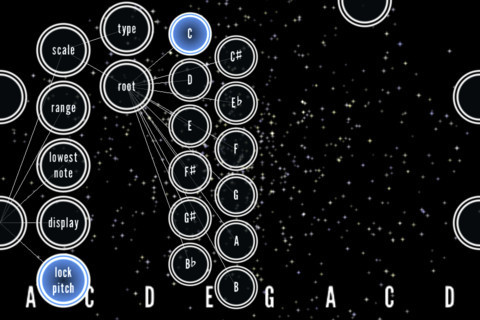 Image courtesy of Wizdom MusicTachyon stems from concepts developed for some of our previous projects at Wizdom Music. It incorporates some of the ideas we’ve assembled over the last few years and employs them in a very new and unique way. We tried to create something that utilizes pretty advanced musical concepts, but at the same time is simple enough for anyone to play. With Tachyon, people use the whole vertical grid touch surface of their iPhone or iPad to express the notes. The concept is to morph in between two sounds. For instance, let’s say that you’re playing a piano sound, and you slowly move your finger up on a note, Tachyon allows you to seamlessly change that piano into the sound of a violin. Because it’s only $2, and is available for the iOS, iPhone, iPad, and iPod, we like to think of it as a product for the masses, that is interesting and unique compared to other apps currently on the market, but is still affordable and simple to use.
One of our primary goals with Tachyon was to link together the worlds of graphics and audio so that they correlate in a really awesome way. A while ago I had this vision of using three-dimensional images made of particles in an app, and we were able to bring this to reality with Tachyon, where a series of particle-based images allows the user not only to change the audio with his finger, but to change the visuals at the same time.
SpaceWiz is a unique application in and of itself. Currently, it’s only available on the iPad. The concept stems from a dream I had about planets, where each one had its own timbre. I thought, what if an app user was able to interact with all of the planets? We could have the whole rotation of the planetary system and each object in the sky.” My partner Kevin Chartier and I teamed up with an amazing developer named Tobias Miller. He and I started putting this vision of mine into reality, Spacewiz features beautiful images of the planets and a spacy, interactive soundscape.
In some ways, it’s a generative music app, because it’s possible for users to just call up a patch that they like, and hear and see the evolving music and visuals, but it’s also possible to play it more like a traditional instrument.
You’ve been playing music for almost all of your life and learned on physical instruments. Are tablets and apps enabling children and newbies to learn your craft? How?
It’s been an amazing time in the creative world, partly thanks to these multi-touch playing surfaces that are really inexpensive and available to everyone. Before the iPhone and iPad came out, somebody who wanted to play music on a multi-touch surface would have to spend thousands of dollars to but an instrument, most of which involved software. The release of the iPhone completely revolutionized the music technology world. When I first started using an iPhone, I was overwhelmed with the amount of musical opportunities it presented. This device has resulted in an explosion of creativity throughout the musical community. Because these apps cost as little as $1 or $2, we’re seeing all these guys in their basement creating really cool apps. It’s an amazingly creative time with people all over the world contributing to the effort.
What role do you see apps playing in music in the next five years? Are apps a fad or a game-changer?
We don’t know where things are going down the road. Maybe things will evolve more towards the computer or the web. I’m not really sure. The real game changer is taking the modern power of computer technology and creating a device that’s small enough that you can walk around and perform with it, and through innovations like the touch surface, you can have a very unique interaction, that was never available with older instruments. I can’t say if apps are a game-changer, I don’t even know if we’ll keep calling them “apps” but I think that there’s a definite future for multi-touch devices. One of the most recent concepts is that rather than a smooth playing field, users should be able to further express themselves through a textured surface. A lot of people are already working on that. In my opinion, thing that’s missing from iPhones is that there’s no after-touch. There’s no tactile sense. That’s an area that still needs some development.
In The Age of the Platform , you talked about your love of Apple products. What’s your opinion of Android as a development platform?
There are so many people out there with Android, and I know that it’s a really good system. Personally, I’ve had some problems with it — and that’s why I took so long to get into it and am not anxious to keep working on that platform. First, there’s been an inherent issue with the audio on Android, which has been frustrating to a lot of developers. When you touch the screen to play a sound, there’s a delay, which destroys the reality of the musical experience. It’s a latency issue. Obviously the people in charge of Android’s release overlooked this. It’s a problem that’s definitely preventing some of the music developers I know from wanting to create apps for the platform.
The other problem with Android is, as far as I’m concerned, that the systems aren’t set up to allow for a solid business. Android piracy is rampant. For example, we put out a really cool Android version of MorphWiz Play (even better and easier to use than the one on iOS). But, according to the numbers coming back to our company, it’s being ripped off right and left. Android employees need to create a system that’s fairer to developers.
Aside from Dream Theater, you do solo gigs and play in many side projects, as do your bandmates. Given the state of the music industry, do you think that more and more musicians will play in multiple bands to make a living?
It is definitely harder to survive as a musician than it used to be. Unfortunately, I see many of my very, very talented musical friends feeling a need to quit, and trying to find other career opportunities. The successful musicians I know can either play a range of instruments, genres, and/or have strengths in areas of music technology or production. At this point, in order to be successful within this genre, it’s essential to be somewhat versatile. My advice is: If music is the only thing that you love to do, then do it… 24/7… practice, listen, work. Expand your musical interests and abilities. How music is played and listened to and purchased is changing all the time. I’m passionate about staying on top of the flying carpet ride that music technology presents and that has definitely been one of the keys to my success (and happiness).
Mobility in the Enterprise
In this video, I discuss issues to related to mobility for mid-market organizations.
Feedback
What say you?

This post was written as part of the IBM for Midsize Business program, which provides midsize businesses with the tools, expertise and solutions they need to become engines of a smarter planet.

August 14, 2012
Breaking Bad: What if Hank Already Knows about Walt
Warning: this article contains spoilers.
Originally posted on fan-pages.com.
In “Hazard Pay” (episode 503), Assistant Special Agent in Charge Merkert (Michael Shamus Wiles) talks to Hank and Gomey about how he never suspected that Gus Fring was a meth kingpin. Merkert is about to take a forced early retirement, and laments that he can’t believe that Fring was someone else completely, right in front of him.
That line seems to resonate particularly profoundly with Hank, who we know isn’t entirely convinced that Heisenberg is dead. We’re all expecting a Hank-Walt showdown at some point in season 5. Count me in that camp, but I can’t help but wonder: What if Hank has already connected the dots? What if he has already figured out that Walt is Heisenberg? Perhaps Hank is just collecting more evidence, looking to make his case air-tight against Mike, Jesse, and others involved in Fring’s operations.
The Evidence
Remember that Breaking Bad has taken place over the course of a single year and change. During that time, Walt has continued to walk between the raindrops, to some extent aided by Skyler. Well, he can’t count on her silence anymore. It’s looking less and less likely that she will keep spinning things and keeping up appearances. In fact, as we see in the preview from next week’s episode, Skyler may be on the verge of flat-out giving Walt up. And we know that Marie has a big mouth.
Regardless of Skyler’s actions (or inactions), Hank continues to zero in on Heisenberg. (It remains to be seen how or if Hank’s new job as ASAC takes him away from the day-to-day responsibilities of his cases). In “Dead Freight” (episode 505), Walt ostensibly breaks down over Skyler and the state of his marriage. As Walt cries, Hank predictably gets uncomfortable, shutting the blinds on two of the windows in his office and leaving to get Hank a cup of coffee. It appears as if Walt’s doing the manipulating, as he hurriedly plants bugs in his brother-in-law’s office. But remember that the third blind remained unopened. What if Hank was actually watching Walt? What if he knew that Walt was listening to his calls?
Hank has more than once stumbled across would-be clues that would ostensibly implicate Walt. Case in point: Walt’s sloppy inventory of high school chemistry equipment. And let’s not forget Gale’s notebook with the “WW” inscription. In “Dead Freight”, Hank notices Walt’s extravagant new watch and even comments on it.
To be sure, we’ve underestimated Hank before. Even while confined to his bed, he’s able to make progress on the Heisenberg case. In “One Minute” (episode 307), even while shot by the Brothers Salamanca, Hank is able to pick up a shell, load his gun, and fire a single bullet into the head of his ax-bearing attacker.
What if Hank is playing Walt–not vice-versa?
August 13, 2012
Send Me to Austin
Last year, I made the final cut to present at South by Southwest (SXSW). This year, I’m back at it. I’d like to talk to as many people as possible about The Age of the Platform. If you have a few minutes to spare, I’d appreciate your vote for my talk.
August 3, 2012
System Failures Still Haunt Us
In the course of a single day, Knight Capital Group, “lost $440 million of the firm’s capital in a trading disruption which messed up the market.” Its value plunged from $1.5 billion to a little over $1 billion. While the details are still a bit sketchy, the culprit appears to be a good old-fashioned a system failure.
The more things change…
It’s funny and kind of perverse. I spend most of my time these days speaking, thinking, and writing about platforms, emerging technologies, and other forward-thinking types of things. Yet, we still see many of these high-profile IT projects gone amok. Although I started writing Why New Systems Fail for years ago, it’s evident to me that we’ve not solved many of the fundamental problems plaguing IT projects.
Simon Says
Before your organization goes all “2.0″ and spends a fortune on sexy new technologies, do the proper due diligence. Clean your data. Test and then test some more. And, for God’s sake, don’t attempt to go live under extreme duress.
Feedback
What say you?
August 2, 2012
A Retail BI Case Study
Papa Gino’s is a restaurant chain based in Dedham, Massachusetts specializing in American-style pizza along with pasta, subs, salads, and a variety of appetizers. There are over 200 Papa Gino’s locations in Connecticut, Maine, Massachusetts, New Hampshire, and Rhode Island. Like many mid-market retail organizations, it has had its challenges in getting real-time information to field employees.
I recently sat down with Papa Gino’s CIO Paul Valle to talk about how his company deployed Cognos, a new business intelligence (BI) tool. The following are excerpts from that conversation.
How long did it take to get Cognos up and running?
It took about eight months. This included installing the application and hardware, as well as creating our first complicated dashboard. We had the help of a valuable IBM implementation partner, QueBIT. (Note: Papa Gino’s and QueBIT were recently selected for IBM’s Engine of the Week Award. This honor is given to midsize businesses that have transformed themselves using insight and IBM technology.)
Talk about the data challenges you faced prior to implementing Cognos’ tools.
All reporting was Excel-based. It was a bit of a mess. Our users struggled with extreme complexity across multiple tabs, workbooks, and even servers. Workbooks contained the same data which was unfortunately not necessarily in agreement. We maintained a multitude of sources for data, making it impossible to bring it together effectively.
How does the field access BI? Desktop? Tablet? SmartPhone?
Current field access is via laptop for direct access to Cognos. Some report distribution happens thru email. We are peparing to deploy smartphones and tablets to field team members in the near future.
Can you provide specific measures of success? Yes, customer satisfaction has improved, but can you cite specific KPIs?
We were able to report on and improve upon several guest service metrics. The metrics measure things like:
How quickly we answer the phone
Whether guests are getting busy signals or perhaps abandoning calls
The frequency we deliver in accordance with our promised times
Once we gained visibility to our business, we were able to focus on the opportunities, the low-hanging fruit. As such, we have seen improvements in guest satisfaction.
For more on Papa Gino’s use of BI, watch the video below:
Simon Says
PapaGino’s shows that the benefits of emerging technologies need not be confined to large organizations. Mid-market companies can see improvements in many areas as well.
Feedback
What say you?
This post was written as part of the IBM for Midsize Business program, which provides midsize businesses with the tools, expertise and solutions they need to become engines of a smarter planet.
July 31, 2012
A Platform for Micro-Businesses
Originally published in HuffPo. Click here for the original post.
I recently sat down with Ron Daniel, founder and CEO of SohoOS. The company’s vision is nothing if not ambitious: it aims to “establish a new global micro-economy by empowering micro-businesses and freelancers worldwide with the management tools they need to flourish.”
Here’s an edited version of our conversation.
How would you describe the SohoOS to the layperson?
SohoOS is the free and simple way to manage a micro-business. It is designed to help users focus on what they are passionate about while daily administrative activities are fully automated by the SohoOS platform. We believe that in today’s hyper-competitive market, a micro-business owner should be focused only on how to reach customers, build a product, etc. She should not be forced to deal with paperwork, marketing, accounting, branding, website maintenance, and an endless parade of other tedious activities just to keep on running. Users should be able to run their business while at home or on the road through the web or mobile devices with minimum effort.
You’ve said that SohoOS is trying to consumerize the management platform. Can you explain what you mean by that?
Sure. We believe that micro-business owners tend to behave more like individual consumers than business entities. I call it the “assistant test.” If, like most micro business, you don’t have an assistant, then you really can only rely on yourself. You want to make your day-to-day processes as simple and smooth as possible. Most don’t want to spend precious time learning and relearning business applications and platforms. Those are best left for much bigger companies who, not coincidentally, have the staff to support this. As you write in The Age of the Platform, business platforms are designed with the organization as the key entity. On the other hand, consumer platforms are designed with the individual or consumer in mind. This is where we are focused. We put the business owner’s needs front and center, understanding that this in turn will best serve the business.
Can you talk about future phases for SohoOS?
We envision SohoOS in three phases. These days we are finalizing phase one. We are making the simplest management environment on the web available for free to millions of businesses throughout the world.
We are now moving into phase two. This entails supplying a market for third parties to distribute fully integrated web services to these micro-businesses. To this end, we’ve build attractive and economical pricing into the product. This means that third parties can now integrate via our API and offer applications to the end user as part of the work process. There are only two conditions:
the services should be seamlessly integrated
the services should be relatively inexpensive (read: affordable to micro-businesses)
By doing this, we will enable our users to expand their capabilities. At the same time, they can enjoy cutting-edge services without any long-term, expensive commitment. This will also enable our users to experience how economies of scale can serve them. In effect, they can take advantage of being on a single platform.
Next year we will start rolling out phase three. We call this the virtual corporation. Basically users will be able to consolidate and split their activities on demand. For instance, one business will be able to sell products from another business’s inventory. Also, several businesses will be able to work together and offer shared services and subscriptions. SohoOS will enable millions of businesses to seamlessly leverage a single database and share resources and information.
What do you think about the complexity of most enterprise software? Is your company’s philosophy markedly different?
I think complexity is not a bad thing by itself, it is just a matter of context. Let’s face it: Most big organizations need complex solutions that answer to a vast range of different needs. I think the question is not the complexity, but the usability. It is much more difficult to enable billions of people to communicate, like Facebook does, than to manage a hundred-person organization. Facebook provides an extremely easy user experience.
I am sure that enterprise software providers are starting to realize this. However, they can’t change on a dime. The DNA built into their products is just too different than what it would take to create a user-friendly and efficient experience. Furthermore, today’s technology has reached the point where complexity is no longer a good excuse for poor usability and tedious user experience. At SohoOS, we have separated the product department from the R&D department for exactly that reason. We want our product team to operate free from restraints. This will let those employees imagine the best possible product for the segment we are serving without being dragged into technology barriers.
So, what is the final vision for SohoOS?
SohoOS was started as a philosophical concept. We wanted to create a form of capitalism that serves well both the big players and the small players in the market. Our final dream is to turn SohoOS into the platform that delivers this vision. We believe that this will create a better world.
July 30, 2012
Inc. Article #11: Facebook’s Biggest Problem
My 11th Inc. Magazine article is now live. Here’s an excerpt:
Unless you’ve been living in a vacuum, you know that Facebook’s stock has been reeling. Sure, the company is making money but not nearly enough to satisfy Wall Street.
The company has built the largest trove of data the world has ever seen and is rapidly closing in on one billion users. But Facebook still has to figure out how to monetize its increasingly mobile user base in the post-PC or “PC plus” era.
In this post, I’d like to look at one of Facebook’s biggest problems from the perspective of a small business owner.
Click here to read the whole thing.