Phil Simon's Blog, page 91
July 11, 2013
A Ridiculously Early and Hopefully Amusing Review of Google Glass

I got the chance to test drive Google Glass for about ten minutes at the Tech Cocktail Startup Showcase courtesy of Shawn Maguire. Here are some really preliminary and mostly sober insights:
These are light. Really light. I took Glass off and let it go. It then proceeded to levitate towards sky before someone caught it in mid-air.
Saying “Bing” crashes the device and emits a small shock on your head.
Glass doesn’t like noisy environments, and there were about 150 people there last night. Outside away from all of the hubbub, it did better with only ambient noise.
I couldn’t Google myself. I kept coming up as , the ESPN guy who hates Doc Rivers.
It takes some adjustment, but eventually you get the hang of the navigation.
Geolocation is embedded. Without asking, Glass told me that it was 84 degrees in Vegas. It also directed me to the nearest Blackjack table and, when I resisted, took control of my feet and started marching me into Binion’s.
Glass puts Canadian flags on all of your shirts. Feature or bug? I can’t tell.
Taking videos and pictures very easy. I can see major privacy concerns, especially with facial recognition.
Glass images and navigation are easier to see against a solid backdrop, not video game screens.
Timing is everything. There’s a certain cadence to making it work. When talking to Glass, you have to be precise when barking commands. A second too fast or slow will confuse the device.
That’s about it.
This post was about 80 percent serious.
The post A Ridiculously Early and Hopefully Amusing Review of Google Glass appeared first on Phil Simon:.


On Language and Reorganizations

Microsoft today announced a reorg at the company. From CEO Steve Ballmer’s statement:
Today’s announcement will enable us to execute even better on our strategy to deliver a family of devices and services that best empower people for the activities they value most and the enterprise extensions and services that are most valuable to business.
How about in English now, please?
I’ve seen worse corporatespeak in my day, but this is near the top of the list. To paraphrase George Carlin, words should convey, not confuse. Ironically, in the same memo, Ballmer writes:
We must have a clear strategic direction but also empower employees closest to the customer to make decisions in service of the larger mission.
If the first quote leads to a clear direction of any sort, I’ll eat my hat.
Simon Says
I can’t help but wonder that, based upon the words above, many people inside Microsoft don’t understand what’s going on, never mind why. And this can’t be the desired effect.
KISS is as true as ever.
Feedback
What say you?
The post On Language and Reorganizations appeared first on Phil Simon:.
July 10, 2013
I’m An Expert. Don’t Trust me.

On June 13th, I’ll gave the keynote at TechCocktail Week in Las Vegas, NV. I gave a bunch of examples about how experts are often wrong. The experts missed Apple, the PC, Seinfeld, Breaking Bad, Rush, and scores of others.
Here’s the video of the talk:
The post I’m An Expert. Don’t Trust me. appeared first on Phil Simon:.
July 3, 2013
Big Data and Casinos

Spreng Ben via Compfight
I don’t know much about many things, but I know a great deal about gambling and Big Data. Ever wonder why loyalty cards are so important to casinos? Why will a pit boss try to stop you when you’re losing? Why don’t casino’s just let you lose as much as you can?
In the short video below, Tariq Shaukat, CMO of Caesars Entertainment, explains how casinos can use data to retain customers
Simon Says
The only gamble with Big Data is not taking advantage of it.
Feedback
What say you?
The post Big Data and Casinos appeared first on Phil Simon:.
Apple-ization of the Enterprise White Paper

I recently wrote a white paper “Understanding IT’s New World” for Code42. The paper is part of the company’s the Apple-ization of the Enterprise campaign.
I’ll be hosting a webinar on July 18th on the subject as well. Click here to register. Over the summer, I’ll be moderating a few webinars as well.
The post Apple-ization of the Enterprise White Paper appeared first on Phil Simon:.
July 1, 2013
Visualizing Health Care Data
As readers of my blog know, I am a Google fanboy and I’m hardly alone. When most people think of search these days, Google comes to mind. The company continues to dominate the US market. Yahoo! and Bing are afterthoughts for most of us.
Dominant isn’t the same as perfect, though. Yes, Google’s text-heavy results are usually pretty useful. At the same time, though, they can be overwhelming, even if your searches include quotes, negative keywords, timelines, and other tricks. What’s more, depending on the subject, Google search results don’t necessarily lead you to the “right” answer. Many times, we have to refine our searches and ask better questions.
It’s silly to assume that all types of searches are created equal. “Best business books of 2012″ isn’t the same type of search as “address of the Bellagio hotel.” One is more subjective than the other. And, for obvious reasons, searches on personal health are special, especially in light of privacy concerns and the recent Prism scandal.
What if you could easily access all relevant health data in an secure, visual, and interactive format?
Big Data Empowering Social Health
That’s the promise behind Israeli social health startup Treato. In the course of researching my new book, I came across this neat little company. Treato lets users search any medication or medical condition and find out what people are saying about it online. It provides access to known side effects, medication comparisons, and online discussions are easily available.
When users enter a disease, they quickly see many things related to it, including conditions and symptoms associated with it, some of which may be entirely surprising.
What if you could easily access all relevant health data in an secure, visual, and interactive format?
How does Treato do this? Think data. Big Data. Users access anonymized data on more than 23 million patients. As of this writing, Treato users can quickly search through more than one billion posts, 11,000 medications, and 13,000 conditions. And visualizing the results is built in. With that capability, imagine the amazing things that you might be able to learn about your health.
Typing in cancer below, I saw the following results:
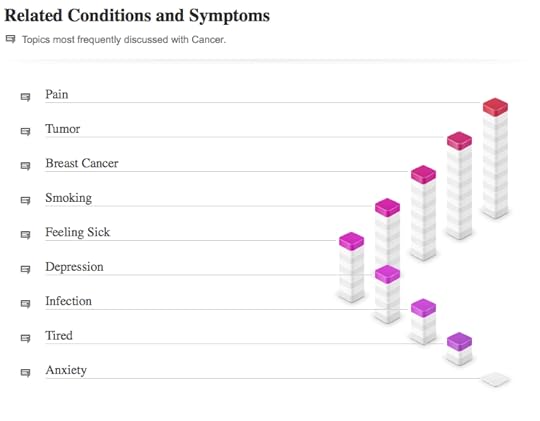
(There’s much more you can do. Check it out for yourself.)
While there’s no guarantee, presenting information in visual ways like this may well lead to better, more informed decisions.
Treato’s Tech Lesson
In Too Big to Ignore, I wrote about how many companies these days extensively use natural language processing and other emerging technologies behind the scenes. At a high level, NLP lets people make sense out of unstructured data, deriving meaning among different words and images.
Rod Smith of IBM and I recently discussed the massive opportunity in healthcare for Big Data. Treato and a panoply of other startups correctly view the healthcare system as broken and in need of massive disruption. This has been true for a while now. Big Data only raises the stakes.
Simon Says
Yes, we are awash in a sea of data. Thankfully, there are more powerful boats and oars to help us not only survive, but to get where we ultimately need go to.
Look into powerful solutions like Big Data-friendly technologies like Hadoop, NoSQL, NewSQL, and NPL. They’re real. They’re here. They’re game-changers.
If a start-up can effectively leverage Big Data, then mid-market firms can as well. Don’t try to cram everything into a relational database.
Feedback
What say you?
 This post was written as part of the
IBM for Midsize Business
program, which provides midsize businesses with the tools, expertise and solutions they need to become engines of a smarter planet. I’ve been compensated to contribute to this program, but the opinions expressed in this post are my own and don’t necessarily represent IBM’s positions, strategies or opinions.
This post was written as part of the
IBM for Midsize Business
program, which provides midsize businesses with the tools, expertise and solutions they need to become engines of a smarter planet. I’ve been compensated to contribute to this program, but the opinions expressed in this post are my own and don’t necessarily represent IBM’s positions, strategies or opinions.
The post Visualizing Health Care Data appeared first on Phil Simon:.
June 30, 2013
Book Review: Difficult Men
Originally published on Huffington Post.
While working on my own books, I have to be careful about my own reading. I usually take a break from pleasure reading when scribing a new text. As readers of this blog know, I’m a huge fan of Breaking Bad, The Sopranos, and other long-form dramas about morally complicated characters.
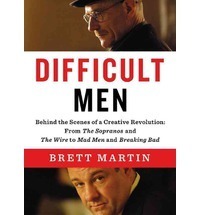
Against that backdrop, I couldn’t wait to get my hands on Difficult Men: Behind the Scenes of a Creative Revolution: From The Sopranos and The Wire to Mad Men and Breaking Bad (affiliate link) by New Yorker writer Brett Martin. I pre-ordered it months ago and yesterday the book arrived.
Difficult Men is well written and researched and I did enjoy it. While reading it, though, something began gnawing at me roughly 50 pages in. Difficult Men feels like two separate books fused into one, and the result is ultimately unsatisfying.
I’d wager that nearly 70 percent of the book is about The Sopranos, clearly the show that spawned what Martin calls “the creative revolution.” No argument here. Matthew Weiner of Mad Men has a Sopranos’ lineage. And Vince Gilligan has said that there would be no Walter White without Tony Soprano. Additional kudos go to David Simon’s The Wire, also a groundbreaking show. Unfortunately, however, Martin gives culturally significant series like Six Feet Under, Breaking Bad, and others short shrift.
For some reason, Martin keeps bringing everything back to The Sopranos, and often its creator David Chase. Difficult Men spends far too much time on the show that spawned the Creative Revolution and not enough on the other shows of that revolution. Yes, The Sopranos was important. We get it. As I read the book I kept asking myself, Why not just write a book about The Sopranos and another, more balanced one on what Martin calls The Third Golden Age of Television? Maybe the publisher recommended that Martin add popular shows to the subtitle of the book for SEO purposes?
A few pet peeves: I lost count of the number of times that the author dropped words like auteur and tropes. Some of that seemed a bit gratuitous. And why Bryan Cranston is on the cover of this book is beyond me. This is mostly a book about The Sopranos and the impact it has had.
The post Book Review: Difficult Men appeared first on Phil Simon:.
June 26, 2013
Nouns as Verbs and Other Language Pet Peeves

To me, language is about choices. I choose not to use buzzwords. I choose to write and speak in relatively straightforward manners.
I just don’t read the work writers who routinely use five- and six-line sentences. Short sentences are godsends, especially after longer ones. They give people time to digest your profundity.
You’ll never see or hear me use partner or transition as verbs. Same with the inverse.
And I absolutely loathe made-up nouns like the value-add, take-away, deliverable, and learning. I’m not for censorship, but these are nothing short of atrocities.
Each one feels like stepping on a rake.
Simon Says
Yes, language evolves. To tweet is entirely legitimate. Sounding smarter isn’t rocket science. Start with writing and speaking simply.
Feedback
What say you?
June 25, 2013
Google Glass: Enabling Powerful Sports Visualizations?
My friends know that I’m a big tennis fan, and I love technology as well.
The jury is still out on Google Glass, but cool visualizations of tennis data like the one below may well be coming. The chart below is on stroke pattern frequency during a French Open match.
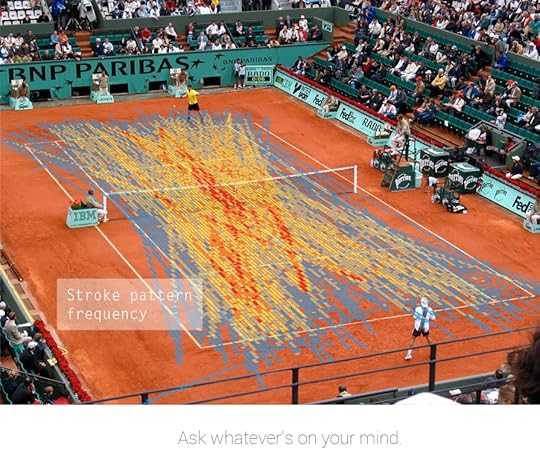
I used to look at relatively simple charts and graphs with a pretty ho-hum attitude. They got the job done, but they weren’t terribly exciting.
At this point in the writing and researching process for The Visual Organization, I’m just amazed. Yes, I am starting to ask myself, What can’t we visualize? How are we improving upon prosaic staples?
It’s evident to me that the tools today are orders of magnitude more powerful and just plain cooler than their counterparts of the 1990s.
Simon Says
Yes, we are living in an era of Big Data. Fortunately, we have developed the tools to understand this new world.
Feedback
Are you stuck in the Excel chart days?
June 20, 2013
Youtility: An Interview with Jay Baer
Originally published on Huffington Post.
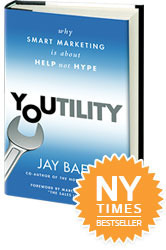
Jay Baer is one of the foremost authorities on marketing and social media, as well as a friend of mine. I’ve quoted him in two of my books. I sat down with him to talk about his new book, Youtility: Why Smart Marketing Is about Help Not Hype.
PS: Other than a nifty word, what is Youtility, really?
JB: Youtility is marketing so useful, people would pay for it. Of course, you probably won’t actually ask customers or prospects to pay, but it’s marketing that has so much inherent value, they would fork over a few dollars if you insisted.
PS: Why would companies want to spend time and money on this, given the number of other priorities they have?
JB: Youtility will not be optional; it will be required. All businesses are now in an unprecedented, hyper-competitive environment where they are competing for attention not just against other businesses, but against EVERYTHING. Think about your Facebook feed, or Twitter feed, or Instagram, or even your email inbox. What you find there is a confluence of personal and professional relationships. Companies are side-by-side with messages from your real friends and family members. That’s an extraordinarily tough marketing environment, having to use the same venues and technologies that we’re using to connect authentically to people we actually cherish.
So, in this information overload arena, companies only have two options to break through that clutter. They can be “amazing” or they can be useful. To me, the culture of “just be amazing” and “be viral” has gone too far. Most companies aren’t amazing, and viral is a strategy of hope. Being truly, inherently useful and creating Youtility is a repeatable, trackable, marketing approach that works.
Companies that are embracing Youtility – and I profile dozens of them in the book – are being rewarded with attention, sales, loyalty and advocacy.
PS: Can you give me an example?
JB: One of my favorites is Columbia Sportswear, the Portland, Oregon–based manufacturer and retailer of outdoor wear and gear. They have a super useful free app called “What Knot to Do in the Greater Outdoors.” It provides detailed instructions for how to tie dozens of knots, including which to use when. The app has forty-eight five-star reviews out of fifty-three total reviews in the Apple iTunes Store. With little marketing support, it’s been downloaded 351,000 times in approximately twenty months.
They conducted research and found it is very common for outdoor enthusiasts to carry smartphones on excursions, thus they built the app to provide useful information to their customers. But this is the key: Columbia doesn’t sell rope.
A big part of Youtility is to transcend the transactional. A app about how to pick out the best jacket isn’t particularly interesting, or useful. But an app that shows you how to tie knots is. Even though it’s not about Columbia products per se, it still matters within the lifestyle context of their customers. You have to give your company permission to make the story bigger, and create Youtility that’s tangential, yet relevant.
PS: It seems like there would be a great deal of doubt in organizations looking to do this, no?
JB: Absolutely. In most organizations, there are two barriers standing in the way of this new type of marketing. One is psychological, and the other is operational.
On the psychological front, the truth is that the tenets of Youtility—making your company inherently useful without expecting an immediate return—is in direct opposition to the principles of marketing and business deeply ingrained in practitioners at all levels. We’ve been trained to think that marketing activities and outcomes follow a linear progression. We’ve been told over and over that we sell more with bigger budgets and better targeting, and by perfecting the crafts of interruption and inbound marketing. Youtility is something entirely different. It requires companies to intentionally promote less at the point of consumer interaction, and in so doing build trust capital that will be redeemed down the road.
In most companies, creating marketing that customers want is a colossal shift from the norm. As a result, many current programs of this type represent the first time the business has tried useful marketing. Because there is no internal history with it, the operational barrier to Youtility centers on roles and responsibilities. Who should be in charge of this? Marketing? Guest Relations? Some other department?
But once you get your organization aligned, you’ll find that Youtility pays dividends over the long-term. Especially since creating programs of this type typically isn’t very expensive.
PS: How important is mobile to programs of this type?
JB: Critical. In fact, the prevalence of smartphones and the fact that always-on Internet access has made us all passive-aggressive is one of the key drivers of the Youtility trend.
It used to be that we created relationships with people. Increasingly, we now create relationships with information, because engaging in a synchronous exchange via phone (or even email) is too much of a hassle for both parties. Customers want to do the research online themselves, because they have the ability to do so at any time from the palm of their hands. Why would you want to have a sales rep call you until you’ve exhausted all the freely available online information first?
And in fact, Sirius Decisions’ research finds that in B2B – where this trend is most impactful today – customers contact a company only after 70% of the purchase decision has been made. The sales team used to be top of the funnel. Now they get involved mid-funnel or later. It’s a huge shift.
Read more about Jay at his site.
The post Youtility: An Interview with Jay Baer appeared first on Phil Simon:.