Phil Simon's Blog, page 83
January 6, 2014
Evernote’s Platform Struggles
Originally posted on www.theageoftheplatform.com.
Evernote is indispensable to untold numbers of people, and CEO Phil Libin knows it. As a result, the company is not lacking in ambition or funding (reportedly, $250 million raised so far). As former TechCrunch writer recently Jason Kincaid put it, Evernote literally “aims to be an extension of your brain.”

At least, that’s the theory.
The company has fumbled of late on a number of fronts. As a recent TechCrunch article explains, on 01/04/14 Libin “responded to the scathing criticism of the company made in a blog post [by] Kincaid. A post which ended up making headlines recently. Libin says new versions of all the apps are planned, targeting note editing, navigation, search, sync and collaboration.”
2014 may well prove to be a better year than 2013 for Libin et. al. Still, Evernote’s recent struggles only underscore the difficulty of creating a true platform–one that works on Android, iOS, Macs, PCs, Google Glass, etc.
Let me be blunt: Building a platform isn’t easy. Sure, the term is all the buzz these days, but operating on all different mobile and computing operating systems and devices is much easier said than done, never mind building a company based on platform thinking. For every Amazon, Apple, Facebook, and Google, there are many companies struggling to succeed in the platform business.
Simon Says
Grand ambitions for platforms are all fine and dandy, but it’s best to get the product right first. Exhibit A: IBM with Watson. A “platform” sans a working, stable, and reliable product is unlikely to go anywhere.
Feedback
What say you?
The post Evernote’s Platform Struggles appeared first on Phil Simon:.


January 5, 2014
Why I Don’t Blog Every Day
Cross-posted on Huffington Post.
Look around the web and you’ll find now shortage of advice on blogging. Long gone are the days in which blogging or journaling can be called a new phenomenon. WordPress recently celebrated its 10-year anniversary. 
While there’s no universal rule about how often one should blog, many people advocate blogging on a daily basis. (Here’s Chris Brogan’s post on the matter.) Some of the ostensible advantages of doing so include:
Better SEO. (Google likes volume.)
You’ll improve as a writer.
You have a better chance of going viral.
You’ll ultimately find your voice.
It enables you to build your tribe, to steal a phrase from Seth Godin.
Now, I can’t argue with any of these benefits. They’re all valid arguments, but I am not a fan of daily blogging. Here’s my case against churning out a new post every day:
Daily bloggers may find that the squeeze isn’t worth the juice.
I am not a full-time writer. If I were blogger-in-chief of Acme Corporation, then I would rightfully be judged on my output. I’m not. Aside from writing, I speak and consult. I also run a small micropublisher. Small business owners have to wear many professional hats, and blogging is just one of mine.
Want to vs. Have to. I don’t enjoy brushing my teeth; I do it because it prevents cavities. Sometimes I would rather read or watch TV or play tennis than write.
I have other writing to do. Aside from my own site, I blog for two others on a weekly basis and my other clients at least once per month. Oh, and I’m usually working on a book of considerable length to boot.
More blog posts equals greater potential overlap. As of now, there are nearly 700 posts on this site. Does each express a unique idea? Of course not. That goes tenfold for daily bloggers. Case in point: I used to read Seth’s blog pretty religiously until I started to find it a bit redundant. I suspect that I’m hardly alone here. After a while, you just can’t shake that feeling that you’ve seen that movie before.
Less is more/the quality argument. Most TED talks are interesting, but make no mistake: not every idea is worth spreading. Mediocre posts dilute the quality of a site. In my case, I won’t delude myself. Not every post here is a gem, but I hold myself to a relatively high writing standard. People who commit themselves to daily blogging may very well feel the need to put something (anything!) out there just to keep one schedule, even if the post isn’t terribly good, original, or timely.
Web traffic hinges upon time of year. With few exceptions, every blogger cares about stats and traffic, myself included. Web traffic typically declines around November of each year for most sites. Holidays, vacation, and year-end work activities intervene. I’d like my posts to reach the largest possible audience, and posting on Thanksgiving and Christmas defeats that purpose.
I average about three posts per week on this site and feel very comfortable with that number. With my sleep issues, I could blog daily if I wanted. I consciously choose not to.
Simon Says
If you want to put something out there every day or every hour, then knock yourself out. Before doing so, consider the drawbacks of a daily blogging strategy. You may find that the squeeze isn’t worth the juice.
Feedback
What say you?
The post Why I Don’t Blog Every Day appeared first on Phil Simon:.
January 3, 2014
The Perils of the Single Sentence
I recently saw the following text in a presentation about HR at Netflix:
The actual company values, as opposed to the nice-sounding values, are shown by who gets rewarded, promoted, or let go.

I agree with the sentiment, but bad English muddies the message. Sentences like these are downright confusing. Why not split the single, run-on sentence into two or more comprehensible ones? And why not lose the passive voice while we’re at it?
How’s this instead?
Any company can pay lip service to obvious dictums like “people and culture matter.” In reality, an organization demonstrates its actual values not through its words, but by its actions: promotions, reward systems, and how it handles employee exits.
Simon Says
Want to learn to write and speak better? Recognize that, while writing is subjective, words matter. In this case, arguments are often better and more clearly expressed as several sentences in the active voice. Don’t try to cram everything into one sentence or bullet point.
The post The Perils of the Single Sentence appeared first on Phil Simon:.
January 2, 2014
What’s Inhibiting Employee Productivity?
A while back, I attended an interactive one-day event with 40 other thought leaders. The agenda was fairly loose: We participated in a wide array of discussions on a tech-related topics. These included Big Data, cloud computing, and “platforms” (never a precisely defined term these days).
While I agreed with much of what was said, some level of discord was inevitable. After all, what are the odds that so many folks from disparate backgrounds will concur with every comment made?  It didn’t take long until I heard a few things that just didn’t make sense. In this post, I’ll focus on one attendee’s particularly objectionable lamentation: “Employees would be so much more productive if better tools existed.” I didn’t concur, and jumped in as soon as that person finished talking with a few points that I’ll expand below.
It’s Not the Tools, Stupid. It’s Us.
The “no-tools” argument is wrong on so many levels, but I’ll focus on just a few here. First, there’s a little thing called reality. Long gone are the mid-90s when we relied upon e-mail and, to some extent, nascent knowledge bases and intranets. Sure, e-mail remains the killer app, but it doesn’t need to be that way. But don’t believe me.
Too many of us are lazy or unwilling to learn new ways of doing things.
In his latest book The Year Without Pants: WordPress.com and the Future of Work (affiliate link), Scott Berkun writes about how the 200 Automattic employees don’t use e-mail, opting instead for Skype, IRC, P2, and other collaboration tools. And I can name oodles more: DropBox, Asana, and screen-sharing tools like Join.me. Oh, and WiFi, LTE, smartphones, tablets, and apps allow us to be more productive while away from the office. Brass tacks: Vastly superior collaboration tools exist relative to 15 years ago. It’s not even close.
Second, the fallacious argument completely ignores organizational culture and the human sides of the equation. If you extend this line of thought to its logical extreme, employees are just waiting for that über-useful tool to come along. When it does, they’ll immediately adopt it in droves and become ten times more productive. They’ll unlearn bad habits and force IT departments to approve them.
Again, the history of technology suggests otherwise. There’s always an adoption curve. Is our general lack of collaboration a function of deficient technology or something else? I’d argue the latter. Aren’t many of us lazy or unwilling to learn new ways of doing things?
Simon Says
Perhaps the advent of the Web coincided with a relative dearth of employee productivity tools. but make no mistake: That hasn’t been true for a very long time. Don’t let anyone tell you otherwise. People who rely exclusively on e-mail do so out of habit, ignorance, or fear of something better. To them I say, “Open your eyes.” There’s a world of better, user-friendly, and free/inexpensive productivity tools out there.
Feedback
What say you?
 This post was written as part of the IBM for Midsize Business program, which provides midsize businesses with the tools, expertise and solutions they need to become engines of a smarter planet. I’ve been compensated to contribute to this program, but the opinions expressed in this post are my own and don’t necessarily represent IBM’s positions, strategies, or opinions.

The post What’s Inhibiting Employee Productivity? appeared first on Phil Simon:.
December 31, 2013
Books I Read in 2013
Bibliophile site GoodReads tells me that I read 29 books in 2013. That sounds about right, although I read some that I didn’t review on the site.
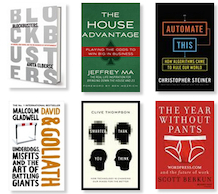
Almost all of the books I read were non-fiction. The sole exception: Kevin J. Anderson’s excellent Clockwork Angels. (Yes, it’s based on the Rush album of the same name.)
To see the complete list of books I read in 2013 as well as my ratings and reviews, click here.
The post Books I Read in 2013 appeared first on Phil Simon:.
December 30, 2013
My Most Popular Posts from 2013
I’m a bit of a stats guy. I like playing with numbers to understand things better. As I look at the most popular posts from the past year, I can’t say that I’m entirely surprised. There’s a big amount of Big Data going on. Tried and true posts like my disdain for Microsoft Access 2007 seem to have some staying power, and I’m not exactly shocked that my Breaking Bad interview with Jonathan Banks got some play.
Without further ado, here they are in descending order of popularity:

Big Data and Teenage Sex
Reporting vs. Analytics
Looking for Data Visualization Case Studies for My Next Book
The Myth of the Data Scientist
My Interview with Jonathan Banks of Breaking Bad
Visualizing Health Care Data
Social Networking in the Workplace
Three Ways Writers Evolve Over Time
Why Microsoft Access 2007 Sucks
Book Trailer for The Visual Organization
Netflix, Big Data, and the Big Leap of Faith
Refine Your Data the Google Way
George Orwell and Why I Write
The post My Most Popular Posts from 2013 appeared first on Phil Simon:.
December 21, 2013
A Few Sample Pages from the New Book
The new book has been laid out. It’s about to be proofread and indexed. Endorsement requests are out.
Here’s a small text sample:
I would add that, for the purposes of understanding large, unpredictable datasets, interactive data visualizations are generally superior to static infographics, dashboards, and standard reports. (I should know. I’ve designed thousands of the latter in my consulting career for my clients.) By definition, presenting even Small Data in predetermined, static, noninteractive formats limits what users can do with–and ultimately get from—data. This has always been the case. In other words, these types of formats generally preclude people from interacting with the data.* They can’t drill down and around. They can’t explore, nor can they ask iterative and better questions, and ultimately find answers.
For pictures of a few sample pages, see the gallery below:
Click to view slideshow.
We’re still on target for a March release. It’s been on Amazon for a few months now. Consider checking the book out. It doesn’t suck. I promise.
The post A Few Sample Pages from the New Book appeared first on Phil Simon:.
A Few Sample Pages from The Visual Organization
The new book has been laid out. It’s about to be proofread and indexed. Endorsement requests are out.
Here’s a small text sample: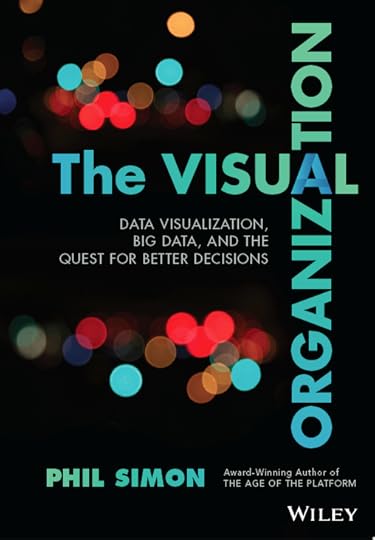
I would add that, for the purposes of understanding large, unpredictable datasets, interactive data visualizations are generally superior to static infographics, dashboards, and standard reports. (I should know. I’ve designed thousands of the latter in my consulting career for my clients.) By definition, presenting even Small Data in predetermined, static, noninteractive formats limits what users can do with–and ultimately get from—data. This has always been the case. In other words, these types of formats generally preclude people from interacting with the data.* They can’t drill down and around. They can’t explore, nor can they ask iterative and better questions, and ultimately find answers.
For pictures of a few sample pages, see the gallery below:
Click to view slideshow.
We’re still on target for a March release. It’s been on Amazon for a few months now. Consider checking the book out. It doesn’t suck. I promise.
The post A Few Sample Pages from The Visual Organization appeared first on Phil Simon:.
December 18, 2013
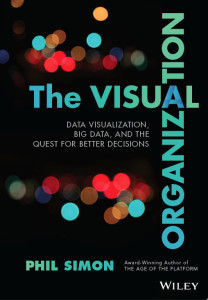
Win a Copy of My Sixth Book
I’m giving away a few review copies of The Visual Organization. There are only a few requirements:
You promise to give the book an honest review on your blog/site.
Copy and paste that review on Amazon and/or GoodReads.
You promise to do so in a timely manner. (The book will be released in late March of 2014.)
If you’re interested, fill out the form below for consideration. I’ll be in touch.
Fill out my online form.
The post Win a Copy of My Sixth Book appeared first on Phil Simon:.
December 16, 2013
Big Data and Small Companies
File this under “proof that I’m not a complete idiot.” My first post on HBR is now up, titled “Even Small Companies Can Tap Big Data If They Know Where to Look.” Here’s an excerpt:

True that in the past, companies seeking to tap into big data needed to purchase expensive hardware and software, hire consultants, and invest huge amounts of time in analytics. But trends such as cloud computing, open-source software, and software as a service have changed all that. New, inexpensive ways to learn from data are emerging all the time.
Take Kaggle, for instance. Founded in 2010 by Anthony Goldbloom and Jeremy Howard, the company seeks to make data science a sport, and an affordable one at that. Kaggle is equal parts funding platform (like Kickstarter and Indiegogo), crowdsourcing company, social network, wiki, and job board (like Monster or Dice). Best of all, it’s incredibly useful for small and midsized businesses lacking tech- and data-savvy employees.
Read the whole thing here.
The post Big Data and Small Companies appeared first on Phil Simon:.