A Visual Look at Ray Allen’s Stats
 When I was a kid, I loved sports. I would religiously look at box scores and at the backs of baseball cards to see who was good at what. I didn’t really create graphs or data visualizations until college.
Today, there’s no shortage of tools to visualize data and create interactive tools. It’s a key point in The Visual Organization. Sure, static bar and pie charts often get the job done on simple tasks, but they don’t promote data discovery to the same extent that their interactive counterparts do. By and large, these new tools are portable (read: device-agnostic) and incredibly user friendly, both of which are imperative in an era of mobility and BYOD.
For instance, I’ve been playing around with Datawrapper, a neat free and open-source tool for visualizing data. I grabbed some data from BasketballReference on Miami Heat shooting guard Ray Allen and presented it below:
Static box scores seem so 1998.
It’s interesting to see how Allen’s minutes played (MP) and, by extension, field goal attempts (FGA) have varied over the years. Although his minutes have declined as of late, his shooting percentage has not. The man is remarkably consistent.
Creating the interactive dataviz above just took a few minutes. To be sure, it is interesting on some level, but it doesn’t answer the question Where does Allen most often shoot? For that, we can go to Vorped.
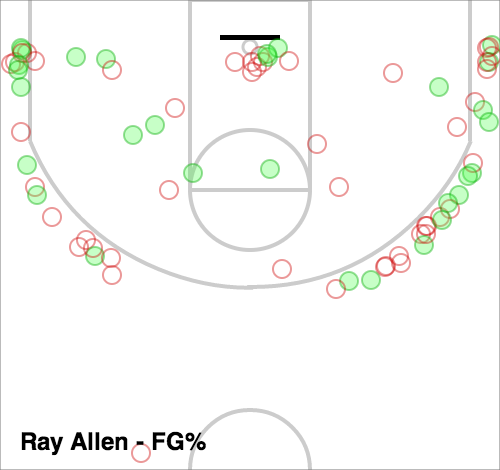
Click to embiggen.
Simon Says
I can geek out all day here but you get my point: There have never been more ways to ask questions of our data. To boot, it’s never been more important to do so. Even single-purpose bar and column charts can be integrated into more holistic views of statistics.
The post A Visual Look at Ray Allen’s Stats appeared first on Phil Simon.