Umm Zakiyyah's Blog, page 3
March 31, 2020
Let’s Be Honest with Ourselves During This Time
The other day I read a post about how people who are healing from emotional trauma and abusive relationships have been practicing social distancing and isolation for many years now. This is the “survival mode” they’ve had to implement to protect themselves from toxic environments and relationships. But what happens when the toxic environment is within us, and what happens when that toxic relationship is with our own souls?
As we struggle to make sense of the trials that are befalling us during this difficult time, we can benefit from self-honesty regarding our spiritual lives and how terribly we’ve been falling short. So let us sincerely consider the strong possibility that this coronavirus trial (no matter where it originated) has much more to do with the toxic state of our hearts and souls than with any toxic virus hidden in the air or in our human bodies.
Yes, we must recognize the physical reality of the coronavirus and the necessity to take every precaution to keep ourselves and others safe. But let us also recognize the spiritual reality of our lives, so that we can take the greatest precaution of all: purifying our souls from the toxic environment of sin and dhulm (wrongdoing), which has become widespread amongst both Muslims and non-Muslims today.
How do we purify ourselves spiritually?
To my non-Muslim sisters and brothers in humanity, I invite you to purify your soul by accepting Islam (sincere submission to the Creator alone). And know, if you accept this invitation, all of your previous sins will be forgiven. (If you have questions about the specifics of this faith, download this FREE eBook: He Asked About Islam).
To my believing brothers and sisters, I remind you (as well as my own struggling soul) to sincerely reflect on your spiritual life up until now. Then be honest with yourself about everything you’ve done to harm your soul—both privately and publicly. I also ask you (and my own struggling soul) to sincerely reflect on the deeds you have supported up until now— both privately and publicly. Then be honest with yourself about those that you know deep inside are displeasing to Allah and thus contribute to the widespread toxic environment of soul-harm on earth today.
I also invite my believing brothers and sisters to sincerely reflect on how the early Muslims understood painful trials of this nature, especially those that caused widespread harm to numerous lives and souls.
The Year of Ashes
When ‘Umar Ibn Khattaab (may Allah be pleased with him) was the caliph of the Muslims, they suffered a severe drought, and this period was called “The Year of Ashes.” At this time, ‘Umar would consistently remind the Muslims to repent from their sins and seek forgiveness from Allah as a means of removing the severe trial. He and the Muslims would cry to Allah, raise their hands in prayer, begging for forgiveness and relief from the drought.
In one sermon, ‘Umar told them, “O people, I fear that this wrath [that has descended upon us] is directed at all of us. So ask your Lord for forgiveness, give up sinning, repent to your Lord, and do good [deeds]” (At-Tabaqaat 3/322, and Akhbaar ‘Umar, p. 116).
He would also recite from the Qur’an the words of Prophet Nooh (Noah, peace be upon him): “I said [to them], ‘Ask forgiveness from your Lord. Verily, He is Oft-Forgiving. He will send rain to you in abundance, and give you increase in wealth and children, and bestow on you gardens and bestow on your rivers’” (Nooh, 71:10-11).
When he led the Muslims in the formal prayer seeking rain, most of his prayer was focused on begging for forgiveness. In this heartfelt supplication, he cried so much that his beard became soaked with tears (At-Tabaqaat, 3/320, 321), and Taareekh Al-Madeenah Al-Munawwarah, by Ibn Shibbah 2/742).
The Day I Cried
It was when they closed the gates of Masjid An-Nabawi (the Prophet’s Masjid in Madinah) that I cried and couldn’t hold back the tears…
I remembered the drive from Makkah to Madinah after completing my ‘Umrah and wondering what the City of the Prophet would be like.
Then I remembered the crowds of believers at my side, my sisters in Islam walking swiftly in groups through the entrance of Masjid An-Nabawi, then praying alongside me in the women’s area. I remembered the surge of the crowd walking toward the resting place of our beloved Prophet (peace and blessings be upon him), hearts yearning to offer him their salaams.
I also remembered my uniformed sisters, who were on duty to remind their fellow believers to do no more than this, and to refrain from crying out their supplications to the Prophet and to direct them to Allah alone instead.
I remembered praying in the Rawdah (the area that is considered a piece of Paradise) and then sitting and reading Qur’an, feeling so much peace in my heart.
Moments like these were a stress relief for me while I lived in Saudi Arabia, and I just couldn’t imagine a world without this opportunity granted to every believing soul.
So I cried—and my heart ached with a sadness that could not be soothed.
But what hurt most was the voice beneath that sadness coming from the painful self-honesty of my heart: “But we deserve this,” that voice said. “Wallaahi—by Allah—we deserve this.”
Then I cried more.
Embrace Painful Self-Honesty
Dear believing soul,
Let us reflect honestly on our current spiritual state that afflicts the hearts of so many of us who profess Islam. Because this is the same toxic spiritual environment in which we met this coronavirus trial:
Sin has become a way of life for us more than Islam itself. Submitting to our desires has become more pleasing to us than submitting to Allah. Following our own opinions and behavior codes has inspired in us more conviction than upholding the teachings of Allah. Calling to our own preferences and lifestyles fills our time more than calling to the preferences and lifestyles of the prophetic Sunnah.
By Allah! So many of us call ourselves Muslims, but so few of us believe in Islam.
We take pride in our lineage, skin color, and wealth and boast to the world about our superiority over others. We brag about our worldly successes, lasting marriages, and “exemplary” children, proudly taking credit for God’s work and calling it our own.
We commit open sin and post about it on social media, then shame and humiliate even the smallest voice reminding us to fear Allah. We continuously cry out, “Don’t judge!” yet almost never utter, “Submit to the Judgment of Allah!”
We support clear dhulm (wrongdoing and oppression) when it benefits us—and have even found ways to call this justice. Then we cry out in a fit of rage when that same dhulm benefits someone else. We scorn and vilify the truthful believers and righteous scholars who are imploring us to return to the true teachings of our faith. Then we rush to follow our beloved imams and spiritual teachers who give us permission to change the deen (spiritual way of life) taught to us by Allah.
But we can recite the five pillars like a nursery rhyme, though we adhere to but a few. We neglect and abandon our five foundational prayers, and then claim that true faith is in the heart.
Then we visit the masjids like we do our occasional vacation homes, then return to worshipping our nafs (inner self and desires).
O Allah, have mercy on us! Guide us and forgive us!
Perhaps this is why the gates of Your houses of worship are being closed in our cities—and even in the Blessed City too.
Because so many of us have already closed the gate to Your worship in our hearts.
Repent, Dear Muslims. Repent
Dear believing soul,
Ask Allah to forgive you, and beg this of Him. Then rush to correct your life.
Because you can quarantine yourself in your home, engage in social distancing, and wash your hands and bodies a thousand times over, hoping to protect yourself from the harms of the coronavirus.
But tell me, dear soul, what are you doing to distance yourself from the harms of your own sins, and to cleanse your soul from all traces of the toxic environment of your heart?
You don’t have to struggle alone. Let’s work together: uzuniversity.com

Umm Zakiyyah is the internationally acclaimed author of more than twenty books, including the If I Should Speak trilogy, Muslim Girl , and His Other Wife . She recently launched her “ Choosing To Love Alone ” series via UZuniversity.com to support struggling believers seeking to nourish their emotional and spiritual health.
Join UZ University now.
Subscribe to Umm Zakiyyah’s YouTube channel , follow her on Instagram or Twitter , and join her Facebook page.
Copyright © 2020 by Al-Walaa Publications. All Rights Reserved.
REFERENCES
As-Sallaabee, A. M. (2010). The Biography of ‘Umar Ibn Al-Khattaab, Vol. 1. Riyadh. Maktaba Dar-us-Salam.
The post Let’s Be Honest with Ourselves During This Time appeared first on Umm Zakiyyah.


March 16, 2020
How To Nourish Your Mind, Heart and Soul During This Time
“Therefore remember Me. I will remember you, and be grateful to Me, and do not disbelieve [or show ungratefulness by refusing sincere submission].”
—Qur’an (Al-Baqarah, 2:152)

Years ago when I was in college, I remember studying about how the body and mind instinctively react to fear and pain, and how they constantly seek comfort and peace—even if that comfort or peace is irrational or will cause even more fear or pain in the long run. However, when we react to fear or pain in healthy ways, we are using our built-in self-protection system the way it was intended when we were created.
What is interesting about our body’s built-in self-protection system is that our brains do not always differentiate between physical pain and emotional pain. Thus, we react similarly to both. Moreover, our brains do not always differentiate between individual pain and social pain, so we feel pain on deep levels no matter where the suffering stems from. In other words, even when our pain is incited more by what is happening around us than what is happening within us, this external experience does not necessarily lessen the actual pain we experience.
Science Daily shares this summary of a research conducted by SISSA Medialab: “’Social’ pain hurts physically, even when we see it in others. The distress caused by social stimuli (e.g., losing a friend, experiencing an injustice or more in general when a social bond is threatened) activates brain circuits related to physical pain: as observed in a new study. This also applies when we experience this type of pain vicariously as an empathic response (when we see somebody else experiencing it)” (ScienceDaily.com, February 27, 2014).
Given the widespread social impact of the coronavirus, nearly everyone in the world is affected by it, even those who are not physically unwell and even those who have varying opinions about how to react to the virus itself. In other words, whether the coronavirus is affecting us directly or indirectly, it is causing social pain in a way that is affecting all of us, even in ways we are unable to perceive.
Naturally, whenever there is a health scare on this level, the first reaction is to inform people how to physically stay safe and healthy, and how to properly quarantine themselves if are directly affected. While taking these safety measures are absolutely crucial and most urgent, what is also crucial and urgent is taking safety measures regarding our emotional and spiritual health.
Emotional and Spiritual Quarantine
“Quarantine yourself with istighfar,” Hamdalah Sanni advises on her @hamdalahsanni Instagram account, referring to the spiritually nourishing practice of consistently asking Allah to forgive us throughout the day. She then shares this hadith as a spiritual reminder during this difficult time: The Messenger of Allah (ﷺ) said, “If anyone constantly seeks pardon (from Allah), Allah will appoint for him a way out of every distress and a relief from every anxiety, and will provide sustenance for him from where he expects not”(Abu Dawud).
Reading this really touched my heart and reminded me of the ayah in the Qur’an in which Allah says what has been translated to mean, “And whosoever has taqwaa of Allah, He will make a way out for him [from every difficulty]. And He will provide him from [sources] he could never imagine. And whosever puts his trust in Allah, then He will suffice him. Verily, Allah will accomplish his purpose. Indeed Allah has set a measure for all things” (At-Talaaq, 65:2-3).
The Arabic term taqwaa is often translated as having fear of Allah, keeping one’s duty to Allah, or maintaining a level of God-consciousness that protects the soul from spiritual harm. In the discussions of tafseer (explanation of Qur’an), taqwaa is likened to placing a barrier between oneself and the punishment of Allah—or from spiritual suffering in this world or in the Hereafter.
When we understand taqwaa in this way, we can think of having taqwaa as building an emotional and spiritual quarantine for ourselves in this world. And here, I don’t mean that taqwaa will protect us from suffering physical pain, diseases, or health challenges. Rather I mean that taqwaa protects our soul and nourishes our emotional and spiritual health no matter what pain, disease, or health challenge is decreed for us in this world.
In other words, while the medical field offers us ample resources to help us make the best decisions for our health care, taqwaa offers us ample tools to help us make the best decisions for our soul care.
Health Care in Soul Care
Undoubtedly, no matter how crucial nourishing our physical health is for us in this world, nourishing our spiritual health will always be more crucial. Nevertheless, our Merciful Creator offers us tools for nourishing both. Not only are we taught prayerful supplications that assist us in protecting ourselves from physical diseases, we are also given the gift of Qur’an to help us heal the physical ailments that are decreed to befall each of us during our lives.
Moreover, modern day research now confirms that physical health regiments are most effective with the person has a healthy emotional and spiritual outlook on their life and circumstances. Similarly, modern day research confirms that long-term emotional and spiritual suffering leads to very real physical health challenges, chronic pain, or diseases in our bodies. This emotional-physical health connection was made famous in the bestselling book The Body Keeps Score: Brain, Mind, and Body in the Healing of Trauma by Bressel van der Kolk, MD.
Therefore, even when we are most focused on maintaining optimal physical health for ourselves, we have no choice but to also nourish our hearts and souls if we are to be truly healthy in our bodies, minds, and souls.
How To Nourish Your Mind, Heart and Soul
In seeking holistic health for ourselves, I share eight (8) ways that we can nourish our minds, hearts, and souls during this difficult time:
(1) Peaceful Surrender to the Qadar of Allah
In an earlier blog that I wrote about loss, I share this reflection on dealing with painful trials in this world:
When we are in the midst of sadness or grief, the challenge for the sensitive believing soul is navigating our emotions in a way that is spiritually healthy for us. In this, we strive to express our emotional pain in a way that nourishes our souls and that refrains from harming our souls (i.e. in a way that reflects true sabr).
In the Qur’an, Allah says what has been translated to mean, “And certainly, We shall test you with something of fear, hunger, and loss of wealth, lives, and fruits. But give glad tidings to the saabiroon (the patient ones)” (Al-Baqarah, 2:155).
In the realm of human emotion, the tragedy of loss is not faith-specific. Worldly loss weighs heavily on anyone, as feeling the pain of loss is merely a manifestation of how Allah created the human heart. In our feelings of sadness, these emotions are not necessarily a reflection of our spirituality. Rather, they are a reflection of our humanity.
In the above ayah, our Creator is reminding us of the nature of life, in all of its agony and loss, and how tragedy will touch every one of us. Sometimes that loss will be of something very close to us, and sometimes that loss will be from something connected to us from a distance. However, in either case, our Merciful Creator reminds us that it is only the saabiroon (the patient ones) who will derive benefit from these losses.
Specifically, the saabiroon are believers whose sabr is such a defining trait of their heart and lives that the Creator Himself has defined them by their steadfastness in soul-care. For the saabiroon, the health of their souls consistently takes priority over everything, irrespective of whether they are enjoying times of ease and happiness, or enduring times of extreme pain and difficulty. In their life of soul-care, an inherent quality of the saabiroon is that despite sometimes feeling deeply painful emotions, they consistently channel their pain in way that nourishes their souls and fills their hearts and tongues with dhikr (sincere remembrance of Allah).
In the Qur’an, Allah describes how the saabiroon handle tragedy and loss. He says what has been translated to mean, “[They are those] who, when afflicted with calamity, say, ‘Truly, to Allah we belong and truly, to Him we shall return’” (Al-Baqarah, 2:156).
In this ayah, Allah is not only describing what is happening on the tongues of the people of sabr, but He is also describing what is happening in their hearts. When the saabiroon experience tragedy, their hearts are immediately reminded that everything of this world—whether their wealth and treasured possessions, or the human souls that are beloved to them—are owned by the One who created them and brought them into existence. Therefore, the people of sabr realize from the very depths of their hearts that, in their Creator’s immeasurable Mercy and Wisdom, He can do with His creation as He pleases.
What this means is that if we are seeking holistic health in reaction to the trials of life, then we must teach our hearts to peacefully submit to the qadar (divine decree and decision) of Allah, even when that qadar includes some suffering. I reflect on this part of soul-care in the following reflection from my journal:
The bulk of your soul-care work is just surrender—a humble, complete surrender to the Power of the Most Generous. Realizing this has taken so much of the weight off my heart. And it quells the worry that often torments me, as I restlessly ask, “How am I going to do this?”
Yes, there will be work, and yes, there will be pain—and both are rooted in humble surrender.
Being patient through the pain of purification is the very essence of that surrender.
Use the pain to fuel the spiritual contentment of your soul.
[And say]: I submit to You, O Allah! I have no power over myself except that which You give me.

(2) Compassionate Presence
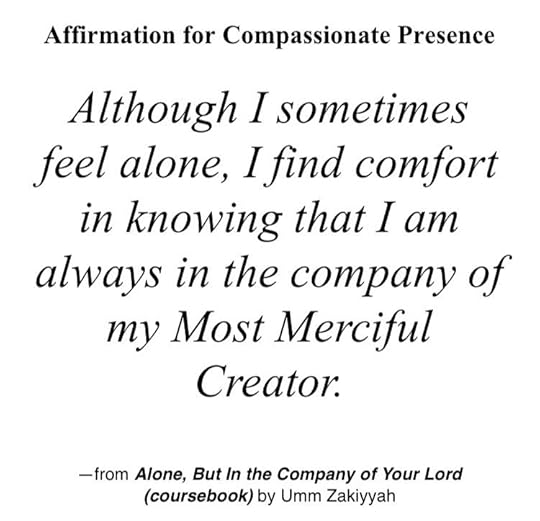
In the coursebook Alone, But In the Company of Your Lord, I discuss the importance of maintaining “compassionate presence” on our journey of emotional and spiritual healing, in section entitled “What Is Compassionate Presence?”:
In a sentence, compassionate presence is the consistent process of making your mind and heart a safe space for you.
Compassionate presence is rooted in self-acceptance and beautiful patience, no matter how far you are from where you’d like to be. It is looking into the mirror of your soul and saying, “I accept you for who you are, and will compassionately and patiently support your improvement each day.” It is also saying, “I know I cannot do this alone, so I beg my Most Merciful Creator for help.”
Compassionate presence is embracing the present in a way that nourishes your heart and soul, instead of exhausting or tormenting them by dwelling on the past, or by anxiously fearing the future or impatiently awaiting it. This means making the conscious heartfelt choice to accept your past (both the good and the bad) without dwelling on what happened in it, whether it was something really good that is no longer part of your life, or something really painful that is causing lingering anxiety, regret, emotional triggers, or emotional wounding.
This compassionate presence also means having a calm acceptance of the unknown future, whatever it may bring. It is your heart saying, “I am pleased with whatever my Lord has written for me,” without anxiously fearing the worst, and without impatiently seeking a better tomorrow.
When compassionate presence is absent from our emotional experience, our mind and heart are not safe spaces for us. Consequently, our minds are consumed with negative self-talk, with toxic self-criticism, and with crippling self-doubt…
In this unhealthy space, sincere gratefulness or beautiful patience in the now becomes extremely difficult or impossible. This leads to poor emotional, spiritual, and even physical health…
However, compassionate presence is not denial, suppression, forced forgiveness, or “extreme positivity.” In other words, compassionate presence does not ask you to deny the pain or trauma of your past or to rush to forgive abusers or oppressors as a quick fix to healing yourself…
Compassionate presence is nourishing the soul through seeing the beauty in the now and trusting in the beauty of the future, no matter what pains have past or are (possibly) to come. Compassionate presence is rooted in self-love and self-care, whatever that means for you right now, even if what this means will change in the future.
Compassionate presence is lifting your heart and hopes to your Merciful Creator, and trusting that He will take care of you, even when you feel incapable of taking care of yourself…
(3) Patience and Prayer
In the coursebook, Alone, But In the Company of Your Lord, I share this reflection about our emotional and spiritual healing journey, inspired by what our Merciful Creator teaches us regarding soul-care:
In the Qur’an, Allah tells us that the starting point of seeking help with anything that we are struggling with is maintaining patience and establishing the prayer. He says what has been translated to mean, “And seek help in Sabr and the Salaah, and truly it is extremely heavy and hard except for Al-Khaashi’oon (those who are sincerely and humbly submissive)” (Al-Baqarah, 2:45).
If we are seeking help through sabr, this means we are patiently withholding ourselves from doing anything that would harm our lives and souls, and we are patiently and continuously doing whatever would benefit our lives and souls.
If we are seeking help through Salaah, then we are at the bare minimum praying our five foundational prayers every day on time. Additionally, when possible, we are also praying any optional prayers that would help us through life’s trials and demonstrate true gratefulness to Allah, such as Qiyaam ul-Layl or Witr, or the Sunnah prayers that accompany the five obligatory prayers (Fajr, Dhuhr, Maghrib and ‘Ishaa).
However, when we are struggling in our emaan, maintaining patience and keeping up with our obligatory (let alone optional) prayers can be very difficult, hence the saying of Allah, “…truly it is extremely heavy and hard except for Al-Khaashi’oon (those who are sincerely and humbly submissive)” (2:45).
Thus, we should constantly supplicate to Allah to make us of the khaashi’oon. In the meantime, it is important for us to show sabr in keeping up with what helps our souls, especially the five daily Salaah and any other spiritual obligations, even when we feel unmotivated or empty inside. I remind myself of this in my personal journal:
Struggling in your emaan? Do you feel dead inside when you pray, make du’aa, or read Qur’an?
Remember this: It’s okay to show up empty. Just be sure to show up.
And your Lord will fill your heart with the spiritual fuel it needs, eventually.
But you have to show up.
Show up to prayer.
Show up to du’aa.
Show up to Qur’an.
Just the act of showing up is a powerful act of faith.
Allah will take care of the rest.
(4) Dhikr and Du’aa
Throughout the Qur’an and prophetic teachings, we are consistently reminded to keep our minds, hearts, and tongues in the remembrance of Allah (dhikr) and supplicating to Him (du’aa).
The practice of dhikr in particular brings calm, rest, and satisfaction to our hearts. Due to the natural trials of life, our hearts are often in a state of pain, confusion, and frustration—which then cause us to use our tongues to complain about our own lives, or about what other people are receiving or doing in theirs.
In this, we use the tongues that Allah has given us to express how unfair it is that some people have such-and-such or get to do such-and-such. This sort of thinking and speaking is undoubtedly the result of an unsettled, troubled heart. And it is the unsettled, troubled heart that becomes distant from Allah and most prone to harboring ill feelings in the heart and becoming frustrated and displeased with Allah’s qadar.
Allah says what has been translated to mean, “Those who believe, and whose hearts find rest (and satisfaction) in the dhikr of Allah, for without doubt in the dhikr of Allah do hearts find rest” (Ar-Ra’d, 13:28).
Additionally, Allah lets us know that turning away from this dhikr is a cause for us to take into our company a shaytaan (devil) as an intimate companion. He says: “And whoever turns away (or blinds himself) from dhikr of the Most Merciful, We appoint for him a devil to be an intimate companion” (Az-Zukhruf, 43:36).
What will help us protect ourselves from this unhealthy companionship in our most intimate relationship with our souls is to use our tongues for dhikr instead of expressing ungratefulness, frustration or anger at Allah’s qadar.
There are numerous adhkaar and supplications that we are taught in the Qur’an and prophetic teachings that can help calm and purify our hearts throughout the day. Many can be found in the book Hisnul-Muslim or Fortress of the Muslim by Sa’id bin Ali bin Wahf Al-Qahtani (published by Darussalam), which is now available via a downloadable app. And of course, we can find numerous supplications in the Qur’an itself.
Among these supplications is one that can protect us from harmful physical diseases, and it can be recited for protection from coronavirus or any other ailment: “O Allah, I seek refuge from leprosy, insanity, mutilation, and from all serious illness” (Sunan Ibn Dawood, 1556).
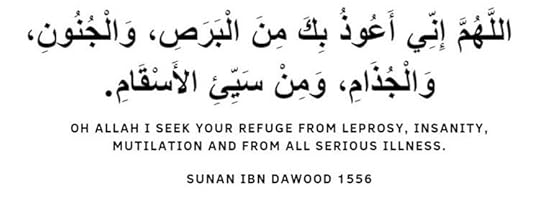
Image via @theprophetspath IG
It is also important to read Qur’an every day, even if only one ayah or for a few minutes. This will help keep our minds, hearts, and souls nourished during this time.
(5) Mindfulness About Unhealthy Escapism
During times of stress, we as humans are hardwired to seek escape from fear and pain. As alluded to at the beginning of this blog, this inherent tendency can be healthy or unhealthy. Therefore, in embracing self-care that is soul-nourishing, it is important to remain mindful of when we are falling into unhealthy escapism.
Unhealthy escapism is any form of avoiding or escaping fear or pain that disrupts the healthy function of our daily lives. This disruption can manifest practically, emotionally, or spiritually. One common form of unhealthy escapism is excessive binge watching of entertaining television, movies, or YouTube videos, especially if this results in neglecting our practical or spiritual obligations in any way.
If you are striving for healthy self improvement in your relationship with television or other visual entertainment, I encourage you to read the blog, “It’s Okay Not To Watch: Ten Points of Self-Honesty with TV.”
If you are looking to stock up on beneficial reads during this time, I am offering the opportunity to download 25 eBooks for only $25 as a self-care promotion before Ramadan.
(6) Soul-Nourishing Online Connections
Because our physical movement and travel are restricted during this time, it is natural that many of us will be spending more time online than we usually do. Therefore, it is important that we remain mindful of our online usage just as we remain mindful of our excessive consumption of television, movies, and other entertainment.
Fortunately, in this day and time, we are blessed with a multitude of beneficial online resources, communities, and courses. I encourage each of us to take advantage of these soul-nourishing online connections that offer both free and affordable content. Amongst them are Woman By Nature (for women only), Qur’an Journaling courses by Mariam Poppins, and Honest Tea Talk, which was created as a Muslim alternative to Jada Pinkett Smith’s Red Table Talk.
Additionally, I myself offer support in navigating emotional and spiritual struggles at uzuniversity.com via my videos, eBooks, and courses. Click here to subscribe to our free newsletter and soul-nourishing content.
In seeking soul nourishment while using social media, I share a reminder I wrote to myself in my personal journal:
Do a social media “soul cleanse” such that every moment you spend online becomes a benefit to your spiritual life, bi’idhnillaah. How? In addition to seeking out and sharing posts that are beneficial reminders to yourself and others, interact with others in a way that helps purify your heart from anything that can sully your soul—and that helps true love for the sake of Allah take root in your heart.
Here’s what I find helpful:
Honor your guests, whether they enter your personal space virtually, in reality, or in your thoughts. Pray for them. Ask Allah to bless them and grant them happiness and success in this world and in the Hereafter. If they are falling into error or sin, ask Allah to guide them and forgive them. If they are posting something about their own happiness and success, take a moment to leave a comment congratulating them and praying that they are increased in good.
And whenever you have a free moment, take time to send someone a message to just ask how they are doing, or to just send love and salaams, especially if you aren’t close friends who interact often.
If you are upset or angry with someone, spend time in sajdah and private supplication asking Al-Kareem (The Most Generous) to remove any ill-feelings and misunderstandings between you, until peace, compassion, and empathy settle in your hearts.
And most importantly, ask Al-‘Aleem, Al-Ghaffaar (The All-Knowing and Continuously Forgiving) to help you see clearly your own faults, sins, and wrongdoing, and to help you regret them and repent from them.
When we do this, we’ll likely find that the one who is harming and hurting us most is ourselves. Yet still, show yourself love and compassion by praying for assistance, guidance, and forgiveness in your brokenness and confusion. Then, bi’idhnillaah, you’ll be able to show this same love and compassion more freely with others—in your personal life and online.
(7) Online Transition for Family, Schools and Businesses
For individuals, schools, and business that could benefit from practical assistance in transitioning their events, courses, and activities online during this time, email ismail@kicreativestudios.com (the Muslim-owned company I use for my website and online university).

(8) Embrace Your Solitude
In closing, I suggest that each of us finds contentment in solitude, a lesson at the heart of what I share in my course “Alone, But In the Company of Your Lord.” In my journal, I reflect on the blessings of both solitude and occasional suffering in life:
Suffering is a means of purification. Solitude is a means of clarification. And loss—whether of companionship, wealth, or even trust itself—is a means of enrichment.
It is a gift.
It is like your Lord handing you a weathered roadmap, one retrieved from the aged dirt of the earth, and pointing you in the direction of home.
Yet you didn’t even know you were lost. You didn’t even know what was home.
Until He placed that roadmap in your hand.
That’s the moment your soul falls in submission—despite all the suffering, clamoring, and confusion of life—and you humbly accept this inescapable truth: You are all alone on this journey home.
And step by step, breath by breath, and pain by pain, you are being called back.
And all those worldly comforts and human relationships you thought you couldn’t live without? They were just temporary companions on your journey home. They were divine mercies—and tests—scattered along your path. But like a cool drink of water on an arduous journey, they quench the veins only for the moment, and only enough to keep you moving.
Because even they have a path and roadmap of their own.
And that’s the beauty. That’s the blessing.
Because without the suffering and abandonment when your roadmaps point to diverging paths, you’d think that these temporary comforts and tests scattered along your path were the destination itself.
You don’t have to struggle alone. Let’s work together: uzuniversity.com
Umm Zakiyyah is the internationally acclaimed author of more than twenty books, including the If I Should Speak trilogy, Muslim Girl , and His Other Wife . She recently launched her “ Choosing To Love Alone ” series via UZuniversity.com to support struggling believers seeking to nourish their emotional and spiritual health.
Join UZ University now.
Subscribe to Umm Zakiyyah’s YouTube channel , follow her on Instagram or Twitter , and join her Facebook page.
Copyright © 2020 by Al-Walaa Publications. All Rights Reserved.
The pain of social exclusion: Physical pain brain circuits activated by ‘social pain’. Retrieved on March 15, 2020 from https://www.sciencedaily.com/releases/2014/02/140227101125.htm
The post How To Nourish Your Mind, Heart and Soul During This Time appeared first on Umm Zakiyyah.
March 2, 2020
Come Back To Allah, Dear Soul
“This dunya won’t stop chasing you. Look at you, you’re tired. Bruised. Broken. And hurting. Isn’t it time you ran back to Allah? Isn’t it time you embraced His love for you? Tell me, and tell me honestly. Has this world or its people ever been able to comfort you the way one prostration to Allah does?”
—AcceptingQadr (via @acceptingqadr IG)
“Everybody isn’t as strong as you are,” the woman told me angrily. “You need to understand that.”
Her words cut deep and reminded me of so many of the private battles I’d fought for years, and continued to. These were battles that she knew nothing about. This woman, my sister in faith, had no idea that there was a time that I’d nearly left Islam, that there was a dark moment when I nearly took my own life, and that sometimes there were still days when I felt like I was just holding on by a thread.
Part of me wanted to share this with her, but my gut told me to keep quiet. I sensed that it didn’t really matter what I’d struggled with in the past, or what I struggled with still. In her mind, I was a “strong Muslim” and she was “weak Muslim,” and that alone explained why I disagreed with her sentiments about Salaah.
But that’s where she was wrong. I understood her more than I could express. But I knew that if I even attempted to share my own struggles or even my empathy with hers, she’d view my words as condescending, or she’d assume, “You just don’t understand.”
So I said nothing.
Her initial angry words had been in response to me mentioning the importance of holding on to the Salaah—the five daily prayers—no matter what. Because I’d reminded her, as well as my other sisters and brothers in faith, to never abandon the prayer, even in times of deep emotional pain and spiritual confusion, the woman was offended and assumed that, for me, praying all five prayers had always been easy.
But nothing could be further from the truth.
I used to dread when it was time for prayer. Sometimes I felt so overwhelmed by even the idea of praying that my body felt like a deadweight that couldn’t move. So I would crawl to the Salaah—literally. Then I’d pray sitting down, while my heart felt completely empty.
Does My Soul Matter Too?
Throughout my life I’ve faced numerous struggles that till today I don’t feel comfortable sharing with anyone. These are personal battles that I pray Allah keeps covered for me until I meet Him.
Also amongst my trials are personal battles that I’m not sure I can properly put into words, even if I tried. But in this moment as I write this blog, I’m praying that Allah gives me the words for one that is closest to my heart. In sharing this, I beg Allah to allow its lesson to touch the heart of every believing soul who sincerely desires what is best for their own soul and for the soul of every struggling Muslim:
During my most difficult battles with my nafs, what made my struggles all the more overwhelming and painful was hearing the very advice about the Salaah that my sister in faith was insisting I offer others: “It’s okay if you stopped praying. Allah knows your heart. Sometimes life is so overwhelming that all you can do is keep the love of Allah in your heart. And that’s better than nothing.” Or: “If praying all five prayers feels like too much for you, then start with only one. Praying one prayer a day is better than praying no prayers at all.”
But for me, hearing something like that took the last bit of “fight” out of me. I didn’t need to hear words that “gently” excused me from battling my nafs and properly worshipping my Creator. I needed to hear words that “gently” inspired me to keep fighting for my soul—even if it hurt my nafs to hear them. Hence this note I wrote in my personal journal:
Struggling in your emaan? Do you feel dead inside when you pray, make du’aa, or read Qur’an?
Remember this: It’s okay to show up empty. Just be sure to show up.
And your Lord will fill your heart with the spiritual fuel it needs, eventually.
But you have to show up.
Show up to prayer.
Show up to du’aa.
Show up to Qur’an.
Just the act of showing up is a powerful act of faith.
Allah will take care of the rest.
The Salaah Was My Lifeline
Deep in my heart, no matter how much I struggled with my faith, I knew that Salaah was my lifeline—everyone’s lifeline, in fact. So I couldn’t understand how any Muslim felt comfortable telling struggling believers that it was okay to effectively take their own life—spiritually speaking—with the hopes that they’d one day come back from the dead.
Even in my darkest days, this emotional logic was incomprehensible to me. Yet still, it ultimately became a fitnah for me, as my hurting heart began to absorb this “compassionate message” that incited a sense of peace in disconnecting from my Lord.
And while I understood that praying one prayer a day was definitely better than praying none at all, I also understood that neglecting any obligatory Salaah was not like other sins. If I were struggling with removing my hijab, for example, or with drinking alcohol or falling into zina (fornication or adultery), I would at least still be within the fold of Islam. But that wasn’t the case with Salaah, for after the shahaadah (declaration of faith) itself, Salaah was the most foundational manifestation of Tawheed in a Muslim’s life.
While “Laa ilaaha illaa Allah” was the Tawheed of the heart and tongue, Salaah was the Tawheed of the limbs. And just as there was no safe “middle ground” with neglecting Tawheed in our hearts or on our tongues, there was no safe “middle ground” with neglecting Tawheed with our limbs.
For this reason, the “compassionate message” that told struggling Muslims that praying one prayer was better than praying none was more a philosophical point than an Islamic one. In the merciful deen of Islam, if prayer were ever to be looked at through the lens of praying only “one Salaah” a day as an acceptable bare minimum, then we’d have to look at the word “Salaah” as a five-part singular.
In other words, if we understand “one Salaah” from the lens of true spiritual health, then we’d have to view this “one Salaah” as having five principal parts: Fajr, Dhuhr, Asr, Maghrib, and ‘Ishaa. There was no “one Salaah” without these five components—hence the five-part singular.
But I realize that this weighty point can only be understood by hearts that define spiritual minimums according to our faith instead of their emotional wounds.
Salaah Is a Weighty Matter
In the Qur’an, Allah says what has been translated to mean, “Say to My servants who have believed, that they should establish the Salaah… before the coming of a Day on which there will be neither mutual bargaining nor befriending” (Ibrahim, 14:31).
When I reflect on the weightiness that Allah places on the Salaah and how it is the second pillar of our faith itself—and the most crucial manifestation of Tawheed of the limbs—I wonder what we imagine will happen to us if we die while abandoning the Salaah, or while praying only one prayer a day.
“But Allah knows our hearts!” we say. “He judges us by our intentions!”
SubhaanAllah. Whenever I hear proclamations like these, I shudder and think to myself, “You know Allah knows your heart and intentions, yet that doesn’t scare you?”
It was with the knowledge of our hearts that Allah exhorted us over and over in the Qur’an to establish the Salaah, no matter what. It was with the knowledge of our intentions that Allah removed the option of neglecting the prayer, ever.
Or do we imagine that we know our hearts and intentions better than our Creator? Or perhaps we intend to inform our All-Wise Creator of how His deen—spiritual way of life—should manifest itself in our lives? Yet Allah says what has been translated to mean, “Say, ‘Will you inform Allah about your religion? While Allah knows all that is in the heavens and all that is in the earth, and Allah is All-Aware of everything’” (Al-Hujuraat, 49:16).
Regarding “good intentions” in particular, in my blog “I’m Muslim and Don’t Pray, What Should I Do?” I share this clarification surrounding the myth that we can “build up” to praying our five prayers, so long as we intend to pray all our prayers “one day”: “Myth: Actions are by intention, so if I intend to pray one day then Allah will record that for me. Truth: Actions are by intention, so if you know you are supposed to pray and you intentionally don’t pray, then Allah has recorded that for you.”
In the Qur’an, Allah makes it undeniably clear that neglecting the Salaah isn’t ever connected to good intentions; rather it is connected to pursuing our desires—no matter how “compassionately” we frame this soul-harm to ourselves or others. He says what has been translated to mean, “But there came after them a posterity who neglected the Salaah and pursued desires, so they are going to face destruction. Except those who repent, believe, and do righteousness; for those will enter Paradise and will not be wronged at all” (Maryam, 19:59-60).
In seeking to impress upon the believing soul the tremendous magnitude of this issue, Prophet Muhammad (peace and blessings be upon him) said: “Between us [the believers] and them [the disbelievers] is the prayer, and whoever leaves it falls into kufr (disbelief)” (Al-Tirmidhi, saheeh). He also said, “What is between a person and committing shirk (associating partners with Allah) and kufr (disbelief) is abandoning the prayer” (Sahih Muslim).
How then could it ever be okay to delve into kufr or shirk, no matter how deep our emotional pain? And how could it ever be okay to toy with kufr and shirk, even if only for part of the day? And how could any believing soul know that neglecting the Salaah is equated with kufr and shirk, yet they offer it—even if only partially—as an option for others to reconnect with Allah?
Don’t Confuse a Mercy with an Uswah
So often in our lives, we go through dark periods, and Allah in His infinite Mercy brings us out of that darkness. Then in our sincere desire to help others come out of their own darkness, we share our personal experiences as a means of giving them both hope and an example to follow in reconnecting with Allah. However, we need to be careful with this. If we are not framing our spiritual “success stories” from the vantage point of Allah’s Mercy more than an uswah (example or pattern to be followed), then we are making a grave mistake.
Our experience is not an uswah for other believers, and our experience alone should never be the foundation of any naseehah (sincere spiritual advice) we offer others. Yes, our experience can certainly be a powerful and beneficial part of our naseehah, but it should not be the essence of the naseehah itself, especially if our advice contradicts the guidelines of Islam. This is a spiritual reminder that cannot be overemphasized, as misunderstanding this can be disastrous to our souls.
If we continuously use our experiences as an uswah to others, we run the risk of changing the deen of Allah, despite our good intentions and despite our sincere effort to help others have a “spiritual success” story too.
In this, we must realize that at the very core of our “successful” personal experience, it wasn’t our own efforts or our “step-by-step” strategies that allowed us to reconnect with Allah and re-establish the Salaah. It was the Mercy of Allah, and the Mercy of Allah alone. This is especially the case if our personal story—at any time—included neglecting the obligatory Salaah in part or whole, even if we imagine our step-by-step strategy “worked” for us.
In the Qur’an, Allah says what has been translated to mean, “There has certainly been for you in the Messenger of Allah an excellent uswah (example or pattern to followed) for anyone whose hope is in Allah and the Last Day and [who] remembers Allah often” (Al-Ahzaab, 33:21).
In this ayah, Allah is letting us know that there is only one divinely approved uswah for all believers, and that is the example of Prophet Muhammad (peace and blessings be upon him). Naturally, this doesn’t mean that we cannot share our own stories as an inspiration and lesson to others. It only means that any sharing of our stories must be rooted in reconnecting the believers to the uswah of the Prophet, not the uswah of our personal experiences—no matter how helpful, inspirational, or powerful our success stories feel to us or others.
Understand, Your Story Isn’t Their Story
In the hopes of reminding the believing heart to stay focused on the guidance of Allah instead of the guidance of our own experiences, I recently shared this note from my personal journal on social media:
If there was a time in your life that you stopped praying, yet Allah brought you through this and you came back to the Salaah, then praise Allah for this immense blessing. But please, for the sake of your soul and for the souls of your struggling sisters and brothers in faith—even those who appear “strong” to you—never tell a believer that it’s okay that they stopped praying.
Don’t assume that your story will be their story, and don’t assume that your darkness will be their path to light.
When Allah brings you out of an abyss, don’t advertise the abyss—advertise the Light.
Tomorrow is not promised to any of us, so never give advice to someone such that if they followed it and died right after listening to you, they would meet Allah without emaan (faith).
And there is no emaan without the prayer.
Just because you found your way back to Allah after spiritual darkness doesn’t mean that the dark parts of your journey should become the blueprint for other struggling souls. There are some darknesses that we should never remain in—even for a split second—no matter how deep our trauma or pain. Our Salaah is like the oxygen in our lungs and the water in our veins. There is no life without it, and there is no goodness without it—even if, due to His immeasurable mercy, Allah granted you life and goodness after you deprived yourself of your source of life.
Telling someone it’s okay to abandon prayer due to their trauma or personal struggles is like telling someone it’s okay to worship idols today because you used to do shirk (paganism) and Allah guided you to Islam.
Or it’s like telling someone it’s okay to attempt suicide because Allah blessed you to survive a suicide attempt.
Just like it’s never okay to support someone ending their physical life even when they don’t feel like living another day, it’s never okay to support someone ending their spiritual life even when they don’t feel like praying another day.
When people are feeling so depressed that they feel tempted to end their physical life, we urge them to call a suicide hotline.
And when we’re feeling so broken inside that we feel inclined to end our spiritual life, Salaah is our “suicide hotline” for the soul.
Call it—and there will always be a Compassionate listener on the other line.
Then you can deal with your emotional trauma and pain after you hang up from the only connection that will actually save your life.
Whose Emotions Matter Most?
Even if we were to believe that emotional pain ever carries the most weight in giving spiritual advice—as my sister in faith was trying to convince me of—we should sincerely ask ourselves why the emotional pain of those who abandon the prayer should matter more than the emotional pain of those holding on to Salaah by a thread. These are people holding on to the five daily prayers, even if only barely, only because they genuinely believe that letting them go is not an option for their soul.
Why then doesn’t it matter to “compassionate advisors” how their “gentle” words could cause other people’s spiritual threads to snap? Why can’t they see that by reassuring those who abandoned the Salaah that this is okay, they are also encouraging many struggling Muslims to let go of Salaah too?
I wish we felt more compassion for those who appear “strong” in their emaan, I said to myself one day before writing this heartfelt reflection in my journal:
When you appear strong, no one cares about the trauma you’re battling or how their words meant to comfort others unravel and wound you. It’s okay if their words set you back spiritually and force you to clamor for your faith. So long as the “weak person” feels validated, it’s completely okay to invalidate you. Your soul is collateral damage in the compassion we owe to those who are ostensibly struggling with theirs.
Come Back To Allah, Dear Soul
So often we convince ourselves that our emotional battles are so difficult that we are excused from nourishing our souls. This is undoubtedly the result of living in a time where the chief idol and ilah (object of worship) are the emotions of our hearts—the foundation of the deen of emotionalism. However, in the Qur’an, Allah exhorts us to flee from these sources of idolatry and spiritual self-harm, no matter how appealing they are to our hearts; as He instructs the Prophet to proclaim what has been translated to mean: “So flee to Allah, verily I am a plain warner to you from Him” (Adh-Dhaariyaat, 51:50).
In the merciful deen of spirituality that Allah has gifted us with, when we are facing difficult emotional and spiritual battles, we are instructed to seek help by persevering in nourishing our souls, even when it hurts, and by continuously establishing the Salaah, even when it’s difficult. Thus, any advice that is truly “compassionate” will remind the struggling Muslim to seek help with their faith through their faith, and to seek help in their Salaah through their Salaah.
Allah says what has been translated to mean, “And seek help in Sabr (patiently persevering upon what nourishes the soul) and the Salaah, and truly it is extremely heavy and hard except for Al-Khaashi’oon (the humbly submissive)” (Al-Baqarah, 2:45).
In this ayah, our Merciful, Compassionate Creator is letting us know that He knows full well how difficult this path of soul-nourishment can be to our hurting hurts. And He is letting us know that He knows full well how overwhelming and difficult it is to pray during times of emotional and spiritual pain. However, still, He is telling us to persevere on this path, as it is our very lifeline. And then He offers us a step-by-step goal to strive toward: becoming amongst the khaashi’oon, a goal that can only be achieved through maintaining Sabr in soul nourishment and the Salaah.
In another ayah, our Merciful Creator further reassures us that this path will protect us from harm, no matter how much we are suffering currently, as He says what has been translated to mean, “Verily, the Salaah keeps one from the great sins and evil deeds…” (Al-Ankaboot, 29:45).
In reminding us to stay focused on what’s most important in life, our Prophet of Mercy (peace and blessings be upon him) said, “The first matter that the servant [of Allah] will be brought to account for on the Day of Judgment is the prayer. If it is sound, then the rest of his deeds will be sound. And if it is bad, then the rest of his deeds will be bad” (Al-Tabarani; saheeh, Sahih al-Jami).
So dear soul, ask yourself sincerely: What concern in this world could ever be so weighty that it makes neglecting the Salaah (in part or whole) beneficial or helpful for you?
Come back to Salaah, dear soul, without delay—even when it feels burdensome or impossible. This is how you come back to Allah.
Because, understand this, dear soul: There is no one in this world, no matter how inspirational their spiritual life or success story, who knows what you need—right now and forever—better than He does.
My Heartfelt Prayer
O Allah, protect us from being of those who abandon the Salaah, no matter how much trauma and emotional pain we endure in this world! And O Allah, for those of us who have stopped praying, restore us to spiritual life!
And O Allah, Al-Haadee! Guide us to always seek help through connecting to You—our spiritual lifeline—no matter how much pain and difficulty we face in our personal lives! And we beg You, Al-Kareem, to take our souls in the highest state of emaan!
You don’t have to struggle alone. Let’s work together: uzuniversity.com
Umm Zakiyyah is the internationally acclaimed author of twenty books, including the If I Should Speak trilogy, Muslim Girl , and His Other Wife . In 2019, she launched UZ Soul Gear , a passion project fueled by her love of both art and inspirational reflections. UZSoulGear.com offers apparel, wall décor, and more, aimed at supporting and inspiring the soul-centered lifestyle.
Join UZ University now.
Subscribe to Umm Zakiyyah’s YouTube channel , follow her on Instagram or Twitter , and join her Facebook page.
Copyright © 2020 by Al-Walaa Publications. All Rights Reserved..
The post Come Back To Allah, Dear Soul appeared first on Umm Zakiyyah.
February 3, 2020
Facing Your Moments of Truth
“We’re all experts at finding fault in others, so we see quite clearly the parts of their lives that need serious improvement. In this way, it’s relatively easy to recognize someone else’s moments of truth. But are you self-aware enough to recognize your own?”
—from the journal of Umm Zakiyyah
Years ago, when I was living as an American expat in Riyadh, Saudi Arabia, I met another African-American woman who, like myself, had made hijrah there with her family. She had such a beautiful, calm spirit; and noor (a spiritual light of emaan) illuminated her face. As I got to know her, I learned that she and several of her children were huffaadh, memorizers and preservers of Qur’an. (May Allah bless and preserve them upon the Qur’an and right guidance until they meet Him.)
One day the woman (whom I’ll call Noor) was telling me the story of how she’d grown up Christian and accepted Islam as a teenager. Throughout her childhood and youth, Noor had a close friend (whom I’ll call Tina) who’d also been raised in the church. Shortly after Noor accepted Islam, Tina visited her and couldn’t contain her confusion as to what inspired her best friend to change religions.
“Why did you become Muslim?” Tina asked.
Noor began to explain to Tina the parts of Islam that had intrigued her and pulled at her heart, inspiring her to finally convert. In the middle of one explanation, Tina began screaming at the top of her lungs and covered her ears. “Stop! Stop!” she yelled. “I don’t want to hear anymore! I don’t want to be held accountable!”
As Noor shared this part of her story with me, my eyes widened in shock. “Are you serious?” I asked. “She actually screamed and covered her ears?”
“Yes,” Noor said, shaking her head in disbelief. I could tell by Noor’s sad, reflective expression that the incident still troubled her till today. “It was like seeing in front of your eyes what Allah talks about in Sooratu Nooh,” she said.
In this, Noor was referencing the ayah where Allah describes a supplication made by Prophet Noah (peace be upon him), which has been translated to mean, “And verily, every time I called unto them that You might forgive them [O Allah], they thrust their fingers into their ears, covered themselves up with their garments, and persisted [in their refusal], and magnified themselves in pride” (Nooh, 71:7).
“But that’s not how being excused for ignorance works,” I said, still in shock. “You can’t just cover your ears and think you’re from the people who didn’t hear the Truth.”
“I know,” Noor said, the exhausted disbelief in her tone suggesting that she herself was still in shock. “I guess Tina figured that if she could just block out what I was saying, then she wouldn’t be held accountable on the Day of Judgment for never becoming Muslim.”
“SubhaanAllah,” I said, at a loss for words.
At the time that Noor had left the United States to move to Saudi Arabia with her husband and children, Tina was still a professed Christian.
Five (5) Crucial Moments of Truth for Us All
Till today, I often think of the story of Noor and Tina. Yet with each year that passes, Tina’s life path fills me with a bit less shock and a bit more sadness. Since that day I sat in Noor’s home and listened to the story of her best friend, I’ve gone through many life challenges of my own. I’ve struggled through divorce, fought for my life, and nearly lost my emaan (faith in Islam) itself.
I think every soul is seeking something between complete freedom and total surrender, I wrote in my journal the other day. In this reflection, I was referring to how within each of us is the desire to live the life we want, guilt-free. Yet there is also deep within us the desire to surrender to a Power greater than ourselves who can carry us through the difficult tides of life.
And somewhere in the midst of this internal pull in opposite directions are our personal truths—which are entangled with so many of the lies we tell ourselves. Throughout my life, I’ve sometimes wondered if one of my lies was the claim that I sincerely believed in Allah. This is a personal question I felt most deeply when I feared I could no longer be Muslim.
Due to my now better understanding of how uncannily common ghuroor (spiritual self-deception) is—even amongst Muslims—I examine the spiritual honesty of my heart often. When I find a disconnect between what I claim to believe and how I’m actually living out my life, I ardently pray to Allah to guide me, protect me from myself, and keep me firm upon His deen (spiritual way of life).
In the Qur’an, Allah says what has been translated to mean,
“Do people think that they will be left alone to say, ‘We believe’ and will not be tested? And We indeed tested those who were before them. And Allah will certainly make known those who are true, and will certainly make known those who are liars” (Al-‘Ankaboot, 29:2-3).
Throughout our lives, each of us will come to a spiritual crossroad—repeatedly—and at each crossroad is a crucial moment of truth for our souls. These crossroads manifest in so many different ways that they’re impossible to count, but in this blog I discuss five common moments of truth that each of us face. These are challenging moments for our lives and souls, as they expose the truth (or falsehood) of our claim when we say, “I believe in Allah.”
(1) When Spiritual Truth Comes To You
So often when we think of the test of accepting or rejecting spiritual truth, we think of people like Tina, non-Muslims hearing of Islam for the first time. However, the reality is that this test reaches all of us, even when we already profess Islam.
It is well-known that not everyone who claims to be Muslim is actually Muslim in front of Allah. It is also well-known that even amongst actual Muslims, so many of us are living upon beliefs and lifestyles that contradict Islam. This misguided state places us under the threat of dying upon misguidance and sin, or one day falling outside the fold of Islam while we’re unaware. For this reason, I caution myself and my brothers and sisters in faith to stay vigilant regarding the safety of their souls, especially when we find ourselves comfortable in a certain religious group, or content with a specific spiritual teacher.
The necessity of this spiritual vigilance is as crucial for the student of knowledge and scholar, as it is for the simple worshipper. In my book, I Almost Left Islam: How I Reclaimed My Faith, I share this advice from my personal journal in this regard:
While this warning [to guard oneself from misguidance] is certainly relevant to laypeople who dismiss or trivialize the knowledge of scholars teaching authentic Islam, it is also very relevant to those who are scholars themselves but have fallen into error, whether due to natural human fallibility or to having studied in a system rooted in falsehood.
Undoubtedly, it is difficult to dedicate years of your life to something only to realize in a moment’s clarification that you were wrong and that, for the sake of your soul, you need to tread a different path. Many converts to Islam understand this feeling on a deeply personal level, especially those who had been religious preachers or ministers in their former faith tradition. However, this predicament is not unique to non-Muslims. It happens to Muslims too, even those who are imams, scholars, sheikhs, or Islamic preachers.
Though we often hear the stories of laypeople who move from sect to sect and sheikh to sheikh in search of spiritual truth, it is rare you hear the stories of scholars and sheikhs themselves openly admitting that they were wrong and in need of repentance for spreading false teachings.
Similarly, it is more common to hear stories of average people converting to Islam than of priests, ministers, or rabbis leaving their religions to become Muslim. However, following spiritual truth is no less obligatory upon religious scholars than it is upon common people. Why then is there such a wide discrepancy in who accepts truth?
The answer is so simple that it is chilling: The more we stand to lose in terms of our worldly status, earthly comforts, and pride, the less likely we are to follow the truth when it comes to us. However, given the nature of spiritual matters and the tests that Allah promises He will give us on earth, we can be almost one hundred percent certain that we will be asked to sacrifice one or all of these throughout our lives, sometimes repeatedly.
So how do we protect our souls? Here are five points to remember:
Authentic Islam is based on the teachings of the Qur’an and Prophet Muhammad (peace be upon him), as understood by the Companions and earliest Muslims, as there is no new Islam. Bear in mind that believing that it is allowed to introduce new interpretations of foundational principles, obligations, and clear matters of halaal and haraam is what laid the path for the People of the Book making entirely new religions with no connection to the teachings of the Prophets Moses and Jesus (peace be upon them).
No human being other than the Prophet (peace be upon him) has authority to teach commandments or prohibitions in the religion or introduce concepts that promise specific reward or punishment in this world or the Hereafter—no matter how knowledgeable, righteous, or saintly we imagine them to be.
The role of the Islamic scholar is to teach what was revealed to Prophet Muhammad (peace be upon him) of the Book (Qur’an) and the Wisdom (the Sunnah), nothing more, nothing less.
No Islamic teacher or believer (other than the Prophet himself) has perfect knowledge of Islam, even if his or her foundational understanding of the religion is correct. Thus, when we are studying our faith, we must constantly supplicate to Allah to allow us to benefit from what is truthful and to protect us from what is mistaken, no matter who our teacher is and no matter how much we love, trust, and respect him or her.
Know that Allah has made the truth of His faith so clear that every human being who hears the message of Islam, whether illiterate or scholarly, has the capacity to recognize it as true. Likewise, every human being who accepts Allah’s religion has the ability—and the obligation—to recognize and reject religious falsehood being taught as Islam, no matter whom or where it comes from. In this vein, know that we will all be held accountable on the Day of Judgment for our beliefs and actions, and we will not be able to blame our spiritual teachers or scholars for our own misguidance.
When in doubt, pray for guidance. Allah hears and answers all prayers.
(2) After You Sin
Prophet Muhammad (peace and blessings be upon him) said, “All of the children of Adam sin, and the best of those who sin are those who constantly repent” (Sunan al-Tirmidhī 2499, Sahih by Al-Suyuti).
While each of us knows that none of us is without sin and thus we all need repentance and forgiveness, how we handle that knowledge in our own personal experience often tells a different story. For this reason, what happens after we sin is a crucial moment of truth for our souls.
Some of us handle this moment of truth by merely admitting our sin mentally, but continuing in the sin without ever intending to repent—or by telling ourselves we’ll repent “one day.” Some of us handle this moment of truth by defending our sin, claiming it’s not a big deal, or by pointing out how others are doing worse sins.
One of the most common ways that we modern-day Muslims trivialize our sins is by pointing out the philosophical reality that someone guilty of our sin could be a better Muslim than a Muslim who is not. This is where statements like, “A man who doesn’t pray on time can be a better Muslim than a man who does!” or “A woman who doesn’t wear hijab can be a better Muslim than a woman who does!”
While these statements are “technically true,” none of these claims does a single thing for our own souls suffering the harm of sin. Thus, expressing these points while in the midst of unrepentant sin is just a path of ghuroor (spiritual self-deception) and merely compounds our current sin with the additional sin of kibr (destructive pride).
Yes, for the one who is not struggling with that sin, these points are definitely helpful in reminding ourselves that just because we are not struggling with this sin doesn’t mean that we are better than someone who is. However, when spoken from the vantage point of living in sin itself, these points are destructive to our souls—unless they are spoken as a form of self-encouragement while embarking upon sincere repentance.
This is where we remind ourselves that our sin can draw us closer to Allah, if we let it. Here is a note I wrote in my personal journal about this beautiful spiritual opportunity:
“How can sin draw you closer to Allah?”
During my studies, an Islamic teacher asked us this question. We had just learned that emaan increases with obedience to Allah and decreases with disobedience, so we found the question confusing.
Then she explained that a person may sin, but their subsequent regret and repentance thereafter can draw them so close to Allah that their emaan actually becomes stronger than before committing the sin.
This lesson stayed with me.
In the Qur’an, Allah says what has been translated to mean, “Say, O My slaves who have wronged their souls! Despair not of the mercy of Allah. Verily, Allah forgives all sins. Truly, He is Oft-Forgiving, Most Merciful” (Az-Zumar, 39:53).
In taking to heart this compassionate encouragement to our imperfect souls, life after sin can become a moment of truth that testifies to the spiritual sincerity of our hearts—even as we continue to struggle to overcome our faults and sins.
(3) When Your Heart and Soul Contradict
In the Qur’an, Allah advises us with regards to whom we can choose for marriage, when He says what has been translated to mean,
“And do not marry the mushrikaat until they believe. And indeed a slave woman who believes is better than a mushrikah, even though she pleases you. And give not your [daughters] in marriage to the mushrikoon until they believe, and verily, a believing slave is better than a mushrik, even though he pleases you. Those [mushrikoon] invite you to the Fire, but Allah invites [you] to Paradise and forgiveness by His leave, and makes His ayaat (verses and signs) clear to mankind that they may remember” (Al-Baqarah, 2:221).
In this ayah, Allah is making it clear that it is not permissible for believing men or women to marry people of shirk (those who associate partners in worship with Allah, those who assign divine qualities to creation, or those who assign to Allah attributes of His creation). He also clarifies that He fully understands the love and affection we have in our hearts for these women and men of shirk, yet still, He lets us know that these “good people” are unhealthy for our souls.
This is because by the very nature of their beliefs and lifestyle, women and men of shirk are inviting us to the Fire, even when they themselves are not consciously intending to. So unless they accept Islam, they can never be permissible wives or husbands for believers—no matter how much our hearts desire their companionship.
Due to Allah permitting Muslim men to marry chaste, righteous women who are Jews or Christians, many believing men use this divine permission as an excuse to marry any non-Muslim woman they choose, whether atheist, Hindu, Buddhist, or any other. And even amongst the Muslim men who marry only professed Jews or Christians, many do not concern themselves with her chastity, righteousness, or even the modern-day shirk she delves into that directly contradicts the traditional teachings of her own faith.
When we are tested with falling in love with a person of shirk, this becomes a crucial moment of truth for our souls. Consequently, how we handle this difficult test becomes a testimony to the truth (or falsehood) of our claim, “I believe in Allah.” If we choose the desires of our heart over the needs of our souls, this is undoubtedly a testimony to either our deep ignorance of Islam or to our intentional disregard for divine teachings.
Naturally, this trial of choosing between the desires of one’s heart and the needs of one’s soul is not only in falling in love with a mushrik. It also applies to a Muslim woman choosing to remain with a husband who has left Islam, or who refuses to accept Islam after she herself converts. This further applies to having sinful desires toward someone who is not permissible for us to marry, whether due to same-sex attraction or something else. It also applies to being given a lucrative opportunity to earn money when the means of attaining it are haraam (divinely forbidden).
And it also applies to how we handle a loved one making a decision that is permissible for them, but that we ourselves dislike—hence the next crucial moment of truth for our souls: when they don’t choose you.
(4) When They Don’t Choose You
“I’ll kill him if he marries another woman,” a colleague of mine said after mentioning how some men were marrying other wives who had no need of financial provision.
I chuckled in response, imagining that she was speaking only in jest.
“I’m not joking,” she insisted. “I’ll kill him if he does something like that.”
I began to feel uncomfortable with the conversation, but I still imagined that she was not speaking seriously. “No you wouldn’t,” I said in lighthearted dismissiveness. “If he marries another woman, you could just get a divorce.”
“I won’t need a divorce if he’s dead.”
Her words unsettled me, but I still didn’t want to believe what I was hearing. I chuckled again and waved my hand at her. “I don’t think you’re willing to spend the rest of your life in prison over some man.”
“Prison?” she said as if I’d lost my senses. “I’m not stupid enough to leave any traces.” She then described step by step the sihr (dark magic that involves working with the jinn) she would use to ensure that her husband died without a single shred of evidence that the legal system could trace back to her.
Another woman spoke of how she would go to the American government and accuse her husband of abuse or terrorism if he would dare try to marry another wife. Another woman put a knife to her husband’s throat while he was sleeping and waited on top of him in this manner until he awoke, then said, “If you ever marry another woman, I’ll kill you.” Other women have taken their children away from their father and threatened to never allow him to be part of their lives again if he continued to seek or live in polygyny.
And the list goes on.
When we are faced with the difficult trial of a loved one doing something that hurts our hearts but is permissible for their souls, then we are being faced with a crucial moment of truth for our own souls. Some of us handle this test by turning to Allah in our time of emotional pain and having sabr (patience and perseverance upon soul nourishment) through the trial. In this way, we bear witness to the truthfulness of our claim, “I believe in Allah.”
However, others of us become so enraged at what our loved one is doing that we are willing to destroy our own souls in opposition to their decision. In these moments of spiritual self-harm, not even the merciful option of divorce satisfies our hearts, as we view even this divine permission as a form of dhulm (wrongdoing or oppression). “Why should I have to leave?” we exclaim if we are reminded of this permissible option in our faith.
In this space of choosing our wounded hearts over the needs of our souls, we reach for anything at all that will satisfy our hearts—except the spiritual prescription our Creator offers us. In the Qur’an, our Merciful Creator says what has been translated to mean, “Those who believe, and whose hearts find rest (and satisfaction) in the remembrance (dhikr) of Allah, for without doubt, in the remembrance of Allah do hearts find rest” (Ar-Ra’d, 13:28).
If we turn away from this path of dhikr (seeking the guidance and remembrance of Allah) to get us through our trial, we might find our hearts discontent with Allah’s revelation itself, as we see it as the source of our troubles. As a result, we might begin to use the tongues that Allah has given us to disagree with the divine permissions of this faith. For so many Muslims—women and men—this often results in seeking to change the rules of Islam itself to fit into what our hearts desire.
Naturally, this crucial moment of truth regarding “when they don’t choose you” is not exclusive to women dealing with the emotional trial of polygyny. It also applies to Muslim men whose wife has chosen divorce but the men refuse to accept her decision and thus resort to mistreatment or abuse to force her to remain married to them. Additionally, this trial applies to fathers and mothers being faced with their child choosing a life path they disagree with but is allowed in Islam, or with their child choosing a permissible marriage companion that they dislike. And the list goes on.
(5) How You Treat Others
In our brief time on earth, it is not only the choices of our loved ones that present a moment of truth for our souls. It is also the choices of others, even when their lives are not meaningfully connected to ours in any way. When our faith is not rooted in a mindset of dhikr (the remembrance and guidance of Allah), we rely heavily on emotionalism more than spirituality in our treatment of others.
In a space of emotionalism, our hearts are filled with love of people we like or agree with, while our hearts are filled with resentment and animosity toward people we dislike or disagree with—even when they are doing nothing sinful. However, most of us are unaware of this unhealthy state of our hearts until it is exposed to us through a crucial moment of truth in our lives.
In this moment of truth, our hearts are exposed to us—and to the world—with how we speak about and treat others, specifically our brothers and sisters in faith who are enjoying the mercies of Allah in a way that we would not choose for ourselves. If this moment of truth exposes the truthfulness of our claim, “I believe in Allah,” we will immediately turn to istighfaar (seeking forgiveness) and dhikr of Allah—the remembrance and guidance of our Creator—when we find ourselves struggling to accept someone’s life path that is permissible for them but emotionally triggering or upsetting for us.
When we turn to Allah in these difficult moments, we will find that this path of dhikr is the antidote to our hurting hearts. Additionally, we will find that our unhealthy inclination to speak negatively about a servant of Allah is replaced with a sense of calm and rest, as we fully trust the wisdom of Allah’s guidance and qadar. “…For without doubt, in the dhikr of Allah do hearts find rest” (13:28).
However, if we turn away from this dhikr and instead persist in expressing disagreement with a servant of Allah obeying Him in a way we dislike, then this moment of truth exposes the falsehood of our claim, “I believe in Allah.” Consequently, we become amongst those whom Allah describes in the Qur’an when He says what has been translated to mean, “And whoever turns away (or blinds himself) from the remembrance (dhikr) of the Most Merciful, We appoint for him a devil to be an intimate companion” (Az-Zukhruf, 43:36).
As a result, we spend an inordinate amount of time, whether in our personal lives or on social media, mistreating and speaking ill of fellow believers who trigger our unhealthy emotionalism. Whether it’s due to their decision to enter an intercultural marriage, to marry the former spouse of a friend or family member, or to enjoy the merciful option of plural marriage in their lives; if we are not relying on the dhikr (guidance and remembrance of Allah) to understand our emotions, then we are relying on our unhealed wounds and the companionship of Shaytaan, even if we are unaware of this corrupt presence.
As I discuss in my blog, “Teaching Your Heart Love for Allah’s Sake”: When this happens, we genuinely imagine that our feelings, complaints, and convictions are based on what we’ve seen from these people in real life or what we’ve experienced and observed in our own lives in general. But in reality, it is all coming from our nafs welcoming into our most intimate space (i.e. our hearts) a devil to urge us toward this thinking.
May Allah protect us from ghuroor—spiritual self-deception.
Final Notes: Ensuring Your Claim of Emaan Is True
If we are honest with ourselves, none of us can claim to have hearts full of spiritual purity. This is because each and every one of us is tested with battling unhealthy emotions and desires of the heart.
In fact, the battle against our own nafs (inner self) is the most difficult battle in this world—literally. Therefore, not a single one of us should feel safe from failing the emotional trials of life and thus exposing, in a crucial moment of truth, that our claim of emaan (having true faith) is untrue.
In facing our moments of truth, so many of us are similar to Noor’s friend, Tina, who screamed and covered her ears rather than let the merciful guidance of her Lord enter her heart. Like so many of us, Tina’s emotions were so entangled in her vision of how her life should be, that she didn’t even want to hear about a path that challenged her to become a better person.
It is beyond heartbreaking that, as Muslims, so many of us are rushing to follow this path. Nevertheless, by Allah’s mercy, there are many other Muslims who recognize the unhealthy state of their hearts. As a result, they sincerely wish to become better versions of themselves—the version that reflects the beautiful fitrah (spiritual purity) in which Allah created them.
How To Purify Your Heart for Allah’s Sake
In the blog “Teaching Your Heart Love for Allah’s Sake” I share tips on how we can purify our hearts from feelings and life paths that can destroy the spiritual health of our souls. Here are two that can, bi’idhnillaah, help purify our hearts and ensure that our claim of emaan remains true until we are lowered beneath the ground:
Build your day and life around Sabr and Salaah. In practical spiritual application, Sabr is two things: (1) displaying patience in consistently doing and saying those things that will nourish your soul in this world and in the Hereafter, and (2) displaying patience in staying away from doing and saying those things that will harm your soul in this world and in the Hereafter.
Allah says what has been translated to mean: “And seek help in Sabr and Salaah, and truly it is extremely heavy and hard except for Al-Khaashi’oon (the humbly submissive)” (Al-Baqarah, 2:45).
In seeking help through Salaah (formal prayer), you can build your entire day around the Salaah. This means that your schedule is based on the daily prayer times (i.e. you plan what you’ll do before and after prayer vs. at a specific time on the clock). And you can pray Qiyaam (the night prayer) regularly, even if for only one night each week.
Naturally, in order to benefit most from any Salaah (whether obligatory or Sunnah), you must strive for khushoo’ (sincere humility, reflection and concentration). You do this by asking Allah to make you amongst the khaashi’oon, and by spending extra time in rukoo’ and sujood, while making extra du’aa to Allah while in sujood particularly.
Attach your heart to the Hereafter. One way to attach our hearts to the Hereafter is by reading Qur’an every day, even if only one ayah or for a few minutes. This helps soften our hard hearts, bi’idhnillaah, and put our life (and the lives of others) into proper perspective.
Allah says what has been translated to mean: “Do they not then think deeply on the Qur’an, or are their hearts locked up?” (Muhammad, 47:24). Naturally, it is impossible to think deeply on the Qur’an (and thus avoid a heart that is “locked up”) if we are not reading Allah’s Book regularly.
Here are some tips for benefiting the most from Qur’an during our daily reading:
If you come across an ayah discussing those with whom Allah is pleased, supplicate to Him and ask to be amongst them. If you come across an ayah discussing right guidance, ask to be amongst the rightly guided. If you come across an ayah discussing those who are disobedient or oppressive, ask for protection from being amongst them (as the oppressor or the oppressed). If you come across an ayah discussing Allah’s forgiveness and mercy, ask Allah for forgiveness and mercy for yourself.
If you come across an ayah discussing Paradise, ask to be admitted amongst the companions of Paradise. If you come across an ayah discussing Hellfire, ask for Allah’s protection from it. If you come across an ayah that you do not understand or incites confusion, ask Allah to increase you in beneficial knowledge and understanding.
O Allah! We beg you to increase us in beneficial knowledge and understanding of Your deen! And O Allah, Al-Quddoos, As-Salaam, Al-Haadee! We beg You to purify our hearts from spiritual diseases, from unhealthy emotions, and from anything that would cause us to say or do anything that would make our claim of emaan untrue, while in the midst of a crucial moment of truth in our life!

Umm Zakiyyah is the internationally acclaimed author of twenty books, including the If I Should Speak trilogy, Muslim Girl , and His Other Wife . In 2019, she launched UZ Soul Gear , a passion project fueled by her love of both art and inspirational reflections. UZSoulGear.com offers apparel, wall décor, and more, aimed at supporting and inspiring the soul-centered lifestyle.
Subscribe to Umm Zakiyyah’s YouTube channel , follow her on Instagram or Twitter , and join her Facebook page.
Copyright © 2020 by Al-Walaa Publications. All Rights Reserved.
The post Facing Your Moments of Truth appeared first on Umm Zakiyyah.
January 28, 2020
Mourning the Loss of a Beloved Soul Who Wasn’t Muslim
“Every soul shall taste death… The life of the world is only the enjoyment of deception.”
—Qur’an (Ali ‘Imraan, 3:185)
This past Sunday afternoon after having prayed Dhuhr, I was sitting in the prayer area of my home doing my daily Qur’an reading when my daughter asked if she could talk to me for a minute. She then asked, “Did you hear what happened?” I told her I didn’t know what she meant. “About the basketball player, Kobe Bryant? You knew who he was, didn’t you?” Her use of the past tense confused me momentarily. “Yes…” I said tentatively. “He died,” she said, sitting next to me and handing me her phone so I could read the news for myself.
For a brief moment, I thought she was mistaken and had read something from a fake news site, but as I read the reports, I slowly processed the weighty reality. Kobe Bryant, as well as everyone else aboard the helicopter along with him, had died in a tragic accident. I would later learn that his thirteen-year-old daughter was among them.
As the heartbreaking news sunk in, I immediately thought about my own soul and the ever-present shock and pain that death brings, despite it being the only guarantee of life itself. I also thought about loved ones I’d lost over the years, and how I was still making sense of a world without my younger brother who died in 2008 and my father who died less than a year ago.
No matter how familiar death was in the experience of life, it rarely felt familiar, and it rarely seemed to make sense. And today was no different.
Though I was not personally connected to Kobe Bryant in any way and was not a basketball fan myself, he was very much a part of the world I’d known. My heart first became endeared to him in 1996 after he went to the prom with the singer Brandy. I thought it was the most heartwarming prom story. Over the years, his growing pains and challenges inspired in me a feeling similar to what I’d have for a younger brother, with all its moments of frustrations and pride.
When you lose someone who touched your life even in a distant way, it’s not easy to make sense of your feelings. For reasons that are often inexplicable to us, some deaths incite deep emotional pain while others incite merely a passing feeling of distant sadness. Naturally, the more deeply felt the pain, the more challenging or confusing the grief. When the deep sadness is incited by the passing of a soul that was not Muslim, the feelings that one grapples with can become all the more confusing.
For this reason, I share here ten (10) tools of emotional healing and soul-nourishment when we are tested with mourning the loss of a beloved soul who wasn’t Muslim, whether that person was a close friend or loved one, or someone who touched our hearts and lives from a distance:
(1) It’s Okay To Cry and Feel Pain
Those of us who have non-Muslim family are very familiar with the emotional pain and confusion that comes along with mourning a beloved one who had not accepted Islam. In this, we become accustomed to navigating the delicate space between honoring the affection we have in our hearts for them and submitting to the spiritual etiquette that our faith has outlined for us when someone has died.
Here, I find it appropriate to share a one-sentence summary from the prophetic teachings that we learn about navigating grief: The heart aches and the eyes shed tears, but the tongue does not say anything that is displeasing to Allah.
Thus, it is completely okay to feel sad and cry tears, as death is a painful reminder of the fragility of life and how any of us can be literally here today and gone tomorrow. This visceral reality alone is enough to weigh down the heart with sadness and inspire tears to flow from the eyes. Therefore, sadness and pain should not be viewed as disagreeing with Allah’s qadar (divine decree) or as representing any spiritual declaration about the deceased soul, as sadness stems from multiple sources.
Sometimes our sadness is rooted in the loss of something familiar that we have grown accustomed to. Sometimes our sadness is a reflection of the empathy we feel for the passing of a human soul. Sometimes our sadness is rooted in what we will miss about a person. Sometimes our sadness reflects the loss of hopes and dreams we had for that person, whether worldly or spiritual. Sometimes our sadness is rooted in an emotional trigger that is causing us to relive the death of someone we lost previously. Sometimes our sadness is a reflection of deeply feeling our own mortality. And the list goes on.
Just as there are many faces of grief, there are many triggers of grief. And not all of these triggers are directly related to something specific about the person who is triggering our sadness and tears. Sometimes we ourselves do not understand why a particular death affects us deeply while another does not. Whatever is inspiring our emotional pain, it is helpful to remember that we do not necessarily need to fully understand our sadness, as so much of human experience exists beyond the realm of conscious understanding.
In this realm, it is quite possible that the Creator Himself has allowed a certain tragedy to touch the hearts of so many as a means of reminding each of us (whether Muslim or non-Muslim) to get our spiritual affairs in order. This is because the reality of our own death is just a matter of time—which could be sooner rather than later.
(2) It’s Okay To Honor Their Memory
In our worldly experience, we will benefit from many people and feel inspired by countless souls who cross our paths. Some of these souls we will interact with directly, and other souls we will connect with from afar. However, how a particular soul touches our life (whether directly or indirectly) is ultimately the decision of our Creator, as we have very little power over the details of who touches our lives and hearts in a certain way.
In His qadar, our All-Wise Creator has assigned certain people to be a source of tremendous benefit or inspiration for us, and He has assigned others to be source of severe pain or agony. Each of these trials (in benefit or pain) are part of the tests He has promised us on earth. Regarding certain people being placed in our lives as a trial for us, our Creator says what has been translated to mean, “And We have made some of you as a trial (fitnah) for others. Will you have patience?” (Al-Furqaan, 25:20).
Here, it is helpful to remember that a fitnah (weighty trial) can incite deep pain or harm, or it can incite deep benefit or pleasure. Or it can incite a mixture of both. In this ayah, our All-Wise Creator is letting us know that no matter what a particular trial incites within us, the purpose of the trial is to test our sabr (patience).
As I often mention in spiritual discussions, though the term sabr is usually translated as merely “patience,” in our practical spiritual experience, sabr is two things: (1) withholding ourselves from saying or doing anything that will harm our souls and (2) remaining steadfast in saying and doing anything that will benefit our souls.
And undoubtedly, expressing shukr (sincere gratefulness) for our worldly blessings is a means of benefiting our souls. So when we speak of the benefit or inspiration that someone has brought to our lives, whether directly or indirectly, this can be a form of showing shukr to our Creator. This is because Ar-Rahmaan (the Most Merciful) is ultimately the One who decreed that we would derive a specific benefit or inspiration from a certain part of His creation.
Thus, when someone has been a source of good for us, speaking openly about this blessing is a sign of emaan (true faith). Prophet Muhammad (peace and blessings be upon him) taught us: “Whoever does not thank people has not thanked Allah” (Sunan Abī Dāwūd, 4811; Sahih by Ahmad Shakir). Naturally, if a person is alive, we can show gratefulness by thanking them directly, but when they have passed away, we can show gratefulness by speaking of the benefit or inspiration that Allah brought to our lives through them.
In this way, we can honor the memory of someone and use this as an opportunity to express shukr to our Merciful Creator. We see an example of this in how the books of prophetic history mention how the Prophet’s uncle Abu Talib brought benefit to the believers, and how the Prophet’s family, including his parents and his grandfather Abdul-Muttalib, were honest trustworthy people of noble lineage and upstanding character. Honoring this part of their worldly legacy in no way contradicts our recognition of the unseen spiritual reality that pertains to their souls in the Hereafter.
Therefore, it is completely okay to acknowledge the worldly benefit and inspiration that we gain from Allah’s creation. So long as our words and actions are rooted in sabr (withholding ourselves from saying or doing anything that will harm our souls), this honorable mention can be a means of thanking our Merciful Creator Himself. This is because deriving worldly benefit and inspiration from each other—irrespective of our varying faiths—is how our Creator has designed the human experience on earth.
(3) Don’t Confuse Emotions with Spirituality
When we are in the midst of sadness or grief, especially regarding someone close to our heart, the challenge for the sensitive believing soul is navigating our emotions in a way that is spiritually healthy for us. In this, we strive to express our emotional pain in a way that nourishes our souls and that refrains from harming our souls (i.e. in a way that reflects true sabr).
In the Qur’an, Allah says what has been translated to mean, “And certainly, We shall test you with something of fear, hunger, and loss of wealth, lives, and fruits. But give glad tidings to the saabiroon (the patient ones)” (Al-Baqarah, 2:155).
In the realm of human emotion, the tragedy of loss is not faith-specific. Worldly loss weighs heavily on anyone, as feeling the pain of loss is merely a manifestation of how Allah created the human heart. In our feelings of sadness, these emotions are not necessarily a reflection of our spirituality. Rather, they are a reflection of our humanity.
In our mortal experience, it is human nature to feel a sense of sadness when we lose something beloved to us. This is the case even when we lose lifeless things such as wealth, a beloved piece of jewelry, a coveted job, or a lucrative opportunity. How much more when that loss involves a human soul?
In the above ayah, our Creator is reminding us of the nature of life, in all of its agony and loss, and how tragedy will touch every one of us. Sometimes that loss will be of something very close to us, and sometimes that loss will be from something connected to us from a distance. However, in either case, our Merciful Creator reminds us that it is only the saabiroon (the patient ones) who will derive benefit from these losses.
Specifically, the saabiroon are believers whose sabr is such a defining trait of their heart and lives that the Creator Himself has defined them by their steadfastness in soul-care. For the saabiroon, the health of their souls consistently takes priority over everything, irrespective of whether they are enjoying times of ease and happiness, or enduring times of extreme pain and difficulty. In their life of soul-care, an inherent quality of the saabiroon is that despite sometimes feeling deeply painful emotions, they consistently channel their pain in way that nourishes their souls and fills their hearts and tongues with dhikr (sincere remembrance of Allah).
In the Qur’an, Allah describes how the saabiroon handle tragedy and loss. He says what has been translated to mean, “[They are those] who, when afflicted with calamity, say, ‘Truly, to Allah we belong and truly, to Him we shall return’” (Al-Baqarah, 2:156).
In this ayah, Allah is not only describing what is happening on the tongues of the people of sabr, but He is also describing what is happening in their hearts. When the saabiroon experience tragedy, their hearts are immediately reminded that everything of this world—whether their wealth and treasured possessions, or the human souls that are beloved to them—are owned by the One who created them and brought them into existence. Therefore, the people of sabr realize from the very depths of their hearts that, in their Creator’s immeasurable Mercy and Wisdom, He can do with His creation as He pleases.
In contrast, the hearts that are not defined by sabr unhealthily fixate on what a certain worldly possession or beloved human soul meant to them and others in this world. As a result, nearly all of their sadness and grief is rooted in a form of emotionalism that spills into their spirituality in an unhealthy way. In this space of suffering that is not rooted in sabr, the grieving soul uses its emotions to understand the world of spirituality, instead of using its spirituality to understand the world of emotions.
It is in this unhealthy space that the unsettled heart expresses anger, frustration, or disagreement with Allah’s qadar, or makes emotional proclamations regarding the unseen spiritual world that they imagine awaits the one they loved or admired. Here is where we find believers speaking about how they know this “good soul” will be in Heaven and will be rewarded immensely by God for all the good they have done. These proclamations are often expressed as a means to soothe their own aching hearts, whose very core is rooted in an emotional connection to the creation more than a spiritual connection to the Creator.
For this reason, it is crucial for the believing soul to consistently strive and pray for sincere sabr, as the absence of true sabr could mean filling our hearts with a form of emotionality that guides our spirituality, instead of authentic spirituality that guides our emotionality.
(4) Respect the Spiritual Etiquettes of Your Faith
When our emotionality begins to fuel our spirituality, we begin to view the world from the lens of human judgment instead of divine judgment. Consequently, our entire understanding of even the unseen spiritual world is viewed through this inverted lens.
This is how so many of us become genuinely confused as to how a “good person” could ever be denied Paradise after they die. This is also how so many of us openly proclaim that a person we’ve labeled as “good” will in fact enter Paradise or will “rest in peace” in their graves. Oddly, we proclaim this about the ghayb (unseen) even without having the least bit of knowledge of this person accepting emaan (authentic spirituality) while they were alive.
Yet in the Qur’an, our All-Wise Creator and Master of the Day of Judgment says what has been translated to mean, “Truly, the [only] deen with Allah is Islam…” (Ali ‘Imraan, 3:19).
As is well known in Islam, the Arabic term deen refers to each person’s spiritual way of life, religion, or set of beliefs and behavior codes that they adopted in this world. Regarding the option to choose a spiritual way of life other than Islam, Allah says what has been translated to mean, “And whoever seeks a deen other than Islam, it will never be accepted of him, and in the Hereafter he will be one of the khaasiroon” (Ali ‘Imraan, 3:85).
Specifically, the khaasiroon are those who experience ultimate spiritual loss in the Hereafter and will never enter Paradise, despite all of the apparent good they did while they were on earth.
This religious perspective (that ultimate spiritual loss is linked to one’s disbelief in a specific faith and that ultimate spiritual gain is linked to one’s belief in a specific faith) is not unique to Islam. It is in fact an inherent characteristic of all Abrahamic faiths (i.e. Judaism, Christianity, and Islam).
Despite the fact that modern day Judaism and Christianity have strayed from the pure monotheistic teachings of the Prophets Moses and Jesus (peace be upon them), the modern practice of these faith traditions still retain some remnants of their roots in Tawheed (worship of Allah alone) and Islam (submission to Allah alone and belief in all of His prophets and messengers). One such root is the belief that spiritual atonement in the Hereafter is a divine gift granted exclusively to those whose most intimate relationship with their Creator was rooted in authentic spirituality (emaan), true faith as defined by God Himself.
In the divine definition of emaan, all of a person’s goodness emanates from the faith in their hearts. As such, all of a person’s worldly deeds stem from this spiritual root and are judged based on this core reality. This is why so much emphasis is put on the opportunity for forgiveness, atonement, and mercy instead of on a human being’s inherent goodness itself. In the spiritual realm, there is no ultimate human goodness except when it stems from a sincere, humble connection to one’s Creator.
In light of this, we can understand the deep spiritual wisdom behind each faith tradition having very specific acts of worship and spiritual etiquettes that are unique to it—especially at the moment after which a soul has transitioned from its worldly home and is embarking on the first step toward its everlasting home in the Hereafter. After our private worship and spiritual beliefs themselves, how this moment of death is handled by the living is arguably the most obvious manifestation of our own spirituality on earth.
Therefore, when a person dies, those whose hearts truly believe in their own faith traditions will sincerely and humbly respect the spiritual etiquettes of their faith.
In this, we begin to understand that there is a very sensible, spiritual reason that funerals are hosted by the faith community of the deceased, not by anyone else, no matter who their family was or how much others loved and admired them in this world.
As such, Jews do not host funerals for Christians and Muslims, and Christians do not host funerals for Jews and Muslims. This is because it is well known that funerals are fundamentally acts of worship. In these acts of worship, formal prayer services are held for the deceased and are conducted based on very specific beliefs about the unseen journey of the soul. So naturally, these formal prayers for the soul mirror what that deceased person himself or herself actually believed in this world.
Therefore, refraining from offering official prayers or from hosting the funeral services or memorials of someone outside our faith merely reflects our acknowledgement of not only what the deceased sought spiritually for themselves, but it also reflects our respect for the spiritual etiquettes that our Creator has outlined for us at the time of death.
(5) Refrain from Judging Souls As Good or Bad
When we refrain from offering prayers or memorials for a soul outside our faith, this does not necessarily point to any definite unseen reality except our own heart’s humble and sincere respect for our own faith tradition. In refraining from offering spiritual prayers for non-Muslim souls, we are not claiming to know that a person was ultimately “bad” or “good” in front of their Creator. This is because, in the end, only Allah knows the exact state that is written for each soul at the time of death. Thus, as sincere believers, we refrain from what is often referred to as “playing God.”
So often in life, we advise each other, “Don’t judge!” intending to remind each other that ultimate judgment of someone is reserved for God alone. However, in times of death, we often forget that this same advice applies. In other words, just as we are forbidden from casting judgment on someone as being ultimately “bad,” we are also forbidden from casting judgment on someone as being ultimately “good.” The only exception to this is when specific personalities are mentioned by name as being “bad” or “good” in the divine texts.
Those who delve into judging specific souls as “bad” or “good” are treading a very dangerous path in which they are assigning to their own mind, heart, and emotions perfect divine knowledge and wisdom. In this, they fail to comprehend this basic, fundamental reality of life as a creation of Allah:
What is most important to you is not necessarily what’s most important to the Creator. It is in forgetting this that we become distressed regarding how a “good person” could ever be denied Paradise. The question for the self-honest soul, however, is “How are you defining human good?” When we are honest with ourselves, we see the answer to our question quite clearly in our own worldly experience.
In this world, there are undoubtedly many charitable, ostensibly selfless activists and “good people” who are beloved and admired by nearly everyone in their community. But as is well-known, amongst these “good people” are those who, in their most intimate spaces at home, are emotionally unavailable, unkind, neglectful, or even intentionally harmful to their loved ones. If we become aware of this hidden harm, who amongst us would continue to label these wrongdoers as “good people” due to their public persona alone?
While there may indeed be people who genuinely believe that someone’s public kindness and “goodness” cancels out any consistent wrongdoing to their loved ones in private, this is not how our Creator defines human goodness. Similarly, while there may indeed be people who genuinely believe that someone’s beautiful relationship with creation should overshadow any consistent wrongdoing to their souls in private, this is not how our Creator defines piety or spiritual sincerity.
Just as we recognize that it is our most intimate worldly space that most correctly defines who we “really” are as a person in this world, we should also recognize that it is our most intimate spiritual space that most correctly defines who we “really” are as a person with regards to our spiritual fate.
And the most intimate space anyone can have in this world is in their relationship with their Rabb (Creator and Guardian-Lord).
(6) It’s Okay To Hope for the Best
As we strive to respect the spiritual etiquettes of our faith and stay clear of “playing God” by declaring the ultimate goodness (or badness) of a human soul, it is okay to hope for the best for them. This is where our hearts hope that a person who was ostensibly non-Muslim privately accepted Islam before their death.
However, in respecting the spiritual etiquettes of our faith, it is not correct for a believing soul to formally act on this hope by offering prayerful supplications, funeral programs, memorial services, prayer vigils, or anything else in the realm of worship. This is because acts of worship are by their nature faith-specific, and our Creator has not legislated this sort of response to the death of a non-Muslim soul.
In Islam, it is well known that all acts of worship have the general ruling of being forbidden unless there is specific evidence for them in the Qur’an or prophetic teachings. And other than showing respect for a deceased soul and speaking about their observable worldly deeds that we’ve benefited from, it is a part of sabr to refrain from any formal acts that honor the spiritual state of a soul outside our faith.
Nevertheless, even as we maintain sabr while our hearts hope for the best, it is important to understand that our choice to refrain from formally praying for a non-Muslim soul does not grant us permission to speak ill of them in any way. Our Mother Aa’ishah (may Allah be pleased with her) said that Prophet Muhammad (peace and blessings be upon him) said, “Do not abuse the dead, for they have reached what they put forward” (Ṣaḥīḥ al-Bukhārī 1329).
In this merciful prophetic teaching, we are reminded that every deceased soul is seeing the results of their deeds, so there is no need for us to use our tongues to speak on this matter of the unseen. As such, our spiritual obligation on earth is merely to refer to the spiritual etiquettes of our faith in responding to what has been made apparent to us.
Those who apparently lived as believers in this world will be granted the formal prayers and funeral services that beseech our Merciful Creator to shower forgiveness and mercy upon their souls. In contrast, those who apparently lived as disbelievers in this world are granted the respect of silence regarding their spiritual state—even as we are free to hope in our hearts that they had a good end.
(7) The Unseen Is Known To None But Allah
It is true that our faith has very specific spiritual etiquettes in response to a person’s death, and in this, our formal prayers are reserved only for known believers. However, this spiritual etiquette does not negate the fact that there will indeed be professed Muslims we pray for in this world, but who will never enter Paradise due to dying in a state of kufr (disbelief), even though no one knew this about them except Allah.
Similarly, there will indeed be those who for all appearance were non-Muslims in this world, and thus, we refrain from formally praying for them after their deaths. However, unbeknown to us, they actually died in a state of emaan (Islamic spirituality), while no one knew this about them except Allah.
Therefore, it becomes obvious that our choice to pray for a certain soul cannot possibly benefit them if their heart had no emaan during their life. Likewise, our choice to refrain from praying for a soul cannot possibly harm them if they died upon emaan without our knowledge.
Yet still, we submit to the spiritual etiquettes of our faith, as this is a form of submission to our Creator.
That the unseen spiritual reality of someone’s soul sometimes contradicts what our spiritual etiquette would seem to suggest about them teaches us that when it comes to acts of worship, the primary purpose of them is submission to Allah, not human declaration of the unseen.
(8) Reserve Your Prayers for the Living
In Islam, our choice to pray for someone or refrain for praying for someone is more about the spiritual state of our own souls than it is about theirs. This is because a heart that is filled with true emaan knows that all spiritual goodness is ultimately rooted in submitting to the decree of Allah—in respecting the spiritual etiquette He’s decreed as part of our faith in this world, and in respecting the unknown spiritual reality He’s decreed for human souls in the Hereafter.
In other words, how we handle the death of someone is a test for our own souls, not a declaration about theirs. In this, our Creator is placing a trial in our lives to see if we will have sabr—in refraining from saying or doing anything, except in direct response to what has been made apparent to us—while leaving the unseen reality of their souls to Allah.
As such, if we sincerely wish to offer prayers after a non-Muslim soul has passed away, these prayers should be reserved for the living. Here, we can pray that this painful tragedy is a means of spiritual and emotional healing for the loved ones who were left behind (or for anyone touched by the loss), such that this deep emotional pain serves as an incentive toward spiritual guidance and self-correction in their lives.
(9) You Carry the Burden of No Soul But Your Own
All of these spiritual lessons teach us that it is not upon us to stress over someone else’s spiritual relationship with their Creator. No matter how much we loved or admired them in this world, navigating their spiritual reality is a burden that was placed on their soul and their soul alone—just as the burden of your soul was placed on you and you alone. And only Allah knows how each of us has fulfilled this responsibility.
Therefore, just as we do not pass judgment on any soul by claiming them to be ultimately good or bad, we do not pass judgment on any soul by claiming that they were “Muslim in their heart” or a “sincere believer” when they themselves did not proclaim emaan while they were alive. This spiritual etiquette is directly connected to the necessity of separating our emotional feelings from someone else’s spirituality—even when it relates to “good” Jews and Christians whom the Qur’an describes as “People of the Book” or “People of the Scripture.”
What causes some sincere Muslims confusion in this regard is that the Qur’an describes some People of the Book as true believers who will enter Paradise after they die—due to their belief in Allah and the Last Day and adhering to the pure teachings of the Prophets Moses and Jesus (peace be upon them) while they were alive. Upon reading these ayaat, some Muslims interpret this reality as permission to arbitrarily declare any professed Jew or Christian as a believer (especially one they view as a “good person”).
Therefore, these Muslims treat a “good” Jew or Christian who has passed away like they would their deceased brother or sister in faith. Consequently, upon this person’s death, they grant this non-Muslim all the spiritual rights that Allah reserved only for people of emaan, such as offering formal prayers for them, participating in memorial services, and praying for their forgiveness.
Given the divine clarity of Qur’an in clearly and unambiguously defining emaan and distinguishing it from kufr, this arbitrary assumption about a “good” Jew or Christian contradicts the spiritual guidelines and etiquettes of our faith. Naturally, this sort of spiritual error is rooted in either sincerely misunderstanding the Qur’an or consciously rejecting the teachings of the divine texts.
Because this is a vast topic that is beyond the scope of this blog, I will summarize this topic by sharing this reminder to the sincere believers who wish to protect themselves from saying or doing anything that could harm their souls:
Even if you were to interpret the ayaat in the Qur’an about the believers amongst the People of the Book as referring to religious people of today, their belief would be subject to the same conditions as any believer. In this, even a professed Muslim who has declared the shahaadah (formal testimony of Islamic faith) falls outside the fold of Islam if he disbelieves in anything from the Qur’an, even a single ayah. How much more a person who disbelieves in all of the Qur’an? Moreover, how much more a person who has heard of Prophet Muhammad (peace and blessings be upon him) yet has chosen a deen other than Islam?
(10) Let This Be a Beneficial Reminder To Your Soul
When we are faced with painful tragedy or loss, it is helpful to see this as an opportunity to remind ourselves of the weighty affair of our own human soul.
In the Qur’an, Allah says what has been translated to mean, “Every soul shall taste death. And only on the Day of Resurrection shall you be paid your wages in full. And whoever is removed away from the Fire and admitted to Paradise, he is indeed successful. The life of the world is only the enjoyment of deception” (Ali ‘Imraan, 3:185).
So as we mourn the loss of any beloved soul, let us bear in mind that regardless of their ultimate fate in the next world, we ourselves are still alive in this world. Therefore, we should stay vigilant to the numerous ways in which our own hearts and lives are becoming entangled with this “enjoyment of deception.”
In enjoying this pleasurable ghuroor (deception), so many of us are so intoxicated with the glitter and success of this world that we genuinely imagine that all human goodness stems from in it—with regards to our own legacy and that of others.
However, what is most urgent in times of loss is to bear in mind that not all of us will “rest in peace” after we die. Therefore, we should humbly and sincerely pray that we are amongst those who are forgiven and thus granted the spiritual honor of peacefully returning to our Creator at death.
This, so that when someone prays for us, saying, “May they rest in peace,” it will reflect not only their own spiritual etiquette, but also our actual spiritual reality beyond this world.
Umm Zakiyyah is the internationally acclaimed author of twenty books, including the If I Should Speak trilogy, Muslim Girl , and His Other Wife . In 2019, she launched UZ Soul Gear , a passion project fueled by her love of both art and inspirational reflections. UZSoulGear.com offers apparel, wall décor, and more, aimed at supporting and inspiring the soul-centered lifestyle.
Subscribe to Umm Zakiyyah’s YouTube channel , follow her on Instagram or Twitter , and join her Facebook page.
Copyright © 2020 by Al-Walaa Publications. All Rights Reserved.
The post Mourning the Loss of a Beloved Soul Who Wasn’t Muslim appeared first on Umm Zakiyyah.
January 20, 2020
It’s Okay Not To Watch: Ten Points of Self-Honesty with TV
The other day a young Muslim woman vented to me about all the Muslims she saw online talking about a new Netflix series entitled The Messiah. “I’m not going to watch that crap,” she said. “Stuff like that just pisses me off.”
I myself hadn’t seen it or heard about it before that moment, so I couldn’t offer her my own opinion on the show. But I did let her know that she was definitely correct in prioritizing her spiritual health over “being in the know.” I told her that what we called “avoiding keeping your head in the sand” too often was used as a justification to expose our eyes, ears, and hearts to what we know will be a testimony against us on the Day of Judgment—or at the very least could potentially harm our spiritual health in this world.
Nevertheless, I told her that outside of clear obligations and prohibitions, I generally withheld myself from expressing opinions on what other Muslims should or should not be doing, especially when it came to modern-day entertainment. This was because I truly believed that this issue wasn’t as simple as either “Just don’t watch any of it, period!” or “We need to watch all these shows to know what’s out there!”
In my view, what was more urgent was incorporating the daily practice of spiritual self-honesty and accountability into every moment of our lives, instead of running from ourselves and our personal realities through claims of some elusive “greater good.”
So if you’ve reached a point in your spiritual life where you find yourself conflicted over whether or not to watch a certain TV series or movie, here are ten points of reflection to keep in mind:
(1) Choose Spiritual Honesty Over Self-Deception
In making a spiritually honest decision on whether or not to watch a particular TV series or movie, it is important that we keep in mind that our primary responsibility on this earth is to nourish our spiritual health, not to corrupt it. And a crucial part of this nourishment is protecting our senses (which are loaned to us by Allah) from any definite harm.
Naturally, when it comes to TV and movies, this protection of the eyes, ears, and heart goes far beyond merely turning our heads away from nudity and sexual imagery or avoiding shows with explicit sexual content. It further extends to any content in which people are being called away from the path of spiritual guidance.
In the Qur’an, Allah says what has been translated to mean, “And it has already been revealed to you in the Book that when you hear the Verses of Allah being denied and mocked at, then sit not with them, until they engage in a talk other than that; [but if you stayed with them] certainly, in that case you would be like them…” (An-Nisaa, 4:140).
Therefore, it is not correct for a person with emaan (true faith) in their hearts to remain in these environments, even for social reasons, let alone for voluntary entertainment in the privacy of our homes.
No matter how beneficial it is for some Muslims to watch certain shows and then analyze them from an Islamic perspective, this sort of conscious “good intention” could very easily be a path of ghuroor—spiritual self-deception—for our souls. And when it comes to ghuroor, not even the sincerest “religious” Muslim, spiritual teacher, or scholar is safe from it.
(2) You Are What You Consume
“But I’m watching it to point out what’s wrong!” we say, or “I’m trying to better understand the world we live in!” While these praiseworthy intentions certainly have their place from time to time in today’s society, this general social reality should not distract us from our personal spiritual reality. This is where we get so caught up in our ability to point out the “good” and “bad” we see in the TV and movies we watch, that we fail to perceive what is actually happening to our souls while we watch (despite our good intentions), hence this reminder to myself:
Don’t misunderstand. The mind and heart do not speak the same language. This is very important to remember during this time, when we consume popular television and movies like we consume water and food.
Think of it like this: The mind is like a camera or recording device, and the heart is like the veins and the human stomach. While a camera or recording allows you to playback things and analyze them as good or bad and right or wrong while being largely untouched by the harm or wrong you see, the veins and the stomach can only be nourished by what you actually feed them.
There is no other possibility.
The reason we can watch, read, and listen to sinful content on a daily basis is that the spiritual diseases of our hearts make us assume that our rational “playback” conclusion represents what our heart really believes. But you are nourished only by what you actually eat—not by what you know you should. And you certainly are not nourished by your “perfect analysis” of the bad contents of what you just ate.
Put simply, if you consume what is bad or toxic for you, you run the risk of getting sick or putting your life in danger. This is indisputable scientific reality, and it is indisputable spiritual reality as well. Therefore, when it comes to the health and sickness of your body, it doesn’t matter whether you’re a celebrated doctor or nutritionist, or a self-proclaimed “junk food junkie.” If you eat what’s harmful for you, then that food will harm you—and no amount of “healthy food knowledge” will protect your veins or stomach from suffering the results of what you actually put in them.
In other words, knowledge about healthy food only benefits you if you actually eat the healthy food itself—not if you just mentally process it, or talk about it.
The same reality exists for spiritual knowledge and health.
Yes, what you eat before or after a bad or toxic meal will definitely determine how sick you get, or your ability to detox faster. But the toxins are still there if you’re consuming them.
(3) You Don’t Help the Sick By Getting Sick
Just as it makes no sense to stay in a toxic or abusive relationship for the “noble purpose” of educating others about toxic and abusive relationships, it makes no sense to consciously consume what will make you sick for the “noble purpose” of helping those who are already sick.
As Allah aptly points out in the ayah mentioned above, when we make a conscious decision to remain in or place ourselves in environments where divine teachings are being denied, disparaged, or mocked by those who are committed to harming their souls, “…in that case you would be like them…” (4:140).
When we read spiritual warnings like these, we often assume that Allah is speaking only of an unseen spiritual reality, and is only giving us a strong reprimand. But in many cases, He is also speaking of something quite literal and observable in our actual lives: We do indeed become what we consume (i.e. if we eat bad food, we suffer bad health), and we are indeed on the path of those in our closes social circles and intimate environments—literally.
In realizing this, just imagine what is happening to us when we develop an intimate, close relationship with people on the TV or movie screen, such that we set aside “quality time” each day to spend with these beloved companions.
We become the sickness we consume.
Consequently, our thoughts, convictions, emotional sensitivities, and even our moral compasses mirror the exact pattern of what is displayed to us in our beloved TV programs and movies.
This is no coincidence.
In an article published in ScientificAmerican.com entitled “Television Addiction Is No Mere Metaphor,” authors Robert Kubey and Mihaly Csikszentmihalyi said:
“Perhaps the most ironic aspect of the struggle for survival is how easily organisms can be harmed by that which they desire. The trout is caught by the fisherman’s lure, the mouse by cheese. But at least those creatures have the excuse that bait and cheese look like sustenance. Humans seldom have that consolation. The temptations that can disrupt their lives are often pure indulgences…” (February 23, 2002 via researchgate.net).
(4) Your Mind Is Not Your Heart
In seeking to protect our hearts and souls from harm, it is crucial that we remember this: When continuously watching whatever we like when it is labeled “entertainment,” the mistake we make is assuming that just because our minds are processing “wrong” that our hearts are processing “wrong” too. This is simply not the case.
As we know very well with sins like fornication, adultery, and drinking alcohol, a person can indulge in these sins daily while the mind knows quite clearly that it is wrong. Meanwhile, the heart becomes content in sin until the person has no real desire to repent.
This is because the mind is not the heart, and they do not speak the same language. The mind processes theoretical truth, while the heart processes actual reality—i.e. the truth you actually live.
Yes, there are times that the mind and heart do in fact speak the same language. However, that’s only after we consistently expose ourselves to sin until even our minds can no longer process right and wrong correctly.
Or it’s only after we consistently expose ourselves to what is pleasing to our Lord until both our minds and hearts recognize the need to stay away from sin at all times, whether we’re watching it on a TV or movie screen, or committing it directly with our own limbs.
(5) Ask Allah First
Due to the very real harms that exist in modern-day entertainment, till today, it is a practice in my home to make du’aa before watching or reading anything entertaining, such that we ask Allah to protect us from any harm and allow us to benefit from any good. And if we have any deep concerns about the greater harm or good in something, we pray Istikhaarah before deciding to read or watch it.
I’ve personally found this practice very helpful in inspiring more self-honesty in myself, and in avoiding watching things that I really don’t need to but have managed to convince myself that I’m getting something beneficial out of.
Consequently, today, the isolated argument that “it can help with da’wah” is just not good enough for me. I know this is often just one way that we modern-day Muslims run from our spiritual responsibilities (as found in the Qur’an and prophetic teachings) by fabricating our own. In this mentality of self-justification, we relax in indulging in any entertainment we like, so long as we intend to teach others some beneficial lesson about it later.
While there are certainly times when watching something for the purpose of da’wah is indeed necessary or beneficial, this is an exceptionally rare occurrence, not a regular practice.
Furthermore, given the obviously toxic nature of modern-day entertainment in both its explicit and implicit programming, this go-to argument is about as logical as a mental health professional intentionally entering a toxic or abusive relationship for the “honorable purpose” of educating others about the dynamics of a toxic or abusive relationship.
There is simply no amount of “greater good” that could ever come from intentionally harming oneself in this way.
(6) Pay Attention To What It’s Doing To Your Heart
Because the effects of entertainment consumption are so subtle and hidden, it’s not possible to detect every aspect of how this pastime is affecting us specifically. However, in everything that harms or benefits our souls, Allah gives us signs. In the ayah mentioned above, He already informed us that we become the environments that we voluntarily expose ourselves to.
One sign of this reality affecting on own our lives directly is when we find ourselves completely relaxed and content while watching a TV series or movie, yet we rush through our prayers, pray with very little concentration, or even regularly miss or delay prayers. This is undoubtedly a sign that our hearts are pleased with the company of popular entertainment (despite being consistently invited to sin and misguidance), yet we are unsettled and discontent in the company of our Rabb (despite being consistently invited to His forgiveness and mercy).
This is no small matter, and it’s a sign that we should not take lightly.
Another sign that is particularly telling is how our hearts process what we hear or read from Qur’an. When our hearts have absorbed the subliminal programming of modern-day media and entertainment, we tend to be most concerned with how disbelievers or misguided Muslims would misinterpret, misunderstand, or misuse certain ayaat—instead of being most concerned with how well our own lives reflect the true guidance of Qur’an.
In this mindset, we see ourselves as sort of PR representatives for Islam, instead of struggling souls in need of Islam. Therefore, our primary interaction with Qur’an is for the “noble purpose” of dispelling harmful misconceptions that we feel will tarnish the “true image of Islam.” Thus, clarifying misunderstandings becomes our spiritual focus instead of striving to personally benefit from our Creator’s soul-nourishing teachings.
“How are we going to explain such-and-such verse to non-Muslims?” is a question at the center of a heart that is disconnected from Qur’an as a lived experience, but is determined to defend it for the sake of da’wah and protecting the “image of Islam.”
This is one direct result of our minds and hearts absorbing the emotional sensitivities of disbelievers via modern-day entertainment, until we begin to see the Qur’an as a consistently problematic Book that needs constant explaining, defending, and even reinterpretation. This is all for the “urgent” purpose of making sure no one misunderstands it.
(7) Are You Viewing the Qur’an As Problematic?
When we sincerely interact with the Qur’an as we should, then we become aware that making sure that no one misunderstands Qur’an is a futile endeavor. This is because Allah Himself has already told us that there will always be people who not only misunderstand His teachings, but who will also go astray after hearing them. This is primarily due to the spiritual sicknesses in their hearts and their personal commitment to evil and misguidance.
Allah says what has been translated to mean, “(They say) ‘What does Allah mean by this parable?’ By it He causes some to stray, and some He leads to the right path. But He causes not to stray, except those who are faasiqoon (rebellious and disobedient)” (Al-Baqarah, 2:26).
Therefore, our job is to merely share the message of Qur’an in a clear way that reaches a person’s heart, bi’idhnillaah, and then to trust that Allah will guide those who are sincere. Regarding those whose hearts are intent on misguidance and seeing the worst in their Creator’s Words, there is absolutely nothing we can do for them.
In striving to teach our own hearts this, we need to realize that the Qur’an doesn’t need our help. We need its help.
Yes, we should definitely teach others the truth about Islam and the Qur’anic teachings, especially when the media is spreading false information. However, our primary focus should be on living the divine teachings in our own lives, instead of stressing over all the “problematic” messages that a disbeliever (or corrupt Muslim) could take from them.
In the beginning of Al-Baqarah, Allah tells us that His Book is a source of guidance to the muttaqoon (people of taqwaa). Therefore, we should strive to be amongst these people whose very lives are defined by sincere consciousness of their Creator, as we prepare to meet Him.
As we strive to instill this taqwaa in our hearts, we should not be treating our Creator’s merciful Message like it’s a consistent problem that needs our help, apologetics, or reinterpretation. When we find our hearts fixated on dispelling “problematic” interpretations of Qur’an for the sake of satisfying disbelievers, this is often a sign that we are consuming far more modern-day media and entertainment than is healthy for our hearts and souls.
(8) Islam Doesn’t Need You, You Need Islam
Here are some reminders I wrote to myself in my journal to help me stay away from self-deception in consuming modern-day entertainment:
Protecting your soul from harm is more important than protecting Islam from a bad “image.” So don’t neglect yourself in your zeal to refute the media’s anti-Islam propaganda. Islam is guaranteed success. It is Allah’s religion after all. The question is, will you be part of this success? So focus on that.
• • •
Be careful what you feed your eyes and ears. They feed your mind, and your mind feeds your heart, and your heart feeds you…and gives you life.
• • •
There are some choices that come with a hefty cost. If you are wise, you accept that you’ll have to pay the fee—or you choose another path.
• • •
We remove negative and toxic people from our lives to protect our emotional health, yet we voluntarily imbibe negative and toxic messages about our faith from the television. Turn it off. Your mental and spiritual health need protection too. You become what you consume most. So consume what rejuvenates you, not what frustrates and angers you. Negative media is fueled by viewership. Give it one less viewer. Take care of yourself.
(9) Fight Programming with Programming
In an earlier blog I wrote entitled “Everybody’s Preaching Something, Don’t Be Naive,” I offer this closing reflection to readers regarding their interaction with modern-day entertainment:
The reality is that for most of us, we are not intentionally consuming sinful entertainment for the conscious intention of supporting un-Islamic messages. Many of us are simply stressed out due to our personal struggles and are hurting emotionally. Thus, we turn to entertaining television, movies, and books to escape the painful realities of life…
However, repetition and repeated exposure to anything ultimately affects the state of the human soul, and this spiritual alteration happens whether we are aware of it or not. This is what popular television, movies, and books achieve in their ostensibly “relaxing” entertainment that programs our thoughts, feelings, and beliefs without us consciously perceiving the spiritual changes we are undergoing.
So what’s the solution? We need to fight this spiritually harmful programming with spiritually nourishing programming of our own. In other words, we need to use repetition and repeated exposure in a way that helps us instead of harms us.
But how?
(10) Program Salaah and Qur’an Into Your Life
In incorporating the benefits of repetition and repeated exposure to combat media toxins, we can begin with Salaah and Qur’an. In this, we make a conscious effort to establish the five prayers every day on time, without exception. This practice in itself can help us overcome our sins, whether in consuming haraam entertainment or in doing haraam directly. Allah says what has been translated to mean, “Verily, the prayer (Salaah) keeps one from the great sins and evil deeds…” (Al-Ankaboot, 29:45)
Additionally, we should make a conscious effort to be more focused in our prayers and spend more time in rukoo’ and sujood instead of rushing through the movements. Prophet Muhammad (peace and blessings be upon him) said, “The worst type of thief is the one who steals from his prayer.” The Companions asked, “O Messenger of Allah, how does one steal from his prayers?” The Prophet (peace and blessings be upon him) responded, “He does not complete his rukoo’ (bowing), nor his sujood (prostration)” (Ahmad, al-Tabarani, Ibn al–Khuzaymah, and al-Hakim).
We should also make an effort to pay attention to the meaning of what we are saying instead of treating the words and supplications like meaningless rituals. This allows us to benefit from our prayer and subsequently benefit from any other good deeds we do, as there are no good deeds for the one whose prayer is not sound.
Prophet Muhammad (peace and blessings be upon him) said, “The first matter that the slave will be brought to account for on the Day of Judgment is the Prayer. If it is sound, then the rest of his deeds will be sound. And if it is corrupt, then the rest of his deeds will be corrupt” (al-Tabarani, Sahih al-Jami).
Regarding Qur’an, Allah says what has been translated to mean, “Do they not then think deeply on the Qur’an, or are their hearts locked up?” (Muhammad, 47:24).
In seeking to implement this spiritual contemplation of Qur’an into our practical daily lives, I offer this advice from my personal journal:
Read Qur’an every day, even if only for a few minutes, even if you don’t feel like it, and even if your heart feels empty or distant from Allah.
Just as your body benefits from physical cleansing even when you’re not fully “enjoying” the bath, your heart and soul benefit from spiritual cleansing even when you’re unable to taste the sweetness of emaan. Yes, a bath you enjoy refreshes you far beyond merely cleansing the skin, and a spiritual practice you enjoy makes your heart come alive far beyond merely earning blessings for uttering divine words.
But with or without enjoyment, your body needs daily cleansing—and with or without “feeling faith,” your soul needs daily purification. So in addition to praying your five daily prayers, read Qur’an each day, dear soul, even if only a few lines or for only a short time. Your heart might not feel the purification happening within you during prayer and reading Qur’an, but it is happening nonetheless.
Use this as an opportunity to self-reflect and clear your mind and heart, bi’idhnillaah, sincerely interacting with Qur’an. Do this by taking time to think on the meaning and personal implication and lesson of each ayah in your life. (If you can’t read in Arabic, listen to Qur’anic recitation and read along in English or your native language).
Here are some ways to sincerely, from your heart, interact with each ayah you read:
If you come across an ayah discussing those with whom Allah is pleased, supplicate to Him and ask to be amongst them. If you come across an ayah discussing right guidance, ask to be amongst the rightly guided. If you come across an ayah discussing those who are disobedient or oppressive, ask for protection from being amongst them (as the oppressor or the oppressed). If you come across an ayah discussing Allah’s forgiveness and mercy, ask Allah for forgiveness and mercy for yourself. If you come across an ayah discussing Paradise, ask to be admitted amongst the companions of Paradise. If you come across an ayah discussing Hellfire, ask for Allah’s protection from it.
If you come across an ayah that you do not understand or incites confusion, ask Allah to increase you in beneficial knowledge and understanding.
O Allah! We ask You to increase us in beneficial knowledge and understanding. And we beg You to guide us and forgive us, and allow us to make the necessary changes in our spiritual and personal lives such that we draw closer to You in this world and in the Hereafter.
And O Allah! We beg You to purify our minds and hearts such that with every moment in our day, we are consciously and sincerely preparing to meet You—for surely, every breath we’re taking and every moment that passes is a countdown to this Meeting.
Umm Zakiyyah is the internationally acclaimed author of twenty books, including the If I Should Speak trilogy, Muslim Girl , and His Other Wife . In 2019, she launched UZ Soul Gear , a passion project fueled by her love of both art and inspirational reflections. UZSoulGear.com offers apparel, wall décor, and more, aimed at supporting and inspiring the soul-centered lifestyle.
Subscribe to Umm Zakiyyah’s YouTube channel , follow her on Instagram or Twitter , and join her Facebook page.
Copyright © 2019, 2020 by Al-Walaa Publications. All Rights Reserved.
The post It’s Okay Not To Watch: Ten Points of Self-Honesty with TV appeared first on Umm Zakiyyah.
January 14, 2020
Your Lord Has Not Forgotten You: To the Non-Arab Learning Qur’an
“O mankind! There has come to you a good advice from your Lord (i.e. the Quran), and a healing for that which is in your breasts, a guidance and a mercy for the believers.”
—Qur’an (Yunus, 10:57)
In some of my moments of spiritual confusion, I’ve wondered why so many of us are born into cultures and lands with no understanding of the Arabic language, yet we have the spiritual obligation to live by a divine Arabic Book and believe in and follow an Arab prophet and messenger (peace and blessings be upon him).
Today I think on this because the nature of this world incites so many questions for the human soul. Even when we’ve already taken the first step toward our Creator through humbly and resolutely declaring our lifelong commitment of submission to Him—via the shahaadah of Islam—we can still go through moments wherein our hearts are restless in confusion. In this state, our minds try to understand the ways of our Rabb, even as our hearts already believe in His wisdom and guidance.
Perhaps, this is what Allah is conveying to us in the Qur’an when He shares this story, which has been translated to mean:
“And [mention] when Abraham said, ‘My Lord, show me how You give life to the dead.’ [Allah] said, ‘Have you not believed?’ He said, ‘Yes, but [I ask] only that my heart may be satisfied.’ [Allah] said, ‘Take four birds and commit them to yourself. Then put on each hill a portion of them, then call them. They will come [flying] to you in haste. And know that Allah is Exalted in Might and Wise.’”
—Al-Baqarah (2:260)
Sometimes the question in our heart is about the nature of life and death, and other times it is about something more intimately personal, like the trials we face in our individual lives or why Allah decreed certain parts of our lives to be a certain way. For me, some of these questions were incited during my struggles in learning Qur’an and Islamic spirituality, particularly as it relates to the central role of the Arabic language in this path of knowledge.
Why So Much Emphasis on Arabic?
In the Qur’an, Allah says what has been translated to mean, “Indeed, We have sent it down as an Arabic Qur’an so that you may understand” (Yoosuf, 12:2).
Regarding the preservation of this Arabic revelation, He says what has been translated to mean, “Verily We, it is We Who have sent down the Dhikr, and surely, We will guard it [from corruption]” (Al-Hijr, 15:9).
In the first ayah, Allah is making it clear that the choice of Arabic was not incidental. Rather it was for the deliberate purpose of inspiring true understanding of His revelation.
In the second ayah, He uses the eminent “we” pronoun, which in grammar is known as the royal “we” or the imperial “we” that is reserved for sovereigns such as kings and queens speaking in the singular as far as contextual meaning is concerned but in the plural as far as their actual speech is concerned.
From a grammatical standpoint, the purpose of choosing the eminent “we” over the standard “I” in certain contexts is to emphasize the lofty status of the speaker over others in terms of existence, knowledge, and authority. In the world of human royalty, this imperial “we” is often used by monarchs when issuing a public decree to their subjects that cannot be disputed or opposed (i.e. “We have decided such-and-such…”).
In the above ayah, Allah uses the Arabic version of this eminent “We” twice as a means of emphasizing His divine sovereignty. Then He tells us that He has revealed the Dhikr, and He uses this “We” again for a third time to let us know He has taken it upon Himself to guard His revelation from any corruption.
Divine Promise of Preserving the Dhikr
Given that the Arabic term dhikr indicates a type of remembrance, reminder, or message, the use of this term specifically in this ayah when discussing the revelation of the Arabic Qur’an and its preservation points to the underlying purpose of the revelation of the Dhikr (i.e. Qur’an) itself: It is for understanding and guidance, not only for verbatim recitation of its Words.
Therefore, the divine promise of preservation in this ayah indicates an all-encompassing and deeply meaningful protection that goes far deeper than a letter-by-letter preservation of Arabic Words and Tajweed sounds. It is the preservation of literally every word and letter of Qur’an, as well as every authentic spiritual meaning attached to each of them. In this way, Allah is letting us know that these beautiful Words that we recite were revealed first and foremost as a source of guidance, as found in the “Dhikr”—the remembrance, reminder, and message—of Allah’s Book.
In this context, by emphasizing the eminent “We” over and over again in reference to Himself, Allah is letting us know that no matter what human methods (such as our own hifdh of Qur’an) we use to preserve Allah’s Dhikr to the best of our ability, ultimately, it is Allah and Allah Alone, through His Sovereignty over all creation of every generation, Who is actually preserving this Divine Message and guarding it from corruption.
In this preservation, He chose the Arabic language as the medium to convey His timeless Message (i.e. Dhikr). Based on the ayah from Sooratu Yusuf, we see that the choice of Arabic in particular allowed for deeper understanding of His Words, even as these Words would reach people whose native tongue is not Arabic. The implication here is that no other language in the world offers this universal clarity across cultures and generations, amongst Arabs and non-Arabs.
Allah says what has been translated to mean,
“And if We had sent this as a Qur’an in a foreign language other than Arabic, they would have said, ‘Why are not its Verses explained in detail? What! [A Book] not in Arabic and [the Messenger] an Arab?’ Say: ‘It is for those who believe, a guide and a healing. And as for those who disbelieve, there is heaviness (deafness) in their ears, and it (the Qur’an) is blindness for them. They are [as it were] those who are called from a place far away.”
—Al-Fussilat (41:44)
In this ayah, we understand that this Arabic Qur’an is a source of guidance and healing for the believers, and it would be conveyed to the people through an Arab prophet and messenger.
But What About Non-Arabs?
The more my heart understood the essential role of the Arabic language in comprehending Allah’s Book and the prophetic teachings, the more I felt a lack of worthiness as a non-Arab. I know that’s not a feeling to be proud of, but the truth is, I struggled to find a sense of spiritual worthiness nonetheless.
It was almost like I was being invited to this remarkable way of life, but only as an outsider who was welcome to benefit from it but had no significant role in the essence of its preservation.
It didn’t help that many Arabs themselves (whom I lived amongst after traveling to Egypt and Saudi Arabia) looked down on non-Arabs, and in a blatant and unapologetic way. Many Arabs felt that non-Arabs, especially Americans, could never be real Muslims—or even full respectable human beings—and they treated us as such. And the darker your skin, the worse your treatment.
As I mention in my book Prejudice Bones In My Body, when I was in high school I had only one Muslim teacher (who happened to be Arab), and one day he called me to his desk to tell me, “Black people in America can never be Muslim.” I was a young teenager at the time, and his words would stay with me for years. I still recall that moment vividly today. At the time, I found his words so confounding and disconnected from Islam, so the only way I could make sense of them was to assume that this man had a deep personal problem.
When I myself lived as an American expat in the Arab world, I discovered that the sentiment that my Arab teacher expressed was deeply embedded in so much of modern-day Arab culture. To my dismay, I discovered that many Arabs genuinely felt that the only purpose of non-Arabs was one of two in the world: to be effective slaves or servants to Arabs, particularly if these non-Arabs migrated to the Arab world for any reason, or to offer an opportunity for Arabs to earn blessings by teaching an ‘Ajnabi (lowly non-Arab) about Islam. And even then, this ‘Ajnabi could never be a “real” Muslim.
Even some classes that were centered around tafseer of Qur’an and Islamic principles were taught in a way that made it clear that in the eyes of many Arabs, Islam itself rejected the moral value of any non-Arab people or culture, Americans most especially. And this lack of moral value extended to non-religious cultural practices such as speech patterns, hand gestures, artistic expression, clothing, and even hairstyles. It was as if to them, “Arab” was synonymous with Islam itself, and “non-Arab” was synonymous with the very essence of fisq (sin and evil).
While my mind understood that this was not the case, it was still very difficult to understand my worthiness in an Arabic-centered world of spirituality when my only interaction with the world from childhood had been through American English. And after being immersed for years in an Arab environment that continuously disparaged my people in the name of Islam, I had some weak moments in which I genuinely wondered if there was indeed something inherently wrong with Americans and other non-Arabs.
I also wondered if Allah Himself really did love and favor Arabs above everyone else. This sentiment was certainly what many Arabs were saying, and it was a point of pride for them. They equated Allah favoring Prophet Muhammad (peace and blessings be upon him) above all people in terms of noble lineage and spirituality, with Allah favoring Arabs themselves above all people in terms of noble lineage and spirituality. Thus, it was as if my American non-Arab existence itself was a sin.
But isn’t my American identity, language, and culture Allah’s decision, and not mine? I’d think to myself.
How Allah Honored the Non-Arabs
Undoubtedly, being guided to Islam and preserved upon its merciful way of life is the greatest honor any human soul could be granted in this world. However, even upon receiving this tremendous spiritual gift of guidance, the human heart can become restless in seeking to find its unique place of distinction in front of its Lord. This is especially the case if you are tested with being in religious environments wrought with racism and nationalism, as I myself experienced in the Arab world, as well as in many Muslim communities in the United States.
If you don’t know Arabic or Qur’an, especially if your native language is not Arabic, it can be extremely distressing trying to learn what you need to know while seeking a sense of spiritual self-worth at the same time. This is particularly the case at the beginning of your learning journey. I know so many American Muslims who abandoned learning Arabic and Qur’an altogether due to being unable to withstand the Arab nationalism and blatant racism that was embedded in so many of the classes.
During my own studies, I would sometimes find myself sitting and reflecting on the great difficulties so many of us face as non-Arabs in learning Arabic and Qur’an, and I tried to resign myself to the fact that Allah favored Arabs over people like me in having a significant role in understanding and preserving His deen and revelation.
Then I realized something: If you are a sincere believer who doesn’t know Arabic or Qur’an, then Allah has chosen you for the honorable role of being an essential part of the preservation of His Dhikr until the end of time.
How?
In education, we have a saying that the best way to retain knowledge or develop a deep understanding of a topic is to teach it to others—and the only way this teaching is possible is to have students who are willing and ready to learn.
And the world is filled with millions of non-Arab Muslims who are willing and ready to learn. Amongst them are those who are new to Islam or are embracing the Islamic lifestyle for the first time, independent of their Muslim families and cultures. And with each heart that is inclined toward living Islam is a heart inclined toward learning Arabic and Qur’an.
This ever-present existence of Muslims who are eager to learn Allah’s Book is an essential method that Allah Himself uses to preserve His Dhikr generation after generation. It is not Arabs preserving the Qur’an. It is Allah Himself—Who is using both Arabs and non-Arabs for this purpose.
And the non-Arabs have a unique role in this divine preservation that Arabs do not have.
The Honorable Role of Non-Arabs in Preserving Qur’an
Naturally, the first step to retaining knowledge (i.e. preserving knowledge) on any topic is to acquire that knowledge itself. The second step is to teach it to others (based on the principle that the best way to retain knowledge is to teach it). Those who fit into both of these categories (learning and then teaching) have the deepest retention and understanding of a topic, even more so than those who assumed they already understood the topic.
With regards to Qur’an in particular, these people are regarded as the best amongst all of the Muslims, irrespective of their Arab or non-Arab background. Prophet Muhammad (peace and blessings be upon him) said, “The best among you is the one who learns Qur’an and teaches it [to others]” (Bukhari).
Learning Qur’an requires at least a basic understanding of Arabic. Therefore, when a non-Arab begins their studies of Qur’an, they are getting to the very core of Allah’s Dhikr, by learning every single harf (letter) underlying it. In this way, with the non-Arab’s study of Qur’an, no part of Allah’s Dhikr is trivialized or taken for granted.
Whether it is the precise pronunciation of a letter or the very unique shape and stroke of that harf in the mus-haf (the physical book containing the Arabic Qur’an), the non-Arab’s study of Qur’an itself prioritizes every single part of the Dhikr in way that is unique to their non-Arab circumstance.
Therefore, part of the preservation of Allah’s Dhikr is decreeing that generation after generation, there will always be non-Arab students who are studying the tiniest details of every harf in His revelation. Yes, even Arabs must study and learn the Dhikr in detail, and this too is an essential part of divine preservation. However, the non-Arab’s role in learning Allah’s Dhikr goes much deeper.
Non-Arabs Preserve Arabic Itself
The existence of non-Arabs itself ensures that the only Arabic that will ever be counted as true Arabic is fus-ha, the classical Arabic that forms the Qur’an. This is because when the non-Arab seeks to learn the Arabic Qur’an, they are seeking to learn only what will allow them to understand what their Rabb is communicating to them, as well as to all of humankind—not the language that Arabs are communicating amongst themselves in their various dialects.
Moreover, many of these Arabic dialects have strayed so far from fus-ha that some are arguably Arabic-inspired languages instead of Arabic itself. However, many Arabs think of their Arabic-inspired speech as actual Arabic, and some of them even read and recite the Arabic letters of Qur’an with the mispronunciation of their cultural dialects.
Furthermore, in today’s world, fus-ha has been abandoned almost completely amongst Arabs in terms of having any relevance to their daily life and speech. For most Arabs, their only connection to the actual language of Allah’s Book is through formal studies in school. Otherwise, it has very little to no significance in their lives.
In fact, many Arabs see the use of fus-ha in every day speech and writing as something extremely ancient, backwards, and farfetched. This is so much so that if anyone speaks fus-ha to communicate with people, this person becomes an object of mockery and ridicule. I’ve witnessed and experienced this firsthand while living amongst Arabs.
Amongst the Arabs whose hearts have absorbed excessive admiration of the Western power structure, there are those who do not even understand or speak much Arabic at all, as learning and speaking English has become their number one priority. In this, it is quite telling that among them, speaking American or British English is a sign of one’s lofty status and intelligence, while speaking the language of Allah’s Book is a cause for mockery and ridicule.
In this way, much of modern-day Arab culture is an actual hindrance to the preservation of Allah’s Dhikr. This is the case not only in preserving the true Arabic language of Qur’an, but also in preserving the immeasurable value of the timeless guidance being conveyed by every harf of Allah’s Book.
Non-Arabs Value Classical Arabic
Amongst non-Arabs who have learned fus-ha Arabic, you will find their homes and lives infused with the language of Allah’s Book. In this, they seek to incorporate classical Arabic into even their interactions with family and friends who also know or are studying Arabic. In this way, non-Arabs revive the prophetic Sunnah in a way that values even the daily speech of the Prophet (peace and blessings be upon him) himself, as well as the language of Qur’an.
This is in sharp contrast to many Arabs who relegate the language of Allah’s Book and the prophetic Sunnah to something that should be discarded when they are at home amongst family and friends or living their daily lives. Even the Arabs who value and understand classical Arabic due to their studies in school, many are unable to speak it themselves, thereby making it extremely difficult for them to preserve the Arabic of the Qur’an in their practical lives. Meanwhile, many non-Arabs who have learned classical Arabic speak it amongst themselves as a matter of course.
Allah Honored the Non-Arabs
In this way, Allah has honored the non-Arabs by choosing them to be amongst the most foremost preservers of the very language of the Dhikr that He has taken it upon Himself to preserve. They, along with the Arabs who actually do value their true language and thus speak it and teach it to others, are amongst the most beloved servants of Allah on earth. These are believers whose very taqwaa (piety and consciousness of Allah) inspire them to learn, teach, and value the Arabic of the Qur’an in a way that no other Muslims do, whether Arab or non-Arab.
Understanding this reality brings new meaning to the Qur’anic ayah in which Allah says what has been translated to mean,
“O mankind! We have created you from a male and a female, and made you into nations and tribes, that you may know one another. Verily, the most honorable of you with Allah is the one with the most taqwaa. Verily, Allah is All-Knowing, All-Aware.”
—Al-Hujuraat (49:13)
It is undoubtedly the sincere taqwaa in the heart of the believer, whether Arab or non-Arab, that inspires him or her to learn, teach, and preserve the language of Allah’s Book in his or her daily life—while supporting and assisting other people of taqwaa on this journey.
In Every Harf Is a Blessing
Prophet Muhammad (peace and blessings be upon him) said, “[Whoever recites a letter] from Allah’s Book, then he receives the reward from it, and the reward of ten the like of it. I do not say that Alif Laam Meem is a harf (letter), but Alif is a harf, Laam is a harf, and Meem is a harf” (Tirmidhi, hasan).
In this prophetic narration, we learn the multitude of value that Allah places on reciting even a single harf from His Book. And it is non-Arabs who are the foremost students of the huroof (letters) of Qur’an. This is for the simple reason that they are the ones who are initially most unfamiliar with them.
In the non-Arab’s studies, every single harf—from its utterance and distinct script to its root formation (asl) of Arabic words—is dissected, examined, and implemented. This detailed method of learning the Arabic huroof inspires an appreciation and understanding of every single letter in a way that an Arab would more easily take for granted. But in preserving His Dhikr, Allah has honored non-Arab students of His Book with the role of ensuring that not a single letter of His revelation is taken for granted in even the tiniest way, until the end of time.
Non-Arabs Enhance Everyone’s Preservation of Qur’an
Without the existence of non-Arabs, so much of the intricate study and even comprehension of Arabic words and phrases could be lost under the assumption of prior understanding based on Arabs’ cultural use of certain Arabic terms. Even Arabs who know classical Arabic and value it greatly find their own knowledge, understanding and appreciation of the Arabic language increased by merely interacting with non-Arabs who are learning Arabic and Qur’an for the first time.
The questions that non-Arabs ask are ones that many Arabs would not even have thought of due to their Arab background. Thus, Arab scholars and teachers themselves are forced to go back to Allah’s Book and the prophetic teachings to re-examine terms and phrases that before then they had thought very little of. In this way, the non-Arab’s ignorance of Arabic itself elevates the preservation process even for learned Arabs.
Non-Arabs who come from non-Muslim cultures in particular further purify the preservation of the Qur’an as a Book of timeless spiritual guidance in a way that people from Muslim cultures simply cannot. This is because non-Arabs from non-Muslim societies come with little to no preconceived notions about any Islamic concept, except that they sincerely wish to understand what their Rabb is saying and what He meant by it.
It is no doubt that Allah decreed this to happen as a means to preserve His Dhikr for all times.
A direct benefit of the consistent existence of non-Arabs from non-Muslim societies learning Allah’s deen and revelation is that there will always be on earth a group of muttaqoon (people of taqwaa) who are untainted by cultural baggage and biases connected to Arabic terminology and living Islam itself. This is a point that is tremendously significant because it is through the lens of cultural baggage and biases that both teachers and students from predominately Muslim societies filter the very meaning of their Lord’s Words, even as much of this happens unintentionally and subconsciously.
The sheer desire and determination of ostensibly ignorant non-Arab Muslims to learn the “pure truth” of Allah’s deen forces even the most knowledgeable teachers and scholars to go back, study, and relearn many Islamic concepts themselves—if they are indeed sincere and truthful in the weighty amaanah (trust) that they carry.
In this way, the student of Arabic and Qur’an aids the teacher’s own knowledge and understanding of the subject, just as the teacher or scholar aids the student’s knowledge and understanding of the subject.
Consequently, both teacher and student and Arab and non-Arab aid the preservation of Allah’s Qur’an, wherein they all have interdependent roles in this honorable distinction. In this interdependence, Allah has assigned the non-Arab a distinct role, just as He has assigned the Arab a distinct role. Therefore, not a single person’s role can be subtracted from the preservation of Allah’s Dhikr except that part of the actual preservation is lost. And Allah would not allow that to happen.
Your Lord Has Not Forgotten You
If you have emaan (true faith) in your heart, as well as a sincere desire to learn Arabic and Qur’an, this in itself is a sign that your Rabb has chosen you for a noble, honorable role in this world. No matter how far you are from your goal, and no matter how distressed you feel about your mistakes, ignorance, and faults along this path, none of these human failings change anything regarding the honor and distinction Allah has written for you.
Allah says what has been translated to mean,
“By the Glorious Morning Light, and by the Night when it is still, your Guardian-Lord has not forsaken you, nor is He displeased. And verily the Hereafter will be better for you than the present. And soon will your Guardian-Lord give you [that wherewith] you shall be well-pleased. Did He not find you an orphan and gave you shelter [and care]? And He found you wandering, and He gave you guidance. And He found you in need, and made you independent. Therefore, treat not the orphan with harshness. Nor repulse the beggar. But the bounty of your Lord, rehearse and proclaim!”
—Ad-Dhuhaa (93:1-11)
So no, your Lord has not forgotten or overlooked you, even as you make mistakes, fall backwards, and sometimes wonder if you’ll ever overcome your numerous faults. This is because even your striving to overcome your mistakes and faults in the path of knowledge and living this deen is an essential part of Allah taking it upon Himself to preserve the Dhikr—the Message of Qur’an. It is also an essential part of you purifying your own heart and soul on earth, bi’idhnillaah.
Furthermore, if you are struggling in your studies of Qur’an and are finding it difficult to read and understand the Arabic, then know that this too is a gift from your Merciful Rabb. In this, He wants to shower extra blessings upon you in this path of seeking knowledge, while granting you a status above even the most excellent and skilled reciters of Qur’an.
Our Mother Aa’ishah (may Allah be pleased with her) said that the Prophet (peace and blessings be upon him) said, “Verily the one who recites the Qur’an beautifully, smoothly, and precisely, he will be in the company of the noble and obedient angels. And as for the one who recites with difficulty, stammering or stumbling through its verses, then he will have twice that reward” (Al-Bukhari and Muslim).
SubhaanAllah.
In reflecting on this immense blessing, there is no cause for distress regarding your struggles or faults, and there is no cause for confusion regarding your noble, honorable status in front of your Rabb.
Rather it is upon each of us—whether Arab or non-Arab— to look honestly in our hearts and at the innumerable blessings in our lives, and then ask ourselves, as Allah asks us over and over in the Soorah that is aptly titled Ar-Rahmaan (The Most Gracious): “Then which of the favors of your Lord will you deny?”
O Allah! Put noor (the spiritual light of faith) in our hearts, such that we are guided upon the right path every day of our lives. And purify our hearts such that we are grateful for the favors that You continuously shower upon us, whether we are in ease or hardship. And O Allah, Ar-Rahmaan! Beautify for us the emaan in our hearts, and make Your Dhikr the most beloved gift to our souls in this world. And we beg You by Your Mercy to write us down amongst Your most sincere and dedicated Companions of Qur’an until we meet You!
Umm Zakiyyah is the internationally acclaimed author of twenty books, including the If I Should Speak trilogy, Muslim Girl , and His Other Wife . In 2019, she launched UZ Soul Gear , a passion project fueled by her love of both art and inspirational reflections. UZSoulGear.com offers apparel, wall décor, and more, aimed at supporting and inspiring the soul-centered lifestyle.
Want to find or improve your writing voice? Join UZ University to learn how, so you too can share inspirational stories with the world: UZuniversity.com
Subscribe to Umm Zakiyyah’s YouTube channel , follow her on Instagram or Twitter , and join her Facebook page.
Copyright © 2019, 2020 by Al-Walaa Publications. All Rights Reserved.
The post Your Lord Has Not Forgotten You: To the Non-Arab Learning Qur’an appeared first on Umm Zakiyyah.
January 10, 2020
Are You Helping Others, But Harming Yourself?
“Soul work nourishes community work, and it nourishes family work. And all work begins with the heart. So the most effective work you can do for your community or family stems from nourishing your own heart and soul.”
—from the journal of Umm Zakiyyah
In reflecting on our respective soul tribes in this world, I asked this question of social influencers who take pride in being a blessing to others: “But Are You a Blessing To Yourself?”
Think of the stereotypical politician who gives charity and feeds the poor only when the cameras are on, as a way to win votes. In this “good deed” of charity, the candidate does not sincerely seek any nearness to God in this world or the Hereafter. This is one obvious example of being a blessing to others while not being a blessing to oneself.
Nevertheless, though this insincere “good deed” ultimately harms this man’s soul, this negative spiritual reality doesn’t change the fact that the actual act of giving charity and food does indeed benefit the lives of others in a tangible way. This charitable act might even inspire others to be sincerely generous themselves.
However, beyond securing votes in an election, this ostensible generosity doesn’t benefit the “charitable man” in any meaningful way. Consequently, if he continues living in this way, he is taking a soul path that will ultimately harm him in this world and in the Hereafter.
What Is Your Blessing Doing For You?
In reflecting on the weighty reality of soul paths and what this means for our own individual spiritual experiences, I wrote this reflection in my journal as a personal reminder to myself:
If you are blessed—or tested—with being a blessing to others, be sure to sincerely ask your heart each day, “Am I a blessing to myself?”
Helping or inspiring others can be so fulfilling at times, that we genuinely imagine that it is nourishing the self. But it is not.
Yes, being a benefit to others can certainly increase our soul-nourishment. But it is not soul-nourishment itself. All self-nourishment begins with our intimate relationship with our own soul and its connection to our Lord. Everything else (whether good or bad) stems from this.
So if we are engaged in healthy soul-nourishment, everything we do in sincerity thereafter merely deepens and increases this spiritual purification within. But if we are not engaged in healthy soul-nourishment (which is the very definition of sincerity), everything we do thereafter merely deepens and increases the spiritual darkness within—even if the act itself is “good” and even if it brings genuine benefit or inspiration to other people’s lives.
How Would I Know This About Myself?
One sign that you could be falling into benefiting others at the expense of yourself is this: You exhaust yourself with charity and community work—or in serving your spouse and family— but you regularly miss prayers or delay them unnecessarily. Or you rush through prayers or pray with very little concentration. Or reading the Qur’an isn’t part of your daily routine. Or you don’t strive to memorize Qur’an or understand it in the way it was revealed.
Why? Because almost all of your time is spent in servitude to others.
When we are in the habit of spiritual self-neglect due to our sacrifice for others, we often view our “selfless” lifestyle as something good or praiseworthy. However, this perspective itself is a sign of ghuroor, spiritual self-deception.
Those of us who fall into this spiritual self-deception genuinely imagine that our extensive and exhaustive community work or “family commitment” makes up for our lack of spiritual work. In this way, we deceive ourselves into believing this trade-off is somehow for the greater good—a “sacrifice for the sake of Allah” so to speak.
But it is not. It is merely spiritual self-deception in one of its most obvious, cliché forms.
Though this form of self-deception is rooted internally and emanates from a fractured, unhealthy spirit, one external sign beyond our own fractured spiritual practice can be our lack of meaningful presence with our loved ones—or our meaningful presence with only our loved ones or anyone else other than ourselves.
Regarding our lacking meaningful presence with loved ones, here is where the stereotype of the heroic community activist who is an emotionally (or physically) absent parent is quite apt. Or it could be the award-winning educator who has no time or energy to patiently educate his or her own children in the way he or she does with other people’s children. Or it could be the sheikh or imam who genuinely imagines that his wife (and children) should patiently and humbly accept his consistent absence (emotionally and physically) due to the “higher purpose” of his service to the greater Muslim community. It could even be the dedicated mother who is physically present for everything with her children but is emotionally and spiritually absent due to her lack of soul-care.
Naturally, these manifestations of lacking soul-care are different from someone struggling to maximize or enhance their soul-care due to the multitude of their duties to community and family.
It is one thing to struggle to memorize as much Qur’an as you’d like because of your long list of responsibilities during the day, and it is quite another to rarely if ever pick up the Qur’an on a daily basis, even if only for a few minutes. Similarly, it is one thing to struggle to have the peace and quiet you crave for Salaah, and it is quite another to rarely if every pray on time or with any concentration. Similarly, it is one thing to struggle to pray every Sunnah prayer throughout the day, and it is quite another entirely to rarely if ever pray any Sunnah prayer on any day.
When our faulty worship goes beyond what our service to others really requires of us, this isn’t praiseworthy “sacrifice for the sake of Allah.” It is unhealthy self-neglect, no matter how sincere we imagine ourselves to be in serving our community or family.
It’s Not Sincere, and It’s Not For the Sake of Allah
Here’s the truth about spiritual self-harm under the guise of praiseworthy sacrifice in servitude to others: There is nothing in the realm of human choice—and I mean absolutely nothing—that sacrifices the spiritual health of your soul that could also be labeled as sincere or “for the sake of Allah.”
There are no exceptions to this—none whatsoever—especially when this neglect affects our basic spiritual obligations such as Salaah and interacting at least minimally with the Divine Book of guidance that is supposed to anchor every part of our lives.
And here, I’m not talking about battling circumstances beyond your control such as serious health conditions (whether physical or mental) or having overwhelming responsibilities such as raising your children or working to feed your family, such that so little time is left for you in the day. But even these uncontrollable circumstances do not excuse any soul from at least minimal spiritual nourishment—unless the pen has been lifted from you for some reason (i.e. the angels are no longer recording your deeds).
Put simply, your service to others will bring you no ultimate benefit if you are not first “servicing” yourself. This is true for our emotional experience, and it is even more so true for our spiritual experience.
Allah says what has been translated to mean, “Say, ‘Shall We tell you of those who lose most in respect of their deeds? Those whose efforts have been wasted in this life, while they thought they were acquiring good by their deeds.’ ” (Al-Kahf, 18:103-104).
Though these ayaat refer directly to “do gooders” amongst the disbelievers, this type of spiritual loss can also affect “do gooders” amongst the Muslims.
‘But I’m Not a Bad Person’
One of the main reasons that soul-neglect in service roles is so widespread and causes so much harm is that we see ourselves as “good people” while we are in this cycle of spiritual self-harm. In our subconscious (or conscious) minds, we have stereotypical ideas of “good people” and “bad people,” and we know that we are not “bad.”
While this might be true—at least according to our own notions of goodness and badness—the issue of spiritual health isn’t about static categories of “good” and “bad.” It is about our individual lifestyles and the conscious choices we make each day, some of which can nourish our souls and others which can harm our souls.
Moreover, human categories of “good” and “bad” are not static realities, hence the necessity to focus on our good and bad choices instead of whether or not we’re good or bad people. In any case, even “good people” can harm their souls, and even “bad people” can nourish their souls—thus resulting in “good people” turning bad and “bad people” turning good. Therefore, focusing on the spiritual ramifications of our daily habits and choices is a much healthier focus than defending or justifying our spiritual negligence through claiming we are “good people.”
Allah says what has been translated to mean, “…So ascribe not purity to yourselves. He knows best who fears Allah and keeps his duty to Him” (An-Najm, 53:32).
In this divine reminder is a tremendous lesson to the truly sincere heart: It is a part of emaan (true faith) and submission to Allah to never label yourself (or anyone else) as being spiritual pure or a “good person” in the absolute sense (unless Allah or His Messenger, peace an blessings be upon him, labeled them as such).
Our focus must always be on striving to be spiritual pure as defined by Allah—by fearing Him and keeping our duty to Him—instead of claiming to be spiritually pure. This is because true spiritual purity is reflected in each soul taking personal responsibility to be ever conscious of the Master of the Day of Judgment, and thereby serving Him first and foremost.
This spiritual servitude to Allah alone is ultimately the only essential “praiseworthy service” in this world—no matter who else we dutifully serve in our community or family, as we first nourish and “serve” ourselves.

Umm Zakiyyah is the internationally acclaimed author of twenty books, including the If I Should Speak trilogy, Muslim Girl , and His Other Wife . In 2019, she launched UZ Soul Gear , a passion project fueled by her love of both art and inspirational reflections. UZSoulGear.com offers apparel, wall décor, and more, aimed at supporting and inspiring the soul-centered lifestyle.
Subscribe to Umm Zakiyyah’s YouTube channel , follow her on Instagram or Twitter , and join her Facebook page.
Copyright © 2020 by Al-Walaa Publications. All Rights Reserved.
The post Are You Helping Others, But Harming Yourself? appeared first on Umm Zakiyyah.
January 7, 2020
But Are You a Blessing To Yourself?
“O you who believe, fear Allah and keep your duty to Him. And let every soul look to what he has sent forth for the morrow—and fear Allah. Indeed, Allah is All-Aware of what you do. And be not like those who forgot Allah, so He made them forget themselves. Those are the faasiqoon.”
—Qur’an (Al-Hashr, 59:18-19)
“Each day, someone is messaging me about how I inspired them or helped them,” the woman told me proudly. This was her way of proving to me that her establishment of an online “progressive community” that reinterpreted the Qur’an until it denied Allah’s definition of marriage, gender and halaal sexuality, was somehow blessed and valid.
“And you really think that has anything to do with truth or falsehood?” I asked, genuinely taken aback by her pride and spiritual ignorance. “I get those same messages,” I told her, “and so does every other public figure, even disbelievers. It’s only a benefit for you if what you’re teaching is actually true in front of Allah. Otherwise, it’s just proof against us, and we’ll have to answer to Allah for all the souls we misguided and harmed in this world.”
Social Influence Isn’t Always a Blessing
Regarding those who use their social influence to misguide others, Allah says what has been translated to mean, “They will bear their own burdens in full on the Day of Resurrection, and also of the burdens of those whom they misled without knowledge. Evil indeed is that which they shall bear” (An-Nahl, 16:25).
People praising you or being inspired by you is not evidence that you’re on the right path. This is a note I wrote in my personal journal as a spiritual reminder to myself.
I wanted to remind my soul that people supporting you or feeling inspired by you proved absolutely nothing about the rightness of the path you were taking. Yes, it is indeed a divine blessing to be gifted with the opportunity to benefit others. However, this worldly blessing ultimately means nothing if you aren’t also a blessing to yourself.
Moreover, being an inspiration or influence to others is not the same as being an actual benefit or blessing to them.
Blessings Are Only for Healthy Souls
The nature of this world is such that each soul is drawn to another based on the spiritual state of their own heart, not by the authenticity of the person’s spiritual path.
Soul connections are a reality for all human beings, irrespective of one’s faith or level of righteousness. A soul that is content in sin feels drawn to another soul that is content in sin, and a soul that finds contentment in worshipping Allah feels drawn to another soul that finds contentment in worshipping Allah.
In each of these respective states, we “inspire” each other and feel connected to each other. In these states, we also feel repelled by those whose “soul vibration” opposes ours. For this reason, a soul that is content in sin recoils against a soul that is repentant to Allah.
However, the existence of emaan (sincere faith) in a sinful heart, or the existence of the fitrah (inherent spiritual state of purity) in a disbelieving heart makes it possible for us to benefit each other by using spiritual reminders that touch the deepest part of ourselves.
Allah discusses these soul-touching reminders in this ayah about how believers should treat the hypocrites: “They (hypocrites) are those whom Allah knows what is in their hearts, so turn aside from them. But admonish them, and speak to them an effective word to reach their inner-selves” (An-Nisaa, 4:63).
Even as we share beneficial reminders to every human soul, it is only the heart of the mu’min (sincere believer) that will consistently benefit from these spiritual reminders. In the heart of the believer, these reminders inspire repentance, self-correction, and purification of the soul. Allah says what has been translated to mean, “And remind, for indeed, the reminder benefits the believers” (Adh-Dhaariyaat, 51:55).
In contrast, those whose hearts have been overcome by spiritual diseases such as contentment in sin or kufr (disbelief) will not necessarily benefit from reminders—even if they recognize them as true. Rather, their hearts find satisfaction and inspiration in words and environments that allow them to feel content in sin. In the heart of the faasiq (evildoer), there is a restless desire to escape self-correction and repentance—until it genuinely sees good as evil and evil as good.
This heart condition makes the faasiq spiritually deaf to beneficial reminders, spiritually “dumb” in comprehending anything that can heal the soul, and spiritually blind to soul-nourishing truth, even if the noor is right in front of their eyes. Allah says what has been translated to mean, “They are deaf, dumb, and blind, so they return not [to the right path]” (Al-Baqarah, 2:18).
For this reason, online communities of fisq—like the “progressive” one that the woman built for professed Muslims who wanted to indulge in LGBTQ lifestyles—will almost always be a source of “refuge” and a “safe space” for ailing souls. Due to the sheer number of human souls running from surrendering to their Creator, these communities will almost always have droves of followers and countless people who are “inspired” by them—often more numerous than communities of souls running toward the forgiveness of their Lord.
But this camaraderie of inspiration is due to the shared states of these people’s ailing hearts, not to the spiritual benefit of the community itself.
Soul Connection Doesn’t Equal Spiritual Benefit
When the woman bragged to me about how many people she was inspiring in her progressive community, she failed to realize that every person has a “soul tribe” in this world. In these soul tribes, we inspire and draw inspiration from each other based upon the spiritual inclination of our hearts, whether toward guidance or misguidance. However, these “inspirational” soul connections do not necessarily involve any spiritual benefit.
In fact, for those whose entire tribe is built on supporting and encouraging sin, what is being interpreted as “inspiration” is merely each person pushing the other deeper and deeper into a spiritual abyss.
In the soul-tribe of spiritual harm, the “inspirational” words of a leader or public figure merely serve as a human channel to aid Iblis (Satan) in doing what he promised, as discussed in Qur’an: “…I shall indeed adorn the path of error for them on earth…” (Al-Hijr, 15:39).
Who Is Your Soul Tribe?
Our Mother ‘Aa’ishah (may Allah be pleased with her) said, “I heard the Prophet (peace and blessings of Allah be upon him) saying: ‘Souls are like conscripted soldiers; those whom they recognize, they get along with, and those whom they do not recognize, they will not get along with’” (Sahih Bukhari).
In this prophetic teaching, we learn that our souls are like magnets to one another. Therefore, while we are in this world, we are drawn to kindred souls that are on relatively parallel spiritual paths. In this way, we inspire each other on our respective soul paths—even if that path leads directly to Hellfire.
These stark differences between our worldly soul paths is conveyed in these words from the Qur’an, as proclaimed by a believer at the time of Pharaoh, “And O my people, how is it that I invite you to salvation, while you invite me to the Fire?” (Al-Ghaafir, 40:41).
I remember one day reading an Instagram post by the author Lalah Delia that said something like, “Your tribe is a spiritual message.”
And I thought to myself, SubhaanAllah, how true that is—for better or worse.
In another post she said, “The right people bring your soul medicine.”
And I recognized just how profoundly true that is. The only question is, What type of medicine are you seeking?
Are you seeking medicine to soothe the pangs of guilt so you can feel peaceful while your soul surrenders to the agony of sin and misguidance? Or are you seeking medicine to heal the wounds on your soul, so you can peacefully surrender to the guidance of your Lord?
Even if that “medicine” tastes bitter, and stings as it purifies your spiritual veins from sin.
Because it is only through the medicine of sincere spiritual surrender that you—and your soul tribe—become a blessing to yourself.
Umm Zakiyyah is the internationally acclaimed author of twenty books, including the If I Should Speak trilogy, Muslim Girl , and His Other Wife . In 2019, she launched UZ Soul Gear , a passion project fueled by her love of both art and inspirational reflections. UZSoulGear.com offers apparel, wall décor, and more, aimed at supporting and inspiring the soul-centered lifestyle.
Want to find or improve your writing voice? Join UZ University to learn how, so you too can share inspirational stories with the world: UZuniversity.com
Subscribe to Umm Zakiyyah’s YouTube channel , follow her on Instagram or Twitter , and join her Facebook page.
Copyright © 2019, 2020 by Al-Walaa Publications. All Rights Reserved.
The post But Are You a Blessing To Yourself? appeared first on Umm Zakiyyah.
January 4, 2020
Being a True Muslim Is a Fantasy?
“On the Day you shall see the believing men and the believing women their light running forward before them and by their right hands. [Their greeting will be]: ‘Glad tidings for you this Day! Gardens under which rivers flow (Paradise), to dwell therein forever! Truly, this is the great success!’”
—Qur’an (Al-Hadeed, 57:12)
A few years ago, I was in a conversation with a woman, explaining to her my desire to strive my level best to be a sincere, practicing Muslim without attaching myself to any sect or specific religious group. I told her that I wanted to be Muslim as defined by Allah and taught by His last messenger, Prophet Muhammad, peace and blessings be upon him.
“You’re living in a fantasy!” she declared. “You have to be part of a religious sect or group. Everyone does,” she said. “You can’t be ‘just Muslim.’ It’s just not possible.”
I then asked her, “According to you, or Allah?”
She had no response.
Spiritual Authenticity vs. Religious Labels
When I have conversations like the one I had with the Muslim woman who believed I had to attach myself to a specific religious group, I am reminded of why religious labels make me uncomfortable.
I realize that so long as our spiritual life aligns with the guidance of the Qur’an and prophetic teachings, it is not sinful to attach a religious label to oneself, or to even affiliate with a specific religious group. For this reason, I do not take issue with anyone preferring a religious label or group for themselves. I just do not prefer this for myself.
I know my discomfort is partly due to how I was raised and partly due to the spiritual lessons I learned from my studies of Qur’an and prophetic teachings, and from my personal life experience.
My father and mother grew up Christian, and after spending some years in the Nation of Islam, they converted to orthodox Islam the year I was born. Growing up, I remember how they would always tell us, “If someone asks you what type of Muslim you are, tell them you’re just Muslim.” They would explain that technically speaking, our family would be defined as ‘Sunni Muslim.’ However, since this term simply meant following the life and example of Prophet Muhammad (peace and blessings be upon him), it was sufficient to say you’re just Muslim, because no one could be Muslim without following the life and example of the Prophet.
These early spiritual lessons taught me to focus on the truth of who I was in front of Allah instead of the “truth” of who I was in front of people. These early lessons were further instilled in my heart after I spent over fifteen years studying the Qur’an and prophetic teachings in the United States, Egypt, and Saudi Arabia.
Naturally, these studies revealed that there are indeed different types of Muslims, some whose beliefs and practice aligned with the Qur’an and prophetic teachings and others whose did not. However, every Qur’anic and prophetic lesson regarding this reality pointed right back to what I’d been taught as a child: Focus on how Allah defines you, not how people define you.
My personal life experience further instilled in me the spiritual urgency of centering your religious beliefs and practice around what Allah and His Messenger (peace and blessings be upon him) have defined as Islam and right guidance, instead of what your preferred label or group defined as Islam and right guidance.
Throughout my life I’ve met and become closely acquainted with Muslims who identified as nearly every religious label out there today: Sunni, Shia, Salafi, Sufi, progressive, secular, feminist, etc. And for each and every one of these Muslims, their religious label served one of two purposes: Either the religious label dictated how they defined and lived Islam, or Islam dictated how they defined and lived the label.
In most cases, it was the former: The label dictated their beliefs and practice, irrespective of what Allah or His Messenger actually taught.
And this scared me—and it continues to till today, hence this reflection I wrote in my personal journal as a reminder to myself and my soul: Drop the label. Drop the prefix. Who are you to ALLAH?
Our Soul’s First Responsibility Is To Allah
Allah says what has been translated to mean, “And verily, this is My Straight Path, so follow it. And follow not [other] paths, for they will separate you away from His path. This He has ordained for you that you may attain taqwaa (piety and God-consciousness)” (Al-An’aam, 6:153).
The famous Companion Ibn Mas’ud (may Allah be pleased with him) said that one day the Messenger of Allah (peace and blessings be upon him) drew a line in the sand with his hand and said, “This is the straight path of Allah.” Then the Prophet drew lines to the right and left [of this line], and he said, “These are other paths, and there is no path among them but that a devil is upon it calling to its way.” Then the Prophet recited the ayah [from Al-An’aam, 6:153], “Verily, this is the straight path, so follow it and do not follow other ways” (Musnad Aḥmad 4423, sahih by Ahmad Shakir).
Furthermore, Mu’aawiyah ibn Abi Sufyaan (may Allah be pleased with him) said, “The Messenger of Allah (peace and blessings of Allah be upon him) stood among us and said, ‘Those who came before you of the People of the Book split into seventy-two sects, and this ummah will split into seventy-three: seventy-two [will be] in Hell and one in Paradise, and that is the jamaa’ah (main body of Muslims)” (Abu Dawood 4597 and others; sahih by al-Haakim and Ibn Taymiyah).
As we strive to be amongst the “main body of Muslims” whose Islamic spirituality and practice align with the Qur’an and prophetic teachings, we need to focus more on learning actual spiritual truth and falsehood, as opposed to finding safety in alluring religious labels and groups. In doing this, we need to differentiate between religious sects as defined by Allah and His Messenger, and religious sects as defined by people. They are not one and the same.
Humans can and certainly will adopt religious labels and descriptions that define their specific label or group as being rightly guided, or as being the only ones embracing “traditional” Islamic spirituality. However, no matter how sincere these claims are (amongst both scholars and worshippers), this claim in itself does not automatically mean that this group or person is rightly guided or living authentic Islamic spirituality.
Every Group Has Truth In It
In realizing how easy it is to fall into spiritual self-deception with regards to our manmade religious labels and groups, I wrote this reminder to myself and my fellow sisters and brothers in faith:
If you find yourself defending (or criticizing) something based on the group you are part of (or not part of), be careful. Spiritual truth and falsehood are not defined by labels and groups. They are defined by the Book of Allah and the teachings of His Prophet, sallallaahu’alayhi wa sallam.
No group has a monopoly on guidance, and no group has a monopoly on misguidance. If a group is within the fold of Islam, they will inevitably get some things right (otherwise, they couldn’t be counted as Muslim). And if a group is within the fold of humanity (i.e. they haven’t ascended to an angelic, non-human status), they will inevitably get some things wrong, as this is what it means to be human.
So what is upon us is to know our deen, no matter where we are learning it and whom we are learning it from. Beautiful explanations of forbidden things don’t make those things okay, and offensive labeling of those who uphold the Sunnah don’t make these people wrong.
Yes, Islam recognizes the existence of guidance and misguidance, as well as Sunnah and bid’ah (sinful religious innovation). And yes, the Prophet, sallallaahu’alayhi wa sallam, taught us about the group of believers who will remain upon the truth until the Last Day—and about those who will break up into sects.
But here’s the thing: Those who are upon the truth have certain beliefs and characteristics that we can strive toward. However, whether or not we are ultimately counted amongst them remains a matter of the unseen, and thus known only to Allah.
In truth, even as we strive upon this noble spiritual path, sometimes we’ll get things right; other times we’ll get things wrong.
So stay vigilant, and guard your soul from harm, no matter how content and rightly guided you feel in your favored religious group—or in your religious practices that you assume are harmless, beneficial, or good.
Islam Is Perfect and Complete
As we strive upon spiritual authenticity and seek the pleasure of Allah during our time in this world, here is something to remember: Islam is holistic and balanced, and it nourishes the whole person, not just parts of who we are.
When humans fixate on certain spiritual needs to the exclusion of others, we become imbalanced and spiritually fractured or broken. This “brokenness” then chips away at our personal spiritual practice, resulting in deep spiritual wounding and religious misguidance, which sometimes amounts to kufr (disbelief). Furthermore, this brokenness ultimately chips away at our collective spiritual practice, as we share our fractured and broken spirituality with the world. In this way, religious sects are born, even if unintentionally.
The Results of Fractured Spirituality
The more we invest in our fractured spirituality, the more attached our hearts become to it, and the more defensive we become of our imbalanced, broken way of life. Because fractured spirituality is rooted in actual spiritual truth (albeit partial), it becomes both easy and self-serving to fixate on the merits of the single spiritual truth that we actually live.
In this state, if we are called to authentic Islamic spirituality, which upholds holistic spiritual truth as opposed to merely partial spiritual truth, we justify and deepen our spiritual brokenness by focusing on the brokenness of others, as well as on the merits of our singular spiritual practice. In this, we are often able to correctly identity the faults and misguidance of other Muslim groups and sects, while being blind to our own.
As a result, in our fractured state, we feel spiritually healthy and religiously superior to other Muslims. It is this feeling of self-contentment and pride that incites us to rejoice in the “fractured Islam” of our desired Muslim group or sect. Of this, Allah says what has been translated to mean, “…And be not of those who associate partners with Allah, of those who split up their religion and become sects, and followed their vain desires, each sect rejoicing in that which is with itself” (Ar-Room, 30:31-32).
This Is Bigger Than Us vs. Them
In my blog, “Why I Write What I Write,” I discuss the spiritual phenomenon of fractured spirituality in comparison to holistic Islam:
Islam is based on definite concepts about Allah, proper belief, and authentic worship. However, in today’s world, no physical Muslim group encompasses all that authentic spirituality entails.
Some [groups] have correctly identified Islam’s core beliefs but are tragically disconnected from the soul-enriching experience that defines Islam as a lived experience. Others have correctly identified the need for soul-enriching spirituality but are tragically disconnected from the foundational concepts of Islam itself. Some are so fixated on identifying with the “authentic” Muslim label that they have lost sight of what authentic Islam is supposed to actually mean. Others are so fixated on what authentic Islam is supposed to mean that they spend their entire lives sifting through books and attending classes, searching for the path to Paradise on the printed page or on the carpet or chair in a scholar’s lecture.
In practical reality, this translates into one Muslim group, for example, upholding the authentic spiritual need of constant dhikr (remembrance of Allah), tazkiyyatunnafs (purification of the soul), and respect for the Islamic guidance of scholars and spiritual teachers. Yet they abandon the soul’s need for correct foundational beliefs about Allah, tazkiyyah, and Islamic practice itself. Consequently, they often overpraise or blindly follow their favored scholar or spiritual teacher until they fall into bid’ah and/or shirk (associating divinity to other than Allah), wherein the teachings of a sheikh take precedence over the teachings of Allah and Prophet Muhammad (peace and blessings be upon him).
Meanwhile, another Muslim group upholds the authentic spiritual need of having correct foundational beliefs about Allah, tazkiyyah, and Islamic practice. Yet they abandon the soul’s need for constant dhikr, for heart-softening spirituality, or for respecting truthful scholars and spiritual teachers. Consequently, the beautiful, soul-nourishing “spirit of Islam” is lost in their quest for truthful Islamic beliefs sans nourishing Islamic spirituality. In this state of fractured religiosity, their practice of Islam lacks both self-compassion and compassion for others. Thus, their lives are filled with arrogant self-importance and cruel fault-seeking of fellow Muslims. Meanwhile, they genuinely imagine that they are the only Muslims living upon the right path on earth.
The spiritual solution for both of these groups is to attain authentic Islamic knowledge and thus recognize their fractured spirituality, which incites them to fixate on very specific spiritual needs to the exclusion of others. In this space of spiritual self-honesty, they can then (bi’idhnillaah) embrace the entire deen of Islam—i.e. holistic spirituality—instead of only those parts of Islamic spirituality favored by their preferred group or sect.
The ‘Fantasy’ We All Must Live
“Oh, so you’re part of the ‘I’m not part of any group’ Muslim group!” a man once mocked me after I explained my desire to identify with Allah’s definition of Islam instead of any particular Muslim group or sect. Like the woman who’d claimed that my desire to be “just Muslim” was a fantasy, this man was unable to conceive of a spiritual reality beyond his human perception and manmade religious labels.
Furthermore, he, like the woman, had associated Islam with manmade groups for so long that he’d forgotten that being Muslim was only about you and Allah.
As I listened to his sarcastic mockery of my desire to do only what Allah required of me, my heart was filled with both sadness and conviction. I was saddened by his ignorance and what it implied, but I was also inspired with a deeper conviction to strive upon spiritual truth as defined by Allah.
I did not want to turn out like this man or the woman I’d met previously—unable to understand the human’s spiritual responsibility to Allah outside the context of manmade religious labels and groups.
Yes, I fully understood that humans would always categorize me (and every other Muslim) into some group or another, thereby placing a host of labels next to my name—some truthful, some not. But none of that changed the fact that I would be standing before Allah alone on the Day of Judgment. On this momentous Day, I would have to answer for how well (or poorly) I fulfilled my spiritual responsibility in this world, independent of any group and label.
On that Day, the only group or label that would ultimately matter is the one defined as “Islam” by Allah. Therefore, I couldn’t afford to be concerned with any description of me in this world—except what was written next to my name in front of Allah.
If this focus meant that I would be living a “fantasy” in this world, as the woman claimed, then I fully embraced that “fantasy.”
Because if being a true Muslim as defined by Allah is actually a “fantasy,” then it is a “fantasy” that our Lord has obligated upon every believing soul.
O Allah! Help us see truth as truth, and help us follow it; and help us see falsehood as falsehood, and protect us from it! And O Allah! Remove from us the diseases of the heart that make us love what You do not love and that attach our hearts to that which harms our souls, even if we imagine we are pleasing You or honoring Your Messenger, sallallaahu’alayhi wa sallam, through it. And O Al-Ghafoor, forgive our sins and take our souls as believers who are rightly guided and living upon the Sunnah of the Prophet—holistically.
Umm Zakiyyah is the internationally acclaimed author of twenty books, including the If I Should Speak trilogy, Muslim Girl , and His Other Wife . In 2019, she launched UZ Soul Gear , a passion project fueled by her love of both art and inspirational reflections. UZSoulGear.com offers apparel, wall décor, and more, aimed at supporting and inspiring the soul-centered lifestyle.
Want to find or improve your writing voice? Join UZ University to learn how, so you too can share inspirational stories with the world: UZuniversity.com
Subscribe to Umm Zakiyyah’s YouTube channel , follow her on Instagram or Twitter , and join her Facebook page.
Copyright © 2019, 2020 by Al-Walaa Publications. All Rights Reserved.
The post Being a True Muslim Is a Fantasy? appeared first on Umm Zakiyyah.