David Gessner's Blog, page 7
October 11, 2016


October 3, 2016
Lundgren’s Lounge: “Hillbilly Elegy,” by J.D. Vance

Hillbilly Elegy: A Memoir of a Family and a Culture in Crisis by J. D. Vance is a curious book that brought to mind both Thomas Franks’ What’s the Matter with Kansas: How Conservatives Won the Heart of America and Joe Bageant’s Deer Hunting with Jesus: Dispatches from America’s Class Wars. While the two latter titles are much more overtly political in perspective than Vance’s memoir, all the works reflect a growing preoccupation with a demographic group that feels left behind in the tectonic cultural and employment shifts that have ensued in the wake of globalization.
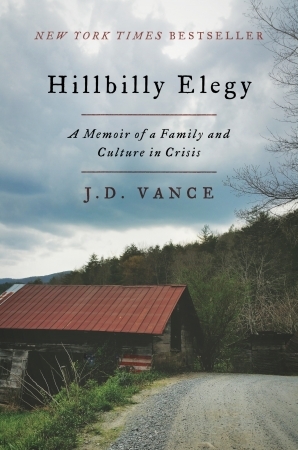 I say curious because Vance attributes his ability to “escape” from the poverty and dysfunction of Appalachian Kentucky to the efforts of his grandparents in offering him a stable home. While his mother was besieged by drug addiction and a succession of boyfriends that paraded through Vance’s life, spending time with Mamaw and Papaw (who interestingly, lived apart from one another), kept his eyes focused on the prize just enough to enable him to get into college and eventually attain the American dream, attending Yale Law School and moving to the Silicon Valley area, where he now works for an investment firm.
Yet there is an inconsistency to Vance’s story. While crediting the stability provided by his grandparents as life-saving, Vance fails to mention why their lifestyle differed from those around them. It turns out that his Papaw had a good job at Armco steel, where he was probably a member of the union—curiously (or perhaps not), Vance fails to mention this. Papaw retires with company stock and a lucrative pension, all benefits directly related to the influence and presence of the union—yet a few pages later Vance expresses his undying fealty and devotion to ex-Indiana governor Mitch Daniels, a guiding light of the Tea Party movement and one of the most virulently anti-union politicians in recent history.
More recently Vance penned an op-ed article for the New York Times in which he excoriated Hillary Clinton for her description of some Donald Trump supporters as “deplorable.” Yet while decrying the political insensitivity of Obama’s description of folks embracing their “guns and their bibles” and Hillary’s “deplorable” comment, Vance simultaneously wants to dismiss the racism and identity politics at the heart of Trump’s appeal to poor white voters. In the process he begins to sound awkwardly like an apologist for the good ol’ boys of his childhood environs because really, that Confederate flag flying proudly from their pick-up truck isn’t about race… right?
Despite the inconsistencies, this is an entertaining read… in the same way that watching the dysfunction and foibles of reality tv is entertaining.
Bill Lundgren, reader, critic, blogger, athlete, teaches at Southern Maine Community College.
September 28, 2016
In the Trump Mines
 It’s the familiar lament of the political cartoonist. As a human you hate the politician and want them gone as soon as possible. But as a cartoonist, you want the same person to stick around for a long, long time. This has never been more true than with Donald Trump. Who wants to spend four years drawing Hillary?
The problem is not an acute one for me as I am no longer a professional cartoonist. I’m a writer and probably should stick to what I do best, but every four years or so I feel some sort of evolutionary, almost primal, prodding to pick up the pen and dip it in ink. It worked out pretty well with Romney and I was pleased with my caricature of him (which was challenging since he is blandly handsome). Trump has given me fits, however. I think it’s the same with satiric writing about him: how do you caricature someone who has pushed himself beyond caricature? But for me it’s even more basic than that. I don’t have him yet, and that bugs me. While my wife self-medicated (red wine) to get through the debate, I sat there with my drawing board in my lap drawing Trump after Trump after Trump. Sometimes I felt so close to capturing him…it should be so…easy….that strange little pouty kissy thing he does with his mouth…..the Grinch-like frown…..the brows pulled down like an angry Dad…..the sighs and overblown body language…..it’s just sitting there, a caricature already, so why can’t I just get it? I draw forty more Trumps and still, like a disobedient dog, he won’t come.
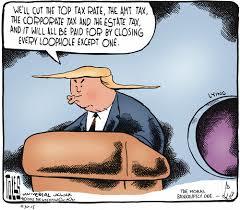
I google “Trump cartoons” to see what’s out there, and with a few exceptions, I see I am not alone in my struggle. I no longer have an insider’s sense of what is going on in the political cartooning world. By the time I quit it seemed like a kind of stupid art form to me, just beating 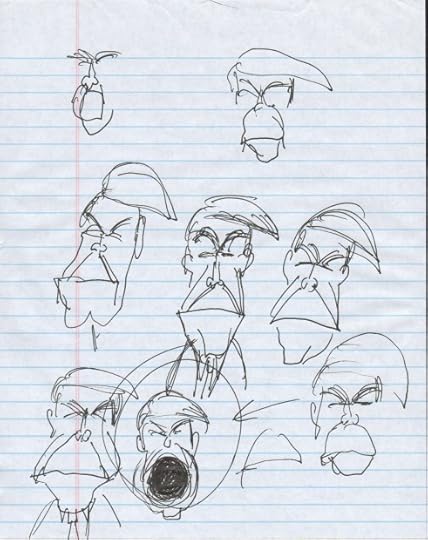 a dead horse, and then beating it again, even though it was really dead, and then again and again. But Tom Toles, who is now with the Washington Post, brought a lightness, absurdity, and real sense of humor (which is surprisingly rare) to the art form, just as Patrick Oliphant had earlier elevated the form through sheer artistic genius. Toles could never hold Oliphant’s brushes, artistically speaking, but his caricatures, quick sketches that are like slightly fleshed-out stick figures, are genius of their own sort. And I see that his Trump is pretty damn good. He seems to have wavered for a while but is now going full Kissy Face. Like this:
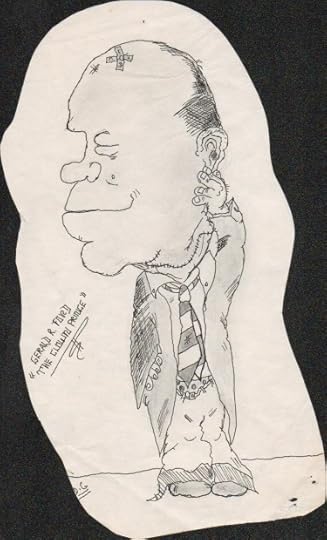
My most serendipitous presidential caricature was Gerald Ford, who I first drew when I was about my daughter’s age, thirteen. I wasn’t even trying to draw Ford, who with his bland features and bald head defeated much better artists than me, when a kind of fetal Frankenstein just jumped off my pen, all at once, full-blown and full-born.
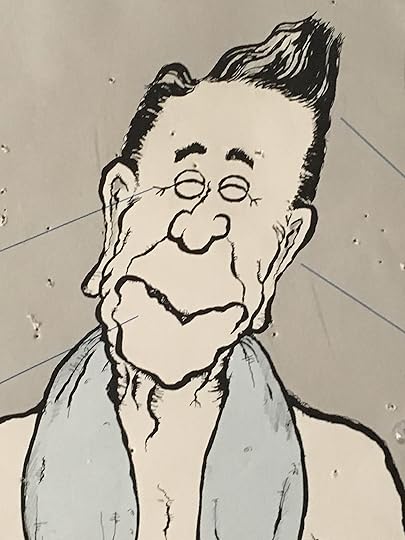
Of course the only President who I ever feel I got cold was Reagan. That was partly because he reigned during the time when I cartooned full time, before writing took over. I drew him all through college and then, after graduation, drew a poster of him that my friend Dave Rotman and we marketed (or tried to market) nationally. Before I drew the final version I spent a few weeks up in the attic of my house on Cape Cod drawing Reagan after Reagan, auditioning various versions for the poster. That poster, thirty-three years old, is thumbtacked to the wall above me where I type now. Here is a photo my Reagan’s face:
I would like to do the same with Trump, though I’m an amateur now, with a day job and without the time for the necessary obsession. Still, I can’t feel like Trump is right there, on the other side of an invisible wall. And if I keep sketching, doodling, maybe he will suddenly appear, right there under my pen. I hope I get him before he’s gone. Of course more than that I, or at least the non-cartoonist parts of me, hope he’s soon gone, whether I get him or not.
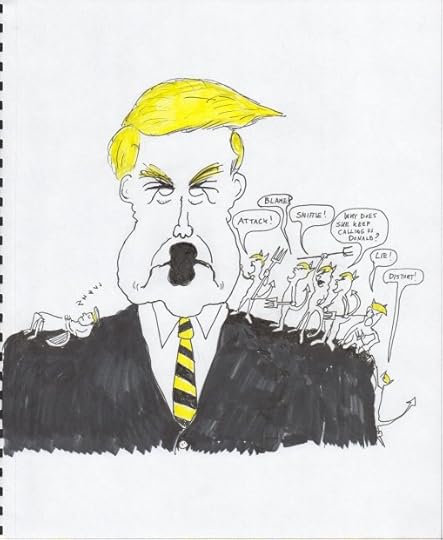
P.S. The only Trump cartoon I’ve done that I’m truly pleased with has been one that is too crude to publish. It’s the only one that’s “jumped off my pen,” so to speak. Since this is a little further down in the page I’m going to sneak it in here:
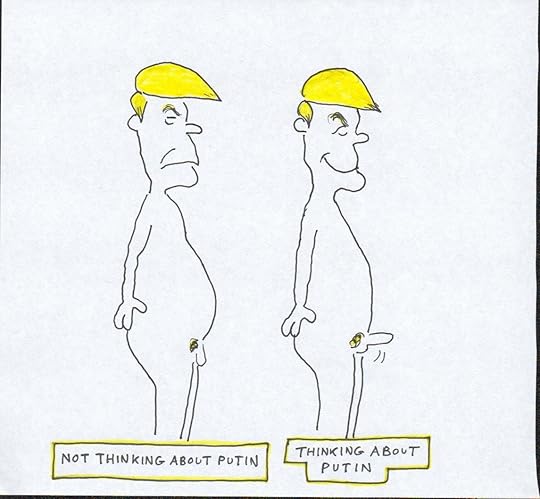
September 27, 2016
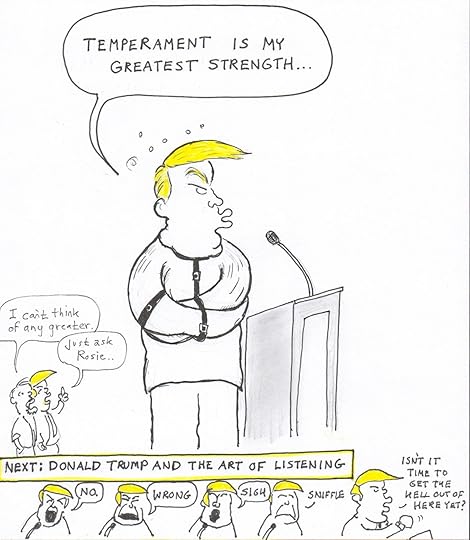
September 23, 2016
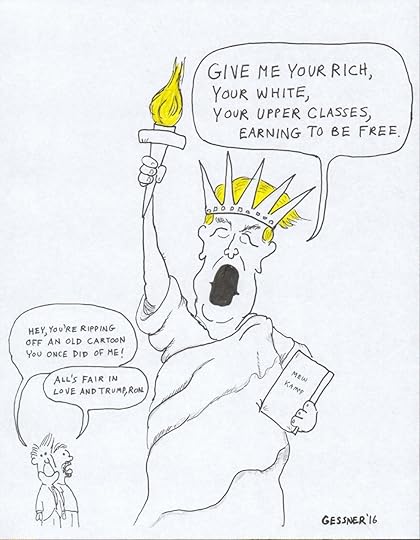
September 14, 2016
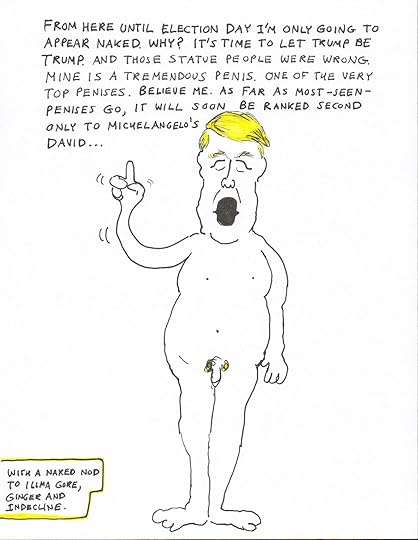
September 13, 2016
Lundgren’s Lounge meets Bad Advice Wednesday: Do Your Summer Reading this Fall

Bill Lundgren with Pearl the Blind Pug
The return to school and teaching duties in the fall always comes with a bittersweet sense of loss. Gone the unfettered freedom of summer with the absence of deadlines and in their place swimming and gardening and hiking and baseball and most of all, reading… savoring the exquisite pleasures of books and marveling at the universe’s talent for selecting just the right book at just the right time. Below are a few of the highlights of the past summer’s reads. But don’t let Fall keep you from discovering them all:
Underground Railroad by Colson Whitehead—I have been a fan ever since the dense, mysterious layers of The Intuitionist. In Whitehead’s latest the underground railroad is not merely metaphor, but a living, breathing beast that runs from Georgia to Maine beneath a society riven by the evils of slavery.
Everybody’s Fool by Richard Russo—in a sequel to Nobody’s Fool we return to the upstate New York hamlet of North Bath and the adventures of Sully and his merry band of misfits, only this time the focus is on chief of police Doug Raymer. Reading Russo is like spending time with one’s favorite uncle, who also happens to be America’s consummate storyteller.
The Fire This Time edited by Jessamyn Ward—a brilliant anthology of writings riffing on James Baldwin’s letter to his nephew warning of the perils of being Black in America, an issue that will not go away because we refuse to honestly address it.
The One-in-a-Million Boy by Monica Wood—a heartwarming tale of love and grief and people coming together to find their way in the world. Tender, hilarious and as always with author Wood, exquisitely crafted.
Barbarian Days by William Finnegan—I have been a fan of Finnegan’s ever since reading his under appreciated classic of youth culture in the contemporary U.S., Cold New World. Barbarian Days is a memoir recounting the author’s lifelong obsession with surfing, from a dissolute youth roaming the world in search of waves to the renowned author and family man who continues to be entranced with surfing.
Hillbilly Elegy by J. D. Vance—this curious memoir of growing up in Appalachia perhaps reflects our growing national preoccupation with the forgotten culture of the Rust Belt and a group of people that have seemingly been left behind in the wake of globalization. Vance escaped to Yale Law School and silicon valley but has never lost his fondness nor fealty for hillbilly culture.
Underground Airlines by Ben Fountain—in a futuristic United States, the Civil War never happened. Instead, in the aftermath of Lincoln’s assassination a compromise is reached where four southern states are allowed to continue practicing the peculiar institution of slavery. Add in a tortured slave-catcher and myriad twists and turns… riveting.
The Accidental Life by Terry McDonnell—former editor of Outside, Men’s Journal and Esquire magazines, McDonnell shares his memories with the writers that peopled his fascinating world, among them Jim Harrison, Tom McGuane, James Salter, George Plimpton and Hunter S. Thompson.
The Sport of Kings by C. E. Morgan—a majestic, sprawling novel that uses the lens of the thoroughbred horse racing world of Kentucky to examine race and power in America. Morgan’s clear-eyed gaze and prodigious writing talent mark this as a book that will endure.
Bill Lundgren, reader, critic, blogger, athlete, teaches at Southern Maine Community College.
September 7, 2016
Bad Advice Wednesday: Start your Writing Machine!
After how many years in school, and then 25 more as a professor, I’m hopelessly (and happily) hooked into the academic year. Summer is a time to refill the buckets of the soul–but come September, all those ideas from all those sunny days with all those friends old and new start to take paragraph form, my brain begging to get back to work, my fingers itching for the keyboard. I don’t teach anymore, but I’ve kept the writing machine oiled and ready to go, dependable old thing! And I’ll be getting back to Bill and Dave’s, as well. Dave’s already in–but in the south, you know, they start school early.
Ladies and Gentlemen, start your engines!
September 3, 2016
Nature Good. Screens Bad.
This has been getting a lot of play since National Geographic posted it on their Facebook page last week:
http://channel.nationalgeographic.com/explorer/videos/5-things-to-know-about-the-call-of-the-wild/
And here’s the hulu link again: