David Gessner's Blog, page 30
July 30, 2014
Bad Advice Wednesday: Don’t Wait Till the Last Minute Like Me!
It’s still Wednesday, by nine minutes. I just want to say: don’t wait. Not only don’t wait till the last minute like me, but don’t wait. So many times an acquaintance with a great book idea or story to tell will describe it and then say: Can’t wait to get started. What they mean by that is: I’m waiting to get started. Till I have some time off. Till the kids are grown. Till I’m done with grad school. Till, till, till, till, till.
But honestly, that’s not how it’s done. How it’s done is by doing, in whatever increments of time present themselves. Because that ideal time just never comes.
Today, I had NO TIME for Bad Advice. And yet here I am, nipping minutes.
A variation on the theme is the writer who’s doing research. Research. Research. Research. That’s the clock ticking again.
Okay, I’ve got six minutes.
After you read this, if you’ve got some great idea that’s not getting done, take twenty minutes or five or even just one and start writing it. Then, when you can, take another minute and continue. Watch your mind start working the real problems of the story. Which are never, Where’m I gonna get the time?
Okay, four minutes left. I’d better proofread and add tags and find an image and call it a post!
11:59!
Must hit publish!
follow Bill on twitter! Good stuff! @billroorbach


July 29, 2014
July 27, 2014
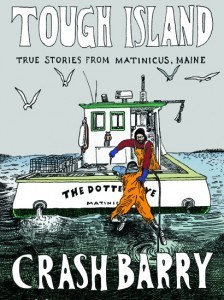
Serial Sunday: “Tough Island,” by Crash Barry (Episode 29)
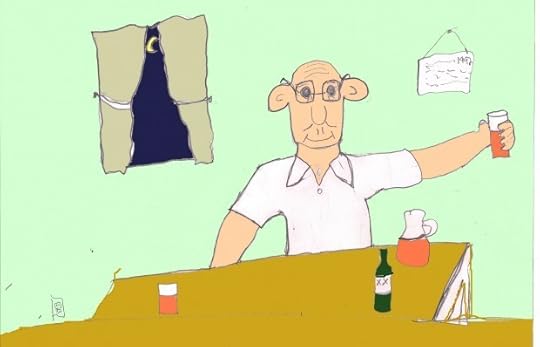
Captain Emery
“You know what ruined this island?” Captain Emery asked, slurring his words because the orange juice mixed with moonshine from his basement still was powerfully strong. “Radio! Radio ruined this island!” We were drinking at his kitchen table. Emery – in his early 80s – remembered the days before radio. “Back then we had dances.” He paused to take another long sip. “We’d have church socials. Play games. Play cards. Sing songs.” He sighed. “Then radio comes along, with its news and music and stories, and people would just stay home and sit in front of a box.” He snorted and shook his head. “Nowadays, nobody does nuthin’ together.” He pointed at me. “And everyone hates everybody else.”
Emery was a funny looking fella, short and stocky with big ears and a long nose. He sort of looked like the little homesick alien in the movie ET. I’d heard from other islanders that his reputation as a sexual swordsman was well known across Penobscot Bay. Even as a rugged elder, he mischievously flirted with females of all ages. Girls swooned under the spell of his twinkling eyes and crooked grin, wanting to hug and squeeze him. He always obliged. Emery’s fishhouse was next to Edwin’s. He was the oldest man still lobstering on the island. His traps were made from spruce, not wire. His arms were huge from a life of hard labor and his brain was filled with the knowledge of natural history. He understood what the clouds and birds had to say. He could smell storms and tell which way the breeze would blow. He trusted his gut more than technology.
I really liked learning from him. That’s why we were drinking the moonshine. We’d spent the whole day working on the shore, jacking up his fishhouse. Before Emery showed me how, I had no idea two humans could lift a building. He appreciated my help and wanted to repay me with cocktails and conversation.
“Radio,” he repeated emphatically, “radio ruined this island.”
#
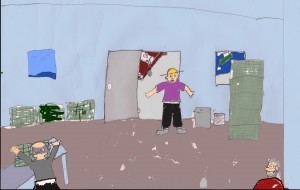
Wrestle Mania is on the satellite tee-vee!
One wicked windy morning, I was working in a huge shop, a hundred feet from Emery’s and Edwin’s fishhouses. It was an illegal building, constructed without permits or permission. Upstairs were unfinished apartments. Downstairs was a big open space, shared by several lobstermen. To make some extra cash, I was bending wire and building traps for another captain, a newly learned skill that I enjoyed. A half-dozen other men were involved in similar trap-related tasks. To me, the labor felt ancient and traditional, despite the thump, chortle and hiss of the compressor that sporadically drowned out the rock ’n’roll coming from the radio, courtesy of WBLM. Philly’s truck came speeding down the dirt road and screeched to a stop in front of the shop.
Philly, the 65-year-old ne’er-do-well father to a couple of the meanest outlaws that ever called the island home, climbed out of the pick-up slowly – because Philly didn’t do anything fast, except drive his truck. Truth was, his brain was dim. Islanders blamed the fact that his mom and dad were brother and sister. Philly’s torpor could have been caused by drugs, too. He was a pill-head. A lover of Valium, he popped ’em like candy. His speech was sluggish and his sense of humor non-existent. Listless, lethargic and droopy-eyed, Philly constantly seemed to be on the verge of falling asleep while standing up. This morning, his mission must have been urgent, because he almost sprinted into the shop.
“Everybody!” he yelled, then paused to wheeze. “Let’s go!” Was there a house on fire? An injured child? A shipwreck? A sinking boat? “WRESTLEMANIA!” he hollered. “WRESTLEMANIA IS ON THE SATELLITE TEE-VEE!”
Within a minute, the place was almost empty. The gang filled the back of Philly’s truck and raced up to his house in the middle of the island, home to a swimming pool–sized satellite dish. Not me, though. I stayed down on the shore and kept building traps, listening to the radio.
 Crash Barry will be appearing at the
the Jesup Library in Bar Harbor on Thursday, July 24, at 7 p.m. Signed copies of his books Tough Island, Sex, Drugs and Blueberries and Marijuana Valley are available via crashbarry.com.
Crash Barry will be appearing at the
the Jesup Library in Bar Harbor on Thursday, July 24, at 7 p.m. Signed copies of his books Tough Island, Sex, Drugs and Blueberries and Marijuana Valley are available via crashbarry.com.
July 21, 2014
Lungren’s Lounge: “The Last Magazine,” by Michael Hastings

Michael Hastings
Michael Hastings was the personification of a modern day journalistic Zelig. Beginning his career as an unpaid intern at Newsweek magazine, he began covering the invasion of Iraq when his fiancee, working for an NGO, was killed in an ambush that received international attention and resulted in his first book, I Lost My Love in Baghdad. He later wrote a piece for Rolling Stone magazine that described the barely-concealed disdain that high-ranking military officials felt towards the politicians in charge of the war effort. The resultant political and media shitstorm ended with the resignation of Gen. Stanley McChrystal, commander of U.S. forces in Afghanistan and Hastings’ award winning book, The Operators. He next turned his attention to the Occupy Wall Street movement and the secretive surveillance of the movement by Homeland Security, and then penned a profile of Bowe Bergdahl, long before Bergdahl became the subject of international fascination after his release from Taliban captors in a prisoner exchange.
And shortly before he died in a fiery car crash in 2013 Hastings was covering what he described as the “war” on journalism being waged by the Obama administration. His final piece, published by the blog BuizzFeed, was “Why Democrats Love to Spy on Americans.” Shortly before his death, Hastings was reportedly working on an investigative piece about the CIA. Although his death was ruled an accident, conspiracy theories proliferated, including the observation by former NSA advisor Richard Clarke that evidence from the crash was consistent with a car cyber attack. Clarke pointed out that the world’s major intelligence agencies are presently quite capable of seizing remote control of a car.
Though we may never know for certain what happened to Hastings, what we do have is a posthumous novel detailing his days at Newsweek in the period leading up to the first U.S. invasion of Iraq. The Last Magazine is a scathing, profane, hilarious, depressing account of the state of journalism in a contemporary world, where the fourth estate has abrogated all responsibility to report and become instead a whorish shill for corporate interests.
In The Last Magazine, Hastings depicts the shortcomings of traditional print journalism as that medium is gasping its final pathetic wheezing breaths. Though the account is uneven, as any posthumous, ‘unfinished’ manuscript will be, it is a valuable addition to the story of how we have arrived at the sorry state of affairs today, where trust in any form of media is undermined by the special interests that Hastings is warning us about. Beyond being an engrossing page-turner of a novel, this book is evidence of the mania and brilliance of Michael Hastings and a living testament to his ferocious journalistic ethic to tell the story, warts and all.

[Bill Lundgren is a writer and blogger, also a bookseller at Longfellow Books in Portland, Maine (“A Fiercely Independent Community Bookstore”). He keeps a bird named Ruby, and teaches at Southern Maine Community College.]
July 19, 2014
The Song of Valerie Macon
 The Song of Valerie Macon
In the land of Pat McCrory,
Where we all live Art Pope’s story,
Where we all must praise the fetus,
Or else be damned as an elitist,
Came a poet brave and true.
Came a poet brave and true.
Not some fancy, school-learned bard,
Using words that are too hard,
No! A rhymer for the masses,
(When she wasn’t taking classes,
Or awards she wasn’t fakin’,)
In she strode, our Valerie Macon.
Decreed the One by Lord McCrory,
She would tell our state’s true story,
She would sing of sea and mountain,
Spewing as if from a fountain.
And she woulda, woulda too,
If not for fancy folks like you.
Out they crawled the poet folk,
And in that sneering voice they spoke,
“This Val she isn’t one of us,
She has no airs, she rides the bus,
She simply cannot wear the laurel,
She needs a poetry tutorial.”
And though old brave McCrory fought it,
It was clear that Val had bought it.
The fancy folk with their degrees,
Had brought proud Macon to her knees.
So sing with me of good Val Macon,
From whom the laurel wreath was taken.
It’s true she knew not meter nor diction,
(Though her resume showed a gift for fiction.)
Alas, her laureate days are fin,
(The poet lobby, they always win).
Who knows, if they hadn’t dragged her down,
She might have proudly worn the crown,
She might have sung of our great state,
Its tolerance, its beauty, and, yes, its hate
She might have turned on old McCrory,
She might have sung, in rage and glory,
“You’ve sold us out for Art Pope’s cash,
Your smallness spreads just like a rash.”
But no, we’ve driven her from town,
Dragging behind her faery gown.
And now the governor, surely vexed,
Decides alone who will be next.
He ponders hard, a brooding Zuess,
“Why not a poet I know….like Dr. Suess?
Or someone like me, a crony, a pal.
Uncluttered, unpublished, like our dear Val.”
But oh the fancy folk conspire,
And he doth know what they desire,
A poet like them, with prizes and books,
A stuck-up sort with priggish looks.
And so when the common man goes down,
Some Poindexter will wear the crown.
So sing once more of good Val Macon,
From whom the laurel wreath was taken,
Not some fancy professor dropping names,
Just doing her job: disability claims.
She could have sung of unwashed masses,
Instead she’ll be back in our classes.
July 18, 2014
My Budding Ears, or, On Being an E-Hypocrite
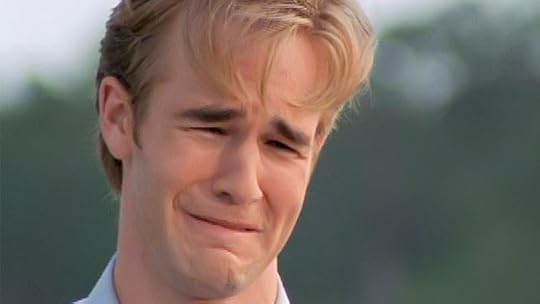
Dawson, sad about his creek
I’ve spent an inordinate amount of time on Facebook over the last 14 hours (these hours included eight hours of Facebookless sleep) which of course leaves me feeling a little bit guilty, unworthy of the serious writer mantle that I like to wear (except in summer). Part of this spasm of activity was due to the fact that Salon picked up my “Up Shit Creek” piece and then a few other places picked it up after that. Which is to say I enjoyed the small ego buzz of being noticed while at the same time cringed at the exhibitionist spectacle of yet another author (in this case me) waving his arms around and yelling “Hey, look!”
But that’s not entirely fair–to myself or others–and what I’d like to try to be here is fair, or at least a little balanced, rather than blasting away, in grumbling old man fashion, at all things E. I’ve been doing a lot of that this summer by the way. Grumbling and cursing. With good reason. As bad as it was back on the campus in Wilmington, it’s much worse in Harvard Yard. You have to remember that here, unlike in the South, people never said hello or looked at each other in the first place. Now there’s not a chance of it happening. At night they all stagger around the Yard like zombies, their faces lit up by the machines they stare down into. To further insulate themselves, many of them have buds in their ears and talk out loud with no one around like packs of schizophrenics.
And so I have muttered and cursed my way through the summer. One night, with my poor appalled daughter walking next to me, I started actually accosting the i-people, saying things like “What are the orders from central control?” or “What is the robot leader telling you?” “Dad!” Hadley yelled. Until that moment she had through the height of being appalled was the fact that neither of her parents owned an i-phone.
But of course, like everyone else this side of Wendell Berry, I am a big fat hypocrite. In the late spring, training to run a 5k with Hadley, I broke down and bought an i-pod. Maybe I once romanticized running, liking the animal aspect, but at this point it is everything I can do to run 3 miles, and if that means blasting Springsteen or the Talking Heads into my ears, so be it. I have continued this unseemly practice up here, running along the Charles, at least until five days ago. That was the day I made the tragic mistake of thinking these thoughts (in full sentences) after my run: “You know, I’ve had a lot of injuries and ailments in my time, but I am very lucky that I’ve always had good knees.” Of course the next day I heard a little pop. Two days later I replaced running by the river with walking by the river and, as I headed out for my first walk, I instinctively grabbed the i-pod.
Now running with an i-pod is one thing. It’s a way to get through something tough. But walking? Walking is a nature writer’s bread and butter; walking is how I think; walking is where I get most of my words. Not only that, if I put those buds in my ears I was becoming just like the zombies I hated so. Right? Perversely, I did it anyway. And something strange happened. It is true that my best thoughts often come from walking, but it is also true that half the time my thoughts aren’t so great when I walk, especially in the city, and amount to little more than the usual hamster wheel worries and irrational anxieties that fill my mind at least half of my waking hours. Now, suddenly, there was music! The volume was still loud, from the running, and I was listening to it and not worrying. I started walking to the beat of Steely Dan’s “Home at Last,” and at one point did a little Ali-shuffle with my feet. And then something even stranger happened: crossing the bridge by the boat house, caught up in some song by REM, I saw a pigeon–just a pigeon–take off from in front of me and fly out over the water. And my brain flew with it–as surely as it ever did with ospreys. I had the sort of brief ecstatic moment I used to have a lot when I was a teenager, before my mind got rutted down. The moment went away–these moments are always brief and transitory–but then came back again when I saw the leaves of an oak tree fluttering.
What was happening? How had my i-pod turned me into Whitman? I suppose it was just a kind of short circuiting of my habitual thinking. One of the reasons I used to have more moments like that is that I wasn’t as used to my brain as a teenager, and now somehow the music scrambled my old brain so it felt new again.
Which brings me back round to Facebook. Sure there were the usual lesser–perhaps sleazy and certainly self-involved–reasons for posting about my essay. But that led quickly to some fun chatter and then to another post about not knowing how to use Dropbox, which led to a bunch of funny jokes from old friends from all over the country, and suddenly I was having fun typing, and though I was alone sitting in the little courtyard in front of our apartment drinking a couple of beers, I felt as if I was at a party.
P.S. I suppose my usual tactic with these little essays is to start moral and turn more human and open. But this postscript is the moral part, not to say the moral. I still reserve the right to grumble about i-phones. Why? Because once Nina and Hadley got home, my e-party ended. I put away the computer and we went out to Legal Seafood and then came home to bed and I didn’t turn the machine on again until morning. If I owned an i-phone or other sort of smart phone that would have been impossible. There would have been no time away.
Or maybe it is possible. But if it is, I haven’t seen it. In fact, I’ll end with a question. Have you ever met anyone who owns a smart phone who is able to use it discreetly and politely? Anyone who is not at least occasionally rude?
July 16, 2014
Bad Advice Wednesday: On Getting It All Wrong
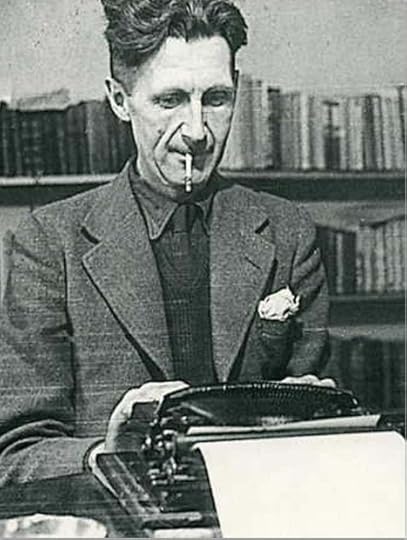 I re-discovered George Orwell in a Paris bookstore in July of 2013. I was scanning a case of books about Paris, hoping to find a title that would help me better savor the pleasures of the city, when I spotted a forlorn copy of Orwell’s Down and Out in Paris and London on the bottom shelf, eclipsed by the glitzier travel offerings. I brought it back to my hotel and started it that afternoon.
As I read Orwell’s nonfiction account of living and working among the lower classes in two of Europe’s capitals—washing dishes in the basement of a swanky Parisian hotel, sleeping with the homeless in Trafalgar Square, picking hops with migrant workers in the London suburbs—I was astonished at how beautifully and insightfully he captured the lives and conditions of the poor and marginalized members of his time. His analysis of poverty, its causes and effects, struck me as deeply relevant for today, since Orwell was writing at a time of swelling industrialization and an increasingly globalized economy.
Down and Out sent me into Orwell’s other writings about the poor and oppressed classes of his time. He chronicled the horrific working conditions of miners in the north of England in The Road to Wigan Pier; he gave an account of sleeping in homeless shelters in “The Spike”; he depicted the oppressed peoples of the British empire in “Shooting an Elephant” and “A Hanging.” I found all of these analyses equally penetrating and eloquent.
What a prophet, I thought to myself! Everyone knows that Orwell accurately prophesied things like the rise of the police state, the failures of communism, and the denigration of the English language; but it seemed to me that the world had yet to see his equally brilliant analyses of poverty. I became totally convinced that, eighty years after he wrote them, his arguments on this topic deserved a fresh airing. I envisioned a book project in which I would present the world with Orwell’s trenchant analysis of poverty in a capitalist society, and highlight how vital his work remained for us. My tone would be reverent—I would be a humble acolyte broadcasting the genius of the master.
So I dug into Orwell more deeply. I read his early, mostly forgotten novels (ever hear of The Clergyman’s Daughter or Keep the Aspidistra Flying?); I ploughed my way through a four-volume collection of his essays and journalism; I read several book-length volumes of his letters.
And did so with an increasingly sinking feeling.
While I continued to find powerful insights into poverty, and especially the debilitating effects it has on those who suffer in its grasp, I began to see that the prophet Orwell made many predictions that have turned out to be dead wrong. Worse still, he usually made them publicly and quite confidently.
Many of his ill-made prophesies stemmed from his conviction that World War II would destroy Christianity and capitalism. So here, in an essay on the novels of Henry Miller called “Inside the Whale”:
“What is quite obviously happening, war or no war, is the break-up of laissez-faire capitalism and of the liberal-Christian culture . . . Almost certainly we are moving into an age of totalitarian dictatorships—an age in which freedom of thought will be at first a deadly sin and later on a meaningless distraction.”
One sees here glimmers that will result in the storyline of 1984—but not the storyline that would play out in the real world. Still, while Orwell feared the rise of the totalitarian state, he was quite happy with one positive result he foresaw from the death of capitalism. Separate economic classes, he predicted, would disappear:
“This war, unless we are defeated, will wipe out most of the existing class privileges.”
Ahem.
Orwell wasn’t just wrong about the big economic issues of the day. For several years he wrote a weekly newspaper column called “As I Please,” and one of those columns takes up the pressing question of whether or not humans will ever be freed from the drudgery of washing dishes. Orwell envisions that the eventual solution will be communal dishwashing:
“Every morning the municipal van will stop at your door and carry off a box of dirty crocks, handing you a box of clean ones (marked with your initial, of course) in return.”
Mistaken predictions like these can be found all through his published and unpublished essays, on topics large and small. But one of the reasons I love Orwell was that he was his own best critic. Writing while the war was winding down, he looked back at his own work and noted how wrong he usually was:
“One way of feeling infallible is not to keep a diary. Looking back through the diary I kept in 1940 and 1941 I find that I was usually wrong when it was possible to be wrong.”
So Orwell was not quite the infallible prophet that I had first imagined I had found. Part of that may stem from the fact that he was such a prolific writer—his collected writings total more than 8,000 pages—who frequently engaged with political topics in magazines and newspapers. But part of it stems from the fact that he was a human, and humans aren’t perfect.
Once my initial disappointment at Orwell’s humanity wore off, and I continued to dig my way through his collected works, I could see how much valuable insight still remained from his early nonfiction writings, and a new way to think and write about Orwell, and his continued relevance for us, began to take shape in my mind. I’m still writing the book, even if it won’t quite be the one I first envisioned.
But reading his collected works, and seeing how often he got it wrong, has changed my relationship with Orwell. I no longer see him as an untouchable genius, as the author who produced masterpieces of political prophecy, and who perches atop his literary throne above the rabble of the rest of us.
Nope, Orwell was a writer who sometimes got it wrong—among his other faults. He also liked to make fun of people he referred to as “sandal-wearing vegetarians” or “fruit-juice drinkers.” And he made occasionally baffling remarks like “you can only love your enemies if you are willing to kill them in certain circumstances.” Some of his essays have really terrible endings. His early novels are mediocre at best—a fact which he also recognized, requesting that one of them never be reprinted.
As a writer myself, this was all quite liberating to discover. Orwell was a writer, and he did all the things that the rest of us do: struggle with words every day, write occasional bad sentences, get things wrong, haggle with editors and publishers, plead with his agent for better deals, and churn out essays when he didn’t have much to say. He did, in other words, the same stuff that I do.
So for my bad advice this Wednesday, I recommend that you read some really terrible shit by your favorite canonical author. Get a collection of their letters, their early essays, or that first or last novel that nobody reads. Read James Joyce’s poetry, or David Mamet’s political screeds. When your heroes have been knocked off your pedestal, you might find that hanging around with them becomes more enjoyable. They’re not perfect, and neither are you.
But don’t let that stop you from writing—Orwell never did.
James M. Lang is the author of four books, the most recent of which is Cheating Lessons: Learning from Academic Dishonesty, published last fall by Harvard University Press. His current book project focuses on George Orwell’s nonfiction writing about poverty. Visit his website at http://www.jamesmlang.com or follow him on Twitter at @LangOnCourse.
July 14, 2014
The New Ecotone is Coming!
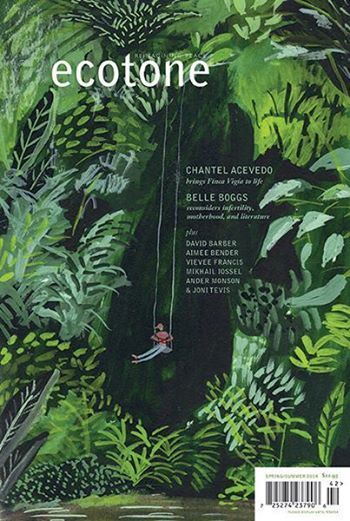
The cat is out of the bag. Our summer issue is now at the printer and heading for newsstands soon. Look for new essays by Belle Boggs, Joni Tevis, and Ander Monson; poems by David Barber, Carrie Fountain, Vievee Francis, Margaree Little, Dexter L. Booth, and Melissa Range; and stories by Chantel Acevedo, Clare Beams, Vedran Husic, Delaney Nolan, and Matthew Neill Null, whose novel Honey from the Lion is forthcoming from Lookout Books in 2015. The cover painting and art portfolio are by Kirsten Sims Illustration.
July 13, 2014
Serial Sunday: Crash Barry’s “Tough Island” (Episode 28)
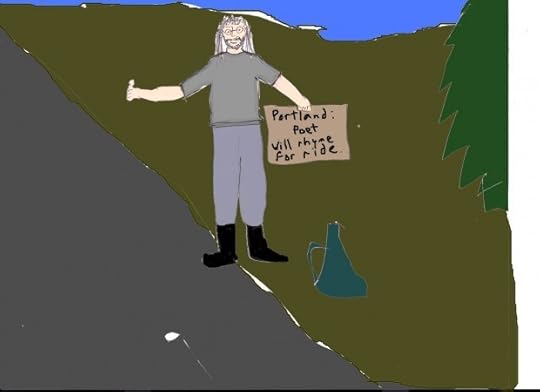
Edwin and Nan dropped me off on Route One. My cardboard hitchhiking sign read: “PORTLAND: Poet, will rhyme for ride!” Tall and strong, with long hair and a beard, I looked like a cross between Charles Manson and Jesus Christ. The first ride gave me a lift as far as Waldoboro.
The second ride was a dream come true. I was standing on the foot of the hill across from the Shop ’n Save when a primer-gray VW GTI stopped for me. A beautiful blonde girl, in her early 20s, sat behind the wheel. No one in the back seat. Seemed like the beginning of a fantasy. Or a pornographic film.
“I’m going to Portland,” she said. “Hop in.”
Her name was Ginger and she was hot. A great laugh. Sparkling blue eyes. Luscious lips. Plus a small canister filled with potent purple weed. After I admonished her for picking up a fella as crazy-looking as me, we pulled into a rest area and got wicked high. And talked and talked. I recited a poem about rejected refugees and told her about my time in Haiti. Then I told her about Buzz shooting at my shack the night before.
“Oh my,” she said, putting her hand over her mouth to stifle a laugh. “That must have been awful!” Then she giggled. “But you’re fine now. So it’s kinda exciting.” She looked over at me and smiled. “Why don’t you pack another bowl? Are you in a hurry?”
I felt a stirring from within and the mutual attraction growing.
“Nope,” I said. “Just gotta be down to Portland by five.”
“Great,” she said. “One more bowl, then.”
#
 We continued down Route One. The soundtrack was U2 and The Smiths, Billy Idol and The Cure. We laughed. We joked. I felt wicked comfortable with her. When we arrived in Portland, Ginger seemed disappointed to drop me off. She gave me her number, and I hugged her.
For a second, I realized how easy it would be to change plans and stay with Ginger. No one would know where I was. Alice would be stuck at the Village Café with our parents, wondering when I was gonna appear, but instead I’d spend the rest of the day, the night and my life with Ginger. Smoking purple ganja and listening to new wave with a blonde beauty. We’d fall in love. Fool around a little bit, at first. No rushing. The sex, I knew, would be awesome. We’d have kids and laugh when we told ‘em Mom picked Dad up on the side of the road.
Instead, I said goodbye. She drove away. I never called.
#
Still high from the ride, I couldn’t understand why my storytelling during the Italian feast at the Village Café wasn’t a hit. Alice was nervous, being around my parents, knowing that later we’d be revealing the big news. Her mom, though, was unusually quiet after she heard the details about the previous night. Turned out Shoe was her second cousin. She was quite embarrassed by my tales of island hooliganism and tried to tell my parents that such behavior was rare. My mom nodded like she understood, but I figured she was remembering their visit and the fella whose truck got shot up.
We skipped dessert and my future in-laws invited us all to their Winnebago parked in the Village Café parking lot. Over coffee, Alice and I revealed our big news. I’d been accepted for the winter semester at the University of Southern Maine. I was leaving the island in January. Alice and I were gonna move in together, then get married the following summer. Both sets of parents acted pleased and issued congratulations. But the tension thickened and the evening ended soon after.
My parents were tired and wanted to get to their motel. Alice’s parents were suddenly in a hurry, eager to head Down East to work their part-time job: Emptying the proceeds from all the pay-per-view binoculars mounted near picturesque sites on the coast.
Alice and I drove to her place in suburbia. Made love. She fell asleep in my arms, while I thought of Ginger.
 Crash Barry wonders what Ginger is doing right now. His books about the seamy side of Maine life are available via crashbarry.com.
July 12, 2014
Getting Outside Saturday: Going Deep
Here is “Going Deep,” my essay on gannets (not ultimate) that just came out in the August issue of Audubon: http://mag.audubon.org/articles/birds/going-deep
Great photo by Andrew Parkinson. In fact, try to take a look at the print issue if you can, to see more of his great shots.
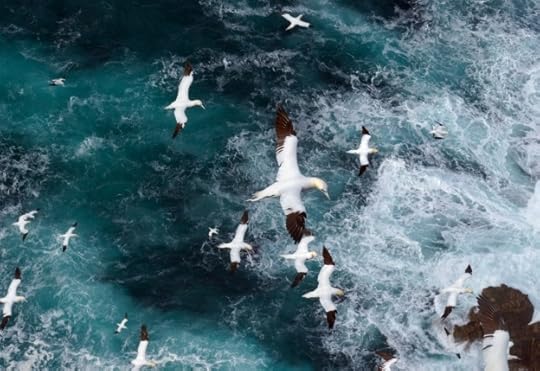
See more of Andrew Parkison’s shots of gannets HERE.