David Gessner's Blog, page 29
August 13, 2014
Bad Advice Wednesday: Greatest Hits
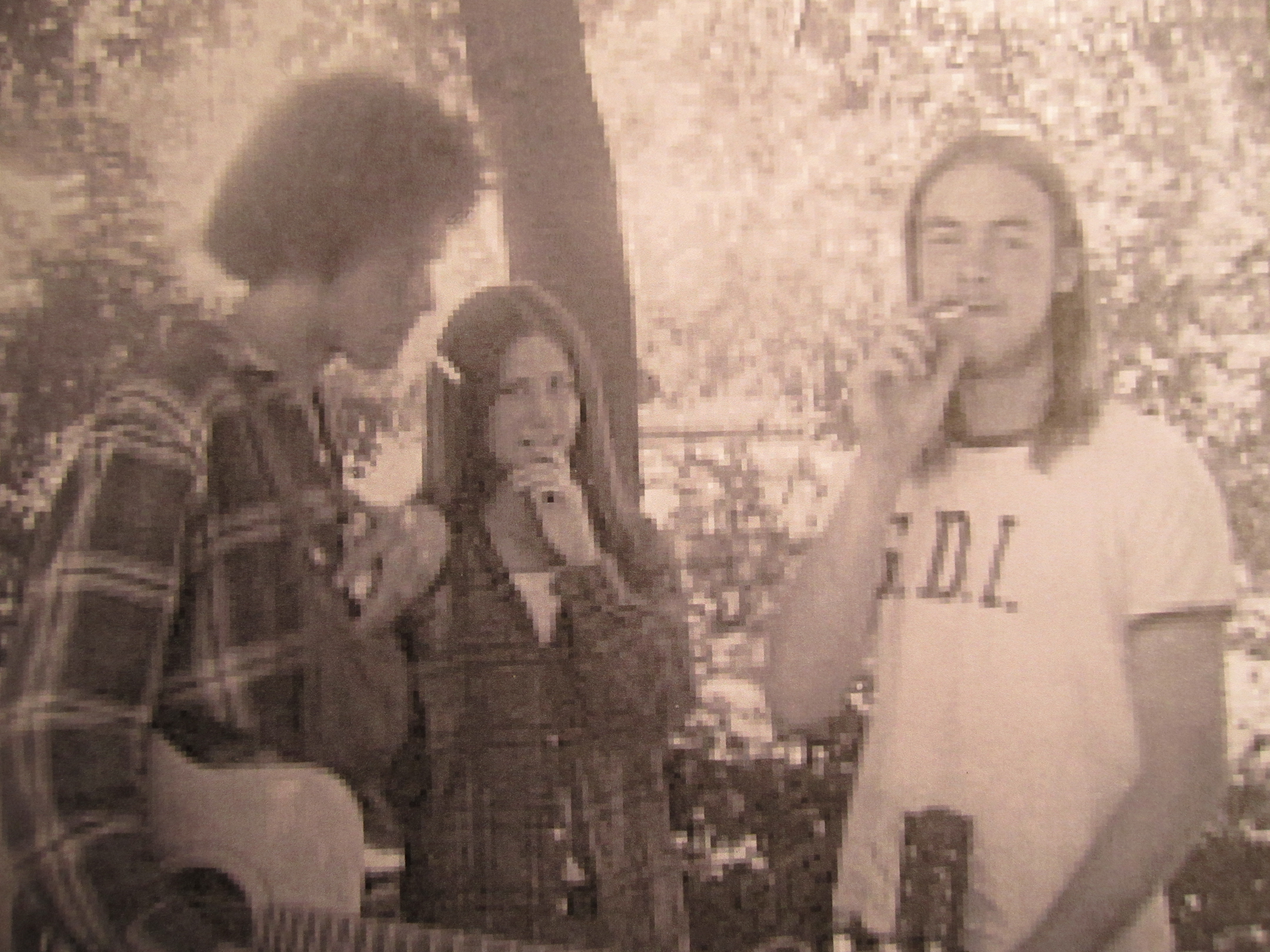
Bill and friends, August, 1972
One of the many curious things about the act of writing is the way it can give access to the unconscious mind. And in the hidden parts of consciousness lie not only hobgoblins and neurotic glimmers, but lots of regular stuff, the everyday stuff of memory. The invisible face of your grade school bully is in there, somewhere, and the exact smell of the flowers on vines in your grandma’s  backyard, along with most everything else, perhaps including borrowed memories, even false ones. Some memories are going to be painful, but some pleasurable, too. An awful lot is just informational, the stuff of lost days.
And—I’m just realizing this—memory is what people are made of. After skin and bone, I mean. And if memory is what people are made of, then people are made of loss. No wonder we value our possessions so much. And no wonder we crave firm answers, formulae, facts and figures. All are attempts (however feeble in the end) to preserve what’s gone. The present is all that’s genuinely available to anyone, and the present is fleeting, always turning instantly to the past. Even facts distort: what’s remembered, recorded, is never the event itself, no matter how precise the measurement (a baseball score is not the game). Memoir is never a re-creation—that’s impossible. At best what we can do is listen to memory and watch memory (the other senses are involved, as well), and translate for those we want to reach, our readers.
If you’ve written fiction at all, you know that detail is required to make a vivid scene. What’s in the room? What sort of day is it? Who exactly is in the scene, and what exactly do they look like? All well and good writing fiction: you make it up. But writing nonfiction, the challenge is different: how to remember. For, of course, if we’re going to call it a true story, the details better be true, right? Then again, we all know memory is faulty. Don’t forget Tobias Wolff: “[M]emory has its own story to tell.”
My sister Carol likes to tell the story of the time our younger brother, Doug, sucked on a hollow toy bolt till it suctioned onto his lips. He was maybe four. She and Mom and Doug were at Roton Point, our run-down beach club in Connecticut, end of the day, marching to the car carrying blankets and towels and pails and toys. Doug was a stocky little kid (we sibs meanly called him The Bullet till he shot up into a slim young man), and he looked cute as hell stumbling along carrying the Scotch cooler with this big blue bolt suctioned onto his lips. In the car he still wore it, all the way to the guard booth, where he liked to say good-bye to the genial old guard who watched the beach gate. Carol tells the story at Thanksgiving and Christmas about every year. And I believe she told it at Doug’s wedding: rehearsal dinner. Anyway, at the gate, Bullet Boy tried to pull the bolt off to say hi to the guard, but it wouldn’t come. He’d sucked on it so long and so hard he couldn’t unstick it. So Carol grabbed hold of the threaded end of the thing, wrestled with it a little till pop it came loose.
And Carol looked at Doug and Doug looked at Carol and then Carol said, “My God!” and so Mom turned and said it, too: “My God!” Doug’s lips—poor Doug!—were ballooned up like some character’s in a cartoon, so big even he could see them. Doug freaked! Carol freaked! Mom freaked! Doug cried and cried, even though it didn’t hurt, but before they could even get near the doctor’s, the swelling had disappeared.
That’s it. Cute little family story. But the trouble is, Carol wasn’t there! I was there. And the bolt wasn’t blue, it was yellow. And that guard was a nasty old guy. I can still see him, all crabbed in his cheap uniform. And Mom didn’t freak; she laughed. She laughed despite herself, because poor little Doug looked so comical, and because—this is important—she knew he’d be all right. And I laughed and laughed, “Bwaa-ha-ha!” because I was a big brother, and big brothers laughed at the misfortunes of younger, at least they did in 1963.
I let Carol tell the story at meals, only occasionally challenging her, and now that’s part of the family story, how we both claim the memory. I know she’s wrong. She knows I’m wrong. Whom do you believe? Does it matter? Maybe we’re both wrong. Is something more important than swollen lips at stake here?
Memory is faulty. That’s one of the tenets of memoir. And the reader comes to memoir understanding that memory is faulty, that the writer is going to challenge the limits of memory, which is quite different from lying. One needn’t apologize. The reader also comes expecting that the writer is operating in good faith, that is, doing her best to get the facts right.
Listen to Darrel Mansell, a teacher of writing, in his article on nonfiction in the old Associated Writing Programs Chronicle.
“You just can’t tell the truth, the whole truth and nothing but the truth about that amorphous blob primary substance—language with its severely limited and totally unrealistic rules and regulations won’t permit it. Furthermore the aesthetic and rhetorical demands of writing won’t quite permit it either. The best you can do is to be scrupulous about facts and conscientious about what you and only you know to be the essential truth of your subject. That way you have a shot at telling one modest aspect of what really happened—something true, up to a point.”
[From Writing Life Stories]


August 12, 2014
The Remedy for Love Pretend Dinner Party and Group Interview
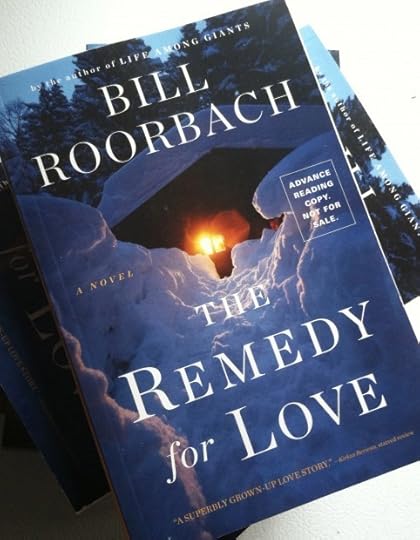
It’s such a pleasure to talk about a new book with friends and acquaintances that I thought I’d host a dinner party to do just that, invite a bunch of writers, readers, booksellers, radio hosts, filmmakers, and musicians, among others, to a bash in celebration of The Remedy For Love. We’ll meet somewhere nice, since it’s all going to be pretend anyway. I’m thinking Kauai, the garden isle of Hawaii, and will foot the pretend bill for all that pretend travel to a pretend luau, complete with fire dancing and hula lessons, all under a flapping tent, ocean breezes, tropical warmth, a fine contrast to the weather in the new novel, which is cold, cold, cold, a blizzard of epic proportions. I’ve given my guests just a little to go on—a quick description of the novel (a small town lawyer tries to help a homeless woman and ends up stuck in a cabin with her during the storm of the century…) , and the quotes above from Peter Heller and David Abrams (two terrific novelists I had the good fortune to meet on the Life Among Giants tour). Because, I don’t want to give away too much! And now, everyone’s assembled, huge round table, cheerful (and well-tipped) servers dropping fabulous food, bowls of rum punch, bottles of wine. Everyone has a gift copy of The Remedy for Love, still gaily wrapped (do not open until October 14, 2014, which is publication day!). The dancing has yet to begin. Amid the laughter, someone speaks up, gets us started.
Melissa Falcon, novelist: Thanks for the month in Hawaii, Bill. That’s one way to get to be the center of attention, you big showoff.
Ellen Cooney, novelist: I’ve got a question for you: How did the title happen? At the start or later? I’m feeling the coolness of the “For” where one would expect an “Of.” Somehow it puts out a sense of something startling and totally genuine.
 Bill (looking out over the surf to the horizon): Wow, thanks, I agree. The working title was Storm of the Century. Which isn’t bad, except that it was a Stephen King book some years back. And sounded a little too much like nonfiction, especially since the weather is just part of the story. My editor, Kathy Pories, and I batted around all kinds of ideas, a lot of laughs (Two People Stuck in a Storm, They Met in a Grocery Store, The Shining), but nothing great was emerging. Then I remembered my friend Liesel Litzenburger, who is a novelist herself, and a kind of title savant. I sent her a very brief description of the book via email, and not four minutes later she shot back a thorough reply (including citations), the story of Henry David Thoreau and his only love. Suffice it to say, the object of Henry’s affection shot him down. And he went home and wrote in his Journals, “The only remedy for love is to love more.” Liesel said, “So there’s your title, The Remedy for Love, but I don’t know if you’re woman enough to pull it off.”
Bill Lundgren, Bookseller at Longfellow Books, Portland, Maine: How much of this new novel has been influenced by the syndrome that John Gorka characterized in song as “The one who got away,” the lost love or fleeting love or missed connection that haunts ever after?
Bill: Maybe in this case more like “The one who couldn’t get away.”
Sarah Bagsby, Watermark Books and Café, Wichita, Kansas: Will there by any children?
Bill: I think we might be getting ahead of ourselves a little here. We don’t even know what’s going to happen when these two meet!
Jamie Ford, novelist: When was the last time that someone broke your heart? Who was it? And are you over it?
Bill: Oh, a while back. I’ve been with Juliet for thirty-something years. But my heart is broken reading all the time, and watching movies, even listening to music, or hearing the news on the radio. I cried when Phillip Seymour Hoffman died. But I guess that’s not quite what you mean.
Desi Van Til, screenwriter, producer (brandishing a leg of suckling pig): The setup for this book sounds like it could be seamlessly translated into a stage play or musical. Has it ever occurred to you to adapt this novel into another medium?
Bill: Of course, I always think about that, at least once the book is done. I’d love an opera of The Remedy For Love. You could have these, like, ghostly figures lit behind scrims the whole time singing all the backstory, while the main characters roamed the stage. The fake snow alone would cost a billion dollars, and the cleaning staff would be grumpy. But what a show! And, seriously, I think it’s going to make a great movie. In a way, it’s already halfway to being a stage play—I use a lot of dialogue in the telling of this one. And I would dearly love to have even the slightest thing to do with live theater. Thanks for the chance to fantasize.

Na Pali Coast, Kauai
Jeff Young, keyboardist and singer with Jackson Browne, Sting, Steely Dan:
Bill, I’ve come up with a term for a certain type of creative musician. I call it SIME:
Self Indulgence at My Expense. Could be a solo played too long by a jazz musician,
A singer who chooses gospel embellishment over the melody, or someone who expects me to spend more time to perform their music than they are paying me for! My question is, can a work of fiction be longer than is necessary, and who would the author
trust to tell him or her that it might be? Would it have to be another author, or could it be
an observant friend?
Bill: I love these hypothetical questions! Life Among Giants was on the long side, especially in draft, and the one to tell me was my editor, among others. But I know you’re not talking about that! This book? The Remedy for Love? This one I started out with the idea that it would be short and sweet. And it is. Two characters, one setting (more or less), backstory under control, all to be read in a frenzy. I want to keep people up all night, get them fired from their jobs for sleepwalking.
Cheryl McKeon, Manager, Book Passage Ferry Building, San Francisco: You have such an appreciation for nature. Is it tempting to use fiction to write a fable incorporating global warming or other threats to the earth?
Bill: Yes, and along with Eric and Danielle, nature is a main character here. A terrible storm could come in any era, but these super storms are coming much more frequently, and all around the world. It wasn’t hard to imagine my way into a spectacular and historic blizzard here in Maine. And we’ve just come through a really fantastic snow winter, along with much of the rest of the northern hemisphere.
Kent Wascom, novelist: As a Gulf Coaster who harbors an irrational yet no less acute fear of cold and snow, the thought of the drifts piling higher and higher outside that cabin gives me the horrors. What’s the worst snow-tastrophe you’ve experienced?
Bill: I really feel like I’ve experienced this one, the one in the book. I was working on revisions last summer and it was like eighty degrees, but I’d shiver and work and be surprised when I looked up to find it was still summer. And just this last February it took me two extra days to get to BooksAlive, a book festival in Panama City, Florida. Because of snow in Panama City! Like an inch, but that was a catastrophe in those parts. I spent one night at an airport hotel in Boston, the next at a similar one in Baltimore. Great chowder the first night, great crabcakes the second. 27 degrees when I got to Florida, and here I’d pictured myself lying on the beach in my bikini!
Tony Simmons, novelist and journalist, Panama City, FL: Bill, based on the title, (and sorry about the weather) I would wonder if you (or rather, your characters) view love as a disease, passed through an unknown vector (possibly via eye contact?) — a condition to be avoided or perhaps inoculated against, a weakness of heart and mind that can only be remedied … how? Does the vaccine include a sample of dead love germs to initiate a specific immunity?
Bill: My two main characters, Eric and Danielle, have had a rough go with love and a lot else, and might very well find the whole romance business pathological. And they definitely want to avoid contagion. But, remember what Thoreau confided to his journal: Love more!
Ilie Ruby, novelist, Boston, MA (sloshing her Mai Tai): If you had to create a tincture to “cure” love, what ingredients would you use for the formula?
 Bill: Ilie, we are going to make some money on this one. I think it would contain essence of love, for one thing, which can take years to distill a single drop. The rest of the ingredients are proprietary, though I wouldn’t be surprised to find alcohol involved.
Abigail Thomas, memoirist, New York City: Would The Remedy For Love have worked in a heat wave with lots of flies? Is bad weather one of your favorite characters? Is it still snowing up there?
Bill: That’s the nice thing about winter—no flies. And, come to think of it, there is an outhouse in the story, though it doesn’t fare well. Bad weather is a great character. I’m so happy to be in Hawaii. You mean snowing up here at the head of the table, yes? Yes. Yes it is. It seems to snow wherever I go.
Christine Byl, memoirist, Healy, Alaska: I’m a sucker for epic winter snowstorms. Which came first, the storm or the story?
Bill: The storm came third, after Eric, and then Danielle. I needed a mechanism to bring them together, then keep them together, since they’d never have done it on their own! And the storm just kept getting worse.
Janet Mills, Attorney General of Maine: What prompted you to use a lawyer as one of your main characters in this romantic-sounding novel? What is it about the character’s profession as a small town lawyer that contributes most to the plot and character development in this story?
Bill: You’re right. For a proper romance, I should have made him a lumberjack. But his profession in a small town means he’s seen the seamy underside of things. And he knows everyone, one way or another. His view of the town gives the reader a sense of setting, of the interrelatedness of people and professions. He’s seen a lot of people in trouble, and really, what he’s seen makes him disinclined to help in this case. But then, of course, he does. And soon it’s a question of who’s rescuing whom.
Cheryl McKeon: Does The Remedy for Love have a mystery inherent in the plot, or is it more of a romance?
Bill: The mysteries here are in who these people really are, as the disaster forces them to confront their own myths. If it’s a romance, it’s a prickly one, and enacted in an emergency.
Melissa Falcon (appearing suddenly in a hula skirt and leaping to the table—one lesson and she’s a pro! More than that, she’s discovered the great spirituality of hula, an impressive performance, all while talking seriously): Bill, Eric discovers that Danielle is married to a guy named Jimmy, that there’s profound history between the two of them, Yet the information Eric gets is fragmented, disordered, bits of backstory, scandal, intense sexuality, love and heartbreak, terrible trouble.
Bill: Where did you get an advanced reading copy?
Susan Gregg Gilmore, novelist: You get into a woman’s head and heart like no other male writer I know. How come you’re so damn good at that—were you raised by older sisters?
Bill: I’m sure that’s the nicest compliment I’ve gotten in my career. I have younger sisters, two of them, who will probably laugh at this question. But I always paid a lot of attention to them, and to all the women in my life, and learned what I could, which is that we all have a little of the other in us, some of us a lot. Another great source of intelligence was twenty-five years of teaching college and graduate creative-writing classes (though I now write full-time): I got to glimpse the hearts and souls of a lot of very different young women (men too) who were talking about, recreating, and even living through every imaginable disaster and joy. People are people, and much of the rest when it comes to gender is just a social veneer. Then again, vive la difference.
Fire Dancer and Samoan guy
Cheryl McKeon: Was it difficult to create a protagonist as likable and intriguing as Lizard?
Bill: The challenge, really, is not to write the same character over and over. Eric is more guarded and yet more porous than Lizard, but way more practical, too. He’s got a smug corner that will make it harder to like him at first, but I hope in the end he can win us all over.
Alise Wascom, novelist and bookseller emeritus: How do you plan to celebrate on the publication day of The Remedy for Love?
Bill: I hope I’ll be doing a reading at some great independent bookstore somewhere! And drinks after, showers of confetti!
Erika Shepard Robuck, novelist: Bill, I really, really want to know why you write. Is your reader in your mind when you work, or are you satisfying a private impulse? Would you write if you couldn’t get published? Does writing help you figure out the answers to the questions you ask?
Bill (with a reflective gulp of spiked coconut milk): I have often wondered this over a long career of ups and downs. I certainly kept writing when I wasn’t getting published. A capacity for suffering is a trait most writers need to cultivate. An ideal reader floats in and out of mind as I work, at least when it’s going well, someone who gets what I’m doing and appreciates what it costs, who laughs at what’s funny and cries at what’s sad. On bad days, the opposite, a kind of Wicked Witch of the West who keeps asking who the hell I think I am. Really, though, lately, all these years of battling away, I’ve gotten to where most of the pleasure is in the making. And maybe at long last I’m not so desperate to be loved. I type and I type, and with luck, someone reads. That’s enough love for me. Like these stray letters—someone’s found a book of mine in their local library and just wanted to let me know they enjoyed it. That’s worth a lot.
Sarah Bagby, Watermark Books and Café, Wichita, Kansas: Do you write standing up?
Bill: Sometimes. Helps my aching back and neck. I also write in my head pretty much whenever I’m walking, which is a lot. I still haven’t figured out how to write lying down.
Sarah Bagby: How did you do your research?
Bill: So much comes from experience, of jobs, relationships, people, events. The rest comes from the library, and increasingly, the Internet. And I talk to people, and email them, ask about their jobs, or their neighborhoods, or their experience of plowing the roads in huge snowstorms, for one example relevant to The Remedy For Love. For another example from this book, I needed help understanding the physics of heating water, and reading and web surfing didn’t help. So I wrote to a physicist friend here at the university, and he laid out the problem for me in simplest terms, then added a layer of complication, including some vocabulary I was able to make use of.
Kent Wascom: Is there a certain work in the literature of maroonment that was particularly influential or inspirational?
Bill: Oh, I hadn’t thought of it that way. Maroonment! Wow. Pass the taro rolls? But of course, that’s exactly right. I loved The Swiss Family Robinson when I was a kid, and Robinson Crusoe. I just re-read the Mutiny on the Bounty trilogy, and it’s fantastic, and based on a true story, killer: so taut, so compelling. Writers that inspired me toward The Remedy For Love are more contemporary, though, like Jim Crace, and Ian McEwan. And oh, there’s a great book that’s essentially about a young couple marooned in their own love story: Endless Love, by Scott Spencer, a great favorite, even if the movie was so-so. And I love those big Bronte novels, either sister, and most anything by George Eliot, those great heroines marooned in their times!
Ellen Cooney: It’s so brave and daring to make a novel with such an elemental plot–and it’s a love story! I’m wondering what the writing experience was like in terms of getting to a point (early, middle, late?) where you felt, oh my God, what am I doing here? Like you were maybe as snowed in as your characters? Like you were maybe scared or a little bit worried?
Bill: Definitely scared, both as a writer and for these people. I once confided the writer part of the fear to Lee K. Abbott, my colleague back in the day at Ohio State. He said, “Of course we’re scared. We’re always trying to do the thing we can’t do.”
Melissa Falcon: What was the thing you couldn’t do here?
Bill: Pull off such a tense story in such a tight space within an emergency and somehow keep it tender.
Christine Byl: What is love the remedy for?
Bill: I think, to be serious, that love fixes everything, big love, I mean, the kind that rhymes with compassion: aloha.
Susan Gregg Gilmore: You’re pretty funny on your feet, Bill, and you weave just the right dose of comic relief into some of the tensest moments of your writing. Now I’m already picturing some nail-biting scenes for Danielle and Eric, hunkered down in an isolated cabin, buried in snowdrifts, in the middle of Maine. Please tell me I’m going to laugh just when I need it most! Please!
Bill: Later, Susan, later! Here come the fire dancers!
August 10, 2014
Serial Sunday: Crash Barry’s “Tough Island” (Final Episode and Afterword!)

Shaking hands with Cap’n Donald
Occasionally, I wonder how my life would have been different if I had stayed on the island and bought a crumbling fishhouse and wharf that was for sale for a mere five grand. Could’ve fixed it up and turned it into the coolest pad. Problem was, the shack was right next door to Donald’s wharf and he’d be the worst neighbor. He didn’t wave at me once after I stopped working for him. If I was walking down the road, he’d drive by and look the other way. Mary-Margaret didn’t wave either. And when I bumped into her at the post office, she’d silently glare at me with an icy gray stare.
If I had stayed on the island, my career options would have been quite limited. I couldn’t teach without going to college first. And I wouldn’t have been satisfied working for another fella for the rest of my life. I’d never be able to be my own captain. Once a sternman, always a sternman. That’s the Matinicus rule. If I tried to set gear, the island pirates would have cut off my buoys. If I didn’t get the message and set more gear, they would have sunk my boat. Then burned my shack. Maybe even shot me. No telling.
So I left Matinicus and went to the university. Living on the mainland took some adjustment. Rules and laws were enforced. And social norms were expected to be followed. No longer could I stop on the side of any road and take a leak. Smoking pot in public was not acceptable. Drunken loudness was frowned upon. And daily showers were considered essential.
Alice and I married, then divorced soon after. I quit school when I landed a gig as a reporter at a weekly paper in suburban Portland, then went on to a life of journalism mixed with bouts of hard labor. Lived on other islands. Drove other boats. Ate lots more lobster. Did lots of drugs. And always compared everything to Matinicus.
***
I returned to Matinicus twice. The first visit, about four years after leaving, was on assignment for a magazine to report on the annual town meeting. I hitchhiked from Portland to Owls Head, then flew out to the island with my backpack, plastic tarp, sleeping bag, ganja, bottle of whiskey and a notebook. I spent the first evening at Captain Rick’s. We got drunk and high. He caught me up on island gossip.
The next day was the big meeting, held at the schoolhouse. I intended to write a story about the Maine state government’s ignorance about life on the islands. The ferry service was threatening to cancel the nine annual trips to Matinicus because the Steamboat Wharf wasn’t an adequate berth for their modern vessels. And the replacement wharf would cost over $25 million. Over a half million bucks per island resident. Plus it would require a massive construction project that would change the two-century-old layout of the harbor. The islanders hated the idea.
The story seemed easy, but I wasn’t a good enough writer – and didn’t have enough distance from the topic – to do the tale justice, so the magazine piece was eventually spiked.
After the meeting, I headed down to my old stomping grounds. I made the rounds from shack to shack and barely knew anyone. All my sternmen pals had moved off and on to different careers. The fellas on the shore treated me like an outsider and viewed me even more suspiciously upon hearing I was on the island for a magazine story. No one wanted to talk about anything. On the record or off. Feeling uncomfortably out-of-place, I headed to Rick’s for supper, drinks and smoke, then to South Sandy for a night of beach camping, wrapped in my tarp. The next morning, I flew off the island and hitchhiked back to Portland.
A decade after leaving, I returned with my buddies Amy Kretz and Dr. John Flood, a Portland veterinarian who practiced animal medicine aboard his 37-foot Albin trawler. He usually focused on Casco Bay islands, but wanted to take a trip to the outer banks of Penobscot Bay, to scout possibilities for expanding his coverage. Really, though, the trip was an excuse for us to have an adventure. We navigated around the backside of the island, after steaming between Ragged Ass and Matinicus, and my heart swelled with recognition. We couldn’t go through the Gut, because the tide was draining, but I caught a glimpse of Wheaton’s on the way into the harbor. The settlement was no longer abandoned. An artist had purchased it and renovated the old buildings. The place looked great, restored to its former glory.
The rest of the harbor seemed pretty much unchanged. We tied up at the Steamboat Wharf and heard the hum of the island generator. We walked to the post office and store and checked out the bulletin board. One flyer cheered me with good news. Islanders had stopped dumping their cars and trash into the ocean, thanks to a recycling and clean-up program spearheaded by island baker-journalist-author-EMT Eva Murray.
Burn barrels were no longer considered the appropriate way to dispose of paper and plastic. I also learned that the store well, which kept me hydrated for almost two years, had been filled in. The water, according to the state, was not fit to drink.
Amy decided to take a run around the island. John and I were debating whether to stroll to my old shack or to check out Wheaton’s when a skiff, carrying three men, came in from the moorings and slowly rounded the corner of the Steamboat Wharf. Lo and behold, it was Donald. I couldn’t believe it. I hurried over to the wharf, amazed to see him again.
Captain Donald
“Captain Donald,” I called out after he scaled the ladder and climbed onto the dock. He stopped and turned around. He looked exactly the same: Like a caricature of a Maine lobsterman. “Do you remember me?” I asked.
He squinted as I walked toward him, my hand outstretched.
“Nope,” he said, after a second. “Can’t say that I do.”
“I was your sternman,” I paused. “For a year.”
He looked at me again. Looked real close. He stared, then grinned.
“You the one who was with me when I went overboard?”
“That’s right,” I said. “I’m Crash.”
“Hah-hah,” he cackled, then grabbed my hand and shook it.
“What the hell are you doing out here?”
I pointed to our boat tied to the wharf. “That’s my friend’s,” I said, “We’re here to…”
“You better get underway something quick,” he interrupted. “Tide is draining. If you don’t leave soon, you’ll be high and dry.”
“Okay,” I said. “We’ll get going…”
“That’s my grandson,” he pointed to the strapping fella who just climbed onto the wharf. “You knew his mom.”
The young man was my Coastie pal’s son. I knew him as a toddler. I wanted to ask about his parents and his siblings, but didn’t know where to begin. We didn’t have time anyway. So I just shook Donald’s hand again. He turned and limped toward his truck.
John and I climbed aboard his boat and quickly got underway. We couldn’t wait for Amy to finish her run. We would have to launch John’s skiff to retrieve her, because I didn’t want to end up stranded on Matinicus.
 Crash Barry is relieved now that Tough Island the illustrated serial will be preserved for eternity inside the slightly drunk repository known as Bill and Dave’s Cocktail Hour. Email Crash or buy signed copies of his books Tough Island, the rollicking novel Sex, Drugs and Blueberries and the true story Marijuana Valley via crashbarry.com.
To read the complete Tough Island, click here.
August 9, 2014
Getting Outside Saturday: Some Summer Sightings (A Photo Haiku)

A tiger moth type that I call Rio Jesus moth, or blackbird moth…

Yellow Bolete
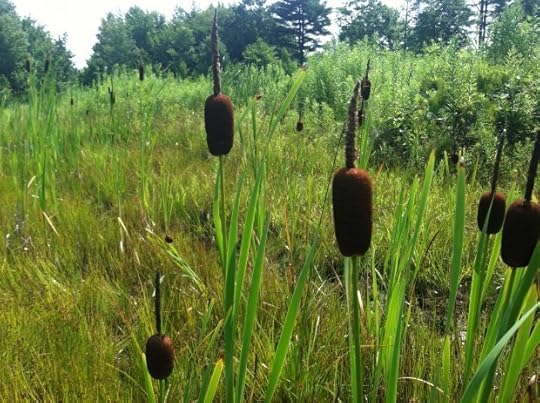
New bog in bulldozer ruts after logging…
August 7, 2014
A Morning with William James
It’s been a busy summer and it has flown by. Tomorrow is our last day in Cambridge and, despite the last-minute busyness and grading, I finally did something this morning that I have wanted to do all summer. I headed over to Houghton Library and spent a little time with the papers of my new-old friend, William James.
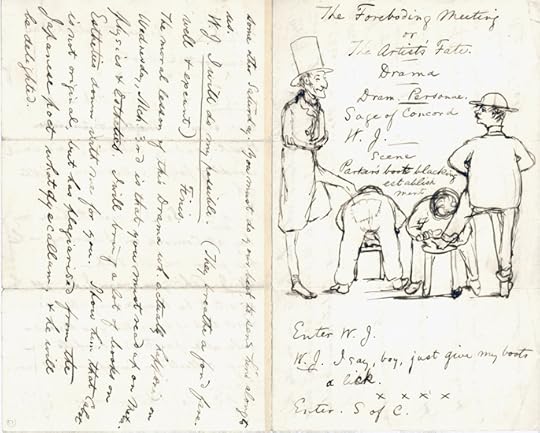
One of the nice surprises of going through his letters and notes was to find that many were spotted with caricatures. The first file I opened, after it had risen from the bowels of Houghton in the elevator (signally its arrival by the hum and the click of the elevator) contained this drawing of a meeting at a shoe stand between James and Emerson:
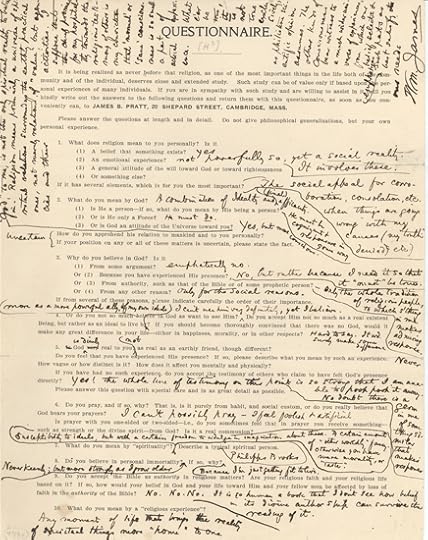
And that was just the beginning of the fun. Among other things, I got to read a questionnaire on religion that WJ filled out, that included this answer to the question “What do you mean by religious experience?”: “Any moment of life that brings the reality of spiritual things more ‘home’ to one.”
Here is a copy of the questionnaire from Houghton:
August 6, 2014
Bad Advice Wednesday: Hold Onto Your Delusions
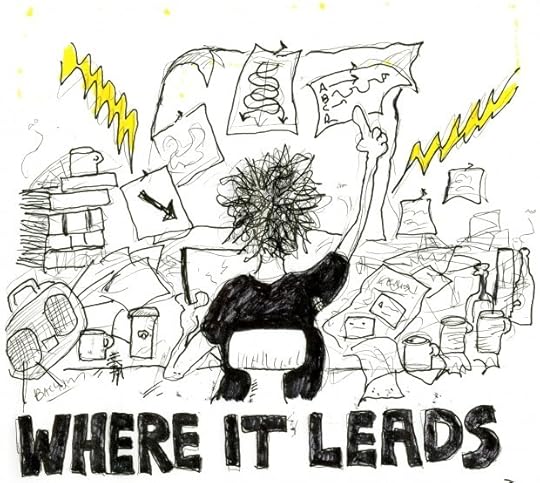 When I played Ultimate Frisbee, I sometimes billed myself as “the greatest player of all time—by far.” Of course I wasn’t. It was meant mostly as a joke, an Ali-like brag and also a parody of some other Ultimate players I knew who, unrestrained by coaches or media or reality, could imagine they were the greatest that had ever played.
But it wasn’t entirely a joke either, at least not in my mind. Not that I ever objectively thought that I was the best player, either at the time or of all time. But I sure as fuck wanted to be. And I would contend that it was that desire, and the corresponding internal exaggerations of the glory that would befall me as my greatness was achieved–and, it went without saying, became clear for all to see–that was part of what drove me during those years.
It goes without saying that lofty ambitions are painful, especially when you fall short of them. An argument can always be made for a more “realistic” commonsensical approach and that is an argument I understand.
But there is something to be said for the fuming, fretting, planning, obsessing, worrying and of course constant working that is required to attain more. Obviously I am not talking about just Frisbee any more. One of the fascinating things for me about the writing program where I teach is how infrequently the idea of ambition is discussed among the grad students, as if it were a dirty word. But if they are honest they will admit that there can be no reason for them to have given up their lives someplace else, sacrificed other possible careers and a good deal of money, if not in hopes of doing something big. Big of course is scary. Small is safe. Big can be intimidating, which is why we like quotes like Isak Dinesen’s “Write a little every day without hope or despair.” This sort of thing calms us.
But there is something to be said for the opposite of calm, too. For being riled up, roiled, almost too excited to work.
Just because it is embarrassing to say it out loud doesn’t mean you shouldn’t try to make something great. That your swan dive off the high rock might turn into a thwapping, humiliating belly flop makes it frightening. But it sure isn’t boring.
Good advice might be to trim and prune your delusions. Today’s bad advice is to hold onto them.
August 5, 2014
Beavers
 “I’m like you,” Hadley, now 11, tells me.
What she means, she explains, is that she is very social but after a while needs periods of being alone.
She continues: “My thoughts are like a river. Having people around is like beavers damming up the river. And after a while the water builds up and the dam explodes.”
August 4, 2014
Lundgren’s Lounge: “Fridays at Enricos,” by Don Carpenter
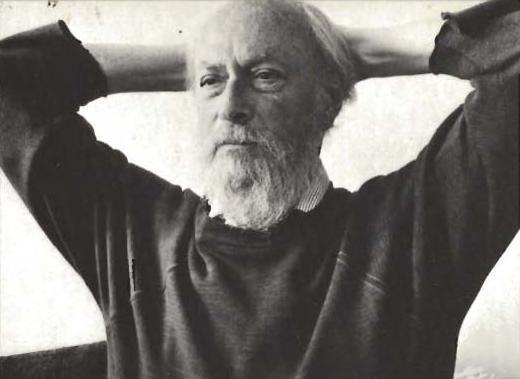
Don Carpenter
Good novels about the writing life are rare, at least to my recolllection: Wonder Boys by Michael Chabon comes to mind, Starting Out in the Evening by Brian Morton, Crossing to Safety by Wallace Stegner. The Ghost Writer by Philip Roth perhaps? Maybe fiction writers find the idea of writing about being a writer to run the risk of redundancy or worse, irrelevant navel-gazing, doubling their misery in the process.. For judging from the fiction writers that I know (and I know many), the act of creating fiction can be a sort of unique, self-imposed misery and its practitioners often seem to do it it because they are compelled and have no choice.
 We now have another title to add to this rather select genre: Fridays At Enrico’s by Don Carpenter. Carpenter’s small masterpiece captures exquisitely the essence of the writing life–the isolation, the doubt, the fickleness of both the publishing world and the reading public and at the heart of it all, the writer’s absolute and inescapable compulsion to write. Carpenter’s circle of friends, nearly all of whom are fellow writers, move from San Francisco at the beginning of the Beat generation, up to the pastoral and fecund environs of Oregon and then south again, to North Beach and Marin County. Always they are writing, engaging in that sweet torture of trying to explain the world by telling stories. Their unwavering discipline to the task is both breathtaking and clearly essential to the work. There are references and even a few brief cameos by the superstars (Kerouac, Corso, Ginsberg, Ferlinghetti and City Lights bookstore), but the real star of this captivating novel lies in its descriptions of the routines and the relationships and the sacrifices that fuel the work of writing. Along the way Hollywood comes calling, with it’s chimerical promises of fame and riches, but even this, Carpenter makes very clear, is secondary to the work.
Reading Friday’s At Enrico’s should make every reader appreciate the debt of gratitude we owe to those who devote themselves to the Sisyphean task of enriching our world through stories. Though sadly Carpenter’s life ended early when, beset by poor health, he followed the lead of his close friend Richard Brautigan and killed himself, what he left us is a gift, a body or work that lives on and resonates. Championed by Jonathan Lethem (who ‘finished’ Fridays, though one wishes someone had paid closer attention to the task of copy-editing) and a website lovingly maintained by uber-fan Chris Cefalu (http://www.doncarpenterpage.com), Carpenter deserves recognition and appreciation. Begin with Hard Rain Falling, a work described as “one of the best prison novels in American literature,” then sample his lovely short essay on Brautigan (“My Brautigan: A Portrait from Memory”) and finally dive into the sublime pleasures of Fridays At Enrico’s… trust me, a literary feast awaits.

[Bill Lundgren is a writer and blogger, also a bookseller at Longfellow Books in Portland, Maine (“A Fiercely Independent Community Bookstore”). He keeps a bird named Ruby, and teaches at Southern Maine Community College.]
August 3, 2014
Serial Sunday: “Tough Island” by Crash Barry (Penultimate Episode!)

A Close Shave
I was lucky to have been accepted to the University of Southern Maine, because my writing was getting worse and worse. I had practically stopped using punctuation. I called it “free verse” when it was merely “lazy.” My big beard, round glasses, flannel shirt and typewriter didn’t help me understand grammar, sentence structure or onomatopoeia. I needed to learn those things, and that wasn’t gonna happen while lobstering on a rock 20 miles off shore. With lots of encouragement from Edwin and Nan, I made preparations to head to the big city and the university, to a louder, busier life. Thanks to the GI Bill, I had money. Thanks to Alice, I had a place to stay.
Before and After
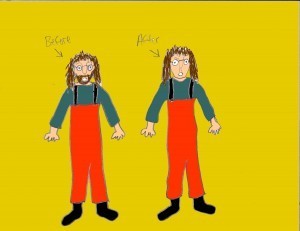
I decided to get rid of my beard before I left the island. Couldn’t attend the university looking like a lumberjack. I’d visited the Portland campus the month before and it was filled with hotties and hipsters. And my long beard and flannel shirt wouldn’t be in style for a couple more years.
Five nights before I moved off Matinicus, Edwin and Nan invited me up for supper. I trimmed, then shaved off all my whiskers before showering. When I sat down at the dinner table, my skin was red, scraped and bloody, but Nan said I looked five years younger, like I was 18. Like a college freshman.
I should have waited to shave. When Edwin and I went out to haul traps the last couple of times, the sea spray iced up my face and the January wind froze my cheeks. I worried my face would fall off from frostbite.
On my last day on the island, I hurried to pack. A charter plane was scheduled for 1 p.m. to pick up me and my boxes of stuff. Books, mostly, and lots of bad poetry and failed short stories. Plus my sea bag full of fisherman clothes mixed with remnants of Coast Guard and Russian sailor uniforms and Grateful Dead-wear. And my boots, oilskins, stereo, typewriter, tea kettle and toaster oven. Almost all of it fit into the borrowed car I was driving.
Heading up Harbor Point Road, a station wagon surprised me. My pal Tommy pulled out of a path in the woods that motor vehicles never used.
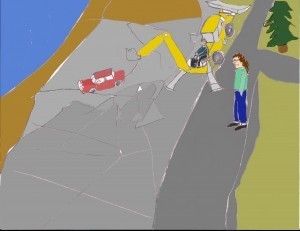
I swerved to avoid collision and drove off the road and over a cliff. It was a small cliff, compared to the others nearby. Five feet to the left or right and I would have plummeted to my death.
Crash’s Crash
Instead, the car landed about 10 feet below road-level, nose down on a dirt-covered ledge protruding from the rocky slope that ran down to the cove. Unscathed, but scared shitless, I climbed out of the car. The rear wheels were still spinning. I clamored up the rocks and crawled to the side of the road.
Tommy was surprised to see me alive. We jumped into his wagon and headed up to Max Ames’ house. Max was a bad-ass biker, but a sweet fella at heart. He owned a backhoe and, luckily, he was home. Ten minutes later, we were back at the scene of the accident. We attached chains to the rear and Max plucked the car up with the backhoe and dragged it back onto the road.
Max, having heard I was moving, didn’t want a dime. He wished me luck and went home. I drove to the airport and unloaded my boxes, which were undamaged by the crash.
I made one more trip to my shack for odds and ends, then back to the airport with a couple minutes to spare. The single engine Cessna from Owls Head landed on the runway. The pilot had removed the extra seats on the mainland to make room for my boxes. Together, we quickly loaded the plane, then strapped in and took off.
I asked him to circle the island once, to fly over the Lower Harbor and Edwin’s fishhouse. That’s when I waved goodbye.
 Crash Barry will be speechifying about the joys of marijuana on August 9 during the Southern Maine Cannabis Expo in Eliot. Signed copies of his books Marijuana Valley, Tough Island and Sex, Drugs and Blueberries are available via crashbarry.com.
To read all the previous episodes of Tough Island, click here.
August 1, 2014
Kirkus Loves our Bill
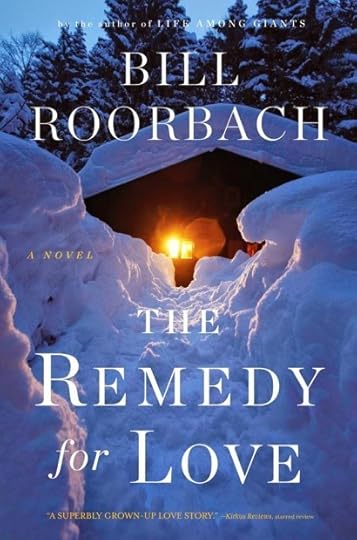
Things have been kind of quiet this summer at Bill and Dave’s but that is about to change. For one thing, there is a certain novel that is about to take the world by storm (if you know what I’m saying). Publication day is October 14. Publisher is, once again, Algonquin Books.
Here’s what Kirkus Reviews has to say about The Remedy for Love, in the very first pre-publication review to appear:
#
KIRKUS REVIEWS
The Remedy For Love
by Bill Roorbach
A closely observed meditation on isolation and loneliness “in a world in which no social problem was addressed till it was a disaster.”
Eric is a middle-aged “small-town lawyer with no cases,” struggling with separation and lost love, when he lays eyes on a young woman in the supermarket line who’s just such a disaster. Danielle is a hot mess brimming with suspicion and hostility, to say nothing of being hobbled by a bad sprain and no immediate prospects. When Eric helps her with her groceries—and then, episode by episode, with bits of her torn-up life—young Danielle responds mostly with cagey bitterness, dismissing the train wreck that is her existence with tossed-off observations like “[p]eople are complicated.” Yes, they are, and Danielle—if that is her real name, for, as she tells him, it’s “Danielle, for now”—is more complicated than most. Set against the backdrop of a howling Maine blizzard (“Storm of the Century, that’s what I heard,” says Eric. “Of course that’s what they always say”), Roorbach’s story never takes an expected or easily anticipated turn. Eric makes a project of Danielle, a project that brings some glimmer of meaning into his life. Danielle, in turn, resents being made into said project. She’s an exceedingly strange bird, but strange is better than nothing—maybe, for Danielle is harboring enough secrets to keep an NSA agent busy for years. “I’m sure I lied,” she tells Eric, simply, in one typical exchange. And so she has, though she has her reasons, which we learn as Roorbach’s superbly grown-up love story unfolds.
Lyrical, reserved and sometimes unsettling—and those are the happier moments. Another expertly delivered portrait of the world from Roorbach (Life Among Giants, 2012, etc.), that poet of hopeless tangles.
And check out this:
David Abrams picks the best books of 2014 so far.
http://www.davidabramsbooks.blogspot....
The Remedy for Love
by Bill Roorbach
Take two strangers—Eric, a small-town lawyer, and Danielle, a former schoolteacher turned homeless squatter—put them in a cabin in the Maine woods, spice it up with a little romantic tension, stir in the wreckage of past love affairs, sprinkle liberally with sharp, funny dialogue, then add the Storm of the Century which buries the cabin in huge drifts of snow, and—voila!—you’ve got The Remedy for Love, one of the best novels of this or any year. I’m not a doctor, but I’ll be prescribing Bill Roorbach’s novel to readers sick of blase, cliched love stories that follow worn-out formulas. What we have here is a flat-out funny, sexy, and poignant romantic thriller. The Remedy for Love is good medicine which most readers will want to swallow in one dose.