K. Rex Butts's Blog, page 8
November 28, 2022
Advent: Hope
Eight words… “I’m sorry, but we’ve pronounced your son dead.”
Those eight words have impacted my life more than I can fully grasp. Two days prior was one of the most incredible days in my life as I held my son Kenny for the first time. Just under four years into our marriage, my wife and I were still in our twenties. On top of that, I recently graduated from Harding University with my bachelor's degree and was preparing to attend seminary at Harding School of Theology.
Life seemed to be going so well, and if that wellness was light, I can’t imagine how it could have been any brighter until that day on Friday, August 2, 2002. It was sometime in the afternoon when the light suddenly turned to darkness.

I have learned to navigate in darkness in the twenty years since that terrible day.1 God has renewed my faith in Jesus Christ, which has been the light that has allowed me to see the path forward, but that doesn’t mean the way has always been bright. Life is filled with ups and downs. As a minister of the gospel, there are moments of great joy, but just as it takes little effort to cut down a strong tree, there are moments of great sorrow that can easily displace the joy.
Rather than a bright summer day full of blue skies, life often seems more like a damp and dreary day. The day is light enough to know that it’s there, but the clouds remain gray, and I am the weary journeyman who must still put one foot in front of the other.
I say that to say that I am a weary soul. But I have not lost hope because God raised the crucified Jesus Christ from death. This is the faith that sustains my hope. This faith keeps me going despite doubts fueled by disappointment, grief, and fear. This is also why Advent matters to my faith, and I believe it matters to your faith.
Here we are in late November, and the skies are again gray. Yet, in giving our attention to the Advent season, we are reminded that hope remains. God is not finished, and we have not been abandoned to the weariness of our souls.
In his book Living The Christian Year, Bobby Gross describes Advent as a season for waiting for the coming of God. Gross writes,
Our world is messed up and we are messed up. We lament our condition and long for God to set things right, to make us better. So we pray and watch for signs of his presence. We do all we know to do so that we are open and ready. In the midst of hardship and disappointment, we continue to wait. We wait in hope.2
Yes, that seems to resonate so well.
Advent is a time for entering the story of God’s redemptive good once again so that even in the weariness, we are reminded that what is beautiful, true, and good does exist. It exists because God is bringing it about in the coming of Jesus. No, this redemptive good has yet to be fully realized, so we are waiting, but as we begin the new Christian year, we are reminded of the hope that sustains our waiting as an act of faith.
Yes, we are waiting, still waiting, for the day when the darkness will be no more. But that day when we will walk in the light of the Lord is coming.
“Oh house of Jacob, come, let us walk in the light of the Lord.” - Isaiah 2:5
1You can read the full story about my son's death and the rediscovery of hope by reading K. Rex Butts, “Lost Sons,” Surrendering to Hope: Guidance for the Broken, eds. John Mark Hicks, Christine Fox Parker, and Bobby Valentine, Abilene: Leafwood Publishers, 2018.
2Bobby Gross, Living The Christian Year: Time to Inhabit the Story of God, Downers Grove: InterVarsity Press, 2009, 37.


November 16, 2022
The End
In his book The 7 Habits of Highly Effective People, the late Stephen Covey says the second habit begins with the end in mind. Covey writes, “The most fundamental application of ‘begin with the end in mind’ is to begin today with the image, picture, or paradigm of the end of your life as your frame of reference or the criterion by which everything else is examined.”1
The point Covey makes is why goals matter. Whatever the goal might be, we live with that end in mind. Peter concurs, too, when he says, “The end of all things is near”(1 Pet 4:7)2, albeit with a more nuanced understanding of what the end is.

The word “end” in our passage is the Greek word telos, which can be rendered with several English words, depending on the context. Typically these English renderings include words like the end, conclusion, or goal. Peter uses this word three other times in this letter, in 1 Peter 1:9, 3:8, and 4:17. 1 Peter 1:9, in particular, says, “for you are receiving the outcome [telos] of your faith, the salvation of your souls.” Peter is speaking about the overall goal of our salvation in this passage, the aim of God’s redemptive work in Christ.
The word telos is important in reflecting on the Christian doctrine of eschatology, which has to do with the overall goal or aim of God’s redemptive work in Christ. In the New Testament, Jesus has already been crucified, resurrected, and exalted as the Lord and Christ, so in one sense God has already achieved the goal of redemption. However, God’s redemptive work is not yet fully realized until Jesus comes again. So when Peter says that the “end of all things is near,” he has in mind the very consistent early Christian belief that history was in its final stage. However, the outcome of this history, the redemptive goal of salvation, was already decided in the resurrection and exhalation of the crucified Jesus and was now soon to be fully realized.3
Thus, when Peter speaks of the end, he knows that our future is already a done deal. Jesus Christ is coming again and we need not worry because in Christ we already share in this victory. This is why Peter began his letter referring to the “living hope through the resurrection of Jesus Christ from the dead” that we have as an inheritance as “a salvation ready to be revealed in the last time” (1 Pet 1:3,5).
What’s really important is that we see why Peter is referring to the end. As soon as Peter says the “end of all things is near,” his very next word is “therefore…” The entire passage of 1 Peter 4:7 reads, “The end of all things is near, therefore be serious and discipline yourselves for the sake of your prayers.” Because we will receive the telos of God’s redemptive work in Christ, our salvation, we ought to live with that end in mind. To borrow from both the words from Stephen Covey again as well as Peter, we ought to keep in mind the image or picture of our “living hope through the resurrection of Jesus Christ from the dead.”
My intention here is to help us who profess to be Christians see the end for which we should live our lives. In short, we ought to be living our lives for the gospel—the good news about Jesus Christ and the kingdom of God. Yet from where I sit it seems like more and more Christians are caught in the web of partisan politics. This is a fool’s errand. Lee C. Camp humously but rightfully says “the hostile and beligerant partisanship among American Christians might be compared to a fistfight over table manners on the sinking Titanic.”4
What’s worse is that the pursuit of partisan politics says to an unbelieving world that what matters most is a donkey or an elephant rather than King Jesus. And any reprieve among society seems impossible, for just as the mid-term elections have passed the focus has turned to the 2024 presidential election. The pursuit of partisan politics also leads to divisions among churches with Christians standing on one side of the aisle or the other over whatever the latest political issue is.5 Ultimately, the divisive nature of partisan poltics hinders Christian witness just the same as denominational divisions do because the end is no longer about Jesus Christ and the kingdom of God.
In 1 Peter 4, we are instructed to live with the end in mind because “the end of all things is near.” As Christians, we must get back to our roots. Resist the chase of partisan politics and learn to live with the gospel end in mind again. If you’re wondering what that might involves, a good place to start is with these words in 1 Peter 4:8-11…
Above all, maintain constant love for one another, for love covers a multitude of sins. Be hospitable to one another without complaining. Like good stewards of the manifold grace of God, serve one another with whatever gift each of you has received. Whoever speaks must do so as one speaking the very words of God; whoever serves must do so with the strength that God supplies, so that God may be glorified in all things through Jesus Christ. To him belong the glory and the power forever and ever. Amen.
Let it be so among the church for the glory of God the Father, Son, and Spirit!
1Stephen R. Covey, The 7 Habits of Highly Effective People: Restoring the Character Ethic, New York: Free Press, 1989, 2004, 98.
2Unless otherwise noted, all scripture quotations are from the New Revised Standard Version, Updated Edition Bible, copyright © 1989, 2021 by the Division of Christian Education of the National Council of the Churches of Christ in the U.S.A., and are used by permission. All rights reserved.
3I. Howard Marshall, 1 Peter, The IVP New Testament Commentary Series, Downers Grove, IL: Inter Varsity Press, 1991, 140, who writes, “The universal Christian belief was that the End was near as a result of the coming of Jesus. The manifestation of the kingdom of God in him was the first stage in the complex event that we regard as the End of the old order. The cataclysmic event of the resurrection—and we should not underestimate how cataclysmic it was—would lead Christians to expect further events of similar and indeed greater magnitude in close connection with it.”
4Lee C. Camp, Scandalous Witness: A Little Political Manifesto for Christians, Grand Rapids: Eerdmans, 2020, 100.
5As just one example, read Bobby Ross Jr., “Pandemic and politics exacerbate challenges facing an Ohio church,” The Christian Chronicle, September 17, 2022, available at https://christianchronicle.org/pandemic-politics-challenge-ohio-church/ (last accessed Wednesday, November 16, 2022)).
November 8, 2022
Living Out of Hope
At the core of Christianity is the confession that Jesus Christ is the crucified, resurrected, and exalted Lord. This confession is a historical claim, not just about what has happened but what will happen. To be a Christian then is to have what the apostle Peter describes as “living hope through the resurrection of Jesus Christ from the dead… …for a salvation ready to be revealed in the last time” (1 Peter 1:3, 5).1 Such hope means that life does not conclude with death but with resurrection life.

We stake our lives upon this hope as a matter of faith as we follow Jesus. It is also why, as someone called to serve as a minister of the gospel, I want to help the church live as a proclamation of this good news about Jesus Christ and the Kingdom of God. Peter says that we are “God’s people so that [we] may proclaim the excellence of him who called [us] out of darkness into his marvelous light” (1 Pet 2:9). Proclaiming the excellence of God is one way of describing our calling as the church. But in a post-Christian society, I also realize the enormous challenge of this calling.
Living according to our calling in a post-Christian society is a challenge on one hand because it means going against the grain of society. Following Jesus in a post-Christian society may seem like trying to swim upstream on a downstream current. Such swimming is not impossible, but it’s not easy either.
On the other hand, living this calling is challenging because we live in a society that has, for the most part, already heard about Jesus and yet is turning elsewhere. There are many reasons why people are turning away from the Christian faith. However, we must be honest that part of the reason is the Christianity people have experienced in some churches. People have encountered stories of abuse and corrupt power in churches and coverups of such abuse and power. The scandals of such abuse and corruption have created enough hurt in their wake that some people have decided they are done with Christianity. In other churches, Christianity seems more about a show, the clothes people are wearing, and the pastor's platform and church brand.
I have also talked with college students that have given up on the church because the church of their youth communicated a message that said these students had to vote a certain way and support a particular political platform to be a part of the church. Assuming the best, I’m sure their churches did not intend to communicate that partisan politics is a requirement of belonging to the church, but that is the message their churches communicated. So these students voted: they voted with their feet.
So where do churches living in post-Christian America go from here? There isn’t any mulligan. The only thing churches can do is rediscover Jesus. The question is, what should we do with Jesus, especially now that we find ourselves living in a post-Christian society?
I want to address one matter from 1 Peter within the context of the question I am asking. The apostle Peter instructs, saying, “but in your hearts sanctify Christ as Lord. Always be ready to make your defense to anyone who demands from you an accounting for the hope that is in you” (1 Peter 3:15).
First, Peter reminds us that our reverence for Jesus Christ is a commitment to following Jesus Christ.2 This seems obvious but given some of the problems discussed above, maybe we need to remind ourselves that living as the church means following Jesus Christ. In fact, following Jesus is our primary task as Christians. Whatever other activities are involved in living as the church, they all flow from the Spirit, who equips us to live as followers of Jesus.
Secondly, Peter reminds us that we should be ready to explain our reason for having such hope in Jesus Christ. I know 1 Peter 3:15 is often used as the proof text for the work of Christian apologetics, and I don’t have any problem with that, as there’s a need in every generation for Christian apologetics. However, Peter was not thinking of someone like William Lane Craig or Alister McGrath debating someone like Richard Dawkins and Sam Harris. What Peter has in mind is for us to have the ability to explain why we live with such hope when we’re asked. The instruction of 1 Peter 3:15 is not to tell everyone or grab a bullhorn so that everyone might hear us over all the other noise in our busy society. Instead, all Peter has in mind is that we will live in such a manner (following Jesus) that others may see our conduct and inquire about our way of life. Then, if people ask why, we answer.
Finally, let me be so bold as also to suggest that we should stop worrying about what might happen to Christianity or what might happen to the United States. If we want to see good among our churches and the nation we live in, follow Jesus Christ. Doing so is not a guarantee of anything other than we are living as faithful followers of Jesus Christ whose lives proclaim the excellence of God. We can trust God to bring about his redemptive good, whether we see such results in our lifetime. After all, we know that Jesus is coming again, and so God will bring his redemptive good into its fulfillment.
1Unless otherwise noted, all scripture quotations are from the New Revised Standard Version, Updated Edition Bible, copyright © 1989, 2021 by the Division of Christian Education of the National Council of the Churches of Christ in the U.S.A., and are used by permission. All rights reserved.
2I. Howard Marshall, 1 Peter, The IVP New Testament Commentary Series, Downers Grove, IL: InterVarsity Press, 1991, 115, describes the action of sanctifying in 1 Peter 3:15 as having “an inward attitude of obedience to him that dictates our behavior in the world. Christians will not act in any way that will bring dishonor on Christ or suggest that they do not reverence him as Lord.”
October 25, 2022
Aliens and Exiles
Regular readers of my Substack newsletter know that I am interested in the question of what it means to be a Christian living in a post-Christian secular society. To that end, I believe the New Testament writing of 1 Peter has something to say about this interest of mine. So I have began a four-week preaching series with the Newark Church of Christ called Aliens and Exiles that explores the writing of 1 Peter with an eye toward how Christians ought to live in the United States. Although I am not posting the manuscripts of my sermons,1 I do want to share some of the teaching here.
Though you are a Christian, you probably did not wake up this morning and think of yourself as an alien or exile. I certainly didn’t. Yet the New Testament writing of 1 Peter uses those precise words to describe the Christians dispersed throughout the land of what was then Asia Minor.
The writing of 1 Peter is addressed “To the exiles of the Dispersion…” (1:1).2 Then,, in the second chapter, is where Peter refers to the Christians as “aliens and exiles” (2:11). Other English translations say “immigrants and strangers” (CEB), “sojourners and exiles” (ESV), and “foreigners and exiles” (NIV). However, although it is purely anecdotal, I prefer the language of aliens and exiles because that is likely the most unsettling to Christians living in my context of the United States.
The language of aliens and exiles likely evokes images of political refugees and people illegally crossing the border. That’s not exactly what Peter has in mind, but he is talking about a displaced people within the world. This is important for the context we live in because in this world, whether the context is Asia Minor, the United States, or elsewhere, to be a Christian is to live as a displaced people in the world. As people following Jesus Christ, part of our story is living as aliens and exiles in this world. So we need to sit with the language of aliens and exiles, contemplating what that means for the way we live as followers of Jesus in the world.
We have to accept the reality of our baptism. It doesn’t matter where we were physically born or what nation we are legal citizens of, we are aliens and exiles because God has given us a new birth. Back in the first chapter, Peter says that God “has given us a new birth into a living hope through the resurrection of Jesus Christ from the dead” (1:3).3 So our baptism matters because through this new birth God centers us in the hope that is in Christ and orients us toward the future of our hope. This is more clear when we read 1 Peter 1:3-5…
Blessed be the God and Father of our Lord Jesus Christ! By his great mercy he has given us a new birth into a living hope through the resurrection of Jesus Christ from the dead, and into an inheritance that is imperishable, undefiled, and unfading, kept in heaven for you, who are being protected by the power of God through faith for a salvation ready to be revealed in the last time.
The focus in this passaage is not just on what God has done in giving us this new birth or what God is doing by preserving and guarding our inheritance. The focus is centered in Christ and oriented towards the future, the salvation that will be revealed in the second-coming of Christ.
If we think about the image of birth for a moment then perhaps we can see that the metaphor is more than just what happened in the past. Those of us who are parents were elated with joy at the birth of our children. But we also know that our children are not meant to remain babies, rather they are meant to grow up into mature adulthood so they can live the life they have been born to live.4 There’s a future hope that automatically comes attached to the birth of a baby.
What Peter is getting at is that we have been born into this living hope for a future, except that future is not for the old world but the new world to come — the new creation God is bringing about in Christ. Therefore, what God has done in our baptism is set us on a new trajectory, one that is very particular. Peter refers to this trajectoryas salvation, which God will bring to complete fulfillment in the the eschaton.
So by giving us this new birth into a living hope, God has made us a community of people who are on an entirely new trajectory that’s different from every other trajectory in the world. Our trajectory in Christ is different from every other religious trajectory, political trajectory, social trajectory, and so forth. That’s why we’re aliens and exiles; because we’ve been baptized into Christ—born into a living hope. If we want to be the church living on mission with God, then we must come to terms with our identity as aliens and exiles in a manner than translates into living as aliens and exiles in the world.
Over the next few weeks I’ll explore further what is means to live as aliens and exiles in the world. 1 Peter has much instruction on this matter that is both encouraging and challenging. So thanks for reading and stay tuned in to explore more about what it means to be Christians living as aliens and exiles in the world.
1If you’re interested, my sermons are available on the Newark Church of Christ YouTube Channel.
2Unless otherwise noted, all scripture quotations are from the New Revised Standard Version, Updated Edition Bible, copyright © 1989, 2021 by the Division of Christian Education of the National Council of the Churches of Christ in the U.S.A. and are used by permission. All rights reserved.
3The original readers would have naturally recalled their baptism upon hearing of this new birth and it is arguable that the entire letter of 1 Peter was originally a baptismal sermon, see G.R. Beasley-Murray, Baptism in the New Testament, London: MacMillan, 1962, 251-258.
4Peter H. Davids, The First Epistle of Peter, The New International Commentary on the New Testament, Grand Rapids: Eerdmans, 1990, 52, makes this important point.
October 12, 2022
Christianity in a Skeptical Age
Over the last year and a half, I have slowly read through a book by Charles Taylor called A Secular Age. Charles Taylor is a ninety-year-old Christian and philosopher who lives in Canada. This book, A Secular Age, is regarded as his magnum opus. Now reading this book has been an arduous task. At 874 pages, Taylor’s book is one which I read a couple of paragraphs, and then I have to reread to ensure I understand. Yet the book is phenomenal in laying out how secularism gradually developed over the last four hundred years and how secularism works in the Western world today.1
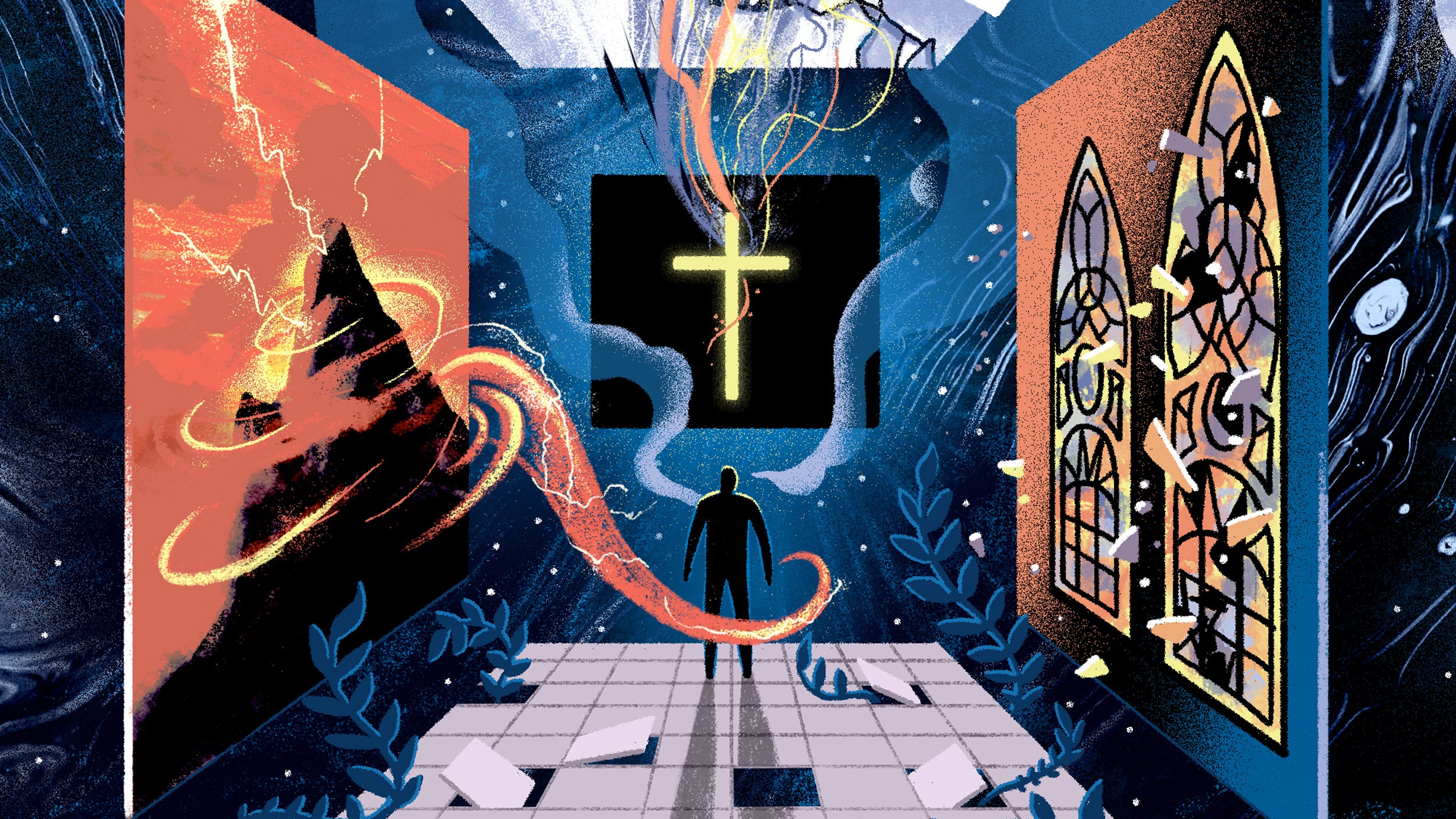
One of the ideas that Taylor unpacks is what he calls a “social-imaginary,” which has to do with how people “collectively imagine” human existence.2 As Taylor uses the concept, a social-imaginary is different from what we might think of as a worldview in that it’s not a carefully constructed set of beliefs but more like assumed beliefs. Some of these accepted beliefs are ideas that operate below the surface of people’s awareness. So the way the social-imaginary works in life today is the loss of transcendence in people's lives.3 In other words, people can easily live life without any awareness of God at work in life — Christians included.
You and I, as well as almost every other person, can go about our day without ever praying, and for the most part, there isn’t any noticeable difference. Now I’ll come back to this because there is a difference, but to see it takes more intentionality. We’ll return to this because I want to explain why these words of the apostle Paul in Philippians 4 matter. But before I do, there’s one other wrinkle I want to bring to your attention, and it has to do with why I titled this message Christians Among A Skeptical Society rather than just a secular society.
In 2022, we are living in a post-truth culture. Lee McIntyre, another philosopher, wrote a book called Post-Truth in which he describes our society as one in which all kinds of people are trying to make us believe in ideas whether there’s good evidence or not.4 But he’s not talking about the car salesman trying to convince you that the Ford sedan you’re taking for a test drive is the best car you’ll ever drive. In his book, McIntyre mentions the Tobacco Industry as an example. For years cigarette manufacturers colluded to fabricate so-called expert evidence that said smoking cigarettes was harmless to our health. The Tobacco Industry engaged in this disinformation campaign even though they knew there was conclusive research showing that, in all likelihood, the tar in cigarettes caused cancer.
Over time, spreading disinformation and spinning facts has helped create a culture where truth seems relative. Although we are now to the point where truth no longer matters as much as feelings.5 As a result, people may now add adjectives to the word truth and, in doing so, seemingly claim whatever they believe as truth, whether true or not. For example, a part of our vernacular now includes phrases like "my truth" and "alternative facts" to justify a claim. Of course, this accomplishes making our opinions, perceptions, etc., a totalizing reality, even if it is self-deception.
This post-truth reality is also why what we do as Christians, and not just what we say, matters more than ever. If we claim that the good news of Jesus Christ and the Kingdom of God is true, our claim must be seen in what we do and how we live.
The secular age we live in means belief is always contested. Almost everyone has doubts about what they profess regarding religion and spiritual life. But the silver lining is that unbelief is always contested too. That is, no matter how much atheism and agnosticism press the case for unbelief, there will always be questions that raise doubts about their unbelief. Taylor mentions the aesthetic awareness of beauty, the awareness of a need for ethics and morality, and the awareness of the creative capacity that humans possess as reasons why there are questions that cast doubt on unbelief. The awareness of beauty, morality, and human capacity evokes a wonder that a secular framework of unbelief cannot explain.6 In other words, beauty, morality, and creativity raise questions that go unanswered in a life without God. Furthermore, as Taylor explains, “there must be some way in which this life looks good, whole, proper, really being lived as it should.”7 Therefore, even in our day, where moral relativism flourishes, people know there is a right and wrong way to live, good and evil.
I believe the questions that contest unbelief, including the awareness of right and wrong, open space for the church. Knowing that people still have a sense of right and wrong and wonder where that comes from is a gateway for the church to point to God's existence and redemptive work. This opening is based on how we live life, particularly by practicing what Paul describes as true, honorable, just, pure, pleasing, and commendable (cf Phil 4:8-9). This life described by Paul is why we must live a life that rejoices in the Lord. As Paul writes, “Rejoice in the Lord always, again I will say rejoice”(Phil 4:4).8
This verb rejoice occurs in Philippians nine different times (cf. 1:18 [2x]; 2:17, 18, 28; 3:1, 4:4 [2x], 10). The key to rejoicing is in this little phrase “in the Lord.”9 When we are convicted that “living is Christ and dying is gain” (Phil 1:21), the kenosis life of living Christ—emptying ourselves for the sake of others and becoming a self-sacrificial servant to others—is doable. That’s because we know this kenosis way of living is not a defeat. Rather, participating in Christ like this is the road to resurrection. So we rejoice and demonstrate our joy in the Lord by letting our “gentleness be known to everyone” (Phil 4:5). We strive not to be anxious or fearful, which is probably easier said than done. But we have God near us and, as Paul says, “the peace of God, which surpasses all understanding, will guard [our] hearts and [our] minds in Christ Jesus” (Phil 4:7). Because this peace of God rests on the conviction that Jesus is the crucified, resurrected, and exalted Lord and Christ, it dispels whatever anxiety we have. When that happens, we can live according to what is true, honorable, just, pure, pleasing, and commendable.
Now there is an issue that comes up when we think about living as Christians in a skeptical society. Some people will point out the times when Christians have utterly failed to live according to what is true, honorable, just, pure, pleasing, and commendable. And I think we have to be honest about that and say, “Yeah, they’re right. It was wrong, and we’re sorry it happened.” That’s true today when we hear about churches covering up abuse and other unethical behaviors, and it’s true for those who professed to be Christians while riding around at night in white hoods, terrorizing and lynching Black people. Yes, it was wrong, and I’m sorry it ever happened.
But I also know of the wonderful good done by people who became Christians and had their lives transformed by the Spirit. These people have committed to living their lives for Christ according to the teaching of scripture, and I’ll briefly share two examples. First, I think of someone like William Wilberforce, who becomes a Christian in the later part of the eighteenth century. Not only did Wilberforce’s new life as a Christian transform the way he believed and lived, but he also went on to lead the way in abolishing slavery. Second, a Christian organization here in Delaware called Zoë Ministries works to free underage girls from the contemporary slavery that is human trafficking.
You see, despite the wrongs that Christians have sometimes done, there are still Christians who can see the beauty in every living person, including underage girls caught in the vicious web of human trafficking. These Christians clearly understand the morally right response and use their God-given creative capacities to do what is true, honorable, just, pure, pleasing, and commendable.
What I have described is how Christians live in a skeptical society. We let our actions reflect what is true, honorable, just, pure, pleasing, and commendable. Then we let the reflection from our efforts open space for people to wonder where such beauty, moral character, and creative goodness come from. Then when they ask, we tell them the truth about God, the God who has revealed himself in Jesus as the Way, Truth, and Life — crucified, resurrected, and exalted as the Lord and Christ who is saving the world from sin and death.
1This article was originally a manuscript for a message I preached to the Newark Church of Christ on Sunday, October 9, 2022. I have made some edits to present this article as a written message for this newsletter.
2Charles Taylor, A Secular Age, Cambridge: The Belknap Press of Harvard University Press, 2007, 146.
3Ibid, 294.
4Lee McIntyre, Post-Truth, Cambridge, MA: Massachusetts Institute of Technology, 2018, 13.
5Ibid, 116.
6Taylor, A Secular Age, 596.
7Ibid, 600.
8Unless otherwise noted, all scripture quotations are from the New Revised Standard Version, Updated Edition Bible, copyright © 1989, 2021 by the Division of Christian Education of the National Council of the Churches of Christ in the U.S.A. and are used by permission. All rights reserved.
9G. Walter Hansen, The Letter to the Philippians, The Pillar New Testament Commentary, Grand Rapids: Eerdmans, 2009, 287, who says that regardless of the circumstances, there is still an “in the Lord we rejoice.”
October 4, 2022
Dogs and Evil Workers
I’m in the middle of a preaching series covering Philippians and one of the issues Paul has in mind is false teachers. Paul refers to these false teachers as “dogs” and “evil workers” in Philippians 3:2, which at the very least hints at the great concern for false teaching. Of course, false teaching should be a concern for every church, both locally and beyond.

In my own life, serving in ministry among the Churches of Christ, I can remember people slapping the labels of “false teacher” on anyone who taught anything that differed from the de facto creed at work among our tribe. Such overuse, a liberal usage, of an accusation like this was wrong and just seemed to have the same effect of repeatedly yelling fire when there isn’t any fire. Yet with twenty-plus years serving as a minister of the gospel, I am now concerned that Christians need to become more discerning about false teaching and false teachers. However, that raises the question of just who is a false teacher and how might we recognize false teaching.
I can’t even begin to fully answer the question of who is a false teacher and how we might recognize false teaching. So what I want to do is limit my answer to a couple of observations from Philippians 3 and the American society we live in today.
First of all, in Philippians 3, the false teachers Paul refers to are Jewish people who place their confidence in their ethnic identity, which includes circumcision. Paul warns against these false teachers, saying”
Beware of the dogs, beware of the evil workers, beware of those who mutilate the flesh! For it is we who are the circumcision, who worship in the Spirit of God and boast in Christ Jesus and have no confidence in the flesh (vv. 2-3).1
The danger of these false teachers is that they are leading, or at least attempting to lead, believers away from Jesus Christ. Therefore it makes sense why Paul would warn about such false teachers but we should dig a little deeper in our observation.
Now in our contemporary setting, it’s very unlikely that any would be able to lead believers away from Jesus Christ by promoting faith in the Law of Moses. So we don’t have to worry about the specific false teachers Paul was warning about. Also, we would easily recognize someone as a false teacher who came proclaiming another religion or telling us we could do whatever makes us happy. But Paul’s concern for false teaching seems to be anyone who would lead us away from knowing Christ.
This concern about being led away from knowing Christ is why Paul speaks of his own desire to know Christ through “the power of his resurrection and the sharing of his sufferings by becoming like him in his death,” (v. 10). Yet not having fully arrived at such knowing yet, Paul says, “Not that I have already obtained this or have already reached the goal, but I press on to lay how of that for which Christ has laid hold of me” (v. 12). What Paul says here also provides us with the key to identifying some false teachers we may overlook and therefore becoming more discerning about false teachers.
In v. 12 Paul uses the verb teleioõ which means “to finish” or “to accomplish”. This verb is related to the noun telos which means “goal” or “end” and refers to aim or a particular pursuit. For college students, the telos is to graduate, while the telos for an NFL team is to win the Super Bowl. Of importance here is the fact that whatever our telos is, that is what we strive for. For Paul, his telos is the heavenly call of crucifixion and resurrection life in Christ Jesus. This telos is why Paul’s pursuit is to know the resurrected Christ even though that means sharing in the sufferings of Christ.
So why does telos matter so much? Well, if a kind of false teacher is one that leads us away from Christ, then to recognize such false teachers we have to start asking what is the telos of their message. We would do well to keep this in mind in light of the growing influence of partisan politics today. Whether these voices are the politicians themselves or just some influences on Tik Tok, we ought to discern what their goal or end game really is. It doesn’t matter whether their right or wrong about the latest trending issue, what matters is the aim of their pursuit. If their aim is partisan ideology, whether from the right or left, they just might slowly distract us from our aim of the crucifixion and resurrection life in Christ Jesus (note: such people can cite scripture and co-opt Christian language but do so for the telos of partisan ideology).
If such false teachers can distract us from our goal of the crucifixion and resurrection life in Christ Jesus, then we lose our purpose as Christians. When that happens we give away our participation in the mission of God and we may just end up giving away our faith and losing other believers to the category of the “dones.” So maybe it’s time we become a little more discerning about the voices we give space in our hearts and minds, and whether some of those voices might be false teachers leading us away from Christ.
1Unless otherwise noted, all scripture quotations are from the New Revised Standard Version, Updated Edition Bible, copyright © 1989, 2021 by the Division of Christian Education of the National Council of the Churches of Christ in the U.S.A., and are used by permission. All rights reserved.
September 19, 2022
Following the Suffering Servant
The word kenosis, which you may or may not have heard before, is significant to reading Philippians 2:5:-11 and our formation as disciples of Christ. It matters because what we read about Jesus Christ in this biblical text is prefaced by saying that we ought to have the same mindset as Jesus Christ. Here is the full text:
Let the same mind be in you that was in Christ Jesus, who, though he was in the form of God, did not regard equality with God as something to be exploited, but emptied himself, taking the form of a slave, being born in human likeness. And being found in human form, he humbled himself and became obedient to the point of death— even death on a cross. Therefore God also highly exalted him and gave him the name that is above every name, so that at the name of Jesus every knee should bend, in heaven and on earth and under the earth, and every tongue should confess that Jesus Christ is Lord, to the glory of God the Father.1
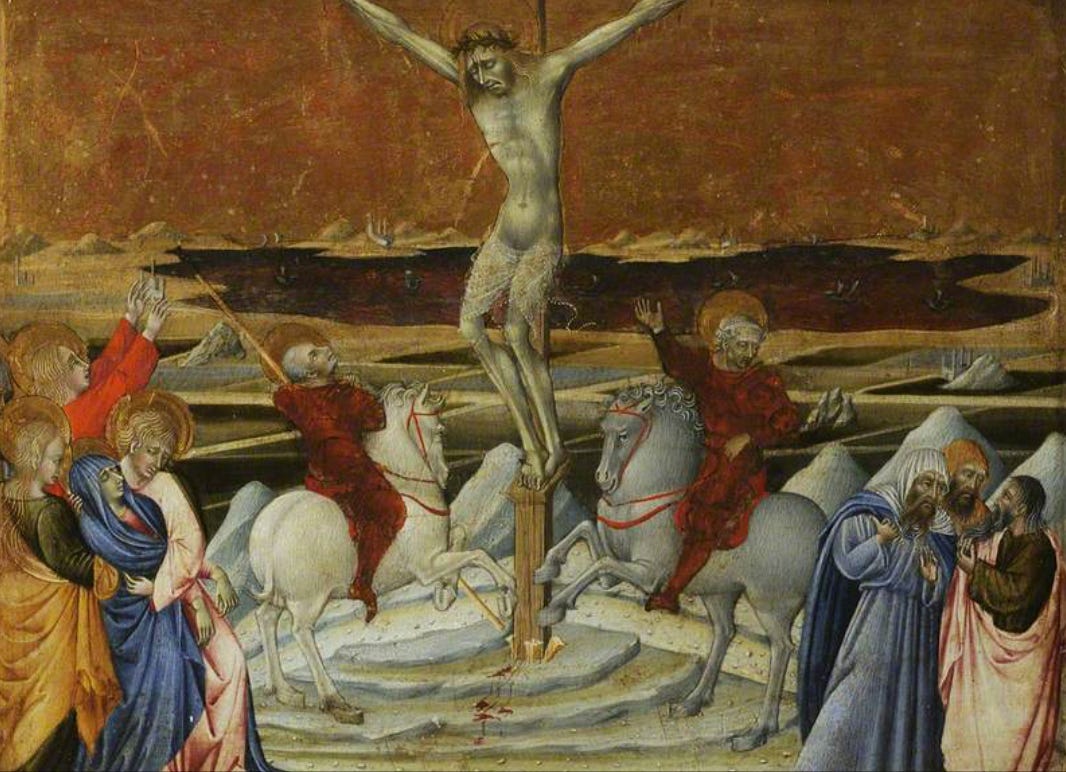 Ugolino de Nerio, “Crucified Christ,” c. 1327
Kenosis derives from the Greek verb kenoō, which is usually rendered as “emptied” (v. 7) in its past tense form. The Common English Bible and English Standard Version as well as the New American Standard Bible and New Revised Standard Version all use the word “emptied.” Whereas the New International Version, which reads “he made himself nothing,” and the New Living Translation, which reads “he gave up his divine privileges,” are a little more interpretative in their translations (though I believe they are correct).
The biblical text leaves us with the question of what it means to say that Jesus “emptied” himself. There are three basic options:2
Jesus Christ empties himself of his divine nature.
Jesus Christ simply displays his human nature.
Jesus Christ fulfills the Suffering-Servant prophecy of Isaiah 53.
I believe the third option is correct, as we create other theological problems by claiming that Jesus gave up his divine nature. There is more going on with the crucifixion of Jesus than simply being a human being. So Paul is pointing to Jesus as the Suffering-Servant, but in doing so, Paul describes Jesus as having “emptied” himself by becoming a slave and humbling himself to the point of death upon the cross.
The kenosis proclamation of Philippians 2 says that Jesus did not make himself equal with God but instead gave up his right to be treated as God, submitting himself in humility as a slave to the will of his Heavenly Father through obedience — even subjecting himself to death on the cross. In other words, instead of exerting his divine power to defeat his enemies with his might, Jesus allowed himself to be wronged by suffering the ultimate humiliation of being crucified on a Roman cross. Instead of exerting his rights and the right to be right, Jesus allowed himself to be afflicted and numbered with the transgressors (cf. Isa 53: 7, 12). Furthermore, by emptying himself, Jesus revealed the glory of God upon the cross.3
This kenosis proclamation matters because it reminds us that God’s way of winning was to become the Man of Sorrows on the cross rather than a warrior with a sword. God’s way of winning was by becoming the slaughtered Lamb rather than proving himself right through the exertion of worldly power that forces his way upon the world.
However, as I I write about the kenosis proclamation of Philippians 2, I have another concern. At present, there seems to be a growing number of Christians lauding the idea of Christian nationalism amidst concern for the placement of Christianity in American society. If you’re unsure what I’m talking about, do a quick search online. Religious nationalism merges the tenants of religion with the identity of a nation. In the case of Christian nationalism, we see an attempt to enforce a Christian ethos through state political power.
There are numerous problems with the idea of Christian nationalism that I won’t get into with this post. I want to point out that the kenosis proclamation cuts right against any notion of enforcing any Christian ideology through state political power. Suppose we, as Christians, are to have the same mindset as Jesus. In that case, our embodiment of the kenosis proclamation means emptying ourselves of our rights, assumed privileges, and power — trust God to exalt us in Christ rather than exalting ourselves.
Philippians 2 says that the example of Jesus is our example to follow. My fellow Christians, please hear what I am saying as a pastor: We can try winning our in society, and we will lose every time. Or we can let go of conventional wisdom for the wisdom of God that prevails through the humility of following the Suffering Servant even to death on the cross. That choice is ours to make, so let’s choose wisely.
1Unless otherwise noted, all scripture quotations are from the New Revised Standard Version, Updated Edition Bible, copyright © 1989, 2021 by the Division of Christian Education of the National Council of the Churches of Christ in the U.S.A. and are used by permission. All rights reserved.
2Moisés Silva, Philippians, Baker Exegetical Commentary on the New Testament, Grand Rapids: Baker Academic, 1992, 2005, 104.
3Stephen E. Fowl, Philippians, The Two Horizons New Testament Commentary (Grand Rapids: Eerdmans, 2005), 91.
September 13, 2022
Living for Christ
What matters in life to you? I’m not sure how you might answer that question, but what matters in life to many people is apparent. Just take a stroll through your local mall or pay attention to television and social media advertisements. And given how algorithms seem to work, the advertisements we see on social media reflect what we spend our time viewing, searching, etc.
I started a new message series on Philippians this past Sunday, and the question of what matters in life is pertinent to what the apostle Paul writes in this letter. Paul even expresses a prayer that the church would gain knowledge and insight in order “to determine what matters…” (Phil 1:10).1
For Paul, what matters is Jesus Christ. This becomes clear as Paul describes his circumstances of being in prison and unsure if he will live or die. Like anyone would feel, Paul wants to live, but his concern is that Jesus Christ will be exalted, whether in life or death. That is, if Paul lives, he wants to exalt Christ in his life, but if Paul dies, he wants to exalt Christ in death. So Paul says, in what is a very well-known Bible verse, “For to me, living is Christ and dying is gain” (Phil 1:21).
Philippians reminds us that Jesus Christ must become the foundation of our life, the center of our life, the purpose of our life, the direction of our life, the power of our life, and the meaning of our life, just as it was for Paul.2 However, that’s easier said than done. Life can distract us from what matters most, from subtly taking our focus from Christ.
So here is the question we must ask ourselves: How do we keep our focus on living for Christ?
To answer this question, let’s recall some teaching about our eyes and ears regarding Jesus Christ. First, when Jesus was speaking about the Kingdom of God, he referred to having the eyes and ears to see and hear (Matt 13:16; Mk 4:12; Lk 8:10). Secondly, Jesus also said in Matthew 6:22, “The eye is the lamp of the body. So if your eye is healthy, your whole body will be full of light.” Then finally, when Jesus was transfigured before Peter, James, and John, God the Father spoke to them and said, “This is my Son, the Beloved; listen to him!” (Mk 9:7; cf. Matt 17:5; Lk 9:35).
This teaching suggests that although we all have eyes and ears, it’s not a given that we see and hear clearly when it comes to living for Jesus Christ. In other words, to live for Jesus Christ, we must see and hear Jesus Christ. The problem is that we don’t have Jesus talking and walking among us, so how do we see and hear Jesus and what he teaches about the kingdom of God?
An obvious answer might be reading the Bible more. Sure! I wrote a book about reading the Bible,3 so I’m for reading the Bible more. However, we need to remember that there were people who professed the Christian faith and read the Bible but also supported a system that built gas chambers throughout Europe. Likewise, some Christians read the Bible in America but supported a system where it was okay for men to wear white hoods as they burned crosses and lynched black people. Yes, those are extreme examples, but I hope that grabs our attention because we must understand that just reading the Bible more does not guarantee we live our lives for Christ. This is why we must give attention to our eyes and ears, to what we see and hear.
So we might consider whether what we spend our time watching and listening to has anything to do with helping us live for Christ. We can easily silo ourselves within our echo chamber to the point that we are kept from seeing and hearing clearly.
I’m a reader, and if you walk into my office, you’ll see books about the Bible and theology. Yet I remember being skeptical about reading any book written by someone outside of the Churches of Christ. That’s changed, but about fifteen years ago, someone asked me how many books I have written either by a woman or someone from the majority world. The truth was that a man of European descent wrote almost every book on my shelf. So I was challenged to read more books by women and authors from the majority world because doing so might help me see something about Jesus Christ I had yet to see.
There are other ways we can silo ourselves within our echo chambers. One of those ways is the news, social media, and politics. Regardless of where we fall on the social-political spectrum, we tend to only focus on the people and platforms who say what we want to see and hear. Doing so is a sure way to follow a blind man off a cliff, as has often happened throughout history.
So I’ll finish by asking a slightly different question: What things in life might be keeping us from clearly focusing on living for Christ?
1Unless otherwise noted, all scripture quotations are from the New Revised Standard Version, Updated Edition Bible, copyright © 1989, 2021 by the Division of Christian Education of the National Council of the Churches of Christ in the U.S.A., and are used by permission. All rights reserved.
2G. Walter Hansen, The Letter to the Philippians, The Pillar New Testament Commentary, Grand Rapids: Eerdmans, 2009, 81.
3K. Rex Butts, Gospel Portraits: Reading Scripture as Participants in the Mission of God, Eugene: Wipf and Stock Publishers, 2022.
August 30, 2022
More Than Conquerors
Football season is upon us again. This is opening week for college football and the NFL kicks off its 2022 football season the following week. Now if you’re not much of a football fan, then you probably don’t care but many people are. Plus, if you hang with me, you’ll like what I want to share with you. But back to football for a moment.
I’m sure there will be many exciting football games played over the next four to five months. However, some will be blowouts and especially so in college football. For example, last year Alabama beat Mississippi State 49-9 and Michigan defeated Northern Illinois 63-10. Both games were likely, for all intents and purposes, over by the end of the third quarter.
 Philip Evergood, The New Lazarus, Whitney Museum of American Art, New York.
Those examples are what we call lopsided games. However, neither of those games compared to a game back in 1916 when Georgia Tech beat Cumberland College by the score of 222-0. I kid you not, the final score was 222-0. Having scored 63 points in each of the first two quarters, Georgia Tech was up by 126 points at the end of the first half. There should have been a mercy rule enacted then but there wasn’t, allowing Georgia Tech to score another 96 points in the second half.
Such a win might be the best way of helping us understand what Paul is trying to describe when he writes in Romans 8:37-39:
But in all these things we win a sweeping victory through the one who loved us. I’m convinced that nothing can separate us from God’s love in Christ Jesus our Lord: not death or life, not angels or rulers, not present things or future things, not powers or height or depth, or any other thing that is created.1
Most English translations, going back to the Geneva Bible, used the phrase “more than conquerors” in this passage. In the original language, it’s one compound word. There’s the word nikaō which means “victory” but this compound word, hupernikaō, means more than just a victory. As I said, most English translations have rendered this word with the phrase “more than conquerors” but a couple of other English translations have chosen other phrases, such as a “sweeping victory” or “overwhelming victory” (NLT).
The point that Paul is making is that in Christ we have this victory that keeps winning and winning without any quit.2 That’s the reason why Paul is convinced that nothing can separate us from the Love of God in Christ.
Pastorally speaking, this is a passage of scripture worth memorizing and repeating so often that it burrows deep within our psyche. As a minister, I have encountered more than a few believers who still doubt God’s love and the assurance of their salvation because of the struggles, either in the past or more recent, they have. Some people I have met even struggle to believe God loves them. Unfortunately, Christian preaching has sometimes portrayed God as a maniacal deity bent on anger and contempt for sinners. The most famous example of such preaching was Jonathan Edward’s sermon Sinners in the Hands of an Angry God.3
This is unfortunate, especially because such theology portrays a false view of the God who has revealed himself in Jesus Christ. Earlier in Romans, Paul wrote that “God shows his love for us, because while we were still sinners Christ died for us” (Rom 5:8). God did not start loving us once we received Christ, rather God loved us so much, even as sinners, that he sent his Son to redeem us. It is in the crucifixion of Jesus Christ that we encounter “the divine axis of love.”4 The good news is that Jesus Christ was not only crucified as an expression of God’s love for us but that God raised Jesus Christ and exalted him so that in Christ we would be more than conquerors.
More than conquerors is who we are in Jesus Christ because of God’s love. Whatever our past sins and struggles may be or whatever trials we may face this week, we need not fear. For God loves us and that’s not changing, not today, not tomorrow… never.
1Unless otherwise noted, all scripture quotations are taken from the Common English Bible, copyright 2011. Used by permission. All rights reserved.
2C.E.B. Cranfield, Romans: A Shorter Commentary, Grand Rapids: Eerdmans, 1985, 225-226, notes that this word is a militant expression of which the present tense implies that the redemptive work of God bringing about the victory of the believers as something that happens always rather than only occasionally.
3Jonathan Edwards, “Sinners in the Hands of an Angry God,” in Sinners in the Hands of an Angry God and Other Puritan Sermons, Mineola, NY: Dover Publications, 2005. The most famous quote from this sermon read, “The God that holds you over the pit of Hell, much as one holds a spider, or some loathsome insect, over the Fire, abhors you, and is dreadfully provoked; his wrath towards you burns like fire; he looks upon you as worthy of nothing else, but to be cast into the fire; he is of purer eyes than to bear to have you in his sight; you are ten thousand times so abominable in his eyes as the most hateful venomous serpent is in ours” (p. 178).
4Brian Zahnd, Sinners in the Hands of a Loving God: The Scandalous Truth of the Good News, Colorado Springs: Waterbrook, 2017, 80.
August 23, 2022
The Intercession of the Holy Spirit
“I am so troubled that I cannot speak.” - Psalm 77:4 (NRSV)
This line from Psalm 77 has resonated with me because I have known such trouble and what it means to be at a loss for words. My story, as my family and friends know, is one of death. At the age of twenty-three, my father died from cancer. A few years later my wife and I lost our son Kenny, who was only three days old. Then only a year later my younger brother John unexpectedly died.
That’s my story. Your story may be similar or different. People encounter suffering in various ways. Realities like cancer, divorce, chronic depression, suicide, disability, poverty, racism, addiction, and much more may be your story. Whatever the suffering may be, Romans 8 describe it as a frustration that all of creation is subjected to and a reality that results in groaning for us as believers. Such suffering is a weakness we live with as we await the fullness of our redemption in Christ.

One of the challenges we face in living with such sufferings is knowing what we ought to pray for. In fact, there are times when we don’t know what exactly we should pray for. There are times when we find ourselves so troubled that we just don’t have words to say or words to pray. What we may take comfort in is knowing that the Holy Spirit knows what to say and pray. Romans 8:26-27 tells us:
“In the same way, the Spirit comes to help our weakness. We don’t know what we should pray, but the Spirit himself pleads our case with unexpressed groans. The one who searches hearts knows how the Spirit thinks, because he pleads for the saints, consistent with God’s will.”1
This is the intercessory role that the Holy Spirit takes up in our lives. Even when we are at a loss for what we should, the Holy Spirit is praying for us.
I don’t know about you but knowing the Holy Spirit is praying for us seems very liberating. First of all, we don’t have to have the right words to pray or necessarily even words at all because the working power in prayer is God through the Holy Spirit. I’m not saying it wrong to pray with words we verbally express. I just want us to understand that when we are too troubled to speak and don’t know what we ought to pray for, we can know that the Holy Spirit is interceding for us in our prayer by praying for us.
Perhaps then another way of praying is to spend time in contemplative prayer, which is actually an ancient Christian practice. Contemplative prayer is a time of reflection on our day and life, focusing on what comes to mind knowing that the Spirit is interceding for us. However, developing a practice of contemplative prayer requires carving out time and space for ourselves where we can be silent. In her book Sacred Rhythms, Ruth Haley Barton writes “The silence becomes a time when we listen for the prayer that the Holy Spirit is praying deep within us as he moves between the depths of our human experience and the divine will, interceding for us beyond words.”2
In my own life there have been times when I absolutely had no idea what to say in prayer. Maybe I would pray the Maranatha of “Lord, come” or pray “Lord, have mercy” but not much else. Sometimes I would just say “Lord, you know…” and then be silent before God. I’m just thankful that the Spirit was interceding for me in prayer over these last twenty years and still is.
So perhaps today is a day in which you find yourself unsure of what to pray for. Maybe you are so troubled that you can’t even speak. If so, I am sorry. Perhaps though I can encourage you to pray, to simply take a walk and be silent before God, allowing the Holy Spirit to pray.
1Unless otherwise noted, all scripture quotations are taken from the Common English Bible, copyright 2011. Used by permission. All rights reserved.
2Ruth Haley Barton, Sacred Rhythms: Arranging Our Lives for Spiritual Transformation, Downers Grove: InterVarsity Press, 2006, 70.