K. Rex Butts's Blog, page 4
July 9, 2024
The Prodigal Gospel Pt. 2
Last week I shared the first of three posts called The Prodigal Gospel, based on the parable Jesus tells in Luke 15:11-32. In this text, Jesus tells a story about a father who loves his two sons even though they both have problems. So the story Jesus tells reveals a truth regarding the grace of God.1
As you read the text and the rest of this post, I hope this word about the grace of God will encourage you. After all, we all have our issues and we all need an encounter with the grace of God. So hear is the text of Luke 15:11-32
Jesus continued: “There was a man who had two sons. The younger one said to his father, ‘Father, give me my share of the estate.’ So he divided his property between them. Not long after that, the younger son got together all he had, set off for a distant country and there squandered his wealth in wild living. After he had spent everything, there was a severe famine in that whole country, and he began to be in need. So he went and hired himself out to a citizen of that country, who sent him to his fields to feed pigs. He longed to fill his stomach with the pods that the pigs were eating, but no one gave him anything. When he came to his senses, he said, ‘How many of my father’s hired servants have food to spare, and here I am starving to death! I will set out and go back to my father and say to him: Father, I have sinned against heaven and against you. I am no longer worthy to be called your son; make me like one of your hired servants.’ So he got up and went to his father. But while he was still a long way off, his father saw him and was filled with compassion for him; he ran to his son, threw his arms around him and kissed him. The son said to him, ‘Father, I have sinned against heaven and against you. I am no longer worthy to be called your son.’ But the father said to his servants, ‘Quick! Bring the best robe and put it on him. Put a ring on his finger and sandals on his feet. Bring the fattened calf and kill it. Let’s have a feast and celebrate. For this son of mine was dead and is alive again; he was lost and is found.’ So they began to celebrate. Meanwhile, the older son was in the field. When he came near the house, he heard music and dancing. So he called one of the servants and asked him what was going on. ‘Your brother has come,’ he replied, ‘and your father has killed the fattened calf because he has him back safe and sound.’ The older brother became angry and refused to go in. So his father went out and pleaded with him. But he answered his father, ‘Look! All these years I’ve been slaving for you and never disobeyed your orders. Yet you never gave me even a young goat so I could celebrate with my friends. But when this son of yours who has squandered your property with prostitutes comes home, you kill the fattened calf for him!’ ‘My son,’ the father said, ‘you are always with me, and everything I have is yours. But we had to celebrate and be glad, because this brother of yours was dead and is alive again; he was lost and is found.’”2
Ms. Mildred isn’t her real name but I met Ms. Mildred when she was an elderly Christian woman. She wasn’t in the best of health anymore but Ms. Mildred regularly attended the little country church in Arkansas that I preached for when I was a student at Harding University.
Ms. Mildred would always say in a light-hearted manner, “Preacher, I sewed a lot of wild oats when I was young and I’ve been praying for crop failure ever since.” And I always responded in a light-hearted manner, saying something like “I’m sure all of us need to pray for some crop failure at times.” And we do! But then one Sunday, Ms. Mildred seemed upset. Troubled, we might say. I knew that her heart doctor had recently told her that, with her congestive heart failure, she probably would not live much longer. So after worship I asked Ms Mildred how she was doing and Ms. Mildred was unable to speak as she began to cry.
So we sat down and she began to tell me about her days as a young woman running with the moon-shining crowd, working in what was then called a speakeasy—an illegal tavern—where all kinds of untoward deeds took place. Ms. Mildred even told me about becoming pregnant out of wedlock and ending her pregnancy, a burden of guilt and shame along with even grief that was still with her all these years later.
As Ms. Mildred continued to talk, she said, “I know I’m a sinner and I’m scared.” So I asked her why she was scared and with tears in her eyes she said, “I’m afraid God’s going to send me to hell for the things I’ve done.”
Listening to Ms. Mildred brings to mind the great hymn Amazing Grace sang in nearly every church. To this day I can see the smiles on the faces in that little country as they sang, “Amazing grace, how sweet the sound, that saved a wretch like me.” Yet there’s a lot of irony in knowing that a church sings Amazing Grace while at least one Christian still carries the guilt and shame of sin, living with the fear of God’s judgment.
“Why so?” we might ask. Did this little country church lack an understanding of God’s grace, as has been the case in some Churches of Christ? Was the church just plagued by that old heresy known as pulling yourself up by your own bootstraps? Or could it be that even though grace is talked about and even sung about, it’s just too difficult to imagine in cultures where we’re often judged by appearance and merit—the good and bad choices that one makes?
Whatever the reason, here was a Christian lady—Ms. Mildred—who had yet to know God’s grace. And I’ve often wondered since then how many other Ms. Mildreds there are in church.
But it should not come as a surprise that a church might not understand the grace of God. Even some of the religious experts, like the Pharisees and teachers of the Jewish Law, struggled with grace. At the beginning of Luke 15, we are told that the tax collectors and sinners were coming to hear Jesus but the religious experts were muttering, “This man welcomes sinners and eats with them.” Something’s wrong with this scenario. Either Jesus is holding company with the wrong people or the religious experts have misunderstood God and his kingdom.
But Jesus, never missing an opportunity to teach, tells three parables. The first parable is about a lost sheep, the second one is about a lost coin, and finally, the last parable involves a lost son. However, this last parable tells a story about a father and his two sons, neither of which understand the grace of God.
The younger son demands his inheritance and leaves home once his father gives it to him. So the younger son goes to a far-off place where he “squandered his wealth in wild living.” Once famine strikes, he’s left with nothing and must hire himself out as a citizen of another country, where he would gladly eat pig food.3 Not surprisingly though, the young son realizes he has made a foolish mess of his life and wants to come home. As the text tells us, before this younger son even made it back home, “his father saw him and was filled with compassion for him.”
I doubt the religious experts were thinking about compassion or any other expression of grace. But Jesus was. Yet the notion of grace is so difficult to grasp, let alone receive and extend.
In the parable, neither the younger son nor the older son can conceive of any grace. The younger son comes home only because he has nowhere else to go but he can’t imagine any sort of mercy. The younger son believes his only hope is to bargain with his father. So along the way home, he plotted how he would say to his Father, “…I have sinned against heaven and against you. I am no longer worthy to be called your son; make me like one of your hired servants.”
Such a bargain is not grace. Grace is an unmerited favor, whereas a bargain seeks a favor by offering some form or payment in exchange for the favor—meritocracy. Grace is inconceivable. As far as the younger son knows, his best hope seems to be offering himself as a hired hand. Perhaps if he works hard enough, then his father might eventually forgive him. But surprise, surprise! After the father gives his son a big hug and a kiss, he calls for a big celebration. “Let’s have a feast and celebrate. For this son of mine was dead and is alive again; he was lost and is found.”
Absent from the father's response is any rebuke, shaming, condemnation, and certainly acceptance of a bargain where his son can work as a hired servant to atone for his sins. Instead, the father calls for a celebration.4 Does that surprise us? I ask because I doubt the religious experts muttering at Jesus could understand the grace of God that Jesus is revealing. Or perhaps another way is to say that the prominent church-going folks of Jesus’ day couldn’t understand the grace of God.
But the parable Jesus is telling isn’t finished. The party is underway. The feast is happening, with music and dancing. As the party is in full bloom, the older son shows up and hears all the ruckus taking place. The text tells us, “The older brother became angry and refused to go in.” When his father comes out to meet him, the older brother complains to his father, arguing how he has been an obedient child all his life but has never even received a single goat to celebrate. Yet, when the rebellious younger brother comes, a big party is thrown.
The older son believes in meritocracy too. But again, absent from the father’s response is any rebuke, shaming, condemnation, and certainly any concession to the older son’s meritocracy. Instead, the father looks at his older son and says, “you are always with me, and everything I have is yours.”
One of the aspects of grace that makes it so amazing is that grace is for everyone. There’s grace for both brothers, as both are free to share in life with their father. Another aspect of grace that makes it so amazing is that grace is freely given. Grace is not conditioned on anyone’s merit. Both sons have always had a place in their father’s house. The older son has always lived in that grace and when the younger son returns home, he is allowed to live in that grace too. Jesus tells this parable because the grace of God that makes salvation possible is and will always be an unmerited favor that is freely given.
This parable about a father and his two sons is really about God and his relationship to both the Jews and Gentiles. Can we imagine how the grace of God is for both Israel and the Gentiles? If we can then perhaps we can imagine how the grace of God is for both the religious do-gooders and the sinners, the church and the unchurched or dechurched, Christians and those who have yet to become Christians. Then it makes all the sense in the world why Jesus would sit at the tables of sinners. After all, the gospel—the good news of Jesus Christ and the kingdom of God—is the grace of God at hand.5 Jesus is eating with sinners because in and through Jesus, God is extending gracious hospitality to all. Ultimately, Jesus will give his life on the cross, dying and then being raised from death and exalted as Lord, so that no amount of sin nor any other evil power will be a barrier between God and us.
Now can we grasp why the grace of God is truly amazing?
1With a few slight alterations, this post was originally the manuscript for a sermon titled Prodigal Love that I preached to the Newark Church of Christ on Sunday, June 16, 2024.
2Unless otherwise noted, all scripture quotations are from The Holy Bible, New International Version, NIV. Copyright © 1973, 1978, 1984, 2011 by Biblica, Inc. Used by permission. All rights reserved worldwide.
3C. F. Evans, Saint Luke, TPI New Testament Commentaries (Philadelphia: Trinity Press International, 1990), 592, the mention of pigs is regarded as the “extreme of degradation for a Jew.”
4Miroslav Volf, Exclusion and Embrace: A Theological Exploration of Identity, Otherness, and Reconciliation (Nashville: Abingdon Press, 1996), 159, explains that confession wasn’t necessary because “the relationship did not rest on moral performance and therefore could not be destroyed by immoral acts. The son’s return from ‘the distant country’ and the father’s refusal to let the son out of his heart sufficed.”
5Matthew W. Bates, Gospel Allegiance: What Faith in Jesus Misses for Salvation in Christ (Grand Rapids: Brazos Press, 2019), 123, points out that the gospel is grace (χάρις) because it is a gift from God with the saving power for both Jews and Gentiles (cf. Rom 1:16).


July 2, 2024
The Prodigal Gospel Pt. 1
Here is the first of three posts on the story we know as The Parable of the Prodigal Son found in Luke 15:11-32. The story Jesus tells of a father and his two sons has been a favorite of many people and for good reason. But the story is more than just a prodigal child and when we pay attention to the story, perhaps we’ll discover that Jesus is telling us about the prodigal gospel he is proclaiming.1
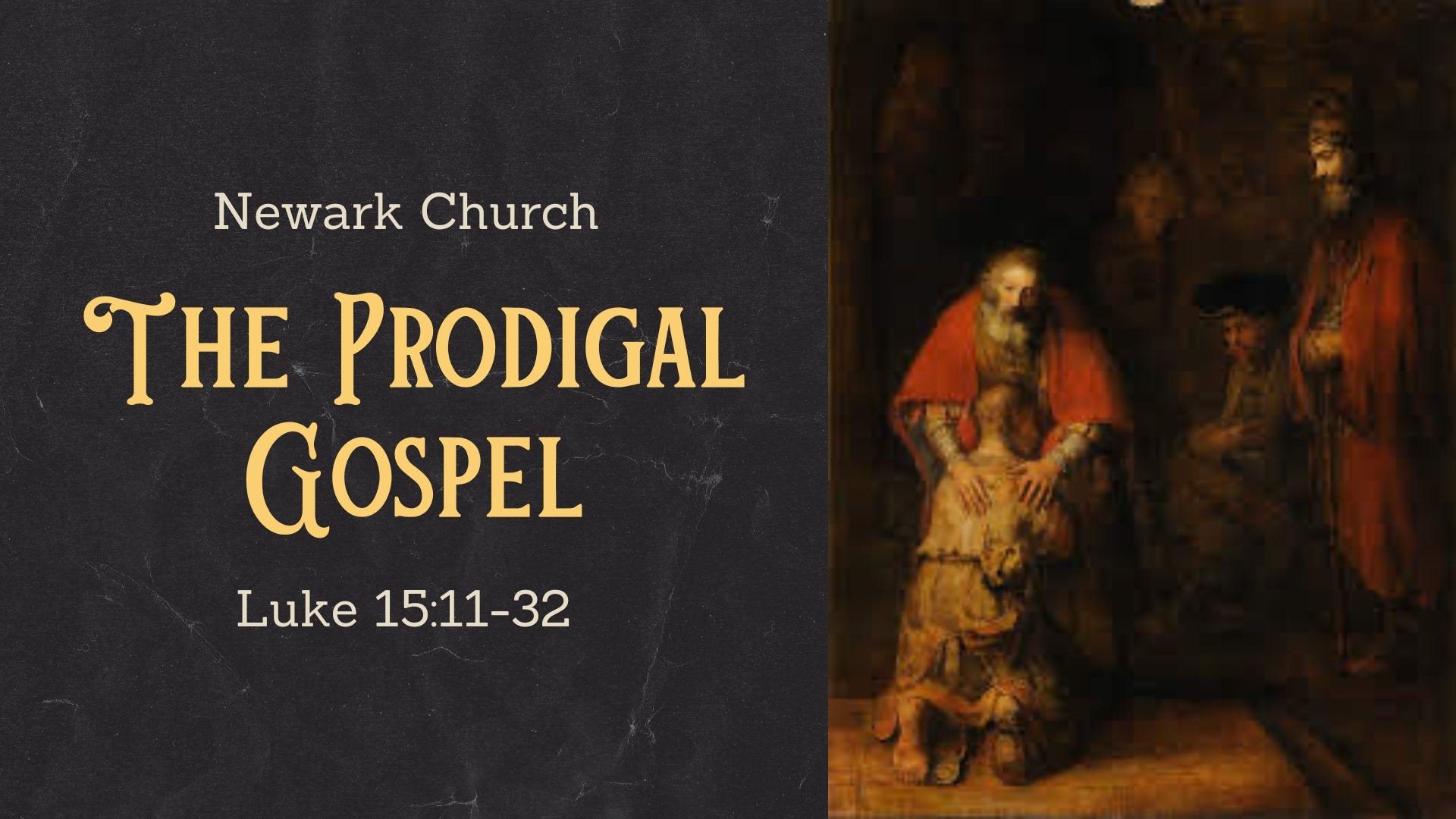
The picture above includes Rembrandt’s painting The Return of the Prodigal Son. I don’t know if you can see it clearly but in Rembrandt’s painting, you have the father embracing his younger son with the older son looking at them. But behind the father and his two sons are two other people, who are just bystanders. Have you ever thought about who the bystanders are? Or perhaps wonder about who the bystanders are today? These questions are something to let simmer as we read the text from Luke 15:11-32
K. Rex Butts Newsletter is a reader-supported publication. To receive new posts and support my work, consider becoming a free or paid subscriber.
Jesus continued: “There was a man who had two sons. The younger one said to his father, ‘Father, give me my share of the estate.’ So he divided his property between them. Not long after that, the younger son got together all he had, set off for a distant country and there squandered his wealth in wild living. After he had spent everything, there was a severe famine in that whole country, and he began to be in need. So he went and hired himself out to a citizen of that country, who sent him to his fields to feed pigs. He longed to fill his stomach with the pods that the pigs were eating, but no one gave him anything. When he came to his senses, he said, ‘How many of my father’s hired servants have food to spare, and here I am starving to death! I will set out and go back to my father and say to him: Father, I have sinned against heaven and against you. I am no longer worthy to be called your son; make me like one of your hired servants.’ So he got up and went to his father. But while he was still a long way off, his father saw him and was filled with compassion for him; he ran to his son, threw his arms around him and kissed him. The son said to him, ‘Father, I have sinned against heaven and against you. I am no longer worthy to be called your son.’ But the father said to his servants, ‘Quick! Bring the best robe and put it on him. Put a ring on his finger and sandals on his feet. Bring the fattened calf and kill it. Let’s have a feast and celebrate. For this son of mine was dead and is alive again; he was lost and is found.’ So they began to celebrate. Meanwhile, the older son was in the field. When he came near the house, he heard music and dancing. So he called one of the servants and asked him what was going on. ‘Your brother has come,’ he replied, ‘and your father has killed the fattened calf because he has him back safe and sound.’ The older brother became angry and refused to go in. So his father went out and pleaded with him. But he answered his father, ‘Look! All these years I’ve been slaving for you and never disobeyed your orders. Yet you never gave me even a young goat so I could celebrate with my friends. But when this son of yours who has squandered your property with prostitutes comes home, you kill the fattened calf for him!’ ‘My son,’ the father said, ‘you are always with me, and everything I have is yours. But we had to celebrate and be glad, because this brother of yours was dead and is alive again; he was lost and is found.’”2
As I mentioned above, most people familiar with this story in Luke 15 know it as The Parable of the Prodigal Son. With such a label as The Parable of the Prodigal Son, which isn’t actually in scripture, the focus is placed on the younger son as the lost son. Yet the story Jesus tells involves a father and his two sons. Each son has his own set of problems and with each son, the father responds in a manner that reveals the true heart of the father. In fact, the father shows himself to be the real prodigal in this story. What’s more important is that as Jesus tells this story, we might just discover that the true prodigal is God revealing to us a prodigal gospel.
I know the word prodigal isn’t that common today but when we do hear the word used, a negative connotation probably comes to mind. After all, describing the younger son as “the prodigal son” certainly isn’t a compliment. We think of him as a prodigal because he acts in a prodigal manner, recklessly burning through his inheritance as he makes foolish choices. As Jesus tells the story, our text says, the younger son took his father’s wealth and “set off for a distant country and squandered his wealth in wild living.”
Foolishness. Terrible life choices and outlandish behavior. It ain’t good. But according to the Random House College Dictionary that sits within arms reach in my office, the word prodigal means “giving or yielding profusely; lavishly abundant.”3 So when we encounter someone with extraordinary talent as a musician, we have a prodigy and when there is a torrential downpour, we end up with a prodigious amount of rainfall. The word prodigal simply describes the act of giving something lavishly or generously.
So Jesus tells us a story about a father and two sons. We’re told first about the younger of the two sons, who comes to his father asking for his share of the inheritance from his father’s estate. Quite bold, even by our cultural standards today. But in a traditional Middle Eastern context, such an ask is dishonorable.4 Sons are to remain serving their father but the son wants his inheritance so that he can take off on his own and make his own way.
But the father, who loves his son just as any father should, grants his son’s request. Dad’s not going to stop his son from walking out the door. As much as it must pain the father, true love is never coercive. Sometimes love hurts because it means loving someone who spurns that love. In this case, love means the father will give his son the freedom given to away even though the father knows things are about to go bad. So the son gets his way. He gets his inheritance and leaves, only to discover that life on his own is really difficult. Imagine that. Life’s especially difficult when passion rules the game and that’s putting it nicely.
In the story Jesus tells, the younger son lives through both natural evil and moral evil—the two categories philosophers and theologians use to speak of the wrongs in the world. Like hurricanes and earthquakes, famine is a form of natural evil that brings a lot of suffering. Moral evil, on the other hand, involves sinful deeds that can yield suffering too. In the son’s case, the suffering of natural evil is made even worse by his own moral evil.
Staying out at all hours of the night, partying, and hopping from one club to another sure seems like fun. Or at least that’s how it’s always portrayed… But eventually, the party dues come due and sometimes those dues are quite expensive. Away from the care of his loving father, the dues come and they’re quite expensive. So expensive, the son can’t pay. Realizing the game is over and he’s on the losing end, the young son sets out for his father’s house. Perhaps he can come home if he offers himself to be just one of his father’s hired servants. “But,” as the story says, “while he was still a long way off, his father saw him and was filled with compassion for him; he ran to his son, threw his arms around him and kissed him.”
What a surprise! No rebuke and no shame, just compassion to go along with a hug and kiss. That’s called love and given the circumstance, it’s a lavish love. The father could have refused his son and turned his back on him but the father was looking for his son because he loves his son. Nothing the son has done has changed how much the father loves his son. So the father now becomes the prodigal, expressing the love he has for his son in a lavish manner.
And Jesus… Church, let me tell you about Jesus. At the beginning of Luke 15, we are told that Jesus is having dinner with the sinners and tax collectors, while the Pharisees and scribes grumble because Jesus is eating with such people. So what does Jesus do?
Well, Jesus tells a parable. Not just one, and not two but three parables.5 The first one is about a lost sheep and the second is about a lost coin. In both parables, when the lost sheep and the lost coin are found, there’s rejoicing. And then Jesus tells a third parable about a father and his two sons. Two sons who both have their problems but two sons who are loved by their father and nothing has ever changed that. In the context of Luke’s Gospel, Jesus is really telling a story about God and his children, both Israel and the Gentiles. Or shall we say, both the sinners and the religious do-gooders? And that means the story Jesus is telling is about God’s love for us too.
Every one of us, no matter what we’ve done or where we’re at with God, we are loved by God. In the parable, the father can see his son from a far-off distance because he’s out looking for his son like any loving parent would do if their child was lost. But in real life, we’re the ones who are lost or at least were lost at one time. Whether that is lost in the sin of foolish choices and wild living like the younger brother or lost in the sin of self-righteousness and entitlement like the older brother, lost is still lost.
The good news and what makes the story of Jesus Christ and the kingdom of God a prodigal gospel, is that God has never stopped loving us. No matter where we are and what we’ve done, God has continued to love us with more love than we can imagine. God’s love for us is so generous and prodigious that he’s filled with compassion for us—to suffer with us—in the person of Jesus to find us. In fact, the love of God is so generous and prodigious that God’s Son, Jesus Christ, dies for us so that we don’t have to remain lost anymore.
Jesus is telling us this story of a father and his two sons as an illustration of God’s love. As Henri Nouwen wrote in his book The Return of the Prodigal Son, “The story of the prodigal son is the story of a God who goes searching for me and who doesn’t rest until he has found me. He urges and he pleads. He begs me to stop clinging to the powers of death and to let myself be embraced by arms that will carry me to the place where I will find the life I most desire.”6
So let’s talk about life. Every one of us are sinners. Fortunately, we’re not here to catalog everyone’s sin. But sinners we are. Maybe we haven’t made a huge mess out of our life like the younger brother and maybe we’re not so smug in our religiosity like the older brother. But like the two bystanders in Rembrandt’s painting, we’re leaning in and listening because we know that we’re no better than either brother.
But life is life and sometimes life is difficult too and sometimes hearing talk about the love of God and knowing the love of God are two different matters. And let me remind us that our enemy, Satan, is always lurking and trying to tell us that we’re bad people… that there no good in us, that God hates us because we’re sinners. That’s a bunch of nonsense and that’s putting it nicely. It’s nonsense because the story Jesus is telling is about God’s love for us, a love that is expressed in abundance—a prodigal love.
Years and years ago, all the way back in 1979, singer and actress Bette Midler sang a song called The Rose. It’s a love song. Some might even say a sappy love song but it was a number-one hit and from a poetic standpoint, the lyrics are a work of art. Here are the lyrics from the third verse:
When the night has been too lonely and the road has been too long, and you think that love is only for the lucky and the strong. Just remember in the winter, far beneath the bitter snow, lies the seed that with the sun's love, in the spring becomes the rose.7
Well, someone might need to hear this: God’s love is the seed, and the Son’s love, the love that Jesus Christ gives in the shedding of his blood on the cross, is your hope. And spring is upon us. We might feel completely lost but this prodigal love of God is your promise of hope. Yes, like the conversations the father has with his two sons, God may need to do some soul work with us through the power of the Holy Spirit. But the redemptive formation in Christ is more than possible because God loves us more than we can ever imagine.
If you hear me say nothing else, I hope you’ll hear me reminding you that God loves you because sometimes in life it is only the love of God that sustains us. And for those of you who are younger, who have yet to leave your parent’s house… You’ve got your whole life ahead of you but along the way, you just might make some poor choices as we all do. Some of your choices may take you down a difficult path. But I hope you’ll remember that you are loved by God because knowing that God loves you will help you to see the arms of God reaching out in love in your darkest moments. As the apostle Paul wrote, “For I am convinced that neither death nor life, neither angels nor demons, neither the present nor the future, nor any powers, neither height nor depth, nor anything else in all creation, will be able to separate us from the love of God that is in Christ Jesus our Lord” (Rom 8:38-39).
The story Jesus tells of a father and his two sons isn’t just a story about a prodigal son, it’s the story about a prodigal God revealing his prodigal love to us in Jesus Christ. That’s why Jesus is fellowshipping with sinners because no matter what our sins are, the love of God is for us and seeks to find us so that we may be lost no more.
1With a few slight alterations, this post was originally the manuscript for a sermon titled Prodigal Love that I preached to the Newark Church of Christ on Sunday, June 9, 2024.
2Unless otherwise noted, all scripture quotations are from The Holy Bible, New International Version, NIV. Copyright © 1973, 1978, 1984, 2011 by Biblica, Inc. Used by permission. All rights reserved worldwide.
3Jess Stein, ed., The Random House College Dictionary, rev. ed. (New York: Random House, 1988), 1056.
4C. F. Evans, Saint Luke, TPI New Testament Commentaries (Philadelphia: Trinity Press International, 1990), 592.
5Brendan Byrne, The Hospitality of God: A Reading of Luke’s Gospel, rev. ed., Collegeville, MN: Liturgical Press, 2015, 147, the parable joins with the previous two parables of the lost sheep and lost coin to ask those who would exclude others from the kingdom if they can accept that God loves and welcomes all people, including the sinners, into his kingdom.
6Henri J.M. Nouwen, The Return of the Prodigal Son: A Story of Homecoming (New York: Doubleday, 1992; reprint, New York: Image Book, 1994), 82.
7Amanda McBroom, “The Rose,” recorded by Bette Midler, Atlantic Records, 1979.
June 4, 2024
Serving as Living Sacrifices
More and more Christians living in the U.S. realize that the influence of Christianity in society has diminished greatly. Whether or not the U.S. was ever a “Christian nation” seems like a debate without end and does nothing to change the present circumstances. That said, Christianity was certainly very influential in this country at one time but no longer has such sway.

Following the same trajectory as Western Europe, American society has entered a post-Christian reality. That is, most people's beliefs, values, and practices are formed by a vision of pluralism, relativism, and secularism that shapes their pursuit of life, liberty, and happiness. People are free to curate their own spirituality, identities, and meaning to life in how they live and express themselves. Although there remains a significant population of professing Christians living in America, of which I am one, society reflects little of the traditional beliefs, values, and practices of Christianity. Hence, the post-Christian reality we now live with.
Lament if you must but this new reality is not about to suddenly reverse course. The path from a society once influenced by Christianity to a post-Christian reality did not happen in a short period and therefore any Christian renewal among people is unlikely to come quickly. Don’t let anyone fool you into thinking there is some quick-fix solution. You might advertise free beer and pizza on the marquee sign outside your church building and you’ll certainly draw a crowd but all you’ll have is a party. Vote if you wish but don’t think voting will suddenly usher in a new Christian era of America. And embracing Christian nationalism is to make a Christian society out of America by legislation, and even force, if necessary is an effective way of ensuring that Christianity is rejected (please note that any form of coercive power is antithetical to the power of Christ-crucified).
If you want to see the Christian faith flourish as I do, then allow me to suggest learning again how to live as Christians in a society that is not Christian. In that regard, we have much to learn from Scripture because much of the writings in both the Old and New Testaments were originally addressed to people living in pagan cultures. The only difference is that for the earliest followers of Jesus, Christianity was a new thing that was unknown to the larger society. Whereas in our time, the Christian faith is known but people have rejected the sort of Christianity they have encountered—sometimes for good reason.
So what can we learn from Scripture about living as Christians in a society that does not share our Christian faith? Well, that is a big question that one could write several books on and still not exhaust the subject. But one place to start that might help us answer the question is found in Romans 12:1-8:
Therefore, I urge you, brothers and sisters, in view of God’s mercy, to offer your bodies as a living sacrifice, holy and pleasing to God—this is your true and proper worship. Do not conform to the pattern of this world, but be transformed by the renewing of your mind. Then you will be able to test and approve what God’s will is—his good, pleasing and perfect will. For by the grace given me I say to every one of you: Do not think of yourself more highly than you ought, but rather think of yourself with sober judgment, in accordance with the faith God has distributed to each of you. For just as each of us has one body with many members, and these members do not all have the same function, so in Christ we, though many, form one body, and each member belongs to all the others. We have different gifts, according to the grace given to each of us. If your gift is prophesying, then prophesy in accordance with your faith; if it is serving, then serve; if it is teaching, then teach; if it is to encourage, then give encouragement; if it is giving, then give generously; if it is to lead, do it diligently; if it is to show mercy, do it cheerfully.1
This text begins with “Therefore” because everything Paul writes in the above passage is based on what the first eleven chapters say about salvation in Christ. Because we have received the grace of God in Christ, we should serve as a living sacrifice to God.
Paul doesn’t specify what it looks like to serve as a living sacrifice to God. Instead, Paul believes that through the renewal of our minds, we will have the wisdom to discern what God’s will is and then put his will into practice as a living sacrifice. For clarity, keep in mind that serving as a living sacrifice is about participation in Christ, which involves letting go of the past “ways of thought and life.”2 We cannot participate in Christ while still living like the rest of society on either side of the aisle. Instead, we submit ourselves to Jesus Christ and allow the Spirit to transform our lives together as one community whose allegiance is to Jesus Christ. Then we can serve by discerning the will of God so that our lives will reflect the beliefs, values, and practices of Christ whom we have been united with in baptism. This is our way of embodying the gospel.3
When we embody the gospel, space opens for proclaiming the gospel in words that have meaning because of the way we are serving as living sacrifices.
Further guidance on how to serve as a living sacrifice comes from recognizing that God has given every Christian different gifts to serve. By using the gifts God has given to us as we discern the will of God, we demonstrate why the gospel is good news. In other words, we are able to amplify the gospel in a manner that allows our words of gospel proclamation to make sense and have integrity.4
By serving as a living sacrifice in accordance with the gifts God has given us, we are then able to tell the gospel story in both word and deed as the church of Jesus Christ. What is never suggested in Romans 12 or anywhere else in scripture is that we confront the unbelieving world with antagonistic criticisms and condemnation. This is something that cannot be stressed enough because the trajectory of the post-Christian reality will not be reversed by fighting a culture war. As long as Christians continue trying to fight a culture war that combats the beliefs, values, and practices of society at large, Christianity in America will lose. The result of such loss is that the gospel of Jesus Christ, which is hitched to us, is seen more and more as a problem that is irrelevant to life rather than a hopeful alternative to pluralism, relativism, and secularism that is commonplace today.
So the tantalizing meme that takes a jab at people who vote differently than you is not how we serve as living sacrifices to God. Virtue signaling and sharing vitriolic posts that label people with pejoratives do not reflect Christ. Such antagonisms and condemnation are excluded from serving as a living sacrifice. On the other hand, serving as a living sacrifice does mean joining your local church in showing mercy to expecting mothers, refugees, and victims of human trafficking. Caring for the elderly in your church, taking a meal to a family facing a crisis, and giving to help people affected by devastating storms are ways of serving as a living sacrifice. Such expressions amplify the gospel or, as I like to put it, such expressions embody the gospel as the good news of Jesus Christ and the kingdom of God. When we embody the gospel, space opens for proclaiming the gospel in words that have meaning because of the way we are serving as living sacrifices.
And one last but important caveat. Paul never says a word about conditioning our service as a living sacrifice on the temporal results. Instead, we trust God that by doing his “good, pleasing and perfect will” the results God desires will follow even if we never see them in our lifetime. As people who are baptized into Christ, our life is now serving as a living sacrifice—period.
1All scripture quotations are from The Holy Bible, New International Version, NIV. Copyright © 1973, 1978, 1984, 2011 by Biblica, Inc. Used by permission. All rights reserved worldwide.
2Ellen T Cherry, By The Renewing of Your Minds: The Pastoral Function of Christian Doctrine (New York: Oxford University Press, 1997), 44, “Stripping off the old and taking on a new self, becoming a new creation, was not literary hyperbole; it was literally true and personally threatening. New life in Christ required a decisive act of separation from the past and participation in the new present reality.”
3K. Rex Butts, Gospel Portraits: Reading Scripture as Participants in the Mission of God (Eugene, OR: Wipf & Stock, 2022), 55-56.
4Matthew W Bates, Gospel Allegiance: What Faith in Jesus Misses for Salvation in Christ (Grand Rapids: Brazos Press, 2019), 33, writes, “Our good deeds can amplify the gospel message, but the message itself must first be verbally proclaimed by someone in order for our actions to reinforce it.” Of course, I agree with Bates that the gospel must be proclaimed in words and any proclamation without words is lacking. But I also want to stress that without good deeds or with deeds that do not embody the gospel, our proclamation of the gospel with words lacks integrity and becomes meaningless. And frankly, the lack of deeds that embody the gospel among Christianity in America has contributed to the emergence of a post-Christian reality.
May 6, 2024
Gathering Together
With just a cursory reading of Hebrews, we discover that this writing has much to say about Christian faith and hope. Both faith and hope are rooted in Jesus Christ and so both are interconnected. As Hebrews 11:1 says, “Now faith is the assurance of things hoped for, the conviction of things not seen.”1
Christian faith and hope are so interrelated that it’s hard to speak of one without the other. Also, as one goes, so goes the other. Jürgen Moltmann describes the relationship between faith and hope, saying:
Without faith’s knowledge of Christ, hope becomes a utopia and remains hanging in the air. But without hope, faith falls to pieces, becomes a fainthearted and ultimately a dead faith. It is through faith that man finds the path of true life, but it is only hope that keeps him on that path. Thus it is that faith in Christ gives hope its assurance. Thus it is that hope gives faith in Christ its breadth and leads it to life.2
Faith is predicated on what we believe whereas hope lives with an expectation of what we believe will happen. Hope emerges out of our faith in Jesus Christ but hope also sustains our faith in Jesus Christ because we know that what we believe isn’t meaningless.
As important as faith and hope are to the Christian life, an important question then is how we keep such faith and hope. Such a question is not esoteric musing either, as I was asked by a fairly new follower of Jesus this very question. And since it is always possible to lose faith and hope, we should be interested in how we can keep our faith and hope intact.
We are more likely to keep our focus on the finish line, remember the promises God has fulfilled in Christ, and remain anchored to Christ when gathering together.
For the last few weeks, I have been preaching a series of sermons from Hebrews to the Newark Church that address the question of keeping faith and hope. I have offered three suggestions for keeping our faith and hope. First, we are likely to keep our faith and hope when we keep our focus on the finish line. Hebrews uses the metaphor of running a race and anyone who runs a race knows that races are finished by staying focused on crossing the finish line. Second, we are likely to keep our faith and hope by remembering the promises that God has made in Jesus Christ. Hebrews has a lot to say about the redemptive work God has accomplished in Christ and remembering those promises allows us to live in light of the salvation we already have received. Lastly, we are likely to keep our faith and hope by remaining anchored to Christ. Just as an anchor keeps a boat from floating adrift in the sea and keeps a house steadfastly secured to its foundation, so we avoid the drift and unsteadiness when anchored to Christ.
However, there’s another aspect to keeping our faith and hope that might surprise Christians today. The surprise I’m talking about is the church, the community of believers gathered together.
Throughout Hebrews, the writing uses the language of “us”. In a recent seminar on Hebrews, John Mark Hicks provided the following chart that shows the first-person plural voice
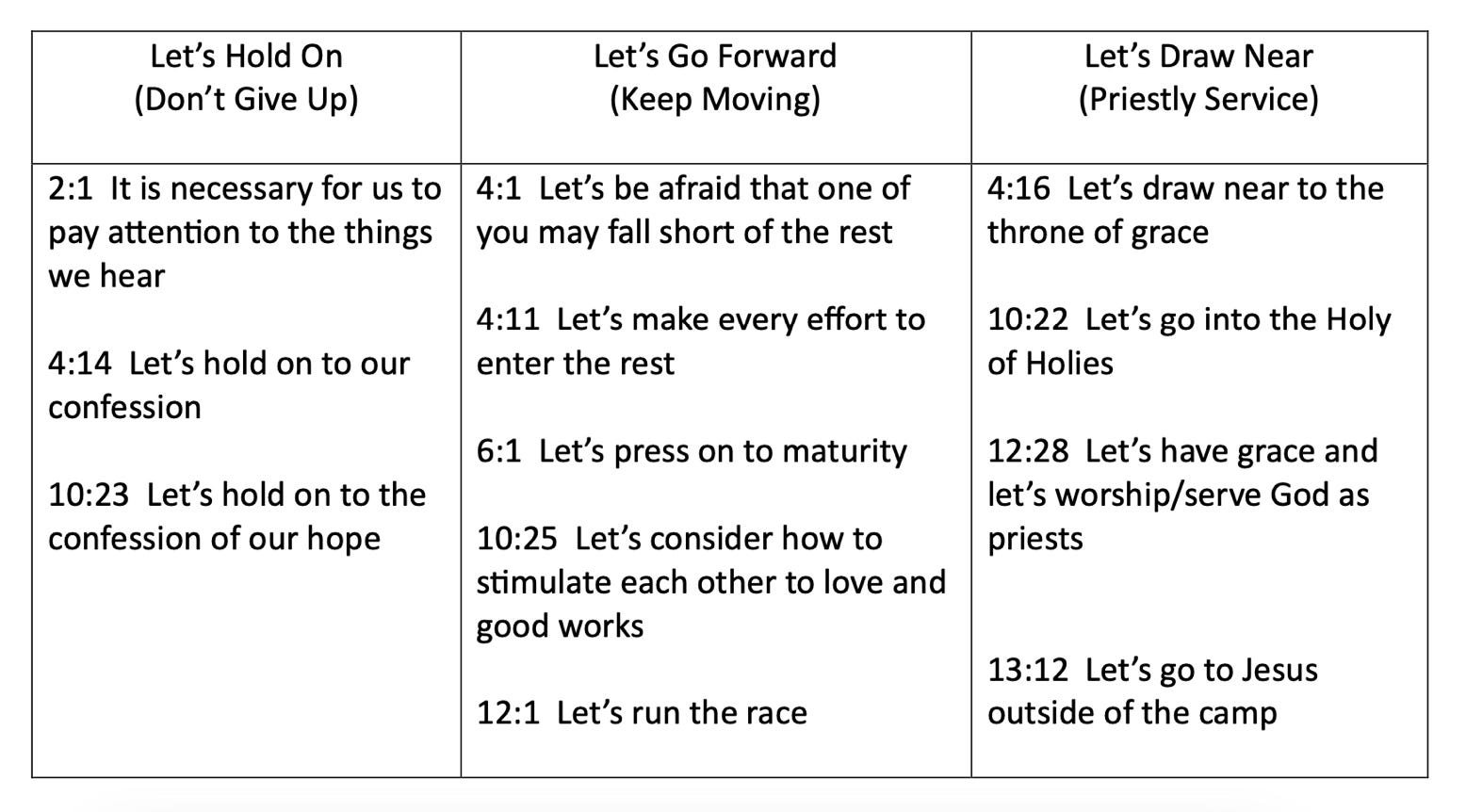
This language is the voice of a preacher saying we rather than me, or to be more precise, a language that says “let us” rather than let you or let I. Eleven times the preacher speaks of “us” because having the support of each other matters3 amidst the challenges we face in life. The importance of us is also why we read in Hebrews 10:25, “not neglecting to meet together, as is the habit of some, but encouraging one another, and all the more as you see the Day approaching.”
It’s unfortunate that in past times Hebrews 10:25 was often misused in a legalistic manner. Weaponizing this passage to guilt-trip people into church attendance or to fear God’s judgment for missing a church service is spiritual abuse—full stop. Anyone who knows me then knows that I want nothing to do with such legalism. But as a pastor, I also am concerned that in trying to avoid such legalism, we can diminish the importance of gathering together as Christians. That would be a mistake. We are more likely to keep our focus on the finish line, remember the promises God has fulfilled in Christ, and remain anchored to Christ when we gather together.
It might be helpful to know Hebrews 10:25 is not just talking about what we think of as Sunday morning church. The old King James Version used the phrase “forsaking the assembly” which in my experience was assumed to mean Sunday morning church. The text never uses the word assembly but instead says “not neglecting to gather together with yourselves” (my translation). Traditional Sunday church services are one way of gathering together but not the only way and some might even say that Sunday morning services are not the most important way. Regardless of what is most important, there are other ways of gathering together. We can gather together in life groups, by meeting up for coffee or even having dinner together. These days the luxury of smartphones allows us to remain connected by checking in with each other through a quick phone call or even a text. However, we would be wise to never allow texting and communication through social media to replace gathering together in face-to-face settings.
The reason why we must pursue a life of faith and hope together is that we are more vulnerable when we’re not together.4 The point of gathering together is about encouraging each other so that when we get tired in this race of life that we’re running, we can encourage each other’s faith and hope in Christ. The answer to the question of how we keep our faith and hope is by staying connected to each other, and by coming together as brothers and sisters in Christ. We are more likely to keep our faith together because the work of the Holy Spirit in the life of every single believer is done as a “we” and “us” together.
Any notion that we can live as Christians apart from participation in a local body of believers, known as a church, would be strange to the preacher who gave us Hebrews. I know there are local churches that are so unhealthy that faith and hope are hindered rather than nurtured. However, gathering together as Christians still matters. So if we want to keep our faith and hope, we would do well to find a local church we can be a part of and participate in life together with that church.
1Unless otherwise noted, all scripture quotations are from the New Revised Standard Version, Updated Edition Bible, copyright © 1989, 2021 by the Division of Christian Education of the National Council of the Churches of Christ in the U.S.A., and are used by permission. All rights reserved.
2Jürgen Moltmann, Theology of Hope: On the Ground and the Implications of a Christian Eschatology, trans. James W. Leitch (New York: Harper and Row Publishers, 1967), 20.
3David A. deSilva, Hebrews: Grace and Gratitude (Nashville: Abingdon Press, 2020), 95.
4Craig R. Koester, Hebrews: A New Translation with Introduction and Commentary, The Anchor Bible (New York: Doubleday, 2001), 445, notes that the word ἐγκαταλείπω (abandon, neglect) implies “leaving something vulnerable to destructive forces such as poverty (cf. 13:5), death (Matt 27:46; Mark 15:34; Acts 2:27), or other difficulties (2 Cor 4:9; 2 Tim 4:10, 16).”
April 24, 2024
Keeping Faith
“Becoming a follower of Christ is a lifelong process of growing, learning, and changing. It is also a process of surrender.” - Richard Stearns
Two Sundays ago I began preaching a series of messages from the New Testament writing of Hebrews called Keeping Faith. I gave the series the subtitle Sermons on the Sermon of Hebrews because most scholars think Hebrews was originally a sermon. Although we don’t know who the identity of the preacher that gave us this writing, the message is as relevant today as it was to the Christians in the first century.

Christianity is a life of faith, one in which we believe in and therefore follow Jesus Christ. Yet, as we all know, living life as a Christian is a journey that encounters challenges along the way. Hebrews understands, which is why the sermon is proclaiming a message of perseverance to Christians who are struggling with faith. We pick up on the challenge in Hebrews 12:1-3:
Therefore, since we are surrounded by so great a cloud of witnesses, let us also lay aside every weight and the sin that clings so closely, and let us run with perseverance the race that is set before us, looking to Jesus the pioneer and perfecter of our faith, who for the sake of the joy that was set before him endured the cross, disregarding its shame, and has taken his seat at the right hand of the throne of God. Consider him who endured such hostility against himself from sinners, so that you may not grow weary or lose heart.1
In recognizing the challenge of growing “weary,”2 this text also offers us some needed encouragement as we seek to keep the faith.
The challenge, of course, is that when we encounter difficulties in life, such difficulties become wearisome. Such weariness opens space for struggles in keeping our faith, losing sight of Jesus Christ and sometimes just wanting to give up all together.
With the struggles and temptation to abandon faith, Hebrews calls our attention back to Jesus Christ.3 Hebrews draws our attention back to Jesus because Jesus is able to sympathize with us. In fact, earlier the preacher says, “For we do not have a high priest who is unable to sympathize with our weakness, but we have one who in every respect has been tested as we are, yet without sin” (Heb 4:15).
Jesus knows the struggles we face because he’s faced his own struggles too, even the struggle of dying on the cross—Crucifixion. So Jesus knows. As we sometimes sing in the old hymn No Not One, “Jesus knows all about our struggles, He will guide till the day is done. There's not a friend like the lowly Jesus—No, not one! no, not one!” Because Jesus knows, the writer of Hebrews wants us “looking to Jesus” or “fixing our eyes on Jesus” (NIV).
Christianity in America seems delusional, with people trying to run a spiritual race called Christianity while simultaneously running in a race of partisan politics.
Of course, we should keep our eyes on Jesus. However, keeping faith in Jesus seems unlikely if our focus is elsewhere and when we face struggles, it’s easy to lose focus of Jesus. So to keep our eyes focused on Jesus, the writer of Hebrews uses the imagery of running a race. The metaphor of running a race is easy to understand even if we’re not running in marathons.
Since the race we are talking about is a metaphor, running in the race involves looking ahead to the finish line.4 That is, we stay focused on the goal of crossing the finish line to be with both Jesus Christ and those who have already crossed the finish line. But as a pastor, I’m concerned. My concern is that more and more people who profess to be Christians and attend church services with some regularity are beginning to run a different race or are at least running way off course.
When the day comes that we draw our final breath, there will only be one thing that matters. So fix our eyes upon Jesus and run the race that matters!
Imagine trying to run two races at the same time. It’s impossible. Or imagine trying to run a race but veering off course. Both are possible when we lose focusing of the goal and miss the markers that would keep us on course because of a failure to pay attention that leads to a drift (Heb 2:1). Yet as a minister of the gospel, this is what is happening.
Christianity in America seems delusional, with people trying to run a spiritual race called Christianity while simultaneously running in a race of partisan politics. This dualistic thinking that each race can be run at the same time has taken some Christians off the course that ends at Mount Zion where the city of the living God is located (Heb 12:22). We know we have veered off course when we seem more interested in trying to convince others on how they should vote rather than doing something that would point to Jesus Christ. We know we have veered off course when our social-media posts seem more like we’ve become spokespeople for donkeys and elephants than the cross. And yet the irony is that some will still wonder why America is becoming more and more secularized as a post-Christian society.5
One of the challenges we face as Christians residing in the United States of America is living as followers of Jesus among a nation whose goal (telos) leads to a different finish line than Mount Zion. This isn’t a criticism of America, it’s just a recognition of reality that exists on both sides of aisle and in every ideological stream shaping American life. Allowing ourselves to get caught up in such political games, extolling one side while denigrating the all others, is to run another race than the race that is set before us as Christians. Jesus offered himself in death as the once-for-all sacrifice of atonement so that we could enter a different race, a race that we will win if we just keep running because Jesus, the pioneer and perfecter of our faith, has already won the victory for us. We just have to keep running the race set before by Jesus Christ until we cross the finish line.
Let me end by saying that point has nothing to do with whether we, as Christians, should or shouldn’t vote in political elections. Likewise, I am not suggesting that having an opinion on various issues that society faces is wrong. What I am saying is that we can only run one race at a time. Thus as my father-in-law would say, when the day comes that we draw our final breath, there will only be one thing that matters. So fix our eyes upon Jesus and run the race that matters!
1Unless otherwise noted, all scripture quotations are from the New Revised Standard Version, Updated Edition Bible, copyright © 1989, 2021 by the Division of Christian Education of the National Council of the Churches of Christ in the U.S.A., and are used by permission. All rights reserved.
2For the original recipients of Hebrews, the weariness is predicated on some persecution that included public abuse and even the plundering of their possessions (cf. Heb 10:32-34).
3Patrick Gray and Amy Peeler, Hebrews, T&T Clark Study Guides to the New Testament (New York: T&T Clark, 2020), 12, “The author therefore seeks to explain the ways in which the new covenant—God’s distinctive way of dealing with humanity through Jesus—demands the utmost allegiance and remains perfectly consistent with the divine plan as disclosed under the original covenant.”
4The good news is that we’re not alone in this race as we run towards the finish line. As Luke Timothy Johnson, Hebrews: A Commentary, The New Testament Library (Louisville: Westminster John Knox Press, 2006), 315, “The runners begin far away from the city in some remote place with few observers, move through growing crowds and greater fatigue, and finally emerge in the stadium before a massed assembly of spectators who watch and applaud as the runners complete their final lap.”
5To be fair, there are other factors that are at work in the emergence of a post-Christian society but to pretend as if Christians don’t have any culpability is nonsensical. For a discussion on some of the other factors at work, see Tara Isabella Burton, Strange Rites: New Religions for a Godless World (New York: Public Affairs, 2020, 53, which include 1) the absence of a wider demographic power, 2) the power of consumer capitalism, and 3) the rise of the internet.
March 27, 2024
They Crucified Him
Years ago my family and I visited Medieval Times, which is a place where you enjoy a royal banquet dinner and watch a staged tournament of sword fighting and jousting on horses. The dinner was good and the show was entertaining but first was the room. The room I’m talking about is an exhibit filled with all kinds of medieval torture devices like The Judas Cradle, The Rack, and the Bronze Bull. It’s macabre to think that people have come up with such grotesque ways of inflicting pain on other people.
Of course, folks living in the medieval ages were far from the first people to implement barbaric forms of punishment. The Romans crucified people; hanging people on a cross for several days until they died. As we know, crucifixion was how the Romans executed Jesus.
 Frans Francken, “Christ on the Cross Between Two Thieves,” 17th Century.
Now unless we’ve seen a film like Mel Gibson’s The Passion of Christ, it’s hard to imagine how horrific crucifixion is. Apart from the flogging and physical assault, the four Gospels say very little about the physical suffering Jesus endured on the day of his crucifixion. The Gospel of Mark simply tells us “they crucified him.”1 Twice, Mark says “they” meaning the Roman soldiers “crucified him”—Jesus the Messiah.
Mark seems more interested in what I think of as the paradox of this crucifixion. Earlier in Mark’s Gospel, the high priest asked Jesus, “Are you the Messiah, the Son of the Blessed One?” For which Jesus said, “I am… And you will see the Son of Man sitting at the right hand of the Mighty One and coming on the clouds of heaven.”2 Yet here in the fifteenth chapter, Jesus the Messiah is crucified.
How can Jesus be the Messiah of God and yet end up crucified? The Messiah comes as the Savior, not as a criminal. Crucifixion is what Rome does to those whose high crimes involve insurrection, who speak in seditious language against Caesar. In a game of thrones, crucifixion is the Roman way of winning and reminding everyone that whoever gets in the way of Rome loses.
So it seems paradoxical as Christians to say that we believe in Jesus, the Crucified Messiah. For Jesus, his crucifixion seems like a paradox. He’s the Messiah who has come to save and yet the crowd watching him hang on the cross responds with taunts and insults. The humiliation Jesus enures is substantial. Betrayed by Judas, disowned by Peter, and seemingly abandoned by the rest of his disciples, here Jesus is—the Crucified Messiah. The feeling of abandonment was so great that Jesus felt completely forgotten by the Father in heaven. So Jesus cried out, “‘Eloi, Eloi, lema sabachthani?’ (which means ‘My God, my God, why have you forsaken me?’).”3
The point Mark has brought us to is an understanding that because Jesus is the Crucified Messiah, God has chosen the cross as his means of salvation.
Yet, in this moment of paradox, another paradox emerges. Mark tells us that as Jesus took his last breath and died, the centurion soldier on guard saw just how Jesus died and said, “Surely this man was the Son of God!”4
The confession of the centurion is somewhat perplexing. Was the soldier’s confession like what we speak of as a confession of Christian faith? It’s hard to imagine that in this particular moment of Jesus’ crucifixion, a Roman guard suddenly has in mind a robust Christology that is taught as a matter of Christian doctrine. Yet, it also seems silly to think that the centurion soldier’s confession is nothing more than a whimsical utterance.
Although perplexing at face value, we should remember that the soldier’s confession is not just what he is saying but what Mark is telling us about Jesus. We might recall that Mark began his Gospel, saying “The beginning of the good news about Jesus the Messiah, the Son of God.”5 With story after story of Jesus healing diseases, driving out demons, and preaching, Mark reminds us that why Jesus is the Messiah, the Son of God. Now, in the crucifixion of Jesus the Messiah, Mark is calling our attention to the death of Jesus and saying this is the Son of God. Mark is asking us to turn our eyes and ears to the crucified Jesus so that we may see and hear that this Crucified Messiah is the Son of God.
The point Mark has brought us to is an understanding that because Jesus is the Crucified Messiah, God has chosen the cross as his means of salvation. This is the other paradox that emerges. Nobody ever expected a Roman crucifixion to be a part of God’s redemptive plan but it is. There is no other way of salvation, for this is how God inaugurates his kingdom—in and through the Crucified Messiah, Jesus, the Son of God.
The implications of this second paradox matter much. I believe that Mark wrote his Gospel so that we, as believers reading his Gospel, will learn to live as faithful followers of Jesus Christ. In fact, Jesus himself, according to Mark, not only calls us to follow him but also demands that we deny ourselves and take up our cross to follow him.6 There isn’t any way of following Jesus apart from embracing the cross as God’s wisdom and power, his chosen instrument of redemption.
Because the crucifixion is God’s chosen instrument of redemption, we must reject all other means by which we might pursue God’s redemption. Our witness to the good news of Jesus Christ and the Kingdom of God must embody “godly power, at work through presence and power of Jesus by the Spirit among a group of people.”7 Discipleship then is not about trying to make sure others vote for political candidates who promise to enact policies that appear more favorable to Christianity. Rather, following Jesus means getting in the trenches with people where we listen and serve, trusting that God is already at work in the trenches for his redemptive good. As we listen and serve, God opens space for us to discern together what needs to change so that we can learn to follow Jesus and pursue the kingdom of God together.
Some might say that this is too idealistic, that we need to open our eyes to the real world around us. But such worldly wisdom forgets that Jesus was crucified in the real world around us as well as raised from death in the real world around us,8 which changes everything. Tomorrow is Good Friday, the day upon which Jesus the Messiah was crucified. Calling the day Good Friday seems paradoxical too but we call it that because it really is in and through the Crucified Messiah that God is saving the world. May we never forget this paradox that is indeed good news!
1All scripture quotations are from The Holy Bible, New International Version, NIV. Copyright © 1973, 1978, 1984, 2011 by Biblica, Inc. Used by permission. All rights reserved worldwide.
2Mark 14:61-62.
3John R Stott, The Cross of Christ, Downers Grove: InterVarsity Press, 1986, 80-81, lists four proposed explanations for the cry as one of 1) anger, unbelief, and despair, 2) loneliness, 3) victory, and 4) dereliction but regards also reads the cry of Jesus as one of dereliction.
4Mark 15:39.
5Mark 1:1.
6Mark 1:17; 8:34.
7David E. Fitch, Reckoning With Power: Why The Church Fails When It’s On The Wrong Side of Power, Grand Rapids: Brazos Press, 2024, 46, this “godly power” is in contrast to what the labels as “worldly power” which is a coercive and/or manipulative power over people.
8We can never understand the true meaning of the crucifixion apart from the resurrection. See Morna D. Hooker, “Believe and Follow: The Challenge of Mark’s Ending, “ in Preaching Mark’s Unsettling Messiah, eds. David Fleer and Dave Bland, St. Louis: Chalice Press, 2006, 48, “The development of Christian doctrine has tended to ling Christ’s death, in particular, with the forgiveness of sin; but we misinterpret the significance of Jesus’ death if we detach it from resurrection. His resurrection marks his vindication and demonstrates his acquittal. Only in the light of the resurrection can we understand the meaning of Jesus’ death.”
March 20, 2024
Bread and Wine, Body and Blood
One thing that we all have in common is the enjoyment of food. Although we all have our favorite cuisines, recipes, and restaurants, we all enjoy food. There’s a reason why we enjoy food that goes beyond eating as a basic necessity of life.
 Leonardo da Vinci, The Last Supper, 1495-1498
Food is fellowship. Food is gathering around a table together. Food is sharing and receiving hospitality in our homes. Food is pleasure at our favorite restaurants. Food is sharing our favorite dishes and desserts at potlucks. Food is also conversation with our families and friends as we enjoy burgers and hot dogs on the 4th of July or some turkey and pumpkin pie on Thanksgiving.
To say it another way, food is a blessing from God. Or as Rachel Marie Stone says, “Food is a sign of God’s love—and there is no room for fear in love, for love casts out fear.”1
Such favorable and enthusiastic descriptions would also be true of the Passover Meal that Jesus shares with his disciples. Except with this “Last Supper,” there is an ominous cloud that is bringing about darkness upon Jerusalem. In reading the Gospel of Mark, Jesus has repeatedly told his disciples that when they eventually arrive in Jerusalem, he will be handed over to the authorities and killed—crucified.2 The disciples have not come to terms with the idea of Jesus, whom they believe to be the Messiah, getting crucified, must less grasping the meaning of such a shameful death. However, by the beginning of the Festival of Unleavened Bread, the disciples are aware of the growing conflict between Jesus and the religious authorities. Something must give and something will or, better yet, someone will give.
The great paradox of the Christian faith is that as horrible as suffering is, hope is born out of suffering. Death is not the end of hope but the beginning of a new hope because Jesus has entered into life with us, giving his body and blood.
Even with the darkness that has emerged, a nice supper has a way of letting everyone forget, if only for a little while, about such darkness. Food and all that food is can have that kind of cathartic effect. But whatever laughter and light-hearted conversations were going on, everything turned for the worse when Jesus told his disciples that one of them would betray him.
The mention of betrayal is a reminder that everything is not okay. And Jesus is trying to tell his disciples that things are going to get even worse in the coming hours. What happens next is something most Christians are very familiar with: According to Mark 14:22-25…
While they were earting, Jesus tood bread, and when he had given thanks, he broke it and gave it to his disciples, saying, “Take it; this is my body.” Then he took a cup, and when he had given thanks, he gave it to them, and they all drank from it. “This is my blood of the covenant, which is poured out for many,” he said to them. “Truly I tell you, I will not drink again from the fruit of the vine until that day when I drink it new in the kingdom of God.”3
We are familiar with this text because it is one that we often read when gathering at the Lord’s Table to share in the Eucharist or Lord’s Supper together. We’ve heard this text read many times, so much that we might just miss not what Jesus is saying but what Jesus is doing.
Jesus is the one giving. He is giving the disciples bread and wine to eat and drink, saying that this bread and wine signifies his body and blood. Jesus is giving a preview of the gift he will give with his body and blood—his life upon the cross. The life of Jesus given upon the cross will be the promise of hope because it is the offering that ratifies God's covenant with Israel, establishing a new covenant.4 Rather than defeat, the crucifixion of Jesus will lead to the resurrection of Jesus because the death of Jesus will not be the end but the resurrection of new life for all, beginning with his resurrection from the dead.
The great paradox of the Christian faith is that as horrible as suffering is, hope is born out of suffering. Death is not the end of hope but the beginning of a new hope because Jesus has entered into life with us, giving his body and blood. Sins are forgiven and death gives way to life because the crucifixion of Jesus is followed by the resurrection of Jesus. This is why Jesus assures the disciples that he will drink the fruit of the vine anew in the kingdom of God.
As I mentioned earlier, something has to give and something did give because someone gave. With Holy Week beginning in four days, we must let ourselves enter into the paradox of the Christian faith. Many of us already carry great sorrows and grief, struggles and challenges, that seem to darken our lives. But God has given new life in and through the life of his Son, Jesus the Messiah. Holy Week, leading to Good Friday, Holy Saturday, and then Easter Sunday is a reminder that we no longer need to worry about what the future might hold. The kingdom of God is at hand in Jesus Christ and is cemented into the very course of history through his crucifixion, resurrection, and exaltation as Lord.
This is the good news of Jesus Christ and the kingdom of God. And part of the good news is that we get to live as a witness to the good news. May we have the faith to live as faithful followers of Jesus Christ, the Son of God!
1Rachel Marie Stone, Eat With Joy: Redeeming God’s Gift of Food, Downers Grove: IVP Books, 2013, 39.
2Mk 8:31-32; 9:31; 10:33-34.
3Taken from The Holy Bible, New International Version, NIV. Copyright © 1973, 1978, 1984, 2011 by Biblica, Inc. Used by permission. All rights reserved worldwide.
4James R. Edwards, The Gospel of Mark, The Pillar New Testament Commentary, Grand Rapids: Eerdmans, 2002, 427, has only made this point about the blood of Jesus saying “‘My blood of the covenant’ implies that the blood of Jesus is the only true and efficacious blood of the covenant, of which the blood of animals was merely proleptic.” However, the point seems equally true with the body of Jesus, since the body and blood cannot be separated—there isn’t any blood without the body.
March 6, 2024
What Must I Do To Be Saved?
“What must I do to inherit eternal life?”1 That’s a good question to ask. In fact, that’s the exact question a wealthy man asked Jesus in a story told to us in Mark 10:17-31. It’s basically the same question that the jailer asked Paul and Silas, who were in prison, after a terrible earthquake (Acts 16:30).

With nearly twenty-five years of ministry experience, I’ve encountered numerous Bible studies attempting to answer this question about salvation. Every study, whether in print form or online, has sought to answer the question similarly to Paul and Silas’s response. These responses include instructions about confessing faith in Jesus Christ as well as repentance and baptism. Such responses are not wrong per se but I have never found one Bible study that answered the question the way Jesus does.
I’m not negating the importance of faith, repentance, and baptism but perhaps we should consider how Jesus responded to the question “What must I do to inherit eternal life?” After all, it’s a good assumption that Jesus’ answer is as correct as the answer Paul and Silas gave to the jailer.
So how did Jesus answer this question about salvation? Well, Jesus said “You know the commandments: ‘You shall not murder, you shall not commit adultery, you shall not steal, you shall not give false testimony, you shall not defraud, honor your father and mother.’”
As Christians, I’m sure we can put a check next to each one of these commands. We should be able to add even a few more checks next to a whole lot of biblical ideas such as faith, baptism, worship, giving, caring for the sick, feeding the hungry, and so forth. But Jesus says, “One thing you lack… Go, sell everything you have and give it to the poor, and you will have treasure in heaven. Then come, follow me.”2
The challenge of following Jesus means there are aspects of our life that we will need to let go of because they stand in the way of following Jesus.
The response of Jesus should grab our attention but if we just take the so-called “plain reading,” then we’re missing the point. Jesus isn’t condemning wealth or saying that we can’t follow him and still have money in our savings accounts. There’s nothing wrong with having money, owning property, etc… unless such wealth comes before God—taking priority over serving God as followers of Jesus. The way we know if our wealth has priority over God seems as simple as it is challenging. Is our life formed by Jesus Christ or by our wealth or desire for wealth? To ask the question another way, are the decisions we make and how we spend our time shaped by our relation to Jesus Christ or are they shaped by wealth? We can ask the same question about other matters in life because wealth isn’t the only thing that we can place before God. There are other possessions and pursuits that may be more formative to our lives—how we think and live—than our relation to Jesus.
We’ve all heard the phrase, “God, country, and family.” But how many times does the order become country, family, and then God? We understand that planning and saving money for retirement is wise but financial stability can also become an idol if we're not careful. Sometimes matters such as family and friends or our health and safety can easily become the one thing that Jesus is talking about.
After pointing out the one thing the wealthy man lacked, Jesus then called the man to come follow him. Yet the rich man walked away sad. So Jesus said, “How hard is it for the rich to enter the kingdom of God.” Likewise, it’s hard for those who insist on country and family before God to enter the kingdom of God, just as it is hard for those who choose security and safety over the mission of God.
What we need not worry about is our salvation, which is more than possible since Jesus says “all things are possible with God.” The way of salvation is simple but challenging: follow Jesus. Of course, the Gospel of Mark is clear that following Jesus means following Jesus even to the cross. The challenge of following Jesus means there are aspects of our life that we will need to let go of because they stand in the way of following Jesus. That was the case for the wealthy man and that can be the case for us too.
I’m not here to tell you or anyone else what is the one thing you may need to let go of. Doing so would mean trying to get the speck of dust out of your eyes while ignoring the log in my eye. What we all should do is consider what might be the one thing we still lack that keeps us from fully committing ourselves to following Jesus.
1All scripture quotations are from The Holy Bible, New International Version, NIV. Copyright © 1973, 1978, 1984, 2011 by Biblica, Inc. Used by permission. All rights reserved worldwide.
2N. T. Wright, Jesus and the Victory of God, Christian Origins and the Question of God, vol. 2 (Minneapolis: Fortress Press, 1996), 302, for this man to participate in this kingdom of God to come, he must give “total allegiance to the way of life which... [is] now to be under Jesus.”
February 14, 2024
He Gets Us
By now you have probably seen the “He Gets Us” commercials that were aired during the Super Bowl last Sunday. In short, the commercial portrays other people following the example of Jesus by washing the feet of different characters representing people who are sometimes shunned and excluded by others in society.1 This is the second year that the He Gets Us campaign has run its commercials.

According to the He Gets Us website, the purpose of these commercials is to “remind us of the example that Jesus set while inviting all to explore his teachings so we can all follow his example of confounding, unconditional love. Because He Gets Us. All of Us.” Seems like a good idea, right?
Well, maybe. But maybe not.
Minutes after the Kansas City Chiefs won the Super Bowl, a barrage of criticisms began to flood social media. Some of the criticism raises a point that deserves criticism. According to the Dallas Morning News, the cost of the 75-second commercial was $17.5 million. Most of us can’t even fathom spending that much money because it is more than we’ll ever earn in a lifetime. So I hear the concerns about whether paying for a commercial slot during the Super Bowl is the wisest way to spend that much money.
Some other criticism I’ve heard leaves me shaking my head, especially since the criticisms come from Christians. On Facebook, I read one post saying the commercial is “spiritually dangerous” because it says nothing about Jesus’ call for repentance. Similarly, I saw a video on Instagram of a pastor claiming the commercial is not biblical because it promotes a caricature of Jesus who washes the feet of people who hate God—those who are deemed to be living sinful lives. Then there’s the video which was made as a correction, “The Super Bowl ad they should have made,” showing different people who once were not Christians but have given their lives to Jesus, becoming Christians.
Don’t be bothered if Jesus extends grace to someone who believes and behaves differently than us, just be thankful Jesus has extended God’s grace to us.
Picture me doing a facepalm right now because of these criticisms. Look, there’s only so much that can be said in a 75-second commercial, so there’s no way possible to say everything about Jesus and the message he proclaimed. We have four different Gospels in the New Testament because neither Matthew, Mark, Luke, or John were able to say everything we need to hear about Jesus and his message. To suggest the He Gets Us commercial is promoting false teaching because it doesn’t mention any call to repentance or because it depicts Jesus serving sinners requires us to read a lot of assumptions into the commercial and draw conclusions based on what the commercial doesn’t say. When we start drawing conclusions from silence, we reveal more about ourselves than those we are criticizing.
There is nothing wrong with a video showing different people who have become Christians, as that is certainly a testimony to the power of the gospel. But I have watched the He Gets Us commercial over and over. Jesus indeed washed the feet of his disciples rather than the “sinners” of Jesus’ day but that misses the point of the commercial. Plus the Gospels do depict Jesus dining with the sinners and tax collectors as well as welcoming a host of other people who were excluded by the religious authorities, which seems to be precisely the point of the He Gets Us commercial.
So, for clarification, I firmly believe that the invitation of Jesus to “follow me” includes also the call to repentance and faith (cf. Mk 1:14-17). This is a call into a lifetime learning endeavor in which we let go of sinful living in pursuit of kingdom living. There is no following Jesus without repentance and faith, so please understand that I am not promoting a watered-down, wishy-washy, notion of Jesus who just approves of whatever life we’re living. But when we start lobbying criticisms like those mentioned above, we end up sounding more and more like the Pharisees who held Jesus in disdain for eating with the sinners and tax collectors, for letting a sinful woman wipe his feet with her tears, for going to the home of a chief tax collector named Zacchaeus, and so forth.
Thus I wonder if the church gets Jesus. I know that Jesus gets us and thankfully so or all of us would be dammed to hell. If we care so much about the world knowing who Jesus is, let’s make sure we spend time with real people in our neighborhoods and serve them as witnesses of Jesus Christ and the kingdom of God. Criticizing a commercial trying to get other people to consider Jesus seems unnecessary. Don’t be bothered if Jesus extends grace to someone who believes and behaves differently than us, just be thankful Jesus has extended God’s grace to us. Go and do likewise!
1I have corrected this post, as I originally said that the He Gets Us commercial portrayed Jesus washing feet but it actually portrays people washing other people’s feet.
February 7, 2024
Church Growth?
The Gospel of Mark was written so that Christians will learn to live as faithful followers of Jesus Christ. However, learning to live as faithful followers of Jesus Christ is a significant challenge, more than you probably realize when reading through the Gospel of Mark. The challenge is rooted in the reality that following Jesus means following Jesus to crucifixion and resurrection, and the can be no resurrection without submitting to crucifixion.

Of course, Jesus is very much willing to let you decide if you want to follow him or not. If you do want to follow Jesus, then the condition is plainly spoken. Jesus says“Whoever wants to be my disciple must deny themselves and take up their cross and follow me” (8:34).1
Whatever taking up the cross might look like in your context, you cannot follow Jesus unless you are willing to lay your own life down just as Jesus does. That includes me. One of the great sins of American Christianity is that a person can be a Christian without the cross, free to continue in a life shaped by American values. I’m talking about materialism and consumerism, American exceptionalism and militarism, radical individualism, religious pluralism and moral relativism, and yes, both American conservatism and liberalism.
So when you read of Jesus predicting his death for the second time in Mark 9, don’t be surprised to see the disciples arguing instead about who is the greatest. The disciples then struggled to grasp what it means to be a disciple just as much as Christians struggle to grasp discipleship today.
Rather than getting angry, Jesus simply corrects the misunderstanding, insisting that following him is not about any aspirations for greatness but about becoming “the servant of all” (9:35). To demonstrate the posture of humility and service required, Jesus picks up a little child and then says, “Whoever welcomes one of these little children in my name welcomes me; and whoever welcomes me does not welcome me but the one who sent me” (9:37).
What’s so challenging about welcoming children? Are children not cute and playful bundles of joy? Of course, they are but children didn’t always enjoy the status they have today. As hard as it might be to understand, in Jesus’ day, children lacked any social standing.2 Welcoming children in Jesus’ context did not elevate anyone’s greatness, increasing their prominence and social standing. In fact, welcoming children could be thought of as foolish.
Welcome those who lack social standing as the way of welcoming Jesus and the one who sent Jesus, and see the way God works for his redemptive good.
The point Jesus is making by welcoming children is that his followers must welcome the people in our society who lack social standing. These are the people who, from a worldly perspective, will not elevate your status and may even have other people questioning your judgment as they silently chuckle. So just who are the people Jesus says to welcome? The answer might be that migrant family who barely speaks any English and comes to the church building asking for food, the single mother living in the section-8 housing you pass on the way to church, the intellectually disabled adult who requires so much extra care, the elderly man who lives on a fixed income that limits how much he can give financially to the church, that man whose breath wreaks of too much alcohol and cigarettes every time he comes to worship, and the declining neighborhood that your church building is located among.
I think you get the idea but here is why such welcoming is a challenge to churches. Most churches are in decline and have been for some time. As a result, scores of books have been written on the subject of church growth so that your church can not only find renewed growth but become like that big megachurch located on the boulevard just off the freeway that appears to be the latest buzz among Christians. My point isn’t to knock megachurches but to say that churches should do some introspection on the desire to grow.
Amazingly, church growth is something Jesus never talked about once. Jesus talked about was repentance, faith, and the kingdom of God with an invitation to come follow him. And then Jesus shows us what it looks like to follow him through teaching and example. As a minister, I understand why churches want to grow and why Christians want their church to grow but instead of seeking to grow a church, perhaps it would be better just to focus on living as faithful followers of Jesus. Do what Jesus does. Welcome those who lack social standing as the way of welcoming Jesus and the one who sent Jesus, and see the way God works for his redemptive good. Maybe your church will grow or maybe it won’t. What I do know is that when churches follow Jesus, they will always be the church Jesus wants them to be and the kingdom of God will come just as it did for that little child Jesus welcomed.
1All scripture quotations are from The Holy Bible, New International Version, NIV. Copyright © 1973, 1978, 1984, 2011 by Biblica, Inc. Used by permission. All rights reserved worldwide.
2R.T. France, The Gospel of Mark: A Commentary on the Greek Text, The New International Greek Testament Commentary, Grand Rapids, MI: Eerdmans, 2002, 374; John R. Donahue and Daniel J. Harrington, The Gospel of Mark, Sacra Pagina, Collegeville, MN: Liturgical Press, 2002, 285.