K. Rex Butts's Blog, page 6
August 22, 2023
Hearing The Gospel Again
It's been a busy month of August for me but in a good kind of busy. First of all, I turned 50 years old. But more importantly, my wife and I celebrated our 25th anniversary and we moved our daughter to Nashville, to begin her college career at Lipscomb University.
Turning 50 is easy because there’s only one alternative to not getting older and frankly it’s not an attractive alternative at my young age. Entering into the 25th year of marriage and seeing my daughter blossom into a young adult follower of Jesus are things I’m proud of because neither marriage nor child-rearing is without challenge. That’s not a negative statement about either, just a matter-of-fact.

However, as I hit the half-century mark, I have other concerns. I am committed to following Jesus, whom I confess as Lord and am called to serve as a minister of the gospel. But I bear this commitment and calling in a cultural context where the Christian faith is increasingly irrelevant to many in society. I’m commissioned to proclaim a gospel that seems to have taken a back seat to ideologies that are played out in a socio-political culture war.
I’m currently reading Russell Moore’s newly published book Losing Our Religion. If you’re not familiar with who Russell Moore is, he currently serves as the editor in chief for Christianity Today and previously served as president of the Southern Baptist Convention’s Ethics and Religious Liberty Commission. Moore served in the latter position until he was removed by his own denomination after speaking out against matters pertaining to racism, political ideology, and sexual abuse scandals within the Southern Baptist Churches.
Moore is not a liberal in any sense of the imagination, as he is a conservative both theologically and politically. However, his allegiance is to Jesus. And even though there are particular theological matters that Moore and I disagree on, I admire his resolve to live as a follower of Jesus. In fact, as far as I can tell, Moore exhibits what I consider to be three great qualities of Christian leadership: Courage, Compassion, and Conviction.
Perhaps we might more fully embody the glory that Paul speaks at the end of Romans when he writes, “May the glory be to God, who alone is wise! May the glory be to him through Jesus Christ forever! Amen.”
The reason I mention reading Moore’s book is because I believe he’s naming the crisis facing Christianity in America. In his introduction to the book, Moore writes:
Some are panicked about rising secularism, and what they fear will be hostility to the church, but act in ways that tie the witness of the church, to forms of power that actually fuel secularism. Some of you are tempted towards cynicism, then, when you see people, you thought you knew taking positions you never could imagine them taking, because of politics or culture. The first group sometimes speaks as though the church will collapse if ‘the culture’ collapses. And members of the second group, sometimes think that the church will not survive the scandals of what passes for Christian ‘influence’ at the moment. Wherever you fit in the spectrum, though, we should all heed exactly what happened at Caesarea Philippi. Jesus rebuked Peter for seeking to adopt the way of Herod and of Ceasar and of Baal—power apart from the cross. In fact, Jesus said this was Satan (Matt. 16:23). What Jesus builds is different altogether—a church that cannot be bought with Caesar’s coin and cannot be stopped with Caesar’s cross.1
Yes, Moore is trying to speak primarily to Evangelical Christianity in America. However, the exchange of God’s power, the wisdom of Christ-crucified (cf. 1 Cor 1:23-24), for that which is adversarial (satanic) to the kingdom of God is, in general, a gospel crisis confronting nearly all of Christianity in America.
Like Moore, I don’t believe there is any quick or large scale solution. The gospel crisis confronting Christianity in America is not a problem that appeared overnight and it is unlikely one that will disappear overnight. But I am hopeful because I believe in Jesus and therefore do believe there is a way beyond this quandary. The way forward is to hear the gospel once again.
But don’t think the simplicity of saying the way forward is to hear the gospel again makes this hearing easy. This is difficult because hearing the gospel again means allowing the gospel to prophetically critique and call us into an expression of the gospel that is different than what we see getting labeled as Christianity today, with an exchange of God’s power for adversarial powers.
So to ask the question of whether Jesus can saved Christianity in America? Yes, of course, he can. But it begins with hearing addressed to us in the context of the misplaced loyalties and ideologies at work in the present.
The good news is that we’re not the first generation to have misplaced loyalties and ideologies. In the first century, there were Jews and Gentiles believers. To them, the apostle Paul wrote a letter that we call Romans and one of the more well known passages of that letter reads, “I’m not ashamed of the gospel: it is God’s own power for salvation to all who have faith in God, to the Jew first and also to the Greek.”2 But don’t let familiarity fool us. The salvation Paul is speaking of is not merely forgiveness of sins and the promise of an eternal after life but a sharing in very divine character of God.3
The gospel of/about Jesus Christ is more than just what is often meant by the revival language of “getting saved.” Salvation is to participate with God as people who have, through baptism, been buried in death with Christ and raised into an entire new life in Christ (cf. Rom 6:3-4). That’s why our faith is not merely a confession or belief expressed in intellectual ascent but is “allegiance” to King Jesus.4
If we are going to hear the gospel again, then we might need to hear Romans 1:16 with a slight variation that takes into account our own context:
I’m not ashamed of the gospel: it is God’s own power for salvation to all who have faith in God, to the [conservative/Republican] first and also to the [progressive/Democrat].
or perhaps…
I’m not ashamed of the gospel: it is God’s own power for salvation to all who have faith in God, to the [progressive/Democrat] first and also to the [conservative/Republican].
What might change if we hear the gospel addressed to us in this manner? How might the Gospel bring a fresh perspective if we read Romans addressed to Christians who also identify as conservative/Republicans and progressive/Democrats? Perhaps we might more fully embody the glory that Paul speaks at the end of Romans when he writes, “May the glory be to God, who alone is wise! May the glory be to him through Jesus Christ forever! Amen.”5
May we have the eyes and ears to see and hear the gospel!
1Russell Moore, Losing Our Religion: An Altar Call for Evangelical America, New York: Senital, 2023, 24-25.
2Romans 1:16; Unless otherwise noted, all scripture quotations are taken from the Common English Bible, copyright 2011. Used by permission. All rights reserved.
3Michael J. Gorman, Becoming the Gospel: Paul, Participation, and Mission, Grand Rapids: Eerdmans, 2015, 276-277.
4Matthew W. Bates, Salvation By Allegiance Alone: Rethinking Faith, Works, and the Gospel of Jesus the King, Grand Rapids: Baker Academic, 2017, 77.
5Romans 16:27.


July 25, 2023
I See Thy Self
The first church I ever served with as a minister was a little country church in Arkansas, nestled in the foothills of the Ozarks. This was a good place for me to start learning how to preach and help encourage people to live as followers of Jesus.
In short, what I love about ministry is getting to share with people what I believe God is doing in Jesus Christ and encourage them to follow Jesus. Whether this happens while preaching during a Sunday worship gathering or sitting across the table from someone while enjoying a cup of coffee, this excites me. Nearly twenty-five years since preaching for that small Arkansas church, I’m still seeking to follow Jesus and praying that I can encourage others to follow Jesus too.

Yet, a lot has changed between then and now. Back then, nearly everyone I met shared the same foundational religious beliefs. That is, we believed in God, and by God, I mean the God we read of in the Bible, who ultimately reveals himself in Jesus Christ, the Son of God. We regarded the Bible as God’s inspired word and useful for teaching us how to live as God’s people (cf. 2 Tim 3:16-17). Today, such religious beliefs are not a given.
People I meet may or may not believe in the existence of God. And even if they ascribe to a theistic belief, they’re understanding of who God is may greatly differ from my own. For some, the Bible is an ancient collection of religious writings, but its significance for instruction about matters pertaining to God and life isn’t any greater than any number of other religious writings. But perhaps the most significant change is the centering of self as the goal of fulfillment.
The centering of the individual self coincides with the age of secularism that we live in. In reality, the centering of the individual self was taking shape long before I was even born. It’s just a reality that I am becoming more aware of while serving in ministry. So the other day, as I was reading Andrew Root’s The Pastor in a Secular Age, these words seeming jumped off the page:
The tightly organized forms of paleo- and neo-Durkheimian religion have exploded like a massive star. In the post-Durkheimian dispensation, we live inside a supernova effect, where a massive buffet of frenetic spiritual options is set before us, none formally ruled better than any other, yoga as significant as communion, Martian chat rooms as important as the preached word. Whatever speaks to you is worthy of exploration and commitment until it no longer does. Divine action is opaque, not because religion and spirituality have been darkened, but because the light of the nova explosion is so intense and inner-directed that a vision for divine action becomes washed out.1
That’s a wordy paragraph, but what Root is describing is the secular context that ministry takes place in. With people centering the individual self, a great chasm has grown that separates the sacred and ordinary, obscuring transcendence because people are so focused on the immanent where the individual self resides. In the centering of the individual self, what becomes the goal is what is good for the self. So, as Root observes with his comparison of yoga and Martian chat rooms to communion and preaching, whatever seems good is the path that people will pursue. It doesn’t matter if such a pursuit is actually good, right, and true, because what matters is what people have determined as good for their individual selves.
A big challenge of serving in ministry is how to help people who are focused on the immanent self begin to see the transcendent work of God in Jesus Christ.
I see this challenge even within Christianity, in the way that individual believers might select which church to be a part of or choose not to be a part of a local church. If a person isn’t “feeling it” at church, or perhaps the worship just doesn’t speak to them.
Well, I’m not complaining, and even if I was, it wouldn’t help because complaining isn’t going to change the reality of the secular society we live in. However, I am trying to understand the implications for ministry in the context of such secularism and the centering of the individual self. This is why I am reading through Andrew Root’s three-volume set Ministry in a Secular Age (Faith Formation in a Secular Age, 2017; The Pastor in a Secular Age, 2019; The Congregation in a Secular Age, 2021).2
To be quite honest, though I have some idea, I’m not sure what all the implications are yet. What I am sure of is that the reality of secularism and the centered individual self exists in Urban, suburban, and rural populations across America. So a big challenge of serving in ministry is how to help people who are focused on the immanent self begin to see the transcendent work of God in Jesus Christ.
1Andrew Root, The Pastor in a Secular Age: Ministry to People Who No Longer Need God, Grand Rapids: Baker Academic, 2019, 143
2For those who are quite ambitious, see also Charles Taylor, A Secular Age, Cambridge: Harvard University Press, 2007.
July 18, 2023
God Stories
My summer preaching has focused on well-known stories from the Old Testament. Stories like Noah’s Ark and the Flood in the book of Genesis, the story of Moses and the burning bush in Exodus, and more. I’ve called the series Great Stories because they really are great stories. However, I have consistently tried to emphasize that what makes these stories to be great stories is that they are God stories.

God stories.
Let that sink in. The great stories of the Old Testament are stories of God at work for his redemptive good. Whatever role other characters have in the different stories throughout the Old Testament, God is the primary actor, the active agent in the stories.
All the stories of God acting for his redemptive good are part of the larger redemptive story told throughout scripture, from Genesis to Revelation.
I’m really convinced that we need reminding of God’s redemptive work. More importantly, we need to know that God is at work not just in the past but in the present, for a future already revealed in the crucified, resurrected, and exalted Jesus Christ.
Why?
As churches face decline and the society around us increasingly becomes more post-Christian, frustrations rise. In such times it’s easy to think we must fight back for the faith,1 forgetting that God has already established his victory in Jesus Christ.
In remembering God’s story, the focus shifts from the changes taking place around us because we give our attention to what God is doing Jesus Christ.
The story of Moses and the burning bush reminds us that God sees and hears exactly what is going on (Ex 3:7). So a part of the redemptive story of God that we participate in as followers of Jesus is knowing that God knows what is going on in the world.
Perhaps the most important thing we can do is to remember the story we participate in. By remembering the story, we remember that God sees and hears. Perhaps then we can remember that God is at work as we speak, even if we can’t always see and hear how he’s working. In remembering God’s story, the focus shifts from the changes taking place around us because we give our attention to what God is doing Jesus Christ.
I bring this up because Christianity, throughout history, has gotten into trouble when the church took its eyes off of Jesus. This is how the church has turned to courting the powers of worldly kingdoms to serve itself at times. On the other hand, when the church has kept the focus on the crucified, resurrected, and exalted Jesus Christ, we see how the church has valiantly participated in the mission of God—even from the most marginal of places.
A few weeks ago, while I was in Indiana, I stopped by one of my favorite indulgences, otherwise known as a used book store. I ended up picking up a little book containing select writings from the late Flannery O’Connor. I’ve never read any of O’Connor’s books, but many preachers and teachers I know and respect have. So I bought this little book by Flannery O’Connor and start reading. I’m glad I did so.
Here is something that Flannery O’Connor wrote in a letter to Dr. T.R. Spivey, an English Professor at Georgia State University. The letter was dated June 21, 1959, five years before O’Connor’s death from Lupus. Here’s what Flannery O’Connor wrote:
I don’t believe that if God intends for the world to be spared He’ll have to lead a few select people into the wilderness to start things over. I think that what He began when Moses and the children of Israel left Egypt continues today in the Church and is meant to continue that way. And I believe all this is accomplished in the patience of Christ in history and not with select people but with very ordinary ones—as ordinary as the vacillating children of Israel and the fisherman apostles.2
That’s what it sounds like to remember our story and participate with God in his redemptive work as followers of Jesus.
Jesus never said living as his church would be easy. However, we will always come out on the good end as we follow Jesus into the future of God’s kingdom. The redemptive work of God the Father, Son, and Spirit says so!
1Andrew Root, Faith Formation in a Secular Age: Responding to the Church’s Obsession with Youthfulness, Ministry in a Secular Age, vol. 1, Grand Rapids, Baker Academic, 2017, 102.
2Flannery O’Conner, Spiritual Writings, Modern Spiritual Masters Series, ed. Rober Ellsberg, Maryknoll, NY: Orbis Books, 2003, 77.
June 26, 2023
Is God Dead?
“God is dead. God remains dead. And we have killed him.” - Friedrich Nietzsche
The idea that God is dead appears first in Friedrich Nietzsche’s book The Gay Science.1 My read of Nietzsche is that his death of God claim was not meant to be a declarative statement about God but rather a commentary on society. Nietzsche is speaking about how the entire Enlightenment experiment has centered humans, particularly human reason, as the source of knowledge rather than God. Under this human-centered way of believing, western civilization assumed that humanity could find answers to all the questions of life through reason. Thus the Enlightenment period was also known as The Age of Reason.

Now we only need a cursory reading of twentieth-century history to see the failures of this Enlightenment experiment. Human reasoning did not prevent people from killing each other in wars and concentration camps. Humans figured out how to land on the moon, but peace was too difficult of a task. Humans made great strides with education and economic prosperity, but racism and classism remained. Twenty-three years into the new century and millennium, it doesn’t seem like people have learned much from our history because the need to center ourselves remains.
That is to say, people still seem ever-bent on centering life in the self and thereby living as though there is not any need for God. One example is found in the way people handle the notion of truth. Over time, our society has started adding adjectives to the word truth, so that “my truth” becomes the “absolute truth.” Both phrases, my truth and absolute truth, are attempts by people to define truth for themselves. Ironically, such attempts have only furthered the pervasive relativism that is part of our culture.
Before I continue, I’ll state my own bias here: I am unapologetically a follower of Jesus because I believe that Jesus is the crucified, resurrected, and exalted Lord and Messiah (Christ). So that means I seek to read the Bible in light of Jesus and read culture in light of Jesus. I don’t always do so well, but from my point of view, as a follower of Jesus, it seems like Nietzsche was right. “God is dead. God remains dead. And we have killed him.”
The people still believe in God, but there’s a big difference between intellectually believing in God and functionally living as though God exists and is the source of knowledge necessary to answer the questions of life.
In broad terms, Nietzsche offers a good commentary on our own society and also the people we read about in Genesis 11:1-9:
Now the whole world had one language and a common speech. As people moved eastward, they found a plain in Shinar and settled there. They said to each other, “Come, let’s make bricks and bake them thoroughly.” They used brick instead of stone, and tar for mortar. Then they said, “Come, let us build ourselves a city, with a tower that reaches to the heavens, so that we may make a name for ourselves; otherwise we will be scattered over the face of the whole earth.” But the Lord came down to see the city and the tower the people were building. The Lord said, “If as one people speaking the same language they have begun to do this, then nothing they plan to do will be impossible for them. Come, let us go down and confuse their language so they will not understand each other.” So the Lord scattered them from there over all the earth, and they stopped building the city. That is why it was called Babel—because there the Lord confused the language of the whole world. From there the Lord scattered them over the face of the whole earth.2
This is a story of people centering themselves so that they won’t be scattered abroad. Fear, self-preservation, and aspirations for upward mobility also seem to be at work3 in the motive of the people acting for themselves by building this tower.
In the meantime, God has completely disappeared from what the people are doing. God is not a part of the equation in their desire to build this tower. The people still believe in God, but there’s a big difference between intellectually believing in God and functionally living as though God exists and is the source of knowledge necessary to answer the questions of life.
If we’re honest, there are probably a lot of intellectual theists who live as functional atheists. Some of these functional atheists even profess the Christian faith and attend Sunday worship gatherings. To be quite honest, I have lived as a functional atheist at times, and you likely have done so too. The problem isn’t just forgetting about God. Rather, the problem is going about life without God, which always leads to bad things happening in life.
The good news is that the story of creation doesn’t end with Babel. God is redemptive and will act for the redemption of his creation. The redemptive response of God will find fulfillment in Jesus Christ and is proclaimed on Pentecost. In Genesis 11, the people are scattered with many languages, but in Acts 2, people are gathered from every nation where the Spirit of God is poured out on everyone as they hear the good news in their own language. What the people hear on Pentecost is that God has raised the crucified Jesus from death and exalted him as Lord and Messiah. The people are then invited to live under the reign of God once again by submitting to Jesus Christ through repentance and baptism, living life in the name of Jesus Christ by the power of the Holy Spirit.
The redemptive response of God says that life doesn’t have to be a bunch of babel. Life must not be a state of confusion, filled with that mixture of fear, self-preservation, and aspirations for upward mobility that never satisfy and may even result in disasters.
Martin Luther King Jr. once said, “Every man must decide whether he will walk in the light of creative altruism or in the darkness of destructive selfishness.” That choice comes down to whether we will allow our lives to be centered in God or center ourselves. Whether we will follow Jesus or whatever suits our interests is a question.
So to circle back to Nietzsche’s claim about God, we might ask the question of whether God is dead. In some people's lives, it sure seems as though God is dead, but life doesn’t have to be this way. The crucified, resurrected, and exalted Jesus Christ says that God is not dead.
1Friedrich Nietzsche, The Gay Science: With a Prelude in Rhymes and an Appendix of Songs, trans. Walter Kaufmann, New York: Random House, 1974; Vintage Books Edition, 1974, 181.
2Unless otherwise noted, all scripture quotations are from The Holy Bible, New International Version, NIV. Copyright © 1973, 1978, 1984, 2011 by Biblica, Inc. Used by permission. All rights reserved worldwide.
3Clause Westermann, Genesis 1-11: A Continental Commentary, trans. John J. Scullion S.J. (Minneapolis: Fortress Press, 1994), 546, “This concluding step renders the decision audacious, beyond anything that is normal. It is an expression of the will to greatness, to something ‘over and above.’”
June 6, 2023
Loving Real People
According to the Gospel of Matthew, Jesus said, “Do not judge, or you too will be judged. For in the same way you judge others, you will be judged, and with the measure you use, it will be measured to you” (Matt 7:1-2).1 Whether a person is a Christian or not, reads the Bible much or not, most people have heard this teaching of Jesus. But this wasn’t the only thing Jesus had to say about making judgments. According to the Gospel of John, Jesus said, “Do not judge by appearances, but judge with right judgment” (Jn 7:24, NRSV).

I want to set aside an exegetical analysis of both passages and just make a simple observation that Jesus is not opposed to making judgments. To suggest that Christians should not judge other people's actions based on Jesus's teaching is a misnomer. But please don’t assume that I believe Christians have the authority to judge people carte blanche. I actually believe a judgmental disposition hinders our witness to the good news of Jesus Christ and the kingdom of God, which I want to explain why and propose a different disposition.
To make this proposal, let me first point out that the judgmental disposition of some Christians is more that of condemnation and scorn mixed with anger and fear. We can observe this from a quick scan of social media and observe how some Christians respond to others displaying their support of Pride Month and the LGBTQ+ community. The contempt and lambasting of people for whom these Christians don’t have any real-life relationships are evident. It is this kind of judging others that cause harm, and Jesus criticized his opponents for doing.
This sort of judgmentalism is not about who is right and wrong on this or that issue. We can be right on any number of issues and still do harm in the way we go about responding to people who believe differently. When we denounce other people’s views in ways that condemn and ridicule them with anger and scorn, we antagonize rather than offer any constructive thoughts that might lead people to reconsider their views. Such antagonism only builds unnecessary walls between the gospel and society. Such antagonisms do nothing to invite people into the kingdom-presence of God, where they might learn to start living as followers of Jesus.
We encounter Jesus building relationships where the presence of God becomes tangible. God is at work in such presence to bring about his redemptive good in Christ.
So I believe we have to step back and ask first what our goal is as followers of Jesus. Is our goal to live in such a way that we invite others into the kingdom-presence of God, where they might learn to start living as followers of Jesus? Or is our goal just to let others know how wrong they are when they advocate views different from our own? If our goal is the latter, then I think we need to go back to the Bible ourselves and reconsider the life Jesus lived, his character and mission, and how that ought to shape our witness as people who profess to follow Jesus.
If, however, we are really interested in inviting others to come and follow Jesus with us, then here is my proposal: Instead of trying to antagonize and criticize the views of people we’ve never met because we don’t like their religious, political, and cultural views, we need to focus on loving the real people living around us, including those people whose values are different than our own—as Jesus did.
I am making this proposal because I believe that our witness to the good news of Jesus Christ and the kingdom of God happens in the context of real relationships. When we read the Bible, we encounter Jesus building relationships where the presence of God becomes tangible. God is at work in such presence to bring about his redemptive good in Christ.2 Although we all must decide what is right and good, we must give up the disposition of judging others. Instead, we must build real relationships with people where there is mutual listening and learning, as a practice of love, and trust that God is at work to bring about his redemptive good in Christ.
1Unless otherwise noted, all scripture quotations are from The Holy Bible, New International Version, NIV. Copyright © 1973, 1978, 1984, 2011 by Biblica, Inc. Used by permission. All rights reserved worldwide.
2David E. Fitch, Faithful Presence: Seven Disciplines that Shape the Church for Mission, Downers Grove: IVP Books, 2016, 27, “In [God’s] presence there is forgiveness, reconciliation, healing, transformation, patience and, best of all, love. In his presence he renews all things. Presence is how God works. But he requires a people tending to his presence to make his presence visible for all to see.”
May 31, 2023
What is Truth?
The truth matters. Every Christian I know would agree with that simple statement. We profess the Christian faith because we believe the story that articulates our faith, the good news of Jesus Christ and the kingdom of God, is true. But we also live in an age where the notion of truth is questioned.
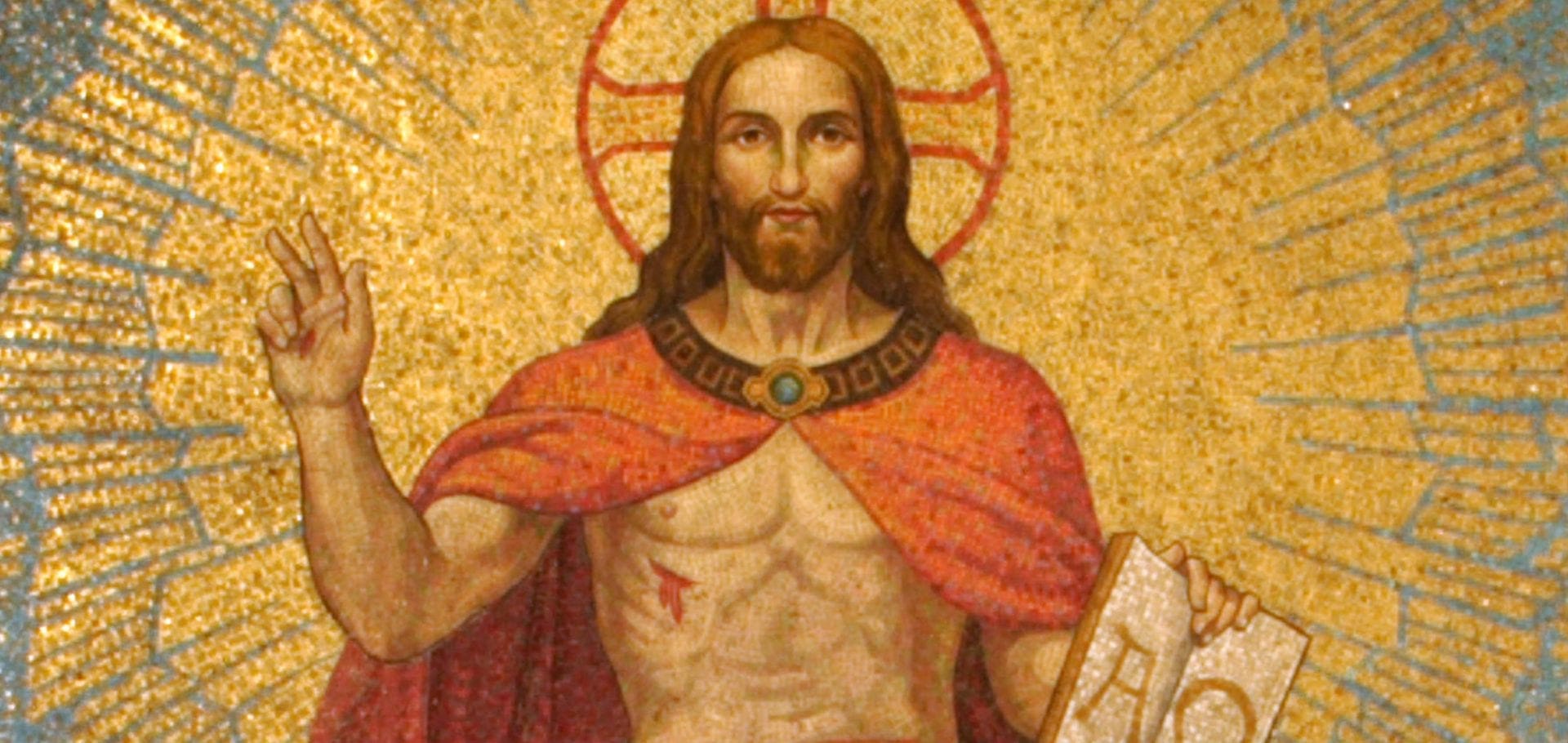
Ours is a post-truth age in which “truth has been eclipsed—that it is irrelevant.”1 Today, people speak of living “your truth” or “my truth” as though the truth is defined by the self. Even the notion of facts has undergone a redefining, with the inclusion of “alternative facts” introduced to our lexicon.2 It seems we are in an age where we can spin anything as truth, creating a reality where everything is relative, and the use of an adjective, such as your or my, to go along with the noun truth symbolizes this problem.
Christians are rightfully concerned about this truth problem, but it belongs to Christians as much as it does to the rest of society. Even before there was your truth and my truth, I can remember Christians affixing adjectives to the word truth. As an undergraduate student, I was assigned to read a book that introduced to me the difference between objective truth and subjective truth.3 Truth is a philosophical concept, and the question of objective and subjective truth in philosophy is a matter rooted in the Enlightenment that gave us modernism and now postmodernism. Or we speak of truth as absolute truth, which seems like another philosophical way of defining our understanding of truth and making our understanding a totalizing claim beyond question (or so we think).
The problem with truth, in part, is that we keep affixing adjectives to the word truth and therefore define what truth is. Whether our definition is personalized in the form of your truth and my truth or given a definition borrowed from philosophy, such as objective and subjective, we are committing ourselves to a particular ideological concept that we must defend rather than the pursuit of truth. That’s how arguments work. We commit ourselves to a particular claim and defend our claim as though our claim about truth were infallible.4 But maybe we should rethink our usage of the adjectives when it comes to truth and this entire game of trying to define truth and subsequently defend our definition of truth.
Can we really pursue Jesus as the truth if we set ourselves on assigning our own meaning to the word truth and defend that meaning as if we are in a philosophical game that we must win?
Let’s consider the Gospel of John because I’m a minister of the gospel who happens to believe we should let scripture speak. As we do so, note that the concept of truth is very important to the Gospel of John. In fact, the noun alētheia, which means “truth,” is used twenty-five times in the Gospel of John. But not once is there ever an adjective affixed to the noun truth in order to qualify the meaning of truth.5 That means our understanding of what truth means in the Gospel of John must be derived (pursued) from the story itself.
The story that John is telling in this Gospel is, of course, about Jesus Christ, the very Incarnate Word of God. Therefore, Jesus Christ is both the one who reveals the truth and is the truth himself. But what really should grab our attention is the exchange between Jesus and Pilate over the notion of truth in John 18:36-38:
Jesus said, “My kingdom is not of this world. If it were, my servants would fight to prevent my arrest by the Jewish leaders. But now my kingdom is from another place.”
“You are a king, then!” said Pilate.
Jesus answered, “You say that I am a king. In fact, the reason I was born and came into the world is to testify to the truth. Everyone on the side of truth listens to me.”
“What is truth?” retorted Pilate.
These are the last three times the noun truth is used in the Gospel of John. First, Jesus claims to testify to the truth and said that those who desire truth will listen to him. But Pilate, attempting to dismiss Jesus, raises the question that captivates much attention by asking, “What is truth?”
So what is the answer to Pilate’s question? The answer is exactly what Jesus said when he claimed to be the way, truth, and life back in John 14:6. Jesus doesn’t engage Pilate in a philosophical debate about the meaning of truth, whether truth is objective or subjective, and so forth. Instead, Jesus gives up his life in crucifixion so that he can take it up again in the resurrection. It is there in the passion of Jesus that we find the true way of life, revealed in the crucifixion and resurrection of the Messiah.
The truth is what Jesus reveals in his very own life. The truth is a person, not a concept, and not something that we can or get to define ourselves by affixing our own preferred choice adjectives to the noun. The truth is Jesus, whom we must pursue before we can ever proclaim but… Can we really pursue Jesus as the truth if we set ourselves on assigning our own meaning to the word truth and defend that meaning as if we are in a philosophical game that we must win?
Jesus showed us the truth by revealing to us the way of life, which comes through the crucifixion and resurrection. In an age of skepticism, where the notion of truth seems irrelevant, the way forward for Christians is following Jesus. Living as followers of Jesus has always been our way as Christians, and that doesn’t change just because some new philosophical notions emerge. So I might be totally off base, but it seems Christianity in America would be wise to stop arguing about the meaning of truth and instead live what we believe is true, just as Jesus Christ did—trusting God with the results.
1Lee McIntyre, Post-Truth, Cambridge, MA: The MIT Press, 2018, 5.
2Aaron Blake, “Kellyanne Conway says Donald Trump’s team has ‘alternative facts’ which pretty much says it all,” The Washington Post, January 22, 2017, available at: https://washingtonpost.com/news’the-fix/wp/2017/01/22/kellyanne-conway-says-donald-trumps-team-has-alternative-facts-which-pretty-much-says-it-all/.
3Francis J. Beckwith and Gregory Koukl, Relativism: Feet Firmly Planted in Mid-Air, Grand Rapids: Baker Books, 1998, 27.
4McIntyre, Post-Truth, 53, makes this point with the notion of truth and political beliefs, but the same logic applies to religious/theological claims.
5The occurrences of alētheia in the Gospel of John are 1:14, 17; 3:21; 4:23-24; 5:33; 8:32 (2x), 40, 44 (2x), 45-46; 14:6, 17; 15:26; 16-7, 13 (2x); 17:17 (2x), 19; 18:37 (2x)-38. The adjective alēthēs is used 14 times, see 3:33; 4:18; 5:31-32; 6:55 (2x); 7:18; 8:13-14, 17, 26; 10:41; 19:35; 21:24.
May 17, 2023
Witnesses of the Gospel
In Scot McKnight’s book The King Jesus Gospel, he tells how John Piper once raised the question of whether Jesus preached the gospel.1 Such a question seems absurd to me as there would not be any good news without the gospel that Jesus lived and proclaimed, which we can read about in all four canonical Gospels. A better question has to do with what we, as disciples, do with the gospel that Jesus lived and proclaimed today.

Such a question pertains to us because after the crucified and resurrected Jesus Christ appeared to his disciples, he said, according to Luke 24:46-48:
“This is what is written: The Messiah will suffer and rise from the dead on the third day, and repentance for the forgiveness of sins will be preached in his name to all nations, beginning at Jerusalem. You are witnesses of these things.2
Although these words of Jesus were not spoken to us, they were spoken for us. So we are faced with the question of what it means to be witnesses of the crucified and resurrected Jesus Christ.
To address this question a little more, I want to begin by saying that living as witnesses of Jesus is not becoming like the Essenes, Zealots, Sadducees, or Pharisees.
The Essenes were a Jewish sect that thought the only way God would restore his kingdom was to withdraw from society in order to live a purified expression of true Israel. Yet Jesus remained among society, and any suggestion that Christians withdraw from society seems excluded.
The Zealots were a group of Jewish people who believed that God’s kingdom would be restored by waging war and overthrowing the Gentile rulers. Yet Jesus Jesus chose the cross rather than the sword, and so any suggestion of using violence or other coercive forms of power as a means seems excluded.
The Sadducees were a prominent group of Jews, having a privileged status with the Gentile rulers, and were, therefore, very satisfied with the status quo. Yet, by proclaiming the coming of God’s reign, Jesus did not align himself with the Sadducees, and so acceptance of the status quo in society today is not an option.
The Pharisees were another Jewish sect who thought God would finally restore his kingdom when Israel returned to a strict observance of the Torah. So the Pharisees sought to impose their understanding of the Torah as law on the Jewish people. Yet, Jesus criticized the Pharisees and refused to impose his own teaching as a law, so living as a witness of the gospel cannot mean imposing the Christian faith as a law either in the form of religious legalism or as Christian nationalism.
If imitating the Essenes, Zealots, Sadducees, and Pharisees are excluded from what it means to live as a witness, then what is a witness of the gospel?
The short answer is that living as a witness means following Jesus. Of course, we follow Jesus by learning to embody his character and mission. That means our witness must be a demonstration of what the kingdom of God is like, and the way we do that is by learning to love people like Jesus. Yet, just saying that we are learning to love people like Jesus is way too abstract, so let me offer some more reflection.
Loving people like Jesus presumes a relationship because we can’t love people unless we’re building a relationship with people. Relationships matter because they open space for people to see what the kingdom of God is really about and begin letting go (repentance) of their idols as they enter into the promise of God’s salvation (forgiveness of sins). In other words, relationships open space for change.
The way to build relationships with people is the way Jesus went about building relationships, which happens by loving people—meeting people where they are and loving them as they are. We can meet people where they are and love them as they are without agreeing on everything or liking every decision they make.
I recently read an essay by John Blake called What a Black man discovered when he met the White mother he never knew. Blake tells how he was abandoned by his mother because he was Black, and her racist White family didn’t want a Black child around. Then at seventeen years old, he asked his dad if he could meet his mother. Eventually, Blake met his mother, but that also meant they had a lot of difficult things to work out in order to build a true mother-and-son relationship. What Blake discovered that he thinks people miss in the conversations about racism is this: “Facts don’t change people; relationships do.”3
John Blake offers us some wise advice that pertains to the way we engage in relationships with non-believers. Arguments, debates, etc… don’t change people, but relationships do. While there are likely a few exceptions, we aren’t going argue the so-called “nones and dones” to faith and debates about the latest trending social-political issue doesn’t seem to bear any good fruit for the kingdom of God. This is why we must work to build relationships. The way to build relationships with people is the way Jesus went about building relationships, which happens by loving people—meeting people where they are and loving them as they are. We can meet people where they are and love them as they are without agreeing on everything or liking every decision they make.
Loving people like Jesus loved people means that we build relationships based on self-sacrificial service, believing that God is already at work. So we can give up the perceived need to prove anything or come out as winners. Instead, we’re free just to love people and let our love be the end goal (telos) itself rather than have ulterior motives or resort to forms of coercion and manipulation. In other words, we are not loving people just so that we can try getting them to visit our church gathering or pressure them with a craftily worded sales pitch. Rather, we engage in such a loving relationship by listening to people and learning from them without judgment or condemnation.
Asking questions with a posture of listening and learning allows God to open space for deeper “gospel” conversations. As such space opens, we must also trust God with the results, just like Jesus did. Do we have faith that God will work through our willingness to engage in relationships based on meeting people where they are and loving them as they are? I hope so because living as witnesses of the crucified and resurrected Jesus Christ is impossible without faith.
At the end of the day, not everyone we love will desire to enter into God’s kingdom and experience the promise of God’s salvation. However, some people will want to participate in this gospel, and that will happen because they have encountered the love of God in the relationships they have with us.
1Scot McKnight, The King Jesus Gospel: The Original Good News Revisited, Grand Rapids: Zondervan, 2011, 25.
2Unless otherwise noted, all scripture quotations are from The Holy Bible, New International Version, NIV. Copyright © 1973, 1978, 1984, 2011 by Biblica, Inc. Used by permission. All rights reserved worldwide.
3John Blake, What a Black man discovered when he met the White mother he never knew, CNN, April 30, 2023, available at: https://www.cnn.com/2023/04/30/us/joh... (last accessed Thursday, May 11, 2023).
May 9, 2023
Can Death Give Way to New Life?
For over twenty years now, I have served as a minister of the gospel among the Churches of Christ with local congregations. I was raised in a Christian family that was members of a small Church of Christ in LaPorte, Indiana, and I committed my life to follow Jesus among a small Church of Christ in South Bend, Indiana, where I also sensed God’s call upon my life to serve vocationally as a minister of the gospel.

Like any denomination, the Churches of Christ has its strengths and weaknesses. I’m aware of the sectarianism and legalistic tendencies that have resulted in some unhealthy practices, but I’m also aware of the charitable and service-minded tendencies that have resulted in many good works. I only point that out to say that I neither view the Churches of Christ through a pollyanna lens nor through a pessimistic lens. That said, I have some concerns pertaining to the Churches of Christ.
I recently picked up a copy of Stanley E. Granberg’s book Empty Church, 2022. In the book, Granberg points out the numerical statistics that show a decline of 1,284,056 members and 13,027 congregations in 1990 to 1,113,362 members and 11,914 congregations in 2020.1 As one who also serves as President of the Reflect Campus Missions board, I know that there are only approximately 145 campus ministries affiliated with the Churches of Christ, which means only a representation of on 2.6% of the roughly 5,500 Title IV institutions of higher education.
One way in which we see how death can give way to new life among the Churches of Christ is by planting new churches and campus ministries.
To put it bluntly, what most people already recognize, the Churches of Christ are declining. The reasons for this decline are varied, some having to do with particular issues germane to the Churches of Christ and other reasons relating to the cultural shifts taking place within American society (reasons why other denominations are in decline too). Because the reasons are varied and sometimes complex, there isn’t any quick-fix solution, and any attempt at a quick fix likely only creates more problems. One thing I am sure of is that complaining or simply trying to preserve/restore the 20th-century era of the Churches of Christ when we peaked numerically will only further the decline.
As most readers know, I believe part of the problem among Churches of Christ has been a legalistic reading of scripture that has become a hindrance to participation in the mission of God. I wrote a book called Gospel Portraits that was published last year, addressing how local churches might read the Bible in a Christ-centered and Kingdom-oriented manner so as to discern a contextualized participation in the mission of God.2 Because the instruction of scripture is so important to Churches of Christ, developing a missional hermeneutic is part of the solution but certainly not exhaustive.
Another part of the solution is the need to plant new churches and new campus ministries. Besides my work with Reflect Campus Missions, I also do some work with Mission Alive. I want to briefly mention the vision of each organization because I believe God is opening space for a future through both organizations. Mission Alive “equips leaders to develop innovative communities of faith focused on transforming marginalized communities.”3 Reflect Campus Missions has a vision of “transforming students for Christ and planting vibrant campus missions.”
Here is the point I want to make: Almost every local Church of Christ is in decline, and many of these congregations will cease to exist in the next twenty-five years. But within the gospel is the belief that death gives way to new life. One way in which we see how death can give way to new life among the Churches of Christ is by planting new churches and campus ministries. How many new churches and campus ministries could the Churches of Christ help plant if every local congregation would dedicate 10% of its budget to the sending and support of missionaries to plant new churches and campus ministries?
Now here is the caveat: We must become comfortable with the reality that new church plants and new campus ministries will look different from churches and campus ministries that were planted during the 20th century. In part, the difference is that new churches and campus ministries must engage people living in the 21st century—not the 20th century. But I’ll also say that if we are only willing to plant new churches and campus ministries that look like those of the 20th century, then our motivation is the preservation of the past rather than participation in the mission of God, and that will fail. So please, consider supporting the planting of new churches and campus ministries, and if you want to know more, please contact me.
1Stanley E. Granberg, Empty Churches: Why People Don’t Come and What To Do About It, 2022, 40.
2K. Rex Butts, Gospel Portraits: Reading Scripture as Participants in the Mission of God, Eugene, OR: Wipf and Stock Publishers, 2022.
3For more on what planting innovative faith communities means, read Tod Vogt, Innovative Faith Communities: Extending God’s Blessing of Help and Hope, Mission Alive Newsletter, April 26, 2023.
April 26, 2023
Jesus Goes to College
Next Tuesday, I will take up what has become a yearly tradition and make my way to Malibu, California, to attend Harbor: Pepperdine University Bible Lectures. This conference is mainly a gathering of folks from among the Churches of Christ, some of whom are fellow ministers of the gospel. So it is always an occasion to catch up with some friends, people I have come to know over the years.

The theme for this year is God Loves Forever, which interests me simply for the sake that I believe we live in a world that needs to hear more about God’s love. Of course, our world also needs to experience God’s love embodied by followers of Jesus too.
I will present a class session too, and I’m thankful for the opportunity. My class, called Jesus Goes to College: Ministry in the Secular University Context will take place on Thursday, May 4th at 10:00 am in Appleby Center, room 261. If you plan to be at Harbor, I’d love to have you as part of the class and see together the way God is working for campus missions.
For now, consider that in 2022 there were roughly 17.9 million students enrolled in a college or university, with about 15 million of those students as undergraduates.1 One of the things I love about having the University of Delaware in my backyard, so to speak, is the diversity of students that come from all over the nation and from around the world. I’m sure it is the same for most colleges and universities. The question is, what will we do? Do we recognize that campus ministry is participation in the global mission of God? Can imagine how God is already at work in the many universities? Is there a way to share the good news of Jesus Christ on college campuses that meets students where they are at? I believe so and look forward to telling you why.
1Causey, J., Cohen, J., Lee, S., Ryu, M., & Shapiro, D., Current Term Enrollment Estimates Expanded Edition: Fall 2022, Herndon, VA: National Student Clearinghouse Research Center, 2023, available at: https://nscresearchcenter.org/current-term-enrollment-estimates/ (last accessed on Thursday, April 20, 2023).
April 7, 2023
How Long, Lord?
Last night the Newark Church of Christ hosted a lament gathering for our Good Friday Service. This was a time to give expression to the various cries of suffering that many people live with while recognizing that God suffers with us in the Crucified Christ. As part of the gathering, I offered a lament homily which I am posting here for your reflection.
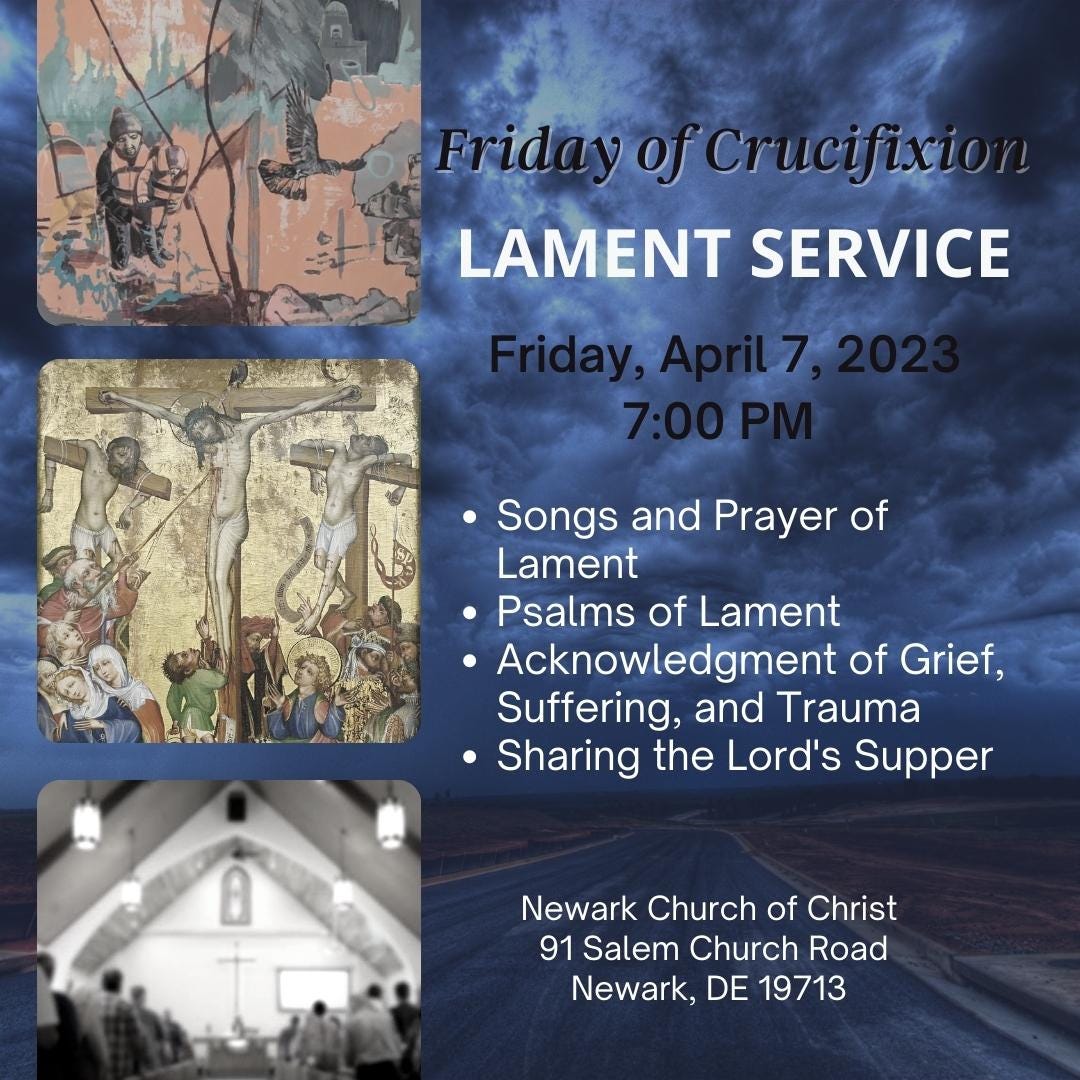
Along with many others, both young and old, I have cried out to God for help many times. I’ve cried out for God to hear me, even wondering at times if God hears me. I have cried out to God on behalf of others too.
What else can we do when grief and pain overwhelm us? So we cry out. Yet, there have been many times when God’s silence has left me with nothing to pray except, “How long, Lord?”
Watching a mother collapse on the ground as she realizes her teenage son isn’t coming home… How long, Lord?
Hearing parents wail at the casket of their middle school child who ended his life… How long, Lord?
Listening to a young girl not even old enough to drive tell me how an older man abused her… How long, Lord?
Every time a child suffers because of neglect, abuse, of simply because the child is regarded as an inconvenience… How long, Lord?
Walking through the pediatric oncology ward of Sloan Kettering Hospital, knowing that some of these children won’t survive… How long, Lord?
Knowing now many parents who, with excitement, have begun anticipating the birth of their child only to learn of miscarriage and silent births… How long, Lord?
Whenever someone is born with disabilities that will keep them from enjoying things in life that most of us take for granted… How long, Lord?
Every time the news breaks with yet another mass shooting… How long, Lord?
Whenever a person is persecuted in some place like Iran or North Korea just because they believe in Jesus Christ… How long, Lord?
I’m sure you can recall your own moments when all you could pray was, “How long, Lord?” I’m thankful that we have this voice of lament in scripture as a way of expressing the grief and pain that we, as well as others, must endure.
There was a time when the word lament wasn’t even on my horizon. But, as those who know my wife and me, that changed after the death of our son Kenny. Part of that grief and pain has been never knowing why. Another part of the grief and pain has been knowing that when our son needed us the most, we couldn’t help him… feeling like we failed. And when we cried out to God, the answer was silence. For whatever reason, just silence.
Some of you know that silence. You’ve prayed for your health but continue to live in pain. You prayed for healing from the abuse you endured as a child, but the silence means that your trauma remains. You’ve longed to have a child only to hear the silence remind you that your body won’t cooperate. Some of you have asked others to pray for you because that’s what we’re taught to do, but even then, there are times when the only answer seems to be silence.
The silence just exasperates the grief and pain, leaving an abyss of nothing to say.1 On more than a few occasions, I’ve identified with the Psalmist who says, “I was too troubled to speak” (Ps. 77:4).2 So I’m thankful we have the voice of lament in scripture to give us a voice for our complaints, a voice of lament expressed in faith.
We can cry out to God and be angry, be disappointed, and feel like we’ve been let down or even forsaken. We can ask God, “Are you listening? Do you hear us? Can you not see the distress we are in and the pain that we bear? It is as if you, God, have placed us in the lowest pit, in the realms of the darkest depths (cf. Ps 88:6).
We are overwhelmed with troubles, sometimes so severe that the longing for an end to the suffering always seems beyond our reach. We can understand why Kate Bowler, who herself suffers from the incurable disease of colon cancer, says that grief “is about eyes squinting through tears into an unbearable future.”3
But like lament so often does, voicing our complaints to God can open space for us to find hope again. Like the time during chapel when I was a seminary student. There I heard the lament subtly expressed in the hymn Be Still, My Soul for the first time. I began to cry because, for the first time ever in a worship setting, I felt like the grief and pain I was enduring were spoken in this hymn.
But I also had this sense that’s hard to explain in words, but I knew at that moment that God was listening. I heard the voice of the Lord speak through that hymn that the Lord is on my side, that there will come a day “when disappointment, grief, and fear are gone, sorrow forgot, [and] love’s purest joys restored.”
Those days haven’t come yet, but like the Psalmist, I have learned to “remember the deeds of the Lord” and “remember [the Lord’s] miracles of long ago” (Ps 77:11). And so I remember that God has not forsaken us but instead has joined us in our suffering, ultimately suffering death himself in the person of Jesus Christ crucified.
The image of Christ-crucified matters for many reasons but one of those reasons is that God identifies with us in our suffering. In fact, the crucifixion of Jesus Christ is a statement of who God is.4 That matters because here lately, I’ve started reading more about the relationship between trauma and theology, trauma being the wounds we live with, and theology is the understanding of the Christian faith we hold to. So the other week, as I was reading about trauma, it dawned on me that, in some way, I was reading about the life my wife and I have lived for the past twenty-plus years.
At the moment, sitting in Brew Ha-Ha Coffee Shop, I felt sad and wanted to give myself a hug, but I thought that would look a little weird. So I just sat back, and as I did, God spoke… not with audible words but in a way that immediately I had this vision of Jesus Christ hanging on the cross saying, “I’m sorry, but we’re going to get through this together.”
And so on this Good Friday, where we remember the crucifixion of Jesus Christ, for every one of you, whatever your suffering and trauma may be, it’s okay to tell God that you’re angry, disappointed, or even feeling forsaken. But my prayer is also that we’ll see a vision of Jesus Christ crucified as God’s promise, saying, “I’m sorry, but we’ll get through this together.”
And that’s a promise we can hope in because Jesus has also promised us that his death will not be the final word. But for the word to come, we’ll have to wait until Easter Sunday.
1Kathleen D. Billman and Daniel L. Migliore, Rachel’s Cry: Prayer of Lamen and Rebirth of Hope, Cleveland: United Church Press, 1999, 105, “When unexpected suffering strikes, and especially when it persists, the sufferer literally does not know how to express what is happening except to groan or cry or scream. Acute suffering creates an abyss of speechlessness for the person in pain.”
2Unless otherwise noted, all scripture quotations are from The Holy Bible, New International Version, NIV. Copyright © 1973, 1978, 1984, 2011 by Biblica, Inc. Used by permission. All rights reserved worldwide.
3Kate Bowler, Everything Happens for a Reason: And Other Lies I’ve Loved, New York: Penguin Random House, 2018, 70.
4Jürgen Moltmann, The Crucified God: The Cross of Christ as the Foundation and Criticism of Christian Theology, trans. R.A. Wilson and John Bowden, Minneapolis: Fortress Press, 1993, 295, “When the crucified Jesus is called ‘the image of the invisible God,’ the meaning is that this is God, and God is like this. God is not greater than he is in this humiliation. God is not more glorious that he is in this self-surrender. God is not more powerful than he is in this helplessness. God is not more divine than he is in this humanity.