K. Rex Butts's Blog, page 2
June 3, 2025
A Testifying Church
The book of Acts begins with a reference to the Gospel of Luke. According to Luke, the Gospel of Luke was “about all that Jesus began to do and to teach…”1 Of course, all of this doing and teaching was about proclaiming God’s kingdom and forming disciples who would follow Jesus as participants in the mission of God. In preparation for continuing as participants in God’s mission, the Gospel of Luke concludes with Jesus instructing his disciples to wait until they have been clothed with power from on high (Lk 24:49). Of course, Jesus was speaking of the Holy Spirit.
Now in Acts, the mention of the Holy Spirit is not a minor detail. By my count, the Holy Spirit is referred to 60 times throughout the book of Acts, serving to speak of God's empowerment.2 In Acts, it is the Holy Spirit who serves as the agent that empowers the disciples to live as witnesses of Jesus.
Jesus tells his apostles that they will be baptized with the Holy Spirit. In other words, they will receive power from God to live as witnesses of Jesus. However, it becomes very apparent that it’s not just the apostles who receive the Holy Spirit but everyone who calls upon the Lord, submitting themselves to Jesus in baptism (cf. 2:38-39). This promise means that everyone who professes to be a Christian is called to live as witnesses of Jesus.
Unfortunately, the apostles are concerned with the question of when God will restore the kingdom to Israel. Their concern is a distraction from a matter that doesn’t matter, so Jesus redirects their attention to what does matter: The Holy Spirit empowering them to live as his witnesses. So, when it was time to ascend and return to the Father, Jesus says to his apostles, “But you will receive power when the Holy Spirit comes on you and you will be my witnesses in Jerusalem, and in all Judea and Samaria, and to the ends of the earth”(Acts 1:8).3 What mattered to Jesus was that those he called to follow him would receive the power of the Holy Spirit to live as witnesses.
Here is where we have a problem. In his book Christian Theology, Alister McGrath writes, “The Holy Spirit has long been the cinderella of the Trinity. The other two sisters may have gone to the theological ball; the Holy Spirit got left behind every time.”4 Any Christian who has been a part of the Churches of Christ for some time knows that our fellowship has left the Holy Spirit behind for far too long. In my opinion, such avoidance had much to do with the fact that our fellowship emerged in the modern age, steeped in Enlightenment concerns. This meant rational thinking and the need for control, neither of which seemed compatible with allowing the Spirit to lead.
As Churches of Christ face increasing decline and the questions that such decline raises, one thing we can do is what we know how to do well. That is, we can open the Bible and read. Not only do we need to (re)discover a missional reading of the Bible, one that is Christ-centered and Kingdom-oriented, but we need to give attention to the Holy Spirit in a manner that is open to the empowerment of the Spirit.5
“The work of God through the Spirit is to empower disciples to live as congregations who faithfully and contextually embody the gospel—the good news of Jesus Christ and the Kingdom of God. While there’s plenty of room for discussion about what constitutes a faithful and contextual embodiment of the gospel, we’re not talking about rocket science. We can recognize the power of the Holy Spirit because such power draws people to God, inviting them to follow Jesus Christ through faith expressed in repentance, baptism, and a lifetime of obedience.”
What ought to be clear from the opening scene in Acts is that the reception of the Holy Spirit is not the end goal itself. Instead, receiving the Holy Spirit is how God will empower the apostles to live as witnesses of Jesus Christ. But this is not just a promise for the apostles. Since every disciple of Jesus receives the Holy Spirit, what Jesus says should matter to the Churches of Christ.
Receiving the power of the Spirit is about living as witnesses of Jesus.6 The business of every congregation of disciples is serving as a witness to Jesus Christ. Furthermore, a commitment to living as witnesses of Jesus Christ opens space for church renewal. However, this business can only be undertaken by allowing the Holy Spirit to lead, empowering every disciple to serve as the witness God calls them to be.
I don’t want to be misunderstood here. I know there are many issues, often complex, that have inhibited the Spirit-led witness of congregations. Overcoming these issues is not as simple as saying we will let the Spirit lead. Working through such issues requires understanding, time spent in prayer, and a lot of open-minded discernment.7 However, we can be sure that allowing the Holy Spirit to empower us will mean living in a manner that reflects the life of Jesus Christ, his beliefs, values, and behaviors. Since the Holy Spirit is the Third Person of our One Triune God, the Spirit empowers us to live in a manner that reflects the will of the Father, as revealed in the Son.
Although I am skeptical about some claims attributed to the Holy Spirit, I am also wary of cessationism. I just don’t think the cessationist view is supported by scripture. Furthermore, I don’t want to limit how God can work through the Spirit. However, getting rid of any box that we might use to limit God does not mean that God’s work through the Spirit is anything goes. The work of God through the Spirit is to empower disciples to live as congregations who faithfully and contextually embody the gospel—the good news of Jesus Christ and the Kingdom of God. While there’s plenty of room for discussion about what constitutes a faithful and contextual embodiment of the gospel, we’re not talking about rocket science. We can recognize the power of the Holy Spirit because such power draws people to God, inviting them to follow Jesus Christ through faith expressed in repentance, baptism, and a lifetime of obedience. Anything else should raise suspicion as to what other unholy spirit is at work.
Ultimately, we know how we ought to live as disciples because Jesus Christ has shown us through his life and teaching. We have both Scripture and the great Christian Tradition to help us learn the life Jesus calls us to live. This life involves extending grace, speaking truth, having compassion, pursuing peace, showing mercy, doing justice, living a holy life, and above all, loving others as we love God. Never has Jesus taught us to hate anyone, not even our enemies or those who do evil, or to seek vengeance against anyone. This life Jesus has taught us to live is the life the Spirit empowers us to live. So let the Holy Spirit give us the courage and conviction to live as Jesus lived. Then we become witnesses of Jesus, a testifying church.
1All scripture quotations are from The Holy Bible, New International Version, NIV. Copyright © 1973, 1978, 1984, 2011 by Biblica, Inc. Used by permission. All rights reserved worldwide.
2Luke Timothy Johnson, Prophetic Jesus, Prophetic Church: The Challenge of Luke-Acts to Contemporary Christians(, Grand Rapids: Eerdmans, 2011, 53.
3_____, The Acts of the Apostles, Sacra Pagina, (Collegeville, MN: Liturgical Press, 1992, 28, notes that witness is one of Luke’s “most inclusive” terms for referencing the followers of Jesus (Acts 1:22; 2:32; 3:15; 5:32; 7:58; 10:39, 41; 13:31; 22:15, 22; 26:16).
4Alister E. McGrath, Christian Theology: An Introduction, Oxford: Blackwell Publishers, 1994, 240.
5At the risk of self-promotion, see my book, K. Rex Butts, Gospel Portraits: Reading Scripture as Participants in the Mission of God, Eugene: Wipf & Stock Publishers, 2022.
6Justo L. González, Acts: The Gospel of the Spirit (Maryknoll, NY: Orbis Books, 2001), 22, writes “It is by the power of the Spirit that we have faith; it is by the power of the Spirit that we can live in hope even in the worst of circumstances; it is by the power of the Spirit that we know that we are loved children of God even while the world tramples us. But that power has been given to us, not just so that we may enjoy it in our own lives, but above all so that we may be witnesses to Jesus and to God’s reign.”
7I also recommend reading Mark Love, It Seemed Good to the Spirit and to Us: Acts, Discernment, and the Mission of God, Eugene: Wipf & Stock Publishers, 2023.


May 27, 2025
The Resurrection
As a chapter, 1 Corinthians 15 is about the resurrection of the dead. The chapter begins with a reminder that Jesus Christ died on the cross, was buried, and was raised from the dead on the third day, afterwards appearing to more than five hundred people. The resurrection of Jesus is not just important because our faith would be futile without it, but also because his resurrection is the firstfruits of the resurrection of the dead. In other words, the resurrection of the dead has begun in Jesus and therefore we, who belong to the Lord, are assured that we too will be raised from the dead.
Without question, the resurrection of the dead is good news. It means there’s hope. But that doesn’t mean that all of 1 Corinthians 15 is easy to read. With language such as “perishable” and “imperishable” as well as “natural body” and “spiritual body,” people find the text somewhat difficult to understand. One thing that should be clear is that the text refers to the resurrection of the body—our own bodies.1 We each have a body, and when the resurrection of the dead is brought to completion, we will not be raised as bodiless entities but with resurrection bodies.2
So, what is the resurrection body? Well, that’s a big question. God raised Jesus Christ from the dead as the firstfruits of the resurrection of the dead, so we can be sure that we will be raised from the dead too.
However, one of the questions this text raises concerns the nature of the resurrection body. Paul says that “If there is a natural body, there is also a spiritual body” (v. 44).3 The question is whether there is continuity or discontinuity between the natural body and the spiritual body. In other words, are we raised with the same bodies we die with or are we raised with different bodies?
Though I once took the view of discontinuity, I now believe there is continuity between the natural body and the spiritual body that we’ll have when we are raised from the dead. I believe that the distinction between the natural body and the spiritual body is one of status and quality rather than essence and entity.4 Now, the reason I believe there is continuity between the natural body and the spiritual body is right in the text. Paul writes, “And just as we have borne the image of the earthly man, so shall we bear the image of the heavenly man” (v. 49).
The text points back to Jesus Christ, who has already been raised from the dead as the firstfruits of the resurrection of the dead (cf. 1 Cor 15:20, 23). So Jesus is the prototype of the resurrection of the dead. When Jesus was raised from the dead, he appeared to over five hundred people (cf. 1 Cor 15:5-8), who recognized him as Jesus of Nazareth. According to the Gospel of John, the disciples were able to see and touch the wounds that Jesus had sustained during his crucifixion. So clearly, Jesus has the same body. Yet there’s something different, which I believe has to do with the status and quality.
“The physical bodily resurrection of Jesus Christ is the promise of hope that we, with our bodies transformed as imperishable and immortal, will be raised from the dead too.”
Elsewhere, in scripture, Jesus is described as “the firstborn from among the dead” (Col 1:18). That is, Jesus is the first to be raised unto eternal life. The sting of sin that brought about death, and therefore brought about the death of Jesus on the cross, no longer has any power. Jesus was raised with his natural body, so there’s continuity between the body of the crucified Jesus and the resurrected Jesus. However, the difference between the crucified body of Jesus and the resurrected body of Jesus is that the resurrected Jesus has overcome the power of sin and death.
Paul writes, “I declare to you, brothers and sisters, that flesh and blood cannot inherit the kingdom of God, nor does the perishable inherit the imperishable” (v. 50). The phrase “flesh and blood” is a Jewish idiom that refers to physical life and its perishable quality.5 So there’s a transformation that must happen to our lives, which includes the transformation of our bodies in terms of status and quality from the perishable and mortal to the imperishable and immortal. However, as the text says, “When the perishable has been clothed with the imperishable, and the mortal with immortality, then the saying that is written will come true: ‘Death has been swallowed up in victory’” (vv. 54-56). So just as Jesus, who is the firstfruits of the resurrection of the dead, has overcome death by being physically raised in his body, we will overcome death too.
Knowing that there is continuity between our natural bodies and spiritual bodies raises other questions for which we don't always have answers. If we are raised with the same but transformed bodies, will we be recognizable to each other? I think so, since we know that Jesus was recognizable. Then what will our bodies look like? Do we get the 20-year-old body that was full of youthful strength and appearance, or do we get the body that is 50-plus years in age, which gravity has not favored? I don’t know. But this is where it gets personal because I wonder what my son Kenny will look like, what it will be like to see him again, and I don’t know what that will be like.
What I know is based on what I read in 1 Corinthians 15. There’s a resurrection of the dead, which began with the physical bodily resurrection of Jesus Christ. The physical bodily resurrection of Jesus Christ is the promise of hope that we, with our bodies transformed as imperishable and immortal, will be raised from the dead too. This promise of hope ought to change everything about our disposition in life. Though we grieve the loss of life, we don’t succumb to despair but remain steadfast in faith, with full assurance of the victory that we have in Jesus Christ.
Such hope, a resurrection hope rooted in faith, is possible because even though “The sting of death is sin, and the power of sin is the law,” there’s also a “but” and it’s a big but… “But thanks be to God! He gives us the victory through our Lord Jesus Christ” (v. 57). The bodily resurrection of the crucified Jesus Christ is the promise of our bodily resurrection. It’s our life, our victory, thanks be to God!
1Ben Witherington III, Conflict & Community in Corinth: A Socio-Rhetorical Commentary on 1 and 2 Corinthians (Grand Rapids: Eerdmans, 1995), 307, notes that the resurrected body in mind is individual rather than corporate, and Paul illustrates this point in verses 39-41.
2Of note, the word “body” (sōma) refers to a physical existence and occurs nine times in 1 Corinthians 15:35-44. So the resurrection body, whatever that might be, matters. See also Robert Sloan, “Resurrection in 1 Corinthians,” Southwestern Journal of Theology 26 (Fall 1983): 82; George Eldon Ladd, A Theology of the New Testament, rev. ed. (Grand Rapids: Eerdmans, 1993), 506-509; James D.G. Dunn, The Theology of Paul the Apostle (Grand Rapids: Eerdmans, 1998), 55-61.
3All scripture quotations are from The Holy Bible, New International Version, NIV. Copyright © 1973, 1978, 1984, 2011 by Biblica, Inc. Used by permission. All rights reserved worldwide.
4E. Earle Ellis, “Sōma in First Corinthians,” Interpretation 44 (April 1990): 142, “When [Paul] contrasts the ‘soulish body’ of Adam with the ‘spiritual body’ of the resurrected Christ, he is not speaking of the substance of the respective bodies but of the powers that characterize and enliven them, the mortal animation of the present creation and the immortal and immediate Holy Spirit animation of the resurrection creation.”
5Roy E. Clampa and Brian S. Rosner, The First Letter to the Corinthians, The Pillar New Testament Commentary (Grand Rapids: Eerdmans, 2010), 828.
May 19, 2025
The Resurrection
Two weeks ago, I began a short sermon series called The Resurrection that’s based on 1 Corinthians 15. The purpose of 1 Corinthians 15 is a defense of the resurrection of the dead, which is predicated on the resurrection of Jesus Christ. For this reason, Paul begins the chapter by reminding the Corinthians of the good news.
The good news, or what we commonly refer to as the Gospel, has to do with the death, burial, and resurrection of Jesus Christ. As Paul writes in 1 Corinthians 15:3-8:
For what I received I passed on to you as of first importance: that Christ died for our sins according to the Scriptures, that he was buried, that he was raised on the third day according to the Scriptures, and that he appeared to Cephas, and then to the Twelve. After that, he appeared to more than five hundred of the brothers and sisters at the same time, most of whom are still living, though some have fallen asleep. Then he appeared to James, then to all the apostles, and last of all he appeared to me also, as to one abnormally born.1
The claim of this passage is also foundational for the Christian Faith. If this claim is false, our faith is useless (cf. 1 Cor 15:13) but if the claim is valid, then we should remain firm in our faith and give ourselves to the work of God (cf. 1 Cor 15:47).
Christians claim that the crucifixion and resurrection of Jesus Christ are true but some people, even Christians, struggle with questions and doubts. Now, let me state up front that there’s nothing wrong with having questions and doubts. However, I do believe there are some compelling reasons to believe in the good news about Jesus Christ and to have confidence in our faith.
What I mean is that I believe there are good reasons for believing but not proof, as in proving the good news of Jesus Christ is true, like one can prove that Newton’s Laws of Physics are true. Seeking scientific proof for the death, burial, and resurrection of Jesus is the wrong approach because the matter at hand isn’t a scientific claim. The good news of Jesus Christ is a historical claim for which I believe there are some compelling reasons to accept.
I share that distinction between scientific and historical claims because I think we do people with questions and doubts a disservice when we try to prove the gospel like it's science. Science is based on observations that raise questions from which we can formulate hypotheses and then test those hypotheses with experiments to disprove the hypotheses. With the resurrection, an observation is made that the tomb is empty, which can lead to several hypotheses: Jesus never died and was buried in the tomb, perhaps the body of Jesus was stolen, or that Jesus was raised from the dead. But what we can’t do is test any of these hypotheses. Therefore, instead of attempting to test these hypotheses, which is impossible, we can pay attention to some historical observations.
The first historical observation relates to the Scriptures. Paul says Jesus died and was raised according to the scriptures. In other words, the claim that Jesus died, was buried, and was raised from the dead isn’t something that happened in a vacuum. Instead, the death, burial, and resurrection of Jesus Christ are part of the larger redemptive story told within the Scriptures and fit well within that redemptive story. So, even though this observation is far from settling the matter of belief, we know that we are being asked to believe a claim that is congruent with the larger story it is told within.2
The second observation pertains to the witnesses. Paul says that after Jesus was raised, he appeared to numerous people. Thus, there were people at the time who could corroborate what Paul was saying.3 The crucifixion of Jesus was a public event that a lot of people who were in Jerusalem for the Passover saw. Other people, some of the same people who witnessed the crucifixion of Jesus, Paul, saw the resurrected Jesus alive again. In today’s parlance, people could fact-check Paul. A lawyer would have been able to go to the people who are said to have seen the resurrected Jesus Christ and have them sign affidavits stating that they saw the resurrected Jesus.
The third observation pertains to the mission of these believers. In his book The New Testament and the People of God, N.T. Wright says:
The single most striking thing about early Christianity is its speed of growth. In AD 25, there is no such thing as Christianity: merely a young hermit in the Judean wilderness, and his somewhat younger cousin who dreams dreams and sees visions. By AD 125 the Roman emperor has established an official policy in relation to the punishment of Christians; Polycarp has already been a Christian in Smyrna for half a century; Aristides (if we accept the earlier date) is confronting the emperor Hadrian with the news that there are four races in the world, Barbarians, Greeks, Jews and Christians...”
...Christianity summoned proud pagans to face torture and death out of loyalty to a Jewish villager who had been executed by Rome. Christianity advocated a love which cut across racial boundaries. It sternly forbade sexual immorality, the exposure of children, and a great many other things which the pagan world took for granted. Choosing to become a Christian was not an easy or natural thing for the average pagan. A Jew who converted might well be regarded as a national traitor. Even slaves, who might be supposed to have less to lose than others, and hence to appreciate an elevation of status through conversion, might face a cost: as we saw, Pliny thought it normal to interrogate, with torture, slave-girls who happened to be part of the early Christian movement. We have no reason to suppose that interrogation under torture was any easier for a young woman in the second century than it is in the twentieth.
Why then did early Christianity spread? Because early Christians believed that what they had found to be true was true for the whole world. The impetus to mission sprang from the very heart of early Christian conviction...4
The conviction of the early Christians was that Jesus Christ died on the cross, that he was buried, and that God raised him from the dead on the third day. Someone might retort that the Apostles and the rest of the Christians just made up the good news about Jesus Christ. However, if that’s true, then many of them suffered great persecution and even, in some cases, death for a story they made up. As challenging as it might be to believe that Jesus actually died and rose again just as the scripture says, it seems ridiculous to think that people would suffer persecution and even death for a story they just made up.
The final observation pertains to the Apostolic Preaching. Despite all the differences that exist within the broad umbrella of Christianity today, the consistent claim of Christianity from the beginning has been the message of Jesus’s death, burial, and resurrection. The late Chuck Colson addressed the consistency of the Apostolic witness by pointing out that the people involved in the Watergate Scandal couldn’t keep their story straight long enough to avoid criminal charges and being sent to prison.5 But the apostles were consistent in their story that Jesus of Nazareth died on the cross, was buried, and was raised on the third day. They were so deeply moved by what they and others had witnessed that they insisted every church share this same story, and the churches did, passing it down from generation to generation.
Again, I don’t believe we can prove the good news of Jesus Christ like we can do with scientific claims but as a historical claim, I do think there are compelling reasons for believing the good news really happened. And what makes this news about Jesus Christ so good is that he died for our sins and was raised from the dead, which means we have victory over the power of sin and death (cf. 1 Cor 15:55-56).
1All scripture quotations are from The Holy Bible, New International Version, NIV. Copyright © 1973, 1978, 1984, 2011 by Biblica, Inc. Used by permission. All rights reserved worldwide.
2Scot McKnight, The King Jesus Gospel: The Original Good News Revisited (Grand Rapids: Zondervan, 2011), 50, who notes that the mention of the scriptures serves as a reminder that this brings the story of Israel to completion.
3Richard B. Hays, First Corinthians, Interpretation: A Bible Commentary for Teaching and Preaching (Atlanta: John Knox Press, 1997), 257, points out that the mention of witnesses “shows that Paul did not think of the resurrection of Jesus as some sort of ineffable truth beyond history…”
4N. T. Wright, The New Testament and the People of God, Christian Origins and the Question of God, vol. 1 (Minneapolis: Fortress Press, 1992), 359-360.
5Charles Colson, “Colson Preaches that Watergate Proves the Resurrection,” Washington Post, September 28, 1983, (last accessed Tuesday, May 13, 2025), wrote, “I know the resurrection is a fact, and Watergate proved it to me. How? Because twelve men testified they had seen Jesus raised from the dead, then they proclaimed that truth for forty years, never once denying it. Every one was beaten, tortured, stoned, and put in prison. They would not have endured if it weren’t true. Watergate embroiled twelve of the most powerful men in the world, and they couldn’t keep a lie for three weeks. You’re telling me twelve apostles could keep a lie for forty years? Absolutely impossible.”
May 5, 2025
Is Empathy a Sin?
As a minister, I often share in the lives of people during both occasions of excitement and significant challenges. Such sharing is a sacred duty that I never take for granted. I have married couples, offered prayers of blessing over newborn children, baptized new believers, and enjoyed dinners as a guest at many tables. Besides hospital visits and funerals, I have walked with victims of abuse, taken people to rehab centers, helped the homeless find shelter, and listened as people shared stories of suffering that go beyond what words can describe. I have also lived with the grief and pain of losing a son twenty-three years ago.

One thing I have learned over time is the importance of empathy. The ability to emotionally connect with people to understand and feel what they are living with is as essential as sympathy or compassion. Am I wrong? Some may think so. Does Joe Rigney?
Published in 2024 by Canon Press in Moscow, Idaho, is The Sin of Empathy: Compassion and Its Counterfeits, by Joe Rigney. The book is short, consisting of only 141 pages. Besides the forward and introduction, the book has six chapters and two appendices. Though Rigney uses footnotes for citations, this is not an academic work intended only for scholars and professionals in the Christian ministry field. The author states in the introduction that he has written this book as a pastor rather than a scholar. Therefore, the book should be easy for nearly anyone to read.
I appreciate that this book, written by a pastor, is accessible to a broad audience. At a time of increasing confusion about what it means to live as a Christian, we need books accessible to all Christians. Such accessibility matters when it comes to considering a subject like empathy, since every Christian is responsible for bearing the burdens of others (cf. Gal 6:2). Yet the author clearly takes issue with empathy as a Christian practice, or at least a particular understanding of empathy that he views as wrong.
The issue in this book is what the author describes as “untethered empathy,” or the sin of empathy. Emathy is understood by the author as a sin when it “dives in to connect with the sufferer, but loses touch with the shore” (p. 15). It is an empathy that involves the suspension of judgment, which means a complete and uncritical agreement with the sufferer at the expense of the Christian Faith. That is, to empathize, the author believes that Christians are expected to sacrifice virtue by failing to steward biblical convictions faithfully. But is this really the case?
In the first chapter, Rigney cites a video clip of Brené Brown with over 22 million views as an example of untethered empathy. In the video, Brown references a nursing scholar named Teresa Wiseman, who understands empathy as involving four qualities. As Brown shares, here is what she says:
Perspective taking: the ability to take the perspective of another person, or recognize their perspective as their truth. Staying out of judgment: not easy when you enjoy it as much as most of us do. Recognizing emotion in other people, and then communicating that. Empathy is feeling with people. …I always think of empathy as this kind of sacred space. …And we look and we say, “Hey!” And climb down, and we say, “I know what it’s like down here and you’re not alone.”1
Now I share that quote because Rigney portrays Brown’s description of empathy as an illustration of why empathy, as he understands, is wrong. However, I have listened to this clip from Brown several times (I have also watched her TED Talk “The Power of Vulnerability” and read a couple of her books), and Brown never suggests that empathy requires a suspension of convictions, embracing a posture of relativism that allows us to agree with everything another person says. Yet this seems to be how Rigney understands Brown’s description of empathy, and to draw that conclusion appears to assume a lot that isn’t said.
“Empathy is not a sin. Rather, empathy is our ability to understand and share in the feelings of others, and that is a good quality to have as we bear witness to the good news of Jesus Christ and the Kingdom of God.”
The problem with this book's argument is that Rigney never offers any concrete examples to substantiate his claim. What he cites to support his argument fails to convince that empathy is a problem. For example, the argument against empathy in Edwin H. Friedman's A Failure of Nerve is brought into the conversation with the assumption that Friedman was right. However, Friedman’s argument against empathy presented a false dichotomy between empathy and leadership: a person cannot lead and simultaneously have empathy for others. In another example, the author brings up the matter of abortion to show how advocates of abortion weaponize empathy by appealing to emotion as they point to vulnerable and endangered women as their case for allowing abortion. What Rigney doesn’t mention is that opponents of abortion make this same emotional appeal by depicting pictures of a fully formed unborn child in the womb as their case for ending the practice of abortion. Are such emotional appeals wrong? No, unless we’re to determine our ethics simply on emotion.
Furthermore, the mention of abortion is such a loaded issue that it almost ensures those who are opposed to abortion will automatically side with the author (which ironically becomes a weaponized emotional appeal itself). In the fourth chapter, the author brings up the issue of racism (another emotionally charged issue) but offers “hypothetical discussion about racial reconciliation” to support his argument regarding untethered empathy. The problem is that hypothetical situations are fictitious scenarios created by the author. Though a hypothetical situation may be based on reality, it is also based on perception to make the very emotional appeal that the author sees as the problem with empathy.
Rigney is not suggesting that Christians should be apathetic toward the suffering of others. He knows very well how scripture speaks of God as compassionate and the compassion Jesus repeatedly showed toward others. What the author argues for is “the need for tethered compassion,” which remains “anchored to what is true and good” (p. 102). I am just not convinced that empathy requires Christians to unteather themselves from their convictions about what is true and good.
Reading Rigney’s book, I sense that ideology, rather than genuine pastoral and theological concerns, drives the conversation against empathy. It is true that empathy, like any other virtuous quality, can be used in unhelpful and even harmful ways. But let’s not throw the baby out with the bath water. Let’s not characterize empathy as a sin. Instead, let’s think more deeply about how we empathize with others. If we can empathize with others, which does not require us to abandon our convictions but does require listening and understanding, then we can lead others. Empathy is not a sin. Rather, empathy is our ability to understand and share in the feelings of others, and that is a good quality to have as we bear witness to the good news of Jesus Christ and the Kingdom of God.
1“Brené Brown on Empathy,” Royal Society for the Encouragement of the Arts, Manufactures, and Commerce, December 10, 2013, YouTube video, 2:53 (last accessed Friday, May 2, 2025).
April 16, 2025
At The Skull
The Gospel of Luke includes the story of what we know as the thief on the cross in telling the story of Jesus' crucifixion. Thief is actually a misnomer because the two criminals were more like insurrectionists who were involved in some sort of seditious activity against the Roman government.
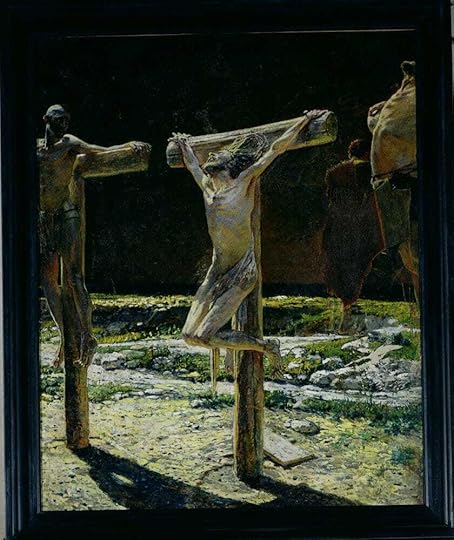 Nikolai Ge, The Crucifixion, 1893
Nevertheless, one of the criminals asks Jesus to remember him in his kingdom and Jesus assures the criminal that he will reside with Jesus in paradise. This little story within the story has been the subject of many sermons trying to persuade people to believe in Jesus and receive the promise of salvation.
Fair enough. Luke wants his readers to believe in Jesus and know that Jesus makes the promise of salvation possible. But some of these sermons became polemical. On the one hand, there was the polemic of using this story to say that receiving salvation is as easy as asking Jesus. Cue in the evangelistic question, “Have you trusted in Jesus to be your Savior and asked Jesus to come into your heart?” On the other hand, there was the polemic that I often heard growing up, which was in response to the other polemic. This polemic wanted to argue that this story was not a valid example of how people are saved since this occurred prior to Jesus’ actual death.
From where I am as a reader of Luke’s Gospel, both polemical sides miss the point of why Luke includes the story of this criminal being saved. When reading through the Gospel of Luke, it becomes clear that Luke wants the readers to know that Jesus of Nazareth is the Savior. He is the Son of God who fulfills the messianic promise of salvation for both Jews and Gentiles, as well as everyone who has been marginalized.
Just as Jesus revealed God’s promise of salvation in his life, he is now revealing the fulfillment of this promise in his death.
Nothing has changed in regard to the fulfillment of this messianic promise now that Jesus is crucified on a Roman cross between two criminals. The emphasis on salvation is shown by the fact that, according to Luke, the first words Jesus speaks from the cross are, “Father, forgive them, for they do not know what they are doing.”1
The crowd, the soldiers, and even one of the criminals all taunt Jesus as to why he saved others but can’t save himself. Of course, little do they know that Jesus would not have been able to save them had he saved himself. The truth is that Jesus could have easily saved himself. Jesus already had the power and authority of God, which he repeatedly exercised throughout his ministry as a blessing to others. But here, at the place called The Skull, where Jesus is crucified, he exercises his power and authority by choosing not to save himself so that he can save others—grace and mercy—as he pleads for the forgiveness of his enemies.
As Jesus hangs, one criminal has the eyes and ears to see and hear. This criminal knows that Jesus “…has done nothing wrong.”2 So he pleads for mercy, saying, “Jesus, remember me when you come into your kingdom.” Jesus responds by speaking the promise of salvation to this criminal: “Truly I tell you, today you will be with me in paradise.”
Do we have the eyes and ears to see and hear what the criminal sees and hears? By telling us about the promise Jesus makes to the criminal, Luke is assuring us that the crucifixion of Jesus is the promise that God’s salvation is possible. Just as Jesus revealed God’s promise of salvation in his life, he is now revealing the fulfillment of this promise in his death.3
On this Maundy Thursday, as we turn our attention toward the final steps that Jesus took to the Skull, where he was crucified, know that this is God’s promise of salvation. Jesus is crucified, dying for the forgiveness of sins so that we might receive the promise of salvation—not because we deserve it or have earned it but because we need it. If you’ve ever wondered whether the promise of salvation includes you, turn your eyes upon Jesus Christ crucified and know that the promise includes you.
1Luke 23:34; all scripture quotations are from The Holy Bible, New International Version, NIV. Copyright © 1973, 1978, 1984, 2011 by Biblica, Inc. Used by permission. All rights reserved worldwide.
2Luke 23:41.
3Joel B. Green, The Gospel of Luke, The New International Commentary on the New Testament (Grand Rapids: Eerdmans, 1997), 823.
March 26, 2025
Is Adaptive Change Possible?
In my previous post, I discussed the decline of Christianity in North America and three lies that churches have bought into to stave off such decline. The point was to suggest that instead of being into the lies of Christian relativism, Christian consumerism, and Christian nationalism, the future for church renewal is discovered in seeking the kingdom of God. With this post, I want to expand on this pursuit of God’s kingdom more and the sort of change this pursuit requires.

Albert Einstein described insanity as “doing the same thing over and over again and expecting different results.” That’s true not only with science but also with churches in the way believers organize and function as a congregation. If a local church is confronted with years of decline, loss of vision, and congregational morale, continuing to do the same is insanity will likely just yield more decline, loss of vision, and congregational morale. What the local church needs is a renewed pursuit of God’s kingdom but that will require change in the way the church organizes and operates.
Is such change possible? Well, anything is possible but not everything is probable. In my experience, even the talk of change is troublesome for churches. I sympathize to a point. When it comes to the local church that we are a part of, that we have invested ourselves in, change is especially difficult. Such difficulty isn’t just because we’re having to learn some new ways of organizing and operating but because we have emotional ties to what is going on.
What we need is to step back and take a deep breath. In other words, pray. Praying is not only a part of any renewed pursuit of God’s kingdom but in surrendering ourselves and our church to God in prayer, our anxiety begins to subside. Once the anxiety level lowers, we can think more and begin to see with eyes toward a long-term vision. A long-term vision can help us become less reactionary and avoid the ever temptation of quick-fix solutions, which usually fail and only produce more anxiety when they fail.
“If our churches are to step forward into the future and discover fresh ways of embodying the gospel within the local context, then learning to adapt isn’t an option but a must.”
Let me be clear that I am not talking about change by means of taking a wrecking ball to the life of the church. Anyone with a hammer can tear something down but that is foolish. The change I have in mind is more likely to happen in gradual increments. For some, slowness is frustrating but let’s remember that the best barbecue is slow-roasted barbecue.
Nevertheless, a renewed pursuit of God’s kingdom involves change that will require courage and conviction. Although the past informs our present so that we step wisely into the future, our future is never just a rerun of the past. Consequently, following Jesus in a renewed pursuit of God’s kingdom means we must accept the necessity of learning to do some things differently when it comes to how we organize and operate as a church.
For example, many existing churches learned how to embody the gospel in the 1950s to 1960s among predominantly White suburban neighborhoods. But now, these same churches, likely predominantly White, find themselves among ethnically diverse neighborhoods that face a lot of economic challenges. Changes are necessary if these churches want to embody the gospel in their neighborhoods. Learning new ways of thinking and doing does not mean changing the gospel message but learning new ways of embodying the gospel in our new contexts.
The kind of change I’m talking about is adaptive because it requires new ways of thinking and doing. Adaptive change is different from technical change, which doesn’t require any new ways of thinking and doing. For example, if a church decides to replace the pews in the church building with chairs, it's a technical change because the church can carry on with business as usual. New ways of thinking and doing are unnecessary for replacing the pews with chairs. On the other hand, if the same church realizes that it inhabits a racially diverse neighborhood, then learning to embody the gospel in a manner that opens space for more racial reconciliation will require new ways of thinking and doing.
It’s not that technical changes are unnecessary. There will still be times when technical changes become necessary to accommodate the adaptive changes that are happening. Just realize that technical changes are not the kind that allows a church to step beyond the present into a renewed future. If our churches are to step forward into the future and discover fresh ways of embodying the gospel within the local context, then learning to adapt isn’t an option but a must. In doing so, we’ll do well to remember that taking such steps requires more trust in God. Let us remember that God’s Spirit is dwelling among us and leading in our renewed pursuit of his kingdom as people following Jesus Christ.
There is so much more to say about church renewal and the kingdom of God. I’m just trying to explain the need for change, particularly adaptive change, in an easily understandable manner. For further reading, I want to recommend two books:
Tod Bolsinger, Canoeing the Mountains: Christian Leadership in Uncharted Territory, expanded ed., Downers Grove: InterVarsity Press, 2015. The book provides a more thorough discussion of the necessary leadership for churches that find themselves in decline but desire to engage in a renewed pursuit of God’s kingdom.
Jack R. Reese, At the Blue Hole: Elegy for a Church on the Edge, Grand Rapids: Eerdmans, 2021. This book is focused on the past and future of the Churches of Christ, leading the reader to a discussion of adaptive change as a necessity for the future.
March 19, 2025
What Do We Do Now?
This past Sunday, I preached on Luke 12:22-34 and called this message Church Renewal and the Kingdom of God. In this particular text, Jesus reminds his disciples not to worry about what they will eat or the clothes they will wear but instead to seek God’s kingdom, trusting in God the Father to provide for their needs. The text is usually applied to the individual lives of Christians, which is an acceptable hermeneutical move. But for this sermon, I had the church in mind because many local churches are living with worry and anxiety today
There are church buildings across the North American landscape where Christians gather for worship, fellowship, Bible studies, and other activities. However, most of these churches have experienced enough decline that there are questions about the future. Will the congregation exist ten years from now or will the congregation, like some congregations have already done, end up closing?
We don’t know the answer to such a question, even though most churches would prefer to continue rather than close. This, of course, raises the question of what local churches do now. The answer, or at least the clue to the answer, is spoken by Jesus in the text of Luke 12:22-34. However, before we think more about what Jesus says as an answer to our question, there are three lies that churches have often bought into as a response to the anxiety about the decline of Christianity in America. I want to mention these three lies because they hinder the ability to believe what Jesus says.
Christian Relativism. Years ago, I heard a well-known Christian pastor speak at a seminar, where he was talking about the Christian faith and other religions. During the Q&A session, someone asked him if Jesus was the only way of salvation. However, the pastor fumbled through his response and never offered an unequivocal response, leaving the impression that Jesus was just a way of salvation rather than the way of salvation. The problem is that the notion of Jesus as just a way of salvation is not only false but if such relativism is true, then there are plenty of other things to do than become a Christian and part of a local church. Also, if there is any other way to God and the promise of salvation, then Jesus died an unnecessary cruel death.
The future of any church is always discovered in seeking the kingdom of God.
Christian Consumerism. The logic of consumerism for churches believes that if we find out what might attract people, then the church might grow if we just adapt to those consumer interests. So we might build a coffee bar near the entrance of the church building, install a fitness center, or give every new child a tablet as a way of attracting visitors. Now, I’m all for removing unnecessary barriers between people and Jesus Christ but what we win people with is what we win them to. If churches win people by feeding the consumer appetite, that’s what we win them to until another church comes along with a better menu. And as I speak, the consumer approach I’m talking about has yet to reverse the decline of Christianity in America.
Christian Nationalism. Notions of nationalism among Christians are on the rise. Although Christian nationalist views are not monolithic, the basic belief is that Christians can make America a Christian nation again by passing laws that reflect Christianity and favor Christian sensibilities. That’s a fool's errand as much as relativism and consumerism. If pursuing a nationalistic agenda was the way to bring about God’s will, then why didn’t Jesus pursue it? It wasn’t for the lack of support because Jesus had plenty of Pharisees and Zealots who bought into notions of Jewish Nationalism. However, Jesus didn’t pursue nationalism because he knew the only pathway to the kingdom, the only way for the promise of salvation to be fulfilled, was through the cross—trusting his Heavenly Father to raise him from death, which he did.
What Christian relativism, consumerism, and nationalism have in common is that each is another human attempt at trying to secure a future. Each approach rests upon human power rather than trusting God’s power—Christ crucified (cf. 1 Cor 1:23-24).
Rather than worrying about the future, Jesus tells us to “seek his kingdom and these will be given to you as well.”1 The future of any church is always discovered in seeking the kingdom of God. So, to the question of what local churches do now, the answer begins with the pursuit of God’s kingdom. Of course, pursuing God’s kingdom means following Jesus because Jesus is the way to God’s kingdom.
Right now, we are at a very abstract level. Hang with me, as next week, I will write more about what is involved in a local church pursuing God’s kingdom for the future. However, at the end of the day, I don’t know what the future holds. What I know is that we must trust God (faith) by following Jesus.
1The Holy Bible, New International Version, NIV. Copyright © 1973, 1978, 1984, 2011 by Biblica, Inc. Used by permission. All rights reserved worldwide.
March 4, 2025
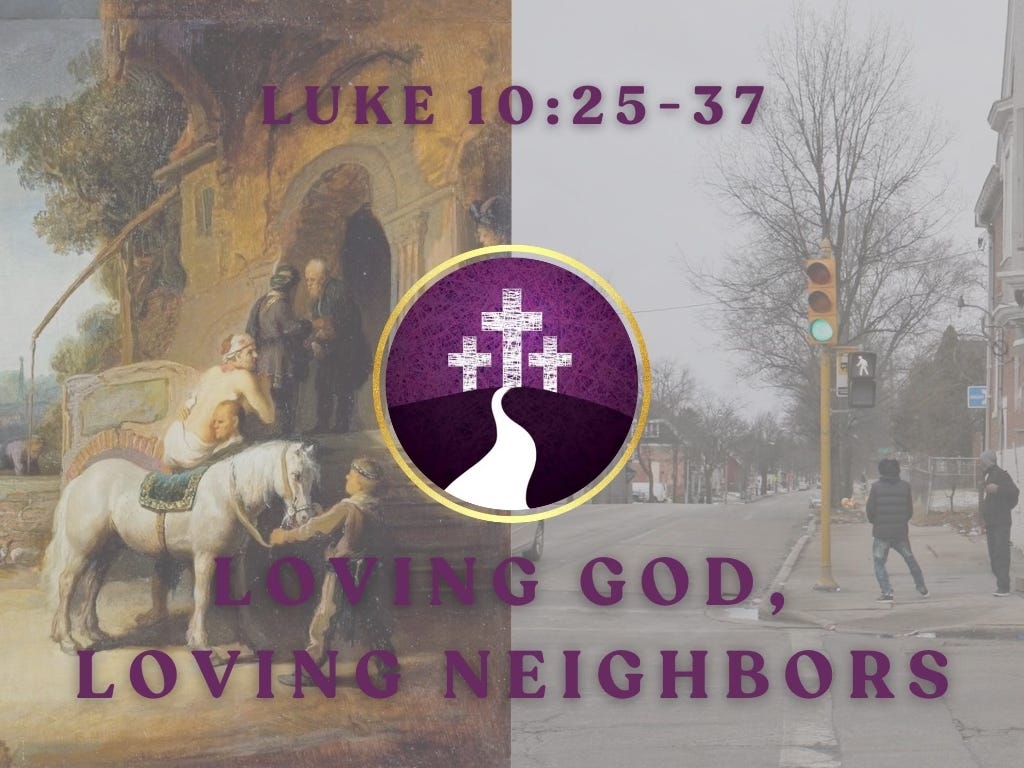
Loving God, Loving Neighbors
Today is Ash Wednesday, the beginning of Lent. Lasting six weeks, Lent ends with Holy Week, the crucifixion of Jesus on Good Friday and his resurrection on Easter Sunday or Resurrection Sunday.
Lent is a season to remember “our creaturely mortality and moral culpability,”1 reminding us of our need for God’s grace. Lent is also an opportunity to reflect on the life of Jesus and the kingdom of God, asking ourselves what we need to let go of so that we might follow Jesus into the kingdom of God. We call this repentance, which is how we take the demand of Jesus seriously when he says, “Whoever wants to be my disciple must deny themselves and take up their cross daily and follow me” (Lk 9:23).2
Following Jesus means letting go or denying ourselves of whatever keeps us from fully embodying the way of God’s kingdom. Fortunately, we know that loving God and loving our neighbors is at the heart of such kingdom living. When a Jewish lawyer asked Jesus about inheriting eternal life, Jesus asked him about what is written in the Law and how he reads that law. It’s like asking us what the Bible says and how we read the Bible.
The answer is easy. Like the Jewish lawyer in Luke 10, we know that the two great commands are “‘Love the Lord your God with all your heart and with all your soul and with all your strength and with all your mind; and ‘Love your neighbor as yourself.’”3 It’s worth noting that Luke doesn’t differentiate between which of the two commands are greater because such differentiation doesn’t matter. The way we love God is by loving our neighbors. We cannot claim that we love God but refuse to love our neighbors. If we love God, we’ll love our neighbors and when we love our neighbors, we are also loving God.
However, the question then is just who is our neighbor? But the question has nothing to do with knowing what the Bible says or even with who our neighbors are. In Luke 10, the question is motivated by the lawyer's desire to justify himself. That’s an important fact because it’s a hint about our problem. We are sinners. We like what the Bible says when it aligns with the way we live and, let’s be honest, when it critiques the lives of others. But when scripture wants to examine us, it’s tempting to find ways of justifying ourselves.
As Luke tells the story, Jesus won’t have any part in allowing any self-justification. Instead, Jesus responds with a clever story told in Luke 10:30-35…
“A man was going down from Jerusalem to Jericho, when he was attacked by robbers. They stripped him of his clothes, beat him and went away, leaving him half dead. A priest happened to be going down the same road, and when he saw the man, he passed by on the other side. So too, a Levite, when he came to the place and saw him, passed by on the other side. But a Samaritan, as he traveled, came where the man was; and when he saw him, he took pity4 on him. He went to him and bandaged his wounds, pouring on oil and wine. Then he put the man on his own donkey, brought him to an inn and took care of him. The next day he took out two denarii and gave them to the innkeeper. ‘Look after him,’ he said, ‘and when I return, I will reimburse you for any extra expense you may have.’”
Then Jesus asks the lawyer, which of these men was a neighbor. Just as surely as the lawyer knows the answer, so do we. The neighbor is the one who showed “mercy” for the victim.
As I said earlier, the problem isn’t knowing what the Bible says. Nor is the problem knowing who our neighbors are. The problem is us. For various reasons, we fail to see people as our neighbors and see them as an other—even an ominous other.
“Learning to love God by loving our neighbors raises the question for us of how we are living lives of love in our neighborhood, our workplaces, and the other social spaces we inhabit. What then do we need to let go of so that we can more faithfully follow Jesus in learning to love God by loving our neighbors?”
The Jewish people didn’t wake up one morning with hatred for the Samaritans. Such hatred was cultivated over time, slowly and in many ways that made the Samaritans into enemies rather than neighbors. Now we may not harbor any outright hatred but we are always in danger of othering people to the point that they are seen as a problem rather than a neighbor.
So I’ve wondered how Jesus might tell his story, The Parable of the Good Samaritan, for our context. Perhaps the story might go like this:
A man was walking in a Milwaukee neighborhood one night, somewhere along Center Street, between Fondulac Avenue and Interstate 43.5 Some thugs, members of a street gang, viciously assaulted this man and left him for dead after robbing him. Shortly thereafter, a Pastor came along, saw the man but was too busy and so he just kept walking. Then came along another Christian who also saw the man but fearful of the neighborhood, he kept walking too. But finally, along came a man of Hispanic descent and a questionable immigration status, who saw this man and began helping him, even calling 911 knowing that calling the police could mean trouble for himself.
And then Jesus would ask that very important question about who the neighbor is. Knowing that the neighbor is the one who showed mercy, the moment becomes a discipleship matter as we hear Jesus also say, “Go and do likewise” (Lk 10:37).
I began this post with a word about Lent as an opportunity for us to reflect on what we may need to let go of so that we might go forward on mission with God. Well, learning to love God by loving our neighbors has everything to do with the mission of God.
Learning to love God by loving our neighbors raises the question for us of how we are living lives of love in our neighborhood, our workplaces, and the other social spaces we inhabit. What then do we need to let go of so that we can more faithfully follow Jesus in learning to love God by loving our neighbors? As we ponder the question, we will do well to recognize that loving people whose beliefs, values, and lifestyles are vastly different than our own can be difficult. Sometimes people do things that anger and repulse us but we’re called to love them as our neighbor anyway. So the question at the beginning of this season of Lent remains: What do we need to let go of so that we can more faithfully follow Jesus in learning to love God by loving our neighbors?
1Bobby Gross, Living The Christian Year: Time to Inhabit the Story of God (Downers Grove: IVP Books, 2009), 127.
2Unless otherwise noted, all scripture quotations are from The Holy Bible, New International Version, NIV. Copyright © 1973, 1978, 1984, 2011 by Biblica, Inc. Used by permission. All rights reserved worldwide.
3These two commands are found in Deuteronomy 6:5 and Leviticus 19:18.
4To have pity is to have compassion. If you read the old King James Version (KJV) or the Common English Bible (CEB), both translations use the word “compassion.” It’s probably a better translation because this Samaritan didn’t just take pity on the victim as in feeling sorry but was willing to suffer with the battered man. Etymologically speaking, compassion means to suffer with and the Samaritan does just that. He sees the battered man and begins tending to his wounds, then takes the man to an inn to recuperate and promises to pay the inn keeper for the expenses.
5This is one of the more violent neighborhoods, if not the most violent, in Milwaukee.
February 26, 2025
Dazed and Confused
I have more than a few books about leadership on my shelf. The focus of these books varies from church leadership, organizational leadership, leadership character, leadership in times of crisis, and so on. Besides the books, I’ve read articles, listened to podcasts, and even attended a few conference presentations on leadership.

Over the years, there are some of the lessons I have learned about leadership that include:
Lead by example. People are more inclined to cooperate with someone willing to do first what he or she wants others to do.
Lead by listening to others. Seeking the collaborative input of others, including those who can offer critical feedback, improves good ideas and can help avoid mistakes.
Lead with moral character. There’s a problem when the integrity of a leader is so compromised that he or she can no longer be trusted and has lost the confidence of others.
Lead with moral conviction. A leader must have the courage to self-differentiate by doing what is right rather than just what is expedient or faddish.
Lead by empowering others. Give praise to whom praise is due and help people serve based on their strengths because their success is also the success of a leader.
Lead with accountability. A leader takes responsibility, accepting accountability for mistakes rather than blaming others.
Of course, as a follower of Jesus, my philosophy of leadership begins with Jesus. Consider the following passage of scripture from Luke 22:24-27…
A dispute also arose among them as to which of them was considered to be greatest. Jesus said to them, “The kings of the Gentiles lord it over them; and those who exercise authority over themselves Benefactors. But you are not to be like that. Instead, the greatest among you should be like the youngest, and the one who rules like the one who serves. For who is greater, the one who is at the table or the one who serves? Is it not the one who is at the table? But I am among you as one who serves.”1
Such a passage affirms the idea of servant-leadership comes from. Leadership is not about wielding authority and power over others but about serving.
Or so I thought.
It seems that I was wrong. It appears that all the books and articles I have read and all the leadership seminars were wrong.
Until our values and what we support match what we proclaim and confess, our witness for the good news of Jesus Christ and the kingdom of God rings hollow.
Apparently, good leadership doesn’t require any moral character or conviction. A “strong man” rather than a servant, who builds his or her platform based on fear, is the mark of a good leader. Eliminating any dissenting voices, those who would dare to criticize an idea of the leader or attempt to hold the leader accountable is okay. A good leader should insult, mock, and scapegoat others, even if it means being dishonest, to advance their agenda. When problems arise, as they always do, a good leader will always blame others rather than accept any responsibility but always take credit for everything that goes well. The same leader, full of narcissism, should always brag about him or herself by over-inflating their accomplishments, all the while ignoring their failures. All of the above is also a great way to cover up a fragile ego that would give off the appearance of weakness.
Yes, this is what appears to make for good leadership here in the United States. Of course, that is utter nonsense, and anyone who has ever served in any position of leadership knows how much nonsense this is. But this is what happens when utilitarianism, where the end justifies the means, is embraced. Virtue no longer matters. And the saddest part of it all is that many Christians embraced such utilitarianism over virtue, at least when it comes to public life. The retort is that public life is not the church, as though they can still embody a Christian witness while embracing a public philosophy that pans Jesus as a weak leader.
All of this is at a time when Christianity in the United States is in steep decline and many Christians are anxious regarding how to stop this decline. I know this because there are volumes of books, some of which are also on my bookshelf, addressing this very matter. According to some voices, we just need more laws that favor Judeo-Christian ideals. But no matter how necessary some laws are, laws don’t change hearts. So it’s past due that Christians begin to look inward for the answers to how we might recapture a robust Christian witness and this, in my opinion, includes examining the kind of leadership we value and support.
There is something grossly wrong when Christians value and support the ideals of Caesar rather than Christ. No matter what we proclaim and what we confess as a matter of faith on Sundays, what we value and support says more about who we are than any proclamation or confession. Until our values and what we support match what we proclaim and confess, our witness for the good news of Jesus Christ and the kingdom of God rings hollow.
Lord, give us eyes and ears to see and hear!
1Taken from The Holy Bible, New International Version, NIV. Copyright © 1973, 1978, 1984, 2011 by Biblica, Inc. Used by permission. All rights reserved worldwide.
February 12, 2025
The Secrets of God’s Kingdom
Last Sunday, I preached a sermon on Luke 8:4-15. This text is the parable of the sown seed that Jesus tells. The parable, I suggest, isn’t about how we sow the seed of the gospel but what kind of soil the seed, sown in us, has landed in. But to understand the parable, it will be helpful to do a little reflection on a very familiar prayer and the kingdom of God.
Our Father, in heaven, holy is your name. Your kingdom come, and your will be done on earth as it is in heaven. Give us this day our daily bread and forgive us our trespasses, as we forgive those who trespass against us. And lead us not into temptation, but deliver us from evil. For yours is the kingdom, the power, and the glory, forever and ever. Amen.
The Lord’s Prayer is a prayer we should probably pray at least once every day. After all, in the Gospel of Matthew, Jesus says that when we pray, we should pray like this (Matt 6:9).

When I’m asked what is the kingdom of God, I start with the line about the kingdom as God’s will done on earth as in heaven. What more could we want than for God’s will to be done on earth as it is in heaven? In your life, as it is in heaven. In my life, as it is in heaven. But praying for the coming of God’s kingdom begs the question of how the kingdom comes.
So, who better to learn about how the kingdom of God comes than from Jesus? After all, Jesus is all about calling people to repentance as he proclaims the arrival of God’s kingdom. Among the Synoptic Gospels—Matthew, Mark, and Luke—the Kingdom of God or the Kingdom of Heaven is mentioned ninety-one times. Thirty-two of those mentions are in the Gospel of Luke because Jesus had a knack for talking about God’s kingdom.
In the Gospel of Luke, we’re told that Jesus is going from town to town. “Proclaiming the good news of the kingdom of God” (Lk 8:1).1 Remember that because whatever the gospel or good news is, it involves the kingdom of God—God’s reign or rule—his will done upon earth as it is heaven.
One of Jesus’ preferred ways of teaching is to tell a parable. A parable is a little story or saying that illustrates a truth.2 In the case of the parable, Jesus tells about a farmer who lavishly sows seed—seemingly anywhere and everywhere. Thus, some seed falls on good soil, but not all. It seems like a lot of seeds fell on bad soil, along a walking path, as well as among rocks and thorns.
After Jesus finishes the parable, he says, “Whoever has ears, let them hear.” In other words, listen up and pay attention. If we want to know how the kingdom of God comes, then pay attention because Jesus is about to reveal what he calls the secrets or mysteries of the kingdom.
“Jesus doesn’t say one word about stifling the power of the devil or stifling any threats of persecution or concerns with the problems of this world. All Jesus says is that a seed planted in good soil, those with a noble and good heart, are the ones who will produce a crop.”
Explaining the parable, Jesus says, “The seed is the word of God.” It’s the message Jesus has proclaimed about the good news of God’s kingdom, which comes with an invitation for us to believe this good news and repent so that we can follow Jesus as participants in God’s kingdom. But not everyone will. For some, the seed just never takes root. Maybe the devil snatches it away. Maybe the challenge of following Jesus is too difficult, and when tested, it’s just easier to give up on Jesus. Or it could be that there’s just more concern for the things of this world that keep the seed from ever maturing.
The silver lining is that some do hear the word of God. Those who hear the word of God are like a seed planted in good soil because the seed produces a crop. However, when Jesus told the parable, he said the crop would produce a hundred times (v. 8), but now, in explaining the parable, Jesus doesn’t say a word about how much the crop produces. Instead, Jesus says, “the seed on good soil stands for those with a noble and good heart, who hear the word, retain it, and by persevering produce a crop” (Lk 8:15).
If I understand what Jesus is getting at, he is talking about how we live. How we live has everything to do with our faithfulness in following Jesus—even when it seems difficult. Our faithfulness in following Jesus is the secret to seeing the kingdom of God come. Jesus doesn’t say one word about stifling the power of the devil or stifling any threats of persecution or concerns with the problems of this world. All Jesus says is that a seed planted in good soil, those with a noble and good heart, are the ones who will produce a crop. They are the ones who, because of their faithfulness in following Jesus, see the kingdom of God.
This is an important point to ponder because we might question how the kingdom can come with all the evil, troubles, and concerns of the world. Wouldn’t it be easier if we formed some sort of Christian coalition and sought to elect politicians who would support laws that favor Christianity? Some voices within Christianity have sought to do just that. Then there’s Jesus, who was offered all the kingdoms of this world if he would just serve Satan. Yet, Jesus refused such an offer because he knew the kingdom of God comes only through faithfulness to God, hearing the word of God that summons him (and us, as his followers) to the cross.
I don’t know what the near and intermediate future will look like in the United States. Ask ten people, and you’re likely to get eleven different opinions. But what I do know is that we are still called to follow Jesus as participants in the mission of God. Whatever that entails, I believe the kingdom of God will flourish as we hear the word of God that Jesus proclaims. No ballots and certainly no bullets are necessary for following Jesus because they never have been necessary. All that is necessary is for us, by the power of the Holy Spirit, to remain steadfast in our commitment to following Jesus.
Will the seed fall on good soil?
1Unless otherwise noted, all scripture quotations are from The Holy Bible, New International Version, NIV. Copyright © 1973, 1978, 1984, 2011 by Biblica, Inc. Used by permission. All rights reserved worldwide.
2Walter Bauer, A Greek-English Lexicon of the New Testament and Other Early Christian Literature, 3d ed., rev. Frederick William Danker (Chicago: University of Chicago Press, 2000), 759, the entry for parabolē describes a parable as a story or saying that points beyond itself to illustrate a truth through comparison or simile.