
W. Terry Whalin's Blog, page 33
October 13, 2019
Be "The Exception" Author

By Terry Whalin @terrywhalin
From my years in publishing. I know there are many authors who
want to write a bestselling book. They take classes and courses and work hard at
learning the craft of storytelling and writing. They join a
critique group and even hire an outside editor to produce an excellent
manuscript and proposal. They go to conferences and meet literary agents and
editors, then follow up with their writing. Each of these steps are important
and essential to the process.
Publishing has a lot of competition as a part of the mixture.
Thousands of new books enter the marketplace every day and there are many books
already in print with those authors trying to sell their books. While
self-publishing is always an option, it is not a route that I recommend to
authors because most of it is not successful (doesn't sell) and you end up doing
everything on your own (everything—including functions that you have no interest
in doing).
As an
acquisitions editor, I'm looking for authors who are the exception. As an
author, I'm trying to be the exception in my approach and life. Such an approach
is not easy-and if it were, everyone would be doing it. The path is filled with
failure and restarts yet there is a path and you can continue in spite of the
failure and restarts. From my experience, those persistent authors are the ones
who eventually succeed and find their way. Here's a couple of examples of these
authors:
Cec
Murphey has written many books including his bestselling 90 Minutes in Heaven . He
had written many books before this title and received a modest advance (and
expectation) from the publisher regarding this book. Through the tireless
promotion of Don
Piper, this book got on the New York Times bestseller list and has
continued to sell year after year. Cec has written many different types of books
and he is a great example of someone who is an exception as an
author.
Jerry B.
Jenkins has published 195 books and been #1 on the New York Times
bestseller list 21 times. Left Behind was his 125th book so he was not an
overnight success. The Left Behind series has sold over 70 million copies. Jerry
has written many different kinds of books and is another example of an author
who is the exception.
While you have probably heard of these last two authors, I'm
intentionally selecting a third author who is the exception and you've probably
not heard of him: Alan Williams. He is the author of The Little Teammate which is
a Morgan James children's book. I understand this book has sold over 400,000
copies—and you would not know it from the BookScan numbers or the Amazon
ranking. How did it happen? The author is selling copies in bulk to
corporation. Every author can use this strategy to sell books but few do so
Alan Williams is an exception. You
can learn about bulk sales through this free teleseminar that I did on the
topic.
Here's a few of my lessons from these exceptional
authors:
1. Be consistent and persistent.
2. Timing is not in your control but you can control your
effort—so make it consistent and persistent.
3. Look for the open doors and march through them. Most people
give up but the ones who succeed keep on knocking and trying and working to find
the right place. Persistence and the right connection will pay off in the long
run.
Are you an “exception” author? Or maybe you know of one and
their actions. Let me know in the comments below.
Tweetable:
Can you be “The Exception” author? Learn some of the key characteristics in this article. (ClickToTweet)


October 6, 2019
A Simple Expression of Appreciation

By Terry Whalin @terrywhalin
The key book which has guided my life in publishing has been the
Bible. For many years, I've read a different version of the Bible from cover to
cover each year. Reading the Scriptures is a key part of the beginning of each
day. I have been reading in The
Passion Translation (Broadstreet). If you don't know about the Passion
Translation, I encourage you to get a copy and read it. From my experience,
often reading in a new translation will give you fresh insights and perspective.
One of the final letters the Apostle Paul wrote was his second letter to
Timothy. In 2 Timothy 3:1–5, he includes a series
of godless acts that will happen during the Last Days. tucked into some terrible
things is a single word: ungrateful. (2 Timothy 3:1-5).
The opposite of ungrateful is gratitude. As a writer, how do you
incorporate gratitude into your daily life?
How you express gratitude doesn't have to be complicated. A
simple expression of appreciation can go a long way. My first book,
When I Grow Up, I
Can Go Anywhere for Jesus , was published in 1992. When the
book first came out, I went to the booksellers convention and met with
best-selling author Richard J. Foster. His classic book, Prayer: Finding the Heart's True
Home had just released. I showed Richard my little 32–page
book and gave him a copy. He celebrated with me and prayed with me about the
book. Several weeks later, I got a surprise in the mail: a handwritten thank you
note from Richard Foster. He was letting me know how much he appreciated the
copy of my book.
This handwritten note from a bestselling author was amazing to
me—and a practical example of something I've done now for years. I've been
writing and reviewing books for many years—in print magazines and online. Almost
every day authors and publishers will send me physical books. I appreciate it
but to be honest, the volume is way more than anyone could read—even if that is
all I did. I read these books in my free time and for fun then write my reviews
and post them on Amazon, Goodreads
and my social media.
If you can't read every book that comes into your mail box, what
can you do? I can take a few minutes and handwrite a note to that author
expressing my appreciation for their efforts. I have a box of thank you notes
and pull one out, address the envelope and write my note often on the same day I
get the book. It is a practice of appreciation that I've done for years—and
something anyone can do.
What practices of appreciation do you incorporate into your
daily life? Let me know in the comments below.
Tweetable:
Discover a simple expression of appreciation from this prolific editor and author. (ClickToTweet)
September 29, 2019
Learn How to Reach the Library Book Market

By Terry Whalin @terrywhalin
You spot a new book that looks interesting. Where do you turn to
get that book? Some of you are thinking Amazon—and yes Amazon would have some
information about the book. Yet on Amazon to actually get the book in your
hands, you have to buy that book and spend money. Often the first place I look
is not to buy the book but to explore my local library. Can I get the book
there? Can I get the audiobook through my library? Can I get the book through
interlibrary loan? Often the answer is yes.
I have a branch of my local public library about three blocks
from my house. As I've learned to use their online catalog, I can often reserve
books from home, then get an email they are ready for me to pick up and go get
these books. If I don't find the book in their catalog, then I can use
interlibrary loan to locate the book and get it. Or sometimes I will make a book
purchase suggestion. For example, last week in my email I saw a book where the
title caught my interest. I searched for the audiobook version on Overdrive but
did not find it. I returned to my local library and filled out a form to make a
suggestion on a book. Later that day, I got an email from the library they were
ordering the audiobook version through Overdrive and it should be available
later that day. A few hours later, I searched for this audiobook, found it,
checked it out and downloaded it to my phone—all without leaving my
home.
Hopefully through these stories you are seeing the value and
diversity for book lovers to be using your local library. Last week I did a
45-minute online class about libraries with Amy Collins. Here's some facts Amy
pointed out:
* Over 57% of Millenials have been in a library or on their
library website in the last month
* 71% of Americans have used a library in the last
year
* The American Library annual budget for materials and books is
just over 2.8 BILLION Dollars.
If you don't know Amy, she is the most trusted and experienced
teacher in our industry and teaches hundreds of classes each year on how to get
your books INTO libraries. There is no special trick to getting your book
approved and purchased by libraries. But there ARE things you have to know and
do to make this amazing side of the book business work for you. Amy Collins is the founder of Bestseller Builders and president of New
Shelves Books. Collins is a recommended sales consultant for some of the largest
book and library retailers and wholesalers in the publishing industry. She is a
USA TODAY and WALL STREET JOURNAL bestselling author and in the last 20 years,
Amy and her team have sold over 40 Million books into the bookstore, library,
and Chain store market for small and mid-sized publishers. She is a columnist
for and a board member of several publishing organizations and a trusted
teacher in the world of independent publishers.
With over 10,000 libraries in North America alone, this
wonderful opportunity to learn exactly HOW to sell into thousands of
libraries is a wonderful opportunity. Amy recorded her workshop and includes a
handout and valuable information. You can access it right away at:
https://www.newshelves.com/Whalin
Do you use your local library? Are you selling your books into
libraries? Let me know in the comments below.
Tweetable:
Are you reaching the library market with your books? Get insights and a free workshop from a respected expert. (ClickToTweet)
September 22, 2019
A Critical Responsibility for Every Writer

By Terry Whalin @terrywhalin
I often hear fascinating stories from writers about their
experiences in publishing. I listen to these stories because I learn more about
the world of publishing. Often in the process, I discover some pitfalls to avoid
with my own publishing efforts. Yes after years in publishing, I continue to
learn—and I hope you are learning too because that is how we continue to grow as
writers.
This author has written a number of nonfiction books. For
his most recent book, he signed with a literary agent and had high hopes for the
success of this book. While I'm not including the name of this agent, she is
well respected within publishing. She has a large number of clients and has
placed a number of books with various publishers. In other words, this agent has
a good reputation and this author was thrilled to sign with such an agent. This
agent took his nonfiction book and placed it with a small traditional publisher
located in the midwest.
With the agent placing his book with a traditional house, he had
high hopes for the success of this book. The author is connected and worked hard
at getting reviews and book signings and other events to promote his new
release. Yet this author could not get much traction (exposure and sales) in the
brick and mortar bookstores. They would not order or carry his book inside the
bookstores. Then he discovered the reason: this publisher did not allow
retailers to return unsold books.
An aside: books inside bookstores have been 100% returnable for
the lifetime of the book since the great depression in the 1930s. Publishers
take all the risk on these books and while it seems unusual to people outside of
publishing, returning books from retailers is simply a part of the fabric of
publishing.
This author was enraged to learn his traditional publisher
didn't allow returns. He spoke with his agent and she shrugged it off, saying,
“Most books are sold through Amazon anyway. Returns is not an issue.”
Another aside: Amazon is a large player in the book publishing
business but books are still selling in brick and mortar bookstores and other
venues. You narrow your possibilities if you are only selling through Amazon (in
my view).
This author learned a lesson from his experience—and one that
every author should learn. You can delegate some things to your agent or a
publisher, yet at the end of the day, the author bears the ultimate
responsibility. The agent doesn't sign the bottom of the contract. Only the
author signs the contract with the representative of the publisher. Yes the
devil is in the details. It doesn't mean you have to do everything, but you have
to know enough to monitor everything because if something falls apart, you will
take the blame.
What did you learn from this story? Does it help you take the
critical responsibility for your own writing and work? Let
me know in the comments below.
Tweetable:
Learn The Critical Responsibility for Every Author—one that can't be delegated to an agent or publisher from this prolific editor and writer. (ClickToTweet)

September 15, 2019
How To Eat An Elephant

By Terry Whalin @terrywhalin
How do you eat an elephant? It's an old joke but you eat an
elephant one bite at a time. It the same way to accomplish any huge task—one
action at a time. Recently I began to write another book. It doesn't matter
that I've done it over and over through the years. Each time it looks daunting
to write an entire book manuscript. No matter what others will tell you for
everyone getting started is hard. The writing in the middle is hard and
finishing is hard. Yes the task is difficult and looks impossible. So how do you
get it done? One bite at a time.
What is the deadline for completing your book? If you don't have
a deadline, then I suggest you set one. After you have a deadline, how many
words a day are you going to write to complete the deadline? Make sure you build
in some extra days for the unexpected (happens to everyone) but make sure you
hit your deadline.
Or maybe your goal is tied to your social media. You want to
reach a certain number of followers on Twitter or a certain number of
connections on LinkedIn. Are you actively working on these networks? Are you
posting a number of times each day? Are you connecting with new people? Without
your regular actions, then it will be hard to increase your presence and meet
your goals.
Do you want to do more speaking? Are you pitching different
conference directors and leaders? From my experience you have to be proactively
promoting your speaking skills to get more speaking meetings.
Do you want to appear on more radio shows and talk about your
latest book? There are thousands of radio stations and programs which use guests
on their program. These bookings do not happen just sitting back and waiting for
them to call. Your phone will be silent if you take this action. Instead, you
need to be actively pitching the producers of these programs.
Or maybe you want to write more magazine
articles or appear on more podcasts? Waiting for the phone to ring will
likely not happen. What proactive steps are you taking to either go ahead and
write the article then submit it to the publication? Or you can write a query
letter and send it simultaneously to different publications and get an
assignment?
Many are surprised that I have written over 60 books through the
years. There are several keys in this process but one of the most important is
consistent writing. It is a matter of writing one paragraph,
then another paragraph which becomes one page then another page. It is the same
process as eating an elephant—doing it in bite-size pieces.
Do you break your writing into smaller pieces? I'd love to have
your tips and insights in the comments below.
Tweetable:
How do you eat an elephant? Learn the secret in this article from this prolific writer and editor. (ClickToTweet)

September 8, 2019
What Is Writing Success?

By Terry Whalin @terrywhalin
Success is a pursuit for many writers, authors and publishing
professionals. If we are honest, each of us will define success in different
terms. In this article, I want to give you some ideas which hopefully will
encourage you to keep going with your writing.
Occasionally book authors will ask me about success or becoming
a bestseller. When asked, I attempt to give them my best answer—and basically it
will boil down to that author's marketing activity and drive to sell books.
There is no single path for each author. If there were such a path, then every
book would be a bestseller and we know that isn't the case.
For me, I write about topics and people which interest me.
Thankfully I have a broad spectrum of interest so there is never a lack of
possibilities for my writing. I learn a great deal with each article or book or
writing project. Each one has built a great deal into my life and the richness
of that experience. I hope writing brings that sort of experience in your own
life.
I've been promoting my book about Billy Graham every day for
over four years. I post different messages and links and images but have been
doing this process over and over every day. Last week one of my long-term
friends added a message to one of my Facebook entries about Billy Graham saying, “Wow I
didn't know you wrote that book.” She purchased the book and is reading it and
has told me she is going to write a review of it when finished. I'm grateful
this friend discovered my book and is reading it. This one exchange is success
for me and one of the reasons I wrote that book.
As authors (from my experience), we don't get lots of feedback
from readers of our work. Yes you may see an occasional review or get an email
or comment. For every review or comment, I expect there are many more readers
who never reach out to the author.
It's the same with these articles in my blog. The people who
comment are rare (outside of the spammers which I delete). Yet each week for
years I continue to write and post a new entry in The Writing Life. I see these
lists of the top writing blogs—and mine is not on it. These lists come from
well-known and respected writing magazines. Yes I have an email subscriber list
of about 500 which goes up and down but stays around that same number.
Last week I got an email about this list of ranked writing blogs. To my
surprise, The Writing Life
blog was the fourth rank of 100 blogs. Notice this ranking includes several
criteria for the ranking—including followers. It was encouraging to see my
followers and be listed on this ranking.
My encouragement to you:
1. Follow your own path with your writing and persist to reach
the right publisher and right readers.
2. Understand that success varies for each piece of writing and
some writing will reach people you have no idea that it reaches.
3. Continue to move forward in spite of rejection, doubts, fears
and other emotions. The journey is a key portion of the reward.
Success is different for each of us and I hope in this article,
I've given you some insights and motivation to persevere and move ahead with
your writing. Enjoy the journey.
What is your definition of Writing Success? Let me know in the
comments below.
Tweetable:
What is Writing Success? Get some ideas from this prolific writer and editor. (ClickToTweet)
September 1, 2019
Get Inspiration

By Terry Whalin @terrywhalin
Where do you find inspiration for your writing? For me, this inspiration comes from many different sources but as a writer we have to be aware and watching for it. I love a good story and find myself returning to these stories mentally and thinking about them over and over.
I've mentioned in the past about listening to audiobooks through Overdrive. It is a free resource through the public library. You can easily check out audiobooks, download them on your phone then listen to them as you walk (through earphones) or drive (through bluetooth) or many other means.
I love listening to memoirs and self-help books. Recently I listened to actor Michael Caine's memoir, Blowing the Bloody Doors Off . At 85 years old, actor Michael Caine has lived an amazing life. Like you would expect, his life is filled with ups and downs—and both aspects are captured in the pages of this fascinating book. I listened to Caine’s narration of the audiobook version cover to cover and enjoyed the book. It is filled with stories and life lessons. To give you a taste of some of these insights, I tracked down the introduction to this book and wanted to include a few paragraphs:
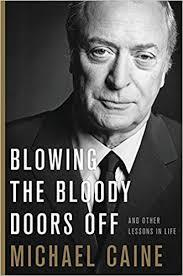
“THE FIRST TIME I was in the United States, when I had just made Alfie, I was sitting on my own in the lobby of the Beverly Hills Hotel and heard the sound of a helicopter landing in the gardens opposite. This, the porter told me, was strictly illegal. He and I stood at the door to see who was so flagrantly flouting the law—presumably the President, of the United States or at least of the Beverly Hills Hotel. Across Sunset Boulevard, out of a swirling sun-flecked cloud of dust, six foot four and in full cowboy get-up, strode the unmistakable figure of John Wayne. As I stood there with my mouth open he caught my eye and altered his course to come over to me. “What's your name, kid?” he asked.
“Michael Caine,” I managed to croak.
“That's right,” he agreed, with a tilt of his head. “You were in that movie Alfie.”
“Yes,” I said. I wasn't really keeping up my end of the conversation.
“You're gonna be a star, kid,” he drawled, draping his arm around my shoulders. "But if you want to stay one, remember this: talk low, talk slow, and don't say too much."
“Thank you, Mr. Wayne,” I said.
"“Call me Duke.” He gave me a chuck on the arm, turned around and swaggered off.
It was a mind-blowing Hollywood moment for an ambitious young actor on his first visit to the city of dreams. And it was great advice for anyone who was going to be acting in Westerns and delivering all his dialogue from a horse. Talk low and slow so you don't scare the horses, and say as little as possible before the horse runs away. But it was not such great advice for someone like me, an actor who was going to play all kinds of characters with tons of dialogue, and mostly, thankfully, with my feet planted firmly on the ground.
I am often asked what advice I have for actors starting out in this business. And for many years my answer was “Never listen to old actors like me." That was because, until John Wayne offered me his words of wisdom, I always used to ask older actors what I should do, and the only thing they ever told me was to give up.
But as I've got older, I've been reflecting on my life, as older people often do. And I've realised that, over my sixty years in the movie business and my eighty-five years of life, I have been given a lot of useful advice—by Marlene Dietrich, Tony Curtis and Laurence Olivier among many others—and I have learnt a lot of useful lessons, from my many glittering successes and my many disastrous failures. I started to think I could do a bit better than “never listen to advice.” In fact, my advice would be, don't listen to that advice.
This book is the result of that reflection. I wanted to look back on my life from the Elephant and Castle to Hollywood, and from man-about-town Alfie to Batman's butler Alfred, with all its successes and all its failures, all its fun and all its misery and struggle, its comedy, its drama, its romance and its tragedy, and find, among it all, the lessons I've learnt and want to share, not just for aspiring movie actors but for everyone.
A few of my “lessons” are quite specific to movie acting. But I hope that most of them will speak, somehow, to most of you. You won't all have to audition for parts but in some ways life is always an audition: everyone has moments when they have to put themselves out there for what they want. You won't all have to learn lines but everyone sometimes has to make sure they're properly prepared. We all have to deal with difficult people and we all have to learn how to balance our professional and personal lives.” (From the introduction of Blowing the Bloody Doors Off .
I just gave a taste of the profound material in this well-crafted book. I highly recommend Blowing the Bloody Doors Off (which was the last line in the entire book). I hope this example has given you some ideas about where I find inspiration—and you can too.
Where do you find inspiration? What are some of your sources? Let me know in the comments below.
Tweetable:
Where do you find inspiration? Get some ideas from this prolific writer and editor. (ClickToTweet)
August 25, 2019
The Necessity of Continued Pitching

By Terry Whalin @terrywhalin
Admittedly after years in publishing, I get tired of the
continuous pitching. Afterall, I've written for many magazines and publisher,
don't the publishing offers just come to me without effort on my part? No.
Rarely in my years in this business does someone come to me with a writing
project. Yes it has happened in my writing but I recognize the rarity of that
occurrence.
One of the realities of the publishing world is the writer has
to continually pitch their ideas to get published. For the world of print
magazines, you have to either write your article completely then send it to
the editor or write a query letter with your idea and get a magazine editor to
assign the article. I've written complete articles which never got published and
I've written query letters which never got picked up an garnered an assignment.
It is part of the risk that every writer takes.
To get on the faculty of a
conference or to get a speaking assignment, you have to pitch the directors
of the event. These directors get a lot of pitches so sometimes you have to
pitch multiple times and multiple possible workshops to get selected. Of
necessity the writer has to be crafting new workshops and innovative ideas to
get selected and not use the same old ideas that have worked in the past. Last
fall I was at a conference and met a writer who I have long admired his work.
Yet during the event I overhead another speaker exclaim, “I heard ___ years ago
and they gave exactly the same workshop that they gave today.” That is not the
reputation I want as a writer and speaker—same old same old. It's why I am
continually making new workshops and teaching new sessions.
To get a publishing deal, you have to write a proposal
or for fiction a complete manuscript and synopsis, then pitch that material to
the right literary agent
or right editor. These book pitches involve crafting the right words which are
innovative and catch attention. While these book pitches are done through email
or mail, the key is they are done through written pitches. As an
acquisitions editor, I regularly have unpublished authors who want to get on the
phone and pitch their idea. I've heard some amazing phone pitches that do not
match the written pitches so those written pitches get rejected. Pitching on the
phone can be a complete waste of time. I need the written pitch to convince my
colleagues to give you a book contract. It's how the system works within
publishing and excellent writing drives everything.
What is your strategy or plan to continually pitch? Do you pitch
different things during different seasons? Let me know your thoughts in
the comments below.
Tweetable:
Wouldn't you like to not be pitching? Learn the necessity of every writer to continually pitch from this prolific editor and writer. (ClickToTweet)

August 18, 2019
Four Reasons to Send Me Your New Book

By Terry Whalin @terrywhalin
Every day new books pour into the market and millions of other
titles are already in print and on the market. As an acquisitions editor at Morgan James, a New
York publisher with about 150 new titles a year, I'm actively involved in
bringing new books into the market. I'm a contributor to the volume of new books
entering the marketplace.
Over the years, I've received many books from publishers and
authors. At a Book Expo in Los Angeles, I picked up an advance reading copy
(ARC) of a book from Doubleday called Covenant House .
I had this book months before it released to the public. I read the book and
wrote a short query letter to a magazine. This publication gave me a word count
and a deadline for my review (which I met). It was my first published book
review. I was a book review columnist for two print publications (both no
longer exist). Each issue I selected the books which were reviewed in these
columns. Some publishers sent me most of the titles they published with the hope
I would select one of their books to include in the magazine. It amounted to
hundreds of books in many different genres and types. I gave away so many of
these books to a church library in Kentucky, the mayor of
the town declared an official Terry Whalin Day.
In this article, I want to give you four reasons to send me your
book (even if it has been out a while):
1. I read constantly in many different genres—mostly nonfiction
but some fiction.
2. I write reviews about books (currently over 900 on Amazon and over 500 on
Goodreads). In general if I read a book (or listen to it in audiobook
format), then I write a review of the book. From my experience it is often a
challenge for writers to find people who will not only read their book but write
a review of the book.
3. I tell others about these books when I teach at conferences.
When I teach at these events, I talk about authors and the different books that
I've read.
4. I tell others about my reviews of books through my social
media connections (over
200,000 on Twitter, over 15,500 on LinkedIn and over 4900 on
Facebook).
How to Pitch Me on Reading Your Book
1. Understand I only read print books. I do not read Ebook
versions through net galley or any other format.
2. I don't read every type of book and I'm selective. For
example, one author has been pitching me several times to read and review his
book. I looked at his Amazon page and it is over 500 pages and not on a topic
that I'm interested in (much less the large size). I politely declined that
book
3. Email your pitch on your book and why I should read it. Your
pitch should be interesting yet short and to the point with the page count, the
release date and the publisher. I will read it and email you back whether I
want to read it or not. If I want to read it, I will send you a mailing address
for the book.
Every author can use this simple pitching process for their own
books. The best way to get reviews for your book is to ask others. If you
are not proactive on gathering and getting reviews, normally it does not
happen—especially for nonfiction books. Sometimes fiction writers have an easier
time getting reviews (depending on the genre and publisher of your book).
Do you read books and write reviews? Let me know in the comments
below.
Tweetable:
Learn Four Reasons to Pitch Your Book to this Prolific Writer and Editor. (ClickToTweet)
August 11, 2019
An Unusual Pitch Session

By Terry Whalin @terrywhalin
During a recent Saturday, I participated in a virtual pitch
session. Through zoom (a computer connection), for two and a half hours, I
listened to 25 authors pitch their book to me. The sessions were rapid fire and
each one lasted about four minutes each.
While I've been going to writer's
conferences for many years and meeting writers face to face for their
pitches, this session involved no travel for me. I was sitting in my office
listening to these authors pitch their work. I understand from the conference
director that the writers came from all over the country for this event. Before
they pitched, they knew my background and about Morgan James
Publishing. I had nothing in advance of my meeting with them—not even their
names. I was one of five possible people for these authors to pitch. There were
three literary agents
and one film producer besides me. Of these varioous professionals, I was the
only one who worked directly with a publisher (and can actually issue contracts
and publish these books). If you don't know, literary agents are great
but they have to sign these authors as their clients for their agency then shop
their proposals or
manuscripts to a publisher before they get a contract. My publisher work is much
more of a direct connection for these authors.
I enjoyed this unusual pitch session. Here's some tips from what
I learned—and these tips will work whether you pitch virtually or in person at a
conference:
1. Establish a
connection with the person. Virtually we greeted each other and
exchanged names. In person I often give someone my business card right away to
begin the process.
2. Be enthusiastic
about your pitch. Each of these authors read their pitch on their
computer but some were more polished and at ease than others. Your enthusiasm
will show as you are excited about your book.
3. Do more than talk about your book and story.
Many authors just stuck to their story and told me about it. Others
added a short piece at the end of their pitch about themselves. Remember the
editor knows nothing about you and your background and most important your
ability to sell books. For example, one author had a moving personal story but
also hinted about her own marketing connection with millions of YouTube
views. These details matter and will be significant to the editor or
agent.
4. Follow-up and actually send your material.
From speaking with the conference director, I learned each of these authors have
completed their manuscript as a part of this coaching program. In each case they
told the status of their project and when they expected to begin submitting
their work (often around Thanksgiving).
These oral pitches were terrific and impressive to me as an
editor. Through the years I've had many writers give fantastic oral pitches yet
their printed work does not match the oral pitch. At the end of the day, it
is your writing which is going to win the heart and enthusiasm of the editor.
Also I wonder how many of these 25 people will actually send me their material?
When they pitched I had nothing from these writers—nothing in print but I'm
working to change that and get their contact information so I can follow up.
Why? From going to conferences for years, I know without my
follow-up, I suspect many will never send me their material—at least this has
been my experience from past pitch sessions and hopefully they will be better
than the past. Some of those pitches are still in my mind—which means to me they
have lots of good potential and I'm eager to get them moving and
published.
Have you ever been in a virtual pitch session like I am
describing? How did it work out for you? Let me know in the comments
below.
Tweetable:
Four Lessons From An Unusual Pitch Session. Read the details here. (ClickToTweet)
---



