
W. Terry Whalin's Blog, page 60
May 27, 2014
Watch Your Subject Lines
Over a year ago, I attended the annual American Society of Journalists and Authors Conference. I
moderated a panel on how to get on the New York Times bestseller list during the conference.
Because I was at the event, I was able to attend a terrific workshop from Sree Sreenivasan (@sree). He is a remarkable
instructor in the area of social media and someone that I recommend you
follow his wise advice.
Sree called to our attention that a Senior Feature Writer for the New
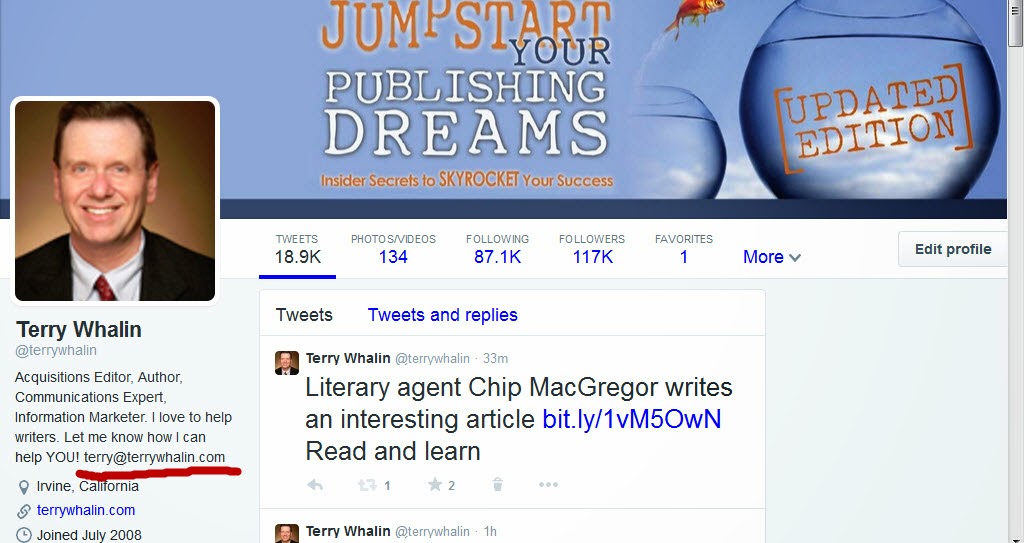
York Times has his email address in his twitter profile. Why does he
publicize his email address? Sree answered, “It's because he wants to be
accessible to the public and if you have a feature story idea, he wants you to
be able to reach him through his email.”
I thought it was a great idea. I want to be accessible to others. During this
workshop I added my email address to my twitter profile. It did make me more
accessible and on a regular basis (almost daily and sometimes several times a
day), I receive emails from writers who wonder what type of help I can give
them. Some of them ask for a specific type of help such as in marketing or
promotion. I answer each email and send them to material in my blog or free teleseminars that
I've done or other resources. It does not take much of time because I have a
ready answer for these questions.
I'm delighted to help these people and it's one of the reasons I wrote these
resources on the first place—to help these writers.
Recently I got one of these requests and it got me thinking about the subject
lines in email here the email I received:
Subject Line: Important
Hello Terry,
I hope you are well.
My name is ________, I am a student at ________________. I live in _____. I
would like you to call me at ______. To discuss a book that I am writer.
Respectfully yours,
Sent from my iPhone
Yes that is the actual email and subject line. I took out the specifics and
left blanks. I wrote back to this writer and said “As important as you believe
your email is, I will not be calling you to talk with you about your book.” Then
I pointed out my various online resources for this writer to use. Calling on the
phone might be something they want but most editors and literary agents are
difficult to get on the phone and then they limit their time on the phone
because they are focused on their work.
A random phone call may or may not (usually not) develop into a publishable
project. This writer didn't look promising to me—especially with the
ungrammatical sentence that she concluded her email.
Here's several tips for crafting the words in your subject lines:
1. Make Them Specific & Interesting. Give me a reason to open your
email. I get a lot of email. Many people get a lot of email so you have to be
mindful of this fact when you write your subject line.
2. Do not Be Generic because you are “asking” for deletion.
3. Think about the person Receiving the Email. As you craft the
subject line, ask yourself if they get a lot of email or a little bit? How can
you help them to be eager to open your email? It's with your few words for the
subject.
4. Use Power Words That Demand to Be Opened. Begin to analyze your own
email and notice which subject lines catch your attention and which ones do you
automatically delete? It will help you with your own emails.
At the end of the day, I'm delighted to have would-be writers email me. My
email address remains in my twitter profile. I have met some amazing people
through my work on twitter.


May 15, 2014
When You Hit A Bad Day
Let's face it head on. Everyone has a bad day. You know what I'm talking
about.
When you walk out to your car and see the tire is flat—and naturally you are
trying to rush off to some important meeting.
Or your computer crashes in the middle of an important rewrite on an article
or book and you lose hours of work because you didn't back it up.
Or you get sick and land in bed. Or someone in your family gets sick. Or a
dear friend suddenly dies.
Or a friend or a co-worker promises they will do something—and they don't. So
it creates huge amounts of unexpected work for you or a project you were
counting on completing didn't happen.
These various possibilities that I just listed are a fraction of what happens
to everyone. The unexpected happens to each of us with our writing and
publishing lives.
Here's the critical question for you: when you meet one of
these difficulties, does it totally derail you so you don't complete what needs
to be written. Or do you rise to the challenge and continue forward with your
writing?
Something derails writing for a day. Do you shake it off and return to it the
next day? Or do you set it aside and say, the time must not be right? There is a
time and place to persevere.
This month many publications and programs have been celebrating the storied
career of journalist Barbara Walters. At 84, she is retiring this week from 17
years on The View. This week I read an article about Barbara Walters
in AARP magazine, which claims have the world's largest circulation at 24.4
million (more than three times the circulation of Reader's Digest).
In the AARP article called What I Know Now: Barbara Walters, she shares the secrets of
her success saying, “I think the secret of my success is that I persevered. I
didn't give up. I didn't say, 'This is a lousy job, and I'm unhappy, and I'm
going to quit.' I went through the tough times, and they were tough. And I was
fortunate that I came out the other end.” I admire Barbara Walter's
perseverance.
Recently my agent friend Steve Laube wrote an article What to do when technology fails? I did feel bad for the
author who lost the entire manuscript on a computer the day it was due at the
publisher. As a result the book was canceled. Buried in the story was the fact
the author had missed the third extension. What happened in the case of
the first two extensions? This story wasn't told.
About ten years ago when I started working as an editor on the inside of
publishing houses, I learned that writers are notoriously late. I've often been
the editor who the author calls and tells about their bad day then asks for an
extension. Publishers know about bad days so they often build some flexibility
into the deadline.
Yet writers should not count on that flexibility or extension. Here's how to
distinguish yourself as a writer and make editors love you: turn in your writing
when you promise to turn it in—with excellence.
It's one of the elements that I've done over and over with my writing
deadlines—met them. I recall writing one section of a book where I stayed at my
computer all night in order to meet the deadline. At that time, I had a
full-time editorial job and I had taken on a book project to write.
When I didn't come to bed, in the middle of the night my wife came down to my
office to see if everything was OK. Everything was fine except I had to meet a
deadline and did not make it to bed that particular night. I fired off my
deadline material to the editor, cleaned up and went off to my full-time job.
Yes, I drank some extra caffeine that day and was tired but I delivered what I
promised to the editor and put in a full day at work. I've only done it once so
I don't make a regular habit of such actions.
How do you handle bad days? Does it derail you so you don't complete what
needs to be written or do you shake it off and continue?
April 27, 2014
A Celebration of Books!
April
is the first ever Wimpy Kid Month, which will become an annual event. Tomorrow,
April 28th, the cover and title for the 9th book in the
Diary of a Wimpy Kid will be revealed in a free
webinar.
This
event reminds me of an amazing experience that I had with books last
October. I
love printed books. I've written numerous books. For years as an acquisitions editor at Morgan James, I’ve helped others get
their books into print.
Yet
something was missing from my experience. I had never toured a book
manufacturing plant. I wanted to see how books were assembled from large rolls
of paper to books you can hold in your hand.
Last
October I finally had that magical experience. I spoke at the Wisconsin Writers Association
and I knew one of the largest book manufacturers was in Stevens Point,
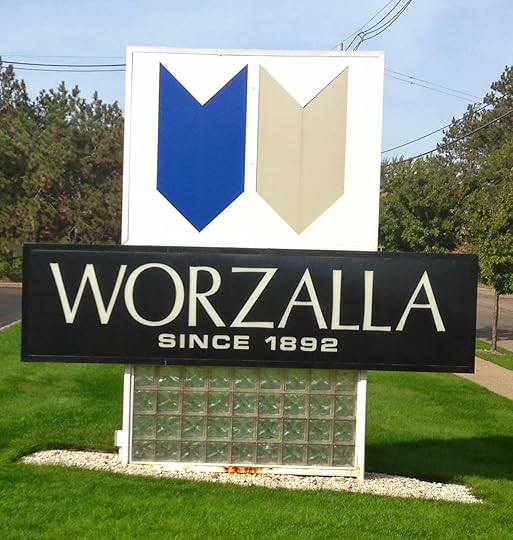
Wisconsin. I arranged a tour of Worzalla Book Publishing which has been operating since 1898.
The plant runs 24 hours a day and seven days a week.
You’ve
got to wear your walking shoes because the plant is over 300,000 square feet of
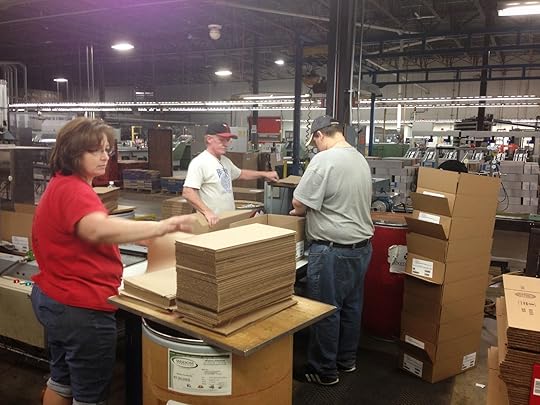
building space. They were running many different print jobs as I walked through.
Some machines were binding paperbacks while others were adding the jackets on
hardcovers. Others were assembling the signatures of books into stacks and
another machine added the hardcover binding.
The
large project in the plant was printing six million copies of Book #8 of the
Wimpy Kid Diary books. I was not allowed to take any photos of this
printing because the book is embargoed and will not release in the bookstores
until November 2, 2013. Yet six million books are not magically printed
overnight and shipped to stores around the country. It happens ahead of time in
book plants like Worzalla.
 I saw
I saw
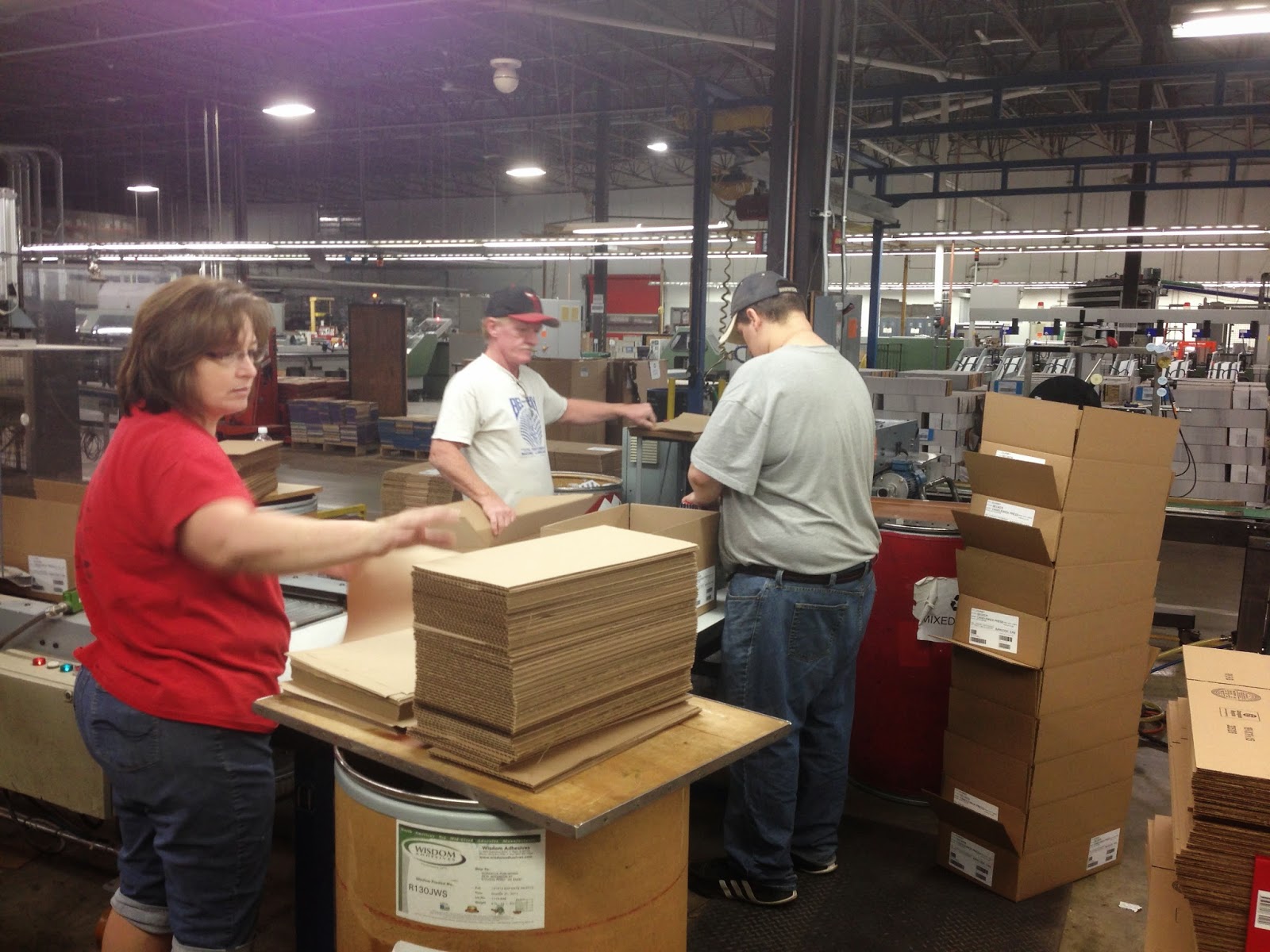
the book in pieces in some places and at other machines like in the bindery,
they were completely assembled and packed into boxes and on pallets for
shipping.
With
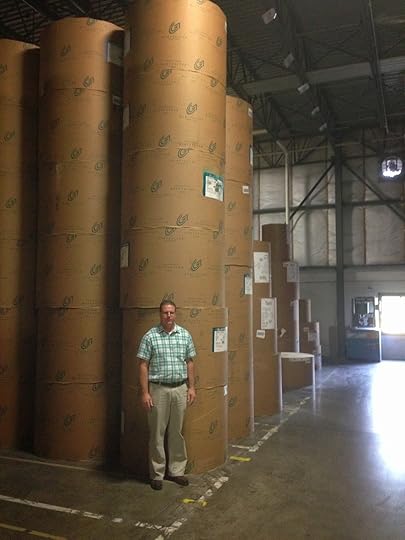
permission, I took a few photos to include with this post. The rolls of paper
are massive and weighed 1300 to 1600 pounds EACH. Notice the tall stacks in
their warehouse. These rolls of paper become books.
I’ve
been wanting to visit this plant for years and last fall, one of my dreams came
true. My plans paid off and I managed to see how books are
manufactured.
What
are you dreaming of seeing manufactured? How can you take action to set
something into motion where you can see this take place? Or maybe it is some
trip you want to take. How will you achieve this dream in the days
ahead?

is the first ever Wimpy Kid Month, which will become an annual event. Tomorrow,
April 28th, the cover and title for the 9th book in the
Diary of a Wimpy Kid will be revealed in a free
webinar.
This
event reminds me of an amazing experience that I had with books last
October. I
love printed books. I've written numerous books. For years as an acquisitions editor at Morgan James, I’ve helped others get
their books into print.
Yet
something was missing from my experience. I had never toured a book
manufacturing plant. I wanted to see how books were assembled from large rolls
of paper to books you can hold in your hand.

Last
October I finally had that magical experience. I spoke at the Wisconsin Writers Association
and I knew one of the largest book manufacturers was in Stevens Point,
Wisconsin. I arranged a tour of Worzalla Book Publishing which has been operating since 1898.
The plant runs 24 hours a day and seven days a week.
You’ve
got to wear your walking shoes because the plant is over 300,000 square feet of
building space. They were running many different print jobs as I walked through.
Some machines were binding paperbacks while others were adding the jackets on
hardcovers. Others were assembling the signatures of books into stacks and
another machine added the hardcover binding.
The
large project in the plant was printing six million copies of Book #8 of the
Wimpy Kid Diary books. I was not allowed to take any photos of this
printing because the book is embargoed and will not release in the bookstores
until November 2, 2013. Yet six million books are not magically printed
overnight and shipped to stores around the country. It happens ahead of time in
book plants like Worzalla.
 I saw
I saw the book in pieces in some places and at other machines like in the bindery,
they were completely assembled and packed into boxes and on pallets for
shipping.
With
permission, I took a few photos to include with this post. The rolls of paper
are massive and weighed 1300 to 1600 pounds EACH. Notice the tall stacks in
their warehouse. These rolls of paper become books.
I’ve
been wanting to visit this plant for years and last fall, one of my dreams came
true. My plans paid off and I managed to see how books are
manufactured.
What
are you dreaming of seeing manufactured? How can you take action to set
something into motion where you can see this take place? Or maybe it is some
trip you want to take. How will you achieve this dream in the days
ahead?
April 13, 2014
Why Words Are Magic

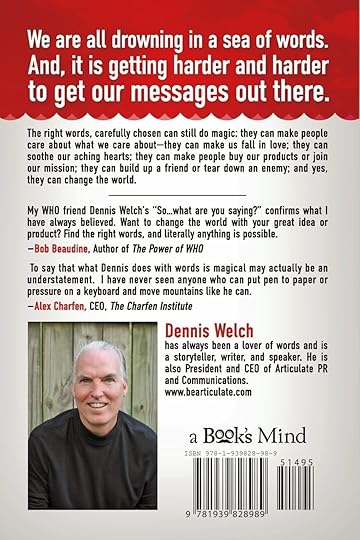
Dennis Welch knows the right words can be magic. The challenge for anyone who writes is selecting the right words. In this hurry-up-and-get-it-out world, "SO...WHAT ARE YOU SAYING?" is a clarion call to choose your words with care.
In places, the storytelling and writing in these pages is laugh-out-loud funny. Yes, I laughed as I read several of the stories--a real testament to the craft inside this little book. The lessons for any writer or communicator are profound. Read this book with a highlighter so you can return to the messages and think about them again and again.
To give you an example of the insights in this book, I’m going to excerpt a few words from one of the final sections called “How You Can Make Magic.” Dennis gives a key principle, “Don’t rush unless you have to.” He writes, “Look, I know everybody is in a hurry. Hardly anybody sits down to write anything for fun. You probably have a reason why you need to communicate more clearly and more effectively. And, you probably have a deadline. You’re not doing this for your health.”
“We live in a fast-paced, get-it-done-yesterday environment, and the biggest danger we fast is speeding along and just getting stuff done so we can mark it off our list.”
“Huge mistake.”
“Take your time. Think through your message. Plan out your writing time, if you can, to allow for some breathing room. Write it down, and then go back later and re-read it with fresh eyes. Check the taxonomy and the tone. I heard someone say once it’s hard to read the label when you’re inside the bottle. That happens a lot. You’re an expert and you use those terms every day in your work and life. But, are you writing to the uninitiated or someone who’s never heard of this stuff (but should)?”
“We all have blind spots as writers. Take the time to let someone else look it over if you can.” (Page 127)
I gave one little snippet of the type of wisdom packed into this little volume. I've got shelves of how-to-write books. In fact, I've given away many more boxes of how-to-write books that aren't on my shelves but I've read through the years. "SO...WHAT ARE YOU SAYING?" is among the best of these books. There are simple, profound insights that are worth reading repeatedly. Dennis Welch has written what I hope turns into a classic. I highly recommend this book.
In fact, I encourage you to get a copy for yourself and a second one to pass to a writer friend. They will appreciate your thoughtful gift.
April 10, 2014
Read the Fine Print

I subscribe to a number of magazines and read them cover to cover. Admittedly
I will skim parts of them but I learn a great deal in this process which is a
regular part of my reading life.
I'm one of millions of subscribers to Readers Digest magazine. For
many years I've faithfully read this publication. In the January issue, I was
drawn to A full color ad and the words, “Love to Write? Pursue Your Passion with
LifeRich Publishing and Reader's Digest.” I scanned my page and have included it
with this article.
The page was positioned near the front of the magazine near the index to
catch a lot of attention. Because I'm constantly reading about publishing and
had never heard about LifeRich Publishing, I read a little closer.
Then I located the
publishing connection—see the second image that I'm including which says,
“The Reader's Digest Association Inc and Author Solutions LLC.”

In the next few months, I'm almost certain to meet authors who will claim
they have been published by Reader's Digest through LifeRich Publishing.
It is the same way writers will claim they have been published by Thomas Nelson through WestBow or Lifeway through CrossBooks or Guideposts through Inspiring Voices.
There are at least 20 different company names for the various Author Solutions
companies. I've met numerous authors who have paid $8,000 to $20,000 to these
publishers and have many books in their garage. The authors who took this leap
did not read the fine print of their agreement.
These companies are only online—i.e. no book placed inside brick and mortar
bookstores. Yes there are some exceptions but of the thousands of titles they
are producing each year, it is only online sales.
I have written about this issue in the past. Make sure you carefully read this Publisher's Weekly article from 2012. Notice this sentence in
the article about their employees, “Its workforce totals 1,565 full-time
employees with by far the greatest number, 1,215, located at its facilities in
the Philippines which handles not only production but sales and marketing
as well.”
The volume of books these Author Solutions companies are producing is staggering. Just
check out this article
from 2011 which shows they produced over 47,000 titles (yes different
books). These numbers have only increased in the last few years.
Recently I heard Mark Coker, the CEO of Smashwords speak at the San Francisco
Writers Conference. He said, “Author Solutions has put the capital V in Vanity
Publishing.” Coker was talking about the cost of publishing for authors and
how they are paying these various Author Solutions companies with very little
return on their investment. There is a reason that Penguin purchased Author
Solutions for over $116 million. Large amounts of money here but not necessarily
beneficial for the authors.
Last fall, I wrote an article about how authors can avoid being cheated. I raised a series of
questions that many authors never ask when they are considering publishing. If
more people ask the questions, they will be wiser about what they are doing. It
grieves me to see authors spend a great deal of money with the expectation their
book is going to sell and become a bestseller—yet in reality they haven't asked
enough questions or the right questions to make an informed business decision.
Yes publishing a book with anyone is a business decision. Ask lots of
questions to make sure you make the right decision.
April 5, 2014
The Power of Consistency

If you want to get your writing published, are you consistently working at that goal? From interviewing more than 150 bestselling author, many authors set a specific word count they want to produce in a day or a week. With this goal firmly in place, they sit in their chair and put their fingers on the keyboard and crank out words toward their goal. There is immense power in working toward a goal on a consistent basis.
If you want to write a novel, then you need to be writing ___ words a day consistently for __ days to achieve this goal.
If you want to be published in magazines, then you need to be writing query letters to editors and pitching your ideas on a regular basis. Then when an editor gives you the assignment, you consistently write excellent material and return it on their deadline.
If you want to write a nonfiction book, then you need to create a riveting proposal which captures the attention of literary agents or editors. A good proposal isn't created in a single session but takes time and energy to craft one.
If you want to build your social media presence in the marketplace, then you need to consistently work at growing your Facebook friends or increasing your twitter followers. I've written about my methods to do this in the past. It is one of the reasons that in the past few days I've gone over 100,ooo twitter followers. I've worked at this goal on a regular basis.
Besides working to increase my numbers, I'm also delivering good content to my twitter followers and my Facebook friends and my LinkedIn connections.
At a recent writers conference, I met with a writer who thanked me for the good content that I put on my twitter feed. She had noticed that it was consistently worth reading. I appreciated this feedback. It is true that I do not spend a great deal of time on what I post on twitter—but I am consistent. It's why I've tweeted almost 18,000 times since the summer of 2008. There is power in consistency.
If you want to be selling your book to people and having them talk about it, then you need to be consistently working to build a larger audience and get in front of people and the media. Whatever your goal, I encourage you to follow what Jack Canfield calls The Rule of Five. In this short video (less than two minutes), Jack explains the rule and how it will help you tap into the power of consistency to accomplish your goals and dreams.
Consistency doesn't have to take a lot of time but the results will add up for you. Eventually you will achieve your goals if you take regular and consistent action.
March 29, 2014
Get My Personal Insights At These Events

Throughout my years in
publishing, some of my greatest insights have come from attending a small
group seminar. In this environment, you can:
gain personal insights from the instructor
have the opportunity to ask specific questions
receive the attention of the instructor for your needs
Your relationships in the publishing community are key and I hope you are
continuing every day to build those relationships through tools like Twitter and Facebook. You never know when one of those relationships will
be important to you and move you forward in your publishing life.
In the next few weeks, I'm holding two events that will provide you with this
type of opportunity.
First, I'm teaching a four-hour workshop on How to Jumpstart Your Publishing Dreams. It will be held in
Irvine on Wednesday, April 23rd. The topic goes with the updated
version of my book, Jumpstart Your Publishing Dreams. I will be giving at least a
dozen different ways for you to propel forward your publishing life.
Second, I'm teaching a two-hour workshop on Go Viral: Making Sense of the Social Media Networks. It will
also be held in Irvine on Wednesday, May 14th. Social media does not
have to consume massive amount of time but it is something you have to tackle
consistently to grow your target audience. I've got almost 100,000 followers on
Twitter and large
numbers on other social networks. I'm going to give you my step-by-step insights
during this workshop. You will leave with an action plan for your social
media.
These workshops are not for everyone. In fact the room only holds ten
people. Talk about some personalized attention!
Each of these workshops are backed up with my “no questions asked” money-back
guarantee. I hope to see you at one or both of these events.
March 28, 2014
Be The Exception
This past weekend I was speaking in Spokane, Washington at the Inland Northwest Christian Writers Conference. It was my first
time at this terrific event and the fourth year for this conference.
Besides giving a couple of workshops, I met throughout the day with various
writers to speak with them about their book projects and to guide them about
what they can do next to achieve their dreams.
I love this opportunity to hear about different books and help them learn
more publishing. I heard about some wonderful books for different target
audiences. In each case, I gave the author my business card and encouraged them
to send me their material so we can consider publishing it at Morgan James. While I
know our program isn't right for every author, our company has many unique
benefits which I stressed during the meetings.
I've been meeting with authors at these conferences for years and here's what
I understand: few of these authors will carry through and actually send me their
material. If they do, then they will be the exception. I'm actively looking for
terrific authors that I can champion to my publication board and get them a book
contract. For the last two years, I've been sending contracts to authors
almost every week.
Yes we receive many submissions at Morgan James (over
5,000 each year) and less than 3% of those submissions are actually
contracted and published. It's a long shot for every author—but here's the
reality: you can't get published if you don't send in your proposal or part of
your manuscript. You have to take action as an author to achieve your
dreams.
During the conference, I saw a woman who looked familiar. Over a year
earlier, we had met at the Seattle conference and talked about her book idea.
She reminded me of the idea and I expressed my continued interest to champion
this author and her idea.
“What happened to your book?,” I asked.
“Oh, life got in the way and I haven't sent it anywhere,” she admitted.
This sort of situation happens much more frequently than you would think.
People are amazed at my number of published books (over 60) or the number of
magazines that I've had articles published (over 50–-I stopped counting a long
time ago).
This type of publishing success does not come from being the best writer in
the room or the most skilled communicator. I am persistent and I do follow
through on the open doors. If an editor says to me, “That's a good idea. Write
that up and send it to me.” Then I take that editor's statement at face value
for the opportunity. I go home, write up the material and send it to the editor.
Yes I get
rejected and not every one of my submissions get published. Rejection is a
part of the process of finding the right opportunity at the right time at the
right place. Yes a number of rights need to line up for that opportunity to
happen.
You can't get published simply cranking out the material on your computer and
leaving it there. You have to take action and follow-through and send it to the
editor. If you do this simple step, you will be the exception and give yourself
the best possible chance for success.
You have to do the work and craft an excellent manuscript. Writing is hard
work and takes a lot of effort from you as an author. But you have to take one
more step—connect with an editor and follow-through on what they requested.
I'm hoping you will be one of those authors in the small percentage who
actually send in their material and get their books into print. It is
possible for you if you will be the exception.


