
W. Terry Whalin's Blog, page 58
June 16, 2015
Support Other Writers With Reviews
Writers are readers. What are you reading? Are you consistently reading books. And what do you do when you complete a book?
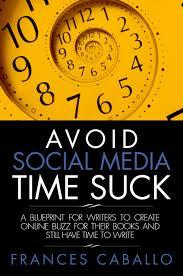
Recently I finished reading Frances Caballo's excellent book Avoid the Social Media Time Suck . As I read the book, I marked several sections that stood out to me. As I finished the last page, I went to my computer and wrote a few words about the book and I posted it on Amazon and Goodreads. Here's what I wrote:
Every Writer or Would-Be Writer Needs this Book
Social media can be a huge time suck and consume your day so you never manage to accomplish what you wanted to do. Most writers want to write and despise talking about their books or their writing on social media. To be honest, get over it.
With thousands of new books entering the market every day (yes, thousands), every writer needs to learn to use social media to their advantage—i.e. do it effectively and not consume hours of time. In this short book, social media expert (a term I don’t use lightly) Frances Caballo gives writers an effective, practical strategy to build their presence online yet still have time to write.
Like it or not, literary agents, editors and publishers are looking at your social media presence then making decisions about whether you can reach your target market or not. Often they have high numbers and criteria for the books that they publish. You can easily drown jumping into the social media sites on your own. This book includes detailed tools (many of them free) to help you succeed and yet not consume your day.
As Caballo writes at the end of the second chapter, “Social media needn’t force you to spend hours at your computer every day, sucking the hours out of your day when you have other pressing needs, responsibilities, and desires. By spending fifteen minutes every morning curating and scheduling and allocating fifteen minutes every evening for socializing online, you too will benefit from the power of social media in today’s world and find readers who will be happy to find you and read your books.” (Page 26)
I highly recommend this book to read, study and apply to your daily life.
----
It did not take a great deal of time and thought to write these few words of honest review. After posting the review on Amazon and Goodreads, I took additional action. I used my various social media channels (Twitter, Facebook and LinkedIn) to tell others about my review. It is one of the ways that I support the authors and the books that I read.
 These simple actions are something every reader can do to help others and spread the message about their books. With the huge volume of books published every day (according to Penny Sanseveri, over 4,500 new books are published every day), with a small action of writing a few sentences of honest review, each of us can highlight good books.
Notice an honest review is not copying or using the words from the back cover of the book. Recently a "reviewer" contacted Morgan James Publishing and requested review copies of books. They were sent and I asked him in return to send us his "published" (loose term) reviews. When we read these "reviews" they were exact words from the back cover of the book. Yes, there was some minor value to get these words out but they were not reviews. This "reviewer" is not going to be sent additional review copies (free books from the publisher to media and book reviewers).
Over the years, I've written more than 500 customer reviews on Amazon. It is a practice I continue today. As you help others, you are building goodwill in the community. When you publish a new book, you will find that these people will support you with reviews.
If you want to know more about this process of writing and how to get book reviews. I recommend this free teleseminar with Dana Lynn Smith: http://YourBookReviewed.com.
Are you writing reviews when you finish a book? Are you telling others about the reviews? It is key to take consistent action.


Recently I finished reading Frances Caballo's excellent book Avoid the Social Media Time Suck . As I read the book, I marked several sections that stood out to me. As I finished the last page, I went to my computer and wrote a few words about the book and I posted it on Amazon and Goodreads. Here's what I wrote:
Every Writer or Would-Be Writer Needs this Book
Social media can be a huge time suck and consume your day so you never manage to accomplish what you wanted to do. Most writers want to write and despise talking about their books or their writing on social media. To be honest, get over it.
With thousands of new books entering the market every day (yes, thousands), every writer needs to learn to use social media to their advantage—i.e. do it effectively and not consume hours of time. In this short book, social media expert (a term I don’t use lightly) Frances Caballo gives writers an effective, practical strategy to build their presence online yet still have time to write.
Like it or not, literary agents, editors and publishers are looking at your social media presence then making decisions about whether you can reach your target market or not. Often they have high numbers and criteria for the books that they publish. You can easily drown jumping into the social media sites on your own. This book includes detailed tools (many of them free) to help you succeed and yet not consume your day.
As Caballo writes at the end of the second chapter, “Social media needn’t force you to spend hours at your computer every day, sucking the hours out of your day when you have other pressing needs, responsibilities, and desires. By spending fifteen minutes every morning curating and scheduling and allocating fifteen minutes every evening for socializing online, you too will benefit from the power of social media in today’s world and find readers who will be happy to find you and read your books.” (Page 26)
I highly recommend this book to read, study and apply to your daily life.
----
It did not take a great deal of time and thought to write these few words of honest review. After posting the review on Amazon and Goodreads, I took additional action. I used my various social media channels (Twitter, Facebook and LinkedIn) to tell others about my review. It is one of the ways that I support the authors and the books that I read.
These simple actions are something every reader can do to help others and spread the message about their books. With the huge volume of books published every day (according to Penny Sanseveri, over 4,500 new books are published every day), with a small action of writing a few sentences of honest review, each of us can highlight good books. Notice an honest review is not copying or using the words from the back cover of the book. Recently a "reviewer" contacted Morgan James Publishing and requested review copies of books. They were sent and I asked him in return to send us his "published" (loose term) reviews. When we read these "reviews" they were exact words from the back cover of the book. Yes, there was some minor value to get these words out but they were not reviews. This "reviewer" is not going to be sent additional review copies (free books from the publisher to media and book reviewers).
Over the years, I've written more than 500 customer reviews on Amazon. It is a practice I continue today. As you help others, you are building goodwill in the community. When you publish a new book, you will find that these people will support you with reviews.
If you want to know more about this process of writing and how to get book reviews. I recommend this free teleseminar with Dana Lynn Smith: http://YourBookReviewed.com.
Are you writing reviews when you finish a book? Are you telling others about the reviews? It is key to take consistent action.


June 10, 2015
Listen to This Podcast to Grow Your Writing Life
John Vonhof interviewed me for his podcast Writers On Fire. We were scheduled to go about 45 minutes but actually went almost an hour and a half. John edited the podcast down to a rich 63 minutes. You can listen to it on his site (click the link). On the site you can listen to it there or download it to your computer.
While I haven't been blogging much lately because of my travel and other responsibilities, it is not far from my radar and intentions. I hope you will use the search tool in the far right column of this blog to look for topics and posts when you have writing questions. There are over 1200 entries in the Writing Life—loads of content.
Thank you in advance for listening to this podcast and I hope it helps you grow your own writing life.
March 10, 2015
Alton Gansky Interviews Terry Whalin about Billy Graham

Recently, my friend Alton Gansky interviewed me about my new biography on the life of Billy Graham. I hope you enjoy this short interview. If you can't see the embedded information below, then use this link, which will open a new window in your browser.
Al and I speak together about the remarkable life of Billy Graham. I tell stories about working for Mr. Graham as Associate Editor of Decision magazine and also about what I learned working on this easy-to-read biography, Billy Graham, A Biography of America's Greatest Evangelist .
March 9, 2015
When Opportunity Knocks, Do You Take Action?
Some people wonder how I've been published in many different magazines
and written a number of books. Yes some of it boils down to having a basic writing
talent. Some of it involves learning the craft of pitching and writing
queries then building relationships with different editors and literary agents. Yet
another factor is critical.
I do not believe that I'm the best storyteller or the best writer in the
room. I continually work at being a better storyteller and writer. I do have a
critical trait necessary to succeed in the publishing world: persistence and
perseverance. If an editor or agent says to me, “That sounds like a good idea.
Write that up and send it to me.”
I slip away for a minute and write down the idea, then I create a plan when I
get home to write the work and send it off to the editor or agent in a timely
manner. If you wait months or years, the editor or agent may have forgotten
the conversation. On the other hand, if you follow through, you will stand apart
as one of the few people to do so.
Some writers get worried and scared about the competition and the massive
volume of submissions in the marketplace for few spots. Yes the volume is
certainly there—as I can validate from the volume of submissions I receive as an
acquisitions editor. Yet there are ways to stand apart from
the other submissions.
1. Craft an excellent article or proposal or manuscript
2. Seize the opportunity and if someone asks for it, submit your material.
When I became an editor, I was surprised at the few people who followed
through on the opportunity and submitted their material. Now that submission has
to be appropriate for the magazine or book publisher or literary agent. But if it
is, then it will be read an considered—because the writer actually took action
when the opportunity was there.
Let's pause for a second and consider your exchanges or interaction with
editors or literary agents. Have you been encouraged to send your material? Have
you followed through and taken action? If not, do it today and you will
distinguish yourself from others at a particular event or conference.
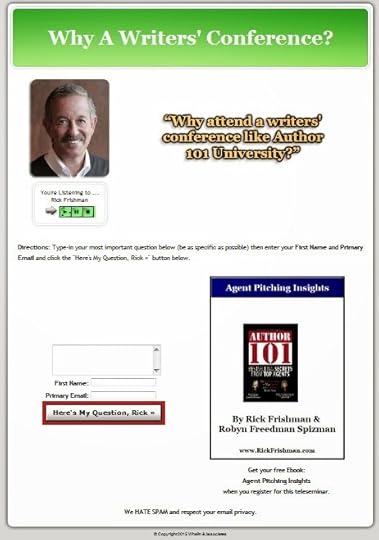
I want to conclude with a new opportunity for you. Wednesday evening, March
11th (in a couple of days), I'm going to be interviewing Rick Frishman, the publisher
at Morgan
James and the driving force behind Author 101 University.
For many years, Rick ran one of the largest public relations firms in the United
States, Planned Television Arts (now called Media Connect). He is
intimately familiar with the process of building buzz about an author and book
in the marketplace.
Author 101
University is not a Morgan James event. Rick brings in publishers, literary agents
and many publishing professionals. It is held twice a year and I know from
attending there are numerous people at this event that you will not be able to
reach and speak with—unless you attend Author 101 University.
The training is unique and excellent.
Here's your opportunity—if you take it: Wednesday I'm interviewing Rick and asking your questions
around the topic, “Why attend a writer's conference?” During our LIVE event,
Rick will be giving away several free registrations to Author 101 University
next month in Los Angeles. To win one of these opportunities, you have to be
on the LIVE call
and be able to attend the event next month. I understand that winning a
free registration, it will still involve some expense to attend the event. Go to
www.writersconf101.com
and register for the LIVE event.
I encourage you to take action when you receive an opportunity. It gives you
the best chance for achieving your publishing dreams.
and written a number of books. Yes some of it boils down to having a basic writing
talent. Some of it involves learning the craft of pitching and writing
queries then building relationships with different editors and literary agents. Yet
another factor is critical.
I do not believe that I'm the best storyteller or the best writer in the
room. I continually work at being a better storyteller and writer. I do have a
critical trait necessary to succeed in the publishing world: persistence and
perseverance. If an editor or agent says to me, “That sounds like a good idea.
Write that up and send it to me.”

I slip away for a minute and write down the idea, then I create a plan when I
get home to write the work and send it off to the editor or agent in a timely
manner. If you wait months or years, the editor or agent may have forgotten
the conversation. On the other hand, if you follow through, you will stand apart
as one of the few people to do so.
Some writers get worried and scared about the competition and the massive
volume of submissions in the marketplace for few spots. Yes the volume is
certainly there—as I can validate from the volume of submissions I receive as an
acquisitions editor. Yet there are ways to stand apart from
the other submissions.
1. Craft an excellent article or proposal or manuscript
2. Seize the opportunity and if someone asks for it, submit your material.
When I became an editor, I was surprised at the few people who followed
through on the opportunity and submitted their material. Now that submission has
to be appropriate for the magazine or book publisher or literary agent. But if it
is, then it will be read an considered—because the writer actually took action
when the opportunity was there.
Let's pause for a second and consider your exchanges or interaction with
editors or literary agents. Have you been encouraged to send your material? Have
you followed through and taken action? If not, do it today and you will
distinguish yourself from others at a particular event or conference.
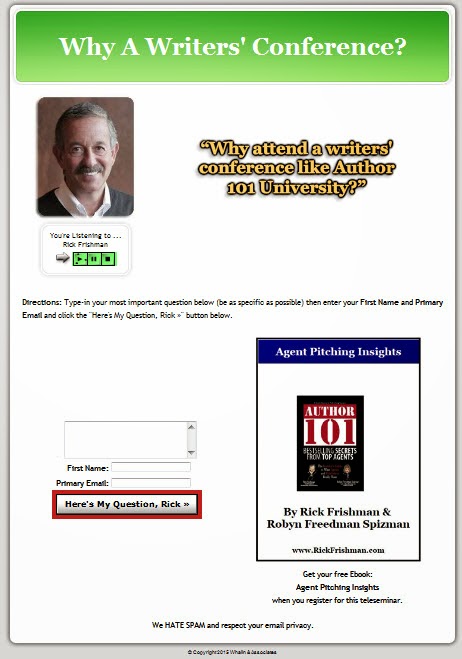
I want to conclude with a new opportunity for you. Wednesday evening, March
11th (in a couple of days), I'm going to be interviewing Rick Frishman, the publisher
at Morgan
James and the driving force behind Author 101 University.
For many years, Rick ran one of the largest public relations firms in the United
States, Planned Television Arts (now called Media Connect). He is
intimately familiar with the process of building buzz about an author and book
in the marketplace.
Author 101
University is not a Morgan James event. Rick brings in publishers, literary agents
and many publishing professionals. It is held twice a year and I know from
attending there are numerous people at this event that you will not be able to
reach and speak with—unless you attend Author 101 University.
The training is unique and excellent.
Here's your opportunity—if you take it: Wednesday I'm interviewing Rick and asking your questions
around the topic, “Why attend a writer's conference?” During our LIVE event,
Rick will be giving away several free registrations to Author 101 University
next month in Los Angeles. To win one of these opportunities, you have to be
on the LIVE call
and be able to attend the event next month. I understand that winning a
free registration, it will still involve some expense to attend the event. Go to
www.writersconf101.com
and register for the LIVE event.
I encourage you to take action when you receive an opportunity. It gives you
the best chance for achieving your publishing dreams.
February 25, 2015
An Unbelievable Price but You Must Act Quick

One of the life-changing events for me was Mega Book Marketing University in
2007, I wrote about it in this post. Now Mega Book Marketing University is called
Author 101 University and held twice a year in Los Angeles. The next one will be
April 9, 10 and 11th.
I’ll be on the stage in a panel with some of the world's leading marketing
and publishing experts at Author 101 University in Los Angeles. This is a POWERFUL event
– and SUPER AFFORDABLE –and you can bring an additional guest at NO cost).
Just go to http://author101-university.com/
(And be sure to use the code TERRY when you check out.) If you register before
March 1st, you can attend this conference at 50% off the normal conference
rate—but you must take action this week.
At this event, writers learn how to become bestselling authors, highly paid
speakers and coaches and respected authorities. AND you can meet & pitch
literary agents and publishers. The entire conference is focused on different
strategies to market and sell books.
-- Connect with literary agents who want to represent you
-- Get your new book published or your old book revitalized
-- Discover how to make your book a bestseller
-- Design the an impact-driven business that's right for you
-- Learn how to turn your online promotions into huge exposure (and
sales)
-- Transform your message into a mega success business
-- Meet and network with amazing people
-- And so much more...
I hope to see you there. The last Author 101 University sold out weeks before the event so
enroll now and BRING A FRIEND at NO cost. Go to Author 101 University
and remember to use the coupon code TERRY when you check out and register before
March 1st and you will get the conference at half off the normal price.
February 24, 2015
The Importance of Follow-up
There are a number of important skills for every writer such as storytelling
ability, consistency of touching the market and writing craft. Each of these
skills take time and practice to develop. As writers, we are in the
communication business.
Ironically much of the publishing world—particularly in book publishing—is
poor at communication. You send in your submission to an editor or agent and you
hear….wait for it….nothing…for months…maybe ever.

As an
acquisitions editor involved in publishing every day, it's part of my
intention to change this situation. I can't change the industry but I can change
the people and writers that I'm communicating with and touching. Yet I admit it
is hard because of the high volume of material that comes to me every day—agents
representing their authors and authors who are looking to get published. I spend
a great deal of time every day answering my email and on the phone with
authors.
Here's something that you can do to help this communication challenge in the
publishing communicate: develop your ability to follow-up yet in a way that
gently prods the editor and agent but does not offend them or turn them off from
your submission. You need to add the skill of proper follow-up to your
communication tools. Why?
According to some publishing experts, there are over a million
unpublished manuscripts, proposals and ideas on the desks of editors and agents.
Yes that is a large overwhelming volume. From reading submissions for many
years, I would expect to discount about 50% of that number because they can
instantly be rejected as inappropriate. If you do your research and send the
editor or agent something that is in the range that they want, you will put your
submission in the category of something that merits their reading or at least
considering. How can you break through and get their attention? It is critical
that you prepare an
excellent book proposal or manuscript. It takes time and energy to prepare a
detailed submission but it is well worth the effort from my years in publishing.
You can learn more at this free teleseminar which is on replay (immediate access to
listen to it).
I know at Morgan James
Publishing, where I work as an
acquisitions editor, we receive over 5,000 submissions a year and
only publish about 150 books. We are considered a medium size New York publisher
and less than 3% of our submissions are contracted.
Even with those high numbers, I spend the bulk of my days on the phone and
email with authors talking with them about their submissions and seeing if that
submission is a good fit for Morgan James. To be honest, some are a great fit
and others are not. The reading and communication process is critical to finding
the right type of authors. Yes, it takes time and effort.

Besides processing the material that comes into the publishing house, I'm
actively looking for new material. About a week ago, I was at the San Francisco Writers
Conference which was a large event with over 400 people. I spent my time at
the conference talking with prospective authors and teaching a couple of
workshops and participating on several panels. Throughout out the event, I
exchanged business cards with a number of authors and my faculty members. This
exchange of information is the first step in the process of forming a
relationship.
I spent several hours this weekend, writing emails to the people I met and
encouraging them to send a submission (when they are ready of course). My
pro-active follow-up with these writers showed them that I cared and really do
want to see their work. This follow-up step is important and will encourage them
to include me with their submissions. Each of us in the publishing community are
constantly searching for good books to publish and the follow-up work is a key
part of this process.
With the many submissions, I never get completely caught up on processing
them and it's always appropriate to send a little email to see if I received it
or when I will be available to take the next step in the process. A gentle and
non-offensive reminder via email is something that I respect and appreciate from
these pro-active authors.
Besides my role as an acquisitions editor, I'm also spending some of my time to
promote and market my own books like my biography of Billy
Graham and my Jumpstart Your Publishing Dreams . The effort
to promote books takes time—yet is an important responsibility for every author
whether you have a full-time job or not.
For example, this weekend I did an interview about Billy Graham and this
coming week I have two more radio interviews scheduled. I'm also working on
getting more book
reviews and other aspects of publicity. The number of new books that are
being produced is sometimes staggering. My marketing friend, Penny C.
Sansevieri was also speaking at the San Francisco Conference. She said there are 4,500 new
books a day. I asked where she came up with this number and she said several
places including a conversation with Bowker (the company which produces Books In
Print and issues International Standard Book Numbers (ISBN). I have several
more follow-up emails to send people who have received review copies of Billy Graham books yet
never added their review to Amazon or Goodreads or Barnes & Noble. While it takes time to send those gentle
follow-up reminders, it stirs people to action. I've seen many people never
follow-up and then they wonder why nothing happens.
While email is a great way to follow-up, often one of the most inappropriate
ways is on the phone to an editor or agent. It is different if the editor or agent has set up an
appointment with you or you have a project in process. I'm talking about the
authors who have a book to pitch and are trying to learn the process. Most
recently a young author and his girlfriend who continually called me to see if I
had read their submission. It turns out their submission was half-baked, poorly
written and inappropriate for my publisher. These young authors made a poor
impression and completely wasted time (theirs and mine). I didn't tell them this
information on the phone but they were making a radical bad impression with the
phone calls.
Take a minute and think about what you want to accomplish with your writing.
Do you need to send a gentle reminder to some editor or reviewer or agent? Get it on your
plans for today then get it done. Then watch the difference it will make in your
writing life.
ability, consistency of touching the market and writing craft. Each of these
skills take time and practice to develop. As writers, we are in the
communication business.
Ironically much of the publishing world—particularly in book publishing—is
poor at communication. You send in your submission to an editor or agent and you
hear….wait for it….nothing…for months…maybe ever.

As an
acquisitions editor involved in publishing every day, it's part of my
intention to change this situation. I can't change the industry but I can change
the people and writers that I'm communicating with and touching. Yet I admit it
is hard because of the high volume of material that comes to me every day—agents
representing their authors and authors who are looking to get published. I spend
a great deal of time every day answering my email and on the phone with
authors.
Here's something that you can do to help this communication challenge in the
publishing communicate: develop your ability to follow-up yet in a way that
gently prods the editor and agent but does not offend them or turn them off from
your submission. You need to add the skill of proper follow-up to your
communication tools. Why?
According to some publishing experts, there are over a million
unpublished manuscripts, proposals and ideas on the desks of editors and agents.
Yes that is a large overwhelming volume. From reading submissions for many
years, I would expect to discount about 50% of that number because they can
instantly be rejected as inappropriate. If you do your research and send the
editor or agent something that is in the range that they want, you will put your
submission in the category of something that merits their reading or at least
considering. How can you break through and get their attention? It is critical
that you prepare an
excellent book proposal or manuscript. It takes time and energy to prepare a
detailed submission but it is well worth the effort from my years in publishing.
You can learn more at this free teleseminar which is on replay (immediate access to
listen to it).
I know at Morgan James
Publishing, where I work as an
acquisitions editor, we receive over 5,000 submissions a year and
only publish about 150 books. We are considered a medium size New York publisher
and less than 3% of our submissions are contracted.
Even with those high numbers, I spend the bulk of my days on the phone and
email with authors talking with them about their submissions and seeing if that
submission is a good fit for Morgan James. To be honest, some are a great fit
and others are not. The reading and communication process is critical to finding
the right type of authors. Yes, it takes time and effort.

Besides processing the material that comes into the publishing house, I'm
actively looking for new material. About a week ago, I was at the San Francisco Writers
Conference which was a large event with over 400 people. I spent my time at
the conference talking with prospective authors and teaching a couple of
workshops and participating on several panels. Throughout out the event, I
exchanged business cards with a number of authors and my faculty members. This
exchange of information is the first step in the process of forming a
relationship.
I spent several hours this weekend, writing emails to the people I met and
encouraging them to send a submission (when they are ready of course). My
pro-active follow-up with these writers showed them that I cared and really do
want to see their work. This follow-up step is important and will encourage them
to include me with their submissions. Each of us in the publishing community are
constantly searching for good books to publish and the follow-up work is a key
part of this process.
With the many submissions, I never get completely caught up on processing
them and it's always appropriate to send a little email to see if I received it
or when I will be available to take the next step in the process. A gentle and
non-offensive reminder via email is something that I respect and appreciate from
these pro-active authors.
Besides my role as an acquisitions editor, I'm also spending some of my time to
promote and market my own books like my biography of Billy
Graham and my Jumpstart Your Publishing Dreams . The effort
to promote books takes time—yet is an important responsibility for every author
whether you have a full-time job or not.
For example, this weekend I did an interview about Billy Graham and this
coming week I have two more radio interviews scheduled. I'm also working on
getting more book
reviews and other aspects of publicity. The number of new books that are
being produced is sometimes staggering. My marketing friend, Penny C.
Sansevieri was also speaking at the San Francisco Conference. She said there are 4,500 new
books a day. I asked where she came up with this number and she said several
places including a conversation with Bowker (the company which produces Books In
Print and issues International Standard Book Numbers (ISBN). I have several
more follow-up emails to send people who have received review copies of Billy Graham books yet
never added their review to Amazon or Goodreads or Barnes & Noble. While it takes time to send those gentle
follow-up reminders, it stirs people to action. I've seen many people never
follow-up and then they wonder why nothing happens.
While email is a great way to follow-up, often one of the most inappropriate
ways is on the phone to an editor or agent. It is different if the editor or agent has set up an
appointment with you or you have a project in process. I'm talking about the
authors who have a book to pitch and are trying to learn the process. Most
recently a young author and his girlfriend who continually called me to see if I
had read their submission. It turns out their submission was half-baked, poorly
written and inappropriate for my publisher. These young authors made a poor
impression and completely wasted time (theirs and mine). I didn't tell them this
information on the phone but they were making a radical bad impression with the
phone calls.
Take a minute and think about what you want to accomplish with your writing.
Do you need to send a gentle reminder to some editor or reviewer or agent? Get it on your
plans for today then get it done. Then watch the difference it will make in your
writing life.
January 27, 2015
Grow Your Twitter Followers in Less Than 5 Minutes A Day
Several months ago, I saw New York Times bestselling author of Twitter Power, Joel Comm and told him that I had
over 100,000 followers. He told me, “You have twitter power.”

If you check my
twitter following, I recently went over 136,000 followers. For the last
several months, they have been growing at about 100 new followers each
day. I'll admit some of this growth is organic and not the result from
anything that I'm actively doing. But a good portion of my daily growth comes
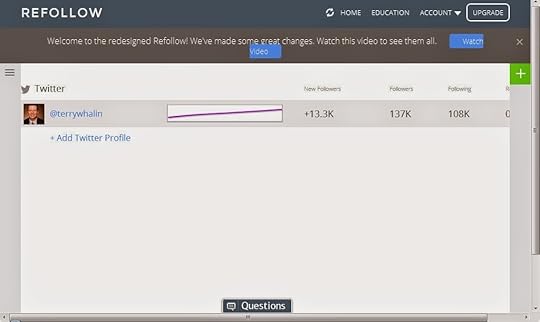
from my active involvement and use of a tool called Refollow. I use the pro
version which is $20 a month but it is well-worth it from my perspective. In
less than five minutes a day, I'm able to follow 800 new people.
One of the keys to effective use of social media from my perspective is to
not allow it to suck large amounts of your time. For months, I've been using Refollow and whether I'm on
the road or at home, using it does not take more than five minutes. In
fact, often I spend less than five minutes.
Here's the home page:
One of the basic principles of twitter is that you follow others and a
certain percentage of those people follow you back. I follow the followers of
leaders in the publishing and writing community. Here's how my numbers have been
increasing:
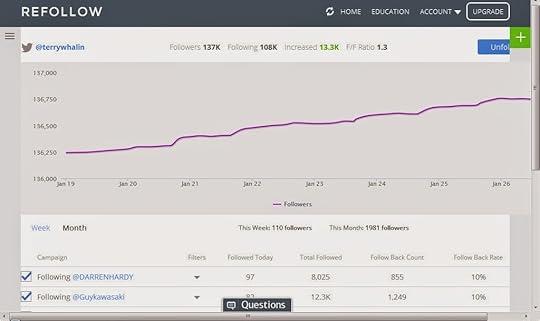
Here's the publishing people that I follow their followers:
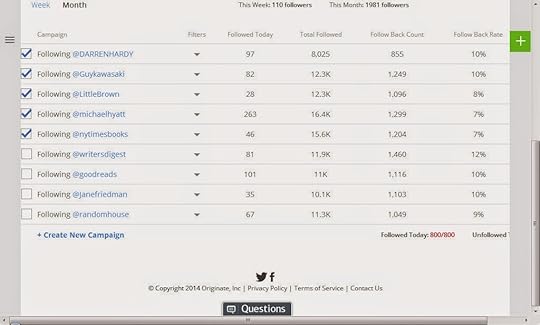
Besides using Refollow, each day I use Hootsuite to regularly send out tweets to my followers. I make
sure I'm sending different articles and educational information about
publishing. I use the free version of Hootsuite and it does not take much time to load up this tool
so it will add tweets every hour throughout the day.
Finally every few days I use the free version of Manage Flitter. It allows me
to find the spam followers, the followers who do not speak English and also to
quickly unfollow people who have not followed me back. It can take a while to
load all of my followers and tweets for analysis but I simply open a tab and
allow it to work as I work on other things.
I have great things happen in my writing life because of being on twitter. I
regularly meet new writers and help them through my involvement on twitter. I'm
careful with my time so it does not consume my day. And it does not have
to consume your day. I wrote these details in this article so you can
follow my example and grow your own twitter following. If some detail is not
clear or you have questions, feel free to leave a comment below and I will
respond.
For every reader, I wish you great success on Twitter and that you too will
find Twitter Power.
over 100,000 followers. He told me, “You have twitter power.”

If you check my
twitter following, I recently went over 136,000 followers. For the last
several months, they have been growing at about 100 new followers each
day. I'll admit some of this growth is organic and not the result from
anything that I'm actively doing. But a good portion of my daily growth comes
from my active involvement and use of a tool called Refollow. I use the pro
version which is $20 a month but it is well-worth it from my perspective. In
less than five minutes a day, I'm able to follow 800 new people.
One of the keys to effective use of social media from my perspective is to
not allow it to suck large amounts of your time. For months, I've been using Refollow and whether I'm on
the road or at home, using it does not take more than five minutes. In
fact, often I spend less than five minutes.
Here's the home page:

One of the basic principles of twitter is that you follow others and a
certain percentage of those people follow you back. I follow the followers of
leaders in the publishing and writing community. Here's how my numbers have been
increasing:

Here's the publishing people that I follow their followers:
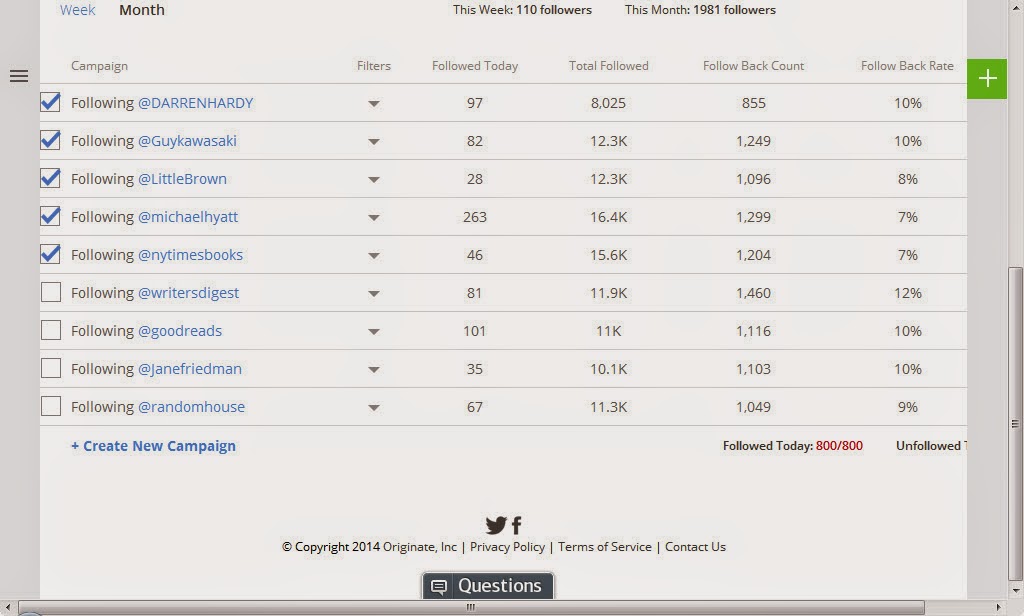
Besides using Refollow, each day I use Hootsuite to regularly send out tweets to my followers. I make
sure I'm sending different articles and educational information about
publishing. I use the free version of Hootsuite and it does not take much time to load up this tool
so it will add tweets every hour throughout the day.
Finally every few days I use the free version of Manage Flitter. It allows me
to find the spam followers, the followers who do not speak English and also to
quickly unfollow people who have not followed me back. It can take a while to
load all of my followers and tweets for analysis but I simply open a tab and
allow it to work as I work on other things.
I have great things happen in my writing life because of being on twitter. I
regularly meet new writers and help them through my involvement on twitter. I'm
careful with my time so it does not consume my day. And it does not have
to consume your day. I wrote these details in this article so you can
follow my example and grow your own twitter following. If some detail is not
clear or you have questions, feel free to leave a comment below and I will
respond.
For every reader, I wish you great success on Twitter and that you too will
find Twitter Power.
January 23, 2015
Effective Use of LinkedIn

For years I ignored the LinkedIn emails asking me if I wanted to “connect”
with someone. Yet there are 300
million people on LinkedIn and it is an effective tool—if you use it
properly.
I changed my resistance to active use of LinkedIn. While my public
profile says that I have 500+ connections, it is really over 4,000
connections. It is one of three or four social networks that I use
constantly. For example, I regularly post updates and publishing information on
LinkedIn. I use Hootsuite
(an effective free tool) for these posts and they appear throughout each day
with articles that I'm reading and other comments related to publishing.
Here's an example of a profile that I did not accept their invitation--in fact I marked it as spam so they will not be able to invite me again:
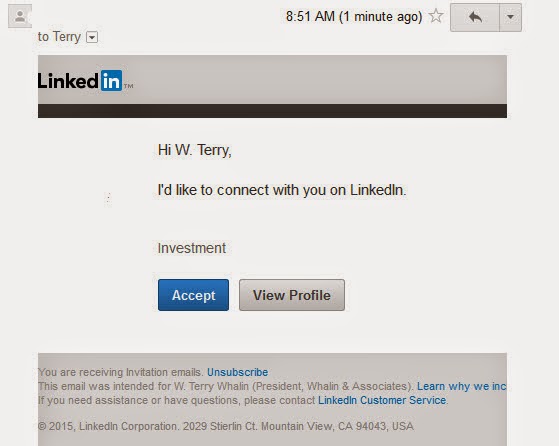
To make effective use of LinkedIn, your first priority is to fill out your
profile. I see some people who don't have their photo or location or background
with their profile. Unless I recognize your name, I'm probably not going to
connect with your LinkedIn profile. It does take a bit of effort but is well
worth it.
The second step is to connect with people that you know—and
people who know you. We live in a mobile society where individuals change
positions. The publishing world is fluid and it's common for people to change
positions several times during their career. Here's one of the key details for
LinkedIn: many professionals and business people use this network. If they
change positions or move, they take their LinkedIn information with them.
They change their emails, phone number and address information in the contact
section of LinkedIn.
If you are trying to pitch a particular editor or literary agent and you are
connected to them through LinkedIn, you can quickly check to see if they are in
the same location by checking their profile—before you fire off your proposal or query and
learn they are no longer with the company or have changed positions.
LinkedIn has tools to help you expand your connections. Because of my large
number of connections, I receive several invitations a day to connect with
individuals. I do not want to be connected to spammers or individuals who I
don't immediately recognize. Each time I check their profile and:
—If blank or only starting their connections, often I do not connect with
them.
—If they are outside of the U.S. and I see no immediate relationship, then I
do not connect with them. Sometimes I mark the person as spam and if so,
LinkedIn will not allow them to send me another invitation.
—If I see they have connections with other publishing people that I know,
like and trust, then I will often connect with those individuals.
Notice several things about how I used LinkedIn:
1. I do not spend much time on the site.
2. My profile is completely filled out—and LinkedIn lists me as an
“all-star” with my information which has a great deal of detail.
3. I'm cautious and thoughtful about the people that I do connect with on the
site.
There are many other ways to use LinkedIn. There are groups and other tools
on the site. I have not chosen to get involved in these aspects because my time
is focused mostly on being an acquisitions
editor at Morgan James Publishing and helping other authors get their
books into print.
If I receive an invitation to connect with someone I do not recognize, some
times I will reply to that invitation. The email goes directly to their in box.
In my short email, I ask them to remind me of our connection or relationship.
Sometimes I hear that the person and I met at a
conference or has a connection with me. In those cases, I will accept their
Facebook and Twitter. In those
cases, it is often unlikely that I will connect with them for that reason. I
have thousands of friends on Facebook and Twitter. You need to give me a stronger connection for
LinkedIn.
There are probably many more effective ways to use LinkedIn. I suspect many
of those ways I'm not using involve large volumes of time (something I do not
have to spend on LinkedIn at the moment). As an additional resource, I encourage
you to grab this 35 page report on LinkedIn from my friend John
Kremer. Through this post, I hope I've given you some new ideas how you can
connect with others in your profession and increase your use of this site.
January 21, 2015
The Unexpected Discovery of My Book
Last weekend I was in Hershey, Pennsylvania at the Hershey Lodge for a conference called Writer to Writer. It was a terrific event which will be repeated in the fall and I met some new writers. Also I got to hang out with a couple of my long-term friends. Jerry B. Jenkins taught the fiction track and Cecil Murphey taught the nonfiction track of the conference. I had the opportunity to speak at a breakfast to the group and also to teach a couple of workshops.
After the conference was completed, the Hershey Lodge was hosting a regional Christian bookseller conference. On Sunday afternoon, I signed over 125 copies of my Billy Graham biography as a way to introduce the book to these retail stores. The experience was a terrific way to help retailers know about the book and its availability. Also it gave me a chance to tell them about the benefits and distinctions of my biography for their customers. My biography is an easy-to-read 172 pages and in a couple of evenings readers can gain an overview of Mr. Graham's life. I included a number of new stories and the book is completely up-to-date.
If you don't know, I worked for Mr. Graham about 20 years ago as the Associate Editor at Decision , the official publication of the Billy Graham Evangelistic Association. I gathered endorsements and a foreword from Luis Palau for my book. You can see these endorsements and a short book trailer on my website. You can order it different ways from my website—even get an autographed copy if you want.

Depending on the time of year, traveling can be challenging. It's exactly what I found on Monday when I traveled home. I was on the early flight from Harrisburg to Philadelphia. I had an hour and a half to change planes but my flight was delayed for over an hour. Supposedly it was because of weather—some other place than Harrisburg where the sun was shining with a blue sky. I missed my connection from Philadelphia to Denver and the next flight was about 6:30 p.m. Yes, I was stuck all day in the Philadelphia airport.
Since I had a lot of time on my hands, I wandered into Heritage Books. As I looked around, I discovered copies of my Billy Graham biography:
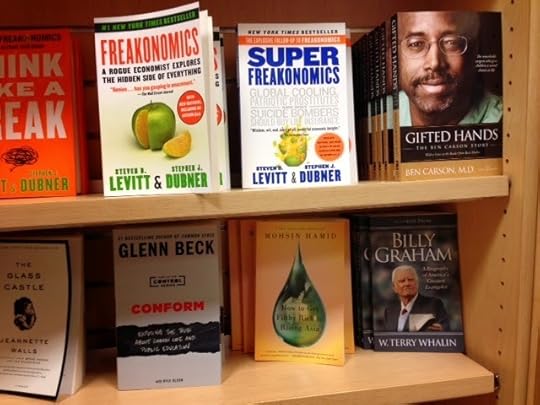
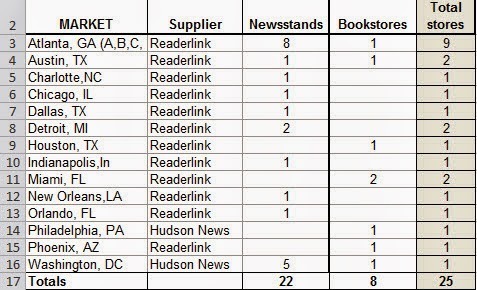
I asked the shopkeeper if I could sign my books. She called her manager to check and the manager said, “Yes.” I pulled out my pen and autographed all of the copies. Throughout November, December and January, my book has been in 25 different airports besides other bookstores across the country. Here's the list:
Travel delays are a nuisance but I made an unexpected discovery of my book in the Philadelphia airport. Fun.
After the conference was completed, the Hershey Lodge was hosting a regional Christian bookseller conference. On Sunday afternoon, I signed over 125 copies of my Billy Graham biography as a way to introduce the book to these retail stores. The experience was a terrific way to help retailers know about the book and its availability. Also it gave me a chance to tell them about the benefits and distinctions of my biography for their customers. My biography is an easy-to-read 172 pages and in a couple of evenings readers can gain an overview of Mr. Graham's life. I included a number of new stories and the book is completely up-to-date.
If you don't know, I worked for Mr. Graham about 20 years ago as the Associate Editor at Decision , the official publication of the Billy Graham Evangelistic Association. I gathered endorsements and a foreword from Luis Palau for my book. You can see these endorsements and a short book trailer on my website. You can order it different ways from my website—even get an autographed copy if you want.
Depending on the time of year, traveling can be challenging. It's exactly what I found on Monday when I traveled home. I was on the early flight from Harrisburg to Philadelphia. I had an hour and a half to change planes but my flight was delayed for over an hour. Supposedly it was because of weather—some other place than Harrisburg where the sun was shining with a blue sky. I missed my connection from Philadelphia to Denver and the next flight was about 6:30 p.m. Yes, I was stuck all day in the Philadelphia airport.
Since I had a lot of time on my hands, I wandered into Heritage Books. As I looked around, I discovered copies of my Billy Graham biography:

I asked the shopkeeper if I could sign my books. She called her manager to check and the manager said, “Yes.” I pulled out my pen and autographed all of the copies. Throughout November, December and January, my book has been in 25 different airports besides other bookstores across the country. Here's the list:

Travel delays are a nuisance but I made an unexpected discovery of my book in the Philadelphia airport. Fun.
January 14, 2015
Are you Pursuing the Different or the Same?
January is a wonderful time of the year. We've turned the page on a new year and we can take a fresh start at our writing and work in publishing. Repeatedly I have read the definition of insanity—doing the same thing over and over expecting a different result. Yes, that is insanity.
What is your specific goal or dream for the days ahead? Is it to build your platform or connection to the audience? Maybe you want to have an opportunity to write for different magazines or book publishers? Possibly you want to increase your writing income or your impact on the world.
The pursuit of a different path begins with formulating a new plan and target for your writing. Recently, I was watching Sunday Morning on CBS and heard the unlikely story behind “Diary of a Wimpy Kid.”
There are several lessons for writers from this short video:
1. Jeff Kinney wanted to be a cartoonist and pursued his dream for years. While he was pursuing his dream, he worked in a related field (animation for games). In the evenings, he worked on his adult book about the Wimpy Kid Diary--which grew to 1300 pages. Also notice his persistence to work on this adult book for eight years.
2. He was actively looking for a publisher and took a sample of his writing to a Comic Book Convention and had the courage to speak to an editor at Abrams.
3. Kinney listened when the editor took a look at his sample and said he had a great book for kids (a different target audience). Abrams ended up publishing the first Diary of A Wimpy Kid book for early readers. Now Kinney has over 150 million copies of those books in print.
Are you continuing with the same actions and expecting different results (insanity) or are you trying different types of writing and actions to achieve something different? If you want to sell more of your writing this year, then I encourage you to try something different. If you want to sell more books, then you need to touch your audience more frequently. We buy from people we know, like and trust. What steps are you taking to build that exposure in the marketplace?
Be encouraged to take action--yet different action from what you did without results.
What is your specific goal or dream for the days ahead? Is it to build your platform or connection to the audience? Maybe you want to have an opportunity to write for different magazines or book publishers? Possibly you want to increase your writing income or your impact on the world.
The pursuit of a different path begins with formulating a new plan and target for your writing. Recently, I was watching Sunday Morning on CBS and heard the unlikely story behind “Diary of a Wimpy Kid.”
There are several lessons for writers from this short video:
1. Jeff Kinney wanted to be a cartoonist and pursued his dream for years. While he was pursuing his dream, he worked in a related field (animation for games). In the evenings, he worked on his adult book about the Wimpy Kid Diary--which grew to 1300 pages. Also notice his persistence to work on this adult book for eight years.
2. He was actively looking for a publisher and took a sample of his writing to a Comic Book Convention and had the courage to speak to an editor at Abrams.
3. Kinney listened when the editor took a look at his sample and said he had a great book for kids (a different target audience). Abrams ended up publishing the first Diary of A Wimpy Kid book for early readers. Now Kinney has over 150 million copies of those books in print.
Are you continuing with the same actions and expecting different results (insanity) or are you trying different types of writing and actions to achieve something different? If you want to sell more of your writing this year, then I encourage you to try something different. If you want to sell more books, then you need to touch your audience more frequently. We buy from people we know, like and trust. What steps are you taking to build that exposure in the marketplace?
Be encouraged to take action--yet different action from what you did without results.


