Teer Hardy's Blog, page 7
June 6, 2021
Family Ties
As we begin to emerge from the COVID-19 pandemic, as I am sure many of you are, I have begun to make a list of the places I want to go, activities I want to do, and people I want to see. As vaccination rates increase, positivity rates decrease, and restrictions lessened my “bubble” has grown but there are still people I have not seen or seen enough. For the most part, these people are family members who live out of town; further away than a quick day trip.
It was a little over a month ago that I hugged my maternal grandmother for the first time in over a year. This time last year I dropped flowers off on a doorstep for her birthday and just last night we had dinner together. The Washington Post has an online, interactive article showcasing reunions as families and friends are vaccinated and are, finally, able to safely begin their return to sharing life in-person and not over a screen or cellphone connection. Like Wendy Elliot and her three friends who pre-COVID play mah-jongg - a 300-year-old tile-based game that demands skill and luck. The four friends played weekly before stay-at-home orders but were able to play online, serving as what Elliot described as “a literal lifeline,” creating an “oasis of normalcy in this year where so much of her life” was in chaos.[1] And still, as so many of us plan to reunite with family and friends who are practically family many knew the sting of separation long before the pandemic began and Dr. Fauci was a household name.
Jesus had returned home from his Capernaum campaign. He taught in the synagogues “as one who had authority, not as teachers of the Law”[2] and healed a man with unclean spirits on the Sabbath. He healed Simon’s mother-in-law who had been bedridden with a fever. Then, people throughout Galilee brought the sick and demon-possessed to him and Jesus, he healed these people and drove the demons away. And then, as if he needed to do more, he healed a man plagued with leprosy, making him clean, not just physically but ritually as well, thus making him no longer an outsider within his community.
All of the people Jesus healed, in one way or another, were separated from their communities, their families by their afflictions, and through his touch or word, he offered them the which no one else could. He healed the sick and released the captive and we today pickup with Jesus and his disciples and a growing crowd. A crowd so large that Jesus and his disciples were unable to eat. The Capernaum campaign was so alarming that the social ordering of the time - the maintaining of files, status, and peace - that revolved around families, the Temple or religious obligations, and pax Roma was threatened, and thus two of the three groups became concerned. The religious leaders, scribes from Jerusalem, believed Jesus’ actions would undercut their authority and social standing.
Jesus’ family attempted to take charge of him, “thinking he was out of his mind.” They thought he had flown the nest. While he had been engaged in his Father’s business in Capernaum it was not the family business. During this time your immediate and extended family -a double-whammy - determined one’s personality, one’s identity, and controlled vocational prospects, and facilitated socialization. In his Capernaum campaign, Jesus took the first-century how-to adult handbook and threw it out the window. In one out-of-town trip with his buddies, Jesus overturned one of the backbones of social order. Doing so left his family, the entire family thinking he must have been “out of his mind.”
Kinship today falls along lines not dissimilar to the first century. While we today may not be dependent upon family for a vocational identity or socialization, that does not mean our identities are unaffected by our families. It does not mean that not towing the family line can’t get you on the “you’ve got to be out of your mind” kind of family meeting.

While many are once again gathering with family, embracing a parent or grandparent after a year apart because of a pandemic - something out of our control, not of our own doing - many will continue the pains of separation that began before we hoarded toilet paper or finally watched everything in our Netflix cue. For every Wendy Elliot gathering with friends that might as well be family or grandmother hugging a grandchild for the first time, some people will continue to eat alone or not feel the embrace of a family because they do not fit into the societal or religious norms - something out of their control, not of their own doing - because they are a member of the LGBTQ+ community.
After Jesus had been confronted by his family and the blasphemous scribes he told those who had gathered before his family or the scribes arrived that they were his mother and brothers. He said that “whoever does God’s will is (his) brother and sister and mother.” Jesus created a new kinship model based on obedience to God - not family, clan, or patriarchy.
At his baptism, the heavens opened and the Holy Spirit once again descended, filling Jesus, enabling him, equipping him for the mission before him. At that moment a voice echoed from the heavens, “You are my Son, whom I love; with you, I am well pleased.”[3] Since his baptism kinship, power, and authority looked different.
Throughout his ministry, beginning in Capernaum, continuing to the cross when he told a disciple and his mother, “Here is your mother. Woman here is your son,”[4] Jesus created a new family, and frankly, it looked and continues to look different than many expect.
Those that were once out are now in.Those unable to be healed are now whole.Those relegated to the outskirts of the community are welcomed home with open arms, with a banquet fit only for a prodigal returning home.This new family includes all of the people who look, think, and act like to us, and all of the people who do not look, think or act like us. This new family includes every person excluded for whatever reason, especially those excluded because fear and bigotry were embraced more than the grace extended to us from God in Christ. This new family includes every person excluded by the church, where judgment is embraced more than love.
This is a family, we are a family-centered on the One who has promised us, assured us by his amazing grace, that all of creation will be made whole. A family held in the love of our Creator. A family empowered by wholly the Holy Spirit to engage in our own Capernaum campaign so that as we embrace one another exiting a year of separation everyone will know the love of their Creator, they would feel the amazing grace of Christ, and be filled themselves with the power of the Holy Spirit.
Subscribe
[1] https://www.washingtonpost.com/nation...
[2] Mark 1:22
[3] Mark 1:11
[4] John 19:26-27, Teer’s translation


June 1, 2021
Happy Pride, Y'all.

This signage project was completed for Mount Olivet United Methodist Church to celebrate pride around our city and let people know that God really likes, and loves, the LGBTQ+ community.
This image is free to use however you’d like. :)
Download ImageNeed the image in a different format? Let Ellen know.
Created with Ellen McDowell — founder of Hellena Creative Studio.
May 24, 2021
Poured Out for All
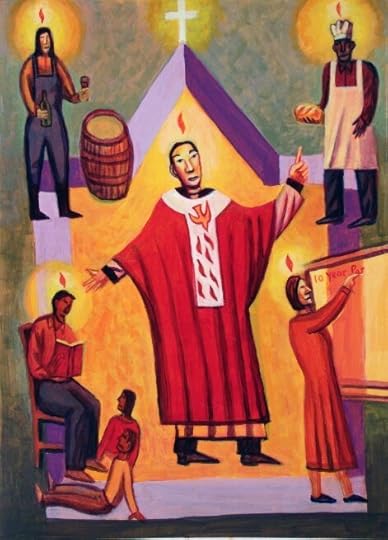
Over 2000 years ago the Holy Spirit appeared like a “violent wind,” as fire breaking across language barriers giving birth to the church. Or as my son explains it like a sprinkler in the front yard going crazy. And in the craziness of Pentecost, the church was born. The Church, Christ’s bride tasked with proclaiming the present reign of Jesus and also looking ahead to the day when Jesus’ kingdom will be fully realized.
What happened on Pentecost 2000 years ago left onlookers wondering just what in the world was going on. Was the gathered mass of people drunk at nine o’clock in the morning? How was what was happening, well happening? These are questions we still ask today as we reflect back, remembering the moment Christ’s Church took shape and Peter gave his first sermon.
Matthias had just been installed as an apostle, replacing Judas. While this was occurring, outside of the Upper Room window, pilgrims from all over the Jewish diaspora had converged upon Jerusalem for the Jewish Festival of Pentecost. This was a festival recalling, celebrating and remembering the first Passover, remembering when God gave the Law to Moses. “Jews from every nation were gathered,” from far and wide, in Jerusalem. From nations like Persia, Mesopotamia, and Cappadocia, along with nations I will allow someone else to pronounce.
This was a roll-call recorded by Luke. People of every tongue and tribe. All present, cutting across whatever divides had been present or would be present.
Then the Holy Spirit descended, causing a commotion the likes of which well-meaning church-folk might frown upon today. At once, everyone began to speak different languages, every known language across the Jewish diaspora, and they understood one another. The crowd started to gripe: Those Christians are doing the same thing they did when Jesus was with them— they’ve been drinking (which, if you’re counting at home, is the first and last time anyone ever accused Christians of being fun).[1]
In our 21st century reading of Pentecost it is not the diverse ethnic gathering of the nations that we miss but rather the historical diversity gathered. Tom Long, a teacher of preachers, points out that four of the nations mentioned by Luke would have had to do some serious time traveling - some Dr. Brown Back to the Future type stuff - to be present. You see, the Medes had been long extinct, for at least 200 years. Luke mentioned the Elamites but they had not been on the scene since the second chapter of Ezra. Pentecost was a gathering of people from the north, south, east, and west, and at the same time a gather of the living and the dead. A gathering of all people.
With all of the nations - past and present - what happened at Pentecost, the outpouring of the Holy Spirit, was for all people.
We were all there.
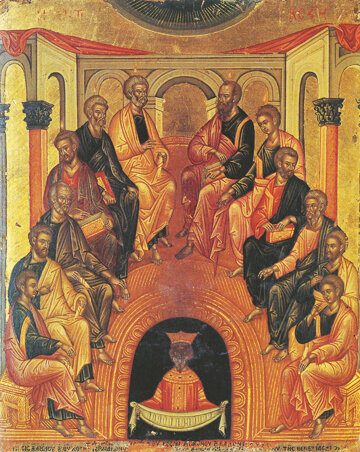
The gift of the Holy Spirit sent upon the church was a gift for those who spoke Hebrew, Cappadocian, and is a for us today who have never studied or heard of the ancient nations recorded by Luke.
Everyone was, is, caught up in the work of the Holy Spirit.
All of our pasts - the parts we celebrate and the parts we want to forget. The events in our lives - the events of our lives we celebrate and the moments and monuments we attempt to sweep under the rug.
All people - the ones we will never meet, the ones we lovingly remember, and those we try to forget. The ones who are told they are not welcomed and the ones we say are not worthy.
All of us. Every part of us. My friend, Rev. Taylor Mertins, often says, Pentecost was “disruptive… confounding, and it is for all.”[2]
And the best part? What happened at Pentecost was nothing new. We in the church often look to Pentecost as the moment when God finally sent the Holy Spirit in the same way Christ was physically sent in the incarnation. The Holy Spirit - the third rail of the Trinity, the person within the Godhead that keeps us on our toes - has been moving and shaping all of creation, dating back to the moment when “a wind from God swept across the face of the waters”[3] and there was light.
The Holy Spirit was present with Moses as he led Israel out of bondage. As he received tablets with ten commandments etched into them.
The Holy Spirit descended when Jesus preached his first sermon and when he was baptized.
The Holy Spirit overshadowed Mary’s womb.
The Holy Spirit spoke to us, we believe and proclaim in our creeds, through the prophets.
The Holy Spirit has been active since the beginning of creation but at Pentecost everyone - breaking through geography and time - was caught up, blessed, remembered, and most of all redeemed by the Spirit.
The promise of the outpouring of the Holy Spirit at Pentecost breaks every artificial boundary, every self-imposed border, every pretense to privilege.
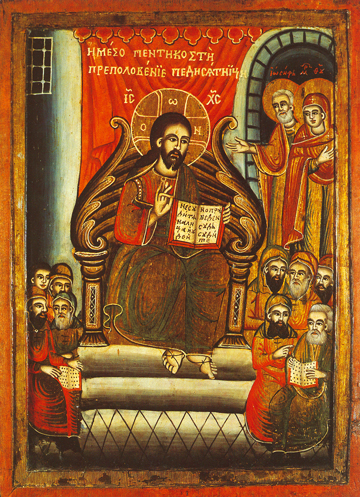
The Holy Spirit though, however mighty it may be, is not oppressive, forcing itself upon you, but rather the Holy Spirit, just like Christ, is life-giving. The late Phyllis Tickle wrote that we today are living in the age of the Spirit. The Holy Spirit is moving us within the Church just as it did at Pentecost - breaking across barriers of race, gender, social status, sexuality, and all of the other markers we use to separate the church - and those outside the church, in a moment of Holy Revitalization so that Christ’s Lordship may be known throughout creation.
The Holy Spirit still may not act like an anesthesiologist numbing you or us to the suffering of the world. To the contrary, the Spirit of God may just place the suffering of the world front and center in your life, front and center in our lives as a called and gathered community.
On that Pentecost we were all there. All of us. All of you. And that is how the church was formed and sent - all people, engulfed by God’s amazing grace, not because of their merit rather because of the faithfulness of the One the church proclaimed then and proclaims today.
At Pentecost, using every language known so that there would be no mistake, no mistranslation, no nuance missed, or nonverbal misconstrued the Holy Spirit descended so that those present, those in the past returned to dust, and us today might trust, we might believe, so that we will have faith grounded in the hard to believe, impossible and yet all too real promise made by God in Jesus Christ - the perfection demanded in the Law, obedience, and perfection, has been given to you, has been given to everyone, not by what we can do but rather by what has been done. What has been done, accomplished - resurrected and ascended - by Christ.
At Pentecost the Holy Spirit was once again set loose on creation, setting the church in motion, filling Peter with words to proclaim, setting us loose and filling us with the cosmic-breaking power of God not so that we would retreat back to the Upper Room. No, filled with the power of the Holy Spirit we, like Peter, point to the One who was present when that “wind from God swept across the face of the waters”[4] and there was light. Proclaiming the Good News of Christ the church then and today proclaims - so much so that we may be confused for being drunk at nine o’clock in the morning - that we have been redeemed, we have been saved, regardless of time, location, or merit. The God who created and sustains has redeemed creation and continues to fill us, sending us out to proclaim it again and again.
SUBSCRIBE [1] http://tamedcynic.org/squatters-rites/
[2] https://thinkandletthink.com/2020/05/...
[3] Genesis 1:3
[4] Genesis 1:3
May 20, 2021
Sabbath is Resistance

As we explore the new normal we find ourselves in during the COVID-19 pandemic the Mount Olivet community has been sharing devotionals to keep our community connected.
Remember the sabbath day, and keep it holy. Six days you shall labor and do all your work. But the seventh day is a sabbath to the Lord your God; you shall not do any work—you, your son or your daughter, your male or female slave, your livestock, or the alien resident in your towns. For in six days the Lord made heaven and earth, the sea, and all that is in them, but rested the seventh day; therefore the Lord blessed the sabbath day and consecrated it.” – Exodus 20:8-11 (NRSV)
Earlier this month a Wall Street Journal essay confronted the consequences of the United States’ addiction to busyness. There was once a time in the United States (or so Pastor Jeff says) when working on a Sunday, really doing anything other than attending church or a family dinner, would have been unthinkable. Yet today, doing more on Sunday, doing more on any day of the week has become the norm while refraining from work or activity the oddity. The WSJ columnist wrote, “The share of Americans who don’t identify with any religion continues to grow, and even many believers reject the concept of the Sabbath as a divinely ordained day of rest. Instead, we are encouraged to pursue lives of constant action and purpose, and we do. Smart devices allow white-collar professionals to freely mingle work and play. The gig economy and the Covid-19 work-from-home trend have further blurred the line between the two. The Sabbath doesn’t fit into the rhythm of our lives. It feels like an imposition—it is an imposition.”
Living in Northern Virginia – a stone’s throw from the DC, America’s hub of power and busyness – I know too well the perceived need to produce more than you did the day before or more than the person in the cubical next to you. I know too well the temptation to send one more email before dinner, to respond to a text message while on vacation, or to work on devotional well into the early morning when I know full well I should be asleep.
There is always one more email to send, one more deliverable to deliver, or one more sermon to work on. Being home for the past year the lines have been blurred to the point that many of us forgot what day to the week it was. We had to adjust our schedules to adapt to working full-time from home, attempting to homeschool our children, caring for a parent or spouse, or any combination plus a few more. The lines have been blurred and we are tired. Tired seems like an understatement. Rest is not part of the American work ethos and yet, as people of faith rest has been ingrained in who we are since God created the heavens and earth.
God rested on the seventh day. The seventh day was/is a holy day, a day of rest. When a new covenant was established the call to Sabbath rest was present.
“Observe the Sabbath day by keeping it holy, as the Lord your God has commanded you. Six days you shall labor and do all your work, but the seventh day is a sabbath to the Lord your God. On it you shall not do any work, neither you, nor your son or daughter, nor your male or female servant, nor your ox, your donkey or any of your animals, nor any foreigner residing in your towns, so that your male and female servants may rest, as you do. Remember that you were slaves in Egypt and that the Lord your God brought you out of there with a mighty hand and an outstretched arm. Therefore the Lord your God has commanded you to observe the Sabbath day.” – Deuteronomy 5:12-15 (NIV)
What was intended to be a day of rest, a day of holiness was twisted into, as Walter Brueggemann put it, “a moralistic prescription for a day of quiet restraint and prohibition.”
Brueggemann continues, “The alternative on offer is the awareness and practice of the claim that we are situated on the receiving end of the gifts of God… the fourth commandment on the sabbath is the most difficult and most urgent of the commandments in our society because it summons us to intent and conduct that defies the most elemental requirements of a commodity-propelled society that specializes in control and entertainment, bread and circuses… along with anxiety and violence.”
Our busyness and restlessness are more prevalent than any epidemic or pandemic experienced. Worse yet we cannot inoculate ourselves or reach herd immunity on our own to save ourselves. Busyness and restlessness have touched us all and while many may see Sabbath-keeping (regardless of what day of the week it falls on) as an oddity in the new social norm, this holy invitation is an opportunity from extended to us for a moment of pause, breath, and peace.
A moment to pause in the beauty of God’s creation, to breathe in God’s life-giving Spirit, and a moment of peace in a world that seems hell-bent on turning away from peace every change it is given.
Sabbath-keeping is not another thing to do, or a task to be accomplished. Sabbath is a divine “No!” to the things that compete for our time, the things we gain at the expense of others. Sabbath is as Brueggemann puts it, “the regular, disciplined, visible, concrete yes to the neighborly reality of the community beloved by God… a rest rooted in God’s own restfulness and extended to our neighbors who must also rest.”
May you find rest this week. Rest from your labors. Rest in your weariness. Rest in the grace that surpasses all grace.
May 5, 2021
Never Said It
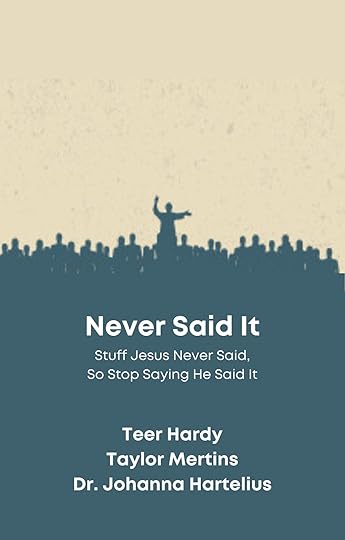
Taylor Mertins and I have a new book! Never Said It is our attempt to examine the all-too-popular Christian catchphrases that don’t actually appear in the Bible. At all.
Here’s a little bit of the introduction from Dr. Johanna Hartelius:
“In this collection of sermons and brief reflections, Teer and Taylor (the Reverends Hardy and Mertins) pursue an intensely difficult subject, viz., how we contemporary Christians might understand Scripture – what is there and what is not there. The central idea of the book is what is not there, folksy adages that Christians rely on for guidance while ignoring the lack of biblical authority: “God helps those who help themselves, “Everything happens for a reason,” and “Love the sinner, hate the sin,” to mention just a few. Contrary to popular belief and although, as Teer points out, “The Bible says a lot things,” there are a number of fortune cookie idioms that Jesus never said, Paul never wrote, and the Old Testament never authorized.
In Never Said It, Teer and Taylor speak frankly and compassionately about why these sayings have been popular despite being fundamentally misleading, and why setting the record straight about them is worthwhile. That they do so by using a comic frame is important to recognize and come to terms with; humor is not dismissal of a serious subject, but a way to relieve the pressure of tragedy. As literary theorist Kenneth Burke explains, the comic frame may allay the “cynical brutality” of generally accepted truths that aren’t really truths at all. As Taylor says, imposters and distortions of God’s word have been used “as a weapon over and over again.” It is no laughing matter that “hate the sin” has been deployed to justify self-righteousness and the torment of our brothers and sisters; what may be laughable, however, if the laughter turns to self-reflection, is the endless human error of (ab)using God’s word to, in His name, inflict pain on His creatures.”
You can find/purchase the book here: Never Said It
May 3, 2021
We're All Eunuchs
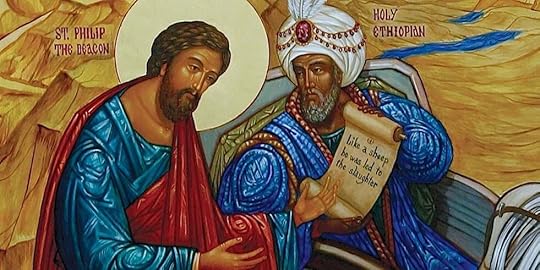
To Lincoln on the occasion of his Baptism
Acts 8:24-40
26 Then an angel of the Lord said to Philip, “Get up and go toward the south[ a ] to the road that goes down from Jerusalem to Gaza.” (This is a wilderness road.) 27 So he got up and went. Now there was an Ethiopian eunuch, a court official of the Candace, queen of the Ethiopians, in charge of her entire treasury. He had come to Jerusalem to worship 28 and was returning home; seated in his chariot, he was reading the prophet Isaiah. 29 Then the Spirit said to Philip, “Go over to this chariot and join it.” 30 So Philip ran up to it and heard him reading the prophet Isaiah. He asked, “Do you understand what you are reading?” 31 He replied, “How can I, unless someone guides me?” And he invited Philip to get in and sit beside him. 32 Now the passage of the scripture that he was reading was this:
“Like a sheep he was led to the slaughter,
and like a lamb silent before its shearer,
so he does not open his mouth.
33
In his humiliation justice was denied him.
Who can describe his generation?
For his life is taken away from the earth.”
34 The eunuch asked Philip, “About whom, may I ask you, does the prophet say this, about himself or about someone else?” 35 Then Philip began to speak, and starting with this scripture, he proclaimed to him the good news about Jesus. 36 As they were going along the road, they came to some water; and the eunuch said, “Look, here is water! What is to prevent me from being baptized?”[ b ] 38 He commanded the chariot to stop, and both of them, Philip and the eunuch, went down into the water, and Philip[ c ] baptized him. 39 When they came up out of the water, the Spirit of the Lord snatched Philip away; the eunuch saw him no more, and went on his way rejoicing. 40 But Philip found himself at Azotus, and as he was passing through the region, he proclaimed the good news to all the towns until he came to Caesarea.
Dear Lincoln,
I want to point of that the Ethiopian Eunuch in our reading from Acts had the scriptures read and explained to him, and then he was baptized. We did things a bit out of order. No, it’s not your parents’ fault. There will be plenty of blame for them coming from you down the line so I’ll take the heat for this one. You see Lincoln, you were just baptized into the life, death, and resurrection of Jesus Christ. It sounds like a big deal because, well, it is. That old life you knew is gone and now, clothed in the new life of Jesus Christ God has placed a claim on your life. In response to this claim your parents, along with all of the people here today on, behalf of our community of faith has promised to see to it that you and every other person are surrounded with a community of love and forgiveness so that you, and they, will grow in service to others and become a disciple of Jesus Christ. What this congregation and your parents committed to today is second only to the new life you have been clothed in.
And since we’re doing things out of order it would probably be best to explain all of this, well some of it to you - I’ll leave the complicated stuff to the congregation. They’ll be more than willing to study, teach, and learn about things like the Trinity, atonement theology, and eschatology alongside you.
We don’t know much about the Ethiopian Eunuch. We know he was from what was considered to be the far reaches of the world. At this point, you’re probably wondering what a eunuch is. I’ll let your parents explain that one to you. I’ll just say that this man, because of his physical condition, was unable to be ritually clean or physically marked as the law prescribed and thus was unable to enter into the very temple he traveled to for worship. Imagine that journey. Day after day in his chariot only to get to the destination and be told he could not enter.
Now, as this man traveled home the Holy Spirit nudged Philip - Lincoln, the Holy Spirit has a habit of doing that and I pray you never get used to it. The Holy Spirit nudged Philip to join the man in his chariot. Before Philip, a disciple of Jesus Christ knew it, he was up in the chariot and teaching the man about the Good News of Jesus.
Philip most likely told the man how he had been called, along with his brother Nathaniel, being told by Jesus that they would see, “heaven opened and the angels of God ascending and descending.”
Philip most likely told the man about the healing of leapers and a lame man who laid by a healing pool for far too long.
Philip most likely told the man about a group of friends lowering their friend through the ceiling so that their friend might be healed by Jesus.
Philip most likely told the man about the Sermon on the Mount or the Beatitudes.
Philip most likely told the man about the parables or at least a parable - Jesus’ use of earthly examples to point out a heavenly truth.
Philip most likely told the man about Jesus walking on water, calming a storm, and clashing with the Pharisees.
Philip definitely told the man about about Jesus’ last days. While some may call this Spring Break, we in the Church call this Holy Week. Philip told the man from Ethiopia about pain and sorrow endured by Jesus only to then proclaim the Good News of Easter.
Philip told this man that in the life, death, and resurrection of Jesus Christ Sin - the thing that continually seems to separate us from God - has lost its grip on us. All of us. On you.
And now, we the church, are witness to this new reality knowing that the Kingdom of God was inaugurated in a manger in Bethlehem and is it not yet fully realized.
Notice Lincoln, the story of Good News changed the Ethiopian man’s life. He was never the same. You, I pray, will never be the same. To say it is sentimental, the water that streamed off your head or even the proclaiming the Good News of Christ misses that attached to the water - so much so that it cannot be strained or filtered - is grace, the abounding of Love of God. And Lincoln, that love is yours. So much so that there’s nothing you can do to undo the claim placed on you.
This grace is offensive to some because it cuts through whatever barriers others will attempt to put in place between us and God. This grace is offensive because it cuts through any barriers others may attempt to place between you and God.
It’s OK that you don’t remember this day when your older, Lincoln. Many of us here today were told about our baptisms or shown pictures a decade or so after it happened. I want you to remember though, with the help of your parents, sister, and family - that includes this entire community - that like the Ethiopian Eunuch, you, and every other person to be dunked, sprinkled, or poured over with this water have been clothed in new life, in the amazing grace of Jesus Christ. You received this pardon, not because of anything you did or because the correct prayer and words were spoken. Not because of the severity of your sins or lack of, no, you, we, have been pardoned and made clean because of everything Christ has done for you. The grace you have received begins exactly where you and others tell you it should end.
So Lincoln, welcome to the family. I’ll warn you now that we probably won’t get it right. We’re going to mess up. We have messed up. And Lincoln, where we fall short, that is where the work of God in Christ, that Good News, is enough.
Grace & Peace,
Pastor Teer
Subscribe
April 23, 2021
Echoing Hope

Kurt Willems joins the pod to share his new book Echoing Hope: How the Humanity of Jesus Redeems Our Pain.
None of us live free of difficulties or hardships. But how can we learn to live richly in the midst of them? And ever grow spiritually because of them? The answer is found in the hopeful humanity of Jesus.
Echoing Hope reveals how understanding the humanity of Jesus can radically transform our identity and empower us to step into our pain-filled world in a new way. Combining rich theological insight with personal stories and practices for response, learn how we can overcome despair and encounter the beautiful potential of our lives.
Friend and mentor Pastor Brian Zahnd said, “Without resorting to worn-out clichés, Kurt Willems walks the reader through the problem of pain with the mind of a theologian and the heart of a pastor. This book will help many people.”
Before you listen, do us a solid and help out the podcast.
Head over to http://www.crackersandgrapejuice.com.
Click on “Support the Show.”
Become a patron.
For peanuts you can help us out....we appreciate it more than you can imagine.
Follow us on the three-majors of social media:
https://www.facebook.com/crackersnjuice
April 21, 2021
Hermeneutics is Back
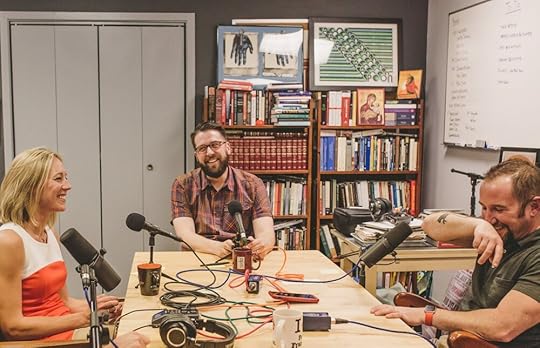 Hermeneutics is back!
In this newest season of Hermeneutics, we're tackling the Gospel of John, bit by bit. To kick things off we're starting at the very beginning with the Prologue.
The Word Became Flesh
1 In the beginning was the Word, and the Word was with God, and the Word was God. 2 He was in the beginning with God. 3 All things came into being through him, and without him not one thing came into being. What has come into being 4 in him was life,[a] and the life was the light of all people. 5 The light shines in the darkness, and the darkness did not overcome it.
6 There was a man sent from God, whose name was John. 7 He came as a witness to testify to the light, so that all might believe through him. 8 He himself was not the light, but he came to testify to the light. 9 The true light, which enlightens everyone, was coming into the world.[b]
10 He was in the world, and the world came into being through him; yet the world did not know him. 11 He came to what was his own,[c] and his own people did not accept him. 12 But to all who received him, who believed in his name, he gave power to become children of God, 13 who were born, not of blood or of the will of the flesh or of the will of man, but of God.
14 And the Word became flesh and lived among us, and we have seen his glory, the glory as of a father’s only son,[d] full of grace and truth. 15 (John testified to him and cried out, “This was he of whom I said, ‘He who comes after me ranks ahead of me because he was before me.’”) 16 From his fullness we have all received, grace upon grace. 17 The law indeed was given through Moses; grace and truth came through Jesus Christ. 18 No one has ever seen God. It is God the only Son,[e] who is close to the Father’s heart,[f] who has made him known.
Before you listen, do us a solid and help out the podcast.
Head over to http://www.crackersandgrapejuice.com.
Click on “Support the Show.”
Become a patron.
For peanuts you can help us out....we appreciate it more than you can imagine.
Follow us on the three-majors of social media:
https://www.facebook.com/crackersnjuice
April 20, 2021
Now, Tomorrow, Always
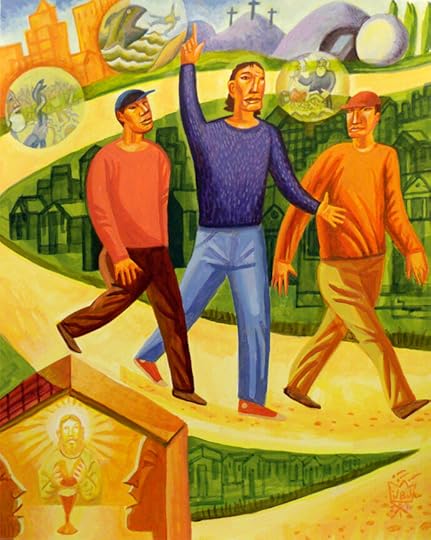
The disciples were still on the shadow-side of the cross. The Good News of Easter was yet to take hold of their lives. The good news we celebrate today, and every day, had yet to send them out in all directions to the world. Luke tells us the loyal, abandoning, and bewildered disciples of Jesus were gathered after two of them had encountered their resurrected rabbi while on the road to Emmaus. Emmaus was a suburb of Jerusalem, seven miles away. Jesus appeared as the disciples walked, revealing his identity during a meal, in the blessing and breaking of bread before vanishing from the two disciples’ sight. Our reading picks up where the Emmaus story ends, with the disciples “startled and terrified” when Jesus, in the glory of his resurrection, appeared to them again.
This is the second encounter recorded by Luke the disciples had with the resurrected Messiah. We are three weeks removed from Easter but for the disciples, they were hours removed from news of the empty tomb that they, well, they didn’t believe. They were still making sense of what had transpired over the past week. Luke’s accounting of Easter began with the disciples being perplexed - not believing what Mary told them - and ended with amazement and in this second encounter, we have the disciples questioning themselves and then filled with fear.
The disciples, not a single one, expected the resurrection of their crucified teacher. Even when Jesus was standing before them they didn’t believe what they saw. What they saw was contrary to the way the world as they knew it was ordered. Jesus stood before them and they didn’t believe. We read that Thomas doubted. Mary returned from the tomb with news that Jesus was gone and the disciples did not believe. The resurrected Messiah stood before Mary and she mistook him to be the gardener.
This was the disciples’ moment of vindication. A moment for them to shout “we knew it all along!” as God in Christ shouted “No!” to the forces of sin and death. This was the disciples’ opportunity to thumb their noses at the empire and instead, they were overcome by fear because they did not believe the physical resurrection of the body of Jesus was possible. The resurrection of the body - full life returning from the dead - was/is counter to everything about the way things work.
Yet, in the midst of the trembling and fear of the disciples, in the midst of the counter-narrative, Jesus did not offer admonishment or condemnation. He didn’t look to Peter and say, “I told you so.” He did not chastise the disciples for not believing what he had told them would happen 15 chapters earlier. He showed them, the disciples, his hands and feet. Jesus invited his friends to touch and see, similar to the Gospel of John’s account of what is often described as doubting Thomas’ interaction with Jesus.
But Luke tells us that having seen his hands and feet, even having him standing before them, even being filled with “joy” the disciples were still in disbelief. They were “wondering” what was happening. What else would it take?
In response to the bewildered disciples, Jesus requested some broiled fish, and with each bite, each chew, and ultimately a swallow Jesus confirmed for the disciples and Luke confirms for us the Good News of Easter - that the resurrection of Jesus Christ was not limited to his spirit. What happened to Jesus on Good Friday was very much a physical encounter - he was beaten, tortured, and left to die nailed on a cross. This is what the disciples remembered, and now three days later Jesus revealed, no confirmed that the resurrection too was very much a physical encounter. The resurrection of the body, God’s great Easter victory, was just that, a full restoring of the body, of the life that had left him three days earlier. Revealed in this holy meal of fish is the promise of the physical nature of the resurrection - promised to us - along with the assurance of the Good News of Jesus’ promise to be physically present with us always. Present with us today as we are physically apart from one another.

We are physical beings. “To be a somebody” as Will Willimon says “is to have a body.” And Jesus is no different. This has been part of the Church’s Easter proclamation since the beginning of the church - Jesus’ fully resurrected and fully restore humanity (his body) alongside his divinity.
Our shared human experience - inside and outside the church - points to this. Our bodies make us somebody and because we are somebody we gather in the physical presence of one another and share our lives together. Over the past year to be in the physical presence of someone outside your bubble has required protective gear and great care to be taken. Because of this many have struggled. To be physically present with one another has been difficult and dangerous, and without this basic act fulfilled in our lives like the disciples many have felt as though they are wondering because they are not able to wander.

One of the things I loved to do before the pandemic was to go to brunch in Ballston with my family. Being the church nerd that I am I always notice the same liturgical act being played out week after week over the sounds of clanging plates and glasses. In the breaking and sharing of bread, at table after table, the fullness of the Kingdom of God was being revealed in a manner similar to what the disciples themselves witnessed, even by those who might have had little or no desire for those acts to hold theological significance. In the church this happens every time we gather around Christ’s table to grace, breaking bread, and sharing a cup.
Like the disciples sharing broiled fish with Jesus on the third day, today we expect, we believe by faith that the physical presence of Jesus is with us. “For where two or three are gathered,” Jesus said, “I am among them.” Physical presence is a hallmark of Jesus’ ministry. He did not take us residence in a tower and then send the Holy Spirit to do his work. Jesus is a hands-on Messiah - hands-on then and hands-on now. This is perhaps why the disciples were still wondering when Jesus stood before them before he asked for a piece of fish. The contrary nature of the resurrection did not make sense until it was physical.
The disciples, for three years, had witnessed the physical signs and miracles confirming precisely who Jesus was. What they saw was contrary to the way they knew the world to work.
Water turned into wine at a wedding in Cana.
The healing of the royal official’s son and the healing of the man who laid ill for 38 years by the healing pool at the Sheep Gate on the Sabbath.
The 5000+ people were fed after they said it couldn’t be done.
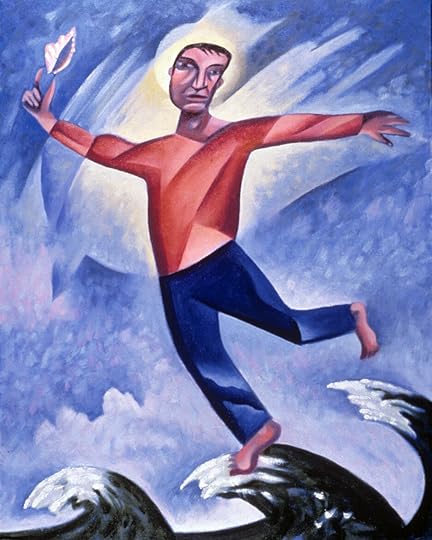
Jesus walking from the shore the meet them in a boat on the water.
The disciples had witnessed first hand the work Jesus had been engaged in and the Gospels tell us early on that they believed. They believe after having received physical confirmation. The disciples believed enough to give up their lives and follow Jesus, an itinerant rabbi, for three years, and at every turn along the way physical signs were being performed to confirm who Jesus was to the disciples and the world.
Every day, for three years, the disciples were alongside Jesus, witnessing Jesus’ ministry and hearing Jesus’ teachings all of which pointed to and revealed his glory - the glory confirmed on Easter.
So now, on the day of the resurrection, the disciples needed another physical reminder of who Jesus is. Just as the Emmaus journey encountered ended with the sharing of a meal, here we have Christ revealing the fullness of the resurrection with a meal. With his real-physical presence.
In eating a piece of broiled fish and in the breaking and sharing of bread Jesus offered the disciples then and us today exactly what they and we need. And it is nothing new and it is the greatest of news. The physical presence of our Lord has been the norm since the beginning of his ministry. As the disciples were 2000 years ago, we are witness to the physical signs of Christ’s presence, recipients of faith by grace not so we can hold on to it for ourselves. No, instead we proclaim a new reality, the good news in the light of the empty tomb - that the resurrected life begins and is sustained not by anything we have done or will do. We are sustained through this very community, through being the body present to somebody - through word and sacrament, in the physical presence of Jesus Christ.
Christ is with us now, tomorrow, and always.
Subscribe
April 16, 2021
Dirty Rotten Scoundrels
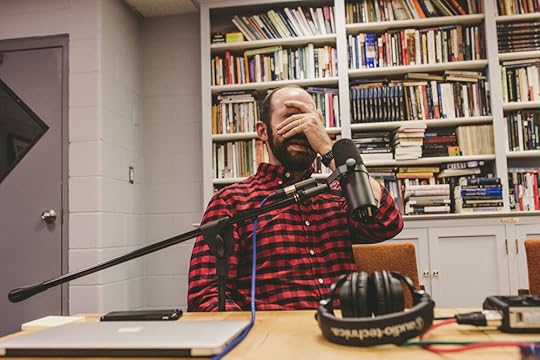
Last week I had the opportunity to sit down with my friend and partner in ministry, Rev. Taylor Mertins, to discuss the lectionary readings for Easter 3B. The topics included:
What's the point of CPE?
Can we use the NT to preach the OT?
How has the pandemic changed our prayers?
The texts for this episode are Acts 3.12-19, Psalm 4, 1 John 3.1-7, and Luke 24.36b-48.
Before you listen, do us a solid and help out the podcast.
Head over to http://www.crackersandgrapejuice.com.
Click on “Support the Show.”
Become a patron.
For peanuts you can help us out....we appreciate it more than you can imagine.
Follow us on the three-majors of social media:
https://www.facebook.com/crackersnjuice