Teer Hardy's Blog, page 15
April 20, 2020
Walking in Wonder
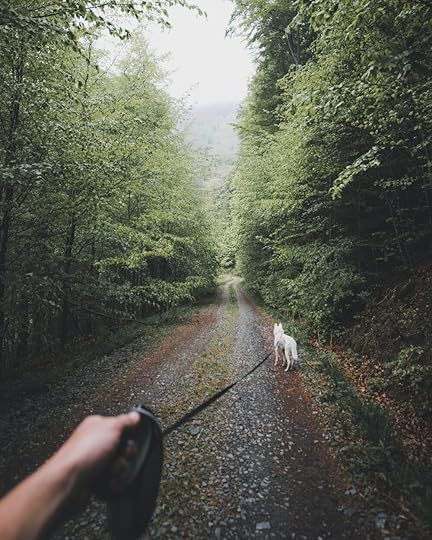
As we explore the new normal we find ourselves in during the COVID-19 pandemic the Mount Olivet community has been sharing devotionals to keep our community connected. Here’s my offering for Monday, April 20, 2020
Over the past week, I have rediscovered the joy of a walk. This time last year I was preparing to begin training to run my first marathon. The result of these preparations resulted in outdoor activities being a means to an end. I needed to get enough base miles on my legs so that when the end of June arrived and my training plan began, I was ready to go. This time last year when I’d go out to walk the dog, I was usually scouting new running routes through the neighborhood. The section of Arlington that we live in has a hill (and when I say hill, I mean small mountain) on every street. There’s no escaping the hills. To escape the hills, one must run downhill out of the Ballston area which means when it comes time to return home, the route home is entirely uphill.
Running uphill is not fun – well it can be fun for a short period of time but to run from Lyon Village back to our home is two miles entirely uphill and two miles uphill is terrible. This time last year when I was out in the neighborhood I was not looking around, learning which homes were recently built or discovering which of the craftsman homes was my favorite. I rarely walked through the parks around our home looking for the beauty of what God had created, examining how our interference with the natural growth of native plants was harming the local ecosystem.
I grew up paying attention to such things. I was a member of the Envirothon team in High School (my specialty was soil). I took Environmental Science and AP Environmental Science in High School. As a Scout, I hiked, camped, and picked up litter from Prince Edward Island to the Blueridge Mountains. Today when I am walking the dog and see litter on the ground, I pick it up. I don’t tell you this to convince you that I am an environmental saint, but to point out that once we learn these practices, regardless of what we are looking for when we are walking/hiking/cycling the practice becomes a habit.
Over the past weeks, since we’ve been sheltering at home because of COVID-19, my walks with the dog or with Camden on his bike have awakened me to the beauty that has been around me. This beauty was here when I first arrived in Arlington nearly three years ago.
This week we mark the 50th anniversary of Earth Day (our Caretakers group will have more for you this week on that). This anniversary has me thinking that while we are facing a pandemic and we are staying at home more than we ever imagined was possible, the beauty in our neighborhoods – the blooming spring flowers and budding trees – are an opportunity to take in the beauty of what God has created and we don’t have to go far to find it. So often we think we need to go hiking through the woods or walk along a beach to see the beauty of God’s creation. Those places are wonderful and my favorite places to connect with our Creator.
For now, I am going to enjoy my walks a little bit more. I am going to pause in front of Capital Caring and pray for those resting within its walls and give thanks for the beauty of the gardens on the property. I am going to walk up 17th Street and enjoy the tulips blooming in a church member's yard (I promise I won’t pick any for Allison).
How are you enjoying what God has created while at home? I’d love to hear about it and I am sure others would too. Call a friend up, send me an email, or talk to a neighbor (staying 6-feet apart) and let’s celebrate the wonders of creation.


April 17, 2020
Mouth to Mouth Recreation
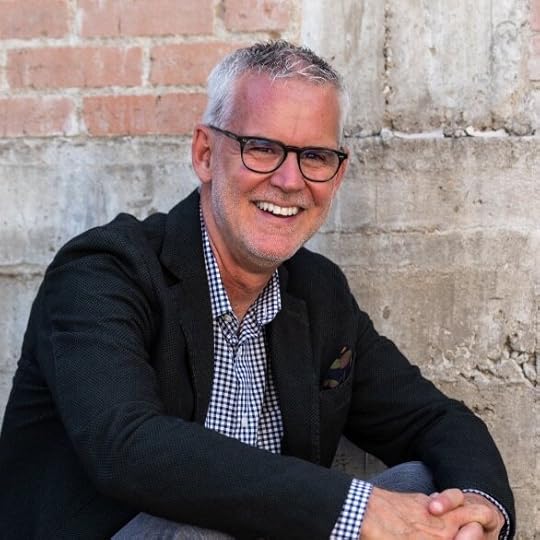
Our guest this week is Professor Jack Levison, author of numerous books including the recent works The Holy Spirit Before Christianity and Boundless God. Jack was a fun, funny, engaging, and insightful guest-- plus, he did his homework enough to know that our producer, Tommie, isn't a dude.
Featured in the Huffington Post and on parade.com, relevant.com, and beliefnet.com, Jack Levison’s writings appeal to a wide popular audience. Eugene Peterson, author of The Message, considers him “the most competent scholar and clearest writer on the Holy Spirit that I have known.” Jack is also an internationally acclaimed scholar. With a BA from Wheaton College, an MA from Cambridge University, where he was a Scholar of Christ’s College and winner of the Fitzpatrick Prize for Theology, and a Ph.D. from Duke University, Jack now holds the W. J. A. Power Chair of Old Testament Interpretation and Biblical Hebrew at Perkins School of Theology, Southern Methodist University. The author of more than a dozen books, both popular and scholarly, he has received grants from the National Humanities Center, the Lilly Fellows Program, the Louisville Institute, the Alexander von Humboldt Foundation, the Rotary Foundation, the International Catacomb Society, and the National Endowment for the Humanities. Jack lives in Dallas, with an office down the hall from his wife, Priscilla Pope-Levison, who is an associate dean at Perkins School of Theology.
Before you listen, do us a solid and help out the podcast.
Click over to http://www.crackersandgrapejuice.com. Click on “Support the Show.” Become a patron.
For peanuts you can help us out....we appreciate it more than you can imagine.
https://crackersandgrapejuice.com/show/youre-not-accepted/
https://www.facebook.com/crackersnjuice
April 14, 2020
Now What?
Easter Sunday 2020 has come and gone.
Sunday morning I did something I have not done since Camden made me a dad in 2013 - I was home on Easter morning when he and his sister hunted for eggs and found their Easter baskets.
The stone was rolled away in the garden before the light of morning had risen. Mary went to the garden, expecting to find the body of her friend and teacher, but instead, she was greeted by a person she believed to be the gardener.
The Gospels’ account of the resurrection of Jesus Christ was the jumping-off point, the beginning of the work continued today by followers of Jesus around the world. The disciples were hiding behind a locked door, the Mary’s delivered the Good News, and then Jesus appeared before his disciples shattering any doubt that remained.
From the point when Mary and Mary encountered the risen Lord on the Church as been proclaiming the resurrection of Jesus. It’s what we do week in and week out. Every Sunday is Easter when we gather to proclaim Christ crucified and resurrected. Our worship may be repetitive but it is because what we proclaim week after week, Christ crucified and risen, is the marker by which the world was changed.
Easter this year was different.
Churches adjusted and produced online worship for their communities.
Choirs and bands produced anthems and songs of praise utilizing new technology.
We gathered online, around kitchen tables and on living room couches.
So, now what?
What are we to now that Easter Sunday has come and gone and it seems as though nothing has changed in our lives. We are still quarantined or sheltering in place in hour homes. We are separated from our families and friends, and still, Christ is risen, truly risen.
The early church, after the resurrection, after the left the locked upper room they had to continue the work begun by Christ, proclaiming the Kingdom of God had come in Jesus Christ and that Christ promises to return, in a final culmination of God’s reign.
The early church had much to figure out in the days, weeks, and years after the resurrection. One of the ways that occurred was through an early Church document called The Didache.
One of the earliest documents in the Christian tradition is called the Didache. This document was the first handbook for the church, explaining how to perform baptisms, gather around the Lord’s table, and live in community with one another. The Didache sought to address many of the disagreements and controversies within the early church.
A dear friend of mine wrote a book on The Didache. Tony’s book, The Teaching of the Twelve: Believing & Practicing the Primitive Christianity of the Ancient Didache Community, guides solo readers and small groups through what Tony says is “the most important book you've never read.”
As we continue our journey in Eastertide I want to invite you to join me and the church I serve, Mount Olivet United Methodist Church, in exploring this ancient text, examining how the early church navigated unchartered waters.
We gather on Wednesday evenings to study, discern and explore on a Zoom call and I’m saving a seat for you. Leave a comment or shoot me a message and I’ll get you the link.
April 10, 2020
It's Good Friday
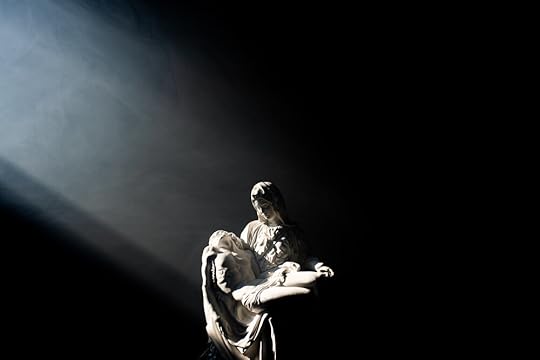
This is an odd time to be preparing and anticipating Easter. As a pastor normally, I would be very busy this week. Normally I would be running errands, writing sermons and prayers, and ensuring the church was ready to celebrate the resurrection.
We were planning an extensive outdoor art installation for Holy Week. This would have been a center point for reflection and worship during Holy Week for Mount Olivet United Methodist Church and The Way.
Things have changed since those plans were made and we were not able to install the outdoor installation. Our wonderfully talented Communications Specialist took what I thought to be a wash and made a 360-degree experience. Take your phone with you on a walk or outdoor break today, and immerse yourself into the Stations of the Cross.
You know as I do, this is not a normal Holy Week. This is not a normal Good Friday. I pray the online Stations of the Cross are an escape for you, from the new normal you have been forced into, a holy distraction from the anxiety and chaos moving around us.
April 7, 2020
Taste and See
As we explore the new normal we find ourselves in during the COVID-19 pandemic the Mount Olivet community has been sharing devotionals to keep our community connected.
When we first moved to Arlington, when I was first appointed to Mount Olivet, we found ourselves full of wonder and awe. As the movers began to off-load the truck and we began to put all of our treasures in their proper place we began to dream, we began to imagine what life would be like in our new home, at a new church, in a new community, in new schools, and in a new barbershop.
At some point, I'm not quite sure when the wonder and awe we brought with us gave way to the daily grind of Arlington. To be clear, our hearts had not become hardened, we had not put up a wall around ourselves because of the people of Arlington or because of Mount Olivet. Our daily grind in Arlington included packing lunches, rushing out the door to the school bus, sitting in traffic for reasons I still am not quite sure of, and a trading afternoon hiking trips for baseball games and practice.
We were not opposed to wondering and exploring the new possibilities around us, instead, our attention was grabbed by other things - just as important for the season of life we were living in.
We did not retreat to the bleachers, becoming spectators as others lived their lives. No, we were now moving too quickly, constantly look for what was next, more process than wonder. Our arms were not crossed, disgusted by the movement of life around us. Instead, we were fully caught up in this movement. We were all-in in this new life we were creating in Arlington.
The Psalmist wrote, "Taste and see how good the Lord is! The one who takes refuge in him is truly happy!"
Taste.
See.
These two actions require a pause.

Tasting what you are eating, to really notice the flavors requires intentionality. To savor a fine meal takes time. I remember when I was in Italy last year and Allison and I would sit down to dinner. These meals were not fast. We sat. We tasted. To taste the goodness of God we must slow down. We pause for a moment.
The same is true in seeing the world around us. Like many reading this devotional, we have gone on more family walks over the past three weeks than we ever have during the day. Morning, afternoon, and evening walks offer us a chance to see our neighborhood, to notice that new families have moved into the community and see trees and flowers as they bloom.
To taste and see is to realize that God is near. God is so near in fact, that our breath, is God's presence in our bodies. Divine breath filling our lungs, sustaining us for yet another day.
We are invited by Christ to taste and see the goodness of God and to experience the newness of God's handiwork among us. In tasting and seeing the goodness of God we can become overwhelmed in the best possible way by the world around us. When we pause for a moment, pausing the daily grind and allowing ourselves to wander and wonder our eyes are opened, our senses heightened, and the goodness of God is revealed.
The goodness of God has always been with us. Breath, growth, and beauty are always around us.
This Holy Week, during a forced pause of life, I invite you to wander and wonder, to taste and see. The goodness of God is yours. The price will be paid on Friday and we will celebrate the fullness of God's goodness and glory on Easter. In the meantime, taste and see.
April 6, 2020
Just Another Manic Monday

As we explore the new normal we find ourselves in during the COVID-19 pandemic the Mount Olivet community has been sharing devotionals to keep our community connected.
Someone has a case of the Mondays. I’m not writing about the Mondays many of us experience when we awake in the early morning hours on the first workday of the week, rubbing the sleep from our eyes, and firmly planting our feet on the floor. No, someone has a case of the Mondays in the best possible way.
The morning routine around our table has changed over the past two weeks. Instead of moving quickly we now take our time. Instead of opting for convenience we now opt for quality – time, food, and preparing for a week. This week we are preparing for a new online school platform, bike riding in the church parking lot, baking cupcakes, finally beating that impossible Star Wars Xbox level, and hitting dingers in the front yard.
It has been easy over the past two weeks for not want to get of bed on Monday. It has been easy over the past two weeks to live each day as though it was Monday – not a Monday in the sense of a chance to do something new.
A case of the Mondays can stop you in your tracks.
A case of the Mondays can change the way you not only see the world around you but also the way you see others.
Each day we firmly plant our feet on the floor, in a brief moment we rarely notice, we make a choice: are we going to have a case of the Mondays, the Mondays we dread or are we going to have a case of the Mondays in the best possible way.
The Psalmist wrote:
21 I thank you that you have answered me
and have become my salvation.
22 The stone that the builders rejected
has become the chief cornerstone.
23 This is the Lord’s doing;
it is marvelous in our eyes.
24 This is the day that the Lord has made;
let us rejoice and be glad in it. – Psalm 118:21-24
You will often hear the phrase, “This is the day that the Lord has made; let us rejoice and be glad in it” in worship, Sunday school, or youth group. We have family members who have this scripture quoted on wall art in their home and I know others who repeat this scripture to themselves each day as they firmly plant their feet on the floor.
There has been much to despair about over the past two weeks. It is easy to become bogged down in news coverage and internet articles. We can become distance ourselves so much that we forget that we are missing out on life by doing so.
I feel bad for the rest of Psalm 118, like every other verse in the third chapter of The Gospel of John that gives up the limelight to verse 16, we miss that while yes this is the day that the Lord has made, “The stone that the builders rejected has become the chief cornerstone. This is the Lord’s doing; it is marvelous in our eyes.”
Every time we allow despair to take a grip on us, we run the risk of forgetting that the Lord has done great things, marvelous things. A new sunrise is a marvelous thing. Making lunch, teaching first-grade grammar, facilitating preschool crafts, working, and then somehow making lunch for everyone is a marvelous thing.
Caring for one another, reconnecting with friends, and pausing one of the busiest areas of the world is a marvelous thing.
Maybe Psalm 118 should be rewritten:
“This is the day that the Lord has made; let us rejoice and be glad in it. This is the Lord’s doing; it is marvelous in our eyes.”
That someone who has a case of the Mondays, that’s me. This Monday, this first day of the work and school week, I know, as my feet are firmly planted on the floor, that what the Lord will do will indeed be marvelous a thing.
April 5, 2020
Ashes to Asses

In years past, the season of Lent has tended to drag on. Maybe it is because the thing we chose to give up was just too much of a shock to our senses, too ingrained into our daily routine and the abruptness with which Lent arrived did not provide us with an adequate amount of time to prepare. Perhaps we were looking forward to the season of Lent and for whatever reason, once we hit week three and there were still three weeks to go, the season we were looking forward to was now the season we wanted nothing to do with, a season that we wished would just getaway. Lent is an odd time in the church year.
The sloth-like pace of Lent is intentional. This is not Advent where we anxiously await the culmination of four weeks with tinsel and decorated homes. Maybe I’m wrong, have you ever decorated your home for Lent? Have you ever put a Lenten tree in your family room? The slow pace of Lent provides space for the Church to do some self-reflecting. This season of fasting, prayer, and repentance is an intentional act to allow the faithful and not-so-faithful to turn back to Christ, turning away from the sin which has grabbed a hold of, that we cling to, in the hope that by the Grace of God we will no longer be bound to our sin and instead we will step into the light of Christ’s resurrection.
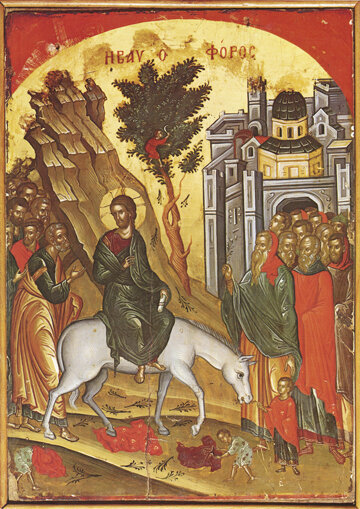
Mustering with his band of followers at the Mount of Olives - the place where God declared to “stand in order to defeat those who had gathered against Jerusalem”[1] - Jesus dispatched two disciples to fetch a donkey and a colt. After retrieving the animals Jesus was saddled up and the disciples along with the followers they had been collecting as they moved throughout the region begin their procession from the Mount Olives towards the Holy City of Jerusalem.
The first-century red carpet was rolled out for the prophet, the Messiah who was coming to free the Holy City, coming to free the world from the weight of that which they had been held captive by. The followers who had been traveling with Jesus, witnesses to and participants of his miracles and teachings - the feeding of the 5,000, teaching Peter about forgiveness, the extension of grace to a woman about to be stoned, the healing of the blind, and so many more - threw their cloaks onto the ground so that the dust from the ground would not be kicked up and onto Jesus by the humble animal he was riding on.
As Jesus and his followers entered the Holy City they were greeted by another group of people, the citizens of Jerusalem. We do not hear about this group of people until nearly the end of the Palm Sunday story. While Jesus had been traveling to the city he was hailed as the Messiah, “Hosanna to the Son of David! Blessed is the one who comes in the name of the Lord! Hosanna in the highest heaven.”[2] These shouts of praise and longing were the echoes of a prayer, of Psalm 118, “a psalm of victory of Israel's Lord, a psalm in which the gate of the Lord is opened so that the righteous may enter.”[3]
When these two groups of people came together - Jesus and his followers, and the residents of Jerusalem - Jesus was identified, by his followers as a prophet but in his procession into the city, Jesus identities himself as Lord, but a Lord who would ride a creature not typically associated with royalty and power. He rode not a warhorse ready to take a triumphant victory through force, but instead fulfilling the words of the prophet Ezekiel, Jesus entered the Holy City with humility.
If Lent seemed to drag on in years past, this year, Lent of 2020 has felt as though we have been moving at the speed of light and yet we have not gone very far. If you’re like me the path you now travel is limited to the walls of your home, with deviations from that path few and far between. The ash on our foreheads is barely been gone it seems and now Jesus is marching into Jerusalem, making a B-line for the temple. And it would be great if that is where the story ended, with shouts of “Hosanna!” But as Lent draws to a close, there is more to the story, there is more than just Palm Sunday and shouts of “Hosanna!” to welcome Jesus into Jerusalem and to the closeout Lent.
If we leave the story at “Hosanna to the Son of David! Blessed is the one who comes in the name of the Lord! Hosanna in the highest heaven”[4] we miss the abruptness with which Lent draws to a close, the closing is not drawn out, and the quickness with which Holy Week moves. Jesus entered the Holy City and before a week goes by, he will have been crucified. He will be dead. In less than a week the man who entered the city peacefully, with no show military force, will tell his disciples to put away their swords as he was taken from a garden, arrested and then killed. The quickness with which we move into Holy Week, beginning with this procession, is a shock we experience year after year. Rev. Fleming Rutledge describes the movement as beginning with “triumph” and ending in “catastrophe.”[5]
The “turmoil”[6] Jesus caused as he entered the Holy City stirred up such alarm among the religious and political leaders that the only thing left to do to this peaceful prophet was to kill him. And in a moment of brief clarity the religious leadership of Jerusalem and the political leadership of Rome, two groups who did not always see eye-to-eye, found a common enemy they could focus their attention on.
We cannot, as Fleming puts it, pass “from Palm Sunday to Easter without Good Friday.”[7]
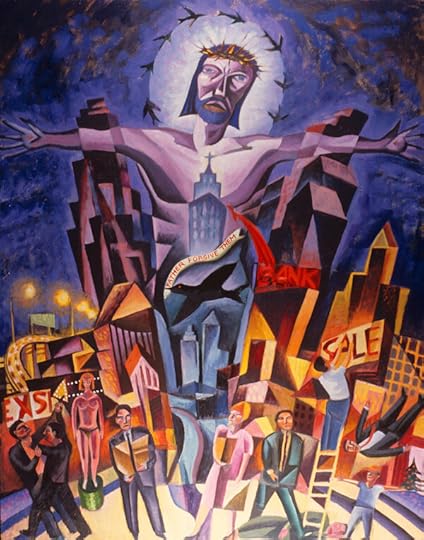
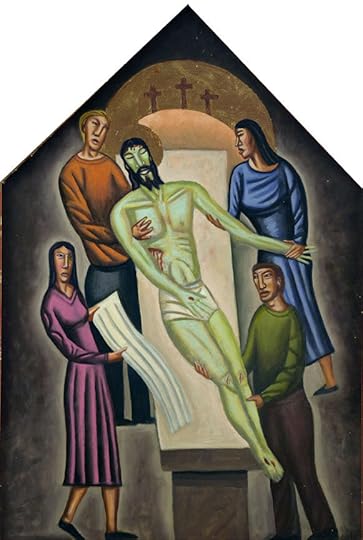
James Janknegt - Father Forgive Us
The movement of Holy Week occurs quickly, so quickly in fact that it is easy for us, the faithful to ignore the events of Thursday, Friday, and Saturday, preferring the celebration of resurrection over betrayal, denial, arrest, mockery, and death. In moving from Palm Sunday to Easter, skipping the rest of Holy Week we forget that the crowd who followed Jesus into the Holy City, the group who shouted, “Hosanna to the Son of David! Blessed is the one who comes in the name of the Lord! Hosanna in the highest heaven”[8] would either shout “crucify” on Friday as Jesus was offered to Pilate in exchange for a murderer or they would go into hiding, fearing the fate of their teacher would soon be theirs.
It happened so quickly. The shouts of “Hosanna” would quickly move to shouts of “crucify.”
And that is where I find myself during Lent. That is where I find myself -answering the question. “Who Am I?” during Lent. There are days when I would like to think I am leading the Palm Sunday procession, keeping the pacing just right and then there are the times when I find myself hiding behind a locked door or joining the crowd willing to exchange Jesus for Barabbas.
The day that we look forward to, Easter, the day we celebrate every Sunday, did not come without a price. “Easter was not ‘made easy’ for Jesus,” Fleming Rutledge writes.[9] And yet, the price paid by Jesus is not the price we pay. The saving grace extended to us by Christ - the same grace extended at the well to the Samaritan woman, the same grace extended to the woman about to be stoned, the forgiveness of our sins - no matter how many the maybe - is free. Free to those who shouted “Hosanna!” and free to those who hid or shouted “Crucify!”
Easter is coming, and it is free, and it extends freedom to us, to everyone. Freedom from captivity to sin and Death was paid for with the unconditional love of God, for you. The peace we seek in this world, as slowly as it may seem to arrive or as quickly as it may seem to depart, is found in the cross of Christ. Beginning at the Mount of Olives, all the way the Calvary, regardless if you were in the crowd shouting “Hosanna!” and then hid in an upper room or if you were part of the crowd who traded the life of Christ for the life of Barabbas, that freedom is still yours and the price has been paid.
[1] Hauerwas, Stanley. Matthew. Brazos Baker, 2006. Page 181.
[2] Matthew 21:9, NRSV
[3] Hauerwas, Stanley. Matthew. Brazos Baker, 2006. Page 182.
[4] Matthew 21:9, NRSV
[5] Rutledge, Fleming. The Undoing of Death: Sermons for Holy Week and Easter. W.B. Eerdmans Pub., 2005. Page 11.
[6] Matthew 21:10, NRSV
[7] Rutledge, Fleming. The Undoing of Death: Sermons for Holy Week and Easter. W.B. Eerdmans Pub., 2005. Page 12.
[8] Matthew 21:9, NRSV
[9] Rutledge, Fleming. The Undoing of Death: Sermons for Holy Week and Easter. W.B. Eerdmans Pub., 2005. Page 9.
April 3, 2020
On American Anti-intellectualism, with Dr. Johanna Hartelius

Expertise in the age of COVID-19 has been shaped by any fool's ability to start a blog, podcast, or stand behind a podium. In this episode, Jason and I sat down with Dr. Johanna Hartelius, host of You're Not Accepted, to discuss the Op-Ed she wrote for the Houston Chronicle.
"Americans are at a crossroads. With the novel coronavirus prompting a nationwide lockdown and hospitals warning of an impending shortage of life-saving ventilators, we, the public must decide: What type of “expert” are we willing to listen to?"
Sacraments in the Cloud

COVD-19 and the need to physically distance ourselves from one another has jolted the routines and structure of our homes and communities. Schools are closed for the foreseeable future. All “non-essential” businesses have been closed. In some areas, if you are deemed an “essential" employee” you are to be provided documentation proving your essentialness. Grocery store shelves have been picked over multiple times by well-meaning people who are frightened of what could happen should the COVID-19 pandemic take an even greater turn for the worse.
In my line of work, the local church, a crisis is beginning to emerge. In our Methodist tradition, the first Sunday of the month is typically reserved by most churches as “communion Sunday.” The sermon is shorter (yay!) to allow the community the time needed to gather around Christ’s table of grace, and I know from experience, there are people in our communities who only attend church that first Sunday of the month.
Well, we are quickly approaching the first Sunday in April - the first first Sunday of the month during the COVID-19 pandemic. Churches of all stripes have been scrambling to determine how they will share the Eucharistic meal with one another when they cannot be physically present with one another.
Before I continue, I want to be honest from the beginning - I am not in favor of online communion. I will do my best below to outline the argument for both positions but if I appear to be prejudice it is because I am.
While many United Methodist Bishops have already spoken in favor of or against, I present to you two cases to be made for and against online communion.
This double-epiclesis requires both the historic physical elements (bread and wine/grape juice) as Christ instituted them but also the physical gathering of the people of God. The physicality or tangible nature of our faith, that God called a tangible people to be his own, came in the person of Jesus Christ, died, and was resurrected physically, is extended to the sacraments, which themselves must also be physical and within a gathered physical community.
On the authority of clergy:
The authority given to celebrate the sacraments, and in particular communion, does not mean that clergy are somehow able to celebrate communion without the gathering of others, and in particular the laity. Nor, in the case of “virtual” communion, does this mean that clergy voices are somehow able to transcend space and time to consecrate elements wherever their voice is heard. If that were so, it would be a very strange form of clericalism.
If not now, when?
As to Holy Communion, now is the time to wait. That we are yearning for Communion is a sign that we have been shaped by the gospel and we will celebrate it with joy when we finally meet together again.
What is the real issue?
Like Wesley, we are also living in a transitional time with important consequences for what it means to be a church and for what the role of a church should be when it comes to tending to the spirituality of people. Ecclesiology is a fluid concept that is shaped by communal practices of members of a faith community in a changing context. These members bring cultural, social, political, and economic diversity into the faith community; therefore, the church is never either-or but inclusive of human experience that reflects the signs of the time. This is why human 2 experience is a critical source of doing theology, just as Scripture, tradition, and reason are essential as sources.
New theology in a new ecclesiology?
The rise of a new theological subject, Cyber Disciples definitely presents an opportunity of theological imagination to ways how Christians worship, practice their faith, and exercise evangelism. The eschatological church always presents the hope of building a living church understanding that it is not yet fully realized but surely exists among the people. The risen Jesus is eschatological hope personalized, and this opens up the possibility of a continuation of the realization of the Holy Spirit upon all people, including Cyber Disciples.
What are the practicalities (2/5, see Dr. Park’s paper for further practicalities)?
“An ordained elder or a person authorized under the provisions of the Book of Discipline” 22 should bless the elements for the sacrament with individually packed portable elements. Once they are blessed, these should be mailed to individuals who have requested them.
“An ordained elder or a person authorized under the provisions of the Book of Discipline “ should use a video web conferencing tool (WebEx, GoTo Meeting, Google Hangout, etc.) to serve the sacrament over the Internet. The same liturgy should be used for the Great Thanksgiving in The United Methodist Church Hymnal, and members should take the communion elements that are already blessed in unity following the instruction of the clergy. The presiding of “an ordained elder or a person authorized under the provisions of the Book of Discipline” is important to uphold the order of elder’s priestly ministry of serving sacrament.
Dr. Park did not write her paper with COVID-19 in the foreground, this paper was written for the new ministry field that is the online space, where people gather at home around a screen instead of in pews, folding chairs, or local community hubs.
The space we find ourselves in is temporary. COVID-19 will not last forever and I find it interesting the urgency with which people are taking to the need for communion. In a recent sermon, Rev. Fleming Rutledge said, “Poor Christians during the time of the coronavirus, unable to celebrate the Eucharist. They’ll have to make do with *only* the Word of God.”
We have the real presence of Christ with us, always. I shared my bias at the beginning of this post and I’ll add one more bias now: perhaps the season of Lent and physical distancing is a time of fasting from the Eucharist. I know that sounds weird, odd, and completely contrary to what my Wesleyan heritage tells me. Dr. Park wrote, “Wesley was adamant about having frequent communion, four or five times a week: Wesley understood that it is Jesus’ command (‘Do this in remembrance of me’—Luke 22:19 KJV), so ‘it is the duty of every Christian to receive the Lord’s Supper as often as he [or she] can.’”
Dr. Kendal Soulen said to me that in communion, the meal itself, we are connected to the history of the people of God, whose life with God is often centered around meals - manna and the Passover meal.
I understand the urgency with which many are moving to online sacraments, I also understand (because I am in this camp) of why people, clergy and laity, are holding off and using this time as a period of fasting.
So what do you think? Are we ready for online communion? When the COVID-19 pandemic is over, will you continue the practice? What will be your theological argument for doing so and then not continuing the practice? Are we prepared for the unforeseen consequences or our decisions?
***UPDATE***
The Bishop of the Virginia Annual Conference, Rev. Sharma Lewis, has just announced guidance for clergy in my neck of the woods. You can more here.
Additional Resources
This Holy Mystery: A United Methodist Understanding of Holy Communion
Comfort Food: Feast of Love Liturgy by Marcia McFee
A Liturgy for When We Cannot Meet by the Order of St. Luke
March 31, 2020
Pass the Pickled Carrots

To say that over the past two weeks the world has changed would be an understatement.
The world has come to a screeching halt.
Then, here in Virginia, the hammer was dropped - an Executive Stay-at-Home Order signed by the Governor.
This means, unless we are going to the doctor or to get groceries, we remain at home. Outdoor recreation can be done in family units but large groups will (maybe) receive a fine and/or jail time.
Nearly every gathering of humans, around the world, has been put on hold. The Olympics (now rescheduled to 2021), baseball seasons, conferences, all have been postponed. The NHL has begun airing virtual games for fun on their networks. Faith communities of every stripe have been forced to no longer gather for in-person worship services and small group gatherings.
The way we move through our communities has changed. In grocery stores and retail stores blue x’s mark the floor to give a visual reminder that we are to be no closer than 6-feet from one another. We only leave our homes for necessary trips - to get food, visit the doctor, etc.
At-home delivery has never seemed more lucrative until you realize the deal you found on Amazon was prepared, shipped, and delivered by someone who more than likely does not have PPE at their place of employment.
There is much to get someone down and in the dumps. There is much that can cause us to retreat into our homes, regardless of the Governor’s order and hide from the world barely moving outside the threshold of our front door.
This new normal seems anything but normal.
Then, yesterday afternoon, Camden and I were in the kitchen while Nora was asleep. We were cleaning up the mess we had made when we cooked homemade macaroni and cheese. We were cleaning up because we were preparing to make homemade pickled carrots.
After we finished making our homemade pickled carrots. Nora woke up. We gently nudged Allison to end her workday early (a perk when you own a business) and went for a family-walk/bike ride. Camden rode his bike down the neighborhood trail for the first time. We ran into a friend from church and then came home and cooked dinner together as a family.
As a family.
We can make jokes about how much time we are spending with our immediate family members. We can lament about not being able to spend time with our grandparents who are about to move across the country.

But yesterday, I had the opportunity to spend the day with my kids. No programming I had to drive them to. No agenda for the day, other than chalk art in the church parking lot, riding bikes, and cooking delicious homemade food ALL DAY.
Like many people, I do want things to get back to normal sooner rather than later. I want the curve the be flattened so we can protect the vulnerable. I want to be able to go to the barbershop with Camden and play pinball while we wait for a chair to open. I miss baseball and hockey.
These past few weeks have not been easy, and we’re only a few weeks in. Anxiety, stress, and tensions are making it tough to be at cooped up. And I know I am blessed. I am in a safe place with people who love and care for me.
Which is why I don’t want to go back to the way things were. I don’t want to go back to a time when work too precedent over bike rides and afternoon walks in the neighborhood. I don’t want to go back to a time when we were going through the motions of the day, trying to check every box on the list just so we could do the same the following day.
I don’t want to go back to a time when neighbors weren’t caring for one another. I don’t want to go back to a time when the local food bank was pleading with the community for food. I don’t want to go back to a time when we opted for the convenience and value of national chains over local businesses.
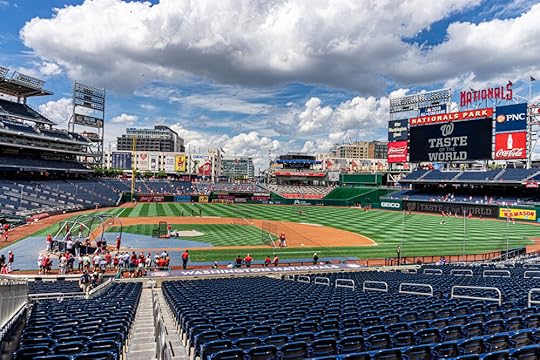
I want things to get back to normal. I want to hear the crack of the bat and I want to pay too much for a bad beer at Nationals Park.
So yes, let’s flatten the curve as quickly as we can.
Let’s heed the word of experts and ignore political grandstanding.
Let’s rally as a community, caring for one another and sharing our toilet paper.
But, when things get back to normal, let’s not forget the work we have done. Don’t forget that during this time we cared for one another, we cooked together, and we set aside the busyness of life to ride bikes, go on walks, and make homemade pickled carrots.