Teer Hardy's Blog, page 16
March 30, 2020
Canceled
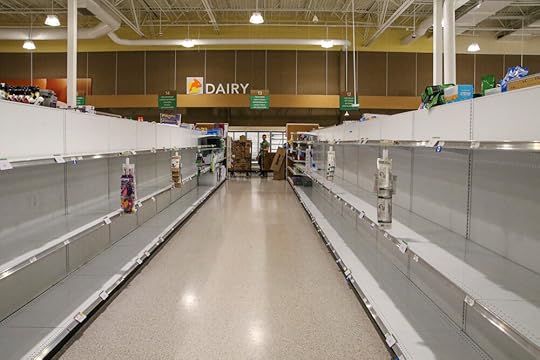
The abruptness of the past few weeks has been jarring, to say the least. Cancellations and changes in plans came without warning. My daughter was scheduled to attend a friend’s birthday party last weekend, her first party as an invited guest. Canceled. Baseball seasons are postponed. Here at the church, we have been forced to reschedule weddings and funerals, all in an effort to protect those who would be gathered in this room.
Flight cancellations have led to business trips and vacations being put on hold.
As much as I would love to go to the dentist next week, that appointment has been rescheduled for later in the summer.
As the world takes a preventative pause and platforms like Zoom and FaceTime are stretched beyond their severs’ capabilities it can seem as though every aspect of our lives is stuck in pause. During an international pandemic, now more than ever, we are reminded that while we can cancel events and change our routines, hitting the pause button on much of life, death is still present.
Now more than ever our mortality, the fragility of life, has been present to us, front and center and as we distance ourselves from family and friends there is little we can do about it.
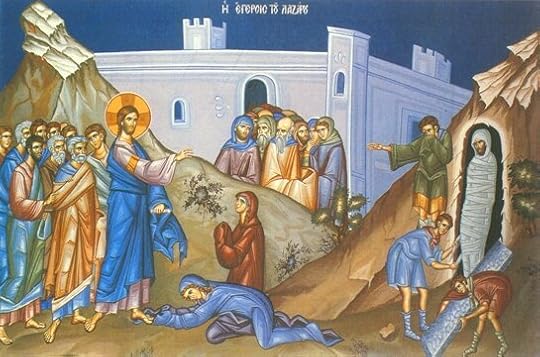
After being accused of blasphemy in Jerusalem, Jesus and his disciples retreated across the Jordan River to avoid the stoning and arrest many of the religious leaders in the city were beginning to insist was necessary. Jesus then received word that his friend, Lazarus, was ill. Jesus waited two days before departing for Bethany, back into the hostile land he and the disciples had just fled.
Before arriving in Bethany, before he was greeted by Martha and Mary, Jesus told his disciples, “Our friend Lazarus has fallen asleep, but I am going there to awaken him.”[1]
The disciples did not read between the lines and Jesus had to tell them plainly, “Lazarus is dead.”[2]
Many of you know the story: Jesus was greeted separately by Martha and Mary, Lazarus had been dead for four days, and Jesus became “greatly disturbed in the spirit and deeply moved.”[3]
Jesus then went to the tomb and he wept.
Standing at the tomb of his friend, a person Jesus deeply cared for and loved, Jesus had a physical reaction. Weeping we know is more than a teardrop rolling down a person’s face. Weeping is an emotional, bodily response when our spirit is wounded.
The Son of Man was deeply moved when confronted by death.
Sin has held power over all of humanity ever since the Garden, ever since Adam and Eve failed to follow God’s commands. Sin has led to death, and even death does not take a day off.
Next, this is my favorite part - Jesus called Lazarus by name out of the tomb.
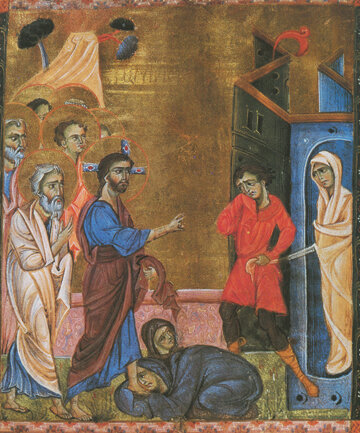
Icon of the Raising of Lazarus
“Lazarus come out!”[4]
“Lazarus (called by name) come out”[5] is an important detail that we cannot overlook. Had Jesus not called Lazarus by name, the entire tomb, all of Lazarus’ family buried together in the family tomb would have come walking out.
Lazarus exited the tomb and those gathered and who witnessed life returning the man they knew to be dead for four days, the man whose soul they knew had left his body, took the burial clothes off the dead man who was then walking before them.
Normally on any given Sunday, there would be an illustration woven throughout a sermon. This illustration would draw you in and hold your attention while you sat on a hard wooden pew or hoped to serve as a distraction from a daydream about your plans after church. The downside to these illustrations is we often remember the illustration and forget the truth spoken to us by God’s word. But friends, this is no ordinary Sunday.

Today we find ourselves in a world on pause, with much of life canceled or rescheduled.
We are living the illustration.
There is no anecdote I can share to make what’s happening at the tomb of Lazarus more clear than the week has made it. Standing at the tomb, Jesus, God Incarnate was deeply troubled.
There’s no easier way to say it then Jesus was angry.
God does not delight in suffering and death. When face-to-face with the condition we call carry God became angry. God wept.
Disease and affliction are not God’s punishment doled out to humanity for _______ reason.
Disease and affliction are signs of an enemy named Death, and standing at his friend’s tomb, face-to-face with this enemy God is angry. So angry that he had a bodily response.
Lazarus carried a disease more widespread than any pandemic the world has ever faced - Death.
We are all afflicted by Death. None can escape it.
No amount of cancellations or changes in plans can cancel or change this condition we all face. But in Jesus Christ, God Incarnate, the One who came down from on high and took on our earthly existence we are the recipients of the promise that Death does not get the last word.
The day is coming when God is going to shout “Come out!” and all of the death will be unbound, their grave clothes will no longer be necessary. The words of resurrection spoken to Lazarus are words of resurrection spoken to us.
God spoke to the prophet Ezekiel say that the dry bones shall live again.[6] Where life and hope seem gone, in dust and ash, and in the grave God is going to shout “Come out!”

Over the past few weeks, we have been reflecting on who we are as followers of Christ. As Saint Paul put it, we ‘adopt the same mind that was in Christ.”[7] How are we? We are resurrection people. We are people who do not believe Death holds the final word. A week after week we proclaim, boldly, Christ resurrected.
As Lent begins to draw to a close and we approach Holy Week, anticipating the grand celebration of Easter, hold onto this promise - the promise that the shadow of the cross, the shadow of Death does not get the last word. We can hold onto this promise no just because of Christ’s triumph over Death on Easter but also because resurrection, new life, eternal life where death was thought to have found victory is who Jesus is.

[1] John 11:11, NRSV
[2] John 11:14, NRSV
[3] John 11:33, NRSV
[4] John 11:43, NRSV
[5] Ibid.
[6] Ezekiel 37
[7] Philippians 2:5, CEB


The Final Hunt
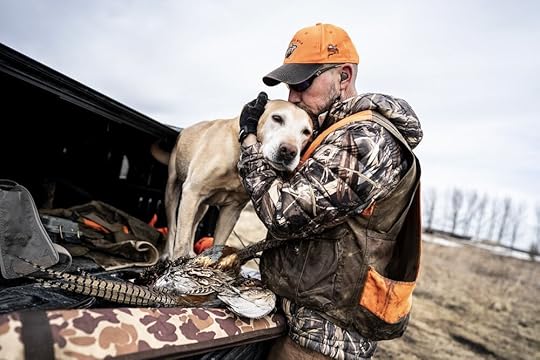
Albert and Tony, Photo Credit: Courtney Perry
A few weeks ago my friend lost his beloved dog. Albert and Tony leaned on one another while hunting and while navigating life. The current situation we find ourselves in during the COVID-19 pandemic has caused many of us to forget that life is still continuing. While we may be locked in our homes, keeping a safe distance (six-feet) from our grandmothers and neighbors, life is continuing. People are falling ill due to COVID-19 but people are also spraining their ankles, having babies, having heart attacks, and losing dear members of their family to illnesses other than the one that has shutdown the world.
I could never write of Tony’s love and affection for Albert. This is Tony’s story to tell and I think it is a story we all need to hear in a time when we are being reminded of our own mortality.
While he loved everyone, Albert’s greatest loyalty was always to me. I don’t know if it’s because he spent his first year in a kennel, but he never had any interest in playing with — or even sniffing — other dogs. On a hunt, he ignored his peers and locked in on me, obsessed with my every move, waiting for a release command so that he could chase birds.
Albert and I stalked ducks and pheasants in South and North Dakota, Iowa, Minnesota and Oregon. His résumé is littered with miraculous retrieves, like the pheasant he found after dark and under a snowbank when all the hunters had retreated to our trucks. Or the very-much-alive Canada goose he fished out of cattails and swam across a lake to me as it squawked and pecked at him.
Once while pheasant hunting, he emerged from a field with a half-moon flap of skin hanging off his chest, the result of running into barbed wire at full speed. I hoisted him onto a pickup tailgate and used a surgical stapler I keep in my canine first aid kit to close the wound. He didn’t even flinch. Then I put him in a crate in the back of the truck — his hunting concluded for that trip — and I set out into the next field. Ten minutes later, he ran up alongside me. He’d busted out of the kennel, intent on hunting at all costs.
I invite you to head over to the StarTribune and read the rest of Tony’s tribute to Albert, and be reminded that while we may be distancing from one another, we are not alone in our grief or in a life that continues to move.
March 27, 2020
Just Breathe
As we explore the new normal we find ourselves in during the COVID-19 pandemic the Mount Olivet community has been sharing devotionals to keep our community connected. Here’s something I think you’ll love from Rev. Jeff Goodman
“The Lord God formed the human from the topsoil of the fertile land and blew life’s breath into his nostrils. The human came to life.” Genesis 2:7 (Common English Bible)
I forget things all of the time. Where I put my glasses, Pi past 8 digits, people’s names (except yours!). But I never forget to breathe. No matter how busy I am, how stressed I am, how distracted I am, I pretty much always breathe. I count that as a win.
It strikes me that I do forget that God-breathed, that God breathed first. God’s breath brought creation – humankind anyway – to life. Likely that God-breathed life isn’t formed for living on the sofa, all Netflix and chill. Don’t get me wrong, in the time of COVID 19 I love being considered a national hero for watching TV with Pam and Lola (the Cocker Spaniel). But like most of society, I miss the physical community I share with you and everyone around us. I’m amazed by how much easier technology has made this isolation – I video chat with Pastor Ed and Pastor Teer almost every day, create and consume online worship and have instantaneous access to the latest news. Even so, I already long to return to the days when I don’t have to move six feet away from a neighbor on the sidewalk.
Last Sunday I preached on John 9, the story of Jesus healing the blind man. Drawn to a kernel in the third verse, I focused on Jesus explaining to his disciples that sin wasn’t the source of the man’s blindness, rather the blindness should be seen as an opportunity to demonstrate God’s work: “This happened so that God’s mighty works might be displayed in him.” (John 9:3, Common English Bible)
I hear a question from the passage in John: how can I – how can we – use our limitations, our fears, our pain to display God’s mighty works? How can we be the people God created us to be? This is a world, a time, that is yearning for God’s presence and we may be just the mirror that the world needs to see God’s work in each of us.
Perhaps we can take this time of isolation to focus on our breathing, to remember God’s breath. Ask yourself this question: how can I use my breath to simply be the person God created me to be? To accept the good and the bad, to accept God’s grace and hope, and to know that I share God’s breath.
Much of the current online chatter focuses on how we can be productive during isolation, on how we can use our time alone to greater advantage. Perhaps we can use this time to not only breathe but to think about our breath, to think about God’s breath. And with each breath remember that you are God’s. Forgiven, loved, cared for. Forever.
Just don’t forget to breathe.
On Being and Ceasing to Be
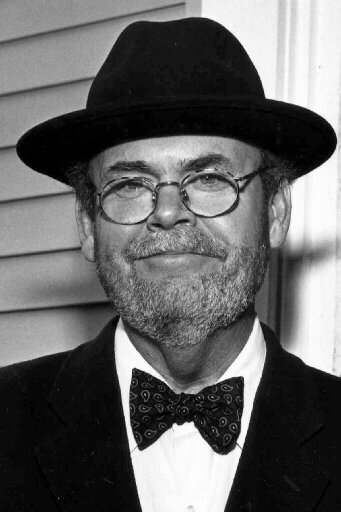
Thomas Lynch is back on the podcast to talk to us about his latest collection, The Depositions: On Being and Ceasing to Be, and about burying the dead in light of COVID-19.
Essayist, poet, and funeral director Thomas Lynch was born in Detroit, Michigan in 1948. His critically acclaimed volumes of poetry include The Sin-Eater: A Breviary (2011), Walking Papers (2010), Still Life in Milford (1998), Grimalkin and Other Poems (1994), and Skating with Heather Grace (1986). Lynch is also the author of essay collections such as The Depositions: New and Selected Essays on Being and Ceasing to Be (2019), The Good Funeral: Death, Grief, and the Community of Care (2013), and The Undertaking: Life Studies from the Dismal Trade (1997). He has received numerous awards and grants from the National Book Foundation, the National Endowment for the Arts, the Michigan Council for the Arts, and the Irish Arts Council. A frequent guest lecturer at universities across North America, the United Kingdom, Ireland, and Australia, Lynch is an adjunct professor in creative writing at the University of Michigan-Ann Arbor.
By using his own daily routine as poetic fodder, Lynch has transformed the mundane task of preparing the dead into a life-affirming event. His lyrical, elegiac poems describe the dead citizens of Milford, Michigan, his own family relationships, and scenes and myths from his Irish Catholic upbringing. Sometimes described as a cross between Garrison Keillor and W.B. Yeats, Lynch’s work dissects the vicissitudes of the human experience with grace and wit. His first collection of poems, Skating with Heather Grace, is set in Michigan, Ireland, and Italy. Library Journal reviewer Rosaly DeMaios Roffman found that the poems “unpretentiously rehearse the dreams of the dying as they celebrate the everchanging relationships of the living.” Lynch, according to Roffman, crafts poems that weave symbolism and mythology into the human experience. His subsequent volumes of poetry likewise contain elements of his professional and personal life, mixed with ruminations about Irish culture and history.
Lynch is a well-known contributor to publications like the New York Times, The Times, Newsweek, and Harper’s. His essays offer a fascinating peek into a profession few of us have ever imagined. The Undertaking: Life Studies from the Dismal Trade (1997) reflects the author’s “eloquent, meditative observations on the place of death in small-town life,” according to a critic in Kirkus Reviews. Lynch’s poetic vision is indelibly colored by his undertaking business, and what he sees often contrasts with what lies on the surface. Dispelling the myths about people in his trade, Lynch wrote, “I am no more attracted to the dead than the dentist is to your bad gums, the doctor to your rotten innards, or the accountant to your sloppy expense records.” His profession has provided him not only with a living but with a unique vantage point from which to observe the entire cycle of life. The Undertaking: Life Studies from the Dismal Trade won the Heartland Prize for Non-Fiction and the American Book Award, and it was a finalist for the National Book Award.
Lynch’s prose book Bodies in Motion and at Rest: On Metaphor and Mortality (2000) explores his Roman Catholic childhood and family, being a father, and the relationship between “mortuary and literary arts.” In 2005 Lynch published Booking Passage: We Irish and Americans, a memoir-travelogue and cultural exploration of the ties that bind two countries with inextricably linked histories. His foray into short fiction, Apparition and Late Fictions (2010) addresses themes found in his poetry and essays, offering sensitive portraits of ordinary people coping with grief.
Lynch divides his time between his home in Milford, Michigan and his ancestral home in Moveen, County Clare, Ireland.
Before you listen, do us a solid and help out the podcast.
Click over to http://www.crackersandgrapejuice.com. Click on “Support the Show.” Become a patron.
For peanuts you can help us out....we appreciate it more than you can imagine.
https://crackersandgrapejuice.com/show/youre-not-accepted/
https://www.facebook.com/crackersnjuice
March 26, 2020
Holding it Together

On Monday night I jumped on (yet, another) Zoom call. It is beginning to feel as though I will be spending more and more time on video-conferencing software in the coming weeks. The Monday night call was a time for clergy colleagues to come together and offer support to one another as we navigate the new ministry fields we were thrust into without much if any warning.
The overwhelming sentiment I heard from the call and that I have shared in other conversations is that social distancing, resulting in no longer being able to worship in the same building or gather around the same table for Bible study, has caused many to feel as though they alone are holding their community together. This panic has lead clergy, church workers, and volunteers to feel as though every single ministry and opportunity for discipleship and ministry that was offered before the COVID-19 pandemic swept across our communities must continue in this new online ministry field we find ourselves in.
I understand the sentiment. I really do. When I began working with teenagers I was a programming addict. I over-programmed my ministry and thus over-committed myself to the point where the ministry and I felt burned out.
My good friend, Rev. Drew Colby, made the observation that maybe, just maybe, this time of social distancing is an opportunity to set re-evaluate the over-programmed ministries and social programs our local churches have stretched to maintain. Drew is not suggesting that we end Bible studies or neglect those on the margins of our communities. What I think Drew was getting at is that the fluff, and if we’re being honest there is fluff in every church, we hold onto and maintain at the cost of others’ time with their families and responsibilities outside walls of the church might be able to be set aside during this time of COVID-19 social distancing.
Clergy, church staff, and church leaders have been working tirelessly over the past week trying their best to hold their communities of faith together - initiating a brand new worship service in a matter of days, figuring out how to conduct pastoral visits, on top of the day-to-day real-life stuff that happens in local congregations. This has led to many clergy to view themselves as being the one who has to do it all. The one to plan, record, edit, and publish worship. The one to plan, coordinate, and lead every Bible study. The one to do every single care phone call. The one to run errands for every person over 65 who cannot leave their home.
If we’re being honest with ourselves this is neither sustainable or fair the communities we are called to care for. It is not up to us, the clergy or paid church staff, to hold the church together. We can lean into one another, lean into the people God has called to our communities. This a chance for us to identify new leaders within the community and invite them, for this period of time, to step forward and care for others. This is a time when the church can be the church, setting aside the fluff we have added to the life of the church, and be a community that is caring for the least of these in a time when the least are the ones still going to work, stocking the shelves, and feeding our families.
All of this is done, not through anything we do, but rather in Christ and through God’s Spirit.
In his letter to the Colossians, Saint Paul wrote, “He is the head of the body, the church, who is the beginning, the one who is firstborn from among the dead so that he might occupy the first place in everything.”
Christ as the head of the church is holding us together. We can lean into Christ, knowing the yoke we carry as clergy is not ours to hold on our own.
There’s no holding together to be done. We are held together. Christ our Lord is holding each of us, each community, the Church universal, and all of creation.
March 25, 2020
The Adaptability of Grace

As we explore the new normal we find ourselves in during the COVID-19 pandemic the Mount Olivet community has been sharing devotionals to keep our community connected. Here’s something I think you’ll love from Margarita and McKenzie.
Remember in Genesis when God made humans and some stuff went wrong and God had to banish Adam and Eve from the garden to toil the land? The first storyline we get from Scripture regarding who we are as humans involves perhaps the greatest feat of adaptability imaginable. Right from the start, we see that God made humans to be flexible, adaptable, clever, resourceful—otherwise, God would have known that God was sending Adam and Eve to certain death. Apparently, God knew Adam and Eve would adapt outside Eden and make it work.
We were, after all, made in the image of God, and no one is more adaptable than the God we serve. God tried every way possible to have God’s grace to reach Israel. You need deliverance from Egypt? Let’s do it! You need food? Manna from heaven! Oh, you need a king now? Ok, let’s try it! You’re captive in Babylon and need a reminder of my promises? Here you go! If you read scripture with special attention to this, you will find that God is not rigid in how God shows grace. God is infinitely creative in meeting people where they are.
And that is never clearer than in Jesus’s interactions with humans. You won’t find some bullet-point version of the Gospel, or Good News, in anything Jesus said. The Good News he brought was always in the context of what people needed. The Good News of Jesus that the blind man encountered in John 9 came in the form of healing and restored sight. But Jesus’s message to the rich young man in Matthew 19 was to sell all his possessions and give them to the poor. It seems like sometimes grace comes in the form of a stern talking-to. In John 4, Jesus meets a Samaritan woman at the well, and in an intimate and almost playful conversation, Jesus gives the woman hope that one day Jews and Samaritans will be reconciled. That is the grace that Jesus shares with her—a message of hope for an oppressed people. When a bleeding woman fights through a crowd to try to touch Jesus’s cloak in search of healing in Matthew 9, Jesus does give her physical healing, but he also offers her human touch and recognition after she had gone unacknowledged for so long. Grace, it seems, can sometimes be as simple as a kind moment that recognizes those who are invisible in society. And in the middle of a sermon on a hill, when the crowd started to get hangry (hungry-angry) Jesus set aside whatever wonderfully thought out sermon he had planned and took some fish and bread, multiplied them, and fed the crowd. Jesus might have planned to share grace and the Good News through his words, but grace that day took the form of soft bread and fresh fish. And Jesus adapted. The love and grace of Jesus Christ, in his own life, was flexible, adaptable, and right for the moment.
Just like the many people Jesus met and spoke to, we’re all different and the Good News is different to all of us. When we read the Bible, we see or hear something unique to us. The places we’ll find grace in the new reality of Coronavirus will be different for each of us too. Some distilleries have stopped making liquor and have started producing hand sanitizer, and some fashion houses are producing personal protective equipment for medical professionals. Here in Arlington, neighbors have turned on their sewing machines to start making cloth masks for hospitals. Empty store shelves, people wearing gloves, social distancing—it’s all starting to feel like the new normal. It has only been a week but we seem to be adapting in countless ways. (Except for cats. Cats still don’t seem to like having their humans at home.) Maybe you, too, have been surprised by the amazing adaptability and resourcefulness of humans. But this was probably no surprise to God.
Communion might not be at the rail or by intinction, but maybe right now communion looks like gathering around the dinner table and sharing a mishmash of non-perishable food items from the pantry. Fellowship looks like Sunday School email chains with updates, and right now the gathering space looks like a Zoom conference. Worship is on screens in our homes, and I know my off-key singing is no replacement for Dr. Shaner and the choir, but that’s what I got right now. It looks different than it did a few weeks ago, but the grace we receive from it is the same.
Right now, school looks like worksheets, hanging out looks like Skype, and working looks like wearing PJ’s on the couch. Right now, loving your neighbor means staying away from them. Compassion for the vulnerable means washing your hands. Right now, the Good News that store clerks need is a smile, a “thank you” and infinite patience. God made Eve because God knew that Adam could not do it all on his own and we are truly discovering that others are our greatest resource... even at 6 feet apart. It is not what we are used to defining as work, school, love, or compassion. It all looks so different, but grace, just like God, remains the same—ever as adaptable, flexible, and resourceful.
- Margarita and McKenzie
March 20, 2020
Set the Worry Aside
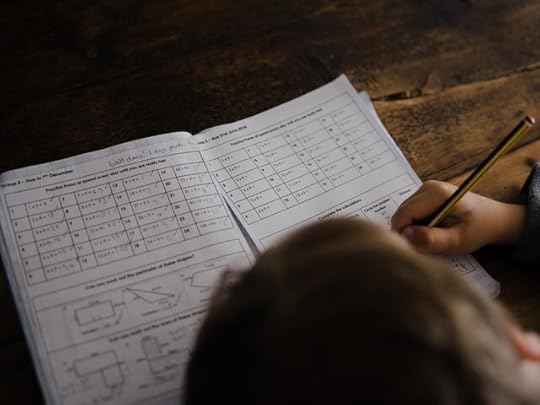
Photo by Annie Spratt on Unsplash
If we’re being honest with one another there is much to worry about these days. There is a virus spreading rapidly across the world. Many people are ignoring the calls for social distancing to help slow the spread of this virus. Hundreds of thousands of people have lost their jobs and more will lose their jobs. Small businesses, the backbone of every community are floundering at best. There is much to worry about these days.
I just proctored my first first-grade grammar and math tests. Camden has completed his first week of homeschool and I’d like to think Allison and I did a better than average job this week at teaching and helping Camden keep a sense of normalcy. Camden’s tests were a combination of fill-in-the-blank grammar and fraction identification. I don’t remember doing this kind of work in first grade. Camden aced his test, missing only one grammar question and to be fair, the question made no sense.
After the test, he came over to me, gave me a hug, and started crying.
I am not his teacher. His teacher, in his words, is “way cooler” than I am. But I am not his teacher. His desk in our basement is not his desk at school. His sister is not the same Nora H. he sits next to at school. Lunch at the kitchen table does not have the same 6-year-old boy jokes and the mac and cheese I make are nowhere near as good as what they serve in the cafeteria.

Photo by Atharva Lele on Unsplash
Bottom line: he knows things are not the same.
As much as we’ve tried to keep a sense of normal and routine, staying home all day, and only playing in the backyard is not the same. We were supposed to have baseball practice tomorrow and batting practice with me is not the same as practicing with his team. While Allison is a great fitness instructor, she is not his Tae Kwon Do master. Facetiming with Elijah or Mimi is not the same as playing together or snuggling and watching a moving.
My buddy and podcasting partner posted this on Twitter the other day - “Do not worry about anything, but in everything by prayer and supplication with thanksgiving let your requests be made known to God.” - Philippians 4:6
I’ve been thinking a lot about Philippians 4:6 during the pandemic...
— Taylor Mertins (@taylormertins) March 18, 2020
Do not worry about anything, but in everything by prayer and supplication with thanksgiving let your requests be made known to God.
After Camden gave me a post-test hug I told him we’d eventually get back to normal and then with the usual 6-year-old charm he smiled and said, “don’t worry daddy, we’ve got this. We’ll figure it out.” He then gave me a wink and told me he was going upstairs to build some LEGO with his sister.
Rev. Fleming Rutledge is right, Camden is a greater theologian than I will ever be.
We don’t need to worry, well we do, because let’s face it, there are serious things to worry about right now. But our worry does not need to control us. We don’t have the stew in our worry because in prayer we are able to lift these worries to God, knowing that God is always listening, always responding and acting, never leaving us on our own to figure out what is next.
The best and brightest of humanity are working to lower the curve and save lives. Regardless of the latest tweets or daily pressers from the White House, smart and capable are working hard to figure out what to do next. Their commitment and steadfastness give me hope. Knowing we are not in this alone, and that God is with us, allows me to set my worry aside and build LEGO with my children.

Photo by freestocks on Unsplash
May the Grace and Peace of Christ be with you, now more than ever.
March 18, 2020
Finding the Old Normal
Photo by Kelly Sikkema on Unsplash
I am a creature of habit (probably to a fault). I have a weekday and weekend routine. My routine has been completely thrown upside down. I don’t mean for this to come off as being selfish, all about me, but come on, we’re not even a week into this virus shutdown and what was normal is no more. The bus is not picking up Camden at the usual stop. I’m not seeing the usual people move up and down the street in the morning as we start our days. Every social interaction outside of my wife and kids is now occurring from the safety of the cloud. I spent over 35 years establishing my habits, my routines, and within days that routine, that normalcy is gone.
As a pastor part of my gig is people. There does not go a day when I don’t see someone from church. These interactions occurred in the church itself but also throughout the community – in coffee shops, at the barbershop, and at Camden’s school. This past Sunday we worshiped online. I have not been the biggest advocate of an online church. I own that, but now, it’s a necessity. When the dust settles from the virus shutdown, we can discuss live-streamed versus prerecorded and edited videos. I don’t have the bandwidth or desire to have that conversation now.
Right now, I am sitting in the sanctuary of Mount Olivet United Methodist Church. I’m sitting on the floor, next to the pulpit as Dr. Steven Shaner records a few videos from the organ. Mount Olivet has a beautiful organ. You cannot walk in the sanctuary and not notice it in the center of the chancel. This morning I was on a Zoom call with a mentor group while Camden did his schoolwork at the table next to me and Nora watched Frozen II. Now, I am sitting on the floor of the sanctuary.
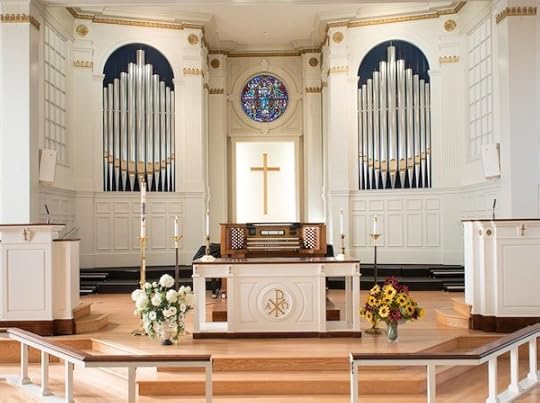
The routine of the church is pretty simple. We begin the week with Sabbath and worship. We take a break from the routines of our lives to rest and give thanks, worshipping God for breath in our lungs, for Grace, and for another day.
Karl Barth wrote, “Christian worship is the most momentous, most urgent, most glorious action that can take place in human life.”
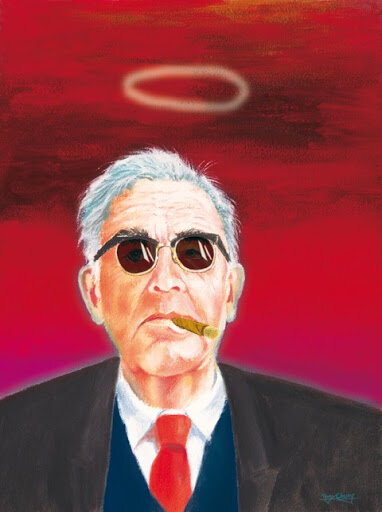
While the routine, the steadiness of our worship has changed in the past week and will continue to be in flux over the coming weeks and months, the act of worship itself does not change. We still bow our heads and pray. We still hold one another, and the world in prayer. We still proclaim the Word of God in song, readings, and poetry. We still use icons and candles to center ourselves, removing the distraction of the chaos swirling around us.
So while I sit here on the floor, I give thanks to God for this moment, for the chance to enjoy a private concert (for free, none the less), and for a chance to take a pause from the chaos around me and worship. Jesus promised that where two are gathered, he is there. The Spirit is moving, I can feel it. Christ is with us.
May the Grace and Peace of Christ be with you, now more than ever.
March 17, 2020
Unity in Distance

Photo by Tim Mossholder on Unsplash
Pentecost of last year I had the joyful opportunity to baptize a sweet newborn. Milana still had the new baby smell and she was everything you want a newborn child to be. Milana was baptized into new life in Christ through the Holy Spirit.
Then, as is the case with many people in the D.C. area, Milana moved. Well, Milana didn’t move per se, her parents were assigned to a new post. I am still not sure how to navigate the temporary stay some people have in D.C. In our corner of Arlington, the average person only lives here for three years but more often than not, these same people move to a new apartment every 18 months.
When someone is baptized, I try to write the sermon with them in mind, whenever possible. This is a great opportunity to remind the entire congregation of the baptismal commitments they’ve made to one another, to “surround one another with a community of love and forgiveness, that they may grow in their trust of God,
and be found faithful in their service to others.”
Milana was baptized on Pentecost which meant she was sharing the limelight with our confirmation class. Since the confirmands where the stars of the show that particular Sunday, I made sure Milana got her time in the sermon.
Here’s what I told her:
The Good News Milana, and everyone who has nodded off by this point, is that we are not in this alone. We are a community of believers, doubters, and skeptics. But Milana, we are committed, just as your parents are, to doing this with you and with one another as part of Christ’s Universal Church. The Holy Spirit will work within you, and as the Holy Spirit works within us - sustaining us in times of suffering, sealing our adoption, and empowering us in the life-changing ministry Christ has called us to and will call you to.
I have not seen Milana since she moved to the other side of the world. She is the same age as my daughter, Nora, and I am sure Milana is now ruling her house, keeping her parents and her little sister on their toes.
I thought of Milana and her family on Sunday morning as we were preparing to live-stream a worship service from the sanctuary of Mount Olivet. These are certainly new waters we find ourselves in and for some reason, I kept thinking about the water I placed on Milana’s head.
When I say I baptized Milana, or I placed water on her head, I mean to say that I am simply the fool God is working through. The means of grace, the water placed on her head - an outward sign of an inward and invisible grace - sealed her as a beloved child of God. There is nothing she or I can do to undo what God has done.
“for in Christ Jesus you are all children of God through faith. As many of you as were baptized into Christ have clothed yourselves with Christ. There is no longer Jew or Greek, there is no longer slave or free, there is no longer male and female; for all of you are one in Christ Jesus.” - Galatians 3:26-28, NRSV
We are not one in our political divisions.
We are not one in our allegiance to a nation.
We are not one in our preference of Coke over Pepsi.
We are one in Christ.
Full stop.
There is no asterisk.
In Baptism, whether you were sprinkled, dunked, poured, or dipped, we are one.
Regardless of when or where you were Baptized, we are one.
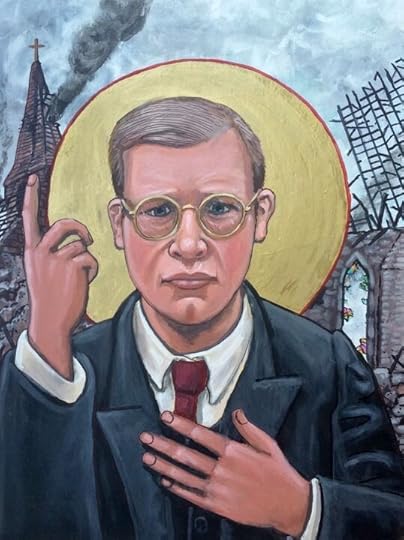
Dietrich Bonhoeffer, Icon - Kelly Latimore
Dietrich Bonhoeffer once wrote, “For Jesus Christ alone is our unity. ‘He is our peace’. Through him alone do we have access to one another, joy in one another, and fellowship with one another.”
We are held together in the faithfulness of Christ, not by our ability to come together whether in times of joy or distress. Left on our own to establish unity, we have no hope. Time and time again, in times of distress or hardship, we retreat into our established tribes and begin to blame the other, those people who are at fault or culpable for the hardship we are experiencing.
What I love about Pentecost is how the Holy Spirit descended and filled everyone. The author of Acts wrote:
“When the day of Pentecost had come, they were all together in one place. And suddenly from heaven there came a sound like the rush of a violent wind, and it filled the entire house where they were sitting. Divided tongues, as of fire, appeared among them, and a tongue rested on each of them. All of them were filled with the Holy Spirit and began to speak in other languages, as the Spirit gave them ability.” - Acts 2:1-4, NRSV
The gathered community in Acts did not fill themselves with the Holy Spirit, in the same way, that we today cannot hold ourselves together or give the Spirit to one another. We depend upon the graciousness of God, through the giving of God’s Spirit and Christ’s promise to always be with us (more on this here). So, while we may be physically distancing ourselves from one another for an extended period of time, away from family members and friends who are closer than family, know that we are not apart. We are not separated, rather we are being held together, through the Grace of God.
If you are an empty-nester or you have a home full of family know that we are together, in prayer yes, but even more so through a power and faithfulness greater than we can imagine.
May the Grace and Peace of Christ be with you, now more than ever.
March 16, 2020
The Stillness is Weird
This morning, sitting in our living room sipping on my morning coffee, I noticed the traffic on our street is rather light. Our house is situated on a hospital route - ambulances drive past our house with lights flashing frequently - and just up the hill from our driveway is a major thoroughfare for Arlington. Every morning as I walk back from taking Camden to the bus I hear the familiar (and calming?) nose of horns honk because someone is on their cell phone and did not notice that the light had turned green. Pedestrians are usually yelling at a car for failing to yield the right of way to the person crossing the street.
When we first moved to Arlington I was warned about this noise. “You’ll get used to it, after a while” I was told, “but it will drive you nuts.” Lucky for me our bedroom window opens to the backyard. While Camden’s room is on the front of the house, dude can sleep through anything (seriously, when the Capitals won the Stanley Cup I lifted him up, shook him in celebration, and he continued snoring).
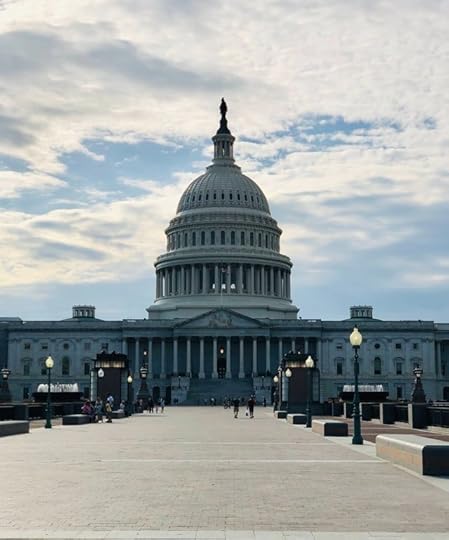
Photo by Chintan Jani on Unsplash
It is never still in Northern Virginia. We live three miles from Washington, D.C. and stillness had escaped us for nearly three years. There is always something to do; always a festival, concert, or sporting event to attend.
All of that has changed.
Things, they’re still here.
Stillness is weird.
Stillness invites us to be present in what’s happening right in front of us, without worrying about catching an Uber to the Kennedy Center or meeting friends for happy hour.
In a world of constant movement, the stillness of what’s happening right now - social distancing to flatten the curve - has left many of us with our hands in the air, not quite sure what to do next.“Be still, and know that I am God! I am exalted among the nations, I am exalted in the earth.” - Psalm 46:10, NRSV
Stillness is a difficult thing, especially when we are searching for answers to questions we may never figure out.
Social media (Facebook in particular) has been a dangerous place for one’s anxiety level over the past few days. Post after post attributing the coronavirus to the wrath of God. The gist is (according to the posters, not me) that we are being punished for the sins of and we’ve had this coming because we have allowed to go unchecked. More often than not these blanks associated with a political stance and not sin.
“Be still, and know that I am God! I am exalted among the nations, I am exalted in the earth.” - Psalm 46:10, NRSV
I’m going to go out on a limb and say that God did not cause the coronavirus. We are not being punished for the sins of .
I know how people can default to a wrathful, revenge-seeking version of God when times are difficult. “If only we prayed more,” they say to themselves or, “if only those sinners weren’t so sinful.” It’s easy in the stillness we find ourselves in to read more into scripture than is there and to ignore the full revelation of God’s word in Jesus Christ.
Many of us are trying to figure out where God can be found in the stillness we find ourselves in. When we ask this question, where is God, we are asking where is Christ? Where is Jesus in the stillness we that have been thrust into?
Christ is with us. Wherever two or three are gathered in his name, we are assured of Christ’s presence. Christ was present yesterday when many gathered for worship online, a new venture for many congregations. Christ is present today with hospital workers, doctors, nurses, and technicians who are working to prevent the spread of this virus. Christ is present in nursing homes and grocery stores. Christ is present in my basement, as I write this while Camden does his school work.
In the stillness we find ourselves in, Christ is present.
Many of us want answers to why we are in this stillness. We want answers to why this stillness doesn’t feel peaceful or still at all. Karl Barth wrote, “When we are at our wits' end for an answer, then the Holy Spirit can give us an answer. But how can He give us an answer when we are still well supplied with all sorts of answers of our own?”
This stillness is not a vengeful God seeking retribution for , nor is this God punishing you for something someone else did. That’s not how this works. But in this stillness, we can pause, and listen for the answers we have been calling out for. We can listen to God in these uncertain times because God has promised to not abandon us in our trials. God has assured us, in and through Jesus Christ, to be with us, always.
“Be still, and know that I am God! I am exalted among the nations, I am exalted in the earth.” - Psalm 46:10, NRSV