Teer Hardy's Blog, page 18
February 9, 2020
Grace and a Straight Razor


On Thursday afternoon Pastor Jeff and I were joking around about the quality and quantity of hair on the heads of two out of the three pastors at Mount Olivet. That conversation got me thinking, because of the expectation of you all, that two out of three of your pastors have hair categorized in the top-ten of United Methodist pastors, I needed to get a hair cut. So this weekend, I headed over to the Neighborhood Barbershop in Falls Church, sat down in Spud’s chair, and I got my ears lowered.

Hair is a big deal in our family. You can’t always tell on Sunday mornings but Camden and I spend more time washing, combing, drying, trimming, and styling our mops that the ladies in our house. You can say we are trying to break the stereotype that guys don’t care about how they look. And let me tell you, it takes A LOT of work to look this good.
When we first moved to Arlington I was anxious about two things: ensuring Camden was admitted into a preschool because we found out we were moving AFTER enrollment at MOPS had closed and finding a barbershop. Allison will tell you when it comes to a barbershop, I am picky (almost to a fault, almost). When we lived in Chesapeake it took me 18 months to find a barber I trusted and then, six months later, we moved. There is a fine line between a salon and a barbershop. There’s something about the smell of talcum powder that takes me back to when I was a kid, getting my hair cut at Cameron Station with my grandfather. The buzz of clippers accompanied by hearing the latest news from the community that puts me at ease.
I’ve noticed something here in Arlington, there are few places we go to where we choose to be in conversation at the least, community when we are at our best, with people who think and look different from us. We tend to self-select into tribes within our neighborhoods and even when choosing which establishments to patronize.

Places like barbershops and cafes become places where we are willing to at the least, sit in a chair or at a table next to someone who looks, thinks, or worships differently than we do. We can choose to skip the neighborhood civic meeting or local dad or mom gathering because of the topic to be discussed or because of the guest speaker, but sitting at a common table in a coffee shop or while having Spud trim up your neckline with a straight razor, it is hard to walk away the moment a conversation turns a direction we don’t want it to or worse a direction we don’t want to consider having any validity over our own strongly held convictions.
In a scene similar to Moses climbing Mt. Sinai and then delivering the Ten Commandments, Jesus has traveled up a mountain, followed by his disciples, and then sitting, Jesus begins what is known as the Sermon on the Mount:
“Blessed are the poor in spirit… those who mourn… the meek… those who hunger and thirst for righteousness… the merciful… the pure in heart… the peacemakers… and those who are persecuted for righteousness’ sake, for theirs is the kingdom of heaven.”
Without a Macbook, access to study Bibles, or a commentary, without a witty opening joke or a story to draw his audience in, Jesus began the flip that will be the hallmark of his ministry. This sermon is what became the basis for the Good News proclaimed by his disciples. This is the Good News we proclaim today.
Those who will find their blessing in his kingdom, the kingdom he proclaimed had come, the Kingdom of Heaven, are those who may have felt as though or been told they were not within the reach of G-d’s blessing.
These were people who may have asked tough questions of the Pharisees and other religious leaders.
The ones who sought peace while living under the peace of Caesar - peace guaranteed by the sword.
Those who were soft-spoken or not given a voice and seat at the table.
Those who suffered because of their commitment to following G-d’s laws, with justice and mercy, as best they could and were unwilling to cave when pressure from the political or religious establishment leaned on them.
What I love most about going to the barbershop or spending time in coffee shops is that commonplaces turn into a means of experiencing G-d’s grace. In coffee shops, avocado toast becomes more than an overpriced brunch item and in the barbershop pomade and scissors are more than a method in which your pastors continue to look their best. Jesus’ invitation is to experience a shared life with those we’ve been told we cannot join at share spaces in our neighborhood. Joining one another at common tables is an invitation to experience the difference a life together, held in G-d’s blessing, can make.
One common space we spend a lot of time in during the summer months is the pool. There is no shortage of pool options in Northern Virginia. At the pool, we see our children’s friends from school, people from church, and the neighborhood. Water slides, splashing, and lifeguard whistles level the playing field, creating a space where all people can come together, relax and enjoy the community together.
This was not always the case. One of the most iconic scenes from Mister Rogers’ Neighborhood took place outside of the Neighborhood of Make-believe. In the spring of 1969, five years after black and white protestors jumped into a whites’ only hotel swimming pool and the hotel owner poured acid into the water, Mister Rogers invited Officer Clemmons, a regular character in the neighborhood, to share a kiddie pool on a hot summers day. Mister Rogers and Officer Clemmons, sitting in lawn chairs they placed their feet into the water. Then the camera focused in on two sets of feet, one set white and the other set black.
At that moment, in a blue plastic swimming pool, the blessing and grace of the common table were shared on televisions and with families in a time when blessing and equality were being determined along racial lines.
Jesus described this moment in his sermon. He was not prescribing a list of tasks but instead told his disciples, and tells us today, exactly what the Kingdom of Heaven will look like.
What you may not know about this scene from Mister Rogers’ Neighborhood is that Mister Rogers and Officer Clemons were friends, dear friends in real life. After appearing on Mister Rogers’ Neighborhood for over a year, the actor who played Officers Clemmons, Francois Clemmons, went to his friend Fred and came out. This is a difficult thing for a person to do in 2020 let alone in 1969. Francois was nervous, afraid his friend who was an ordained pastor would turn him away. He had a secret he had been keeping for nearly everyone. Would Mister Rogers follow through on his song, liking Francois just the way he was? “I will always love you, Francois,” said Fred.
BLESSED ARE THE POOR, THE MEEK, AND THE PERSECUTED.BLESSED ARE THOSE WHO ARE KEPT OUT OF THE TEMPLE, KEPT OUT OF THE CHURCH. BLESSED ARE THOSE WITHOUT THE ABILITY TO SPEAK FOR THEMSELVES.BLESSED ARE THOSE ABUSED, HARMED FOR NO REASON MORE THAN THEY LOOK OR LIVE DIFFERENTLY THAN WE THINK THEY SHOULD.Blessed are those who are told to zip up their identity, hiding it from the world.We experience this blessing and grace every time we gather around common tables and in common places. We experience this, receiving a preview of the realization of the Kingdom of Heaven every time we gather around Jesus’ table of grace and share a meal. This invitation extends into coffee shops, barbershops, and playgrounds. We experience a foretaste of the Kingdom of Heaven when we turn to one another and say, “I will always love you, just the way you are.”
Every time we hear Jesus’ invitation to his table and we share bread and wine, taking seriously his invitation to all people - the poor and the rich, the meek and the powerful, the hungry and those with plenty - we are experiencing the grace and promise of the Kingdom of Heaven.
Jesus’ table is a table of blessing, a common table where the excluded are welcomed and blessed. What we do here this morning, breaking bread, sharing the cup, extends outward to all of the other places we do not want it to happen, where we are told it cannot happen. The grace extended to us by G-d, at this table is a call to extend grace at the tables of our own making - coffee shops and barbershops, playgrounds and lunchrooms.
A place setting has been prepared for you, a chair is open, and no expense has been spared by the host. Jesus is the host of this feast and he has invited us to join him those whose we have neglected to invite.


February 4, 2020
Around the Table


One of my favorite things to do annoys the daylights out of a lot of people. In most of the coffee shops in Arlington, in the middle of the dining area, there stands a common table. The finishing touches of the table vary from shop to shop but the design is the same: a long, narrow table with enough seats for 8-20 people. And here’s what I do that so many people find annoying: I sit next to strangers at the common table and I work.
I sit down to begin writing a sermon (like this one) or to read a book. The person next to or across from me may be working on a laptop or reading and when I sit down I can guarantee one of two reactions. The first, indifference, or a kind gesture, perhaps moving their copy of the New York Times that has crept across the table. The second, a deep and frustrated sigh.
Now I should clear something up. I don’t want you to think I am a psychopath. Whenever possible I leave a chair between me and the person next to me. I love my personal space and want to respect the boundaries of others.
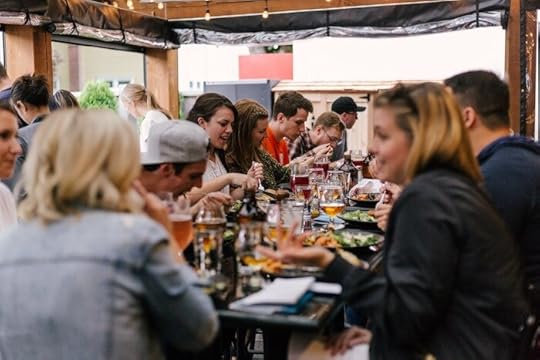
Photo by Priscilla Du Preez on Unsplash
At the common tables and common spaces throughout our community, the boundaries we try to establish between one another begin to fade away and we notice there is a common, shared life we live with one another. I may leave an empty seat between me and the person next to me but someone else will come along and sit down, joining us at the table.
In a scene similar to Moses climbing Mt. Sinai and then delivering the Ten Commandments, Jesus has traveled up a mountain, followed by his disciples, and then sitting, Jesus begins what is known as the Sermon on the Mount:
“Blessed are the poor in spirit… those who mourn… the meek… those who hunger and thirst for righteousness… the merciful… the pure in heart… the peacemakers… and those who are persecuted for righteousness’ sake, for theirs is the kingdom of heaven.”
Without a Macbook, access to study Bibles, or a commentary, without a witty opening joke or a story to draw his audience in, Jesus began the flip that will be the hallmark of his ministry. This sermon is what became the basis for the Good News proclaimed by his disciples. This is the Good News we proclaim today.
Those who will find their blessing in his kingdom, the kingdom he proclaimed had come, the Kingdom of Heaven, are those who may have felt as though or been told they were not within the reach of G-d’s blessing.
These were people who may have asked tough questions of the Pharisees and other religious leaders.
The ones who sought peace while living under the peace of Caesar - peace guaranteed by the sword.
Those who were soft-spoken or not given a voice and seat at the table.
Those who suffered because of their commitment to following G-d’s laws, with justice and mercy, as best they could and were unwilling to cave when pressure from the political or religious establishment leaned on them.
Jesus’ sermon, this first section, is an invitation to a community coming out of exile but now living under occupation, a community oppressed, a community suffering the effects of a corrupt political system to begin living a new ethic.
The words and blessings spoken by Jesus cannot be lived out and fulfilled by any one person. Instead, Jesus’ words of blessing will be realized, fully, when the entire community begins to “live, move, and exist” within the G-d’s kingdom of grace.
Often we hear these ancient words spoken by Jesus and think that first before we can consider the blessing of G-d to be ours we must fit into one the blessed categories listed by Jesus. Before we are blessed we must be poor in spirit, meek, or persecuted.
Jesus was not listing a series of requirements to receive G-d’s blessing. G-d’s blessing of grace is yours.Enjoy it.Hold onto it.Instead, Jesus is putting us on alert, those of us who have felt the blessing of G-d’s grace and give thanks, that while we indeed are blessed, so too are those who have felt outside or apart from the saving work of G-d.
The blessing of G-d we share with our neighbors pulls us out of the siloed lives we create with neatly organized neighborhoods and privacy fences. Jesus’ promise of blessing to the poor, meek, and persecuted, the peacemakers, the hungry and thirsty, is an invitation to us to realize that the Kingdom of Heaven is wider, more expansive than we can ever imagine.
Jesus has turned the common tables in our community into entry points to experience more than overpriced coffee and avocado toast. Jesus’ invitation is to experience a shared life with those we’ve been told we cannot join at share spaces in our neighborhood. Joining one another at common tables is an invitation to experience the difference a life together, held in G-d’s blessing, can make.
One of the most iconic scenes from Mister Rogers’ Neighborhood took place outside of the Neighborhood of Make-believe. In the spring of 1969, five years after black and white protestors jumped into a whites’ only hotel swimming pool and the hotel owner poured acid into the water, Mister Rogers invited Officer Clemmons, a regular character in the neighborhood, to share a kiddie pool on a hot summers day. Mister Rogers and Officer Clemmons, sitting in lawn chairs they placed their feet into the water. Then the camera focused in on two sets of feet, one set white and the other set black.
At that moment, in a blue plastic swimming pool, the blessing and grace of the common table were shared on televisions and with families in a time when blessing and equality were being determined along racial lines.
Jesus described this moment in his sermon. He was not prescribing a list of tasks but instead told his disciples, and tells us today, exactly what the Kingdom of Heaven will look like.
Blessed are the poor, the meek, and the persecuted.Blessed are those who are kept out of the temple, kept out of the church. Blessed are those without the ability to speak for themselves.Blessed are those abused, harmed for no reason more than they look or live differently than we think they should.We experience this blessing and grace every time we gather around common tables and in common places. We experience this, receiving a preview of the realization of the Kingdom of Heaven every time we gather around Jesus’ table of grace and share a meal. This invitation extends into coffee shops, bars, smoothie cafes, and playgrounds.
Every time we hear Jesus’ invitation to his table and we share bread and wine, taking seriously his invitation to all people - the poor and the rich, the meek and the powerful, the hungry and those with plenty - we are experiencing the grace and promise of the Kingdom of Heaven.
Jesus’ table is a table of blessing, a common table where the excluded are welcomed and blessed. What we do here this morning, breaking bread, sharing the cup, extends outward to all of the other places we do not want it to happen, where we are told it cannot happen. The grace extended to us by G-d, at this table is a call to extend grace at the tables of our own making. A place setting has been prepared for you and no expense has been spared by the host. Jesus is the host of this feast and he has invited us to join him those whose we have neglected to invite.

January 29, 2020
You're (Still) Not Accepted

The third episode of Crackers & Grape Juice’s newest podcast is ready for your listening pleasure.
Dr. Johanna, Jason, and I talk about Stanley Hauerwas’ essay whence the pod series name came, “You Are Not Accepted.” The piece is Stanley’s rejection of Paul Tillich’s famous sermon “You Are Accepted” and featured in his book, Unleashing the Scriptures. This provocative critique of the uses and abuses of Scripture in the American church shows how liberal (historical-critical) and fundamentalist (literal) approaches to biblical scholarship have corrupted our use of the Bible. Hauerwas argues that the Bible can only be understood in the midst of a disciplined community of people, where the story is actually lived out by dedicated practitioners.
Before you listen, do us a solid and help out the podcast.
Click over to http://www.crackersandgrapejuice.com. Click on “Support the Show.” Become a patron.
For peanuts you can help us out....we appreciate it more than you can imagine.
https://crackersandgrapejuice.com/show/youre-not-accepted/
https://www.facebook.com/crackersnjuice
January 26, 2020
Do it Again

Subscribe Today & Never Miss a Sermon

Every weekday our family routine follows the same pattern. Here’s a morning sample: we wake, we eat breakfast together, together we panic around 7:25 AM because we are not ready for the five-minute walk to the bus stop.
The details of our morning - what we eat for breakfast, how we brew our coffee or the time we finally roll out of bed - may change during the week but the pattern for ordering our lives stays the same. We eat breakfast at the same table, sitting in the same chairs. We see the same cars and bicycles with the same church people waving good morning around the same time as our pattern and their pattern overlap for a brief moment.
The patterns of our lives intersect, influencing the way we move through the day and week. What appears to be separate journeys are woven together. Our pattern becomes part of your pattern and vice versa.
Our neighborhoods have patterns as well. Every Monday night we hear the sound of trash and recycling cans making their way to the curb. The contents of these containers are affected by the prior week’s pattern which in turn affects the movement of the containers as they settle in their place at the end of the driveway. A gathering of friends may add the clanging of bottlers while at Christmas we hear the sound of cardboard being dragged across the asphalt or gravel of the driveway, and in the spring there will be piles of brush cleared from flower beds to make space for soon to bloom bulbs.
The patterns of our daily routines and shared communities make up the liturgy of lives.
Liturgy is a word typically reserved for Sunday morning gatherings in worship. Liturgy is “the service or worship of God, and particularly the order that is followed in that service.” Put more simply, liturgy is the work the people of the community do together. Even if we think we are not following a liturgy during a worship service, we are. There is always a patter the community uses to navigate our time together, placing our focus on God and not on any individual in the community. We can change a song or prayer during worship and the liturgy stays the same. Even if we were to overhaul the entire order of worship, we would not be ridding ourselves of a liturgy. We would establish a new liturgy, a new pattern by which our community’s worship would be organized.
Jesus has traveled from the banks of the Jordan River eventually arriving in Capernaum. Jesus had not yet turned towards Jerusalem, the religious and political hub of the region. Instead, Jesus stayed in the region surrounding the Sea of Galilee.
Galilee was a region home to revolutionary-zealous movements. Galilee and the cities located in the region were considered to be on the outskirts of the region. Capernaum, even Nazareth (Jesus’ hometown) were removed from the structured patterns of Jerusalem. Galilee is what we would today refer to as a “melting pot.” The liturgy of the community was influenced by those who may not have been comfortable establishing the patterns of their life in an area with stricter adherence to religious law.
It was in Capernaum where Jesus picked up the pattern, continuing the preaching begun by his cousin, John the Baptist - “Change your hearts and lives (Repent)! Here comes the kingdom of heaven!”
In Jesus, the Kingdom of Heaven had come. The Kingdom of Heaven arrived in Capernaum, in Galilee, in a place where the liturgy of the community played fast and loose with the law and the community was not considered Biblically pure. Gentiles lived in the community and the patterns of paganism influenced the patter of Jewish life in the region.
The people living in Galilee still went about their daily liturgy. This is where Jesus found Peter and Andrew, and James and John fishing by the sea. It was amid these men’s daily liturgy, the repetitive routine of mending nets, setting off to fish, returning to shore, selling their catch, and mending their nets that Jesus called them to follow him.
“‘Come, follow me,’ he said, ‘and I’ll show you how to fish for people.’”“Come, follow me, and I will show how to bring people into my Kingdom.”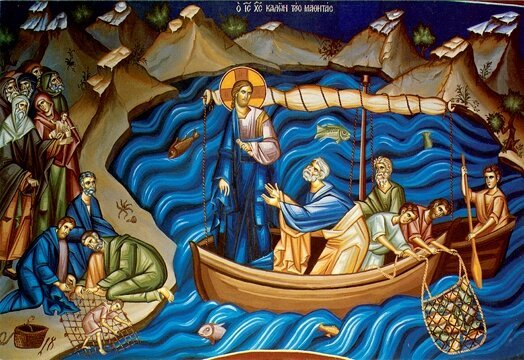
Icon Calling of the Disciples
Jesus’ new pattern for life in the community pulled Peter and Andrew, and James and John from their occupations (fishermen) and vocations (sons) within the community and invited them to not only experience God’s grace but to be instruments of the same grace extended to them.
This new liturgy would take them from the backwoods of Galilee and thrust them into the religious and political hub of the region. Later the liturgy of the Kingdom of Heaven thrust them into the religious and political hubs of the known world for the one purpose: extending the same invitation to the grace of the Kingdom of Heaven.
This morning we are continuing our sermon series: Won’t You Be My Neighbor.
Grace is a word we, people like me and Pastors Ed and Jeff, throw around in the church and rarely define or explore the implications. This “stained-glass” language turns many off not because of its offensiveness (and when we dig down, the unmerited love of God can offend our sensibilities) but rather because those charged with bearing this Grace to the world do not take what we bear seriously. The Grace of God - the unmerited, there is nothing you can do to earn or lose it, love of God - is ours every day of the week. In the nitty-gritty, daily grind we find ourselves in God’s Grace, while we may not recognize it or see it, is ours. Not only is God’s Grace ours, but it is also ours regardless if we want it nor not. God’s Grace is ours to receive and when we step into God’s Grace we are changed and so is the neighborhood.
The invitation to grace was part of what made Mister Rogers and the Neighborhood of Make-believe tick. Fred Rogers was a Presbyterian minister. His calling was to care for children, me and you, in a world that often neglects the intelligence of children in exchange for easy distractions and questions unanswered. Mister Rogers once said, “Love isn’t a state of perfect caring. It is an active noun like struggle. To love someone is to strive to accept that person exactly the way he or she is, right here and now.”
This is grace at its most basic definition, extending love and acceptance to someone exactly as they are, exactly where they are. This is precisely what Jesus did in going to Galilee instead of Jerusalem. Jesus went to a place where the law, the thing that was supposed to guide the liturgy of the community was not always followed. He went to this place and said “Here comes the kingdom of heaven, not because of your ability to follow the liturgy of the community perfectly but because, as you are and where you are, God has come down from on high to heal and share the good news that while we may be filled with sin, God still loves you. God has not abandoned us, leaving us to figure it out on our own. The new liturgy for this community, for the world, we will write it together, guided by God’s love.
The pattern of our community may not always mirror God’s plan but God, in Christ can work with us, guiding us to a new pattern of holiness. This is at the heart of Jesus’ invitation to Change your hearts and lives!” Repent, turn towards God because God’s Kingdom is at hand.
Jesus extended an invitation to the disciples he called by the Sea of Galilee and it is the same invitation he extends to use when we answer his call to follow him and we emerge from the waters of baptism. This invitation is to change the narrative of the community by changing the pattern, changing the liturgy that guides us. The patterns created by our lives together do not change because of anything we do but because we have been changed by Christ’s invitation to grace and cannot imagine doing anything but changing.
A liturgy of grace, the work of God’s love we participate in does not remove us from the weekday and weekend liturgy of the neighborhood. Our work continues.
We go to the bus stop, and there are things to do after the bus pulls away.
We still see Brian riding up 16th Street, and we continue about our day.
We wrestle the trash cans to the curb and then bring it back to the house.

This is why Mister Rogers’ Neighborhood ended each episode with “I’ll be back when the day is new…” Christ’s liturgy grace continues. We get to do this again. Even if we mess it up today the invitation remains and tomorrow, when the day is new, with new ideas and things to talk about we have the opportunity to jump back into the patterns of Christ’s community of grace.
The patterns we engage in now, because of the grace of God and the change in the narrative his ministry sparked, are what author Shea Tuttle describes as “times of holy exchange.” Moments where the good news of God’s reign in Christ touch us and our neighbors.

January 24, 2020
Separation Sadness
“Go ahead. Get your church all cleaned up. Have everyone swear to your cherished ideology. What are you going to do about Jesus? Our Lord refuses to keep reaching out and bringing in the ‘wrong’ people making my church more complicated than I would like it to be. Just wait until the progressive UMC pastor discovers that she’s got folks in her congregation who are just as sexist, racist, and homophobic as the people who walked out? Cure them of their homophobia; next Sunday Jesus will demand that you work on their greed.
If I know anything about Jesus, he’ll show up at the inaugural Sunday of the doctrinally-sound, Bible-believing. WCA-approved congregation with the nicest same-sex couple and their two children. Then what? “
Friend of the podcast and mentor in mayhem, Bishop Will Willimon joins us to talk about the most recent divorce proposal in the UMC, the Protocol for Reconciliation through Grace— a proposal that manages both to sound like a creepy measure in a dystopian science fiction novel (“protocol”) and like a sad euphemism for a break-up.
To read more about the protocol: https://www.umnews.org/en/news/diverse-leaders-group-offers-separation-plan
Willimon’s piece, “Separation Sadness,” will be available soon at Ministry Matters.
Before you listen, do us a solid and help out the podcast.
Click over to http://www.crackersandgrapejuice.com. Click on “Support the Show.” Become a patron.
For peanuts you can help us out....we appreciate it more than you can imagine.
Check out our latest book, Crazy Talk: Stories Jesus Told, as well as our swag store. We have a lot of exciting guests and events lined up for 2020. Until then, Grace & Peace.
January 15, 2020
Without Apology
For Episode #2 of You Are Not Accepted, Stan the Man joins Johanna, Jason, and Teer to discuss the theology of preaching— and why dumbing things down for people just makes for dumb people— from his book Without Apology. Stan shares with us why sermons should be arguments and why listeners should be respected enough to give them the Gospel rather than something allegedly “relevant.”
On each episode of 'You're Not Accepted,' we will discuss a different essay from the one and only Stanley Hauerwas. That’s right, the Hauerwas Mafia is going full Hauerwas! Stan the man will join us periodically and we will do our best to contain Jason the fanboy.
So, that is what you need to know about today’s episode. Enjoy.
https://crackersandgrapejuice.com/show/youre-not-accepted/
https://www.facebook.com/crackersnjuice
https://twitter.com/crackersnjuice
https://www.instagram.com/crackersandgrapejuice/
Before you listen, do us a solid and help out the podcast.
Click over to http://www.crackersandgrapejuice.com. Click on “Support the Show.” Become a patron.
For peanuts you can help us out....we appreciate it more than you can imagine.
January 12, 2020
God Doesn't Forget

Baptism of the Lord - James B. Janknegt
Lord of the Flood, was us with your Spirit that we may be your ark of life, your peace in the sea of violence. Water is life; water cleans; water kills. Frightened, we are tempted to make a permanent home one the ark. But you force us to seek dry ground. We can do so only because you have taught us to cling to our baptisms, where we are drowned and reborn by the water and fire of your Spirit. So, reborn, make us unafraid. Amen. - Stanley Hauerwas, Prayers Plainly Spoken Listen to "God Doesn't Forget - January 12, 2020" on Spreaker.
My mom tells me I was baptized at Faith United Methodist Church in Rockville, MD. I have not set foot in that church in over 30 years. I do not remember playing in the nursery of Faith UMC or being shushed in the sanctuary. I could not tell you where the baptismal font is placed in the sanctuary. I have no idea during which worship service I was baptized or what songs the choir sang.
I do not remember my baptism.This is not an uncommon confession for those of us baptized as infants or children. Many of us do not remember our parents’ pledge to nurture us “in Christ’s holy church,” or the congregation’s response to “surround us with a community of love and forgiveness” so that we might grow in our service to others. I do not remember the water dripping into my eyes.
Was I sprinkled or a pour-over?
Did I cry?
Today, reading Matthew’s account of Jesus’ baptism, we remember our own. During this impromptu therapy session with you this morning it seems ridiculous to ask you to remember your baptism if you cannot remember what you did last week, year, or a decade, let alone remember the when and where of being baptized. In asking you to remember your baptism and be thankful, are Pastor Ed and I being unfair and setting unrealistic expectations? Are we inviting you to lie during worship? To lie in the sanctuary?
The gospels disagree on a lot of things. Details of events - location and timing - do not match from book to book. Entire events are contradicted or worse, omitted altogether. All four of the gospels do tell us Jesus was baptized by John alongside empire colluding tax collectors, thieves, and religious hypocrites.
The Gospel of John leaves out the Nativity and Mark leaves out Easter. Matthew and Luke add to what Mark left out while John is off doing his own thing. But all four of the gospels agree on Jesus’ baptism and crucifixion.
Jesus arrived at the banks of the Jordan River and asked John to baptize him. John’s response to the first words spoken by Jesus recorded in the Gospel of Matthew reflect John’s understanding of who Jesus is:
“‘I need to be baptized by you, and do you come to me?’”
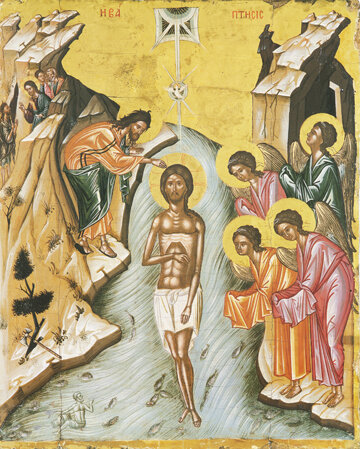
Icon of the Theophany of the Lord
John had been calling people to repent - to turn away from their sins and towards the righteousness of God. John’s invitation was to a human act. John’s offering of baptism in the Jordan River was a symbolic act and would not make you righteous before God. As the waters of John’s baptism washed over the recipients the weight and guilt of their sins remained.
John knew who Jesus was.John knew Jesus was without sin.John knew Jesus was righteous - the righteous one.Jesus was insistent that he be baptized by John, not because Jesus needed to repent and turn towards God but because he was the righteous one, the one without sin and his baptism would “fulfill righteousness,” fulfill our need for righteousness. The judgment preached by John - “Repent, for the kingdom of heaven has come near… His winnowing fork is in his hand, and he will clear his threshing floor and will gather his wheat into the granary, but the chaff he will burn with unquenchable fire.” - this judgment is precisely what Jesus took upon himself as the water in the Jordan passed over his body. Entering into the Jordan River, Jesus entered into the depth of our unrighteousness. In doing so, the connection between his baptism and death - the two things all four gospels agree on - becomes clearer as Jesus emerged from the water and began his ministry.
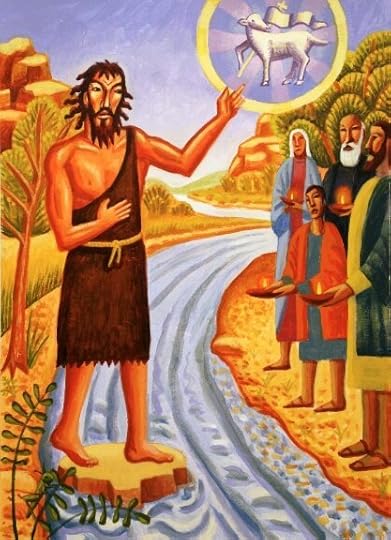
John the Baptist - James B. Janknegt
Assuming our unrighteousness upon himself, Jesus will take our unrighteousness with him to the cross - by the baptism of his suffering, death, and resurrection, Christ has done for us that which we were and continues to be unable to do for ourselves.
We have been made righteous.
We are right before God.
Our justification began in the Jordan River and was realized on the cross when Jesus died for the empire colluders, thieves, and religious hypocrites. John’s baptism of repentance was about soliciting a pardon for us from God. Jesus baptism and our baptism into his death and resurrection is about the work completed by God. The waters of baptism are not a solicitation, no, we are celebrating that in Christ we have received the pardon we could have only hoped for and have claimed the name beloved child of God.
The water we sprinkle or plunge into may look sentimental. After all, on most Sundays our baptismal font is well-places so family photos catch the sun shining from the east side of the building. But this water is outrageous - the grace extended to us and to others is offensive. Attached to these waters, so much that it cannot be strained or filtered, is that because you have been baptized into Christ’s death and resurrection you are forgiven.
Listen to "God Doesn't Forget - January 12, 2020" on Spreaker.You are clean.You are righteous.Your sins, all of them, including that one you cannot forgive yourself for committing, has been washed away.It is done.Once and for all.For everything, full stop.No asterisk.No, if/then prerequisites.Because you have been baptized into Christ you are no longer your sin.You are no longer what sin and death call you.In these waters, God has clothed you with the righteousness of Christ and given you a full pardon. Not because of the one doing the sprinkling or pouring but because Christ took your, took my unrighteousness upon himself, was nailed to the cross, walked out of the empty tomb, leaving our sin and unrighteousness behind.
Professor James Torrance put it best:
“But it is not the water, not the church, not the minister, not my faith, not my dying and rising, which forgives and heals. It is Christ who has done this for us and in us by the Spirit. So we are baptized ‘in the name of Christ’ - not our own name - and we are baptized into a life of union with Christ, of dying and rising with Christ, in a life of communion.”
I remember my kids’ baptism - Camden in February 2014 at Aldersgate United Methodist Church and Nora in November 2018 here at Mount Olivet. I remember pouring water over their heads and making the sign of the cross on their foreheads. I remember pledging to nurture each of them “in Christ’s holy church.” I remember their cries and I have pictures in my office.
On Friday I spoke with the Pastor of Faith United Methodist Church. Rev. Norvell told me I was baptized on August 19, 1984. I was not yet two months old. After talking with Rev. Norvell, no memories were jogged and I did not expect them to be.
Not remembering our actual baptism is squared when we remember that the water we entered into and the pastor pouring, sprinkling, and praying was not the point. In your baptism, you were raised to new life in Christ. You received the pardon, not because of anything you did or because the correct prayer and words were spoken. Not because of the severity of your sins or lack of, no, you have been pardoned and made clean because of everything Christ has done for you. The grace you have received begins exactly where you and others tell you it should end.
Listen to "God Doesn't Forget - January 12, 2020" on Spreaker.Subscribe, Seriously Do It Now
January 10, 2020
Seriously, You're Not Accepted

Listen to "Crackers and Grape Juice Podcast" on Spreaker.
You're Not Accepted.
That is a hard truth to swallow.
Today’s episode is a preview for you, a tasting if you will, of our latest project; 'You’re Not Accepted.' The podcast formerly known as Hermeneutics has received a makeover since we finished our examination of the theological alphabet. For our first episode of 'You're Not Accepted,' we talked with Stanley about his essay in Minding the Web entitled “Preaching in the Ruins.”
On each episode of 'You're Not Accepted,' we will discuss a different essay from the one and only Stanley Hauerwas. That’s right, the Hauerwas Mafia is going full Hauerwas! Stan the man will join us periodically and we will do our best to contain Jason the fanboy.
So, that is what you need to know about today’s episode. Enjoy.
https://crackersandgrapejuice.com/show/youre-not-accepted/
https://www.facebook.com/crackersnjuice
https://twitter.com/crackersnjuice
https://www.instagram.com/crackersandgrapejuice/
Before you listen, do us a solid and help out the podcast.
Click over to http://www.crackersandgrapejuice.com. Click on “Support the Show.” Become a patron.
For peanuts you can help us out....we appreciate it more than you can imagine.
January 2, 2020
Enough in 2020
Like a car fresh off the dealer lot, 2020 still has its New Year smell. Resolutions have been made by many and a few of us are holding out, opting to look for tweaks we can make to our lives instead of extreme overhauls.
If I am being honest, 2019 was tough. I was busy. I felt like I was unable to pause and catch my breath for most of the year. It was not until I began training for the Marine Corps Marathon that I felt like I was able to find space to rest and breathe.
I began 2019 in South Dakota on the Pine Ridge Reservation. I spent some time in Saint Louis for the United Methodist General Conference. I podcasted more than ever with my Crackers & Grape Juice team. Our church became a Reconciling congregation. I graduated from seminary and was commissioned as Provisional Elder. I went on vacation. I published two books. I met with United Methodist Leaders in Kansas City.
On top of all that, I wrote more than I ever had.
In 2019 our family traveled and played. Camden & Nora have grown like weeds. Sometimes it feels like Allison and I were outnumbered.
Early Wednesday morning, 2020 came rolling into town. Allison and I rang in the New Year with Andy and Anderson, live on CNN, from the comfort of our bedroom. We opted for pajamas and craft beer over fancy clothes and overpriced cocktails. It was lovely.
For many, 2020 is a year of hope, or rather, a year where many are looking for hope.
Whether it was the political turmoil driving a deeper divide in the United States or the pace at which we all seem to be moving, I for one was exhausted at the end of 2019. My hope for 2020 is to not only simplify things but also so more at a reasonable pace.
I have noticed a trend moving into 2020. Rather than looking for hope outside of ourselves - ie. new fad diets or fashion trends - many are looking to love as a source of hope in 2020. This isn’t love in the Romantic Comedy sense, but instead loving ourselves and loving one another.
We are enough. Sure, there are always ways we can tweak our day-to-day’s and live better, but the baseline starting point for everyone is this - you are enough, just as you are. The love you seek has been available to you by the Grace of God, regardless if you believe you deserve it, have said the correct prayer, or given money to a televangelist.
“There are two basic motivating forces: fear and love. When we are afraid, we pull back from life. When we are in love, we open to all that life has to offer with passion, excitement, and acceptance. We need to learn to love ourselves first, in all our glory and our imperfections. If we cannot love ourselves, we cannot fully open to our ability to love others or our potential to create. Evolution and all hopes for a better world rest in the fearlessness and open-hearted vision of people who embrace life.”
― John Lennon
I am finding hope in 2020 in my enoughness.
I am enough.
I am enough for my wife to love me.
I am enough in the eyes of my children.
I am enough in the eyes of God.
As a pastor, I tell this to people and rarely listen to the words for myself.
The Psalmist wrote, “I wait for the Lord, my soul waits, and in God’s word, I hope.” The beauty of searching for hope in a New Year is that a week prior to our late-night parties we welcomed the birth of Christ - “The true light that gives light to everyone was coming into the world.”
Christ has entered our world, a light in the darkness, and we can find hope in God choosing to be with us, as we are, in our enoughness.
In 2020, you are enough.
You are enough for those who love you.
You are enough for those who depend on you.
You are enough in the eyes of God.
Leave the extreme life overhauls in 2019. Allow the hope you seek in a New Year to be rooted not in what you need to do but rather in who and what you already are. You are beloved. You are enough.
January 1, 2020
You're Not Accepted

Get ready for the Hauerwas Mafia to do what it does best. We’re going full Hauerwas on you.
Dr. Johanna Hartelius, the host of Hermeneutics, is hosting a new podcast series for Crackers and Grape Juice called You Are Not Accepted: Engaging Hauerwas on Holiness. Every other Wednesday Johanna, Jason Micheli, and Teer Hardy will discuss a writing by the theologian Stanley Hauerwas and oftentimes with Stanley Hauerwas.
On each episode of You’re Not Accepted we will discuss a different essay from the one and only Stanley Hauerwas. Stan the man will join us periodically and we will do our best to contain Jason the fanboy.
The first episode is live. For our first episode, we talked with Stanley about his essay in Minding the Web entitled “Preaching in the Ruins.”
Go ahead and order yourself a copy of Resident Aliens and prepare to be Hauerwas’d.
***Do not worry, the back-catalog of (Her)Men*You*Tics will remain on this feed***
Listen to "You're Not Accepted" on Spreaker.SubscribeSpotifyiTunes