Dan Leo's Blog, page 31
November 28, 2019
"A Thanksgiving Miracle"
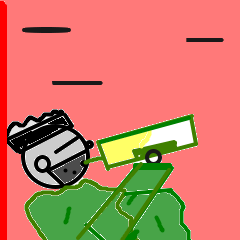
On this cold and grey November afternoon Reggie Wertham sat on an upside down Andy Boy crate in the alleyway next door to Bob’s Bowery Bar, drinking from a quart bottle of Tokay wine. He would much rather have preferred to be sitting and drinking in the warmth of Bob’s establishment, but, alas, he was short of funds, and had only fifty cents in his pocket, which was enough for a cot in the Parker Hotel, the cheapest flop on the Bowery, or, alternatively, the plat du jour at Ma’s Diner, but not both.
The thing to do was to drink the Tokay slowly, to try to savor it and make it last, and not guzzle. But of course Reggie guzzled – he was not a man of great self-control, which was only one the many reasons he was on the bum and had been for ten years.
Suddenly a swell-looking chap in a camel’s hair topcoat tumbled into the alleyway.
“This place taken?”
“Why, no,” said Reggie. “Help yourself, sir.”
The man collapsed against the brick wall and slid down to the cobbles next to Reggie.
“Whatcher name, pal?”
“Reggie,” said Reggie. “What’s your name?”
The man’s chin fell to his chest. He was wearing a nice-looking felt trilby hat, with a blue feather in it.
Suddenly his head popped up again.
“Whatcher name, buddy?”
“Cyrus,” said Reggie.
“Cyrus. The king!” said the man, and his head once again slumped forward.
His shoes were shined, cordovans. His blue socks looked like silk, with tiny black and red clocks.
The head popped up once more.
“Whudjur name, pardner?”
“Jason,” said Reggie.
“Jayzon anna fuggin Argonauts!” said the man, and this time he slumped completely over against the Andy Boy crate.
Reggie shoved the guy’s shoulder.
“Hey, buddy, wake up. This ain’t the Ritz Hotel.”
The man began to snore.
The guy looked like he could spare it, so Reggie got off the box, reached into the camel’s hair, and found the guy’s wallet.
Wow.
Pay dirt.
Three hundred and forty-three dollars, in fifties, twenties, tens, fives, and singles. Reggie put three singles back in the wallet for carfare, he was not a brute, and he stuck the wallet back into the guy’s flannel trousers. He was just about ready to go, when he figured what the hell, pulled the fellow’s camel’s hair coat off, and tucked his own ragged old gabardine around the guy. For good measure he took the man’s hat, and replaced it with his own foul old woolen watch cap. He left the swell his nice suit and shirt, his shoes and socks, but he took his neck tie, which was silk, with a red and grey regimental pattern.
A brief cab ride later Reggie presented himself at the front desk of the venerable Hotel St. Crispian.
“I should like a room, with a view, and I shall pay in advance for one week.”
“Of course, sir,” said Mr. Bernstein, who was used to bearded but well-off eccentrics. For all he knew this not very fresh-smelling fellow was a Nobel laureate, a famous professor, author, or sculptor.
“Would you like me to reserve you a table for dinner, sir? I ask because we still have a table available for the eight o’clock seating.”
“Are you always so busy for dinner here?”
“Ha ha, I wish we were, but, you know, it’s Thanksgiving, and we always fill up for our famous ‘Turkey ‘n’ Trimmings’ table d’hôte.”
Today was Thanksgiving? Reggie had had no idea! After all, a holiday was just another day on the Bowery.
“Yes, by all means,” said Reggie, “a table for one for the eight o’clock seating, please.”
At last, a Thanksgiving with something to be thankful for. In another week he would doubtless be back on the Bowery, but that was the future, and the future was for squares.
(Artwork by the talented rhoda penmarq. Kindly click here to read the fully-illustrated version in A Flophouse Is Not a Home.)


November 24, 2019
"Ten Pages a Day"

Harry Beachcroft had one rule, which was to knock out ten pages a day, no matter how hungover he was. He gave himself one day a week off, Sunday, which meant he could really tie one on Saturday night at his favorite stop, Bob’s Bowery Bar, conveniently located just around the corner from his fifth-floor walk-up at Bleecker and the Bowery.
Today was Monday, a grey November Monday in the year of our Lord 1950. Harry rose at noon as usual, and went down to Ma’s Diner across the street for his usual breakfast, scrambled eggs, scrapple, hash browns, burnt toast, and lashings of black coffee while he read the Times. You never knew, you could get a good story idea from the Times. He left his usual fifty-cent tip, then crossed the street again and went back up to his one-room flat and his battered old second-hand Royal portable.
Harry rolled a blank sheet of paper into the machine and lighted up a Philip Morris Commander. At present he had at least a dozen stories out circulating at the pulps, and three novels (a western, a detective, an exotic oriental adventure) making the rounds of the paperback publishers. He’d finished up his most recent novel on Saturday, so now it was time to start a new “project”. What would it be, a short story, a novel, maybe a serializable novella? As usual, he had no idea. But something always came to him, something clicked in his brain once he’d rolled that blank sheet into the machine and lighted up that first Philip Morris.
Harry started typing:
Barry Beecham had one rule, and he stuck to it. Ten pages a day, no matter what. Rain or shine, horribly hungover or just normally hungover, he always ground out ten full pages before he let himself call it quits for the day and went around the corner to Big Bill’s Bar and that first gloriously satisfying mug of bock.
Barry picked up a fresh sheet of typing paper and rolled it into his old Remington standard, a gift from his father on his matriculation at Yale.
Barry had just finished a story the day before, so it was time to start a new one. What would this one be? A science fiction yarn? An African jungle adventure? Maybe a war story – they were always fun to write, even if Barry had been 4-F (chronic bunions) himself. Whatever, something would come, who knew, maybe a new novel? He had made a cool three hundred bucks from his last one, Range Riders of the Open Steppes, about a band of cowboys in Czarist Russia, pulling off “one last caper” – robbing the fabled Orient Express!
Barry lighted up a Camel, and started typing:
Larry McGarry had one steadfast rule. Ten pages a day. Come hell or high water, that was his quota, ten pages, and he never let himself go across the road to Phil’s Roadhouse for that first cold “English style” ale until he had finished those ten pages…
(Illustration by rhoda penmarq. Click here to read the more lavishly-illustrated version in A Flophouse Is Not a Home.

October 31, 2019
“Try not to be an ass, but…”

If you find you’ve been an ass,
it’s best not to deny it.
Apologize once, and then,
for Christ’s sake, just be quiet.
– Horace P. Sternwall, Songs of the Dumb (1957; an Ace Books paperback original; out of print)

August 7, 2019
The Brawny Embraces
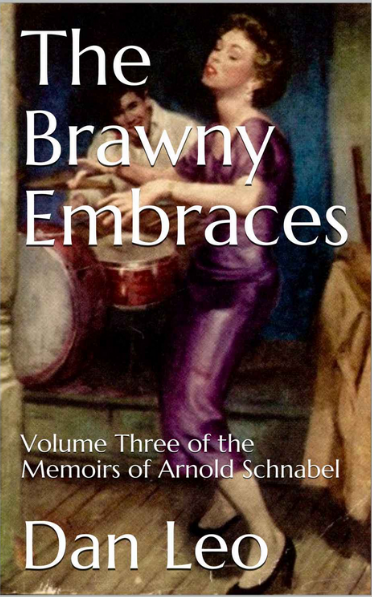
Woo hoo – my new novel is out! This one takes place in Greenwich Village in 1957, and includes no computers or iPhones. Please click on the link below, and support your friendly local novelist. There’s already one hilarious advance review you can read, and if you click on the cover image you can peruse the first fourteen or so pages for free and decide for yourself if this book is just your cup of expresso bongo. And – as a special introductory offer you can purchase this fun-packed 326-page novel for the low, low, crazy low price of only $9.95! Also available as a Kindle e-book.
Click here to buy it, my homies.

June 15, 2019
"Miami Beach"

(Continued from here.)
“Good morning, Gladys, and how was your new year?”
“We stayed in and listened to Guy Lombardo on the radio.”
“Splendid!”
“And how was your new year’s, Mr. Goldsmith?”
Roaring drunk at Bob’s Bowery Bar, but no need to go into all that, so Gerry simply said, “Oh, a cocktail or two with some old friends, heh heh.”
“Here’s your envelope, Mr. Goldsmith, and happy new year to you.”
Gladys handed him the plain envelope and Gerry with his usual casual air slipped it under his threadbare old chesterfield and into the inside breast pocket of his equally threadbare old tweed suit.
“Thank you, Gladys, and may I wish you and your family a most happy new year!”
“Yeah, thanks, but before you go, Mr. Goldstein asked me to ask you to go in and see him when you came in.”
“Oh, dear. Did he say what it was about?”
“Nope. You can head right back. He’s not busy.”
Whatever could it be? Two months in a row that old Mr. Goldstein had asked to see him!
Gerry went through the worn wooden gate, past the reception area and down the hall. Mr. Goldstein’s door was open.
“Mr. Goldstein?”
“Ah, Mr. Goldsmith, come in, sir. Please take a seat.”
Had Gerry’s luck turned again, but this time for the worst? His great fear in life was that somehow his fifty-dollar remittance would be canceled. What could he do if that happened? The thousand dollar inheritance from Aunt Edna, and what was left of his brother Alistair’s hundred dollar “Christmas present” (or bribe, ha ha), would only last so long, and what if he didn’t finish his book and get it accepted by a publisher before the money ran out? He would have to find work of some sort, but what sort of work? Night watchman? Fish monger? Could he be one of those fellows who walked around wearing sandwich boards advertising cheap two-for-one suits? Did those chaps get a staff discount?
“Relax, Mr. Goldsmith, it’s not bad news.”
“Oh, thank God. Could you tell I was worried?”
“You were as pale as a ghost, but I see the healthy color returning to your cheeks even as we speak. In fact I have some more good news for you. Your remittance has been increased from fifty a month to one hundred a month.”
For the first time in his life, Gerry Goldsmith fainted. He had passed out of course, many times, but he had never fainted. Fortunately he had been sitting down, and when he came to he was still in the chair.
“Here, drink this,” said Mr. Goldstein. “It’s whiskey. You like whiskey, don’t you?”
What a question. Gerry drank it down in a gulp and handed the dixie cup back to Mr. Goldstein.
“Feel better?”
“Very much so. Did I dream that you said my remittance has been increased to a hundred a month?”
“It’s no dream, Mr. Goldsmith. All legal. A hundred a month till the day you leave this vale of tears.”
“But, how, why, what?”
“I’m not supposed to tell you, but let’s just say a certain member of your family has added the extra fifty. And the money is guaranteed by a trust for the span of your life.”
“Alistair. My brother Alistair.”
“I am not at liberty to say.”
“He arranged to see me, you know, right before Christmas, and after I hadn’t heard from him for twenty years, and he slipped me a hundred dollars.”
“Guilt.”
“Ha, yeah, maybe. Or more likely just hoping I wouldn’t try to contest Aunt Edna’s will.”
“I can tell you, Mr. Goldsmith, that there were certain, how shall I put this, vaguenesses in your Aunt Edna’s estate.”
Gerry shrugged.
“None of that concerns me, Mr. Goldstein.”
Mr. Goldstein said nothing for a moment, and then he said, “Again, I am not at liberty to divulge details, but, Mr. Goldsmith, I like you, and I just want to say that if you did wish to contest your Aunt Edna’s will I should be glad to take the case, for free, gratis, and for nothing, until or unless you should receive a settlement satisfactory to you.”
“Oh, God, no, Mr. Goldstein. I wouldn’t dream of it. I hadn’t even spoken to my Aunt Edna since since, gee, my college graduation, and I’m sure Alistair needs her money more than I do, what with his house, and three kids, one in college and all.”
“Your brother, Mr. Goldsmith, was a wealthy man even before he received your aunt’s bequest. While you, if you don’t mind my saying so, live on the Bowery, Mr. Goldsmith.”
“Yes, this is true, Mr. Goldstein, I do technically live on the Bowery, but I have my own room, small, but with my own bathroom, and a two-burner hot plate, and my building is kept scrupulously clean even if it is a mite shall we say shabby.”
Mr. Goldstein paused.
There was a carved wooden cigarette box on his desk. He flicked it open, pushed it towards Gerry.
“Cigarette?”
“Sure, thanks, Mr. Goldstein.”
Gerry reached over and took one out. Philip Morris Commander. He was used to rolling his own, so this was a real treat. He lighted it up with the desk lighter in the shape of a fat little Buddha.
“I admire you, Mr. Goldsmith.”
“You do? Whatever for?”
“Because you stick to your guns. You live the way you want to live, and you are a philosopher. How’s the book coming, by the way?”
“Thank you so much for asking, Mr. Goldstein. I am happy to report that I now have nine pages completed and all typed up!”
“Nine pages in a month – not bad. I think Gustave Flaubert would have been more than happy to produce nine pages in a month,” said Mr. Goldstein, without apparent irony.
“I probably would have had a dozen or more pages done,” said Gerry, “but, you know, the holidays.”
“Sure, the holidays, you’ve got to celebrate a little bit.”
Gerry touched his left breast where the remittance envelope was safely secreted.
“So the envelope really contains one hundred dollars?”
“It does, and for every month of your life from here on.”
“What a windfall! I can’t tell you how happy this makes me.”
“Look,” said Mr. Goldstein. “I’m going to be frank. Again, I shouldn’t say this, but I am seventy-two years old and I don’t care. Your brother Alistair is a rich man, and he’s made himself even richer with your late Aunt Edna’s estate. He is hoping to buy you off with fifty dollars a month, whereas, if you pursued the case, there is a very good chance you could come into possession of several hundred acres of prime Miami Beach real estate.”
“Miami Beach? Florida?”
“Yes. You have a very likely claim to the property, or at least a healthy piece of it. It might take a year or two, but you could wind up a well-off man yourself.”
It all struck Gerry as very tedious. Lawyers, depositions, having to show up in court early in the morning, when he loved to sleep late.
“Just say the word, Mr. Goldsmith, and I can start the ball rolling.”
“Miami Beach.”
“Miami Beach. Prime real estate, Mr. Goldsmith.”
“I don’t even like the beach, Mr. Goldstein. Thanks, but I can’t be bothered. I need to concentrate on my book you see.”
Gerry walked out of the building, onto 52nd Street. It was snowing. He took off his old fedora (Brooks Brothers, vintage 1927, graduation present, and unlike his old suit and chesterfield, it fitted him as well as it ever had), and he looked up at the glowing grey sky up there above the tops of the buildings, and he let the cold snowflakes dapple against his face.
One hundred a month. He decided on the spot that he would talk to his landlady Mrs. Morgenstern, and request, no, demand, that she raise his rent from fifteen a month to, what, thirty? No, let’s not go crazy here. Make it twenty-five, that was fair. Fortune had been good to him, and it was the least he could do to spread it around a little.
A cab stopped in front of him. A cab. He hadn’t taken a taxi-cab ride since – since when? Since his college days, with his friends, on a drunken spree.
He got in the cab.
“Where to, buddy?”
“Bleecker and the Bowery, please.”
He would stop off at Bob’s Bowery Bar – it was two-for-one hot dogs on Mondays. He would have four hot dogs, and, to celebrate his good fortune, a couple of mugs of bock to wash them down with. Then, up to his room and the old Royal portable. Just one good sentence maybe, and then a good long nap.
Life was good, and Gerry enjoyed his first cab ride in twenty-eight years, driving downtown through the snowy streets to his home in the slums.
– Miami Beach, and Other Tales of the Bowery, by Horace P. Sternwall, a Pinnacle Books paperback original, 1955; out of print.

June 14, 2019
"The Bodhisattva Is My Buddy"
As he did on every first day of the month – or on the first Monday of the month if the first fell on a weekend or holiday – Gerry “the Brain” Goldsmith made the journey by foot and by subway from his sixth-floor walk-up tenement room at Bleecker and the Bowery to the midtown offices of the firm of Goldstein, Goldberg and Gold to pick up his remittance envelope.
Jerry emerged from the subway at 52nd Street into the bracing cold and looked up at that sky of solid steel grey up there between the buildings of Manhattan that scraped against it.
It was Monday, January the third – a new year!
At the age of forty-eight, Gerry felt that his life had finally turned around. The previous month had been the best month of his life, since – since when? Perhaps since the month of his graduation (barely, but nonetheless) from Harvard, way, way back in that glorious year of 1927, when all of life lay spread out before him like an all-you-can-eat country club buffet. A week after getting his diploma he had boarded a tramp steamer for Calais with his graduation money in his Boy Scout wallet and with the security of his fifty dollars a month remittance (courtesy of the late Grandmother Goldsmith) for the rest of his life.
Yes, fifty a month went a long way in those halcyon days of the late 1920s, even in Paris, where he had lived lazily and contentedly for two years, in his cheap hotel on the rue Claude Bernard with the bathroom down the hall.
But, sadly, as the years passed by after his return to the States (just in time for the crash of ‘29), and as Gerry passed from beamish boy into chubby and dissipated and terminally shabby middle-aged man, that fifty a month had become harder and harder to scrape by on. But Gerry had always remained true to his principles. He had never seriously considered getting a job, even when, as usually happened during the last week of a given month, he had to live on day-old pumpernickel bread and hard-boiled eggs and forgo bock beer and even roll-your-own tobacco, no, he had accepted his lot, and all the while he had continued his work on his great magnum opus, his book of philosophical reflections, begun back in his youthful days of loafing in the cafés of Montparnasse and the Latin Quarter, subsequently filling up dozens of those schoolboy marble composition books all through the grey years, and which, just this past month, he had finally begun “typing up” with his old Royal portable, finally rescued from pawn thanks to the unexpected inheritance of one thousand dollars from his Aunt Edna.
And then there had been that puzzling out-of-nowhere Christmas card from his younger brother Alistair, and their Christmas Eve afternoon meeting at the bar at the Plaza, culminating in Alistair slipping him an envelope containing five twenty-dollar bills. Oh, sure, Gerry knew why Alistair had given him the hundred, hoping to mollify him so that Gerry wouldn’t try to contest Aunt Edna’s will; it was so like boring Alistair. How much had the old girl left Alistair, anyway? A hundred thousand? More? Gerry had no idea, and he didn’t care. If he stretched out that thousand-dollar windfall he might not have to have a bockless and tobaccoless last week of the month for a couple of years, and by that time his book would be finished, perhaps already published, with the royalties just streaming in.
His latest title for the book?
The Bodhisattva Is My Buddy.
Ha ha, just what the reading public was ready for in these dull and humorless commercialized years of the 1950s!
{To be continued.}
The Bodhisattva Is My Buddy., and Other Fables of Our Modern Age, by Horace P. Sternwall; an Ace Books paperback original, 1955; one printing, never republished.

June 2, 2019
"The Albigensian Heresy"
(Continued from here.}
The guy had a name of course, but nobody knew or cared what it was, because in Bob’s Bowery Bar he was known as Funk, short for “Funk & Wagnalls Encyclopedia”, which is what Gerry “the Brain” Goldsmith started to call him because Funk was always showing off how much he knew about everything. “Funk & Wagnalls Encyclopedia” was a little long, though, so pretty soon he just became known as “Funk”, Funk the obnoxious know-it-all.
Billy Baskins had never actually spoken to Funk, in fact Billy hardly spoke to anyone. He was known as a quiet guy in the bar, and no one knew that the reason he was so quiet was that he was an aspiring elegant international assassin, and Billy knew from his magazine stories that a good assassin was always a little mysterious, the quiet type. But Billy couldn’t help but overhear Funk, because besides being a know-it-all, he was loud. But one thing Billy knew, the guy was obnoxious, and nobody liked him. He really was a perfect choice for a practice assassination with Billy’s new pistol.
Billy really wanted not to screw up this job, and so he decided to take his time, to observe Funk, and study his habits, so that he could pull off the assassination at the perfect time and place, like a real professional.
Billy stuck his new pistol into his waistband, put on his old coat and went down the six floors of his tenement and around the corner to Bob’s.
Funk was already there, and you could hear his annoying voice as soon as you came in the door, yammering away in his high-pitched whine.
There were seats open on either side of Funk, because no one wanted to sit next to him, but that didn’t keep him from butting into conversations on either side of him, all the way down to both ends of the bar.
Billy took a stool to the left of Funk and ordered the house bock.
“The Albigensian Heresy?” Funk was saying to the Brain, four seats away. “You want to know about the Albigensian Heresy? I’ll tell you all about the Albigensian Heresy!”
The Brain had been facing the other way, talking to that young poet guy Hector Philips Stone, but he turned around to address Funk.
“Why, no, Funk,” he said, “I don’t want to know all about the Albigensian Heresy, but thank you for offering.”
And he turned back to the young poet.
“I know all about the Albigensian Heresy,” said Funk. “All about it. Y’know what’s really inneresting about the Albigensian Heresy? I’ll tell ya, and this is something most people don’t know, because they don’t read, but I’ll tell ya –”
Suddenly Bob was standing in front of Funk and he rapped his Marine Corps ring on the bar, and everybody knew what that meant.
“Your beer is finished,” said Bob, “and so are you. Now get the hell out of here and don’t come back.”
“What, I can’t talk about the Albigensian Heresy?” said Funk. “What about the First Amendment? What about freedom of speech?”
“I’ll tell you about freedom,” said Bob. “Freedom from loud-mouthed obnoxious know-it-alls like you, which is what I’m gonna have as soon as you take your ass out that door. Or do I have to kick it out the door?”
“Wow,” said Funk. “A guy can’t even have a little conversation.”
“Out,” said Bob. “I ain’t gonna tell you again.”
“Jeeze,” said Funk. “I’m going, I’m going. Wow.”
And he scooped up his loose change from the bar and left.
Billy quickly finished his mug of bock.
“Thanks, Bob.”
“What? Only one?”
“Gotta meet somebody. Maybe I’ll be back later.”
He left a quarter for Bob and quickly walked out. So, a change of plans, but a professional assassin had to learn how to think on his feet. He would have preferred to wait and study Funk’s movements and habits, but it was now or never, because for all he knew he might never see Funk again, and he would have to find somebody else to practice an assassination on.
Outside he saw Funk walking slowly up the block, and Billy quickly followed him. Now was as good a time as any because the street was empty. It was just another cold Tuesday night on the Bowery, and anybody who could be inside and warm was inside and warm. When he was about six feet away from Funk he took out the pistol, aimed, pulled the trigger.
But the gun wouldn’t fire! He kept squeezing the trigger, because in the movies they always said squeeze, don’t pull the trigger, but nothing happened.
He shoved the gun back under his coat. How embarrassing.
Just then Funk stopped and turned around.
“Oh, it’s you,” he said.
“Hi,” said Billy.
“Did you see what Bob just did?”
“I did,” said Billy, joining him, “and I wanted to tell you I don’t think he was very fair.’
“I know! Can’t a guy talk?”
“Sure he can,” said Billy.
“You want to get a drink somewhere?” said Funk.
“Sure,” said Billy.
“You know any good places?”
“Sure,” said Billy. “Come with me, I know a great place.”
His fine mind was working overtime, the way an assassin’s mind should. He led Funk over towards the East River, where he said he knew this one really great bar where they let people talk if they wanted to talk.
When they reached a particularly deserted block of warehouses, Billy interrupted Funk, who was going on about the Albigensian Heresy again.
“Hey, Funk, you know anything about guns?”
“I know all about guns,” he said. “What do you want to know?”
“Well, I bought this pistol, and I know it’s loaded, but when I pull the trigger it won’t fire. Do you want to see it?”
“You mean you have it on you?”
“Yes, I bought it for personal protection.”
“Of course.”
Billy brought out the pistol.
“Ah, a .45,” said Funk. “Service model. So what’s the problem?”
“I pull the trigger but it won’t shoot.”
“Oh, jeeze, weren’t you in the service?”
“No, I was 4-F.”
“Here, gimme.”
Billy handed him the gun.
“Lookit,” Funk said. “You got to rack the slide first, like this, see? That puts a bullet in the chamber.”
“Ah, I get it,” said Billy. “So now it will shoot.”
“No, not yet. You see this little switch here? That’s the safety, you got to flick the safety down like this, and now it’s ready to fire.”
“Safety down, then fire.”
“Correct. Now I’m going to flick the safety up again, which means it won’t fire until you what?”
“Until I flick the safety down again?”
“That is correct.”
He handed the gun back to Billy.
“Thanks, Funk.”
“Actually, my name isn’t really Funk, it’s –”
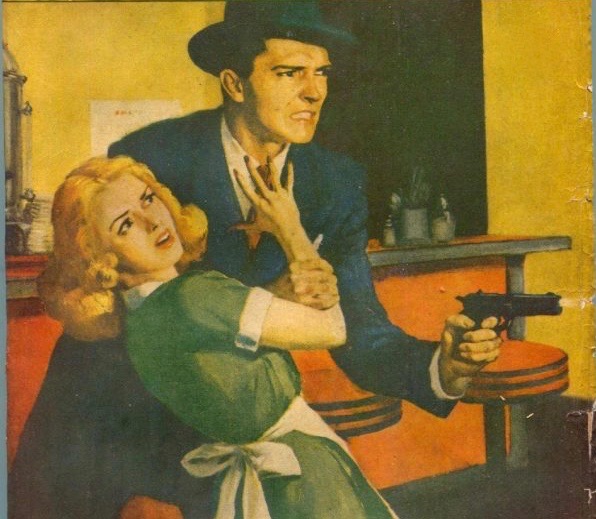
Billy flicked the safety down, pointed the pistol at Funk’s chest, and fired. The pistol jumped in his hand, but he held onto it, and Funk fell backwards.
Billy looked around. Not a living soul. He bent over and looked down at Funk in the pale light of the street lamp. Funk stared up at nothing, and he would never talk about the Albigensian Heresy again.
– The Return of the Last of the Elegant International Assassins, by Horace P. Sternwall, Monarch Books, 1952; out of print.

June 1, 2019
"The Return of the Last of the Elegant International Assassins"
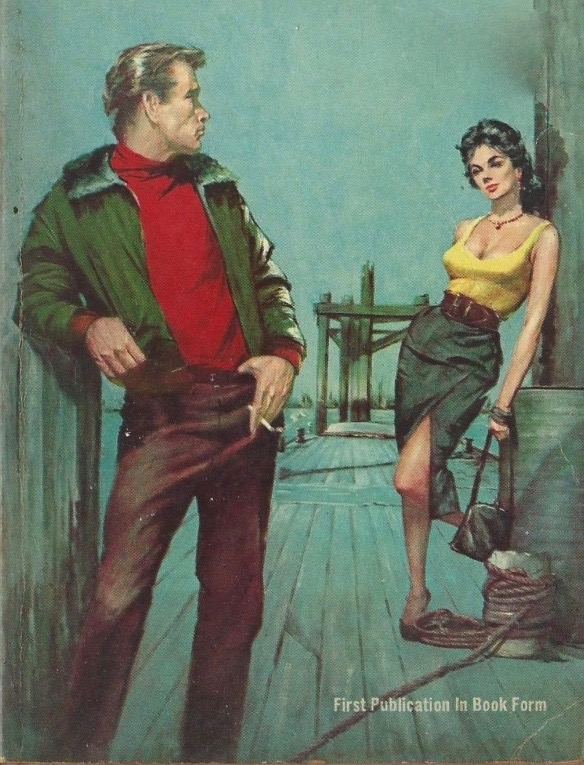
Billy Baskins realized that if he was ever going to become a successful elegant international assassin he would have to learn how to be much more careful.
His first “contract” had proved disastrous. True, he had successfully assassinated Marie McCarthy’s husband Jerry, but only after accidentally also assassinating Marie, who had hired Billy for the job in the first place. And so he hadn’t made a dime from the job. Billy realized later that he should have taken a quick moment to check Marie and Jerry’s persons to see if they had any money on them, but, no, he had been too drunk and panicked to think of that. Anyway, who was he kidding, how much money would a couple of stew bums like those two have on them, especially after celebrating Marie’s birthday in Bob’s Bowery Bar all night?
The first thing Billy decided was that he couldn’t just be assassinating people by hitting them on the head with a brick; he needed to get a gun, like a proper international assassin. This proved surprisingly easy to do, but then, after all, Billy lived in a very poor and crime-ridden slum, so if there was anywhere in the world one could hope to purchase an illegal firearm, where else but the Bowery?
All he did was go up to that gang of teenagers who hung out near Billy’s tenement. They were called the Windbreakers, probably because they all wore windbreakers, but then what did Billy know, maybe they wore windbreakers because their gang was called the Windbreakers?
Billy already knew the kids, because every time he passed “their” corner (northwest corner of Bleecker and the Bowery, right near Bob’s Bowery Bar) he had to give them fifty cents’ “toll”.
So this day, as he was giving their leader Terry his fifty cents, he came right out and asked the kid if he could get him a gun.
“What kind of gun, square man?”
Billy hadn’t given it much thought, but he said, “A pistol?”
Terry paused before answering, and looked up and down the block.
“Meet me in the alley outside Bob’s in one half hour, and bring fifty bucks.”
“Fifty?” said Billy. His savings were daily getting depleted, and it hadn’t occurred to him that illegal guns were so expensive. “Don’t you have anything cheaper?”
“No. But I got a government-issue .45 automatic with the serial number filed, and just because I like you, square man, I throw in a loaded seven-shot ammo clip.”
“Well, okay, then.”
Suffice it to say that one hour later (Terry had been over a half-hour late, and he hadn’t even apologized) Billy sat on his narrow bed in his sixth-floor tenement room holding his new pistol.
Terry had shown him how to pop the clip out and put it back in again, and Billy did this repeatedly, just for practice.
Now, while he was waiting for someone to offer him his next contract, it occurred to Billy that he should try a “practice” assassination.
But who should he assassinate? There were eight million people in this city. Surely thousands of those people would be missed by no one, and so the ethical thing to do (Billy knew that a good assassin always had a code of ethics) would be to pick out someone really obnoxious, someone who had no friends, someone no one would miss.
And Billy knew just the person!
That really boring guy who had started hanging out at Bob’s Bowery Bar lately – the one that they called “Funk”, short for “Funk & Wagnall’s Encyclopedia”, because he was such a know-it-all. Yes, Funk would do, he would do just fine.
(To be continued.)
– The Return of the Last of the Elegant International Assassins, by Horace P. Sternwall, Monarch Books, 1952; out of print.

May 29, 2019
"Wild Times"
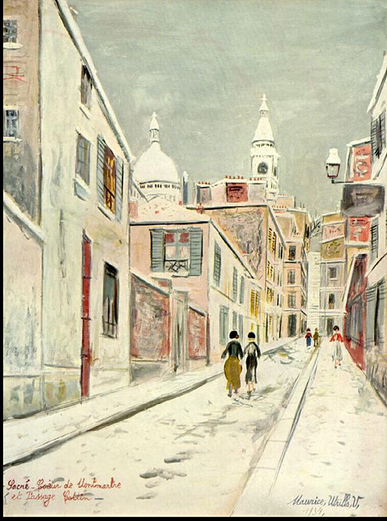
It had been another good day for Gerry “the Brain” Goldsmith; after less than a month of work on assembling his book of philosophical reflections (his latest title: God is Only Dog Spelled Backwards), today he had not only finished his third page, but got a start on the fourth. He left the sheet of paper in his old Royal portable (all ready and waiting for tomorrow’s assault on immortality), pulled on his threadbare chesterfield and left his little room on the sixth floor of his Bowery tenement.
On the third floor landing he came upon his landlady, young Mrs. Morgenstern, who appeared to be prizing up a wad of chewing or bubble gum from the floor with a butter knife.
“And a good day to you, Mrs. Morgenstern.”
“Good day to you, Mr. Goldsmith. How’s the great book comin’?”
“Oh, swimmingly, swimmingly – I started the fourth page today!”
“Fourth page already! By this rate it should be done in another ten years, no?”
“Perhaps, Mrs. Morgenstern, perhaps!”
Gerry continued on down the stairs.
Ah, Mrs. Morgenstern! Would only that he were twenty years younger, or even ten years! Five years? No, that was stretching it…
He went out into the biting but bracing cold and around the corner into the smoky and comforting warmth of Bob’s Bowery Bar.
The after-work crowd was all there, even though most of this crowd didn’t work.
Gerry found an empty stool between Hector Philips Stone (the doomed young romantic poet) on his left, and that strange little guy Billy Baskins, on his right.
Gerry had worked hard today, and now he was due his reward, a fine brimming mug of Bob’s basement-brewed bock.
He had enjoyed that first soul-satisfying deep swallow when suddenly Hector spoke, out of nowhere:
“What was it like in Paris, in the Twenties?”
Paris, in the Twenties.
Two years spent idling in cafés, wandering the streets, going to movies, sleeping the greater part of each day away.
Yes, it had been a good time, or as good as time got.
As good a time as any time of Gerry’s had got.
“It was pretty great, Hector,” he said, and he remembered with fond amusement the one time he had tried to visit the Louvre, only to find the place was en grève, on strike, and he never did manage to make it back there again. It was hard to get to museums when one slept until two or three in the afternoon every day, and it was so much nicer to wake oneself up in a civilized fashion, sitting at a table drinking café au lait, reading an abandoned French movie magazine and watching the girls walk by.
“Did you ever meet Hemingway, or Picasso, or Gertrude Stein?”
Once Gerry had seen Hemingway, he was pretty sure it had been Hemingway, at Shakespeare and Company. Another time he had definitely spotted Picasso at the Dôme. And another time he had stood next to Gertrude Stein when she was buying some apples from a stand.
“Well, you know, Hector,” Gerry prevaricated, “one couldn’t help but run into all sorts of people in those days, in Paris.”
“I guess those were pretty wild times,” said Hector.
Wild times? Was sleeping into the afternoon, sitting in cafés, walking idly around and going to movies what one could reasonably call wild times? No, but why disappoint the young fellow?
“Oh, yes, wild times, Hector, wild times.”
– Wild Times, and Other Tales of Bohemia, by Horace P. Sternwall, a Kozy Book “paperback original, 1935; out of print.

May 27, 2019
"A Christmas Miracle"

It was the first Christmas card Gerry “the Brain” Goldsmith had received since his college days, and it was from his younger brother Alistair, whom he hadn’t heard from in at least twenty years.
Inside the card was written:
“Dear Gerry, I know it’s been a long time but I thought perhaps we could have a drink next week. Could you meet me at the bar at the Plaza on Friday, say, 4pm? Please reply by return post if this is convenient for you. As ever, Al.”
As ever? As far as Gerry knew, Alistair had never liked Gerry. What could this be about? But who was Gerry to be churlish? He had never sent a Christmas card in his life, but he immediately went out to the drug store and bought one, then went to the post office, bought one stamp, and sent it off to Alistair, with a note saying he would be delighted to meet him at the Plaza the following Friday, which happened to be Christmas Eve.
Gerry deliberately arrived fifteen minutes late, because he knew the drinks at the Plaza would be expensive, and he didn’t want to get stuck having to pay for one himself.
Sure enough, there was Alistair. He looked fat, and worried.
“Hi, old buddy,” said Gerry.
“Well, hello there, stranger!” said Alistair, brimming with false bonhomie.
The next half hour soared with tedium.
Alistair had three kids, they were all doing well, one was already at Harvard, carrying on the family tradition. His wife was doing well. His business was doing well. Gerry wanted to scream with boredom. How was it he could happily spend hours at Bob’s Bowery Bar with the bums and degenerates and not be bored, and yet here he was with his own flesh and blood, and all he wanted to do was escape?
Finally Alistair got to the point.
“Anyway, Gerry, I guess you’re wondering why I got in touch after all this time.”
“I must say I was surprised.”
“It’s about Aunt Edna.”
“Aunt Edna? What about her?”
“Well, I mean, about her passing away, and her will.”
“Oh, yes, very sad, but she lived a long life, what was she, eighty something?”
“Yeah, in her eighties. But, look, I heard about what she left you.”
“Oh, really? Well, I must say I was pleasantly surprised she left me anything.”
“A thousand dollars isn’t much, Gerry.”
“To me it’s a lot. You see, it’s allowed me to get my old typewriter out of hock, and so now I can finally finish my book.”
“Your book. Wasn’t that supposed to be a book of philosophy or something?”
“Yes, a book of philosophical reflections. My latest title is Raindrops on a Leaky Roof.”
“Ha ha, clever. So you’re not disappointed?”
“Disappointed? What about?”
“That she only left you a grand.”
“No. Why should I be disappointed? I’ve never had anywhere close to a thousand dollars in my life.”
“Oh, that’s swell, Gerry. I’m glad to hear that.”
And finally Gerry understood. Aunt Edna must have left Alistair a packet, because he worked, because he had a family and was an upright citizen, because he was everything that Gerry decidedly was not, and Alistair was afraid Gerry might make a stink and try to get some more money.
Gerry had never liked Alistair, and he didn’t like him any more now, but when Alistair took an envelope out of his pocket and slid it over to him on the bar top, Gerry took it. He was no one to look a gift horse in the mouth.
“Just a little Christmas present,” said Alistair. “Well, look, I have a train to catch, so have a good holiday, Gerry, and let me know if your book ever comes out.”
Gerry didn’t even open the envelope until he had settled onto his usual stool at Bob’s Bowery Bar. There were five twenties in it. He took one out and put the rest away.
Christmas Eve or not, the bar was filled with all the usual gang. To Gerry’s immediate left sat Hector Philips Stone, the doomed young romantic poet, staring into an empty glass.
“May I buy you a beverage, Hector?”
“Of course you may, Brain,” said Hector. “But I shall not be able to reciprocate.”
“Your lugubrious presence is all the reciprocation I should want,” said Gerry “the Brain” Goldsmith, and he signaled to Bob. “Bob, two bocks, please, and take it out of here.”
Bob didn’t see too many twenty-dollar bills in here, and he held it up to the overhead light.
“I hope it’s not counterfeit,” said Gerry. “It was a Christmas present.”
– A Christmas Miracle, and Other Tales, by Horace P. Sternwall, a Pinnacle Books “paperback original”, 1955; out of print.