Dan Leo's Blog, page 28
June 25, 2020
"Hello, Miss Abernathy"
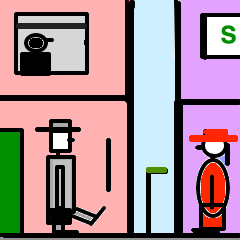
Philip pressed the intercom button.
“Hello, Miss Abernathy?”
“Yes, sir.”
“I feel as if I might be coming down with a virus, so I think I’d better take the rest of the day off, and maybe tomorrow as well.”
“Oh, I’m sorry to hear that.”
“Just to be on the safe side, maybe you’d better cancel all my appointments for the rest of the week.”
“Of course.”
“Better to err on the side of caution.”
“Yes, certainly.”
“I’m going to leave by the back way now. Give me a five-minute head start, then you can let my brother know.”
“I will, don’t worry, and, Mr. –”
But Philip had switched off the intercom.
He got his hat, went out the back door of his office, and walked down the service corridor to the staircase. The last thing he wanted was to meet someone he knew getting into the elevator. As he went down the six flights to the ground floor, he considered the typical itinerary he had followed for his binges ever since rejoining the family firm after the war. First he would hit Joe’s down the block for a quick bracing one before the lunch crowd started coming in, then out the door, and a brisk walk west to the Hi-Low Club on the next block, from there another block west to the Ten Hut, and then a gradual descent downtown through the Irish saloons on Seventh Avenue, and after that the Village bars: Chumley’s, the White Horse, the Kettle of Fish, the San Remo, and so on and so on to the Prince Hal Room at the Hotel St Crispian, where, depending on his state, he would spend the night, before heading off to his final destination the next morning.
But this time, between the mezzanine and the ground floor, Philip had a brainwave.
Why not skip all the preliminaries for once and go right to the heart of the matter? I mean, really, who was kidding who here? What was he trying to prove? He had nothing to prove, and suddenly he felt rather like an eighteen-year-old ball player going right from high school to the majors. And, after all, if he wasn’t a major-leaguer by this point he would never be.
He went out the back of the building and down the alley to the street. It was a sunny warm day in June. Philip raised his hand and an empty cab pulled over at once, so the gods were with him.
He got in, shut the door, sat back, and sighed.
“Where to, buddy?”
“Bleecker and the Bowery, please.”
“What?”
“Bleecker and the Bowery.”
“Bleecker and the Bowery?”
“Yes.”
“Well-dressed gentleman like you? What you want to go down there for?”
“I'm afraid that would be hard to say.”
“You’re the boss, boss.”
The driver pulled out into the flow of traffic. Philip took out his cigarettes, lighted one up, and watched the city drift by the open window.
It would take a while to drive all the way down there, but he was in no hurry now.
No need to rush things. Now was the time to relax.
The buildings and the people on the crowded sidewalks passed by, like a movie, like real life, all these mobs of people going somewhere or other.
Philip knew where he was going.
And Bob’s Bowery Bar would still be there, God willing, whenever he got there.
{Kindly go here to read the “adult comix” version in A Flophouse Is Not a Home, illustrated by the one-and-only rhoda penmarq.}


June 18, 2020
"Ithaca"
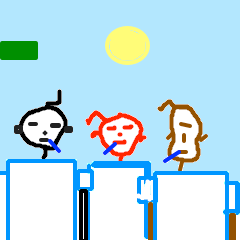
Frank X Fagan, the nature poet, had taken a lot of good-natured ribbing from his fellow poets after that one day when he tried to take a “nature walk”, and had returned to the bar only five minutes later with his friend Howard Paul Studebaker, the western poet, whom he had accidentally urinated on in an alleyway.
“Hey, ya know what?” Frank now said to his fellow poets at their usual table at Bob’s Bowery Bar. “I’m gonna take a walk today, and for real this time.”
“What?” said Scaramanga, the leftist poet. “Go out there in that bright sunlight?”
“Yeah,” said Frank X. “Bright sunlight and all, I’m going for a walk.”
“Great, go then,” said Howard.
“No need to take that tone,” said Frank X.
“I’m sorry,” said Howard. “I’m hungover.”
“We’re all hungover,” said Lucius Pierrepont St. Clair III, the Negro poet. “As usual.” Then he added: “Perhaps a bit more than usual.”
The assembled poets all said nothing to this, but nodded and sighed, because this was the day after Araminta’s famous tea party, and every man jack of them was indeed even more hungover than usual, which was saying a lot for this sorry lot.
“But, dear Frank X,” said Seamas McSeamas, the Irish poet, breaking this unusual spell of silence that had just transpired, “if you take a walk in your present state you may easily stumble in front of a speeding motorcar and get runned over.”
“Thanks for pointing that out, Seamas,” said Frank X. “But I shall try to be careful.”
Hector Philips Stone, the doomed romantic poet, was not even listening anymore, and he didn’t even notice when a half hour later Frank X finally got up, and, after visiting the men’s room, went out into the warm and shimmering June sunlight.
Almost immediately Frank X regretted his decision. It was bright, hot, and everything was ugly. He turned the corner at Bleecker, passed Morgenstern’s cobbler shop and paused for a moment next door at the entrance of the tenement building where he lived in a small room on the fifth floor. It would be nice just to go up and take a three-hour nap, but Frank X knew he wouldn’t be able to sleep, he would only lie on his narrow army cot, staring at the stained ceiling, hating existence, longing to return to Bob’s and to his friends and to a nice cold bock. No, he would forge on.
At the next corner some teenagers wearing T-shirts and jeans stood in his way. The boys all looked malnourished and weak.
“Where you going, man?” said the one kid.
“I’m taking a walk,” said Frank X.
“A walk he’s taking,” said another kid.
“Give us a quarter, daddy-o,” said another kid.
“The hell with you guys,” said Frank X. “I got no quarters to spare for thugs like you.”
“You don’t give us a quarter, we give you no quarter,” said the first kid.
“That’s actually kind of poetic,” said Frank X. “But I’m still not giving you a quarter.”
“You give us no choice but to roll you, buddy,” said this first kid.
“You would roll me?” said Frank X. “A shabby poor poet who barely has a pot to piss in?”
“You’re a poet?”
“Yes, I am, and I am not ashamed to admit it.”
“Tell us a poem.”
“If I tell you a poem will you let me pass?”
“If it’s a good one, yes. If it sucks, we roll you.”
“Very well,” said Frank X. “Let’s see. All right, here we go. I think that I shall never see a poem lovely as my pee. I love to watch it splash into a toilet or into a barroom urinal. This makes me happy, like bock beer washing down a Tuinal.”
“Is that it?” said the first kid.
“Yes,” said Frank X. “If you want a second verse, then you have to give me a quarter.”
For a moment no one said anything, and then the first kid said, “Okay, Mr. Poet Man. You can pass. This time. But if you go by this corner again you got to give us a quarter.”
“How about if I just tell you another poem?”
The kid paused before speaking.
“Maybe,” he said. “If it’s a good poem, maybe we let you pass. Maybe. Otherwise we roll you for everything you got in your pockets.”
“That ain’t much,” said Frank X.
“We’ll be the judge of that,” said the kid. “Now scram.”
Frank X crossed the street. Jesus Christ, he wanted to be back in the bar, but he figured he’d better go at least as far as the next corner, then he could take a right, then another right at the end of that block, back down Bond Street to the Bowery, another right, and then down the block was Bob’s Bowery Bar, his own private Ithaca.
If he walked slow he could at least say he had taken a fifteen-minute walk. Maybe next time he could stretch it out to a half hour, or, say, twenty-five minutes, or twenty…
{Kindly go here to read the “adult comix” version in A Flophouse Is Not a Home illustrated by the illustrious rhoda penmarq.}

June 11, 2020
"Araminta's Good Deed"

It took Araminta all morning and into the early afternoon to clean up her new flat after her big tea party, but it had been worth it, and with all the windows open and the electric fans blowing the smells were all gone, pretty much, or at least should be gone by the next day.
But she still had about a half-dozen assorted small sandwiches left over, and some of the rhubarb pie. Perhaps it would be a nice gesture to make up a little lunch plate for Hector Philips Stone, the doomed romantic poet, who lived on the sixth floor?
The poor chap, so pale and wan, he certainly looked as if he could use a nice lunch. He had said that he rarely went out in the daytime, preferring to stay in and work on his poems, or, if he were drawing a blank that day, to read, or lie in bed and meditate. When Araminta had suggested it might do him some good to get out and take a walk in the fresh air, he had simply replied that he was not fond of sunlight, and if he did take a walk he preferred to walk at night, along dark tenement streets or down by the dock yards. Well, thought Araminta, not for nothing was he a doomed romantic poet! But still, a sandwich or two, a slice of pie, a cup of tea, none of these could hurt, could they?
Araminta made a fresh pot of lapsang souchong, and prepared a nice plate with a double-sized wedge of the rhubarb pie, and three neatly arranged sandwiches: gorgonzola on pumpernickel, liverwurst on rye, ham salad on white bread. She poured a big mug of tea, with lots of milk and sugar (she remembered how he liked it), put the plate and the mug on a tray, and a saucer on top of the mug to keep it warm, unfolded the one clean napkin she could find and laid it over the sandwiches. She paused, wondering if she should add that cunning little vase she had picked up at Mo’s pawnshop, perhaps with one red rose in it, but then thought, no, just a tad de trop…
Carrying the tray, Araminta headed up the stairs from her apartment on the second floor. When she reached the sixth floor she realized that she didn’t know what Hector’s apartment number was. Well, there was nothing for it but to knock at each door until she found the right one! She started at the first door to the right of the stairs.
“I say, hello!” she called, after knocking. “Hello, is anyone
there?”
No one answered. She knocked again, and was just about to call hello again when the door opened inward.
Oh dear, the door had not only been left unlocked, but not even closed all the way!
“Hello,” she called again, “is anyone here?” And straight away she realized how absurd the question was, as the entire tiny apartment was visible at a glance.
Just one room with a Murphy bed closed up against the wall, a lot of books everywhere, a little desk with a typewriter on it, a bathroom with its door open, revealing a toilet and sink and a shower.
This must be Hector’s apartment! He must have gone outside during the day after all – perhaps around the corner to Bob’s Bowery Bar for a “hair of the dog”; he had after all gotten pretty drunk at the party, as indeed had everyone else except for Araminta.
Well, she would just leave the tray for him, with a little note. That wouldn’t be too presumptuous, would it?
Leaving the door open, she went over to the desk, and shoving some papers aside, laid the tray down.
So this was where the magic happened, where Hector wrote his poems!
There was a sheet of paper in the typewriter (an old Royal portable), and she knew she was being nosy, but she just couldn’t help herself, so she read the two sentences that had been typed on it.The only way to be sure not to say something stupid is to say nothing at all.
The previous sentence might well be an example of just what I am talking about.
How clever!
But then the sentences didn’t really seem like poetry, let alone doomed or romantic. Was Hector branching out into the realms of philosophy?
There was a small stack of typing paper to the right of the typewriter, and Araminta couldn’t help but pick it up. She turned it over, and on the first page was typed:
PENSÉES FOR A RAINY DAY
a book of philosophical observations
by Gerard Goldsmith
Gerard Goldsmith…
Gerry! Alias “the Brain”! Gerry “the Brain” Goldsmith, that chubby nice middle-aged fellow! Darn it, now she remembered that he too had said he lived on the sixth floor. What a boner she had pulled. But understandable, of course. And now she felt guilty, because she had thought to bring some lunch to Hector – young and handsome Hector, but had not spared a thought for poor old dumpy Gerry the Brain.
Perhaps she should just leave the tray for Gerry then? Or she could compromise, and leave a sandwich for Gerry, and take the remainder over to Hector? She could leave the sandwich here on the table, wrapped up nicely in the napkin.
But a note would be appropriate. She didn’t want to use up any of Gerry’s typing paper, so she opened a drawer in the desk to look for a notepad. Shuffling through various papers and envelopes she found what looked like a greeting-card box, so she pulled that out. The box looked old and worn, a greyish pinkish color, and printed on its cover in fancy filigree were the words
Plaisirs de Paris
Ah, Gerry had mentioned to her that he had spent a couple of youthful years in the City of Light, back in the late Twenties. He must have kept a box of postcards as a memento of that happy time.
Araminta lifted off the cover of the box, and gasped.
Oh, my!
With trembling hands she lifted out and examined every single post card, all twenty of them, one for each arrondissement of Paris. How many positions! And in Araminta’s naïveté she had thought there were only two, perhaps three or four at most, and this was even after taking the sex ed course at Vassar.
Araminta was brought to from her reveries by the unmistakeable sounds of footsteps on the stairs. Quickly she put all the postcards back into the box, closed it up, put the box back deep into the drawer, shut the drawer, picked up her tray and headed to the door.
Not two seconds after she had closed the door behind her she saw Gerry “the Brain” Goldsmith’s head appear on the stairs.
“Oh, hello, Mr. Goldsmith!”
“Miss Sauvage!” panted Gerry; he was always a bit out of breath after climbing the stairs.
In a matter of only half a minute he made it up the last few steps.
“Well,” he said, “whew! By the way, those stairs aren’t getting any easier! So, what brings you up here to the top of Mount Olympus, Miss Sauvage?”
“Here,” said Araminta, stepping forward and holding out the tray, “I brought you some leftover sandwiches and pie, and a mug of tea, too, so drink it right away before it gets cool.”
“For me?”
“Yes, take it, please, it’s nothing.”
Gerry took the tray.
“Miss Sauvage,” he said, “I am touched –”
“Call me Araminta, and it’s nothing, you’re very welcome, and now I simply must run, you see I have an appointment –”
“An appointment?”
“Yes, doctor’s appointment.”
“Nothing serious I hope!”
“Routine, strictly routine. See you, Mr. Goldsmith!”
And she brushed by him and dashed down the stairs.
“Call me Gerry!” called Gerry, but she was no longer visible, although he could hear her fading footsteps.
Gerry looked down at the tray in his hands.
This was literally the nicest thing anyone had ever done for him.
{Kindly go here to read the “adult comix” version in A Flophouse Is Not a Home with illustratons by the brilliant rhoda penmarq…}

June 4, 2020
"Araminta's Tea Party"

At last Araminta had gotten all settled in at her new apartment, so she decided to throw a tea party for the new friends she had made at Bob’s Bowery Bar, so conveniently located just around the corner. After a month at the Jeanne D’Arc women’s residence over on West 24th Street (no guests allowed), it was such a thrill to be able to entertain!
On moving day Araminta had made friends with two very cool and absolutely divine young dancers and actresses who lived in the apartment next door, Pat and Carlotta, and so of course she invited them. She also invited Hector Phillips Stone (the doomed romantic poet who lived in this very same building, but up on the sixth floor), Seamas McSeamas (the Irish poet), Howard Paul Studebaker (the western poet), Frank X Fagen (the nature poet), Scaramanga (the leftist poet), and Lucius Pierrepont St. Clair III (the Negro poet). She had run into that genial fellow they all called “the Brain” but whose real name was Gerry Goldsmith on the stairs, and it turned out he also lived up on the sixth floor, and so she invited him as well. She decided boldly to cross class lines and invited that cute waitress from Bob’s, Janet, who seemed genuinely surprised at the invitation, but she said she would come, which was nice, and her presence would help to keep the party from being a teensy too male-dominated.
Pat and Carlotta gave Araminta all the “gen” (as they called it) on the best grocery shops and bakeries and delicatessens in the neighborhood, and, most divine of all, steered her to Mo’s Pawn Shop, where she was able to pick up an enormous ancient Russian samovar for only five dollars, as well as a chipped but serviceable gallon-sized teapot and loads of mismatched china and cutlery.
Pat and Carlotta came over to help Araminta set things up. She had three kinds of cake (chocolate fudge, Jewish apple, German marble) three pies (Boston cream, rhubarb, apple), and a platter of assorted sandwiches on white, rye, and pumpernickel, and to wash it all down there was a pound of lapsang souchong from a little Chinese shop over on Mott Street.
The party was due to start at four, but Janet showed up twenty minutes early, and even brought what she called her specialty, an Oreo ice box cake.
“Oh, Janet, you shouldn’t have!”
“Hey, Araminta, you know how many tea parties I been invited to in my life?”
“I should think scads!”
“Nope,” said Janet. “This is my first.”
The boys started rolling in right on the dot at four, and soon enough the lads were making beer runs around the corner to Bob’s. Araminta had a guitar and she played along by ear as Seamas sang several Irish revolutionary songs, Scaramanga sang international revolutionary songs in English, French, Russian, Italian and Spanish, Lucius sang “St. James Infirmary” and “Ol’ Man River”, Howard sang some cowboy songs, Frank X sang “Nature Boy”, Pat and Carlotta sang show tunes, and even Hector ran upstairs for his banjo and came back down and sang a medley of Stephen Foster songs. Finally everyone urged Araminta to sing something.
“Very well,” she said. “If you don’t mind, I should like to improvise something. You see, I am a great believer in the concept of ‘jazz poetry’, and –”
“Shake it, baby!” yelled Scaramanga, who as usual had got a head start on everybody else.
“I beg your pardon,” said Araminta.
“I said shake it, don’t break it, baby!”
“Scaramanga,” said Lucius, “cool it, dude.”
“Wha’d I say?” said Scaramanga.
“Just be cool, man, and let Araminta sing.”
“Sorry, Lucius,” said Scaramanga. “Sorry, Araminta. I get carried away sometimes. Y’see, this is why they drummed me out of the party–”
“Well,” said Frank X, “you’re gonna get drummed out of Araminta’s tea party if you don’t behave.”
“Okay, I’ll shut up. Carry on, Araminta!”
And Scaramanga plopped down in a thrift-shop armchair, his chin dropping to his chest, his eyes closing.
“As I was saying,” said Araminta, “I am a great believer in the concept of shall we say extemporaneous poetry, and so I have been trying to develop a fusion of vocal jazz and poetry, and to that end, I should like to sing a song I shall compose on the spot.”
A chorus of affirmation ensued, and everyone gathered around where Araminta sat on a big cushion on the floor.
She waited until everyone had settled down, then struck a loud and ringing E-minorchord, and began to sing:
Friends, my good friends,
yes, these are my friends
to the bitter ends
of time and tide,
until we take that final ride
in that long black hearse
or, perhaps worse,
are unceremoniously
piled in a lorry
and dumped in an unmarked
grave in Potter’s Field,
with no one there to say
“So long, friend,
it’s been real.”.
Yes, these are my friends;
some call them losers,
some call them boozers,
but these are my friends,
the lost and never found
rolling in the gutter
like trash in the breeze,
hear them lowly mutter,
these my good buddies,
“Ah, gee, ma, why me?
All I ever wanted
was to be free.”
But these, yes, these
are my friends, compadres,
these are my friends, mes amis,
these are my friends,
my friends, you, my pals,
all you chaps, and, yes, you gals,
my friends, my friends
to the ends of the ends
of time’s last ends,
my friends, my friends,
my lovely bohemian friends…
Araminta struck one final ringing E-minor chord, and its reverberations subsided over the hushed room.
When it became likely that the song was indeed over it was Lucius who spoke first, saying simply:
“Wow.”
Then the room erupted in cries of brava and bravissima.
Araminta looked up at all her friends through misted eyes.
Scaramanga now awakened, and rising to his feet he stretched up his right arm with clenched fist and shouted:
“Liberté! Égalité! Fraternité!”
He then sat back down and passed out again, but, no matter, the party was just getting started.
{Please go here to read the “adult comix” version in A Flophouse Is Not a Home, with illustrations by my esteemed colleague rhoda penmarq…}

May 28, 2020
"Bohemian Nights"

“No, man,” said Araminta, addressing all six of the poets at the poets’ table, “you cats don’t understand! I am not a ‘lady poet’!”
“You mean to say,” said Seamas McSeamas, the Irish poet, “you’re one of them transvesticles? Because if you are, you sure fooled me!”
“No, Seamas, I am not what you call a ‘transvesticle’ – a word by the way I have never heard before and which I strongly doubt is even in the unabridged version of The Oxford Dictionary of the English Language – I am indeed a woman – yes, a lady if you prefer such old-fashioned nomenclature, but I most definitely am not a ‘lady poet’!”
She had lost Seamas, but for once he kept his trap shut, not wanting to upset the beautiful lady poet.
“What she’s saying, Seamas,” said Hector Phillips Stone, the doomed romantic poet, “– and please correct me if I’m wrong, Miss Sauvage –”
“Oh, call me Araminta, Hector. We are all fellow poets, and I see no need to stand on formality.”
“Very well, then – Araminta,” said Hector. “So, what I believe you are saying is that you consider yourself a poet first and foremost, and only secondarily a lady.”
“Secondarily nothing,” said Araminta. “I am a woman and I am also a poet, just as I am also presumably a human being. But I refuse to be limited by the appellation ‘lady poet’!”
“Hear, hear!” said Scaramanga, the leftist poet.
“But what I am about to say to you now, my fellow poets,” said Araminta, “may cause you some consternation.”
“Uh-oh,” said Howard Paul Studebaker, the western poet from Hackensack, New Jersey.
“I was born consternated,” said Frank X Fagan, the nature poet who hadn’t been closer to nature than Washington Square Park since 1939.
“Let the little lady speak,” said Lucius Pierrepont St. Clair III, the Negro poet.
“I shall let that diminutive pass for the nonce, Lucius,” said Araminta, “but only for the nonce.”
“My apologies, dear lady,” said Lucius, banned from every bar in Harlem because of his propensity for suddenly and loudly exclaiming his verse, but always welcome down here at Bob’s Bowery Bar, famous for it lenience to exercisers of poetic license. “I know all too well how ill-considered epithets can demean a person’s dignity, and I beg your forgiveness.”
“I may be small of frame and stature,” said Araminta, “but my soul is that of a giant.”
“Hear hear!” said Scaramanga, again, who, truth be told, had gotten an early start this evening and was a few rounds ahead of the rest of the fellows.
“You said you have something consternating to say,” Hector reminded Araminta.
“Oh, right,” said Araminta, “I do, and it’s this. You fellows are all limiting yourselves!”
“We are?” said Hector, who didn’t doubt the truth of what the young lady said in the least.
“Yes,” she said. “Look at you, Hector – a ‘doomed romantic poet’. And you, Howard – a so-called ‘western’ poet.”
“Hey, now,” said Howard.
“You, Frank X –” said Araminta, “an alleged ‘nature poet’! What does that even mean?”
“Um,” said Frank X.
“Scaramanga –,” said Araminta.
“I know, I know,” said Scaramanga, “a ‘leftist’ poet, even though I’ve been drummed out of the Party, supposedly for inebriate conduct unbecoming of a comrade, but you see, dear Araminta, I am still committed to –”
“And you, Lucius,” said Araminta, “how long are you going to get by on being a soi-disant ‘Negro poet’?”
“Wow,” said Lucius.
“And you, Seamas,” she said, pointing a finger at the Irishman, “how long have you been defined by that Barry Fitzgerald brogue of yours?”
“Uh,” said Seamas, for once lost for words.
“We must rise up,” said Araminta, pointing that same finger to the ceiling, that ancient ceiling with its scrollwork barely visible beneath its dark layers of smoke stain, “as poets we must rise up above all limitations on our art!”
“By George, I think you have something there,” said Howard. “I mean, really, why should I limit myself to poems of the prairie and the cattle drive, and of the lonesome coyote?”
Janet the waitress came by with her tray.
“Another round?”
“Same all around, please, Janet,” said Lucius, “and I believe this is my shout.”
“You want another coffee, honey?” said Janet to Araminta.
“Yes, please,” said the lady poet, who was so much more than just a lady poet.
“Have a real drink, Araminta,” said Frank X. “It won’t kill you, and it’s on Lucius!”
“Just coffee, thanks,” said the young poet who just happened to be female. The coffee would keep her up all night, but that was okay, she preferred to sleep during the daytime anyway. And now, just a few weeks after coming down from Vassar, she had finally found a congenial place to spend her nights…
And someday, when I am old, thought Araminta, looking around at her new friends in this smoky bar smelling of beer and whiskey and cheap tobacco, as Tony Winston over at the old stand-up Steinway banged out a spirited rendition of Bud Powell’s “Un Poco Loco”, someday I shall look back fondly on these wild bohemian nights!
{Kindly go here to read the “adult comix” version in A Flophouse Is Not a Home, with illustrations by my esteemed colleague rhoda penmarq…}

May 21, 2020
"Enter Araminta"

It was Monday, “open mike” night at Bob’s Bowery Bar, and as usual Gerry “the Brain” Goldsmith acted as compère. Bob paid him in free basement-brewed bocks for the night, and, come to think of it, this was the closest Gerry had ever come in his life to holding an actual job, unless you counted the book of “philosophical observations” he had been working on for well over two decades (his latest title: Word Is Just a Four-Letter Word}.
“Thank you, ‘Hobo Brucie’,” Gerry spoke into the mike, “for that really stirring rendition of –” Gerry glanced at the sheet of paper in his hand, “’A Flatcar Is My Only Home’, that was really, uh, strangely moving…”
A smattering of applause from the usual Monday night mob.
“Next up we have a newcomer to our little stage, a Miss (I hope I’m pronouncing this correctly) Araminta Sauvage!”
A small young woman dressed entirely in black hopped down from a stool at the bar and walked over to the microphone, neither slowly nor quickly.
“Hi, there,” said Gerry. “Did I pronounce your name correctly?”
“I’ve heard worse,” she said.
“Here, let me just adjust the microphone for you, dear.”
Gerry was not very handy generally speaking, but after a few years of these shindigs he had gotten fairly proficient at adjusting the microphone stand, and so after only a minute or two he finally got the microphone down to the level of the young lady’s lips, which were a very dark red, offset by her paper pale skin, dark eye makeup and dark hair and a jauntily cocked black beret.
“Would you be requiring musical accompaniment?” asked Gerry, gesturing to Tony Winston, who sat at the upright piano with a cigarette in his mouth and a bock in his hand (he too was paid in bocks, for performing the duties of ‘musical director’). “If there’s a song Tony doesn’t know, he’ll fake it, right, Tony?”
“You got it, brother,” said Tony. He played with his combo (the Winstonians) at the Prince Hal Room over at the Hotel St Crispian six nights a week, and this is what he did on his seventh night. Hey, it was free beer, right?
The young woman turned to Tony.
“Can you play something dark?”
“Can I?” said Tony. “How’s this?”
With his left hand he knocked out a ripple of deep dark notes.
“How’s that?” he asked.
“Good,” said the young woman.
“Okay,” said Gerry, leaning down into the microphone, “let’s give it up, ladies and gentlemen, for Miss Araminta Sauvage!”
Another ripple of applause, a few drunken hoots, Gerry made one more slight adjustment to the mike and stepped aside with a bow.
Tony knocked out a few dark chords and another ripple of coal dark notes summoning mental visions of deserted wet city streets at night, and the young woman spoke into the microphone.Because my soul is blackAnd now, whereas before she had been speaking, albeit in a sort of recitativo, she now began to sing, her words oddly matching the dark chords Tony was striking..
I am always on the attack.
Because my flesh is weak
my soul is hard as teak.
Because my life is unreal
my mind is made of steel.
Because my womb is a tomb
I give birth to death.
Can you dig it, daddy-o?
Let me kiss you to death.
Let me ride that big bronco
in that last big rodeo
at midnight when the bleachers
are all as empty as my heart
when all the thrice damned preachers
cry to gods who laugh at them,
yea, even Krishna and fat Buddha
and even my man the Nazz
gives them the razzmatazz.
And looky here, I know this don’t all rhyme,
but book it, man,
‘cause I ain’t got time
for none of that jazz!
Hey, daddy-o,
don’t cramp my free style!
Hey, mama dear,
crack a smile
for your gone, gone daughter
who won’t do what she oughta
even though she knows
someday she’ll be a weird old lady
feeding pigeons in the park,
at this moment now
in this bar so smoky and dark
reeking of piss and cheap beer
she sings this song of freedom,
even though
no one hears
and no one cares,
but she doesn’t care
no, she just don’t care,
daddy-o,
because she dares to dare,
and that is why –I sing this merry air,She stepped back from the microphone, her face expressionless, Tony struck one last discordant but purely fitting chord, for a space of half a minute there was only silence in the bar, not even a single tubercular cough, and then in a great sudden wave came a deluge of applause and cheers and shouts of bravissima.
because I dare to dare,
I sing,
I sing this dark air,
because, because I just don’t care.
“Wow,” said Scaramanga, the leftist poet, “we gotta invite that girl to our table!”
“A dame at our table?” said Howard Paul Studebaker, the western poet.
“Why not a dame?” said Lucius Pierrepont St. Clair III, the Negro poet. “You got something against dames, Howard?”
“We ain’t never had a dame at our table, that’s all I meant,” said Howard.
“That don’t mean we can’t never have a dame at our table,” said Frank X Fagan, the nature poet.
“Especially a good lookin’ little filly like that one,” said Seamas McSeamas, the Irish poet.
“By gum, why not?” said Howard, who even though he was from Hackensack slipped into a western accent when he was deep in his cups. “Let’s invite her over, dag nab it!”
“Maybe she won’t want to come over,” said Hector Phillips Stone, the doomed romantic poet. “Didn’t you guys hear what she was saying? She hates people. And with good reason, too, I might add.”
“Hey.”
The poets all turned in the direction of the person who had spoken.
It was the lady poet, Araminta Sauvage, smoking a cigarette in a black holder.
“Hey,” all six of the poets said, almost in unison.
“You fellas mind if I sit with you?” said the dark young woman.
Suddenly all of the poets stood up, each of them offering her a seat.
And so, for the first time ever, a woman joined the poets’ table at Bob’s Bowery Bar, and none of their lives was ever the same again, not the poets’, not the lady poet’s, not anyone’s.
{Kindly go here to read the “adult comix” version in A Flophouse Is Not a Home, illustrated by my esteemed colleague rhoda penmarq.}

May 14, 2020
"Until They Teach Monkeys"
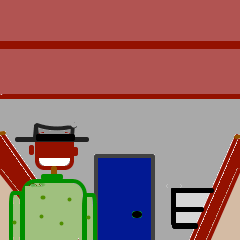
“The only sure way not to say something stupid,” typed Gerry “the Brain” Goldsmith, revising the sentence for the sixteenth time, “is to say nothing at all.”
Whew!
Only one sentence to show for a whole afternoon’s work, but it was a good one!
As usual, Gerry left the sheet of paper in his old Royal portable, all ready for another assault on immortality on the morrow.
But now, the day’s honest toil was done, and it was time for his reward: an imperial pint of the basement-brewed bock just around the corner at Bob’s Bowery Bar.
It was early May, and cool for the time of year, but not cool enough to warrant a topcoat, and so, dressed only in his “new” Donegal tweed suit (new to Gerry, he had bought it at Goodwill when his twenty-seven-years-old Brooks Brothers Harris tweed had finally become too tight to button, either the coat or the trousers) and his trusty old fedora (once an opalescent grey, now the color of mud), he went out the door of his tiny sixth-floor “efficiency” (quite literally a converted storage closet).
On the landing between the third and fourth floors he encountered his landlady, young Mrs. Morgenstern, washing the window with its view of the underside of the “el” tracks.
“Good day, Mrs. Morgenstern.”
“Hey, Mr. Goldsmith, how’s the masterwork coming?”
“Swimmingly, Mrs. Morgenstern,” said Gerry, just as he always did. “And I am happy to say that I now have forty-three pages completed.”
“Not bad, Mr. Goldsmith,” said Mrs. Morgenstern. “That’s about forty-three more pages than I could ever write.”
Suddenly – was it the smell of ammonia combined with the propinquity of Mrs. Morgenstern’s young healthy body in the cramped space of the landing, the smooth skin of her muscular bare forearms, the tendril of dark curling hair that had escaped from under the flowered kerchief on her head, was it spring itself, the month of May, the season of rebirth, was it her deep brown eyes? – Gerry felt the urge to say something. But what? Certainly nothing “fresh” – he wouldn’t dream of it! She was, after all, a married woman, and he, Gerry, despite a lifetime of dissipation, was still a gentleman. And yet he felt this compulsion to say something more than the usual pleasantries.
In later years, when he remembered this moment, as he often did, he recalled, as he did now, that sentence which had been the sole fruit of his labors that day:
“The one sure way not to say something stupid is to say nothing at all.”
But still he felt he must say something and so he said:
“Well, we all do what we can, Mrs. Morgenstern – even if it is just washing windows.”
“Yeah,” she said, “at least until they can teach monkeys to wash windows,” and she dipped the rag she was holding into her bucket.
“Heh heh, yes,” said Gerry. “Well, see you later, Mrs. Morgenstern.”
“See ya, Mr. Goldsmith,” she said, and her strong hands wrung out the rag.
Quickly Gerry went down the stairs, before he could say something else stupid.
{Kindly go here to read the “adult comix” version in A Flophouse Is Not a Home, illustrated by the illustrious rhoda penmarq.}

May 7, 2020
"Nature's Way"

Frank X Fagen the nature poet had had a particularly boisterous night with his fellow poets Hector Phillips Stone (the doomed romantic poet), Seamas McSeamas (the Irish poet), Howard Paul Studebaker (the western poet), Scaramanga (the leftist poet), and Lucius Pierrepont St. Clair III (the Negro poet). Hector had just sold his first book of poems (Love Songs of the Damned) to Smythe & Sons, Publishers, and he had treated his friends generously with his advance money. Normally the poets stuck with the basement-brewed bock, but on this heroic night the Cream of Kentucky bourbon whiskey had flowed like a great flooded river of inebriation, and so when Frank staggered into Bob’s Bowery Bar the next afternoon at around two o’clock all he wanted was a hair of the dog, maybe two or even three.
“A glass of the bock, Bob,” he said, by way of greeting, “and a shot of Cream of Kentucky, but don’t let me order a second shot.”
“What about a second glass of the bock?”
“You can keep the bocks coming.”
After the shot and two glasses of the bock Frank felt the malaise subside, replaced by revived drunkenness and only his usual sense of being just nominally alive. When Bob brought him his third glass he knew he could now relax and take his time. Maybe he would even eat something. The blackboard behind the bar read
TRY TODAY’S SPECIAL
BOB’S MOM’S S.O.S.
ONLY ¢.35
Creamed chipped beef on toast, the perfect day-after meal! But first to drink this glass of bock, and maybe another…
“Jesus Christ, Frank, look at you.”
It was the waitress, Janet.
“My dear Janet,” said Frank, “I assure you the last thing I would want to look at is myself.”
“You were throwing up on the pavement outside last night, and now here you are again, getting your load on again.”
“What else am I supposed to do?”
“It’s a beautiful May day outside and you’re sitting here in this smelly dark bar. Ain’t you supposed to be a nature poet?”
“Well, yes –”
“Then whyn’t you go out and take a nice healthy walk in nature?”
“Go outside?”
“Yeah, go outside.”
“Gee, but –”
“No gee buts. Go outside.”
“Outside.”
“Yeah, outside. What kind of nature poet are you when you spend every day and night sitting getting plastered in a bar?”
Janet had struck close to home.
“Y’know, Janet,” said Frank, “you’re right, you’re absolutely right.”
He lifted up his bock, drank it down in one go, and then, heaving a great belch of satisfaction, he put the thick stubby glass down with a hollow clunking sound.
“Another one, Frank?” said Bob, looking up from his Federal Democrat.
“No, thank you, Bob. I have decided, at Janet’s urging, to go for a walk.”
“You what?”
“I’m going for a walk.”
“Now I’ve seen everything,” said Bob. “And I’ve seen a lot.”
Frank left a quarter tip, almost fell off his stool, and staggered out.
“I hope he don’t walk in front of a garbage truck,” said Bob.
“He might be doing himself a favor if he did,” said Janet.
Outside the bright warm sunlight attacked Frank at once and without mercy, but he couldn’t turn back now. Janet was right, goddammit! When was the last time he had been out in nature? Five years ago? Six? Seven?
He headed right on the Bowery, and again right at the nearby corner on Bleecker. He passed Morgenstern’s cobbler shop and right there next door was the entrance to his tenement building, also owned by Mr. Morgenstern. Should he just go up to his room and take a nap? But no, he knew himself, he would only lie in his narrow bed, unable to sleep, fighting a losing war with the heebie jeebies and longing for a bock – best to keep to his plan! On he walked along Bleecker in the blazing sunlight, breathing the harsh thick smells of this poor quarter of the city. But this asphalt, the dirty concrete and stained bricks, the garbage, the leavings of dogs – was not all this part of nature?
Suddenly Frank realized he had to urinate, and so he ducked into the first alley he saw, the one between Moe’s pawn shop and Fat Chow’s chop suey joint. He unbuttoned the fly of his old tweed trousers, and with a sigh returned some of the bock and bourbon he had drunk to the world.
“Hey, buddy, whatcha doin’?”
The piece of cardboard Frank had been going on lifted up, revealing the face of no other than his friend Howard Paul Studebaker, the western poet.
“Oh, my God,” said Frank, turning his stream away, “I’m so sorry, old man, I didn’t see you there.”
“Oh, well, no hard feelings,” said Howard, sitting up and tossing the wet cardboard aside. “An honest mistake. Buy me a bock and all is forgiven.”
“But I’m taking a walk,” said Frank, buttoning his fly.
“You’re what?”
“Taking a walk.”
“Since when do you take walks?”
“Well, I was sitting at Bob’s having a hair of the dog and Janet shamed me, pointing out that I am a nature poet who spends fine spring days sitting in a bar.”
“You gonna let a woman tell you what to do?”
“But don’t you think it’s a good idea to take a walk now and then, especially on such a beautiful day?”
“What’s so beautiful about it?”
“Um, sunlight, warmth, fresh air?”
“Help me up.”
Frank helped Howard up.
“Did you not make it home last night?” asked Frank.
“What does it look like?” said Howard. “And anyway, a flophouse is not a home.”
“Yes, I suppose you could say that,” said Frank.
“Besides, this alley ain’t so bad,” said Howard. “Until somebody uses you for a urinal, that is.”
“I’m so sorry about that, Howard.”
“All is forgiven, for the price of one imperial pint of bock.”
“Well, that seems fair,” said Frank.
Together the two poets staggered their way back to Bob’s.
“Jesus Christ,” said Janet, when she saw them come through the door. “How long was that walk, Frank? Five minutes?”
“There were unforeseen circumstances,” said Frank.
“In other words you ran into this drunk and he talked you into coming back here to get your loads back on.”
“There was more to it than that, Janet,” said Howard.
“There’s always more to it with you guys,” said Janet.
Over at the poets’ usual table sat Hector, Scaramanga, Seamas, and Lucius, all of them looking ashen and chastened. Frank and Howard went over and joined them.
It was nature’s way.
{Please go here to read the “adult comix” version, illustrated by the illustrious rhoda penmarq…}

April 30, 2020
"Little Ray in Heaven"

Many readers have written letters and postcards asking and wondering, “What ever became of Little Ray the chronic complainer? Did he ever stop complaining?” Well, our motto has always been “Give the People What They Want”, and so, dear reader, read on…
The days and the nights and the years passed, slowly, and yet, in retrospect, all too quickly, and the lugubrious fellow they called Little Ray continued to work at his despised job as a shipping clerk at a fabric factory on Seventh Avenue, and every evening after work he went to Bob’s Bowery Bar and ate whatever the special was and drank Bob’s basement-brewed house bock and complained about his life to anyone he could get to listen to him.
Let’s face it, Little Ray (who wasn’t little, and whose real name wasn’t Ray) didn’t bring much to the great party of life, and nobody knew why Bob didn’t just flag him. Did Bob feel sorry for him? No one knew, but Bob tolerated Little Ray’s baleful presence, and Little Ray knew well enough not to try to complain to Bob himself.
Yes, the days and the nights and the years passed, slowly and quickly, and suddenly it was the future, and flying cars flew down the boulevards and streets, and people in jet packs zoomed up to their offices in the skyscrapers that reached miles into the sky, but still Little Ray worked at the fabric factory (which now manufactured material for space suits) and went to Bob’s Bowery Bar each evening to drink his bock beer and complain to anyone who would listen…
One wet Tuesday evening in April, a tiny old man tapped Little Ray on the shoulder as he sat at the bar hoping that someone would sit next to him so that he would have someone to complain to, and the tiny old man said, “It’s time, Little Ray. Come with me.”
“Can I at least finish my beer?” said Little Ray.
“I am afraid not,” said the little man, “because you’re already dead.”
And Little Ray looked down and saw himself slumped forward over the bar, a victim of a massive fatal thrombosis.
“This ain’t fair,” complained Little Ray.
“Life is not fair,” said the tiny old man, who was an angel named Bowery Bert, “and neither is death. Let’s go, Little Ray.”
“But I’ve never even gone up in one of them flying cars, or flown around in one of them jet packs. I’d like to take one of them excursions to the Moon Colony too. I been saving my money to do that after I retire.”
“Too late now,” said the little man, and suddenly they were both standing at the base of a hill at the top of which was God’s enormous turreted and gabled house.
“Just walk right up there,” said Bowery Bert.
“Do I gotta? I don’t really wanta. What if they send me to hell?”
“Yes, you got to, whether you want to or not. Now be a man and get up there.”
Reluctantly Little Ray walked up the winding stone path through the gardens and shrubbery and went up the steps of the porch to where St. Peter sat at a little table with a big leather book.
St. Peter, a grey-bearded man in a plaid hunter’s cap and a faded yellow canvas work coat, took his pipe from his mouth and said, simply:
“Name?”
“Well, for years they been calling me Little Ray, but –”
“Why ‘Little’ Ray? You look pretty big and fat to me.”
“Um, it’s a shortened version of Little Ray of Sunshine, actually, but my real name is –”
“And why did everybody call you a shortened version of ‘Little Ray of Sunshine?”
“Do we really gotta go into all this?”
“I’ll ask the questions, you answer them. So answer me.”
“Awright, awright, they called me Little Ray short for Little Ray of Sunshine on accounta they thought I complained all the time.”
“And did you?”
“Complain all the time?”
“Yes. Did you complain all the time?”
“Not all the time.”
St. Peter had been turning the pages of his great book, and now he stopped, and put the stem of his pipe on the page.
“Here we go,” he said. “'Little Ray.'”
“They got me listed in there as Little Ray?”
“That’s what everybody called you, wasn’t it?”
“Well, yeah, but –”
“So that’s what you’re listed as.”
“That don’t seem fair to me. That don’t seem very fair at all,” complained Little Ray.
“Quiet,” said St. Peter. “I’m reading. You can complain about how unfair it all is when I’m finished.”
“I wasn’t complaining, I was just saying, I was just making a like observation –”
“I said quiet.”
“Sorry.”
It really wasn’t fair, thought Little Ray. Even in the afterlife he had to be stuck with that awful nickname. Was it his fault that life had been so hard on him? But he kept his trap shut, while St. Peter read the great book, mumbling under his breath and taking occasional puffs on his pipe.
Finally St. Peter closed the big book.
“Jesus Christ,” he said. “You lived sixty-three years and all you did was bitch and moan and complain.”
“It wasn’t all I did. It ain’t fair to say that was all I did.”
“What, because you also slept sometimes? Because the only reason you weren’t complaining every waking hour was because you couldn’t find somebody masochistic enough to listen to your whining?”
“I had a tough life.”
“What about the starving children in China and Africa. You think their lives are easy?”
“I guess not. But still –”
“Never mind. It kills me to do this, but here –” St. Peter scribbled something on a notepad, then tore the note off, folded it once, and held it out to Little Ray. “Take this, go through that door behind you, give it to the person inside.”
“Am I going to hell? Because if I am, I really don’t think it’s fair –”
“Take the paper, go through the door, hand the paper over. Now get out of my sight before I change my mind.”
Little Ray took the folded paper, turned and went through the door, handed it over, and he was led through many vaulted rooms and long corridors until finally the docent brought him to the entrance of what looked like a crowded bar much like Bob’s Bowery Bar.
“Take a seat anywhere, table or bar, and a server will be right with you.”
Little Ray always preferred to sit at the bar, because who could you talk to if you were all alone at a table? Just the waitress, and waitresses never wanted to talk to him.
He made his way through the crowd, and there at the bar he saw many of the old Bob’s Bowery Bar crew who had pre-deceased him: Fat Angie the retired whore, Gerry “the Brain” Goldsmith, Philip the uptown swell, Willie the Weeper, Mushmouth Joe, George the Gimp, Gilbey the Geek, the old guy they called Wine, Tom the Bomb, and a bunch of the poets who never let him sit with them. There was an empty stool between Angie and the Brain and so Little Ray went over and sat on it.
“Oh, my God,” said Angie. “I thought this was heaven, but now look who they let in.”
Little Ray chose to ignore this remark, and the bartender was right there. It was Paddy, the philosophical Irish bartender from Bob’s who had died right around the time when they sent up the first expedition to explore Mars.
“What’ll it be, Little Ray?”
“Can I drink anything I want?”
“Anything you want, as long as we carry it.”
“You got Cream of Kentucky bourbon?”
“No, sorry, that we don’t carry.”
“What about Cyrus Noble?”
“No.”
“What do you got?”
“Heaven Hill?”
“Okay. Give me a Heaven Hill, although I’m not a fan. Can I get a glass of the basement-brewed bock, too?”
“We don’t got a basement-brewed, but we carry a good genuine German bock.”
“I’d prefer Bob’s old basement-brewed bock.”
“Well, we ain’t got that. And anyways, didn’t you drink enough of that stuff back on earth?”
“I liked it.”
“You liked it ‘cause it was cheap. Drink the German bock, Little Ray, and stop your complaining, you just got here.”
“I ain’t complaining, Paddy, I was just saying, just making a observation.”
“Heaven Hill and a German bock,” said Paddy, and he went to fetch Little Ray’s collation.
Angie had turned away from him, so Little Ray turned to the Brain, on his right, who was also turned away, pretending he hadn’t seen Little Ray.
“Hi, Brain,” said Little Ray, loudly.
The Brain turned to face Little Ray, feigning surprise.
“Oh, Little Ray, didn’t see you there, what a pleasant surprise.”
“What,” said Little Ray. “Like you’re surprised they let me in? Let me tell you something, Brain. I wasn’t a bad guy.”
“No one said you were, Little Ray,” said the Brain, already planning to pretend to go to the men’s room and not come back to this seat.
“I wasn’t the worst guy in the world, Brain,” said Little Ray.
“Oh, far from it, I’m sure,” said the Brain.
Little Ray paused for a moment, looking around at the crowded, smoky and noisy barroom filled with chattering and laughing people.
“And you know what else?” said Little Ray.
“Uh, no, what, Ray?”
“This place ain’t so great.”
“No?”
“No. Now don’t get me wrong, Brain, I ain’t complaining.”
“No, of course not.”
“I ain’t complaining, but this joint don’t look that great to me. Again, I ain’t complaining. But I woulda expected something just a little bit more classy, y’know?. But hey, that’s just me. I ain’t complaining. But.”
“But?”
“I’m just saying, just making a, you know, a observation.”
“I see, yes,” said the Brain. “Hey, listen, will you excuse me, Little Ray? I just have to go to the men’s room.”
The Brain had a nearly full glass of what looked like Bob’s old basement-brewed bock, and he lifted the glass, polished it off in three gulps, got off his stool and hurried away.
Meanwhile Little Ray was still waiting for his Heaven Hill and German bock. What, did Paddy have to go all the way to Kentucky for the Heaven Hill and to Germany for the bock? It was busy in here, but it wasn’t that busy, and if Paddy couldn’t handle the crowd they should have another bartender on back there.
Little Ray didn’t want to complain, but still.
{Kindly go here to read the “adult comix” version in A Flophouse Is Not a Home, profusely illustrated by the illustrious rhoda penmarq…}

April 23, 2020
"I Ain't Complaining"
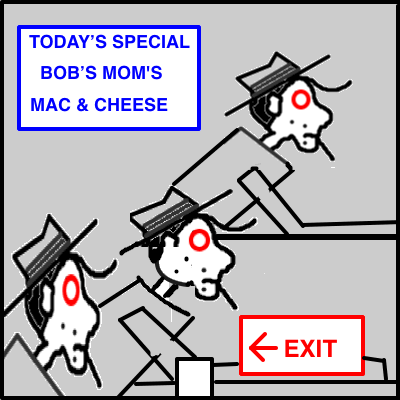
“I ain’t complaining,” said Little Ray. His real name wasn’t Ray and he wasn’t little, either, but everybody called him Little Ray, because one night Fat Angie the retired whore said to him, “Jesus Christ, don’t you do nothing but complain alla time? You’re just a little ray of sunshine, ain’t you? Shut the hell up with your goddam complaining.”
Well, he never did shut up with his complaining, and from that night onward everybody called him Little Ray, short for Little Ray of Sunshine. Hardly anybody even remembered what his real name was, and nobody cared either.
“Lookit,” he said, he was talking to or talking at Philip the uptown swell, down here on another one of his benders, “don’t get me wrong. I ain’t complaining. But these bums at my job, you know what their problem is? They don’t want to work. They want to get paid for doing nothing while I pick up the slack. I ain’t complaining, but it just gets to me, ya know what I mean?”
Suddenly Philip became aware that Ray was talking to him, or talking at him.
“I’m sorry,” he said, “what?”
“I said I ain’t complaining,” said Little Ray, who was a tall fat, disjointed-looking, goofy looking guy with milk-bottle horn-rimmed glasses held together with electrical tape. “I ain’t complaining, but –”
He paused for a moment, gathering his strength to air his many and deep grievances all over again.
“Yes?” said Philip, already losing interest.
“It’s just these lazy bums at my job,” said Little Ray. “They don’t want to work. All they want to do is the least they can get away with, while a guy like me is doing more work than he should be doing –”
“So,” interrupted Philip, “you’re complaining about your job?”
“Well,” said Little Ray, “like I said, I ain’t complaining –”
“You’re not?” said Philip.
“No, I ain’t,” said Little Ray. “I’m only saying. Y’know? I’m only saying that it ain’t fair that I gotta do extra work when these other bums don’t do half the work I do.”
“So you’re complaining about your co-workers?”
“I ain’t complaining, per se,” said Little Ray. “I am only saying. I am only making a observation, Philip. I am not complaining. Nobody likes a complainer.”
But Philip was no longer listening. Little Ray continued to complain but his voice was no more than a meaningless distant buzzing as far as Philip was concerned.
What did Little Ray care?
“Again,” he said, again, “I ain’t complaining, Philip. You understand that. I ain’t complaining.”
He continued to complain, and Philip continued to stare into something that could not be seen here in Bob’s Bowery Bar or anywhere, deep into the swirling multitudinous memories of his life, and even into events and thoughts and sights and sounds he had never consciously remembered before, and might never remember again.
“I ain’t complaining,” said Little Ray. “You understand that, don’t you, Philip?”
For some reason Philip heard this last sentence, and he turned to Little Ray.
“I understand,” he said.
At last Little Ray shut up.
At last someone understood.
He took a sip of the flat and warm bock beer he had been nursing for over an hour in the hopes that Philip would offer to buy him a fresh dime glass. It wasn’t like the guy couldn’t afford it. Everybody knew that Philip was loaded, and came from money, but just try to get these rich bastards to buy you a beer, it was like pulling teeth. Little Ray sighed, and laid the short stubby glass down.
“I ain’t complaining,” he said.
{Kindly go here to read the “adult comix” version in A Flophouse Is Not a Home, illustrated by the illustrious rhoda penmarq.}