
Dan Leo's Blog, page 24
March 25, 2021
“Your Friend From the Mountains”
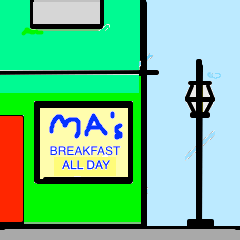
Miss Blotnick opened the door without knocking, came in, and closed the door behind her. She did that sometimes. Philip would have preferred it if she used the intercom, that’s what he had bought it for, or she could at least knock first, but he didn’t have the heart to say anything to her about it.
She came up to his desk and leaned over it.
“There’s a strange dame out there.”
“Do we get any other kind of dames out there?”
“She says she knows you.”
“Did she give you her name?”
“She said to tell you it’s your friend from the mountains.”
“My what?”
“Your friend from the mountains.”
“The mountains?”
“You want me to get rid of her?”
Edna.
“I’ll get rid of her,” said Miss Blotnick.
“No, no,” said Philip. “Please show her in, Miss Blotnick.”
“Don’t forget you got to be in the courthouse at one.”
“I won’t forget.”
“All right.”
Miss Blotnick went out, and a minute later she showed Edna in. Miss Blotnick stood in the doorway. Philip came around from his desk.
“You can close the door, Miss Blotnick.”
She shut the door.
Edna stood there, in a smart grey suit and pale blue coat, with a black leather shoulder bag, a blue pillbox hat.
“I like your secretary,” she said.
“She’s very protective of me,” said Philip.
They didn’t shake hands, let alone kiss or embrace. They had never got that far in the physical realm.
“Can I, uh, take your coat, or –”
“I’ll keep it on.”
“Won’t you sit?”
She sat in one of the two armchairs facing his desk, and Philip resumed his seat behind it.
She took off her gloves, white gloves, dropped them in her purse, took out her cigarettes. Herbert Tareyton cork tips. Up in the mountains she had usually bummed his Luckies. Philip leaned across the desk and gave her a light, then he lighted one of his own.
“I had to do some serious detective work to find you.”
“Oh really?”
“Yeah. I called your firm and they told me you had started up your own practice down here.”
“As you see!”
“So I guess this isn’t what they call a white shoe firm.”
“Ha ha, far from it.”
“I guess this is a slum, right?”
“Well, let’s say low income.”
“So you wanted a change?”
“Yes, I wanted a change.”
“People, places and things.”
“Yeah, that sort of thing.”
“How do you like it?”
“It’s okay. It’s very different from what I’d been used to.”
“I’m sure it is. You staying off the sauce?”
“Yes.”
“Me too. But I only got home a couple of weeks ago.”
“And how’s it going?”
“I go to these suburban AA meetings every day.”
“And how are they?”
“An absolute scream.” She looked around, at his empty walls. “My husband thinks I should get pregnant and we can start living a normal life.”
“Well, why not?”
“I’m bored out of my skull, Philip.”
“If you have a child you won’t be bored.”
“Yeah, you’re probably right. And if I have two or three or four kids I’ll be really not bored.”
“Maybe you should pursue a career?”
“Yeah, maybe. You know, you could decorate this office a little bit.”
“I keep thinking that, but ever since I moved in here I’ve been so busy.”
“Lots of clients, huh?”
“You wouldn’t believe.”
“Poor people?”
“Yeah, most of them don’t have too much money, or any money.”
“How do they pay you?”
“It seems that most of them don’t.”
“You’re too kind, Philip.”
“Maybe.”
They didn’t say anything for a minute, but they had both gotten used to long silences at the sanitarium, up in the mountains.
“You look good, Edna.”
“You too, Philip.”
There was a lot to say, a lot they could have said.
“Tell you what,” said Philip, “do you want to go for a bite of lunch?”
“I don’t want to keep you from your work.”
“I have to eat lunch anyway.”
“Okay.”
“There’s a diner right down the block here.”
“A diner.”
“You’ll like it, it’s called Ma’s Diner.”
“Ma’s Diner.”
“No, it’s good.”
“I’ll bet.”
“It’s not the Stork Club.”
“Thank God.”
“I have to be downtown in court by one.”
She looked at the slim golden watch on her wrist.
“Shall we go then.”
Philip got up.
Would they have an affair, or would they just talk, or not talk, as they had back at the sanitarium, during their walks through the grounds and the woods and along the roads with the snow banked up high as their heads…
In the reception area Philip took his topcoat and hat from the clothes tree and said, “We’re just going down to Ma’s for lunch, Miss Blotnick.”
“City Hall, Mr. Philip. One o’clock.”
“I won’t forget.”
He opened the door for Edna, and they went out onto Bleecker Street.
{Please go here to read the “adult comix” version in A Flophouse Is Not a Home, illustrated by the illustrious Rhoda Penmarq…}


March 18, 2021
“Every Day Is St. Patrick’s Day When You’re a Drunk”
It was one thing to avoid places, another to avoid things. But it was quite another thing to avoid people.
One cold March evening, after a late day at his office, Philip was about to go into Ma’s Diner for his supper, and some shabby-looking guy leaning on a cane near the entrance stuck his hand out.
“Spare a nickel for a cup of coffee for a disabled veteran?”
The guy seemed familiar, but then so many people seemed familiar,
Philip always tried to keep a handful of coins in his pocket. He lived and worked one block from the Bowery after all.
“Here ya go, fella. Take a quarter.”
“Jaysus fuck, if it ain’t old Philip his own self!”
Suddenly the man’s nondescript whining mumble had transformed into a full-throated Irish-accented shout, but Philip still couldn’t place him.
“Doncha know me, Phil-o? You ain’t suffered a bout of brain fever, God forbid.”
The man who had at first seemed hunched-over, crippled, sickly, at death’s front steps if not at its door, now stood erect, vibrant and red-faced, and holding his cane like a club.
“I, uh,” said Philip, “um, I’m afraid you have me at a disadvantage, sir.”
“It’s me, Seamas!”
“Seamas –” And suddenly with a rush Philip saw the red sweating faces of a score of drunken Seamases on a score of drunken nights, pounding his back and the bar top and shouting and laughing in the chaos of Bob’s Bowery Bar as Philip bought him pint after pint of bock and endless shots of Jameson’s whisky. “Oh, hi, Seamas, good to see you again.”
“Where ya fuckin’ been, ya old fucker? I ain’t seen ya in half a year!”
“Well, in fact I was in a sanitarium, Seamas.”
“Ya don’t say? A touch of the consumption perhaps?”
“No, just alcoholism, I’m afraid.”
“Is that all it was? Not a state institution I hope?”
“No, this was a nice private place upstate in the mountains.”
“Lovely.”
“Yeah, it’s pretty nice there.”
“A good rest then?”
“Yes, it was good. I was there for five months this time. I needed it –”
“Ah, the best thing for ya now and then. Give the system a bit of a rest, get your strength back and then come back roarin’ for more.”
“Uh, yes, heh heh –”
“Ya wouldn’t have a gasper on ya, would ya, Phil-o?”
“Oh, of course.”
Philip took out a pack of cigarettes, Seamas took one, and then cocked his head.
“Might I just have another for later, old man?”
Philip took out a cigarette for himself and then told Seamas to keep the pack.
“Ah, you’re all right, Phil-o,” said Seamas, as Philip gave him a light. “I don’t care what nobody says about ya. You’re A-okay in my book.”
Philip lighted his own cigarette. He knew roughly where this was all going, but he also knew he had to play it out.
“Goin’ into Ma’s for a bite to eat, were ya, Phil-o?”
“Yes.”
“Good food in this place, man. The best. But you know what’s a close second?”
“Delmonico’s?”
“Ha ha, no. Ya know what’s a good second for a reasonable bite to eat?”
“The Stork Club?”
“You’re killin’ me, man. No. It’s Bob’s Bowery Bar. You ever try the Mulligan Stew at Bob’s?”
“I might have –”
“Bob’s Mulligan Stew, man. Bob’s old mom makes it. They calls it Bob’s Mom’s Mulligan Stew. Get yourself outside a big plate of that, sop it up good with a couple of Bob’s mom’s fresh-baked rolls, and you’re all set for a good night’s roisterin’ and singin’, spoutin’ roundelays and epic pomes to beat the band.”
“Sounds good.”
“Now, nothin’ against the food here in Ma’s Diner, mind ya, nothin’ at all, but Bob’s Mom’s Mulligan Stew? Forget it, man. Of course to truly appreciate it you’ve got to wash it down with a couple of pints of Bob’s proprietary basement brewed bock, and, oh, that’s heaven, man. And you can keep your heaven with its choirs of angels with their harps and white robes, you just give me a bowl of Bob’s Mom’s Mulligan and a couple of pints of bock, and that’s your man, every time.”
“I’ll bet.”
“So what say we head over there right now, just the two of us. A couple big plates of the Mulligan, a couple or three pints of the bock, and you can tell me all about your vacation at that fine sanitarium up in the mountains.”
“Well, here’s the thing, Seamas, your suggestion really does sound good, but I’ve given up drinking.”
“What?”
“I’ve stopped drinking.”
“What, even bock?”
“Yes, I’m afraid so.”
“What about plain beer?”
“That too.”
“So you’re sayin’, and correct me if I’m wrong, that you have abjured and renounced all alcoholic beverages?”
“Yes. I know it’s hard to believe.”
“May I ask you one question, Phil-o?”
“Sure.”
“If it ain’t too personal.”
“Go right ahead.”
“Why?”
“Why?”
“Why.”
“Why have I quit drinking?”
“You’ve hit the nail on the head, Phil-o. Why?”
“Well, I just got, you know, sick and tired of the continual cycles of drunkenness and hangover –”
“Okay. Fair play. I can see that.”
“Also, I realized I was killing myself.”
“Okay again. I see your point there.”
“And I was wasting my life.”
“And that’s one way of lookin’ at it, no denyin’ that.”
“And in the mountains I started to enjoy life being sober.”
“Now what do you mean by enjoy life?”
“Just the little things. Not being hungover –”
“Not being hungover.”
“Yeah.”
“But don’t you miss the madness, man? The sheer rip-roaring foot-stompin’ cock-slappin’ fuck it all of it all.”
“Well, a little, maybe.”
“So let’s go, old stick, you and me. Now as you might have guessed I’m a bit short at the moment, but if you can stand me a night’s drinkin’ I’ll make it up to you.”
“Well –”
“And I know what you’re thinkin’, Seamas will buy me one bock in ten if I’m lucky, but think of the good fellowship, man. Think of the songs I’ll sing, the pomes I will shout, the tall tales I will tell.”
“Yes, it does sound pretty entertaining.”
“Then why are we wastin’ time here, Phil-o?” Seamas put his big hand on Philip’s arm. “Let’s go, pal. You and me. Once more into the breach, full speed ahead and fuck the torpedoes.”
“I’m going to have to pass, Seamas.”
Seamas stared at Philip. He removed his hand from Philip’s arm.
“All right then, Phil-o. I can respect that. I guess you’re going to go into Ma’s then, have your supper.”
“Yes, that was my plan. Would you like to join me?”
“For supper at Ma’s?”
“Yes. My treat.”
“Ah, now that’s very generous of ya, Phil-o, but I have to say, all our previous talk of the Mulligan Stew over at Bob’s has given me a hankerin’ for some of that, so I think I’ll just stand outside here with me cane for a little while longer and see if I can earn a few more coins and then I’ll be headin’ on over to Bob’s.”
Philip reached under his topcoat and brought out his wallet. He opened it, took out a five-dollar bill, and handed it to Seamas.
“Here ya go, Seamas. Have a good time.”
“A fiver!” said Seamas. “Jaysus, man, I would’ve settled gladly for a buck.”
Seamas stuck the bill into the pocket of his raggedy old tweed coat.
“Well –” said Philip.
“Y’know what they all called you, Phil-o?”
“Pardon me?”
“The uptown swell. Philip the uptown swell they called ya. Said you was just a rich guy who came down to the Bowery when he was on a toot, slummin’.”
“Well, they weren’t wrong, Seamas.”
“No, Phil-o, you was doin’ more than just slummin’, man. You was goin’ down to where it’s real, man. Where people make no bones. Where the people know they’re shite. Where they know they’re already dead, but they still don’t fall over.”
“Until they do,” said Philip.
“Until they do,” said Seamas.
Seamas looked away, across Bleecker to the corner of the Bowery. Bob’s Bowery Bar was right around the corner there. He was ready and raring to go, and five dollars was plenty enough to get your load on there, and more.
“Well,” said Philip, “I’ll catch you later, Seamas.”
“I hope so,” said Seamas. “God bless and keep you, Phil-o.”
And, carrying his cane like a club, he launched himself across the street, against the red light, just barely missing being hit by an ice truck.
Philip tossed his cigarette into the gutter and went into Ma’s Diner.
{Kindly go here to read the “adult comix” version in A Flophouse Is Not a Home, illustrated by the illustrious rhoda penmarq…}

March 11, 2021
"The Calling"

Addison stared at the blank page in his old Olivetti portable (a gift from his grandmother when he went off to his freshman year at Swarthmore), took what he couldn’t help but mentally describing as “a pensive drag of his Herbert Tareyton”, and finally typed:
SIXGUNS TO EL PASO
He stared at the page for another two or three minutes, smoking, and wondering if perhaps he should run down to Ma’s Diner for a restorative cup or two of chicory coffee, perhaps one of Ma’s delicious jelly doughnuts, but then found himself scrolling down a line and rapidly tapping out the subtitle:
A Novel of the Old West
Now what?
Almost as an afterthought he scrolled down another line and typed the preposition:
by
And he was just about to type in his name (his real name, not Addison, which was only the name everyone called him, after “Addison DeWitt” in the movie All About Eve, because he was always trying to be witty and urbane, trying, and, yes, invariably failing on both counts), but he hesitated. Should he use his real name? What if he decided to continue with his comprehensive study of trends in criticism of the modern novel? Would a western novel on his curriculum vitae stand in the way of his being taken seriously by the panjandrums of the literary establishment? Perhaps it would be wiser to choose a nom de plume? He had smoked his cigarette down almost to his delicate fingers. He stubbed it out and looked at the opened pack next to his typewriter. Herbert Tareyton. There was a name with a ring to it. A trochee (was it?) followed by a dactyl? What about, say, Herbert Madison? But, no, that seemed like the name of someone who wrote sensitive novels of upper-middle class despair and ennui. What about something with a bit more of a double-trochee punch? Herbert Jackson. No, Herbert wasn’t quite right, let’s face it, Herbert was an effete-sounding name. Wait, flip it around! Jackson Herbert? No, forget about Herbert, damn it! Jackson, Jackson, Jackson, something with force, with strength, a name that would hit the reader like a Joe Louis haymaker to the jaw – wait: Jackson Stackhouse! Now there was a name with hair on its chest. He typed it in and now looked at what he had so far:
SIXGUNS TO EL PASO
A Novel of the Old West
by Jackson Stackhouse
He scrolled down a few more lines and boldly typed:
Chapter One
Now what?
It occurred to Addison only now that he had never actually read a western novel. He had also never been farther west than Pittsburgh, Pennsylvania. However, he had seen western movies, so let’s stop dilly-dallying around and dive right into it:
The tall stranger looked down on the town of El Paso.
“There it is, yonder,” he said to his horse, Pancho. “Down in that there town lies our destiny, old friend.”
The horse, who was the color of a muddy stream in November, whinnied in response.
“I know, I know,” said the stranger, whose name was Buck Baxter, “you’re not fond of the sounds of gunfire, but I’m sorry, it can’t be helped. I mean to go down into that town and find the gang that killed my kinfolk, and I’m going to kill them killers. With these.”
He pointed in turn to the two sixguns he wore, one on each hip, in holsters of finely tooled Spanish leather.
“And, also, perhaps, with this,” he said, patting the stock of the Winchester carbine in his saddle holster.
“And maybe – just maybe – with a little help from this.”
And he patted the pocket of his leather vest in which he kept his two-shot .50 caliber Derringer.
“Or, come to think of it, with this bad boy.”
And he drew his right leg from its stirrup and pointed to the handle of the shin-holstered Bowie knife protruding from the top of his boot.
Pancho the horse whinnied again.
“I know, I know, Pancho, enough talk. It’s been a long hard trail, and now let’s get to it. Giddy up, old fella!”
Buck Baxter lightly dug his spur into the horse’s flank, and off they went, man and horse, down towards the dusty town of El Paso, stomping ground of that pack of thieving murderers called the Bad Men Gang.
He had reached the bottom of the page. Addison lighted up a fresh Herbert Tareyton and looked over what he had written. Not bad! Not bad at all. Should he describe Buck’s ride down into town? No, descriptions were boring. Leave that crap to Hemingway and Faulkner. Nobody wanted to read descriptions. This is why movies were invented, so that people wouldn’t have to read tedious recountings of cowboys riding horses. Just say it and be done with it. Everyone had seen movies showing some cowpoke riding into a dusty town, why bore the reader with a description of it? Having not the faintest idea of what he would type next, Addison rolled the page out, inserted a fresh one, and began to type:
“Say, mister,” called a young voice from out of seemingly nowhere.
Buck pulled up Pancho and looked in the direction of the voice.
It was a young barefoot lad, towheaded, wearing faded overalls and a straw hat, stepping out from behind a large rock. He held a shotgun that was almost as tall as he.
“Yes, may I help you, sonny?”
“I see you’re carrying a lot of hardware, sir.”
“Yes, I suppose you could say that. Besides what you see, I even have a Derringer in my vest.”
“Nice,” said the lad. “I wonder, would you possibly be heading in to El Paso to join the Bad Men Gang?”
“Far from it, my boy! Indeed, I intend to wipe out the Bad Men Gang, for having my kinfolk slain.”
“You don’t say,” said the boy. “In point of fact I was heading into El Paso my own self to shoot down them murderous varmints, for having my own kinfolk slain.”
“I suggest, my lad, that we combine forces. I could use a good shotgun man at my side.”
“As I could use a stout gunfellow well-armed like yourself, sir. And now, may I introduce my sister, Maisie Mae. Come out from behind that cactus, Maisie Mae.”
And out from behind a nearby cactus came a lissome and comely young lass in a faded gingham dress. She carried an enormous pistol in a gunbelt encircling her shapely hip.
“Well, what have we here?” said Buck.
In the time it takes a hummingbird to bat one of its tiny wings the girl drew her great pistol and, holding it in both hands she aimed it at Buck’s face.
“What we have here is the gal who’s gonna blow your head off if you try and double cross me and my kid brother Jedediah.”
“Now hold on, little lady,” said Buck. “You sure you can hit the broad side of a barn with that blunderbuss of yourn?”
“You got a silver dollar?”
“Yes, I suppose so, but –”
“Then dig it out and toss it up in the air.”
“You’re kidding me, right?”
“I said dig it out and toss it.”
“Oh, very well,” said Buck. “Don’t get your knickers all in a twist.”
“Toss it!”
Buck dug a silver dollar out of his Levi’s and tossed it up into the air flashing against the bright blue sky, a shot rang out, and Pancho reared wildly, tossing Buck from the saddle and to the dusty dry earth.
Buck sat up, dazed, and the young lad capered up to him and tossed a silver disk into the dust between his legs. It was a silver dollar with a neat hole in it. A .44 caliber hole.
The lissome lass approached, holstering that enormous pistol.
“What do you say now, gunslinger?” she said.
“I say you owe me a silver dollar,” said Buck.
Addison rolled the page out of the typewriter.
Two pages done! Three characters introduced, and even the beginnings of a plot!
He looked at the pile of typescript on the floor next to his little table. His study of trends in criticism of the 20th century novel. He got up, bent down, and gathered up the stack of pages and carried it to his closet, where he stuck it on the overhead shelf under his modest collection of pre-war French pornographic magazines. Then he returned to his typewriter and inserted another blank page. He had found his new calling.
{Please go here to read the “adult comix” version in A Flophouse Is Not a Home, illustrated by the illustrious Rhoda Penmarq…}

March 4, 2021
“Sixguns to El Paso”
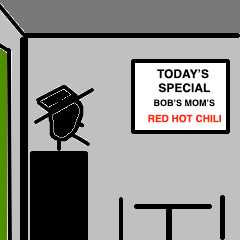
Addison held off going back into Bob’s Bowery Bar for as long as he could, which as it happened was only five days. Where else was he going to go? Oh, sure, there were probably dozens of bars within a ten-minute walk of his tenement building, but if he went to one of them he would only have to go through the whole tedious process of becoming “a regular” all over again. Those initial, strained conversations – the prospect was depressing. And, really, why should he avoid Bob’s, when all he would really be doing was avoiding Tommy McCarthy? And did Tommy even care? Probably not. What was Addison to Tommy, but someone he had gone to an Audie Murphy movie with one time. Someone who, on the way to the movie, had sat in Tommy’s big Studebaker while Tommy went into some dockside bar called Sailor Sid’s, someone who had heard a popping sound that might or might not have been a gunshot, someone to whom Tommy, upon returning to the car, had given a pistol, still warm, “to hold”. Someone whom Tommy had subsequently offered vague employment at the fantastical wage of a hundred dollars a week. Someone who, after a week of the most intense anxiety had somehow gathered the courage to tell Tommy that he would not be able to accept the position, nor to continue to carry the gun.
It was a rainy day, and cold, the last day of February. Addison stood for a minute smoking a Herbert Tareyton in the entranceway of his building. It was going on for four o’clock, the beginning of the alleged happy hour, and around the time that Tommy habitually came into Bob’s.
This was what his life had come to, and Addison a Swarthmore man, living in a tiny tenement flat, jobless, subsisting on the generosity of his grandmother and his great aunts while he “worked on his book”, and afraid to go to his local bar for fear of encountering a semi-literate thug of a river boss. Well, let’s get it over with. What was the worse that could happen? He flicked his cigarette butt into the rain, pulled up the collar of his old Burberry trench coat, and set off to meet his fate.
One minute later he opened the door of Bob’s Bowery Bar, and breathed in that welcoming warm miasma of smoke, whiskey, bock beer, and unwashed human beings. Not unusually for a Friday at this time, the place was packed. Bob had finally installed a juke box this past year, but the machine was silent, because juke boxes required coins to be played, coins that could be better spent on alcoholic beverages. Nevertheless the barroom resounded with the harsh babble of the bibulous. Resounded with the harsh babble of the bibulous, there he went again, mentally transforming every sensation into pretentious prose, he would never learn, he would never stop, not until he was stopped entirely by death.
Through the mob and the smoke he could see the broad overcoated back and shoulders of Tommy McCarthy, at his usual place at the bar, down near the men’s room. If there had been an empty seat anywhere else, Addison in his cowardice would have taken it, but of course the only free stool at the bar was the one to Tommy’s left. Addison took a deep breath of the warm heavy air and headed over for it.
Tommy was reading the afternoon Federal-Democrat, as usual, with his usual cigar and his glass of bock.
“Hey, Addison,” said Bob. “Where you been? You catch the flu or something?”
“Heh heh, no, Bob, just, uh, just, um –”
Bob didn’t care where Addison had been, and without asking he went to the taps to draw Addison’s usual bock. Addison had a quarter all ready (a glass of Bob’s basement-brewed bock was only a nickel, and, really, wasn’t this one of the main reasons why Addison liked the place?), but when Bob put the glass down on a soiled cardboard Rheingold coaster, Tommy disengaged his enormous left hand from his Federal-Democrat and tapped the pile of bills and change in front of him.
“Outa here, Bob. Gimme another one too, and a shot of Schenley’s. You want a shot, Anderson?”
“Of Schenley’s?” said Addison.
“No, of Napoleon fucking brandy.”
“Oh, heh heh, uh, um –”
“Give Anderson a Schenley’s too, Bob.”
For some reason Tommy always called Addison Anderson, but Addison didn’t care, Addison wasn’t his real name anyway. Bob went away, presumably to get the drinks, and Tommy went back to his Federal-Democrat.
When Bob had brought the fresh bock for Tommy and poured the two shots, Addison finally got up the nerve to say, “Well, thank you, Tommy.”
Tommy said nothing, just picked up his shot and continued reading the paper.
Addison picked up his own shot.
“Here’s to you, Tommy.”
Tommy had already tossed back his shot and put the glass down. Again he said nothing, and so Addison quickly drank his own whiskey down. The whiskey helped. Here’s what he would do. He had broken the ice, and so now he would drink his bock, and then order just one more. He would offer to buy Tommy a bock, and, yes, a Schenley’s, and Tommy would probably refuse both. Then Addison would finish his second bock and leave. The next time would be easier…
“Fuck this shit,” said Tommy, and he folded up the paper. “I don’t know why I read it, it’s all bullshit. Where you been?”
“Who, me?” said Addison.
“No, the man in the moon.”
“Heh heh, well, I’ve been, uh, I’ve been rather busy with my book this week –”
“Your book.”
“Yes, you see, I had rather an access of interesting ideas these past few days, and I thought I should strike while the iron is hot, you know, make hay while the sun –”
“I thought maybe you’d stopped coming in this dive.”
“Oh, no,” said Addison, “not me, heh heh, it’s just, you know, my, uh, book?”
“What’s this book about again?”
He had told Tommy, or tried to tell him, at least a dozen times before, but here he went again.
“Well, it’s a comparative study of trends in literary criticism, since the turn of the century, with a special emphasis on Anglo-American –”
“Why.”
“Pardon me?”
“Why.”
“Do you mean why write about trends in, uh –”
“Whatever.”
“Literary criticism?”
“Yeah.”
“Um –”
“Who wants to read that shit.”
Tommy said it just like that, without a question mark.
“Well, uh, I suppose the audience for such a book is rather limited, but –”
“I told you what you should write.”
“You did?”
“Yeah. Westerns.”
“Westerns?”
“Westerns. That’s the kind of shit people really want to read. Not these trends in what the fuck –”
“Literary criticism.”
“Yeah. Nobody wants to read that shit. Why you want to waste your life. Look at me, you think I like doing what I do?”
“I don’t know, Tommy, I would assume you do –”
“If I had an education like you I would write westerns. Like Zane Grey. Harold P. Sternhagen. Jake C. Higgins. Horace P. Sternwall. Them guys. Take my advice, Anderson, don’t waste your fucking life. You only get one ride on this merry-go-round. Don’t fuck it up. Write westerns.”
“You really think I should?”
“You ever hear me say one motherfucking thing I didn’t mean?”
“Well, no, no –”
“Westerns.”
“Westerns,” said Addison. “Well, you know, Tommy, I’ll tell you what, I’ll give it some thought –”
“What’s there to think about.”
“Westerns,” said Addison.
“Westerns,” said Tommy. He looked at his watch, polished off his bock. He put down his glass and shoved his pile of money toward the Bob side of the bar. “I got to go. Business.”
“Well, nice talking to you, Tommy, and thanks for the advice –”
Tommy heaved his great body off his stool.
“Westerns,” he said. He saluted in Bob’s direction, and walked off in that way he had, as if he would walk through a brick wall if it was in his way.
Westerns, thought Addison. Could it be possible? Was Tommy right? First he would need a title, a good title was essential, and then the story could flow from that. What was a good western title?
Sixgun. Prairie. Cowboys. Gunmen. Cactus. Laredo. Tucson. El Paso. Sixgun. Sixguns.
Sixguns to El Paso!
That was it, a splendid title. Sixguns to El Paso. Or what about Six Sixguns to El Paso, or was that a bit de trop? No, Sixguns to El Paso, tout court, don’t overthink it. He would start tomorrow. Then he would go to Bob’s around four, and wouldn’t he have something to tell Tommy.
Sixguns to El Paso!
{Kindly go here to read the “adult comix” version in A Flophouse Is Not a Home, illustrated by the illustrious rhoda penmarq…}

February 25, 2021
"Resolution"
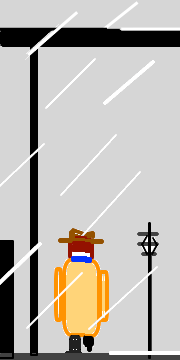
Gerry “the Brain” Goldsmith arose, not unusually, at 1:16 in the afternoon, with no more than his usual Sunday hangover. Not that his Sunday hangovers were all that much different from those of the rest of the week, of the month, of the year, of the past three decades.
After a pensive hand-rolled Bull Durham in bed, Gerry climbed out and padded in his wool-stockinged feet to his closet, where he kept his two suits, one Donegal tweed, one Scotch flannel. Today would be flannel day. Gerry was quite severe about never wearing the same suit two days in a row.
But this afternoon he did a strange thing, something he did so rarely that he couldn’t remember the last time he had done it. He looked at himself in the four-foot mirror hanging inside the closet door.
Good God, did he really look like this? At – what was he? Forty-eight? The protuberant belly, the puffy unshaven face, the balding and greying head.
Where was the beamish one-hundred-and-forty-pound young fellow who had once strolled merrily along the narrow cobblestone streets of the Latin Quarter?
Where was the bounding lad who had played (albeit second-string) on the Harvard tennis squad?
There in the corner of the closet was his old Bill Tilden racket, covered with dust. When had he last even taken it out of its press? And in the corner, a single lonely putter, all the rest of his MacGregor clubs and their bag long gone in pawn.
Thank God his life was not all in vain.
At least he had his work, his book (current working title: Pensées for a Rainy Day), a collection of “philosophical observations” he had been working on for this past quarter century or more. Indeed, had he not been working on it his entire life, by living his life?
Gerry sucked in his stomach, which act produced only a barely noticeable change in the reflection in the mirror. Slowly he exhaled, coughing his smoker’s cough. He must not let himself go completely to the dogs. He owed it not just to himself, but to his work. What if he were to drop dead of a massive coronary before finishing his book? Then his life really would have been in vain.
Quickly, or as quickly as he did anything, which was not very quickly, Gerry took out his old flannel suit and got dressed. Today would be the start of his new health régime. No longer would he start each day with an eye-opener collation at Bob’s Bowery Bar – a restorative shot of Cream of Kentucky, washed down with a soothing rich glass of Bob’s proprietary basement-brewed house bock – followed by a good nap, and then a leisurely breakfast at Ma’s Diner. No, he would launch each day instead with a brisk bracing walk, say a half-hour at first, and then maybe he would gradually build it up to an hour. And after his walk he would go to Ma’s Diner and have a nutritious brunch, washed down with copious cups of her chicory coffee. And even then he wouldn’t go to Bob’s, no, he would return to his digs and work on his book until, let’s say, five, or four at the earliest, and then and only then would he allow himself to go to Bob’s for happy hour.
And just watch those unwanted pounds melt away!
Gerry made his way down the six flights of his tenement building and out the door, where he stopped in the shelter of the entranceway.
Oh, dear.
It was snowing, again. But not one of those scenic poetic snowfalls like in the movies, this was one of those wet driving stinging snows, not laying so much but coating the sidewalk with an icy dandruff. The last few snowfalls still left their evidence in the soot-covered ridges along the curb, and the people who passed by were hunched over, looking like stragglers in Napoleon’s army on their doomed retreat from Moscow.
Gerry adjusted his old Andover rowing-team muffler so that it covered more of his chubby neck, raised the velvet collar of his old camel’s hair Chesterfield. He pulled his fedora down as far as it would go on his head, but how much protection from the cold and wet did a fedora afford? And, alas, he had no gloves. Gerry had always had a hard time holding onto gloves, they were like umbrellas in that regard. He shoved his hands into his coat pockets. Okay, it was snowing, or, no, actually it was more like sleet now, but so what? It wasn’t as if this were an absolute blizzard. Now the question was: which way? It occurred to him that in the twenty-some years he had lived in this building he had never walked farther than to the Houston Street stop of the Third Avenue El. He had only vague and fanciful notions of what lay beyond a two-block radius or so of his building in any direction. Presumably the East River was off to the left somewhere. To the right was the Village. South was downtown, north was uptown, where his lawyer’s offices were, almost the only place besides Bob’s bar and Ma’s Diner that he ever went to, a once-a-month hejira via elevated train and bus to pick up his remittance check.
Which way? Wasn’t Washington Square Park somewhere off in the Village direction? That might be a nice walk. Or he could walk down to the river. That might be picturesque. How many times had he reeled drunk along the quais and across the genuinely picturesque bridges of the Seine? Those were the days, and nights. A pity that he had been so shy as a young man. All those chic shop girls strolling on the trottoirs and sitting at the cafés of the boulevards. Maybe if he headed Villageward he would see some Bohemian lasses, with black stockings and berets. He’d bet they wouldn’t mind hearing about his post-collegiate days in Paris. It’s true he had never met Hemingway, or Picasso, or Gertrude Stein, but there was no denying that he had been in the city of light at the same time as those giants, and once he had even seen Picasso, or someone who looked an awful lot like him, sitting inside the Dôme.
Gerry took out his sack of Bull Durham and his Top papers. Right, left, uptown, downtown? Let’s have a smoke and think it over. Expertly he rolled one up and lighted it with one of the Blue Tip kitchen matches he always had with him.
“Hey, Brain.”
Gerry turned. It was Seamas, the Irish poet, who lived in a room on the fourth floor, even smaller than Gerry’s.
“Oh, hello, Seamas. Up bright and early, I see.”
“As are you, Brain. I say, Brain, remember that last round I bought ya?”
“Not precisely, Seamas.”
“Well, neither do I, but I wonder if you would be willing to stand me a shout or two, or three, or four, as I’ve got a powerful thirst on me, and you know when I get me next dole check I’ll make it up to you.”
“I was going to take a walk, actually, Seamas.”
“What.”
“I was going to take a walk.”
“Why, in Christ’s holy name?”
“For my health.”
“Have you gone mad, man?”
“I don’t think so.”
“Do you not feel how ball biting cold it is out here? Do you not see that gelid shite pissing down? Look at you, your nose is already as red as a ripe raspberry, and dripping with rapidly freezing snot as we speak. How about a gasper.”
“Here, take this one, Seamas.”
“You’re all right, Brain, and I don’t care what anyone says about you. Ah, nothing like a good hand-rolled cancer stick, is there?”
Especially if it’s a free one, thought Gerry, but he was a good fellow, and he didn’t say it, but took out his pouch and his papers and set to rolling a fresh one.
“There’s a good lad,” said Seamas. “Soon as you fire that one up, let’s head on over to Bob’s.”
“But, Seamas, I really did want to take a walk.”
Seamas took a good drag of his smoke, looking up and down the street, then he turned again to Gerry.
“If you’ve not got the money to stand me a drink, you can just say so, Brain.”
“But it’s not that, Seamas.”
“So you do have some of the green on you.”
“Yes.”
“Then what’s the problem. You can level with me, pal.”
Gerry lighted his fresh cigarette.
“I looked at myself in the mirror just a little while ago, and I saw a fat dissipated middle-aged man, balding and ill-favored.”
“And you think a walk in this freezing hell is going to fix that?”
“Well, it might not make it worse.”
“Did you ever hear the phrase catch your death of cold, Brain, or more accurately put, catch your death of the cold and freezing wet?”
“Yes.”
“Do you want to die? Is that it?”
“No.”
“Then come to your senses, man. It’s like fucking Antarctica out here. Do you want to go the way Shackleton went, and his brave but foolhardy men?”
“No.”
“Then stop this nonsense and come with me to Bob’s.”
“I was going to take a walk and then get a good breakfast at Ma’s, and then work on my book.”
“Forget the walk, forget that insanity, man. Let’s go to Bob’s, we’ll have a shot and a bock apiece, and we’ll talk it over. Just one shot and a bock apiece, maybe another Bull Durham or two. And then, if, and please note I say if, dear Brain, if you think you could stand me a meal, I confess that I myself have not taken solid nourishment since roughly this time yesterday, and perhaps I could join you for a light lunch or a heavy breakfast at Ma’s. Please note my usage of the conjunction if. I am only speculating you understand, postulating if you will.”
Gerry just then felt an ooze of snot descend from his right nostril to his upper lip, and he wiped it way with his coat sleeve.
Maybe Seamas was right. It was cold, and wet, in fact the sleet was now more like rain than snow, and Bob’s would be warm, and smoky, and dim, and filled with drunken chatter and laughter.
“Don’t be a cunt, Brain.” said Seamas. “You’ve always been a good fellow. Don’t stop now.”
The man had a point. Gerry could always start his daily walk tomorrow, if it wasn’t too cold, if it wasn’t snowing, or sleeting, or raining.
The two friends set off through the cold stinging rain for Bob’s Bowery Bar, which fortunately for them was just around the corner.
{Please go here to read the “adult comix” version in A Flophouse Is Not a Home, profusely illustrated by the illustrious rhoda penmarq…}

February 18, 2021
"Amends"
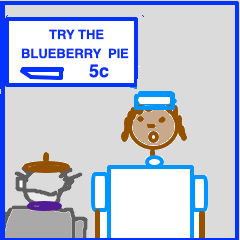
People, places, things. That’s what they told you that you had to watch out for when you got back into the world.
People, places, and things – which in Philip’s case covered a lot of territory.
He had stayed at the institution for five months this time, his longest stay yet, which meant he’d had plenty of time to think about what he was going to do when he left, plenty of time to talk it over with Dr. Himmelmann and with his new friend Edna.
He could have gone back to the firm. After all, it was the family firm, his brother would probably have taken him back, just as he had done all the other times when Philip had been away on binges followed by weeks or months in hospitals and institutions. However, there was that thing, the people, places and things thing, and so Philip formally resigned from the firm, got rid of his apartment on Sutton Place, found an office down on Bleecker and Elizabeth with a one-bedroom apartment upstairs, and he hung up a sign with his name and profession printed on it. He hired the first girl who answered the advertisement, a Miss Blotnick straight out of secretarial school, and he waited for clients to walk in.
Philip could have moved out west, or gone to Paris or Mexico City, he could have gone anywhere. He had a “private income” as it was called, so he didn’t have to work to support himself, but he had to do something with his time, and he had to live somewhere, so why not live and work in this poor neighborhood? Maybe he could actually do some good?
In his first week he had taken on six cases. A divorce, a will, a guy who had beaten up his brother, a kid who had robbed a candy store with a zip gun, a wife who had hit her drunken husband in the head with a clothes iron, another kid who had robbed the poor box at the Church of the Nativity. Word apparently got around about how cheap Philip’s fees were, and Miss Blotnick had a full calendar of appointments for the coming week.
Today was Sunday, his first fully free day since coming back to town. Philip had a kitchen, but all he had in the old icebox that came with the apartment was a bottle of milk. He picked up a book, and went downstairs to Bleecker Street. A stinging, misty cold rain, blotches of dirty snow. He walked down the block to Ma’s Diner, where he had taken every meal since moving down here.
He took a seat at the counter and ordered breakfast from Ma herself. She had asked his name the second day he came in here, and ever since she had greeted him by name. She appreciated his custom, a high class gentleman, so polite and well spoken.
When Ma gave him his cup of chicory coffee, Philip lighted a cigarette and opened his book, The Naked and the Dead, a book he had been meaning to read for some years now, but he had been too busy drinking.
“Hey, Philip. Howya doin’, buddy?”
Philip turned. He knew this guy. What was his name? A shabby little old man, not much different from a lot of other shabby little old men sitting in this place.
“Hello.”
What was the man’s name?
“Bert. You know, good old Bowery Bert.”
“Oh, hi, Bert.”
Philip still couldn’t quite place the guy, but he knew he must have been one of the hundreds or was it thousands of random guys he had exchanged wisdom with while he was drunk.
“This stool taken?”
“No, not at all, help yourself.”
The little guy climbed up on the stool to Philip’s left. He had thick round glasses, a cloth cap, an unlighted stub of a cigar in his mouth. He needed a shave.
“I ain’t seen you around, Philip.”
“Yes, I’ve been away.”
“Away on business like?”
“Yeah, sort of.”
“But now you’re back.”
“Now I’m back.”
“Just a cup of joe, Ma,” said this Bowery Bert guy, to Ma.
“Are you bothering this gentleman, Bert?”
“I don’t know,” said Bert. He turned to Philip. “Am I bothering you, Philip?”
“No,” said Philip.
“Philip says I ain’t bothering him, Ma.”
“Well, see that you don’t. It ain’t many gentlemen I get in this place, and I don’t want you chasing them away.”
“I promise I’ll behave, Ma.”
Ma poured Bert a cup of her famous chicory coffee, and she topped off Philip’s cup.
“This bum bothers you, Mr. Philip, you let me know.”
“Thanks, Ma, but he’s not bothering me.”
“Hm!”
Ma went down the counter with her coffee pot and Bowery Bert leaned in toward Philip.
“If only I was a few thousand years younger, boy, because that is one hell of a lot of woman right there, and just the way I like ‘em, strong and black, just like my java.”
Philip opened his book again, and started to read.
“You don’t remember me, do you, Philip?”
Philip looked up from his book.
“I’ll be honest – Bert is it?”
“Yeah. Bert. They call me Bowery Bert.”
“You seem familiar, Bert, but beyond that I can’t quite remember meeting you before. But please don’t be offended, because, you see, I used to drink a lot.”
“Like a lot of people around here,” said Bert.
“Like a lot of people everywhere,” said Philip.
“Ain’t that the truth?” said Bert. “People.”
“Yeah,” said Philip. “And places.”
“And places?”
“And things,” said Philip.
“People, places, and things,” said Bowery Bert. “Everywhere you go. There ain’t no escaping them.”
“That’s true,” said Philip.
“Here’s your breakfast, Mr. Philip,” said Ma, and she laid it down, fried eggs, bacon, home fries and toast.
Philip closed his book, stubbed out his cigarette.
“That breakfast sure looks good,” said Bert. “Best breakfast in the city here at Ma’s.”
Philip made sure that Ma wasn’t looking, and then he took out his wallet, and opened it on his lap. He took out a bill, and stuck it into the pocket of the old man’s overcoat.
“Hey, I wasn’t looking for no handout,” said Bert. He took the bill out of his pocket, and, keeping it under the edge of the counter, looked at it. “Wow, a fin. Thanks, buddy. How come?”
“I’m making amends,” said Philip. That was another thing they talked about in the meetings. “Why don’t you order some breakfast, Bert?”
“Y’know, pal, I think I just might do that.”
Philip had way too many people to make amends to, including himself. This old bum was as good as anyone else to start with.
{Please go here to read the “adult comix” version in A Flophouse Is Not a Home, profusely illustrated by the illustrious rhoda penmarq…}

February 11, 2021
"Hard Ride to Laredo"

The snow came down in icy droplets. Addison stood in the entranceway of his building, looking across Bleecker at Ma’s Diner, and through the steam-clouded window he could see Tommy McCarthy in his usual booth, facing away, towards the Bowery. Tommy was a creature of habit, and every Sunday after the noon mass at the Church of the Nativity he walked over to Ma’s for a leisurely breakfast and the Sunday paper. Addison had waited until two before coming down. Tommy should be finished eating now.
Addison left the shelter of the entranceway, and started across the street. A car horn bleated, and he broke into a run as a cab drove past, just barely missing him. How ironic if the cab should have had hit him! That would have solved all his problems. Unless he were merely crippled, and then he would have had a whole new set of problems.
Breathing heavily he made it without further incident to Ma’s door, opened it and went inside. The place was full, as it usually was on a Sunday afternoon. Feeling as if he might pitch forward in a faint he walked over to the booth where Tommy sat.
“Hello, Tommy?”
Tommy looked up from his paper. He was smoking one of those big cigars of his.
“Look who the cat dragged in.”
“May I join you, Tommy?”
“Sure, kid. Sit down.”
Addison sat, and put his hands on the table.
“You want somethin’ to eat?”
“No, thank you, Tommy.”
“Cup o’ joe?”
“No, thanks, Tommy, I, uh, I really just wanted a quick word.”
“What’s up?”
“Tommy, it’s about this job you’ve offered me.”
“I’m glad you asked, Anderson, on account I’m gonna need you this week.”
“Oh, really?”
“Yeah. About time you started earning your pay, right?”
“Heh heh. Yes. But that’s the thing, Tommy.”
“What.”
“The thing is, I don’t think I can accept the job after all.”
“What.”
“You see, with this book I’m working on, I really need to concentrate.”
“Concentrate.”
“Yes.”
“It ain’t like I got you working nine-to-five, forty hours a week.”
“Yes, I realize that.”
“You been on the payroll a week, I ain’t asked you to do nothing yet.”
“Yes, I know, and I appreciate that, Tommy, but –”
“A C-note I give you. That was last Monday, right? You got another C-note coming tomorrow, less you want to make your payday another day of the week. It don’t matter to me.”
“Here, Tommy.”
Addison had the money all ready in his coat pocket, and he drew it out and put it on the table.
“What’s that?”
“It’s the hundred dollars you gave me, Tommy.”
“What, you don’t want it?”
“Well, it’s not that I don’t want it, it’s just that I’ve decided that I really can’t accept a position at this time.”
“What, on account of this book you’re writing?”
“Um, uh –”
“Why you insulting me?”
“I, uh, insulting you?”
“You think I’m some kind of Indian giver, Anderson?”
“No, not at all, it’s just I don’t think I can do the the job, Tommy.”
Tommy looked at Addison with those steely blue eyes. Addison was sweating.
“Also, Tommy?”
“What.”
“It’s the gun.”
“What.”
“The gun you gave me.”
“What gun.”
“You know, the, uh –”
“I don’t know what you’re talking about.”
“Oh, sorry, I get it. I mean, that thing you gave me to hold.”
“What about it.”
“I feel very uncomfortable carrying it.”
“It ain’t supposed to be comfortable.”
“I mean, not physically uncomfortable, although it is, that, but I suppose I mean, morally uncomfortable.”
“Morally.”
“Yes. I mean, I just don’t feel –”
“Comfortable.”
“Yes.”
“You got it on you now.”
“Yes, I do.”
Addison put his hand into his coat pocket.
“Hey,” said Tommy.
“Yes?”
“You tryin’ to get us both pinched.”
“Pinched?”
“You gonna drag that thing out in here.”
“Oh, I’m sorry.”
“What if there’s a plainclothes dick in here. Or a professional stool pigeon. What the fuck’s the matter with you, Anderson.”
“I don’t know, Tommy. I’ve been asking myself that question since I was seven years old.”
Tommy took a drag on his cigar, gazing out the wet window at the falling snow. He tapped his ash into the ashtray in front of him, and without looking at Addison he said:
“Pick up that funny section of the Federal-Democrat there. Put it on your lap. Then, holding the paper over your pocket, take out the thing and put it inside the paper. Then put the funny pages with the thing in it on the table.”
Addison managed to carry out these instructions.
Tommy turned, looked at the comics section with the lump in it, looked at Addison.
“All right. You can go now, Anderson.”
“I can go?”
“That’s what I just said, wasn’t it?”
“Thank you, Tommy. Thank you so much. I really appreciate it.”
Addison started to get up.
“Wait.”
“Yes?”
“What’s that?”
Tommy gestured to the five folded-over twenty-dollar bills on the table.
“It’s the hundred dollars you gave me, Tommy, for my first week’s, uh, employment.”
“I look like a welcher to you?”
“No, not at all, it’s just –”
“Pick it up.”
Addison picked up the five twenties.
“Stick it in your pocket.”
Addison put the money in his pocket.
“Good luck with your book.”
“My book?”
“You’re writing a book, ain’t ya?”
“Oh. Yes, heh heh.”
“What’s it about again?”
“Well, it’s a comparative study of critical thinking on the modern novel –”
“You know what you ought to write?”
“Um –”
“You oughta write a western.”
“A western?”
“Yeah. Like Zane Grey. Or that Horace P. Sternwall. You ever read any of that guy’s books?”
“Uh.”
“Hard Ride to Laredo. You read that one?”
“Um, no, I don’t think so –”
“Sally Six-Guns? That one was good.”
“Uh –”
“Tootsie From Tucson?”
“Um –”
“Horace P. Sternwall. Writes like a motherfucker.”
“I, uh, well, I’ll have to look for his books –”
“See ya around, Anderson.”
“I can go now?”
“Unless you’re gonna get something to eat. A cup of joe. A doughnut.”
“No, no, I don’t think so –”
“See ya later.”
Tommy picked up the sheaf of funny pages with the pistol inside it, brought it down to his side.
“See you, later, Tommy.”
Addison stood up.
“Stand there next to me a second.”
Addison stood next to Tommy while Tommy took the gun out of the paper and put the gun into his suit jacket pocket.
“All right, you can go now.”
Addison reeled away, and out the door. It was still spitting snow. He went out into the street and just avoided being hit by another taxi cab.
{Please go here to read the “adult comix” version in A Flophouse Is Not a Home, illustrated by the incomparable rhoda penmarq…}

February 4, 2021
“Roast Wooly Mammoth”
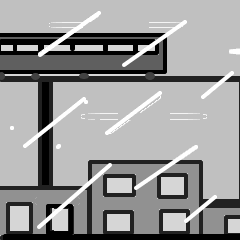
“Cavemen converging on the wooly mammoth, spears at the ready – would there be meat tonight? Would there even be a tonight?”
Gerry “The Brain” Goldsmith looked at the sentence which had been the sole bounty of his previous day’s work.
Yes, it had been a good sentence, a good day’s work.
But how to follow it up?
Gerry paused for a minute, staring out of his grimy window at the thick falling snow.
He heard the faint whirring noise of the Third Avenue elevated coming downtown, heard the whirring become a rumbling, louder and louder, and then the high skidding screeching as it roared past above his window on its way to the Houston Street stop.
Time for another cigarette!
Ever since his monthly remittance had been increased last January (his brother Alistair’s preëmptive move to mollify Gerry into not contesting Aunt Edna’s will, as if Gerry might ever be bothered to do so), he could have afforded to buy factory-rolled cigarettes, but for some reason (reasons?) Gerry had stayed with his Bull Durham shag. Truth to tell, he liked the rolling ritual. And so he rolled himself another, lighted it with a Blue Tip kitchen match, and paused for another minute, enjoying the cigarette as much as he had ever enjoyed any cigarette, and then finally he typed these words:
“And, later that night, sitting round the fire, dining on roast wooly mammoth after a long day’s hunting, and knowing the meat would last the tribe another week, what more could our caveman want?”
Brilliant!
Should he continue?
No, perhaps it was best just to quit while he was hot. Better to write one good sentence than a thousand mediocre ones!
Time for a bock! Gerry quickly knotted a tie and threw on his trusty old Chesterfield over his “new” Goodwill Donegal tweed suit, donned his hat, and headed out the door and down the stairs.
On the landing between the fifth and fourth floors, he saw someone sitting hunched over on the top step.
“Hello?”
The man said nothing, didn’t even turn around. Gerry approached.
“Addison?”
Addison turned his head and glanced up, then turned away again.
“Addison, are you okay?”
Addison said nothing. How very odd. Addison never said nothing.
“I say, Addison, are you ill?”
Addison heaved a great sigh.
“Addison, what’s up?”
This was annoying. Time was wasting, and there were bocks to be drunk. Gerry was loath to say what he was about to say, and he hesitated before saying it, but after a minute of uncertainty he said it:
“Come on, buddy, get up, let’s go get a bock.”
Addison turned his head and looked up at Gerry.
“You don’t want to have a bock with me.”
“Nonsense,” lied Gerry. “I’ll not only have a bock with you, but I’ll buy you one. Come on, get up.”
“No.”
This was truly unbelievable. Addison turning down a free bock? It was literally unheard of. Not only was Addison among the most tedious of men Gerry knew, he was also perhaps the cheapest, and known throughout the neighborhood as a man who would squeeze a nickel so hard that he made the Indian ride the buffalo’s back.
“I know what you’re thinking,” said Addison, staring down the stairs.
“How can you possibly know what I’m thinking,” said Gerry.
“You’re thinking it’s unheard of me to turn down a drink, that I squeeze a nickel so hard I make the Indian ride the buffalo’s back.”
“Nonsense,” said Gerry, after a slight pause.
“See, you hesitated, because it’s true. You don’t like me. No one likes me.”
“That’s not true at all,” said Gerry, after another pause which he quickly cut short as soon as he realized he was pausing.
“It’s not true that you don’t like me, or not true that no one likes me?”
“Oh, come on, Addison, what exactly is this all about? This isn’t the witty carefree Addison I know.”
“The witty carefree Addison you know does not exist. I am neither witty nor carefree.”
Gerry hated to do it, but he sat himself down on the step beside Addison. One thing he did know, he wasn’t going to put his arm around the man’s shoulders. Gerry was a good fellow, but even he had his limits. He took one last drag of his cigarette. He didn’t want to just grind out the butt on the stairs, even though all the other tenants did so with abandon, leaving more work for poor Mrs. Morgenstern and her broom, so he stubbed out the cigarette on the riser of the step, and dropped the butt into his coat pocket.
“Do you know what I did yesterday?” said Addison suddenly.
Why did boring people always ask these unanswerable questions instead of just saying whatever they had to say? But Gerry was a kind man at heart, and so he said, “No, Addison, what did you do?”
“I walked out to the middle of the Brooklyn Bridge, fully intending to throw myself off of it.”
“So,” said Gerry, after a pause during which he could think of absolutely nothing else better to say.
“Yes, so,” said Addison. “So what?”
“So,” said Addison, “I gather you didn’t throw yourself off.”
Addison turned to face Gerry, and Gerry noticed that Addison’s eyes, always bloodshot, were now almost entirely red around the pallid blue of their pupils.
“An angel appeared to me, Gerry. He told me to appreciate the little things of life. And then I fell, or jumped, I’m not sure. But instead of crashing into the river I flew away, all the way up the river and out over Long Island Sound, and then I flew back.”
“To the bridge?”
“Yes, to the exact same spot on the bridge.”
There wasn’t much Gerry could say to this, or, rather, there were many things he might have said, but he said nothing. He didn’t know what else to do, so he took out his sack of tobacco and his papers and began rolling a cigarette.
After a minute Addison spoke again.
“I walked back off the bridge, and I walked around all the rest of the day, and all the night. I walked down to the Battery, and then I walked all the way up to I think Washington Heights it was and back again and I don’t know where. Finally it began to snow, and so I came back here. I’m so tired, Brain. I’ve never been so tired.”
“Why don’t you let me help you up to your digs, old man? A good sleep and you’ll be right as rain.”
“I can’t go to my digs.”
“Why not?”
“Because the walls will close in on me.”
“No they won’t, old boy. You’ll get in bed and be sound asleep before you know it.”
“I couldn’t even kill myself properly.”
“Why would you want to?”
“Do you really want to hear all the reasons? Even that angel who appeared to me told me that I would never amount to anything.”
“Addison, buddy, there was no angel.”
“Yes there was!”
“Well, even if there was, what does he know? Who says angels know everything?”
“They’re angels, damn it!”
“Only God knows everything,” said Gerry, even though he had no idea if this were true, or even if there was a God.
Suddenly Addison began to breathe very heavily, and Gerry was afraid he was going to get hysterical.
Gerry had just finished rolling his cigarette, and so he held it out to Addison.
“Here, Addison,” he said. “Addison. Here.”
“What?”
“Have a cigarette.”
Addison took the cigarette. Gerry brought out his matches and gave him a light.
“There ya go,” he said. He blew out the match and put it in his coat pocket. “The little things. Like your angel said.”
Addison sat there hunched over, the smoking cigarette between his lips, and Gerry rolled himself another one. By the time he had the cigarette rolled and lighted, he noticed that Addison’s chin was on his chest, and his eyes were closed, but the cigarette still dangled from his lips. Gerry removed the cigarette, stubbed it out on the riser, dropped the butt into his coat pocket. Addison’s tiny apartment was on the fifth floor, and although Gerry was not a physically strong man, he figured he would probably be able to drag Addison up to his apartment and get him into his bed. A good long sleep wouldn’t be the answer to all the man’s problems, but it wouldn’t hurt, that was for sure.
{Kindly go here to read the “adult comix” version in A Flophouse Is Not a Home, profusely illustrated by the illustrious rhoda penmarq…}

January 28, 2021
“The River and the City”
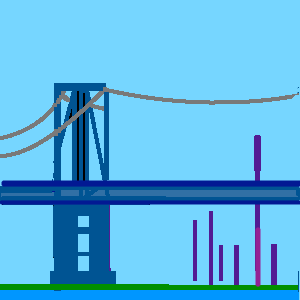
It was the worst possible kind of day, and what better sort of day to jump off the Brooklyn Bridge and end his pathetic life once and for all?
Addison (not his real name, but that’s what everyone called him, so let’s call him that) stood looking down at the East River flowing toward the Atlantic Ocean beneath the cold dirty steel of the bridge. The sky was bright blue, not a wisp of a cloud in it, but the wind was high and freezing. He stood there with his right arm holding onto a girder. He had always been afraid of heights, and yet, here he was, way up here, about to end it all.
What did he have to live for? No one liked him, let alone love, no, love was out of the question, even his own mother didn’t really love him, nor his grandmothers or his aunts and great-aunts. They might send him checks, but that didn’t mean they loved him.
All he had to do was jump.
But.
But on the other hand he was a coward, and always had been. So then the question was, what was he more afraid of: jumping and ending it all, or continuing to live the miserable pathetic life he had always lived?
“May I intrude?”
Addison was so shocked that he almost jumped off the bridge by accident.
A little old man was standing to his left, wearing a cloth cap, thick glasses, a ragged overcoat and scarf. He had a smoking stub of a cigar in his mouth.
“Jesus Christ!” said Addison.
“Oh, I wish!” said the old man.
He seemed vaguely familiar, like someone Addison had seen in Bob’s Bowery Bar.
“Do I know you?”
“We have not been formally introduced, but I have been keeping my eye on you. They call me Bert, Bowery Bert.”
“What are you doing here?”
“I am here because you are here, Addison.”
“How do you know my name, not that Addison really is my name.”
“Nonetheless it is the name that everyone calls you.”
“I know, I know –”
“All because you’re always trying to be witty and acerbic like Addison DeWitt in All About Eve.”
“I know, I know, you don’t have to tell me.”
“It could be worse, maybe they could call you Waldo, after Waldo Lydecker in Laura, ha ha. How’d you like it if everybody called you Waldo?”
“I wouldn’t.”
“So Addison’s not so bad, is it, Addison?”
“Wait, just who the hell are you, and what are you doing here?”
“You saw that movie It’s a Wonderful Life, didn’t you?”
“Yes. And I thought it was sentimental tripe.”
“Well, irregardless, you remember that scene where Jimmy Stewart was gonna end it all, and suddenly a lovable little angel shows up?”
“Yes, what nonsense.”
“Well, I’m an angel, sorta like in that movie. A guardian angel.”
“You’re my guardian angel?”
“Not exactly. I always have to explain this to you stupid humans, so here I go again. We ain’t got enough angels to give everybody on earth their own guardian angel, and so instead we angels are each given districts to take care of. Me, I got the Bowery, or at least a big chunk of it. Which is why they call me Bowery Bert.”
“So, what, you’re here to talk me out of jumping off the bridge?”
“I ain’t here to talk you out of nothing. I’m here only to get you to think about your life for just one minute, but from like maybe a different angle.”
“Oh, like, look how great my life could be, if only I, if only I –”
“May I be honest, Addison?”
“Of course.”
“Your life will never be great, my friend.”
“Wow.”
“You will continue to be shallow and pathetic and untalented. You will never amount to nothing, you will get older, you will continue to drink and smoke too much, your body will deteriorate, and then you will die, friendless and alone, quite possibly after a painful disease.”
“Gee, thanks a lot. I guess I’ll just go ahead and jump now then, if it’s okay with you.”
“Be my guest. But first, consider this: if you decide not to jump, and just walk back to land, think of all the fun things you can do.”
“Fun?”
“Going to see Audie Murphy movies. Reading a good book, even if it’s only a Nero Wolfe mystery. Dunking a doughnut into a cup o’ hot chicory joe at Ma’s Diner –”
“Yes, okay, I get it, the little things, sure. But, don’t you see, I’ll still be me.”
“Yeah, that’s the hard part, ain’t it?” Addison stared at the little old man, and waited. Waited for what? A word of wisdom? But all the little old man did was stare right back at Addison through those thick glasses of his.
Addison turned away and looked down at the river. For some reason he had chosen the northern side of the bridge to jump off of, and so he was looking upriver at Manhattan on the left and Brooklyn on the right, all these thousands of buildings filled with millions of people.
The air and the wind were bitter cold. Like – like what? Like frozen daggers? No, what horrible triteness. Can’t you just say cold, fucking cold, and leave it at that? Must you always try to be clever, even when you’re getting ready to jump off the Brooklyn Bridge?
Addison turned to his left, but now the little man was gone.
So that was it?
That was all?
The little jerk had had nothing more to say?
But, wait, what if the little man had been a hallucination?
What if all there was was this? Just me, inside my head, looking down and out at all that, at the whole incomprehensible world?
Suddenly Addison felt vertiginous, as if his body might take flight of its own accord and go sailing out over the river, and then that’s what happened, he sailed off the bridge, his arms at his side, headfirst, sailing down and down toward the cold grey river, but then, so strangely, just before he was about to crash into the water, he swooped upward, upward, high into the bright cold blue sky, higher and higher, and after a minute he leveled off, and sailed along, looking down at the islands full of people far below him, and way off to the left he could even see the stretches of New Jersey.
Addison sailed along for a few minutes, and then, somewhere over Long Island Sound, he made a great graceful curve and began sailing back, back to the river and the city.
(Kindly go here to read the “adult comix” version in A Flophouse Is Not a Home, profusely illustrated by the illustrious rhoda penmarq…}

January 22, 2021
"Galoshes"
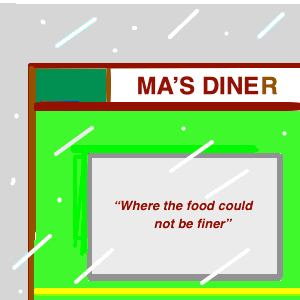
Terry and Araminta had been friends now for more than five months, and they met nearly every afternoon at Ma’s Diner to drink untold cups of coffee and peruse the pages each had produced that morning. They were very kind in their comments, despite the fact that neither could make head or tail of what the other was on about in their respective novels-in-progress.
Today, this snowy cold day in January, Araminta sipped her chicory coffee and read the following from Terry’s book, still titled (she hoped provisionally) Say There, Young Fellow!:Another day awakening to the symphony of the great city! The fartings of the garbage trucks, the belchings of the El train, the wailing of the little guttersnipes in their slum dwellings, the vomiting of the drunkards on the sidewalk, the random shouts of violent young thugs! Jerry Hooley ripped another page from his trusty Olivetti portable and added it to the foot-high pile next to the machine. He inserted another blank sheet into the roller and typed the page number in at the top: 1,000. Not bad, not bad at all. He still hadn’t quite found the plot of the novel, but plots were overrated anyway. He scrolled down an inch and typed
CHAPTER 303
The city’s daily concerto called to Mickey Mooney. Enough of creation for one day, time to go out and experience life! Time to shake off the
That was where Terry had left off. He always stopped writing at noon on the dot, even if he was in the middle of a sentence, or, for that matter at the beginning or ending of one.
“So, what do you think, Araminta?”
“I think it’s marvelous,” said Araminta, as usual. After all, what did she know about what she called boy novels? “Simply marvelous. Is anything going to happen with Annabella?”
Annabella was the presumable “love interest” in Terry’s novel, a bohemian lass who lived in the same building as Terry’s hero Jerry Hooley and who was writing a cycle of poems called Sappho, My Sappho.
“I honestly have no idea,” said Terry. “You know me, I have to go where my characters take me. However, I suspect that there might be something dramatic in store with Melpomene.”
Melpomene, a girl playwright, was the love interest of Mickey Mooney, the hero of the novel (Moon Over the Bowery) that Jerry Hooley (and, actually, Terry) was writing.
“Perhaps,” said Araminta, “and only perhaps, mind you, the development of Mickey and Melpomene’s relationship could mirror the same in Jerry and Annabella’s.”
Terry paused before answering. He lighted up another Camel.
“Wow,” he said, finally. “That could really be a swell idea!”
“It’s a thousand pages you’ve got there so far,” said Araminta. “I know you must follow your own artistic impulses, but maybe it’s time for a little, you know, I hate to use the word.”
“What?” said Terry.
“But I hate to use the word. It’s so crude.”
“What word?”
“I just told you I hate to use it.”
“Oh, I’m sorry. But could you give me maybe a synonym? Or what do you call it when you use a nicer word for a harsh word or phrase?”
“Euphemism?”
“Yeah, that’s it.”
“Oh, hang it all, Terence, the word I mean is sex. There, I’ve said it, full speed ahead and darn the torpedoes. Sex.”
“Sex?”
“Yes. Now please don’t say it again.”
“I promise not to.”
Sex.
Yes, perhaps Araminta was right. Maybe a thousand pages was a little too long to go without, well, Terry didn’t even want to think the word, so careful was he not to offend Araminta by even thinking of a word she found offensive.
“But I could be wrong,” said Araminta, and she took out one of her Viceroys. She waited while Terry scrabbled up his matches and gave her a light. “And after all, look at my own novel.” She brushed her long red-painted fingernails over the cover of the large leather-bound notebook that contained the latest pages of her own work in progress (provisional title: The Womb of the City). “I’ve been working on this thing for almost a year, and Azalea {the heroine of Araminta’s novel} hasn’t even been kissed by a man yet!”
“But,” said Terry.
“Yes?”
“But –”
“Go on.”
“Well, please don’t be offended.”
“Damn it, Terence, stop beating about the bush. Out with it.”
“I thought Azalea was a, you know, I hope you won’t be offended if I say the word.”
“How can I know if I’ll be offended if you don’t say it.”
“You promise not to be?”
“I make no such promise. Now say it.”
“Lesbian.”
“What?”
“I thought Azalea was a lesbian.”
“You thought Azalea was a dyke?”
“Well, not definitely, but, you know, she went to a women’s college, and –”
“Well, Terence, I went to Vassar and I assure you that, despite everything you may have heard, the sisters of Lesbos were a distinct albeit noticeable minority there. Gee, whillikers, you never saw such a mob of boy-crazed sluts as in that school!”
“I’m sorry.”
Now Araminta took pause.
So.
So now she knew why she and Terry had been having coffee together nearly every single day for five months, reading and critiquing one another’s work, and he had never once made a pass at her.
Or.
Or could it be?
Could it be that Terry himself was the one who was a little light in the loafers?
Well, there was only one way to find out.
“Say,” she said, “do you want to get out of here? Take a walk? Or something.”
“But it’s snowing.”
“I love to walk in the snow.”
“Well, okay,” said Terry, who remembered without fondness long hikes with a full pack in the snowy wastelands surrounding Fort Dix.
“I just need to get my galoshes,” said Araminta.
“Sure,” said Terry. They both lived in the same building, just across Bleecker Street and catercorner to Ma’s. “Do you want me to wait here?”
“No,” said Araminta. “Why don’t you come up with me.”
“To your apartment?”
Terry lived on the fourth floor, Araminta on the second, but he had never once been in her apartment.
“Yes, to my apartment,” said Araminta. “So I can get my galoshes.”
Terry really couldn’t see why he had to go up to Araminta’s flat if she was just going to get her galoshes, but he didn’t pretend to understand the first thing about women, so he said okay.
{Kindly go here to read the “adult comix” version in A Flophouse Is Not a Home, profusely illustrated by the illustrious rhoda penmarq…}



![[image error]](https://1.bp.blogspot.com/-6VbaDvZuflI/YFOuQsJDueI/AAAAAAAAHWs/faA-NgafjL8yAJ7ts1LBd-hLkzH5yGlKwCLcBGAsYHQ/s240/flop-88-n.gif)